
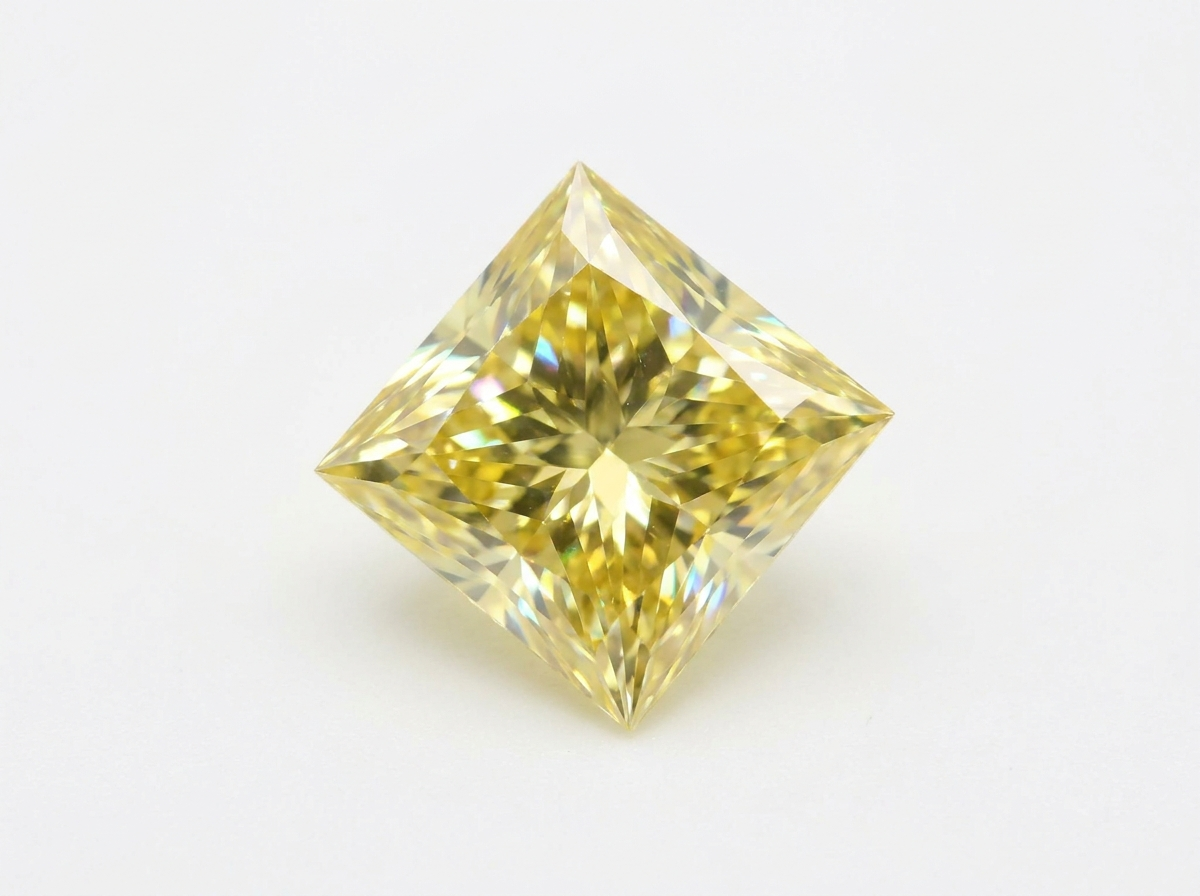
A fancy color princess cut is a square, brilliant-faceted lab-grown diamond in an intentional hue rather than graded colorless. Because princess faceting is built for fire the same way round brilliant is, it shows color less efficiently than a mixed or step-cut shape, which keeps it a specialty request rather than a stocked category. Guru Diam has 7 IGI-certified, CVD-grown pieces on hand; request current inventory or made-to-order.
What is a fancy color princess cut diamond?
A princess cut is a square outline with pointed corners, faceted as a brilliant — typically 50 to 58 facets arranged to maximize fire, the same underlying approach as a round brilliant mapped onto a square outline. That faceting scatters light into many small flashes rather than letting it travel further inside the stone, which is where a diamond's own color gets carried back to the eye — the same tradeoff that makes fancy color round brilliants scarce applies here. Combine that with a squared silhouette the trade more often reaches for in colorless engagement rings, and princess ends up produced against specific orders far more often than held as standing color inventory.
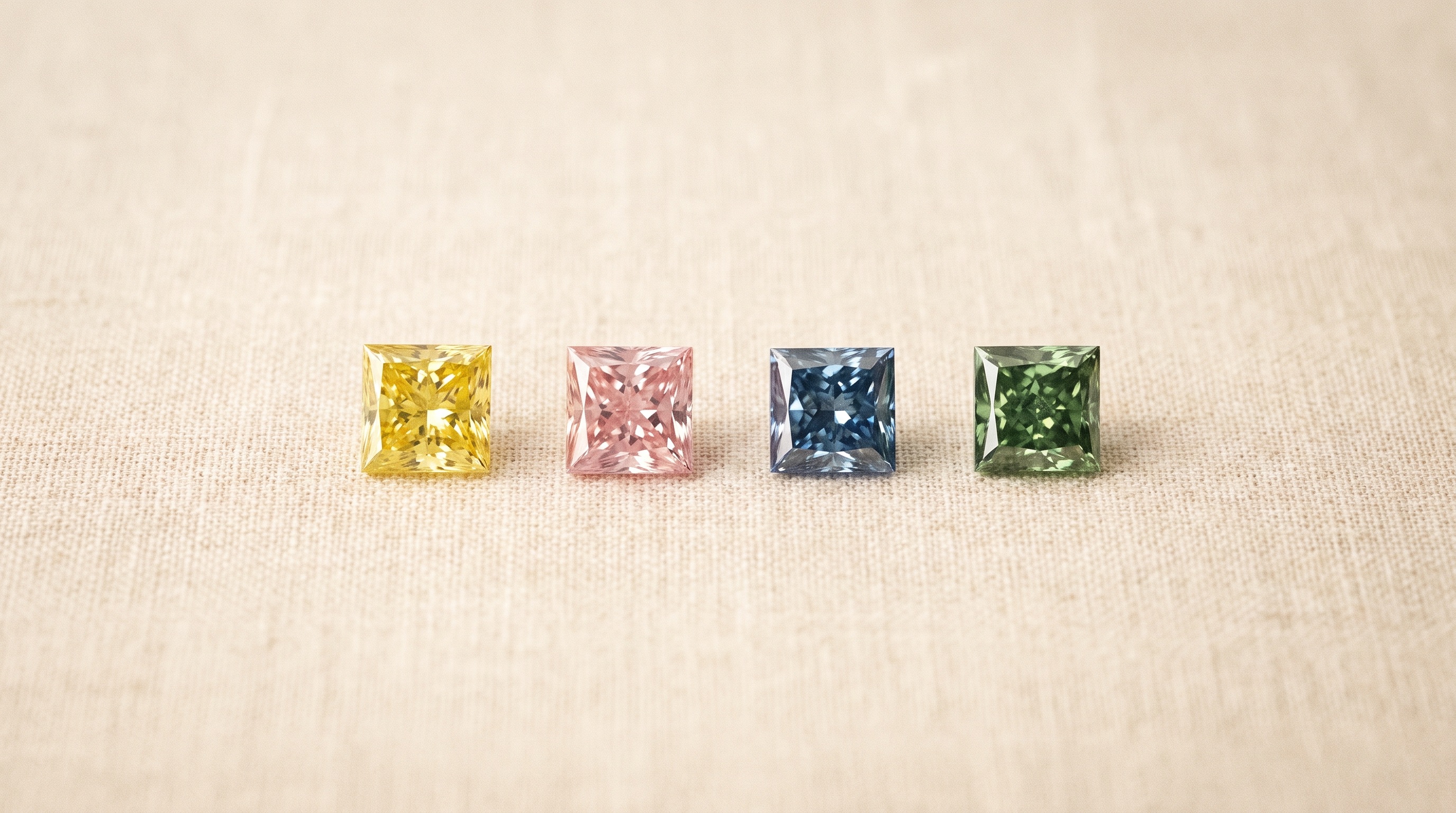
Guru Diam's fancy color princess inventory spans the locked color palette — yellow, pink, blue, and green — CVD-grown and IGI-certified as standard, with GIA available on request. The wider fancy color diamond market includes hues Guru Diam does not stock in this cut, such as champagne, cognac, orange, and gray; those are mentioned here for trade context only, not as an in-stock claim for princess.
A brief trade history of the princess cut
The princess cut is a modern shape, not an antique one. Trade histories generally trace its lineage to a series of square brilliant-style cuts developed in the 1960s and 1970s — a profile cut credited to London cutter Arpad Nagy, followed by the "Barion" cut patented by South African cutter Basil Watermeyer in 1971, which introduced the four-facet chevron pavilion pattern that later princess cuts inherited. The name "princess cut" and its commercial standardization are usually credited to a Los Angeles cutting house in 1980, and the shape spread through the trade over the following decade as a brilliant-faceted alternative to step-cut squares like the emerald and Asscher. By the 1990s it had become the standard second-most-requested shape for colorless engagement center stones, a position it still holds in the modern bridal market. None of that history is about color — princess was developed and popularized as a colorless-diamond shape, which is part of why fancy color rough is rarely cut this way today.
Facet structure and the chevron pavilion
A princess cut's pavilion is built from chevron-shaped facets — stacked V patterns radiating from the culet toward the girdle, usually in two or four layers depending on the cutter's facet count. This is structurally different from a round brilliant's kite-and-star pattern, but functionally similar in what it does to light: it breaks the path into short segments and returns them quickly through the crown as scintillation. A step cut like emerald or Asscher does the opposite — long, parallel facets running the length of the pavilion that act like a hall of mirrors, giving light more distance to travel through the diamond's body before it exits. That extra distance is exactly where body color accumulates and becomes visible face-up. Princess cut's short, fast light paths are why it reads bright and colorless-leaning even in tinted rough, and why cutters steer color-rich material toward mixed and step cuts instead.
How Guru Diam sources and cuts fancy color princess diamonds
Guru Diam's princess cut program starts with rough selected for even color distribution rather than maximum yield. Cutting, faceting, and polishing happen in-house — no location is disclosed as a matter of policy, but the process is not outsourced to a third party once rough arrives at the workshop. For a princess cut carrying intentional color, the cutter's priority shifts from maximizing brilliance to maximizing face-up color: table size, pavilion depth, and crown angle are all adjusted from colorless-cut proportions to trap and concentrate hue rather than scatter it, even though that tradeoff costs some of the fire princess is otherwise known for.
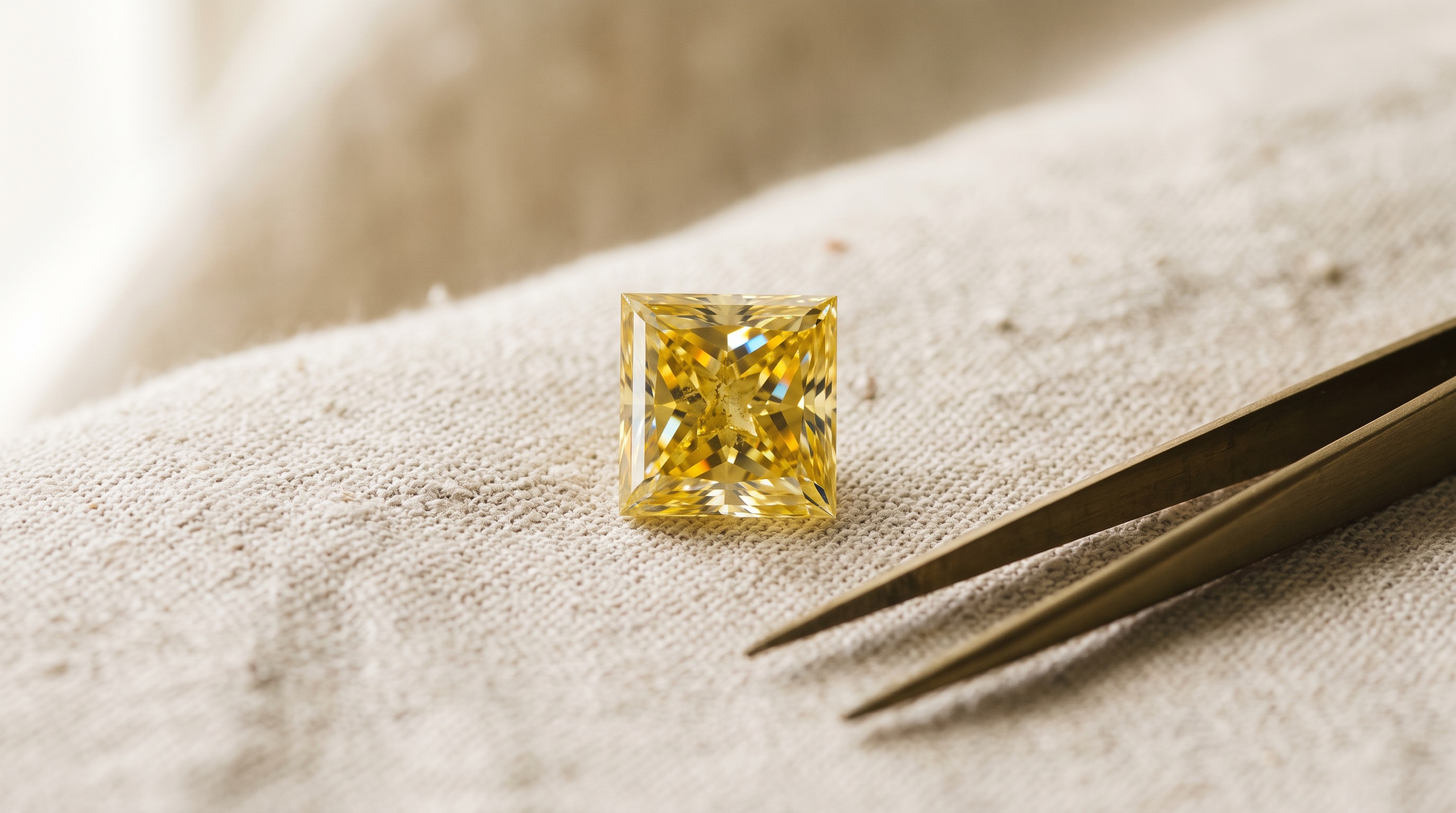
Color origin in CVD-grown diamond differs by hue. Fancy yellow in lab-grown material typically comes from nitrogen incorporated into the crystal lattice during growth — a controlled-atmosphere process, not a post-growth step. Fancy blue typically comes from boron doping during the same growth phase. Pink and green are usually the product of post-growth color treatment, a standard and disclosed step across the lab-grown trade that is applied after the rough is grown and before it is cut and polished. Every Guru Diam fancy color princess cut ships with its growth method and any treatment disclosed on the certificate — that disclosure is a condition of IGI and GIA grading, not an optional add-on.
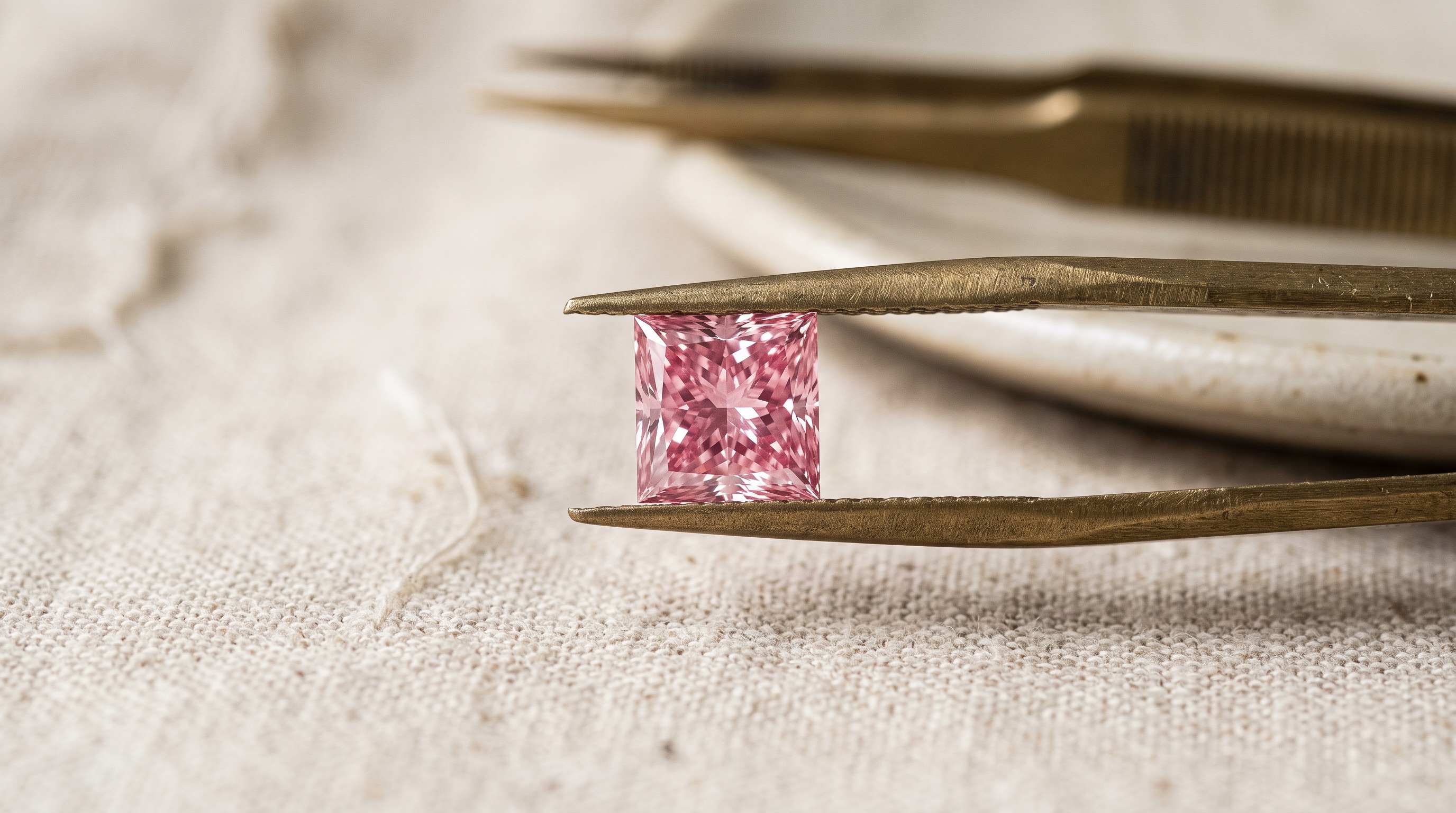
Fancy color princess: spec and availability
| Spec | Detail |
|---|---|
| Outline | Square, pointed corners |
| Facet style | Brilliant (~50–58 facets) |
| Color palette (Guru Diam) | Yellow, Pink, Blue, Green |
| Growth method | CVD-grown |
| Certification | IGI standard; GIA available on request; GCAL available on request |
| Stone type | Certified single stones (not melee) |
| On-hand count | 7 pieces — request current inventory |
| Sourcing path | In-stock (limited) or made-to-order |
Availability
Guru Diam has 7 fancy color princess cut diamonds in stock as of this writing. Matching an exact hue and size to what's on the shelf isn't guaranteed at this depth, so request current inventory directly, or spec a made-to-order cut to your requirements. With 7 pieces on hand, fancy color princess is a made-to-order-leaning category rather than deep bench stock — call ahead with the hue, saturation, and size you need, and the desk can confirm what's on the shelf versus what needs to be cut to spec.
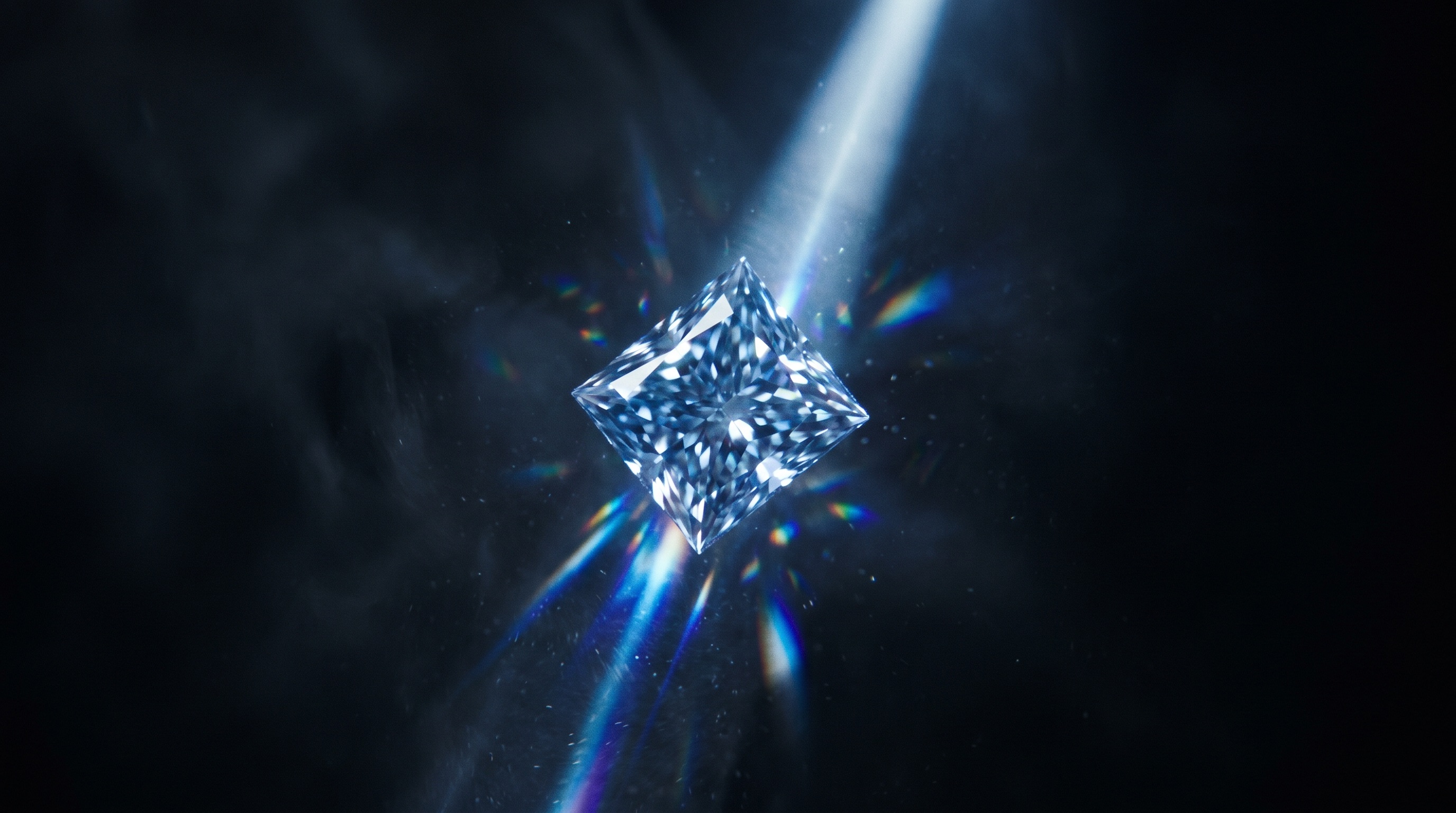
Grading fancy color princess cut diamonds
Fancy color grading runs on a different scale than colorless grading, and it matters more for a princess cut than for shapes that hold color more easily — a stone that's borderline for saturation in a step cut can read noticeably lighter once it's cut into a light-scattering brilliant shape.
Color grading terminology
IGI and GIA both grade fancy color diamonds on a combination of hue, tone, and saturation, using an intensity scale that runs roughly: Faint, Very Light, Light, Fancy Light, Fancy, Fancy Dark or Fancy Deep, Fancy Intense, and Fancy Vivid — with Fancy Vivid representing the strongest, purest expression of a given hue and commanding the largest price step up from the grade below it. For a buyer sourcing wholesale, the certificate's stated grade matters more than the stone's photograph — face-up color under different lighting can shift a stone's apparent saturation, but the graded intensity is fixed on the report.
Clarity and cut considerations specific to princess
Clarity is weighted differently in fancy color stones than in colorless ones. A stronger body color masks small inclusions that would be conspicuous in a colorless stone, so buyers sourcing fancy color princess cuts should expect — and can generally accept — clarity grades a step or two below what they'd require in a colorless princess of the same size, without a visible tradeoff. Cut grading is where princess parts ways from round: neither IGI nor GIA issues the round-brilliant-style overall cut grade on a princess-shaped report, colorless or fancy color. Instead, the report documents proportions, symmetry, and polish, and for a fancy color stone specifically, evaluates how effectively the finished cut carries the graded body color face-up — a judgment call that matters more here than the finish grade itself, since a technically well-polished princess can still be cut too shallow or too light to hold its hue.
One structural point worth flagging to any jeweler buying princess for resale: the pointed corners are the thinnest, most exposed part of the stone, and they chip more easily than any other point on the diamond during setting, wear, or a hard knock against a countertop. That's a durability fact independent of color, but it becomes a real cost consideration once a jeweler is setting a scarcer, harder-to-replace fancy color stone rather than a commodity colorless one.
What drives price in fancy color princess cut diamonds
Saturation is the primary price driver in any fancy color diamond, princess included — a Fancy Intense or Fancy Vivid grade commands a meaningfully higher price than a Fancy Light stone of the same size and hue, often more than carat weight itself moves the number. Hue rarity ranks next: within Guru Diam's stocked palette, blue and pink typically price above yellow and green at equivalent saturation and size, reflecting how much scarcer strong blue and pink material is to produce even in a controlled lab environment, where yield of top-saturation rough is lower than for yellow.
Cut yield works differently for princess than for round. Princess retains a substantially higher percentage of the starting rough's weight than round brilliant does — trade estimates commonly put princess yield in the 70-90% range against roughly half that for round — which is part of why princess exists as a shape at all for colorless material. For fancy color rough, though, yield efficiency is secondary to color efficiency: a cutter will sacrifice weight retention to orient the stone for stronger face-up color, so the yield advantage that makes princess economical for colorless diamonds doesn't fully carry over to color-driven cutting decisions. Certification choice also factors into wholesale pricing — IGI, GIA, and GCAL each carry different turnaround and fee structures, which is one reason Guru Diam issues IGI as the standard and holds GIA and GCAL available on request rather than certifying every stone through all three.
Carat weight moves price the way it does in any diamond category — with step-ups at psychological size thresholds like 1.00ct, 1.50ct, and 2.00ct rather than a smooth per-carat curve — but in fancy color, that carat premium compounds with the saturation premium instead of standing alone. A 1.50ct Fancy Vivid stone isn't just larger than a 1.00ct Fancy Vivid stone of the same hue; it's disproportionately harder to source at that combination of size and saturation, since color-rich rough large enough to yield a princess cut above a carat is scarcer than smaller color-rich rough. Buyers sourcing above roughly 1.50ct in fancy color princess should expect a longer made-to-order lead against rough availability rather than a same-day match from the 7-piece on-hand count.
Setting and styling fancy color princess for resale
For jewelers reselling fancy color princess cuts, the shape reads as modern and geometric — it pairs naturally with clean architectural settings rather than vintage-inspired ones, which fits current bridal and fine jewelry trends toward simpler lines. A few sourcing and styling notes worth passing to end customers:
Protecting the corners
Because the pointed corners are the vulnerable point on any princess cut, four-prong settings with a prong squarely over each corner, or a full or partial bezel, are the standard protective approaches — a V-prong that cradles the point directly is the most common solution in bridal work. A stone this scarce is worth the extra setting labor to protect; replacing a chipped fancy color princess isn't a same-day fix the way a commodity round stone is.
Metal pairing by hue
Yellow diamonds read warmest against yellow or rose gold, where the metal reinforces rather than competes with the stone's color. Pink diamonds work in either direction — rose gold for a tonal, monochromatic look, or white gold and platinum for contrast that makes the pink read more vivid against a cool backdrop. Blue and green diamonds are almost always set in white gold or platinum in the trade; a warm metal tends to compete with a cool-hued stone and can make the color read muddier face-up. Halo settings — a ring of small colorless melee framing the center stone — are a common upsell for fancy color princess specifically, since the halo both visually reinforces the corner outline and adds a layer of physical protection around the most vulnerable points of the shape.
Where fancy color princess fits in a jeweler's case
Fancy color princess sells on a different story than a colorless center stone, and jewelers reselling it generally get better traction merchandising it around that story rather than treating it as a straight substitute for a white diamond in the same setting. A few placements that work in practice:
- Anniversary and statement rings. Because princess reads modern and geometric rather than romantic-vintage, it fits customers already leaning toward clean, architectural bridal or right-hand-ring styling rather than antique-inspired work.
- Three-stone and East-West settings. A fancy color princess center flanked by white princess or trapezoid side stones is a common configuration — the color center stays the visual anchor while the white stones do the brilliance work the fancy color center gives up.
- Birthstone-adjacent gifting. Yellow reads as a citrine or topaz alternative for November birthdays, blue reads as a December alternative to topaz, and green pairs naturally with May emerald-season gifting — all useful hooks for a jeweler's case card or a sales conversation, without implying the stone is anything other than a diamond.
- Men's jewelry. The squared, geometric outline of princess translates well to men's rings and single-stone pendants, a category where round and cushion read as more traditionally feminine choices.
Whatever the placement, disclosing growth method and any color treatment on the point-of-sale documentation isn't optional — it's a condition of the certificate itself and standard practice across the CVD trade, and it heads off the single most common end-customer question about a fancy color stone before it becomes an objection.
Princess vs. radiant vs. cushion for fancy color
Princess is one of three shapes in Guru Diam's regular fancy cut tier that buyers most often compare when sourcing color. Radiant cut — a rectangular or square brilliant with cropped corners, developed in the late 1970s — is widely regarded in the trade as the strongest general-purpose shape for fancy color, because its crown facets are brilliant-cut for fire while its cropped corners and deeper structure hold color more effectively than princess's sharp-cornered geometry. A large share of the fancy yellow diamonds in the market, historically and today, are cut radiant for exactly this reason. Cushion cut — a rounded-corner pillow shape with larger, fewer facets than princess or radiant — holds body color even more effectively than radiant, which is why cushion has long been the default shape for deeply saturated antique and estate-style fancy color stones; its larger facets act more like a step cut's mirrors than a brilliant's scattering pattern. Cushion's rounded corners also make it the most durable of the three for daily wear, with no exposed points to chip.
In practice: a buyer prioritizing color depth and durability should look first at cushion, radiant sits in the middle as the trade's general-purpose fancy color workhorse, and princess is the right call specifically when a customer wants the squared, modern silhouette and is willing to accept a lighter-reading face-up color and a corner-protective setting in exchange. Guru Diam stocks all three shapes in fancy color; see the fancy color radiant cut and fancy color cushion cut pages for shape-specific inventory, or the fancy color overview for the full palette across all shapes. Buyers sourcing princess in colorless material rather than fancy color should see the colorless princess cut page instead.
Sourcing fancy color princess cut diamonds wholesale
Guru Diam sources fancy color princess cut diamonds as wholesale, trade-only inventory — no retail markup — from our New York Diamond District desk (36 West 47th Street, Suite 601A, New York, NY 10036) and our Los Angeles office (607 South Hill Street, Suite 241, Los Angeles, CA 90014). In-stock pieces ship same-day when ordered before 6pm EST from New York or 4pm PST from Los Angeles; a custom setting built around a fancy color princess center stone runs CAD-to-finished-piece in 4–6 days. For shapes with deeper standing color inventory, see our fancy color lab-grown diamonds overview, and for matched side-stone work built around a fancy color princess center, see matched pairs.
How to order fancy color princess cut diamonds from Guru Diam
Guru Diam works with more than 2,000 active wholesale accounts across independent jewelers, designers, and manufacturers, and fancy color princess is ordered the same way as the rest of the catalog. Open a verified wholesale trade account at /signup — this is a trade-only catalog, so account verification comes before pricing and inventory access. Once verified, request current fancy color princess inventory directly against the hue, saturation, and size you need; because on-hand count sits at 7 pieces, a direct request against your spec gets a faster, more accurate answer than browsing a static listing. For a made-to-order cut, the desk will confirm rough availability and color-saturation expectations before cutting begins, since color-rich rough suited to a brilliant-faceted shape is the limiting factor, not workshop capacity.
Buyers who want to see stones in hand before committing can book time with a gemologist at /book-appointment, or reach the desk directly over WhatsApp Business for a faster back-and-forth on hue and saturation photos ahead of a formal order.
Frequently Asked Questions
Why is fancy color princess cut a specialty item rather than stocked deep?
Princess faceting is built for fire the same way round brilliant is, scattering light into many small flashes instead of letting it travel further inside the stone to pick up color. That makes it a less efficient color-performing shape than a mixed or step cut, so it's produced against specific orders more often than held as standing inventory.
Does Guru Diam have fancy color princess cut diamonds in stock, and are they certified?
Yes, in limited numbers — 7 pieces on hand as of this writing, CVD-grown and IGI-certified as standard with GIA available on request. Request current inventory directly, or specify a made-to-order cut.
How fast can I get a fancy color princess stone or a finished custom piece?
In-stock pieces ship same-day from New York or Los Angeles. A custom setting built around a fancy color princess center stone runs CAD-to-finished-piece in 4–6 days from either desk. That turnaround applies to finished jewelry, not to sourcing or cutting a made-to-order loose stone, which depends on matching color-suitable rough.
What colors does Guru Diam stock in fancy color princess cut?
Yellow, pink, blue, and green — the same locked color palette used across Guru Diam's certified fancy color single-stone program. Other fancy hues exist in the broader diamond trade but are not part of Guru Diam's stocked princess cut offering.
Is fancy color princess cut more or less durable than other fancy color shapes?
Less durable at the corners specifically. Princess's pointed corners are the thinnest part of the stone and the most prone to chipping, which is why it's typically set with a V-prong at each corner or a partial bezel. Radiant's cropped corners and cushion's rounded corners are both more forgiving for daily wear.
Should I choose princess, radiant, or cushion for a fancy color diamond?
It depends on the priority. Cushion holds body color most effectively and wears most durably; radiant is the trade's general-purpose fancy color shape, balancing brilliance and color retention; princess is the right call when a customer specifically wants the squared, modern silhouette and accepts a lighter face-up color read and a corner-protective setting in exchange.