
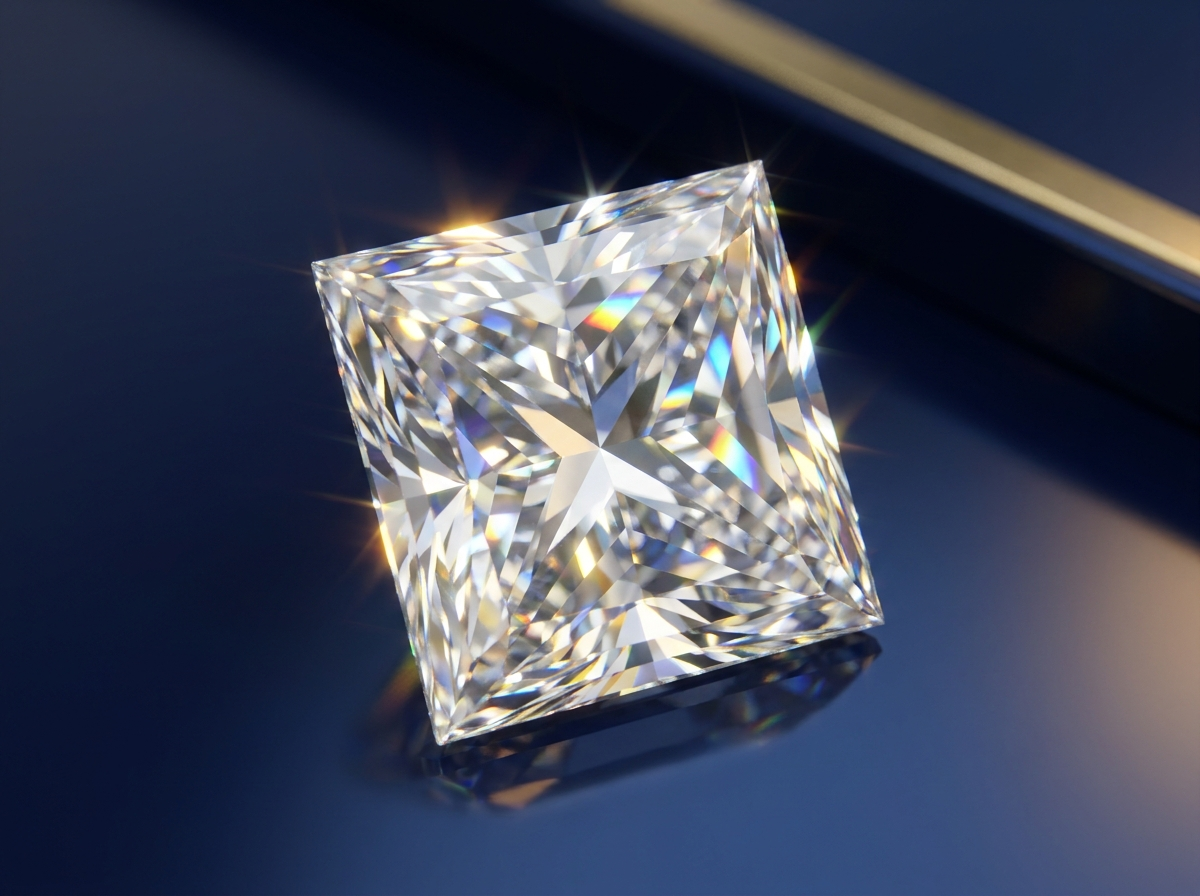
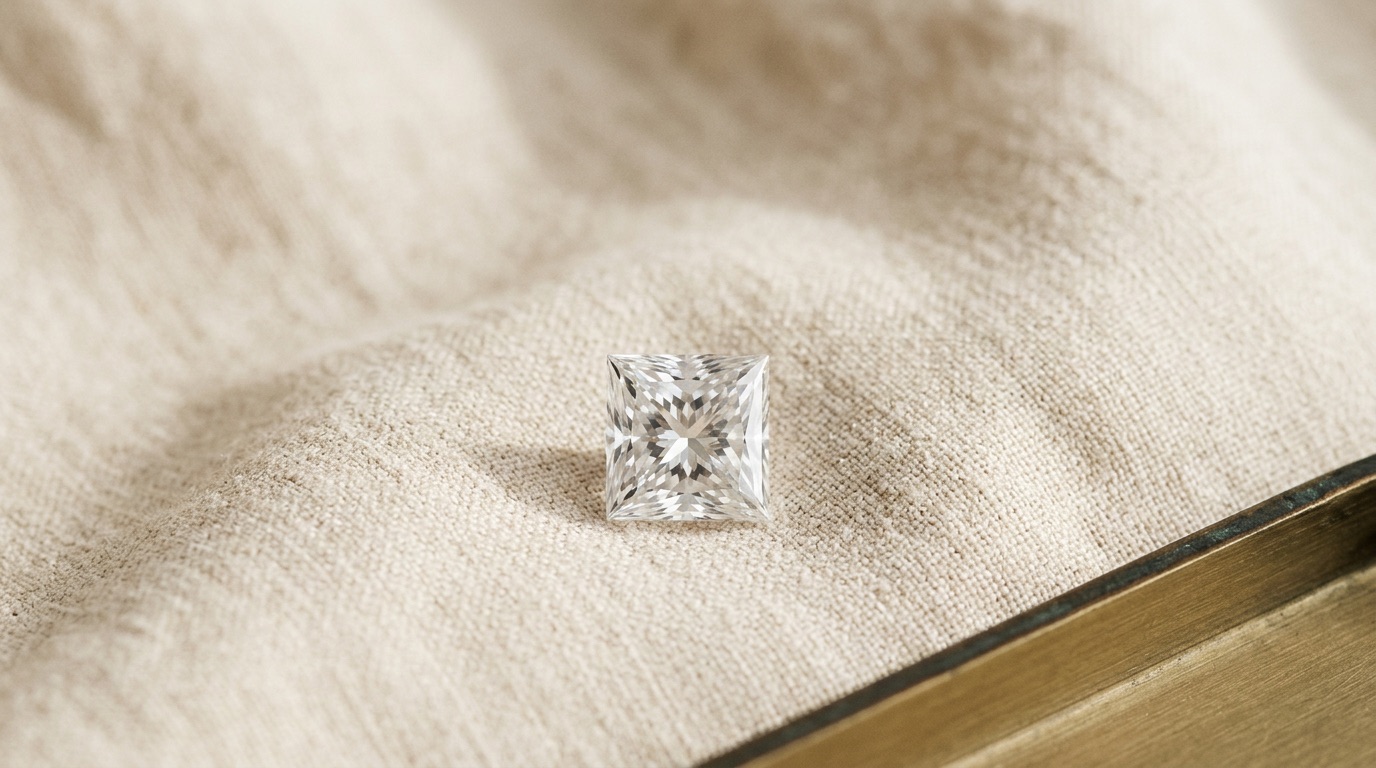
A princess cut is a square (or slightly rectangular) brilliant-faceted diamond with sharp, uncropped corners — the second-most-requested engagement ring shape after round brilliant, prized for its crisp modern outline and high fire. Guru Diam stocks princess cut as IGI-certified, CVD-grown lab-grown loose diamonds, cut in-house, with 185 pieces currently on hand from our New York Diamond District desk.
What is a princess cut diamond?
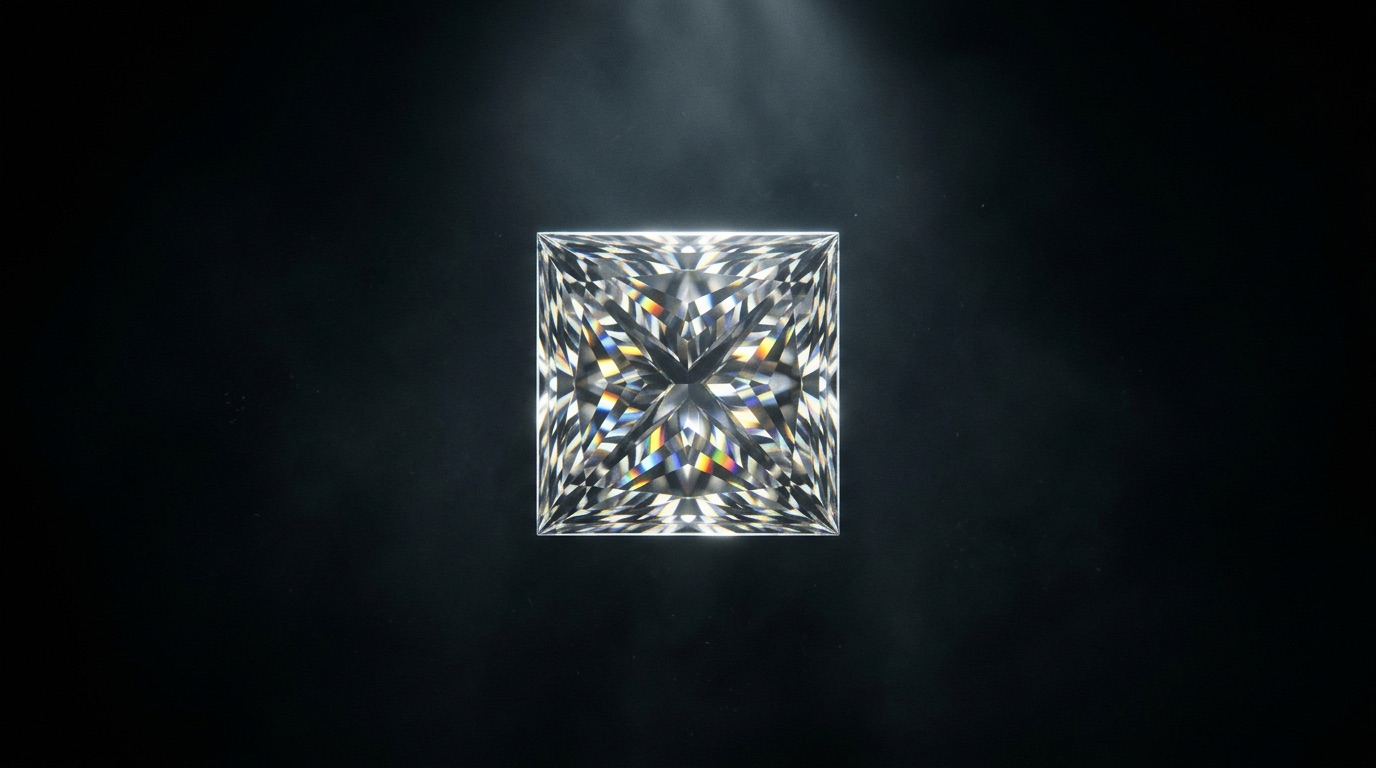
A princess cut is a square or slightly rectangular brilliant, typically faceted with around 76 facets arranged in a chevron (inverted-V) pattern on the pavilion rather than the pie-shaped wedges radiating from a round brilliant's culet. That faceting keeps most of a round brilliant's fire and scintillation while trading the circular outline for sharp, uncropped corners and clean, geometric lines — a look that reads modern and pairs naturally with baguette or trapezoid side stones in a three-stone setting.
The shape's name is a modern marketing term rather than a historical reference to any period style — princess cut as it's cut today dates to the 1970s-80s development of square modified brilliants, refined through several patented variations before settling into the chevron-pavilion form that dominates supply now. That matters for how a jeweler frames it to a customer: it's a contemporary cut, not a vintage revival, and it should be sold on its modern, minimal, high-brilliance identity rather than any heritage story.
Princess also cuts more efficiently from rough than round brilliant — a square outline follows the natural octahedral crystal shape more closely than a circular one does, so less rough is sacrificed to waste in the cutting process. That efficiency was a strong value proposition long before lab-grown production existed, and it carries straight through to lab-grown princess cut pricing today: for a given color and clarity, princess typically runs below round brilliant on a per-carat basis, which is a large part of why it holds the number-two spot in shape demand.
Facet structure and proportions: how a princess cut is built
Princess cut is a brilliant, not a step cut — the pavilion facets radiate and interlock rather than running in flat parallel rows — but the way those facets meet the square outline is what separates a well-cut princess from a mediocre one, and it's worth understanding before quoting a customer.
The chevron pavilion pattern
Cut the pavilion of a princess cut open and you'll typically see facets arranged in an inverted-V, or chevron, pattern radiating from the culet toward the corners rather than the girdle. Most commercial princess cuts run either a two-chevron or four-chevron pavilion arrangement; four-chevron generally produces slightly more scintillation and a marginally better light return, which is one of the small proportion details worth checking on a certificate or lab report before buying for a demanding customer. The crown, by contrast, is faceted much like a standard round brilliant's crown — kite and triangle facets — which is where most of the shape's fire comes from.
Length-to-width ratio
A true square princess cut runs close to 1.00:1 length-to-width. Buyers wanting a slightly elongated, more rectangular look should ask for the exact ratio rather than just requesting "princess," since labeling conventions vary by cutter and a stone sold as "princess" can run anywhere from 1.00 up to roughly 1.10–1.15:1 before it starts reading as a distinctly rectangular shape rather than a square one. Matching a specific ratio matters most when a stone is going into a pre-built three-stone or wedding-set mounting designed around a particular outline.
Depth and face-up size
Princess cut typically runs deeper than round brilliant — 65-75% total depth is common, versus roughly 58-63% for a well-proportioned round — because the squared outline needs that extra pavilion depth to preserve fire and prevent light leakage through the corners. The practical effect for a buyer: a princess cut carries more of its carat weight in depth rather than spread, so it faces up smaller than a round brilliant or an elongated fancy shape (oval, marquise, pear) of the same carat weight. Quote carat weight alongside depth percentage and millimeter dimensions, not carat weight alone, if a customer has a specific face-up size in mind.
Princess cut vs. cushion cut vs. radiant cut
These three shapes get confused with each other constantly on the trade floor, and mixing them up in a quote is an easy way to send a customer the wrong stone. Here's how they actually differ.
| Spec | Princess | Cushion | Radiant |
|---|---|---|---|
| Outline | Square/rectangular, sharp uncropped corners | Square/rectangular, soft rounded corners | Rectangular/square, cropped (cut) corners |
| Facet style | Full brilliant, chevron pavilion | Full brilliant, larger "crushed ice" facets | Hybrid brilliant crown + step-cut influence |
| Facet count | ~76 | 58-64 typical | 65-70 typical |
| Corner setting risk | Highest — sharp corners chip easily | Low — rounded corners are durable | Low — corners already cropped |
| Visual character | Crisp, modern, geometric | Soft, romantic, vintage-leaning | Fire-heavy with a softened outline |
Princess vs. cushion: cushion cut trades princess's sharp corners for a rounded, pillow-shaped outline and larger, chunkier facets — often described in the trade as "crushed ice" faceting. Those larger facets return light differently: less pinpoint sparkle than princess, more of a soft, warm glow, and they hide small inclusions and body color more effectively than princess's tighter chevron pattern does. Cushion also carries essentially none of princess's corner-durability concern, which makes it an easier day-to-day setting stone. The trade-off is character — princess reads contemporary and architectural, cushion reads softer and more romantic — so the two serve different customer briefs rather than competing head-to-head on the same design.
Princess vs. radiant: this is the pairing that gets confused most often, and it's worth walking a customer through carefully before a quote goes out. Princess is a full brilliant with sharp, uncropped corners and chevron pavilion faceting. Radiant is a hybrid cut with corners that are deliberately cropped — closer to an elongated octagon in outline — combining brilliant-style crown facets with a step-cut influence on the pavilion that gives it noticeably more fire than a pure step cut like emerald, while keeping a more contained, elegant outline than round brilliant. The two also photograph differently: princess reads as a crisper, more geometric square, while radiant's cropped corners soften the silhouette and make it look more rectangular even at a similar length-to-width ratio. If a client asks for "princess" but describes cropped corners, or asks for "radiant" but describes sharp corners, confirm the shape before quoting — the two aren't interchangeable in setting (radiant's cropped corners don't need the same corner-protecting prong work princess does) or in price.
Grading and quality considerations for princess cut
Princess cut's spec sheet reads differently from a round brilliant's, and a few of those differences matter enough to walk a customer through before they commit.
Corner durability and the bow-tie effect
The sharp, uncropped corners are princess cut's signature look and its primary durability consideration. Unprotected corners are the single most chip-prone point on any fancy-shape diamond, and in the trade, corner chips are one of the more common warranty and repair claims tied to princess-cut engagement rings specifically — almost always traced back to open, unprotected prong settings that leave a corner exposed to daily knocks. Specify V-tip prongs or a corner-protecting bezel detail rather than standard open prongs on any princess-cut mounting, and flag the durability point to retail customers who are shopping the shape for the first time.
Bow-tie — the dark shadow band that can appear across an elongated fancy shape when light leaks through the pavilion instead of reflecting back — is much less of a concern on princess cut than it is on oval, marquise, pear, or elongated cushion and radiant cuts. A well-proportioned, close-to-square princess cut rarely shows a visible bow-tie because its chevron pavilion facets are symmetrical around a square, not an elongated, outline. It becomes a real risk mainly at the more rectangular end of the range — princess cuts pushed toward a 1.10-1.15:1 length-to-width ratio, or stones with uneven pavilion depth across the four chevron sections — so it's worth checking a face-up photo or video on anything sold as "rectangular princess" rather than assuming the shape is immune.
Color, clarity, and cut-grade nuances
Princess cut's chevron pavilion faceting concentrates body color slightly more visibly toward the corners than a round brilliant's radiating facet pattern does, particularly at larger carat weights. Many trade buyers tighten their color floor by a grade versus what they'd accept in an equivalent round brilliant — G color and above is a common threshold for customers who want no visible warmth face-up. Clarity behaves more like a round brilliant than a step cut: princess cut's brilliant faceting still does a reasonable job of breaking up and hiding small inclusions, so SI1-and-up remains a workable floor for most eye-clean requests, tightening to VS2 or better only for larger stones or customers who inspect closely.
One nuance worth knowing: neither IGI nor GIA issues an overall cut grade for fancy shapes the way they do for round brilliants — "Excellent," "Very Good," and so on is a round-brilliant-only field on both labs' reports. A princess cut certificate will carry color, clarity, symmetry, polish, and proportions (depth percentage, table percentage, length-to-width ratio), and those are what a buyer should actually be reading rather than looking for a single cut-grade rollup that doesn't exist for this shape. Symmetry and polish matter more than they might seem to at first glance — uneven chevron facets or an off-center culet show up as visible imbalance in the fire pattern face-up, even when the certificate's color and clarity numbers look strong.
How Guru Diam sources and cuts princess cut diamonds
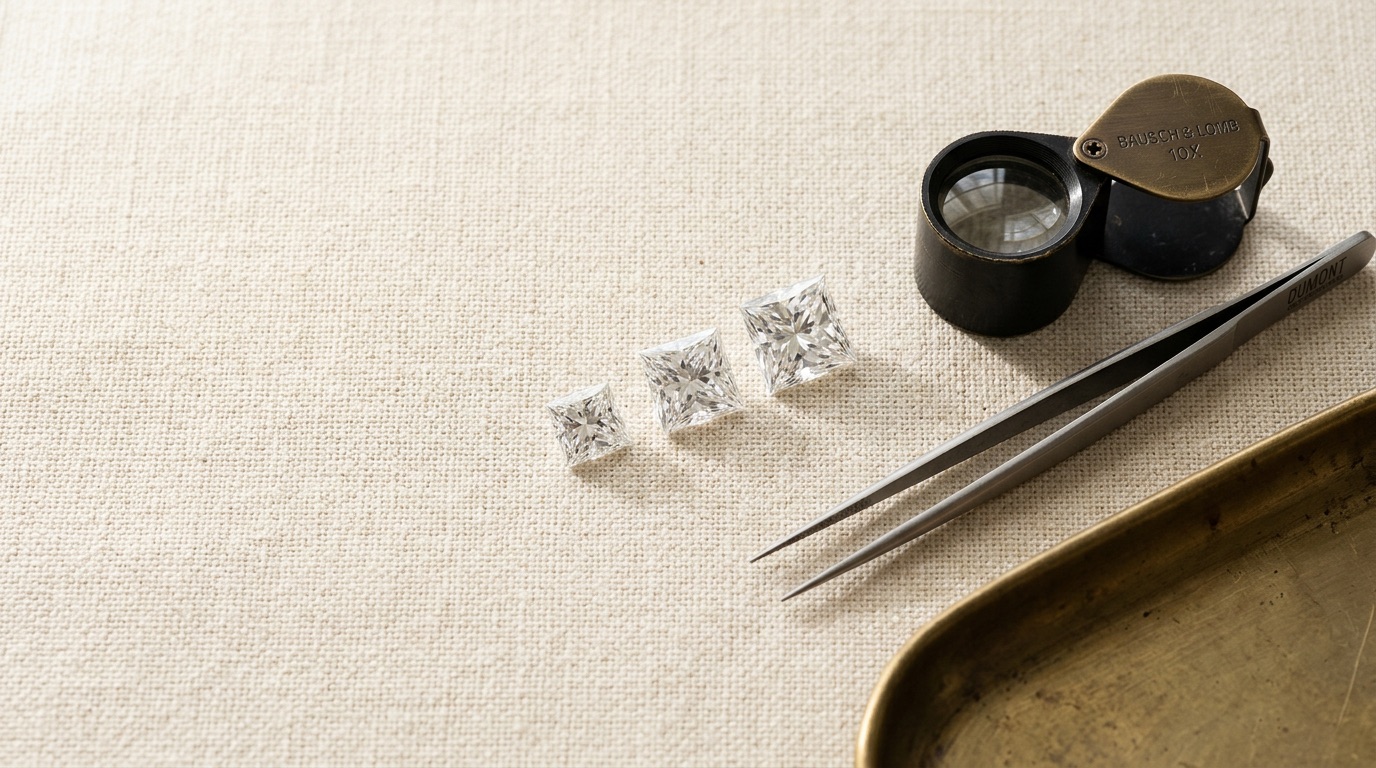
Guru Diam's princess cut inventory is CVD lab-grown and cut in-house against the same proportion and symmetry discipline used across the full fancy-shape catalog — chevron facet alignment, depth, and length-to-width ratio are checked before a stone is certified and listed, not left to whatever the rough happens to yield. Cutting, setting, and polishing are all handled in-house, which is what makes it practical to carry princess cut in real depth — 185 pieces currently on hand — rather than treating it as a made-to-order specialty request the way some fancy shapes have to be.
| Spec | Detail |
|---|---|
| Outline | Square (or slightly rectangular) |
| Facet count | ~76 (chevron pavilion pattern) |
| Facet style | Full brilliant |
| Typical depth | 65-75% |
| Typical length-to-width | 1.00-1.10:1 (true square to slightly rectangular) |
| Growth method | CVD-grown, cut in-house |
| Certification | IGI standard; GIA and GCAL available on request |
| Stone type | Certified single stones (0.30ct+, not melee) |
| On-hand count | 185 pieces |
| Sourcing path | In-stock or made-to-order |
In-stock pieces are ON-HAND INVENTORY, ready to ship same-day. For sizes, ratios, or specs outside current stock, made-to-order cutting is available — and when that stone is going into a finished piece, a custom setting with corner-protecting mounting work included typically runs CAD-to-finished-jewelry in 4-6 days once the design is approved. That 4-6 day window applies to the finished jewelry build, not to sourcing a loose stone on its own.
Fancy color princess cut: what's available and what isn't
Most princess cut demand is for white, colorless-to-near-colorless goods — that's the bulk of the 185-piece standing inventory and the default assumption on a quote. Fancy color princess cut can be cut to request, but square brilliant faceting shows body color less efficiently than a step cut does, so it stays a lower-volume specialty request rather than standing depth inventory the way white princess cut is. Within Guru Diam's certified fancy color loose-stone range, princess cut is available in yellow, pink, blue, and green. Champagne and cognac are not part of the certified fancy color loose catalog, so a request for a champagne or cognac princess cut should be redirected to a different color family rather than quoted against a color that isn't stocked. See our fancy color princess cut guide for sourcing detail on that side of the category.
Pricing factors that move the wholesale price on princess cut
Princess cut prices against the same core variables as any certified fancy shape, with a few points that carry more weight here than they would on a round brilliant:
- Carat weight — the baseline driver, but because princess runs deeper than round for a given carat weight, two stones at identical carat weight can face up noticeably different sizes once depth and length-to-width ratio are factored in, which shows up in how buyers price them for resale.
- Color — weighted slightly higher than on a round brilliant of the same size, since chevron pavilion faceting concentrates visible body color toward the corners more than a round's radiating pattern does.
- Clarity — behaves closer to a round brilliant than a step cut; a jump from SI1 to VS2 moves the price less dramatically here than it would on emerald or asscher, since princess's brilliant faceting still hides small inclusions reasonably well.
- Symmetry and chevron alignment — a stone with clean, evenly sized chevron facets and a centered culet commands a premium over one that's within grade tolerances but visibly imbalanced face-up.
- Length-to-width ratio — buyers sourcing for a specific three-stone or wedding-set mounting often have a target ratio in mind, and true-square stones (closest to 1.00:1) tend to move faster than stones drifting toward the rectangular end of the range.
- Rough yield efficiency — princess cuts more efficiently from rough than round brilliant, which is part of why it consistently prices below round on a per-carat basis at equivalent color and clarity, even in lab-grown production where rough cost structures differ from natural.
- Certification lab — IGI-certified goods make up the bulk of standing inventory and price accordingly; GIA and GCAL certification are available on request for buyers who standardize on a specific lab for their own resale documentation.
None of this makes princess inherently more or less expensive than cushion or radiant at the same carat, color, and clarity — it means the quote is more sensitive to depth, ratio, and chevron symmetry than a round brilliant quote would be, so comparing two princess-cut stones on price alone, without checking those secondary specs, is comparing incomplete numbers.
Setting and styling guidance for jewelers
Princess cut's sharp corners and geometric outline change what a setting has to do compared to a rounded shape like cushion, and it's worth briefing customers on the difference before they commit to a mounting.
V-tip prong solitaires are the default and most durable setting for princess cut. Four V-shaped prongs, each cupping a corner, distribute the stone's weight while fully protecting the most chip-prone points — a plain claw-prong setting borrowed from a round-brilliant mounting is the most common preventable durability mistake on a princess-cut ring.
Bezel and half-bezel settings offer the strongest corner protection of any mounting style and suit customers who prioritize durability over maximum light exposure — a practical option for active-lifestyle buyers or for a piece meant for daily manual work.
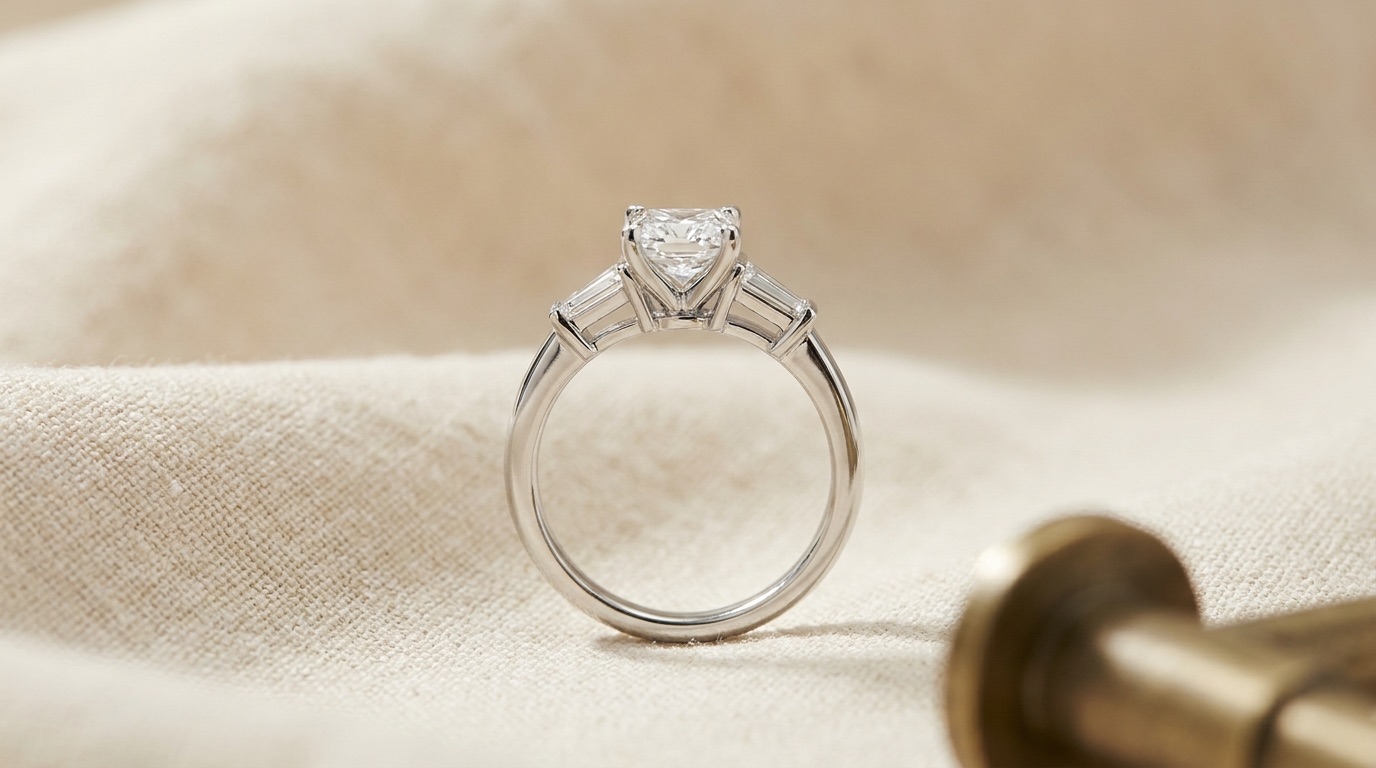
Three-stone settings are where princess cut earns much of its trade demand — a princess center stone flanked by trapezoid or baguette side stones is one of the most consistently requested bridal configurations in the modern-minimal category, and it's a strong upsell opportunity: side stones sold alongside the center stone raise the average ticket without requiring a separate sales conversation.
Halo settings built around a princess center stone visually increase apparent size, which makes princess-plus-halo a strong pairing for budget-conscious customers who want more visual size than the center carat weight alone delivers — useful positioning given that princess already faces up smaller than round or an elongated shape at the same carat weight.
Wedding and anniversary bands channel-set with smaller princess-cut or square-calibrated stones pair naturally with a princess-cut center stone for a matched bridal set, since the repeating square outline reads as a deliberate design choice rather than a mismatched pairing.
Men's and unisex rings are a growing category for princess cut specifically because its geometric, architectural outline reads less traditionally "bridal" than round or cushion — bezel-set or flush-set princess-cut center stones work well in wider, more masculine band profiles.
Custom princess-cut pieces built through Guru Diam ship unbranded by default, so a reselling jeweler presents the finished piece as their own work rather than a visibly wholesale-sourced product.
Sourcing princess cut wholesale
Guru Diam carries princess cut as trade-only, wholesale inventory — no retail markup — from our New York Diamond District desk (36 West 47th Street, Suite 601A) and our Los Angeles office (607 South Hill Street, Suite 241). In-stock pieces ship same-day from New York before 6pm EST, or same-day from Los Angeles before 4pm PST. A custom setting, corner-protected mounting included, runs CAD-to-finished-piece in 4-6 days.
How to order princess cut diamonds wholesale from Guru Diam
Guru Diam carries princess cut as IGI-certified lab-grown loose inventory from our New York and Los Angeles desks, with real-time online inventory and API/CSV feed access for trade accounts. Buyers checking specs before committing can filter live inventory by carat, color, clarity, depth, and length-to-width ratio, and pull certificate numbers directly against IGI, GIA, or GCAL reports before placing an order — no waiting on a static PDF list or a one-off email reply.
For a buyer who needs a size or ratio that isn't currently on hand, made-to-order cutting runs against the same in-house process as standing inventory, so a custom princess-cut spec doesn't mean stepping down to a different production standard than what's already in stock. Guru Diam supports 2,000+ active trade accounts across antique cuts, fancy shapes, fancy color melee, and custom jewelry — princess cut is quoted and fulfilled through the same account, catalog, and gemologist support as the rest of the inventory, not a separate request process.
Ready to buy? Open a verified wholesale account at /signup and book time with a gemologist at /book-appointment.
Frequently Asked Questions
What is a princess cut lab-grown diamond? A princess cut is a square or slightly rectangular brilliant-faceted diamond with sharp, uncropped corners, typically cut with around 76 facets in a chevron pattern. It's the second-most-requested engagement ring shape after round brilliant.
Why do princess cut diamonds need special prongs? The sharp, uncropped corners are the most chip-prone point on the stone and a common source of repair claims when set with standard open prongs. Mountings should use V-tip prongs or a corner-protecting bezel detail instead.
Is princess cut prone to the bow-tie effect? Not usually. Princess cut's symmetrical chevron pavilion around a square outline makes it far less prone to bow-tie than elongated shapes like oval, marquise, or pear. It becomes a real risk mainly on more rectangular princess cuts (toward 1.10-1.15:1 ratio) or stones with uneven pavilion depth — worth checking a face-up video on anything sold as rectangular princess.
Is IGI or GIA certification available for princess cut lab-grown diamonds? IGI is standard across Guru Diam's princess cut inventory, with GIA and GCAL available on request.
How does princess cut compare to cushion and radiant cut? Princess has sharp, uncropped corners and chevron pavilion faceting for a crisp, geometric look. Cushion has soft, rounded corners and larger facets for a warmer, softer look that hides inclusions and color more easily. Radiant has cropped (not sharp, not rounded) corners with a brilliant-crown, step-influenced pavilion that softens the outline while adding fire. The three aren't interchangeable in setting or price — confirm which shape a client means before quoting.
How fast can I get a princess cut stone or a finished custom piece? In-stock pieces ship same-day from New York (before 6pm EST) or Los Angeles (before 4pm PST). Made-to-order cutting plus a finished custom piece (CAD to jewelry) runs 4-6 days from design approval.
Is fancy color available in princess cut? Yes, within Guru Diam's certified fancy color loose-stone range — yellow, pink, blue, and green. Champagne and cognac are not part of that catalog. Fancy color princess cut is lower-volume than standard since square brilliant faceting shows color less efficiently than a step cut.