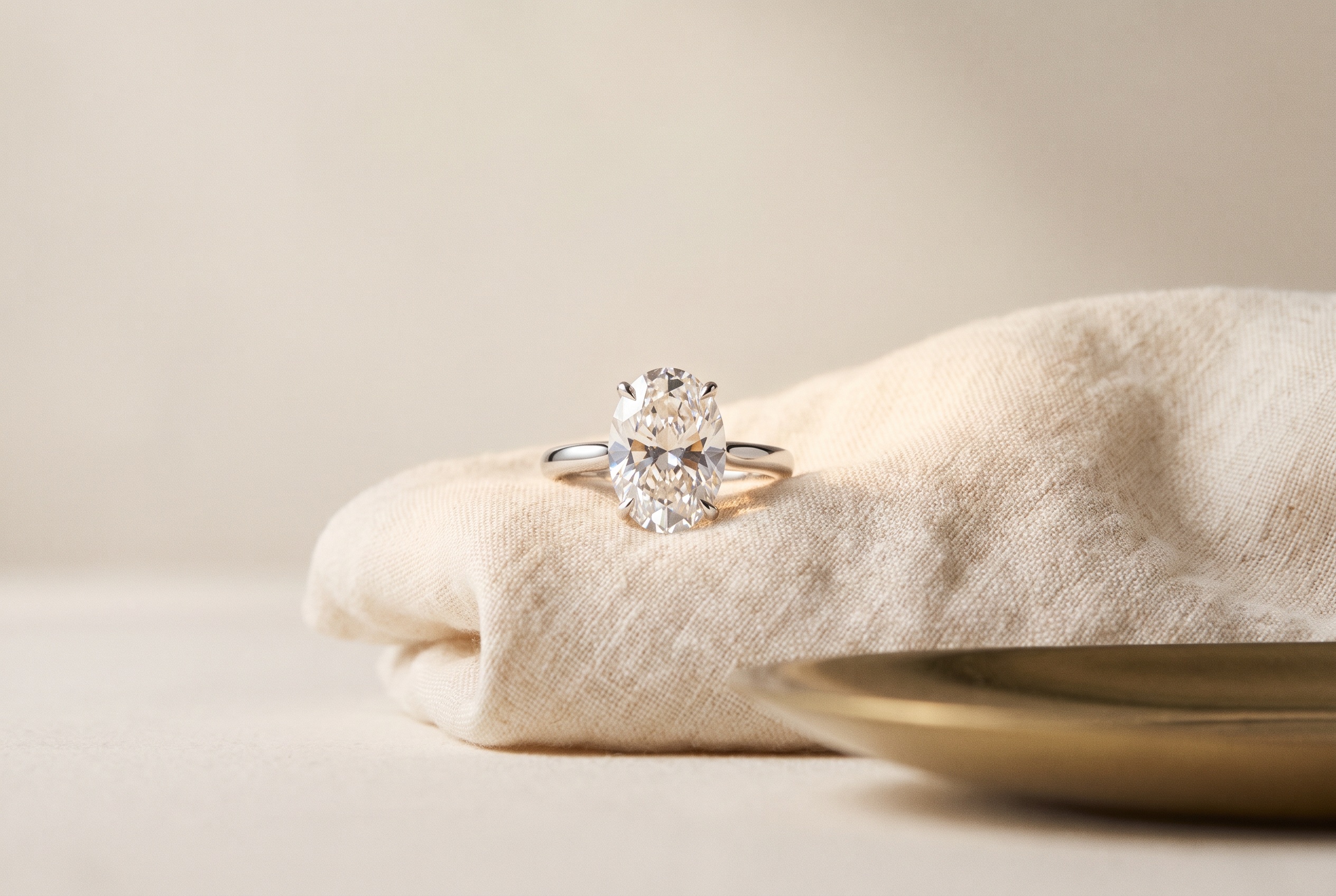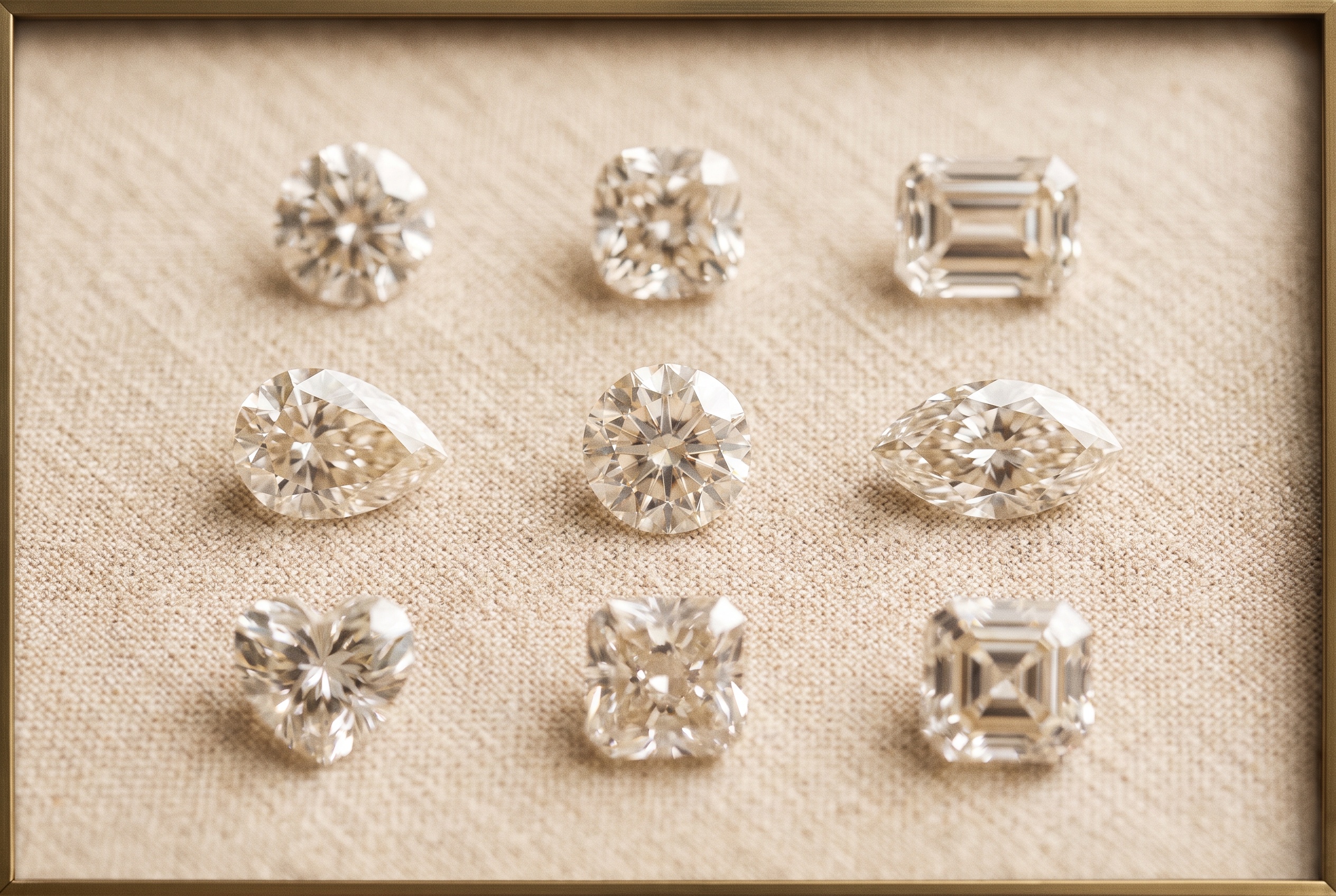

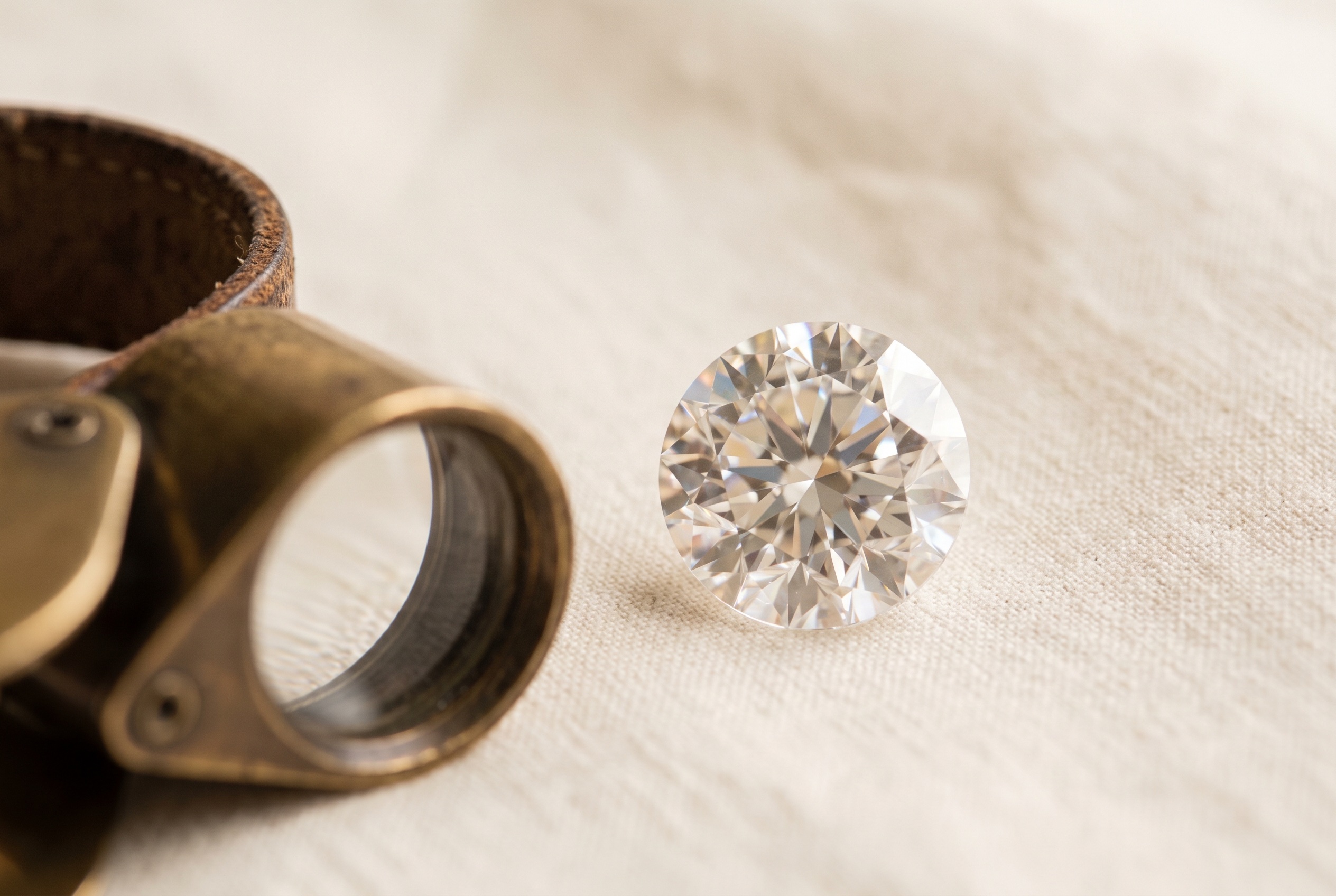
An eye clean diamond is a diamond with no inclusions or blemishes visible to the naked, unaided eye at a normal viewing distance — roughly 6 to 12 inches — even though inclusions may still be clearly visible under 10x loupe or microscope magnification. Eye clean is a practical visual standard, not a clarity grade itself, and it doesn't map to any single number on the GIA or IGI scale.
"Eye clean" is one of the most-searched diamond terms that has no official definition on a certificate, which is exactly why it generates so much confusion at the point of sale. A buyer can hand a jeweler a certificate that says SI1 and get two completely different answers about whether that particular stone will look clean face-up, because clarity grade and eye-visibility are related but not identical questions. This guide covers what eye clean actually means as a concept, how it relates to the formal clarity scale without being interchangeable with it, which grades typically clear the bar and which don't reliably, and why shape, carat size, and the type and location of an inclusion matter as much as the grade number printed on the report.
What "Eye Clean" Actually Means
Every polished diamond, with rare exception, contains some combination of inclusions (internal characteristics like crystals, feathers, or clouds) and blemishes (surface-level marks like scratches or extra facets). Gemological labs grade clarity by examining a stone under 10x magnification — a standardized loupe or microscope — and assigning a grade based on the size, number, position, relief, and nature of what's found. That 10x standard is the entire foundation of the GIA and IGI clarity scale, and it's also the entire reason clarity grade and eye-visibility diverge: 10x magnification shows a trained grader far more than a human eye can ever resolve unaided.
"Eye clean" asks a completely different, much more forgiving question: does this stone show anything to a normal, unaided human eye, viewed face-up, at a typical distance, under typical lighting? Most people's unaided vision simply cannot resolve features smaller than roughly a quarter of a millimeter at arm's length. A diamond can carry a formal clarity grade that acknowledges real, certifiable inclusions and still be functionally invisible-looking to every person who will ever wear it, admire it, or shake hands with the person wearing it — which is precisely the gap eye clean is trying to describe.
It's worth being precise about what eye clean is not. It is not a claim that a stone has no inclusions — it almost certainly does. It is not a grade a lab issues on a certificate; no report will print "eye clean" as a formal designation. And it is not a fixed, universal cutoff — because visibility depends on the viewer's eyesight, the lighting, the distance, and (as covered in detail below) the diamond's own shape, size, and the specific inclusions it happens to have. Eye clean is a practical shorthand the trade uses to describe a real, useful, but inherently judgment-based visual outcome.
Eye Clean vs. the GIA/IGI Clarity Scale: Two Related but Different Questions
The GIA clarity scale — used identically by IGI and GCAL — runs from Flawless (FL) at the top down through Internally Flawless (IF), Very Very Slightly Included (VVS1, VVS2), Very Slightly Included (VS1, VS2), Slightly Included (SI1, SI2), and Included (I1, I2, I3) at the bottom. Our full clarity chart guide breaks down what defines each tier in detail; the short version is that each grade reflects how much a trained grader can see under 10x magnification, weighted by the size, number, position, and type of what's found.
The clarity scale was built for a grading room, not a showroom. It answers "what does a professional see under magnification," which is a repeatable, standardized, defensible question a lab can put its name behind. It was never designed to directly answer "will a customer see anything when they look at this ring across a dinner table" — that's a related but genuinely separate question, and conflating the two is the single most common mistake buyers make when shopping by clarity grade alone.
Because of that gap, two diamonds with the identical clarity grade can look completely different to the naked eye. An SI1 with a single small white feather tucked under the bezel facets near the girdle can look flawless face-up. Another SI1, at the same carat weight and shape, with a dark carbon inclusion sitting directly under the table, can show a visible dark speck the moment it catches light. Both are graded correctly. Both are legitimately SI1. Only one of them is reliably eye clean. This is why experienced buyers treat the certificate as a starting point for asking better questions — about what the inclusions actually are and where they sit — rather than as the final word on how a stone will look.
Which Clarity Grades Typically Qualify as Eye Clean
Despite the caveats above, clarity grade is still the best single predictor available before anyone actually looks at the stone in question, and general patterns do hold reliably enough to be useful as a starting filter.
- FL and IF (Flawless / Internally Flawless). Essentially always eye clean by definition — these grades mean nothing significant was found even under 10x magnification, so there's nothing to become visible at normal viewing distance. The premium attached to these grades is driven far more by rarity and the psychology of "flawless" than by any visible difference a buyer would notice compared to a well-chosen VVS or VS stone.
- VVS1 and VVS2 (Very Very Slightly Included). Reliably eye clean across virtually all shapes and sizes. Inclusions at this tier are minute enough that they're genuinely difficult to locate even under magnification, so naked-eye visibility is a non-issue outside of unusual circumstances. Our VVS clarity guide covers when this tier is worth the premium over VS versus when it's paying for a difference no one will ever see.
- VS1 and VS2 (Very Slightly Included). Almost always eye clean, with VS2 being the point where shape and carat size start to matter more than at higher grades. In a round brilliant under two carats, VS2 is close to a safe bet. In a large step-cut stone, it's worth asking more specific questions (see the shape and inclusion-type sections below).
- SI1. This is the tier where "typically eye clean" becomes "often eye clean, but not guaranteed" — SI1 is widely considered the practical sweet spot for value-conscious buyers precisely because a well-chosen SI1 looks indistinguishable from a much more expensive VVS stone face-up, while a poorly-chosen one doesn't. Inclusion type, position, and shape all start mattering a lot at this grade.
- SI2. Genuinely inconsistent. Some SI2 stones are eye clean, particularly in smaller round brilliants; many are not, particularly in larger stones or step cuts. SI2 is the grade that most rewards actually viewing the stone (or high-resolution imagery of it) rather than buying on the number alone.
- I1, I2, I3 (Included). Not reliably eye clean, and in most I1 stones and virtually all I2/I3 stones, inclusions are visible without any magnification at all — that visibility is part of what defines the grade at this tier. Included-grade stones can still have a place in the market for buyers prioritizing size or budget over a clean face-up appearance, but they shouldn't be marketed or purchased under an expectation of eye cleanliness.
Clarity Grade vs. Typical Eye-Clean Likelihood by Shape
The table below summarizes general tendencies — not guarantees — for how reliably each clarity grade reads as eye clean across the three broad cut categories: brilliant cuts (round, cushion, oval, radiant, princess), which scatter light in a way that helps camouflage inclusions, and step cuts (emerald, asscher), whose open, mirror-like facets do the opposite.
| Clarity Grade | Round Brilliant | Other Brilliant Cuts (Cushion, Oval, Radiant, Princess) | Step Cuts (Emerald, Asscher) |
|---|---|---|---|
| FL / IF | Always eye clean | Always eye clean | Always eye clean |
| VVS1 / VVS2 | Always eye clean | Always eye clean | Essentially always eye clean |
| VS1 | Always eye clean | Almost always eye clean | Almost always eye clean |
| VS2 | Almost always eye clean | Usually eye clean | Usually eye clean; inspect for inclusions near the table |
| SI1 | Usually eye clean | Often eye clean, shape-dependent | Inconsistent — inspect individually |
| SI2 | Inconsistent — inspect individually | Inconsistent, often not eye clean at larger sizes | Unreliable — frequently visible inclusions |
| I1 and below | Usually visible without magnification | Usually visible without magnification | Almost always visible without magnification |
Read this table as a filter for where to start looking, not a substitute for looking. At the SI1 and SI2 rows especially, the honest answer to "is this eye clean" is "it depends on this specific stone" — which is exactly why a certificate number alone is an incomplete tool for this particular question.
Why Shape Changes What "Eye Clean" Means
Cut style is one of the two biggest variables that clarity grade alone doesn't capture (carat size is the other, covered next), and the mechanism is straightforward once you understand how each cut style handles light.
A round brilliant is built with 57 or 58 small, precisely angled facets designed specifically to scatter light in many directions at once — a design our round brilliant cut guide covers in detail. That constant facet-to-facet light scattering has a secondary, very useful effect: it breaks up the visual field inside the stone, making it genuinely harder for the eye to isolate a single inclusion against the surrounding sparkle. The same is true, to varying degrees, of other brilliant-style cuts — cushion, oval, radiant, and princess all use faceting patterns that scatter light rather than presenting one clean, uninterrupted view straight down into the stone.
Step cuts — emerald and asscher chief among them — work by an entirely different logic. Their long, rectangular, parallel facets are designed to produce a hall-of-mirrors effect: broad, flat planes of light and dark rather than scattered scintillation. That's a large part of what gives emerald and asscher cuts their distinctive, elegant look. But those same open, uninterrupted facets act like a window into the stone's interior — there's no scattering effect to break up or camouflage what's inside. An inclusion that would be nearly invisible in a round brilliant of the same clarity grade can be plainly visible in an emerald cut, because the step-cut faceting shows exactly what's there rather than hiding it in visual noise.
The practical consequence: a buyer choosing a step cut should generally shop at least one clarity grade higher than they would for an equivalent round brilliant to land at the same eye-clean confidence level. A VS2 emerald cut and a VS2 round brilliant are not an equivalent proposition for eye cleanliness, even though the certificate numbers match exactly.
Why Carat Size Changes What "Eye Clean" Means
Clarity grading is proportional, not absolute — a grader is assessing the size of an inclusion relative to the size of the stone it's in, not against a fixed physical measurement. That has a direct consequence for eye visibility: the same clarity grade means a physically larger inclusion as carat weight goes up, because a bigger diamond has more surface area and volume for an inclusion of a given relative size to occupy.
A 0.50 carat SI1 and a 3.00 carat SI1 are not carrying inclusions of the same physical size — the larger stone's inclusions are, on average, considerably larger in absolute terms to have earned the same relative grade. Beyond that grading mechanic, a larger stone also simply presents a bigger face-up viewing area, magnifying anything within it purely as a matter of optics and physical scale, independent of the grading math.
This is why the general rule of thumb in the trade skews the eye-clean-safe clarity threshold upward as carat weight increases. A VS2 or even SI1 is a comfortable, low-risk choice under roughly one carat in most shapes. Above two carats, particularly in a step cut, many buyers move up to VS1 or VVS territory specifically to keep the eye-clean margin comfortable rather than borderline — not because a bigger stone objectively requires better clarity to be beautiful, but because the same nominal grade buys less visual safety margin as the stone gets larger.
Inclusion Type and Location Matter as Much as the Grade Number
This is the factor that surprises buyers the most, and it's arguably more important than either shape or carat size for predicting whether a specific stone will read as eye clean. Two inclusions that earn a lab the exact same numeric grade can look nothing alike to the naked eye, because clarity grading weighs size, number, and position — but a human eye responds most strongly to contrast and location, which the grade doesn't fully capture in a single number.
A dark inclusion — carbon spots, dark crystals — creates high contrast against a diamond's typically bright, colorless background, which makes even a genuinely small dark inclusion disproportionately noticeable. A white or translucent inclusion — a feather, a cloud, a white crystal — blends much more easily into the surrounding brilliance and can be considerably larger before it registers to the eye at all. This is also why a stone can be graded SI1 for a dark spot and a different stone graded SI1 for a diffuse white cloud, and the two can present completely differently in person despite an identical grade.
Position matters just as much as color. An inclusion sitting directly under the table — the large, flat top facet a viewer looks straight through — is in the worst possible position for eye visibility, because it's positioned exactly where the eye's line of sight naturally lands. The same inclusion tucked near the girdle, under a crown facet, or hidden beneath a prong once the stone is set can be functionally invisible even though it's the identical physical feature in the identical stone.
| Inclusion Type / Location | Naked-Eye Visibility Risk | Why |
|---|---|---|
| Black carbon spot, under the table | High | Dark color creates strong contrast; table position sits directly in the line of sight |
| Black carbon spot, near the girdle | Moderate | Same high-contrast color, but positioned away from the direct viewing angle and often hidden by a setting |
| White cloud, diffuse, center of stone | Low to moderate | Low contrast against a colorless stone; can still soften brilliance if large or dense enough |
| White feather, near the girdle | Low | Low contrast plus a forgiving position often concealed once set |
| Surface-reaching feather, crown facet | Moderate to high | Surface-reaching features can catch light differently than fully internal ones, adding visibility even at small size |
| Pinpoint inclusions, scattered | Low | Individually too small to resolve to the naked eye even in clusters, unless unusually dense |
The takeaway is straightforward: a buyer who genuinely cares about eye cleanliness gets more useful information by asking a supplier what the inclusions actually are and where they sit than by comparing clarity-grade numbers alone. A supplier who can speak specifically to inclusion type and position — not just the grade on the report — is giving a buyer the information that actually predicts appearance.
Viewing Conditions: Why "Eye Clean" Isn't a Fixed, Universal Line
Because eye clean describes a human visual outcome rather than a measured physical property, it shifts somewhat with the conditions under which a stone is viewed. Bright, direct lighting — the kind used in most showroom and photography setups — tends to make inclusions more visible than the softer, more diffuse lighting typical of everyday indoor environments, because strong directional light increases contrast between an inclusion and the surrounding diamond. Viewing distance matters too: a stone that reads clean at a comfortable arm's length social distance can show something faint under close macro inspection at a few inches, without either observation being "wrong" — they're simply answering different questions. And individual eyesight varies; someone with sharper close-range vision, or viewing a stone under magnifying reading glasses, will resolve more than someone without.
None of this means eye clean is a meaningless standard — it means it should be understood as describing typical, realistic viewing conditions (normal social distance, ordinary lighting, unaided vision) rather than a worst-case or best-case scenario. A stone doesn't need to survive a jeweler's loupe at six inches under a spotlight to earn the label; it needs to look clean the way it will actually be seen, worn on a hand, most of the time.
Why Eye Clean Matters as a Buying Shortcut
The practical value of the eye-clean concept is that it lets a value-conscious buyer stop paying for clarity improvements that produce no visible difference. Clarity grades above the eye-clean threshold for a given shape and size — moving from a genuinely eye-clean SI1 or VS2 up to VVS or Flawless — carry a real price premium that reflects rarity and grading precision, not a visible improvement any viewer will register face-up. For a buyer prioritizing value, understanding where that threshold actually sits for a specific shape and size lets them buy exactly the clarity they need and redirect the savings toward carat weight, color, or cut quality — factors that do change visible appearance.
The flip side matters just as much: buying by grade number alone, without accounting for shape, size, and inclusion specifics, is how buyers end up disappointed by a technically-correct SI2 that shows an inclusion the moment it catches light, or pleasantly surprised by an SI1 that looks better than stones two grades higher. Eye clean is a useful shortcut precisely because it reframes the buying question from "what's the highest grade I can afford" to "what will this actually look like on a hand" — which is, in the end, the question that matters for anyone actually wearing or selling the stone.
Sourcing Eye-Clean Stones: What to Ask For at Wholesale
For trade buyers sourcing on behalf of a client or building inventory to a price point, the eye-clean question comes up constantly — a client wants a stone that reads clean without paying for a grade they don't need. The most useful sourcing habit is asking a supplier for specifics beyond the certificate number: what type of inclusion is present, roughly where it sits, and — ideally — a high-resolution image or video of the actual stone rather than a generic grade-level description. A supplier who can answer those questions directly, stone by stone, is a much more reliable source for eye-clean sourcing than one who can only point to the number on the report.
Guru Diam's wholesale catalog covers certified diamonds across the full clarity range in both natural and CVD lab-grown stock, with IGI, GIA, and GCAL certification all available so buyers can match the certification their own clients expect. That range spans commodity round brilliants through the mid-market fancy shapes — emerald, asscher, cushion, oval, pear, marquise, radiant, princess, and heart — and into antique and exotic cuts, since Guru Diam works as one supplier for antique cuts, fancy colors, fancy color melee, custom engagement rings, and finished jewelry rather than specializing narrowly in a single shape or clarity tier. Buyers assembling matched sets for side stones or full pieces can work through matching pairs, and buyers looking outside the standard white-diamond range can browse fancy color loose diamonds.
Loose stones that are in-house and in stock ship same-day — before 6pm EST out of the New York office, before 4pm PST out of Los Angeles — so buyers filling a specific eye-clean brief against a deadline aren't stuck waiting on inventory that's technically available but not actually ready to ship. Trade accounts can review current terms at the wholesale hub or apply directly through trade partner, and buyers building a finished piece around a center stone — where eye-clean judgment matters most, since the stone will be viewed set and worn rather than loose under a loupe — can work through custom jewelry for engagement rings and other designs made in-house.
Frequently Asked Questions
What clarity grade is guaranteed to be eye clean?
FL, IF, VVS1, and VVS2 are essentially always eye clean regardless of shape or size, since the inclusions at these grades are too minute to resolve to the naked eye in the first place. VS1 is also close to a guarantee in most shapes and sizes; below that, "typically eye clean" shifts to "often eye clean, but check the specific stone."
Can an SI1 diamond be eye clean?
Yes, and a well-chosen SI1 is one of the best value plays in the clarity scale, since it frequently looks identical to a much more expensive VVS stone face-up. Whether a specific SI1 is eye clean depends heavily on the type and position of its inclusions and, for larger or step-cut stones, on carat size and shape as well — it's not automatic the way it is at VS1 and above.
Why does the same clarity grade look different in different diamonds?
Because clarity grading measures size, number, and position under 10x magnification, while naked-eye visibility depends much more heavily on inclusion color/contrast and exact location. A dark inclusion under the table is far more visible than a white one near the girdle, even when both earn the identical numeric grade.
Are emerald and asscher cut diamonds harder to find eye clean?
Yes. Step cuts like emerald and asscher use open, mirror-like facets that show the stone's interior clearly rather than scattering light the way brilliant cuts do, so inclusions are more visible at a given clarity grade. Many buyers shop at least one clarity grade higher for a step cut than they would for a round brilliant of the same size to land at a comparable eye-clean confidence level.
Does a bigger diamond need a higher clarity grade to look clean?
Generally yes. Clarity grading is proportional to the stone, so the same grade allows a physically larger inclusion in a bigger diamond, and a larger face-up viewing area makes anything present more noticeable. Many buyers move up to VS1 or VVS territory above roughly two carats specifically to preserve the same eye-clean margin they'd get from a lower grade in a smaller stone.
Is eye clean the same thing as flawless?
No. Flawless (FL) and Internally Flawless (IF) are specific, formal grades meaning nothing significant was found even under 10x magnification. Eye clean is a much broader, informal description covering any diamond — including many VVS, VS, and even some SI-grade stones — that shows nothing to the unaided eye at normal viewing distance, regardless of what's actually present under magnification.