
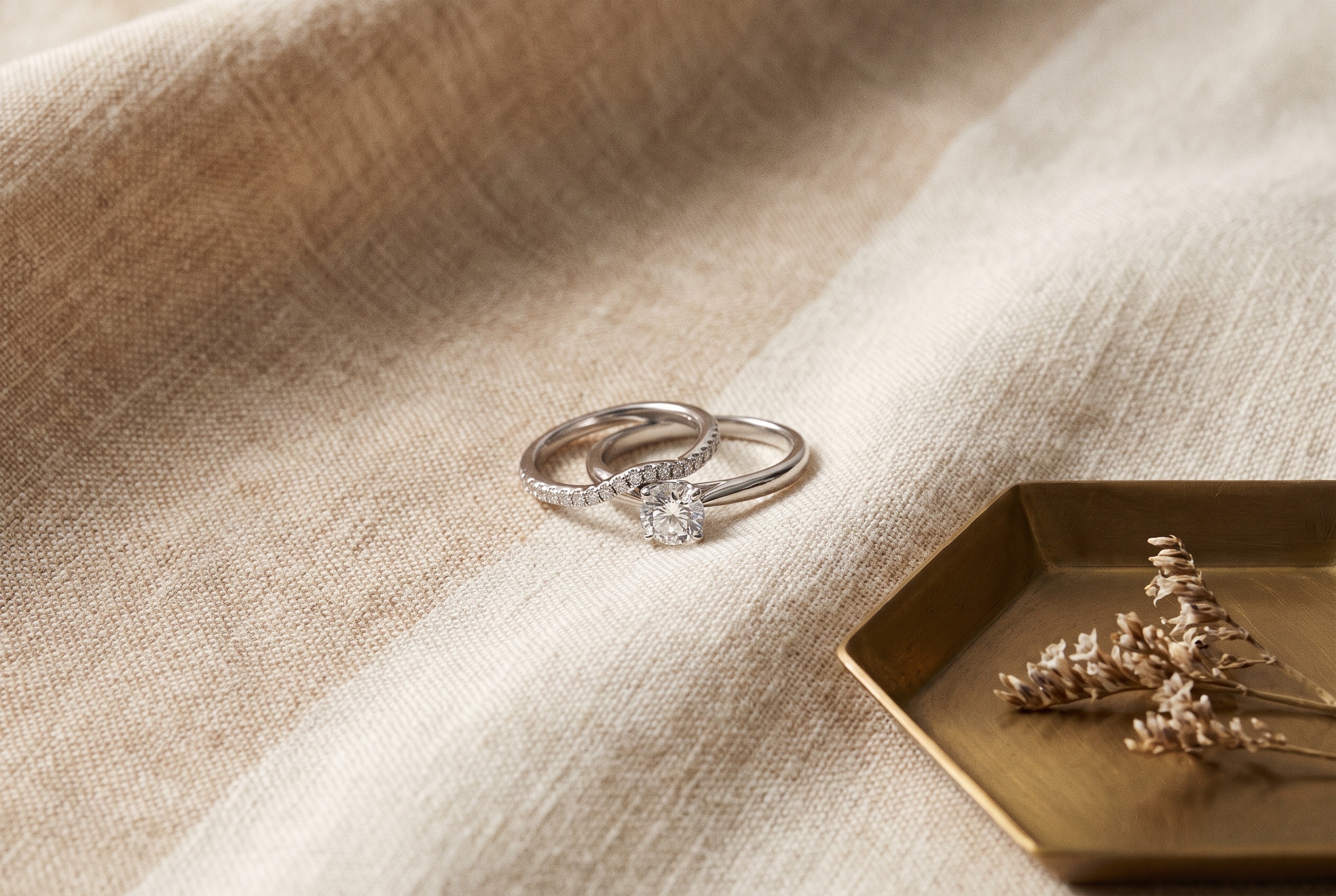
A bridal set is an engagement ring and its matching wedding band, designed and sold together as a coordinated pair rather than as two independently chosen pieces. For a jeweler, sourcing a bridal set is a different problem than sourcing a single engagement ring: the two pieces need to share a metal tone, a stone quality standard, and a design language closely enough that they read as one continuous piece of jewelry when worn stacked, not as two rings that happen to sit next to each other.
This guide is written for the trade — retailers, jewelers, and designers building or expanding a bridal set program — covering what distinguishes a bridal set commercially from a standalone engagement ring, how to plan stone and metal continuity across the two pieces, sizing and fit considerations specific to sets worn stacked, and what to look for in a wholesale supplier for matched-set production.
What Makes a Bridal Set a Distinct Sourcing Category
A standalone engagement ring is sourced and priced as a single decision: one center stone, one setting, one metal. A bridal set adds a second, permanent design constraint — the wedding band has to sit flush against the engagement ring for the rest of the couple's life, which means curve, height, and stone placement on the band have to be engineered specifically around the engagement ring's profile rather than chosen independently. A wedding band that looks fine on its own can gap visibly against a particular engagement ring's prong height or shank curve once the two are worn together.
This has direct sourcing consequences. Retailers selling bridal sets as pre-matched pairs need production capability that treats the two rings as one design unit — cut and fit tested together — rather than pulling a wedding band from a generic band catalog and hoping it happens to sit well against whatever engagement ring a customer picked. Retailers who instead sell the pieces separately and let customers mix and match take on more return and remake risk, since a mismatched fit only becomes obvious once both rings are in hand.
Engagement Ring and Wedding Band Pairing Conventions
| Engagement Ring Style | Band Pairing Convention | Fit Consideration |
|---|---|---|
| Solitaire, prong setting | Straight or slightly curved band | Band clears the prongs without a visible gap at the shank |
| Halo setting | Curved (contour) or straight band | Curved bands hug the halo's outline more closely than a straight band |
| Vintage/milgrain detail | Matching milgrain or filigree band | Detail work needs to continue visually across both pieces, not stop at the engagement ring |
| Three-stone | Straight band, sometimes with side accents | Band width should proportion against the widest point of the three-stone setting |
| Cathedral setting | Curved band matching the raised shank profile | Band curve needs to track the cathedral's arch closely to avoid a visible seam |
Metal and Stone Continuity Across the Set
The two pieces in a bridal set need to match on metal tone and karat closely enough that years of daily wear don't visibly diverge — 14k and 18k gold wear and patina differently, and mixing them within one set produces a visible tone mismatch after a year or two that mixing metals deliberately (as a style choice) does not. Diamonds used as accents on the wedding band should sit at the same color and clarity standard as the engagement ring's side stones or halo, since the two pieces are worn immediately adjacent to each other and any brightness mismatch is far more visible in a bridal set than it would be comparing two rings independently.
Retailers building a bridal set program benefit from sourcing both pieces' diamonds from the same production run rather than pulling the wedding band's accent stones from separate melee inventory reordered at a different time — consistency between the two pieces is the entire commercial premise of selling them as a set rather than as two separate rings.
Sizing and Fit for Sets Worn Stacked
Because a bridal set is worn as two rings on the same finger permanently, fit tolerances are tighter than for a ring worn alone. A wedding band cut with even a slightly different curve than the engagement ring's shank will either gap (leaving a visible sliver of space) or ride up over the engagement ring's prongs, both of which read as a poorly matched set rather than a coordinated pair. Retailers offering true matched-set production typically size and shape-test the wedding band directly against a sample of the specific engagement ring style before finalizing the pairing, rather than assuming a generic curved band will fit any halo or cathedral setting acceptably.
Ring resizing after the wedding — a common request, since finger size can shift between engagement and the wedding date — also needs to preserve the fit relationship between the two pieces. A jeweler resizing only the engagement ring, or only the band, risks reintroducing the same fit mismatch the matched set was designed to avoid; both pieces typically need to be resized together and re-checked against each other.
Popular Bridal Set Styles
Classic Solitaire Sets
A single round or fancy-shape center stone paired with a plain or lightly accented straight band — the highest-volume bridal set style, valued for its versatility and lower per-unit stone cost relative to halo or three-stone sets.
Halo Sets
A center stone surrounded by a circle of smaller diamonds, paired with a curved contour band designed to trace the halo's outline. Halo sets carry more total diamond weight in smaller stones, making calibrated melee consistency a bigger factor in production quality than for a solitaire set.
Vintage-Inspired Sets
Milgrain edging, filigree, and antique-style center stones (old mine or old European cut) paired with a detailed matching band. This category draws heavily on antique-cut inventory and benefits from a supplier who can source and cut antique styles alongside standard modern cuts.
Three-Stone Sets
A center stone flanked by two side stones, paired with a straight or lightly curved band proportioned to the setting's width. Side-stone color and clarity matching to the center stone is a bigger production consideration here than in a solitaire set.
Lab-Grown vs. Natural Diamonds for Bridal Sets
Both lab-grown and natural diamonds are sourced for bridal sets at wholesale, and the origin decision is largely independent of the set's design or fit requirements. CVD lab-grown center stones let a retailer offer a larger carat weight or a halo with more total diamond weight at a given price point, which is a meaningful factor for a category where the center stone is typically the single largest line item in the whole set. Natural stones remain a significant share of bridal set demand, particularly for smaller-carat classic solitaire sets where the price gap between lab-grown and natural is less decisive to the buyer. Both origins can be sourced to the same color, clarity, and cut standard, and either should carry independent certification (IGI, GIA, or GCAL) at typical bridal-set center-stone sizes.
Certification for Bridal Set Center Stones
Center stones in a bridal set — typically 0.50ct and up — are individually certified rather than sold as parcel goods, giving the retailer and the end customer a documented grade to stand behind. IGI, GIA, and GCAL certification are all available depending on customer preference and market; a wholesale supplier offering all three gives a retailer flexibility to match certification to what a given customer base expects, rather than being limited to a single lab. Smaller accent stones on the wedding band itself typically run on a DEF+/VS+ commercial standard as calibrated melee rather than individual certification, consistent with standard melee sourcing practice at those sizes.
Wholesale Pricing Structure for Bridal Sets
Pricing a bridal set at wholesale means pricing two production lines that need to land as one coherent price point to the end customer — the center stone and setting on the engagement ring, plus the band and its accent stones, typically bundled into a single set price rather than sold as two separate line items with separate margins. Retailers benefit from a supplier who can quote the pair together, factoring in any efficiency from producing both pieces in the same production run (shared metal casting, coordinated stone matching) rather than pricing the two rings as if they were unrelated orders.
Building a Bridal Set Program: Inventory Planning
- Anchor styles across price tiers. A well-planned program offers at least one solitaire set, one halo set, and one vintage-style set, spanning a meaningful price range so the program isn't concentrated entirely at one price point.
- Consistent metal tone options. Each anchor style should be available in 14k and 18k, yellow, white, and rose gold, since bridal customers often have a strong metal preference that a limited program can't accommodate.
- Depth on the highest-turnover style. Classic solitaire sets typically carry the highest volume and should be stocked deeper than halo or vintage styles, which sell in lower unit volume but at a higher price point per set.
- A path to full custom. Some bridal customers want a set built around a specific center stone or a personalized detail; a retailer benefits from a supplier who can move from a standing catalog design into a fully custom set without switching vendors.
- Reorder capability for the band alone. Because band-only purchases (from customers who bought the engagement ring earlier and are now completing the set) are common, a program needs to support ordering a matching band on its own, tracked against the original engagement ring's exact specification.
Common Mistakes in Bridal Set Sourcing
- Treating the wedding band as an afterthought. Ordering a generic curved band separately from the engagement ring, rather than having the two pieces engineered and fit-tested together, is the single most common cause of visible gapping once a set is assembled.
- Metal tone drift between production runs. Reordering wedding bands from a different production batch than the matching engagement rings can introduce a subtle tone mismatch that isn't visible until the two rings are compared side by side.
- Underestimating resize demand. Bridal sets are frequently purchased months before the wedding and resized closer to the date; retailers who don't plan for coordinated two-ring resizing risk reintroducing fit problems the original matched-set production solved.
- Inconsistent melee quality between the halo and the band. On halo-style sets especially, accent stones on the band need to match the halo's color and clarity closely enough that the eye doesn't catch a brightness difference moving from one ring to the other.
- No documented specification to reorder against. Without a recorded stone and metal specification tied to the original sale, matching a band reorder months or years later to the exact engagement ring a customer already owns becomes guesswork rather than a reliable process.
Working with Custom Center Stone Selection
A meaningful share of bridal set customers arrive with a specific center stone in mind — a particular shape, a minimum carat weight, or a preference for a fancy color diamond rather than a standard white stone — and expect the retailer to build the set around that stone rather than choosing from a small number of pre-set combinations. This shifts the sourcing problem: instead of stocking finished bridal sets, the retailer needs access to loose certified center stones across a range of shapes and sizes, plus the production capability to build a matching band around whatever stone the customer ultimately selects. A supplier who can move quickly from a loose-stone selection to a finished, fit-tested matched set shortens the timeline on this more customized path considerably compared with a workflow that requires sourcing the stone from one vendor and the setting from another.
Fancy color center stones add an additional matching consideration: the wedding band's accent stones, if any, typically stay white rather than attempting to color-match a fancy colored center stone, since fancy color melee in the exact matching hue is both harder to source consistently and unnecessary — the color contrast between a fancy center stone and white accent diamonds is a standard, well-established look in bridal jewelry rather than a mismatch to correct for.
Seasonal Demand Patterns for Bridal Sets
Bridal set demand follows a fairly predictable annual pattern that retailers can plan inventory and marketing around. Engagement proposals cluster heavily around the November-through-February holiday season, driving a corresponding spike in bridal set browsing and purchase in the following months as newly engaged couples begin planning. A second, smaller demand wave runs through late spring into early summer, tied to the traditional wedding season and to couples finalizing wedding band purchases closer to their ceremony date. Retailers who track these two waves separately — engagement-driven demand for the full set versus wedding-band-only demand from couples who bought an engagement ring earlier and are now adding the band — can plan production and inventory depth more precisely than treating bridal demand as a flat, evenly distributed category throughout the year.
Because full bridal sets often sell during the holiday proposal season while the matching band component alone sells again months later at the actual wedding, retailers benefit from a supplier relationship that supports reordering an exact match to a previously produced engagement ring months or even years after the original sale — not just first-time matched-set production. Losing the ability to precisely match metal tone and stone quality to an earlier purchase is one of the more common service failures in this category, since customers returning for the band component expect it to be indistinguishable from what they would have received had they bought the full set at once.
Presentation and Packaging for Bridal Sets
Because a bridal set represents one of the highest-ticket, highest-emotional-significance purchases in a jewelry retailer's catalog, presentation carries more weight here than for most other categories. Sets are typically boxed and presented as a matched pair — a two-slot presentation box showing both rings together — rather than as two separately wrapped items, reinforcing the set's identity as one coordinated purchase rather than two unrelated rings that happen to be bought at the same time. Retailers sourcing bridal sets at wholesale benefit from a supplier who can supply matched presentation packaging alongside the rings themselves, rather than sourcing generic single-ring boxes and asking store staff to improvise a paired presentation at the point of sale.
Documentation presentation matters similarly: a bridal set typically ships with the center stone's certification (IGI, GIA, or GCAL, depending on what was sourced) presented alongside the set rather than as a separate loose document handed over independently, giving the end customer a complete, retail-ready package rather than a ring plus a certificate that arrives disconnected from the purchase experience.
Comparing Bridal Sets to Related Categories
Bridal sets sit alongside several related categories retailers frequently cross-merchandise. Our cathedral setting guide covers a setting style commonly paired into bridal sets, with specific fit considerations for a matching curved band. For couples specifically comparing a bridal set against a broader matching-bands option that doesn't center on an engagement ring, see our diamond wedding set guide, which covers his-and-hers and couple's matching band programs as a distinct category from the bride's engagement-ring-plus-band set covered here. Retailers building out a full bridal category also commonly stock promise rings as an earlier-stage product in the same customer journey.
Sourcing a Bridal Set Program at Wholesale
Guru Diam supplies certified natural and CVD lab-grown center stones alongside calibrated melee for accent work, with cutting, setting, and polishing all handled in-house — giving retailers a single source for engineering an engagement ring and its matching band together rather than coordinating separate vendors for each piece. IGI, GIA, and GCAL certification are all available on eligible center stones. Retailers can browse certified stones through certified diamonds, review matched-pair and calibrated melee inventory through matching pairs, and work through custom jewelry for a fully bespoke bridal set, with finished sets delivered in 4-6 days. Trade accounts can review terms at the wholesale hub or apply through trade partner.
Frequently Asked Questions
What is the difference between a bridal set and an engagement ring?
An engagement ring is a single piece, sold and worn on its own until a wedding band is added later. A bridal set is the engagement ring and its matching wedding band, designed and produced together as a coordinated pair from the start, with the band's curve and stone placement engineered specifically to fit that engagement ring.
Do bridal set wedding bands have to be curved?
Not always — it depends on the engagement ring's setting. Halo and cathedral settings typically pair with a curved contour band that traces the setting's outline, while solitaire and three-stone settings often pair well with a straight band. The right choice comes down to matching the specific profile of the engagement ring.
Should bridal set diamonds be lab-grown or natural?
Both are commonly sourced for bridal sets. Lab-grown center stones let a retailer offer a larger carat weight at a given price point, while natural stones remain popular, particularly for smaller classic solitaire sets. Either can be sourced to the same color, clarity, and certification standard.
How is a bridal set priced at wholesale?
Typically as a bundled set price covering both the center stone and setting on the engagement ring and the band with its accent stones, rather than as two separately priced rings — reflecting that the two pieces are engineered and produced together.
Why does a wedding band need to be fit-tested against the engagement ring?
Because the two pieces are worn stacked permanently, even a small mismatch in curve or height between the band and the engagement ring's shank shows up as a visible gap or an uneven sit. Fit-testing the band against the specific engagement ring style before production avoids this.
Can a bridal set be resized after purchase?
Yes, but both rings typically need to be resized together and re-checked against each other, since resizing only one piece can reintroduce the same fit mismatch the original matched-set production was designed to solve.
Can a wedding band be reordered later to match an existing engagement ring?
Yes, when the original engagement ring's exact metal, karat, and stone specification was documented at the time of the first sale. A supplier who retains that specification can produce a closely matching band months or years later; without it, matching metal tone and stone quality to a ring already in the customer's possession is considerably harder.