
Diamond ranks 10 on the Mohs hardness scale, the highest of any naturally occurring or lab-grown material, meaning no other mineral can scratch its surface. Hardness measures resistance to scratching specifically — not resistance to chipping, cracking, or breaking, which are governed by a different property called toughness. That distinction matters more than the "10" itself for anyone buying, setting, or caring for a diamond, and it's the thread running through this guide.
"Diamonds are the hardest natural substance on Earth" is one of the most repeated facts in the industry, and also one of the most commonly misunderstood, because hardness gets casually equated with "indestructible" when the two aren't the same thing at all. A diamond can resist a knife blade indefinitely and still chip if struck at the wrong angle against a hard surface. This guide covers what the Mohs scale actually measures, where diamond sits relative to every other gemstone and to moissanite specifically, why hardness is a linear-looking scale that behaves nothing like a linear one, what hardness means for everyday wear and setting choices, and how CVD lab-grown diamond compares to natural on this exact property.
What the Mohs Scale Actually Measures
The Mohs scale, developed by German mineralogist Friedrich Mohs in 1812, ranks minerals from 1 to 10 based on a simple physical test: which minerals can scratch which others. A mineral higher on the scale can scratch anything lower, and nothing lower can scratch it. It's a comparative, ordinal ranking rather than a scale of proportional units — a 4 isn't "twice as hard" as a 2, and the gaps between adjacent numbers aren't equal, which is a detail that trips people up when they picture the scale as a smooth, evenly spaced ladder rather than what it actually is.
The scale's ten reference minerals, from softest to hardest: talc (1), gypsum (2), calcite (3), fluorite (4), apatite (5), orthoclase feldspar (6), quartz (7), topaz (8), corundum — the mineral family that includes ruby and sapphire (9), and diamond (10). Everyday reference points fall inside this range too: a fingernail is roughly 2.5, a copper coin around 3.5, a steel knife blade around 5.5, and window glass around 5.5-6.
Diamond Hardness vs. the Mohs Scale: Comparison Table
| Material | Mohs Hardness | Can Scratch Diamond? | Common Context |
|---|---|---|---|
| Talc | 1 | No | Softest mineral reference point |
| Fingernail | ~2.5 | No | Everyday reference |
| Copper coin | ~3.5 | No | Everyday reference |
| Steel knife blade | ~5.5 | No | Common misconception — a knife cannot scratch a diamond |
| Glass / quartz | ~5.5-7 | No | Household surfaces |
| Topaz | 8 | No | Popular colored gemstone |
| Moissanite | 9.25 | No | Most common diamond simulant, second-hardest gem material sold at scale |
| Corundum (ruby, sapphire) | 9 | No | Second-hardest natural mineral family |
| Diamond | 10 | Yes (only another diamond) | Hardest known natural material |
The Scale Isn't Linear — Here's What That Actually Means
The single most important nuance in this topic: the jump from 9 to 10 is dramatically larger than the jump from, say, 1 to 2. Various hardness studies using absolute (rather than ordinal) measurement methods put diamond at roughly four times harder than corundum (ruby and sapphire, at 9), even though they sit only one point apart on the Mohs scale. That's why "diamond is a 10 and sapphire is a 9" understates the real gap between them by a wide margin — the Mohs scale tells you the scratch-resistance order correctly, but it badly compresses how much harder the top of the scale actually is compared to the middle.
This is also why moissanite, at 9.25, reads as "almost as hard as diamond" on paper but is meaningfully softer in absolute terms — close enough to hold up well in daily-wear jewelry, but genuinely behind diamond rather than a rounding error apart from it.
Hardness vs. Toughness vs. Durability: Three Different Properties
This is where most confusion about diamond durability actually originates, and it's worth being precise about the three terms:
- Hardness — resistance to scratching. Diamond's 10 on Mohs describes this property specifically, and only this property.
- Toughness — resistance to chipping or breaking from an impact or a sharp blow. Diamond is actually only rated "good" to "excellent" on toughness, not the best of all gem materials — jadeite, for example, is tougher than diamond despite being far softer, because toughness depends on a material's internal structure and how it absorbs impact energy, not on hardness at all.
- Durability — the practical, everyday combination of hardness, toughness, and stability (resistance to heat, light, and chemical exposure) that determines how well a stone holds up in daily wear. Diamond's overall durability is exceptional precisely because it scores well across all three properties, not because hardness alone makes it indestructible.
The practical consequence: a diamond will not scratch from contact with virtually anything in daily life, but it can still chip if struck directly on a facet edge or girdle against a hard surface at the wrong angle — a countertop corner, a hard tile floor, another hard gem. This is precisely why prong design and setting choice matter even on the hardest gem material in existence; hardness protects against scratching, not against a hard knock.
Why Hardness Matters for Everyday Wear
A diamond's 10 rating is what makes it possible to wear a ring daily for decades without the stone's facets dulling or losing their polish — nothing a diamond encounters in ordinary life (dust, sand, other jewelry, most surfaces) is hard enough to scratch it. This is a genuine, practical advantage over softer gemstones: a sapphire ring worn daily can pick up fine surface scratches over years from contact with household grit and dust (which contains quartz, at 7, hard enough to scratch a 9); a diamond in the same conditions will not. It's also why diamond retains its polish and brilliance over a lifetime of wear better than nearly any other gem material used in fine jewelry.
Hardness is also directly relevant to why diamond is the standard cutting and polishing medium for diamond itself — only diamond is hard enough to cut, facet, and polish another diamond, which is part of why the cutting process is a specialized, capital-intensive step in the supply chain rather than something any lapidary can do with generic equipment.
Diamond vs. Moissanite Hardness: What It Means for Buyers
Moissanite is the closest hardness competitor to diamond among common diamond simulants and alternatives, sitting at 9.25 versus diamond's 10 — high enough that moissanite genuinely holds up well to daily wear and resists scratching from almost everything except diamond itself. For a buyer choosing between the two, the hardness gap is real but narrower in practice than the two-point gap between moissanite and the next tier down (topaz, cubic zirconia at roughly 8-8.5). Where the two materials diverge more meaningfully is in optical properties (moissanite's higher refractive index gives it a different, more colorful sparkle pattern than diamond's brilliance) and in what each represents to a buyer — natural formation and rarity for diamond versus a lab-created simulant for moissanite. See our cubic zirconia vs. diamond guide and simulated diamond vs. lab-grown guide for the fuller comparisons.
Does CVD Lab-Grown Diamond Have the Same Hardness as Natural?
Yes — CVD lab-grown diamond is chemically and structurally identical carbon, and it scores the same 10 on the Mohs scale as natural diamond. Hardness, along with every other physical and optical property, is a function of the crystal structure itself, not of how or where that structure formed. A trained gemologist needs specialized equipment (not a hardness test) to distinguish lab-grown from natural, precisely because the two are the same material at the atomic level. This is a genuinely useful fact for wholesale buyers positioning lab-grown inventory: durability and hardness claims apply identically whether the stone in the case is CVD or natural, so there's no durability tradeoff being made by a customer who chooses lab-grown for value reasons.
Hardness and Setting Choice
Because diamond's hardness protects it from scratching but not from a direct chip on impact, setting design is where a jeweler's craftsmanship actually protects the stone in daily wear. Prong settings that leave the girdle and facet edges slightly exposed carry more chip risk at the edges than bezel settings that fully surround the stone's perimeter, which is one reason bezel settings are recommended for customers with active hands-on lifestyles even though the stone's hardness rating is identical either way. Point and edge protection — rounding sharp culet points, avoiding excessively thin girdles on fancy shapes like pear and marquise, which concentrate stress at the points — is a cutting and setting consideration that exists specifically because toughness, not hardness, is the limiting factor for chip resistance.
Hardness Across Fancy Shapes
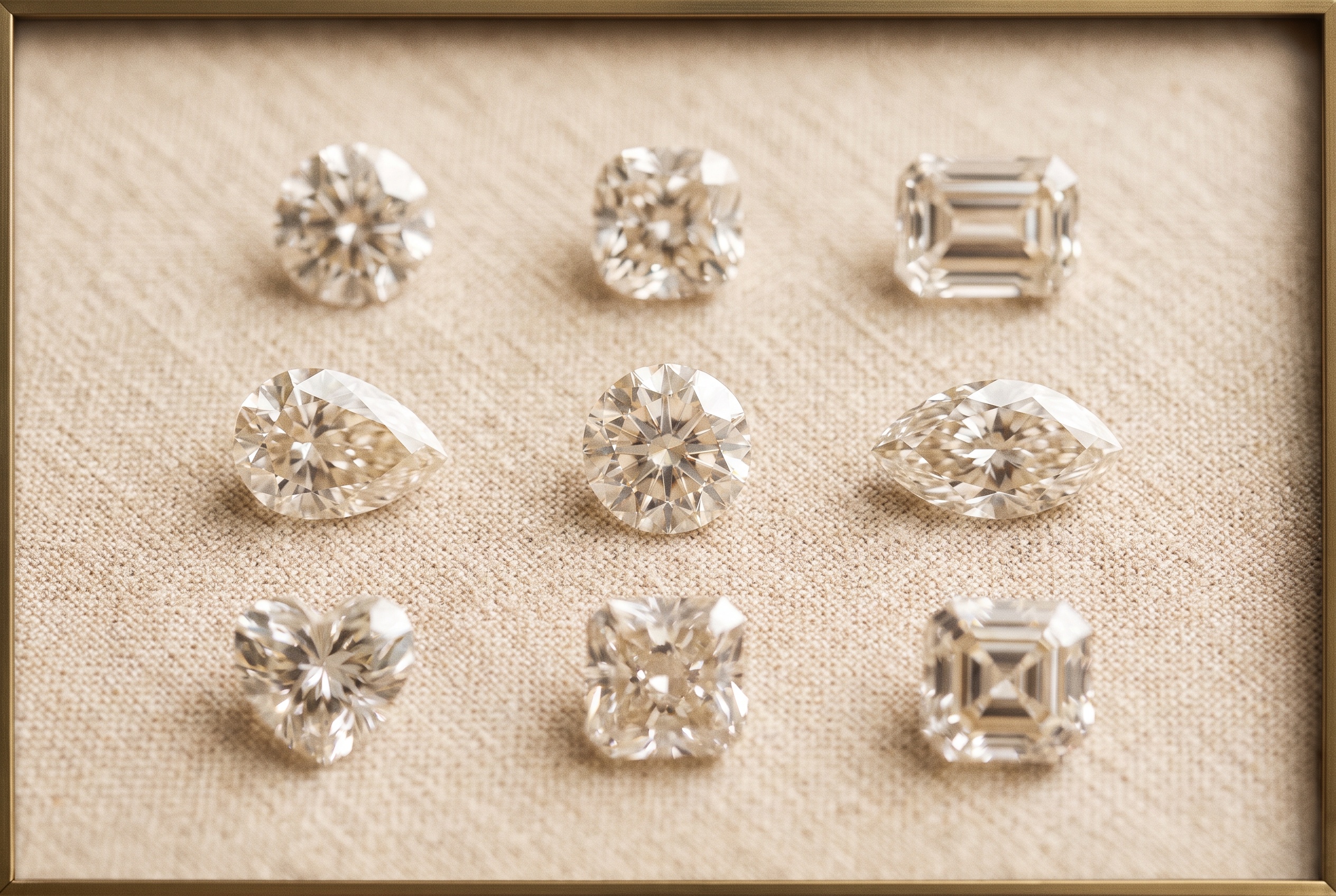
Hardness itself doesn't vary by shape — a round brilliant and a marquise cut from the same rough have identical Mohs hardness — but chip vulnerability does vary by shape because of where stress concentrates geometrically. Pointed shapes (marquise, pear, heart) carry more risk at their tips than round or cushion shapes, not because the diamond is less hard at the point but because a thin point has less material to absorb an impact before it chips. This is a toughness-and-geometry effect layered on top of a hardness property that's constant across every shape.
What Hardness Means for Cleaning and Care
Diamond's hardness is also the reason it's one of the easier gemstones to clean safely at home. Because nothing short of another diamond can scratch its surface, mechanical cleaning methods that would be too aggressive for softer stones — a soft-bristled brush, an ultrasonic cleaner, gentle abrasive contact during polishing — pose no risk of surface damage to the diamond itself. The caution that does apply is about the setting, not the stone: repeated ultrasonic cleaning can loosen prongs or worsen existing fractures near a stone's girdle over time, and certain porous or treated stones (not standard CVD or natural diamond) can be damaged by heat or chemical exposure. For a standard diamond in a well-maintained setting, routine warm water, mild dish soap, and a soft brush is sufficient, and the diamond's hardness is exactly why that simple routine works reliably over decades of wear without dulling the stone's polish. This is a genuinely useful differentiator to mention to retail-facing customers comparing diamond to softer alternatives like opal, pearl, or emerald, all of which require materially more careful handling specifically because they rank much lower on the Mohs scale or, in emerald's case, carry inherent internal fractures that heighten the risk from ultrasonic cleaning regardless of hardness.
Common Misconceptions About Diamond Hardness
- "Diamonds can't break." False — hardness protects against scratching, not impact. A hard, direct blow at the wrong angle can chip or, in rare cases, fracture a diamond.
- "A diamond can scratch anything, including another diamond, easily." True only for another diamond — this is in fact how diamonds are cut and polished (diamond powder and diamond-tipped tools are the only abrasives hard enough to shape a diamond), but nothing else in daily life will scratch one at all.
- "Moissanite and diamond are basically the same hardness so it doesn't matter which you buy." The two are close (9.25 vs. 10) but the top of the Mohs scale compresses real differences — diamond is meaningfully harder in absolute terms than the one-point gap suggests.
- "A scratch test is a reliable way to identify a real diamond." Scratch tests are unreliable and can damage a stone or the surface being tested; gemological identification relies on refractive index, thermal conductivity, and other properties measured with proper equipment, never a DIY scratch.
- "Harder gemstones are always more valuable." Hardness and value aren't linked that directly — sapphire and ruby (9 on Mohs) can carry substantial value driven by color, rarity, and origin despite ranking below diamond, while a low-grade, heavily included diamond can be worth very little despite sharing diamond's hardness with every top-tier stone in the category.
How the Mohs Scale Was Developed
Friedrich Mohs, an Austrian mineralogist, introduced the scale in 1812 as a practical field tool for geologists and mineral collectors who needed a fast way to identify a mineral without laboratory equipment. He selected ten reference minerals spanning from very soft (talc) to the hardest known material at the time (diamond) and defined each mineral's hardness purely by what it could and couldn't scratch relative to the others on the list. The scale was never intended to be a precise, evenly spaced measurement system — Mohs picked minerals that were common and easy to obtain as reference samples, not minerals spaced at mathematically equal hardness intervals — which is exactly why the gap between 9 and 10 turned out, once later absolute-hardness testing methods existed, to be so much larger than the gap between any other two adjacent numbers on the scale. Modern mineralogy still uses the Mohs scale today, more than two centuries later, specifically because its simplicity and field-testability outweigh its lack of precision for most practical identification purposes.
Modern Hardness Testing Methods Beyond Mohs
Gemological and materials-science labs today have more precise tools than a scratch-based ranking, chiefly the Vickers and Knoop hardness tests, which measure resistance to indentation by pressing a diamond-tipped point into a material's surface under controlled load and measuring the resulting indentation size. These absolute-scale tests are what revealed just how much harder diamond actually is than corundum in real terms, rather than the one-point gap the Mohs ranking implies. In practice, gemologists identifying a stone in a retail or grading-lab setting don't run a hardness test at all — hardness is far too crude and potentially damaging a property to use for identification. Instead, labs rely on refractive index, dispersion, thermal conductivity, and spectroscopic analysis, all of which distinguish diamond from simulants like moissanite or cubic zirconia without touching the stone's surface. A scratch test performed casually at home is unreliable and risks damaging both the stone being tested and the surface used to test it, and reputable sellers and appraisers never rely on one.
Why Hardness Doesn't Affect Insurance Appraisal or Resale Value
Because every diamond — lab-grown or natural, any shape, any grade — shares the identical Mohs-10 hardness, hardness itself never appears as a variable in an insurance appraisal or a resale valuation. Appraisers and buyers focus instead on the 4Cs (carat, cut, color, clarity), certification, and, for natural stones, provenance — none of which hardness has any bearing on. This is worth knowing specifically because hardness is such a frequently cited fact in diamond marketing that buyers sometimes assume it correlates with value the way carat weight or clarity grade does; it doesn't, since it's a constant across the entire category rather than a variable that differentiates one diamond from another.
Sourcing Diamonds for Durability-Focused Programs
Wholesale buyers building programs around everyday-wear categories — stackable rings, tennis bracelets, men's pieces meant for daily use — benefit from understanding that hardness is a constant across every diamond in inventory, lab-grown or natural, so durability messaging doesn't need to differentiate by stone origin. What does vary, and what's worth sourcing carefully for, is cut quality and setting design, since those govern the toughness side of the durability equation that hardness alone doesn't cover.
Sourcing Diamonds Through Guru Diam
Guru Diam supplies CVD lab-grown and natural diamonds across standard, antique, and exotic shapes, all IGI, GIA, or GCAL certifiable, with the same Mohs-10 hardness and identical durability properties across both stone types — one supplier for both, rather than sourcing lab-grown from one vendor and natural from another. Loose stones ship same-day from in-stock inventory out of the New York and Los Angeles offices, and custom jewelry orders are cut, set, and polished in-house. Browse certified diamonds for loose inventory, or explore the wholesale hub for the full catalog. Trade accounts can review terms at the trade partner page, and custom builds start at custom jewelry. For buyers weighing durability against price directly, our lab-grown diamond vs. moissanite guide and 4Cs of diamonds guide cover the adjacent grading and comparison questions this hardness explainer doesn't.
Frequently Asked Questions
What is diamond's rating on the Mohs hardness scale?
Diamond rates 10, the highest possible score, meaning no other mineral — natural or synthetic — can scratch its surface. Only another diamond is hard enough to scratch a diamond.
Can a diamond scratch or chip?
A diamond cannot be scratched by anything except another diamond, but it can still chip from a hard, direct impact at the wrong angle. Scratch resistance (hardness) and chip resistance (toughness) are two different properties, and diamond's high hardness doesn't make it immune to chipping.
Is moissanite as hard as diamond?
Moissanite rates 9.25 on the Mohs scale, close to diamond's 10 but meaningfully softer in absolute terms, since the top of the Mohs scale compresses real hardness differences. Moissanite still holds up well to daily wear, but diamond remains harder.
Do CVD lab-grown diamonds have the same hardness as natural diamonds?
Yes. Lab-grown and natural diamonds are chemically and structurally identical carbon, so they share the same Mohs-10 hardness and every other physical property. There is no durability difference based on origin.
Why can a diamond chip if nothing can scratch it?
Hardness measures resistance to scratching, while chip resistance depends on toughness — how well a material absorbs sudden impact. Diamond scores very high on hardness but only good to excellent on toughness, so a direct blow at a facet edge or girdle can still chip the stone.
What everyday materials rank near diamond on the Mohs scale?
Nothing ranks close. Corundum (ruby and sapphire) at 9 and moissanite at 9.25 are the nearest common materials, and even those are meaningfully softer than diamond's 10 once measured in absolute rather than ordinal terms.
Does hardness affect a diamond's price or appraisal value?
No. Every diamond shares the same Mohs-10 hardness regardless of shape, origin, or grade, so it never functions as a variable in pricing or appraisal the way carat, cut, color, and clarity do. Hardness is a constant across the category, not a differentiator within it.