
Cubic zirconia (CZ) is a synthetic, diamond-simulant crystal made of zirconium dioxide — chemically and structurally nothing like a diamond, despite a superficially similar clear, sparkling appearance. The core distinction is simple: a diamond is pure crystallized carbon, natural or lab-grown, while cubic zirconia is a lab-manufactured substitute engineered specifically to visually resemble a diamond at a fraction of the cost, without sharing any of a diamond's underlying material properties.
What Cubic Zirconia Actually Is
Cubic zirconia was first commercially produced in the 1970s by Soviet scientists and quickly became the dominant diamond simulant in jewelry, largely displacing older simulants like synthetic spinel and strontium titanate due to its closer visual match to diamond and lower production cost. CZ is grown from zirconium dioxide powder melted at extremely high temperatures and cooled into a cubic crystal structure — a process entirely distinct from either natural diamond formation or the CVD/HPHT processes used to grow lab-grown diamonds, which crystallize actual carbon rather than a different mineral compound altogether.
The Core Difference: Simulant vs. Lab-Grown Diamond
This is the single most important distinction for buyers to understand, since the terminology gets confused constantly in casual conversation and even in some retail marketing. A lab-grown diamond is a real diamond — chemically identical carbon, grown in a controlled lab environment rather than mined from the earth, verifiable as a genuine diamond by any gemological lab. Cubic zirconia is a diamond simulant — a different material entirely, designed to look similar but never claiming or intended to be an actual diamond. Reputable retailers are always clear about this distinction; it only becomes a problem when a simulant is misrepresented as a genuine diamond, which is a serious, generally fraudulent, practice.
| Property | Diamond | Cubic Zirconia |
|---|---|---|
| Composition | Pure carbon | Zirconium dioxide |
| Hardness (Mohs scale) | 10 (hardest known natural material) | 8–8.5 |
| Refractive index | 2.42 | 2.15–2.18 |
| Dispersion (fire) | 0.044 | 0.058–0.066 (higher, often reads as more "flashy") |
| Relative cost | Highest | Lowest — a fraction of even lab-grown diamond cost |
| Longevity of finish | Never dulls, resists scratching indefinitely | Clouds and scratches with wear over months to years |
Hardness and Durability: Why It Matters for Everyday Wear
Diamond's hardness of 10 on the Mohs scale makes it essentially scratch-proof in any normal wear scenario — nothing a diamond encounters in daily life, including dust and grit that scratch nearly everything else, can mark its surface. Cubic zirconia, at 8 to 8.5 on the same scale, is considerably softer and will show scratching and surface wear over time from ordinary daily contact with countertops, other jewelry, and airborne grit. This isn't a subtle difference in practice: a CZ ring worn daily for a few years will typically show visible surface dulling and micro-scratching that noticeably reduces its sparkle, while a diamond of any age shows none of this deterioration regardless of how long or how roughly it's worn.
Brilliance and Fire: How the Optical Properties Actually Compare
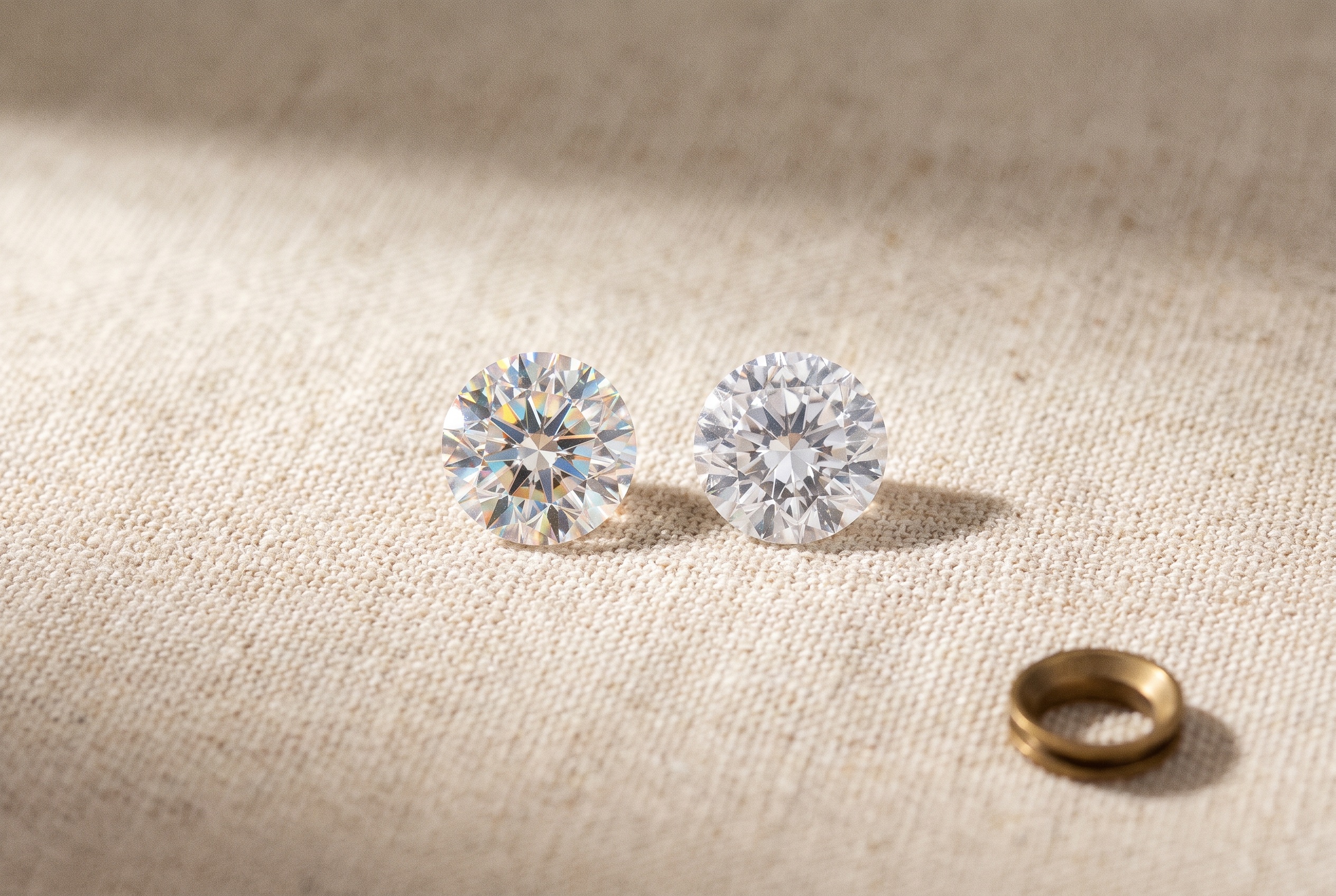
Diamond and cubic zirconia produce genuinely different visual effects due to their different optical properties, though describing one as simply "better" oversimplifies a real tradeoff. Diamond's refractive index and specific dispersion produce a balanced mix of brilliance (white light return) and fire (colored light flashes) that reads as bright and lively without looking artificial. Cubic zirconia's higher dispersion actually produces more colored fire than a diamond does — which sounds like an advantage on paper but in practice often reads as excessive, rainbow-colored flashiness that experienced jewelers and gemologists can spot immediately as a simulant precisely because it "sparkles too much" and too colorfully compared to a genuine diamond's more restrained, balanced light performance.
How to Tell Cubic Zirconia and Diamond Apart
The Fog Test
Breathing on the stone briefly causes it to fog up. A diamond, due to its exceptional thermal conductivity, disperses that heat and clears almost instantly. Cubic zirconia retains the fog noticeably longer, since it conducts heat far less efficiently. This is a quick, informal home test, though not a substitute for professional verification on any stone of real or claimed significant value.
Weight Comparison
Cubic zirconia is notably denser than diamond, meaning a CZ cut to the same visual dimensions as a diamond will weigh meaningfully more. A jeweler with a precise scale and known reference weights for a given millimeter size can often identify a CZ this way, since it will weigh heavier than a genuine diamond of the same apparent size.
Professional Gemological Testing
A thermal diamond tester — a handheld device measuring thermal conductivity — is the fastest, most reliable way to distinguish diamond from cubic zirconia, since diamond's thermal conductivity is dramatically higher than any common simulant's. This is standard equipment at any jewelry store or gemological lab and provides a conclusive answer in seconds, unlike the more approximate home tests above, and it's the method any buyer should insist on before relying on a purchase decision involving a stone of meaningful claimed value.
Color and Clarity: Does Cubic Zirconia Have a Grading System?
Cubic zirconia is manufactured, not mined, which means color and clarity are controlled through the production process rather than sorted from naturally variable rough — most commercial CZ is produced essentially colorless and flawless by design, since there's no manufacturing incentive to intentionally introduce color or inclusions the way nature does in diamond formation. This is a meaningful practical difference from diamond grading: a diamond's color and clarity grade reflects genuine, naturally occurring variation that a grading lab evaluates and documents, while cubic zirconia's near-uniform colorless, flawless appearance is simply a byproduct of controlled synthetic manufacturing, not a graded achievement. Some manufacturers do produce colored cubic zirconia (to simulate fancy color diamonds or other colored gemstones), but this represents a smaller segment of overall CZ production than the colorless, diamond-simulant mainstream.
Manufacturing Process: How Cubic Zirconia Is Actually Made
Cubic zirconia is produced using a skull melting process, in which zirconium oxide powder is heated to extremely high temperatures (around 2750°C) inside a water-cooled copper container — the "skull" — until it melts, then cooled in a controlled way that allows large, clear crystals to form. This process is considerably faster and less resource-intensive than either natural diamond formation (which takes geological time under intense heat and pressure deep in the earth) or lab-grown diamond production (which uses CVD or HPHT methods to crystallize actual carbon over a period of weeks), which is a major reason cubic zirconia can be produced and sold at such a dramatically lower cost than any genuine diamond, natural or lab-grown.
Cost Comparison: Cubic Zirconia, Lab-Grown, and Natural Diamond
| Stone Type | Relative Cost per Carat-Equivalent Size | Real Diamond? |
|---|---|---|
| Cubic zirconia | Lowest — often under $50 total regardless of apparent size | No — simulant |
| CVD lab-grown diamond | Moderate — meaningfully below natural, but a real diamond price point | Yes |
| Natural diamond | Highest | Yes |
This cost gap is the entire commercial logic behind cubic zirconia's continued popularity: it offers a diamond-like look at a price point orders of magnitude below even the most affordable genuine diamond, natural or lab-grown. For buyers who understand and accept that they're purchasing a simulant rather than a real diamond — for costume jewelry, fashion pieces, or placeholder rings, for instance — CZ remains a legitimate, honestly marketed product category. The concern arises only when a CZ is sold or represented as a genuine diamond, which is a different issue entirely from CZ's legitimate use as an intentionally chosen, clearly disclosed simulant.
Cubic Zirconia vs. Moissanite: A Related but Distinct Comparison
Cubic zirconia is often discussed alongside moissanite, another popular diamond simulant, though the two differ meaningfully from each other as well. Moissanite (silicon carbide) is considerably harder than cubic zirconia — 9.25 on the Mohs scale versus CZ's 8 to 8.5 — giving it noticeably better long-term durability and scratch resistance, closer to (though still below) diamond's hardness. Moissanite also carries a higher price point than cubic zirconia, positioning it as a mid-tier simulant option between CZ's rock-bottom pricing and a genuine diamond's cost. Buyers choosing between the two simulants should weigh CZ's lower upfront cost against moissanite's better long-term wear performance.
Longevity and Long-Term Value
Because cubic zirconia degrades visually over time due to its lower hardness, it functions essentially as a consumable, replaceable component rather than a long-term investment piece — a CZ center stone in a ring is commonly expected to be swapped out every few years as its surface dulls from wear, whereas a diamond in the same setting requires no such replacement over a lifetime of normal wear. This has a real practical implication for anyone purchasing a piece intended for decades of use, such as a wedding or engagement ring: cubic zirconia's low upfront cost comes with an ongoing maintenance and eventual replacement cost that a genuine diamond, lab-grown or natural, doesn't carry.
Why Some Buyers Choose Cubic Zirconia Anyway
Beyond simple cost savings, cubic zirconia serves several legitimate, well-understood purposes in the jewelry market: as a stand-in stone for travel (avoiding the risk of wearing a valuable diamond piece while traveling), as a placeholder in a setting while a customer saves toward or waits for a genuine diamond upgrade, as an intentionally affordable choice for costume and fashion jewelry not meant to carry long-term value, and as a practice or sample stone used by jewelers and designers to show a client how a setting will look before committing to a genuine diamond purchase. None of these use cases involve misrepresenting the stone — they're all legitimate applications of CZ's actual value proposition: diamond-like appearance at negligible cost.
Historical Context: Why Cubic Zirconia Displaced Earlier Diamond Simulants
Before cubic zirconia's commercial introduction in the late 1970s, the jewelry industry relied on a series of earlier diamond simulants, each with notable visual shortcomings compared to CZ. Synthetic rutile, popular in the mid-20th century, had excessive dispersion that made it look distinctly yellowish and overly fiery compared to diamond. Synthetic spinel and strontium titanate each had their own optical mismatches — spinel's refractive index ran too low to convincingly mimic diamond's brilliance, while strontium titanate, though closer on refractive index, was extremely soft and scratched easily even by the standards of a simulant. Cubic zirconia's combination of a refractive index reasonably close to diamond's, respectable (if excessive) dispersion, and meaningfully better hardness than its predecessors made it the clear commercial winner once production scaled up, and it has remained the dominant mass-market diamond simulant for roughly five decades since, a remarkably long commercial run for a synthetic gem material in an industry that has otherwise seen rapid innovation, including the more recent rise of lab-grown diamonds as a genuine-diamond alternative to simulants altogether.
Cubic Zirconia in Costume and Fashion Jewelry
Beyond its role as a diamond stand-in, cubic zirconia has developed its own substantial identity within costume and fashion jewelry, where buyers are shopping specifically for an affordable, replaceable, trend-driven piece rather than any kind of diamond alternative at all. In this context, CZ isn't positioned as a "lesser" choice relative to diamond — it's the appropriate, cost-effective material for jewelry designed to be worn heavily for a season or two and then replaced as trends shift, a use case where a genuine diamond's durability and long-term value would be wasted rather than an advantage. Fashion and costume jewelry designers frequently choose CZ specifically for this reason: it lets them execute bold, of-the-moment designs at a price point that matches the piece's realistic wear lifespan.
Setting Cubic Zirconia vs. Diamond: Does It Matter for a Jeweler?
From a bench jeweler's perspective, setting cubic zirconia is generally easier and more forgiving than setting a diamond, precisely because of CZ's lower cost — a small chip or setting mishap on a CZ stone is a minor, inexpensive loss, while the same mishap on a diamond, particularly a larger or higher-grade one, carries real financial consequences that require more careful, deliberate bench work. This difference in stakes is part of why CZ is commonly used as a practice stone for apprentice jewelers learning setting techniques, and why some jewelers use a CZ stand-in stone during initial ring sizing or setting trial fittings before the client's actual diamond is set into the finished piece.
Retail and Disclosure Considerations
Reputable jewelers and retailers are always explicit about whether a stone is a genuine diamond or a simulant like cubic zirconia — this is both an ethical baseline and, in most jurisdictions, a legal disclosure requirement under consumer protection and trade regulations governing gemstone representation. Buyers should expect and request clear, written documentation of exactly what they're purchasing, and should be wary of any listing or seller using ambiguous language ("diamond-look," "diamond alternative," or similar) without clearly stating the actual material, since that kind of vague framing is sometimes used deliberately to blur the distinction for buyers who aren't paying close attention.
Resale and Insurance Considerations
The gap between cubic zirconia and genuine diamond becomes especially clear in resale and insurance contexts. Cubic zirconia has essentially no meaningful resale value — it's a mass-produced synthetic material with negligible material cost, so a used CZ piece is worth little beyond its metal content once melted down. A genuine diamond, lab-grown or natural, retains real material value that can be documented, appraised, and insured, and a lab-grown diamond specifically holds meaningfully more resale value than cubic zirconia despite also being lab-produced, because it remains a genuine diamond with real, tradeable market value rather than a simulant. Buyers purchasing a significant piece of jewelry as a long-term asset, not just a decorative item, should weigh this difference carefully — insurance policies for fine jewelry generally require documentation of genuine gemstone material, and a policy written against a CZ piece will reflect its minimal replacement cost rather than anything resembling diamond insurance value, which is an important distinction for anyone assuming a "diamond-look" piece carries diamond-equivalent coverage without checking the actual policy terms.
Environmental and Ethical Considerations
Cubic zirconia's synthetic, mineral-based production process avoids the ethical sourcing concerns historically associated with some natural diamond mining, similar to the argument often made for lab-grown diamonds — though CZ and lab-grown diamond arrive at that outcome through entirely different means. Lab-grown diamonds are genuine diamonds produced in a controlled facility rather than mined, giving an ethically-minded buyer a real diamond without mining-related concerns. Cubic zirconia sidesteps the same concerns simply by not being a diamond at all, which is a meaningfully different value proposition for a buyer who specifically wants to own a genuine diamond (for its rarity, durability, and cultural significance) rather than a lower-cost alternative that happens to look similar. Neither choice is inherently more or less ethical in absolute terms — they simply serve different buyer priorities, and a buyer's own values around ownership, permanence, and material authenticity should drive the decision more than any blanket claim that one option is universally the "responsible" choice.
Practical Guidance for Buyers Choosing Between the Two
- Choose cubic zirconia for costume jewelry, travel stand-ins, placeholder settings, or any use case where diamond-like appearance matters more than long-term durability or genuine diamond ownership.
- Choose a lab-grown diamond for a genuine diamond at a meaningfully lower cost than natural material, with none of CZ's durability or long-term dulling concerns.
- Always request clear written documentation of exactly what material you're purchasing, regardless of which option you choose.
- Budget for eventual replacement if choosing cubic zirconia for a long-term-wear piece, since its surface will dull and scratch over years of regular use in a way a real diamond never will.
Frequently Asked Questions
Is cubic zirconia a fake diamond?
Cubic zirconia is a diamond simulant — a genuinely different material (zirconium dioxide) engineered to visually resemble diamond, not a fake or fraudulent diamond in itself. It only becomes a problem when misrepresented and sold as a genuine diamond.
Can you tell the difference between cubic zirconia and a real diamond?
Yes, reliably, with professional testing — a thermal diamond tester measures thermal conductivity and gives a conclusive answer in seconds, since diamond conducts heat dramatically better than cubic zirconia. Informal tests (fogging, weight) can offer clues but aren't fully conclusive on their own.
Does cubic zirconia scratch easily?
More easily than a diamond, yes. At 8 to 8.5 on the Mohs hardness scale versus diamond's 10, cubic zirconia will show visible surface scratching and dulling from ordinary daily wear over months to a few years, while a diamond shows none of this regardless of age.
Is cubic zirconia cheaper than a lab-grown diamond?
Significantly, yes. Cubic zirconia costs a small fraction of even the most affordable lab-grown diamond, since it's a synthetic mineral simulant rather than a genuine diamond of any kind, natural or lab-grown.
Is moissanite the same as cubic zirconia?
No — they're both diamond simulants but different materials. Moissanite (silicon carbide) is considerably harder than cubic zirconia and carries a higher price point, positioning it between CZ and genuine diamond on both durability and cost.
Should an engagement ring use cubic zirconia or a real diamond?
For a piece intended for decades of daily wear, a real diamond — lab-grown or natural — avoids the visible dulling and eventual replacement that cubic zirconia requires over time. CZ remains a reasonable choice for a temporary placeholder ring while saving toward a genuine diamond upgrade.
Does cubic zirconia have resale value?
Essentially none. Cubic zirconia is a mass-produced synthetic material with negligible material cost, so a used CZ piece holds little value beyond its metal content. A genuine diamond, lab-grown or natural, retains real, documentable market value that CZ simply doesn't have.
Guru Diam supplies genuine CVD lab-grown and natural diamonds — never simulants — with IGI, GIA, and GCAL certification available on loose stones at 0.30ct and above. Trade buyers can browse current inventory through certified diamonds and review Guru Diam's certification and disclosure standards. For related comparisons, see our lab-grown diamond vs. moissanite guide, simulated diamond vs. lab-grown guide, and what is a lab-grown diamond. New trade accounts can apply through trade partner, with current terms at the wholesale hub.