
A simulated diamond is a stone that looks like a diamond but isn't made of carbon and isn't chemically or optically identical to one — the two most common examples are moissanite (silicon carbide) and cubic zirconia (zirconium dioxide). A lab-grown diamond, by contrast, is real diamond: pure carbon crystallized in a controlled CVD environment, chemically, physically, and optically identical to a mined diamond of the same grade.
The Core Distinction: Composition, Not Just Appearance
The most important thing to understand about simulated diamonds is that the word "simulated" describes a fundamentally different material, not a lower grade of diamond. A diamond — lab-grown or natural — is pure crystallized carbon. Moissanite is silicon carbide. Cubic zirconia is a synthetic zirconium oxide compound. Neither shares diamond's crystal structure, hardness, or refractive properties exactly, which means neither one is a diamond by any gemological definition, regardless of how visually convincing it is at a glance. This distinction matters enormously for wholesale buyers, because it determines what can legally and ethically be represented to a retail customer, and the FTC has specific disclosure requirements around calling something a "diamond" versus a "diamond simulant."
A lab-grown diamond sits on the opposite side of that line entirely. It is not a simulant — it's real diamond material, produced by accelerating the same carbon-crystallization process that creates natural diamonds, just inside a reactor instead of underground. Gemological labs (GIA, IGI, GCAL) grade lab-grown diamonds on the identical 4Cs scale used for natural diamonds, because there is no compositional difference to grade differently. This is the single most important fact for any buyer or retail salesperson to communicate clearly: lab-grown is real diamond; simulated is not.
Simulated Diamond vs. Lab-Grown Diamond: Side-by-Side
| Attribute | Moissanite | Cubic Zirconia | Lab-Grown Diamond |
|---|---|---|---|
| Composition | Silicon carbide | Zirconium dioxide | Pure carbon (real diamond) |
| Mohs hardness | 9.25 | 8.0-8.5 | 10 |
| Refractive index | 2.65-2.69 | 2.15-2.18 | 2.42 |
| Fire/dispersion | Higher than diamond (can look "rainbow-y") | Higher than diamond | Matches natural diamond exactly |
| Graded by GIA/IGI on 4Cs scale | No | No | Yes, identical scale to natural |
| Approx. wholesale cost (1ct equivalent) | $100-$400 | $20-$80 | $900-$1,400 |
| Long-term clarity/durability | Very good, resists scratching well | Loses shine, scratches over years | Permanent, identical to natural diamond |
Moissanite: The Closest Simulant to a Diamond
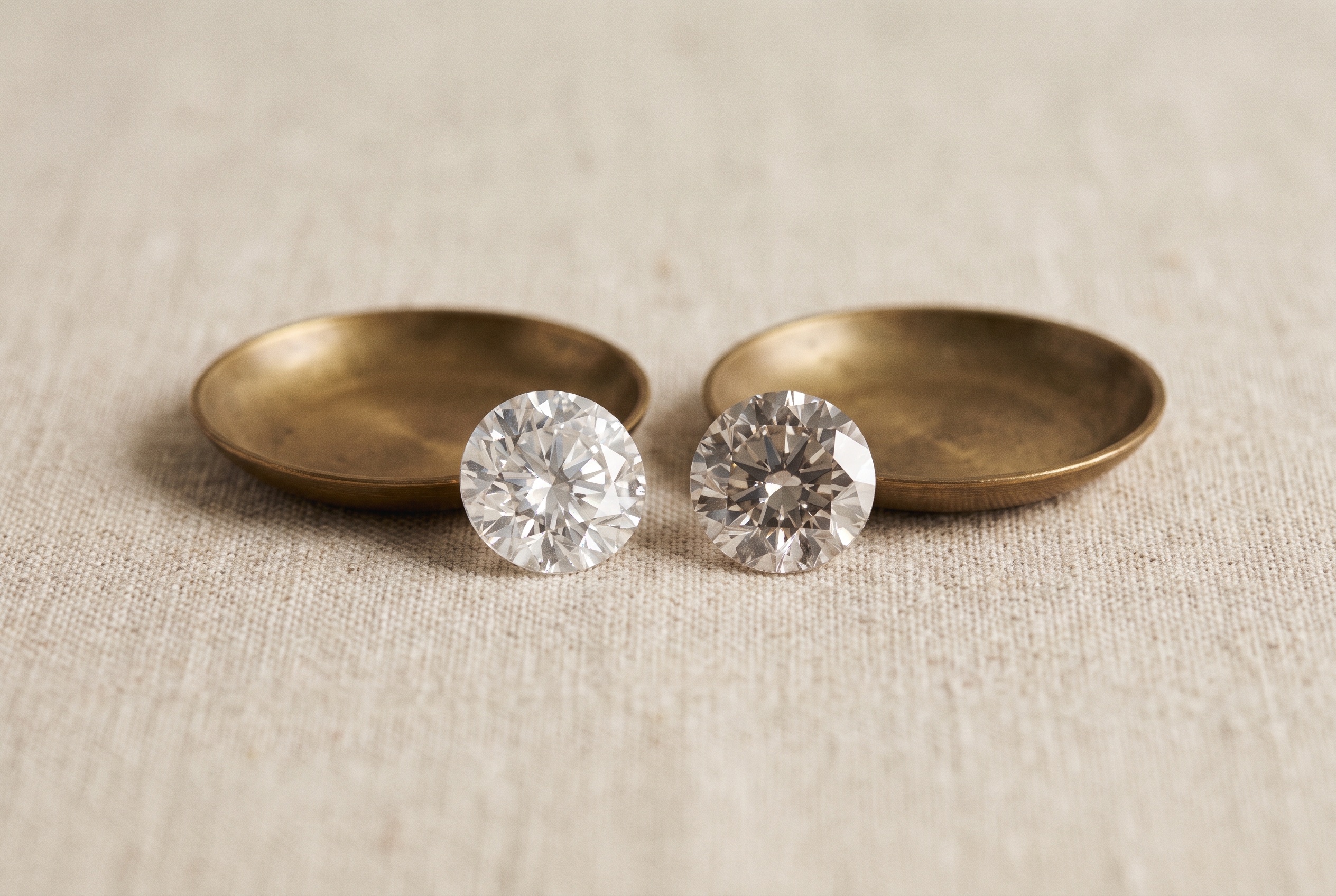
Moissanite is the diamond simulant that comes closest to matching a diamond's hardness and durability. At 9.25 on the Mohs scale, it's second only to diamond itself, which means it resists scratching well enough for genuine everyday wear — a meaningful advantage over cubic zirconia. Where moissanite diverges most visibly from diamond is in its optical fire: its refractive index and dispersion are higher than diamond's, which produces more colorful, rainbow-like flashes under bright or direct light. To an untrained eye this can initially read as "extra sparkly," but to anyone familiar with diamond's more subdued, white-dominant fire, a moissanite's flash pattern is a clear tell, especially outdoors or under strong overhead lighting.
Moissanite is also not naturally colorless the way top-grade diamonds are — most moissanite carries a faint gray, green, or yellowish body tone, especially visible at larger carat weights or under certain lighting, though the highest-grade colorless moissanite has improved significantly in recent years. It's sold with its own grading terminology (not the diamond 4Cs) and is not certified by GIA, IGI, or GCAL, since it isn't diamond material those labs grade.
Cubic Zirconia: The Budget Simulant
Cubic zirconia (CZ) is the most widely produced and least expensive diamond simulant, valued for its low cost and its ability to be manufactured in large, flawless-looking pieces. At 8.0-8.5 on the Mohs scale, it's noticeably softer than both moissanite and diamond, which means it scratches more easily over time — a CZ worn daily will typically show visible surface wear and a duller, cloudier appearance within a few years, something that essentially never happens to a diamond under normal wear. CZ's fire is also higher than diamond's, producing a similar "too sparkly," slightly artificial-looking flash pattern to moissanite, though CZ tends to look flatter and less lively overall due to its lower refractive index. CZ is inexpensive enough that it's commonly used in costume jewelry, sample/display pieces, and temporary placeholder rings, rather than as a genuine diamond alternative for permanent fine jewelry.
Why Lab-Grown Diamonds Are Not Simulants
It's worth stating plainly, because the confusion is common among retail shoppers: a lab-grown diamond is not a "fake" diamond, a synthetic substitute, or a simulant in any gemological sense. It is chemically identical to a natural diamond — pure crystallized carbon with the exact same crystal lattice structure — produced via Chemical Vapor Deposition (CVD), which replicates the natural diamond-formation process inside a controlled reactor rather than underground. A trained gemologist cannot distinguish a lab-grown diamond from a natural one through standard visual or even most standard gemological testing; specialized equipment designed specifically to detect growth-pattern artifacts is required, and even then, the stone that equipment identifies is still, unambiguously, a diamond. The FTC's own updated guidance reflects this: a lab-grown diamond can be marketed as a "diamond," provided the lab-grown origin is clearly disclosed — a materially different regulatory position than for moissanite or CZ, which must be disclosed as simulants and cannot be marketed as diamonds at all.
Refractive Index and Fire: Why "More Sparkle" Isn't Always a Compliment
A common misconception among shoppers is that a stone with more fire is automatically more desirable, which pushes some toward moissanite or CZ under the assumption they're getting "extra" sparkle for less money. In practice, trained eyes and experienced jewelers generally view a diamond's more restrained, white-dominant brilliance as the more sophisticated, higher-value look — the rainbow-heavy flash of moissanite or CZ reads, to anyone who's seen enough of both side by side, as a visual signature of a simulant rather than an upgrade. This is a genuinely useful thing for retail-facing jewelers to be able to explain to customers comparing options, since it reframes "more sparkle" from a pro into a legitimate identifying characteristic of a non-diamond stone.
Durability and Long-Term Wear Differences
Hardness on the Mohs scale determines how well a stone resists everyday scratching, and this is where the practical, long-term differences between simulants and lab-grown diamonds become most apparent to an actual wearer. Diamond, at a 10, is the hardest natural material on Earth and effectively cannot be scratched by anything except another diamond. Moissanite, at 9.25, holds up very well under daily wear and rarely shows visible wear over a normal lifetime. Cubic zirconia, at 8.0-8.5, is measurably softer, and daily contact with countertops, other jewelry, and ordinary household surfaces will visibly dull and scratch a CZ over a period of a few years — a durability gap that matters most for an engagement ring or other piece meant to be worn daily for decades.
Price Comparison and What Drives It
The price gap between simulants and lab-grown diamonds is dramatic and reflects the underlying material reality: CZ and moissanite are inexpensive to manufacture in bulk and carry none of diamond's rarity, formation complexity, or certification infrastructure. A one-carat-equivalent CZ might wholesale for $20-$80; a comparable moissanite for $100-$400; a comparable lab-grown diamond for $900-$1,400 depending on the 4Cs. That gap is the direct tradeoff a retail customer is making — dramatically lower upfront cost against a stone that is not diamond, will not be certified as one, and (for CZ specifically) will show wear over time that a diamond simply doesn't.
Certification: The Clearest Practical Difference
Perhaps the single most useful fact for a wholesale buyer to pass along to retail staff: lab-grown diamonds receive full GIA, IGI, or GCAL certification on the same 4Cs scale as natural diamonds, with a report number that can be independently verified. Moissanite and CZ do not receive diamond-grading certification from these labs, because they are not diamonds — some moissanite sellers issue their own proprietary quality documentation, but it is not equivalent to, or interchangeable with, a diamond grading report. For any retail customer asking "is this really a diamond," the presence or absence of a GIA/IGI/GCAL certificate is the clearest, most defensible answer a jeweler can point to.
How Retail Customers Typically Confuse the Two
The confusion between lab-grown diamonds and diamond simulants is common enough that it's worth addressing directly with retail-facing staff, since it affects how confidently they can answer customer questions. The confusion generally stems from both categories being positioned as "affordable diamond alternatives" in casual marketing language, even though they occupy entirely different categories — one is real diamond at a lower price than natural, the other is a different mineral entirely marketed to resemble diamond. Clear language matters here: "lab-grown diamond" and "diamond simulant" should never be used interchangeably in retail conversations or marketing copy, both because it's inaccurate and because the FTC treats misrepresentation on this point as a real compliance issue, not a marketing nuance.
When a Simulant Might Actually Be the Right Recommendation
Despite the clear material and durability differences, there are legitimate reasons a retail customer might choose a simulant over a lab-grown diamond, and jewelers serving that customer well means being honest about the tradeoff rather than steering everyone toward diamond by default. Common, reasonable use cases include: a temporary placeholder ring while a custom diamond piece is being made, a travel-safe substitute for an insured diamond piece the owner doesn't want to risk losing or damaging abroad, or a genuinely budget-constrained purchase where the customer understands and accepts they're buying a different material, not a diamond at a discount. In every one of these cases, clear disclosure of what the stone actually is remains the standard a reputable jeweler should hold to.
What This Means for Wholesale Buyers Stocking Both Categories
Some wholesale buyers serving retail jewelers carry both lab-grown diamonds and simulants to cover the full range of what their clients' end customers want, from a diamond-grade purchase to a budget placeholder. Where this gets buyers into trouble is inventory and paperwork discipline: mixing simulant and diamond stock without clear, separate labeling and documentation creates real risk of an honest mistake becoming a misrepresentation problem downstream at retail. Buyers who stock both should maintain clearly separated inventory categories, distinct certification paperwork (or clear absence of it, for simulants), and should train retail clients explicitly on how to represent each category correctly to their own customers.
Testing Methods: How Jewelers Actually Verify a Stone
Beyond visual inspection, jewelers have a few reliable tools for distinguishing diamond (lab-grown or natural) from simulants. Thermal diamond testers, the most common tool on a jeweler's bench, measure how quickly heat conducts through a stone — diamond conducts heat exceptionally well, while moissanite and CZ conduct it differently, though older thermal testers can sometimes misread moissanite as diamond because their thermal conductivity is closer to diamond's than CZ's is. This is why most jewelers pair a thermal tester with an electrical conductivity tester specifically calibrated to catch moissanite, since moissanite conducts electricity in a way diamond does not. Between the two tests, a jeweler can reliably sort any stone into diamond, moissanite, or CZ within a couple of minutes, which is standard practice before a retail purchase is finalized, an appraisal is issued, or a trade-in stone is accepted. Because a lab-grown diamond tests identically to a natural diamond on both of these instruments, distinguishing lab-grown from natural requires separate, specialized equipment (spectroscopy or growth-pattern imaging) — a different question entirely from sorting diamond from simulant.
Melee-Scale Simulants: A Related but Distinct Consideration
Everything above applies most directly to center and loose stones, but the same simulant-versus-diamond distinction exists at melee scale (roughly 0.8mm-9.0mm accent stones), where it's arguably even more consequential for wholesale buyers. Melee simulants — small CZ or moissanite accent stones — are common in costume and lower-tier fashion jewelry, priced far below even calibrated CVD melee parcels. The risk for wholesale buyers is greater at this scale, not less: melee is typically sold and set in bulk, without individual certification, which means a supplier's honesty about what's actually in a parcel matters more, not less, than it does for a single, certifiable center stone. Buyers sourcing melee for a diamond-grade finished piece should confirm explicitly with their supplier that a parcel is genuine CVD lab-grown or natural diamond melee against a stated quality baseline (commonly DEF+/VS+), rather than assuming "melee" implies diamond by default — the word describes a size category, not a material.
Guiding a Retail Customer Through the Three-Way Choice
For jewelers fielding the question directly from an end customer — "should I get a diamond, moissanite, or CZ?" — the most useful framing separates the decision into two questions rather than one. First: does the customer want the piece to actually be a diamond, for resale, insurance, sentimental, or symbolic reasons? If yes, the conversation is really between lab-grown and natural, not between diamond and simulant, since a simulant doesn't meet that bar regardless of price. Second, only if the answer to the first question is genuinely no: is the customer comfortable with a different material that resembles a diamond, understanding the durability and resale differences involved? Moissanite is the stronger simulant recommendation for daily-wear pieces given its higher hardness; CZ is more appropriate for temporary, display, or low-budget costume use where long-term wear isn't a factor. Leading with this two-question framework, rather than presenting all three as a simple price ladder, tends to produce customers who are happier with their choice and jewelers who spend less time on post-sale confusion or complaints.
Sourcing Certified Lab-Grown Diamonds at Wholesale
Guru Diam supplies CVD lab-grown diamonds exclusively — no HPHT, ever — fully certified by GIA, IGI, or GCAL on the standard 4Cs scale, alongside natural loose stones and finished jewelry. Every lab-grown stone in the catalog is real diamond, not a simulant, which matters directly for retail-facing jewelers who need to represent their inventory accurately and confidently to customers asking the "is this a real diamond" question. In-stock inventory ships same-day from both the New York and Los Angeles locations (before 6pm EST in NYC, before 4pm PST in LA), and custom engagement rings built around a certified lab-grown center stone finish in 4-6 days. For buyers who want to offer clients a genuine, certified diamond at a meaningfully lower price point than natural — without ever having to explain a simulant tradeoff — lab-grown is the category built for exactly that conversation.
A Note on Terminology in Marketing Copy
Word choice in product listings and marketing copy carries real regulatory weight in this category, more than in most areas of jewelry marketing. "Lab-created," "lab-grown," and "man-made" are all acceptable ways to describe a real diamond of non-mined origin, provided the origin is disclosed clearly and isn't buried in fine print. "Diamond simulant," "diamond alternative," or naming the actual material ("moissanite," "cubic zirconia") are the accurate ways to describe a simulant — terms like "diamond-look" or "faux diamond" can drift into ambiguous territory the FTC has flagged in past guidance updates. Wholesale buyers supplying retail jewelers are in a good position to help standardize this language across their client base, since inconsistent terminology at the retail level is where most real-world compliance risk in this category actually originates, not at the point of wholesale sourcing.
Frequently Asked Questions
What is a simulated diamond?
A simulated diamond is a stone that visually resembles a diamond but is made of a different material entirely, most commonly moissanite (silicon carbide) or cubic zirconia (zirconium dioxide). Unlike lab-grown diamonds, simulants are not chemically or optically identical to diamond and are not graded on the standard 4Cs scale.
Is a lab-grown diamond a simulated diamond?
No. A lab-grown diamond is real diamond — pure crystallized carbon produced via CVD — and is graded on the identical GIA/IGI/GCAL 4Cs scale used for natural diamonds. A simulant like moissanite or CZ is a different mineral entirely and receives no diamond grading certification.
Can a jeweler tell the difference between moissanite and a real diamond?
Yes, generally. Moissanite has a noticeably higher refractive index and dispersion than diamond, producing more colorful, rainbow-like flashes under bright light — a visual tell experienced jewelers can often spot without equipment, and can confirm definitively with a diamond/moissanite tester.
Does cubic zirconia scratch or wear out over time?
Yes. At 8.0-8.5 on the Mohs hardness scale, CZ is noticeably softer than diamond or moissanite and typically shows visible scratching and dulling within a few years of regular wear, unlike diamond, which effectively never scratches under normal use.
Why is a lab-grown diamond more expensive than moissanite or CZ?
Because it's a fundamentally different, rarer material — real diamond, not a substitute mineral. Even though lab-grown diamonds cost far less than natural diamonds, they're still priced well above simulants because they carry genuine diamond hardness, optical properties, and full 4Cs certification that simulants don't have.
Is it legal to sell moissanite or CZ as a "diamond"?
No. FTC guidance requires diamond simulants to be clearly disclosed as such and prohibits marketing them as diamonds. Lab-grown diamonds, by contrast, can be marketed as diamonds as long as the lab-grown origin is clearly disclosed — a materially different rule than for simulants.
Can moissanite or CZ pass a standard diamond tester?
CZ generally does not, since its thermal conductivity is clearly different from diamond's. Moissanite can sometimes register as diamond on an older thermal-only tester because its conductivity is closer to diamond's, which is why jewelers pair thermal testers with an electrical conductivity test specifically to catch moissanite.
Quick Summary
A simulated diamond (moissanite or cubic zirconia) is a different mineral entirely, not diamond, not graded on the 4Cs scale, and legally required to be disclosed as a simulant rather than marketed as a diamond. A lab-grown diamond is real diamond — chemically, optically, and gemologically identical to natural — fully certified by GIA, IGI, or GCAL, and can be marketed as a diamond as long as its lab-grown origin is disclosed. Wholesale buyers who keep that distinction sharp, in inventory, paperwork, and retail-facing language, protect both their own compliance position and their clients' credibility with end customers.