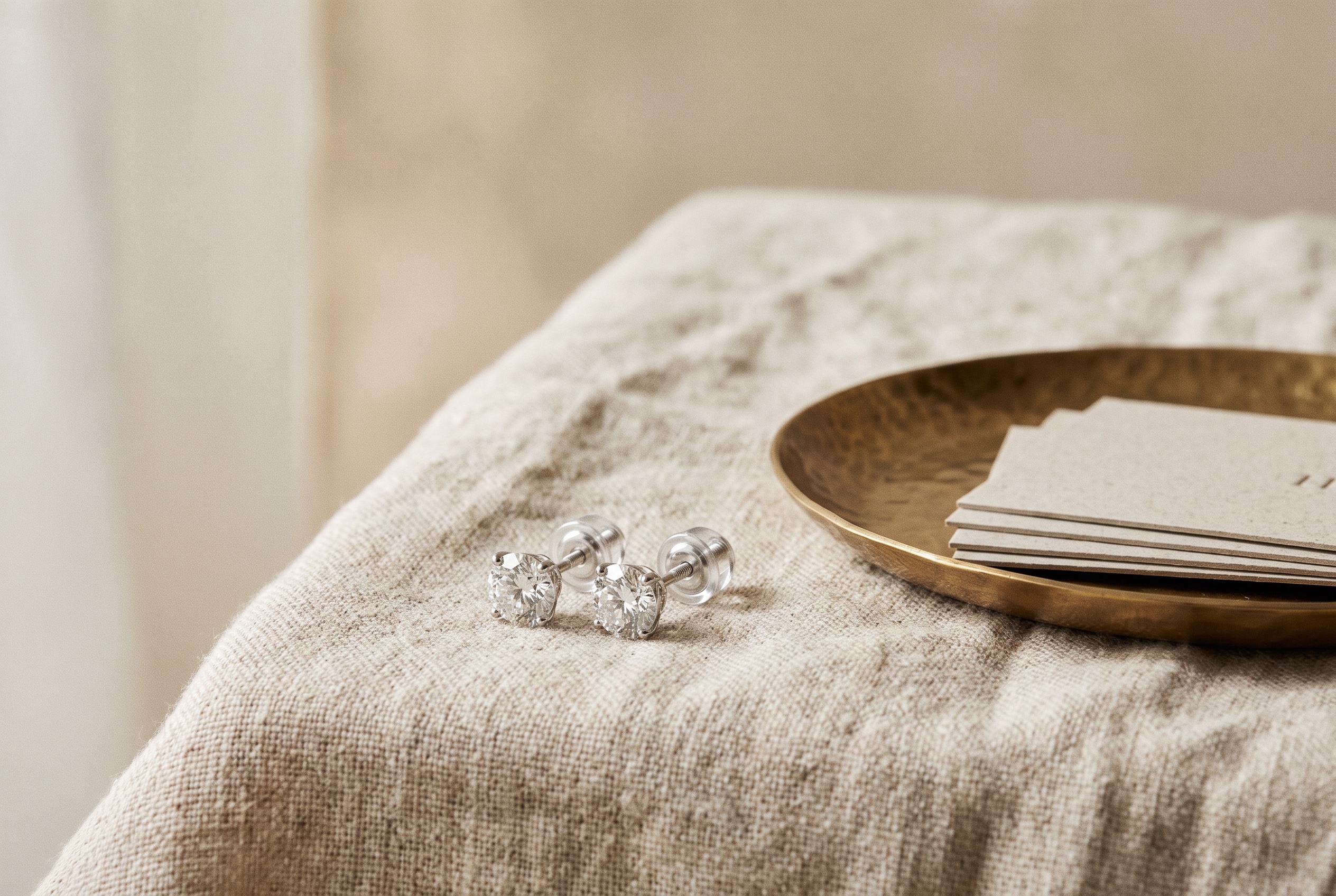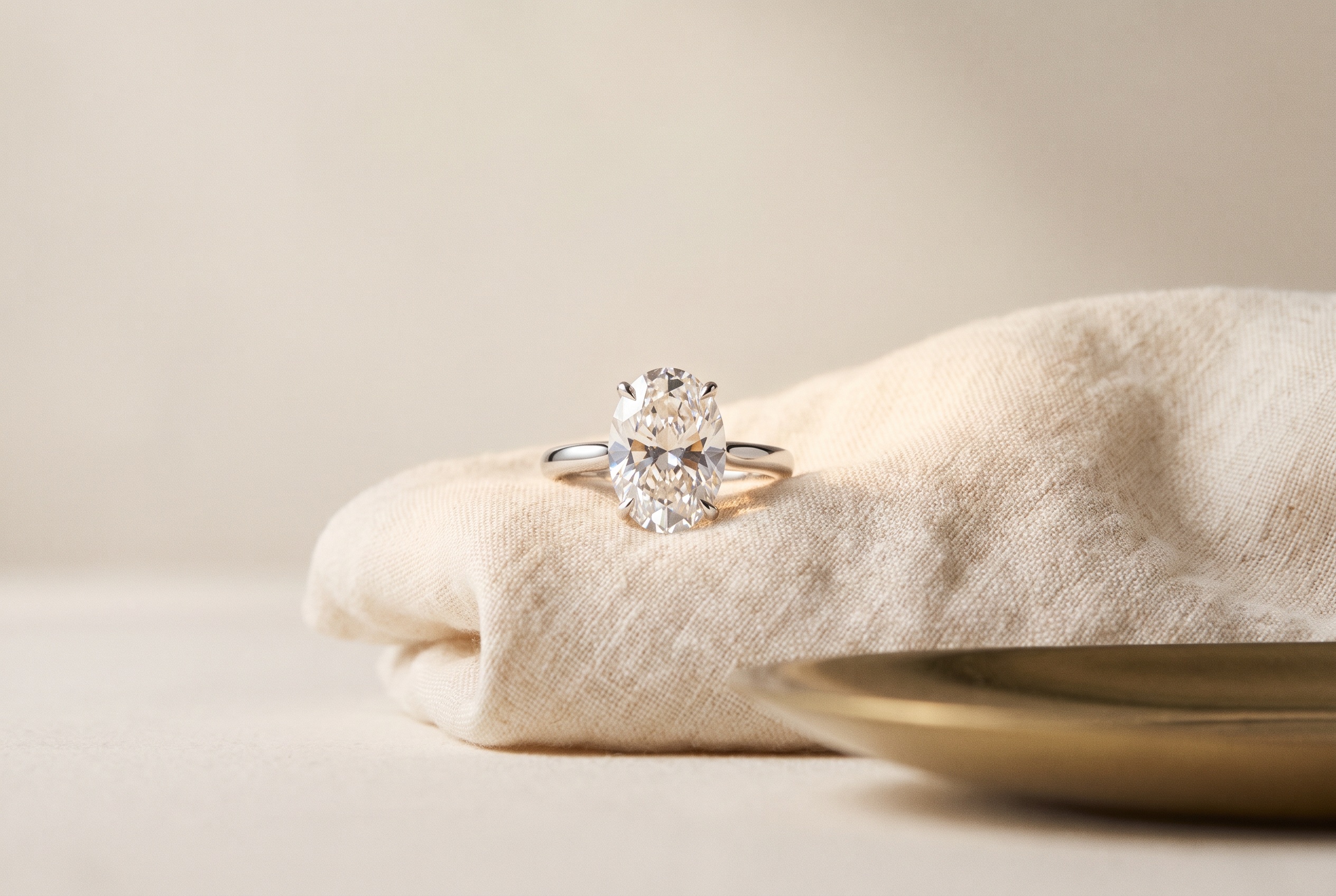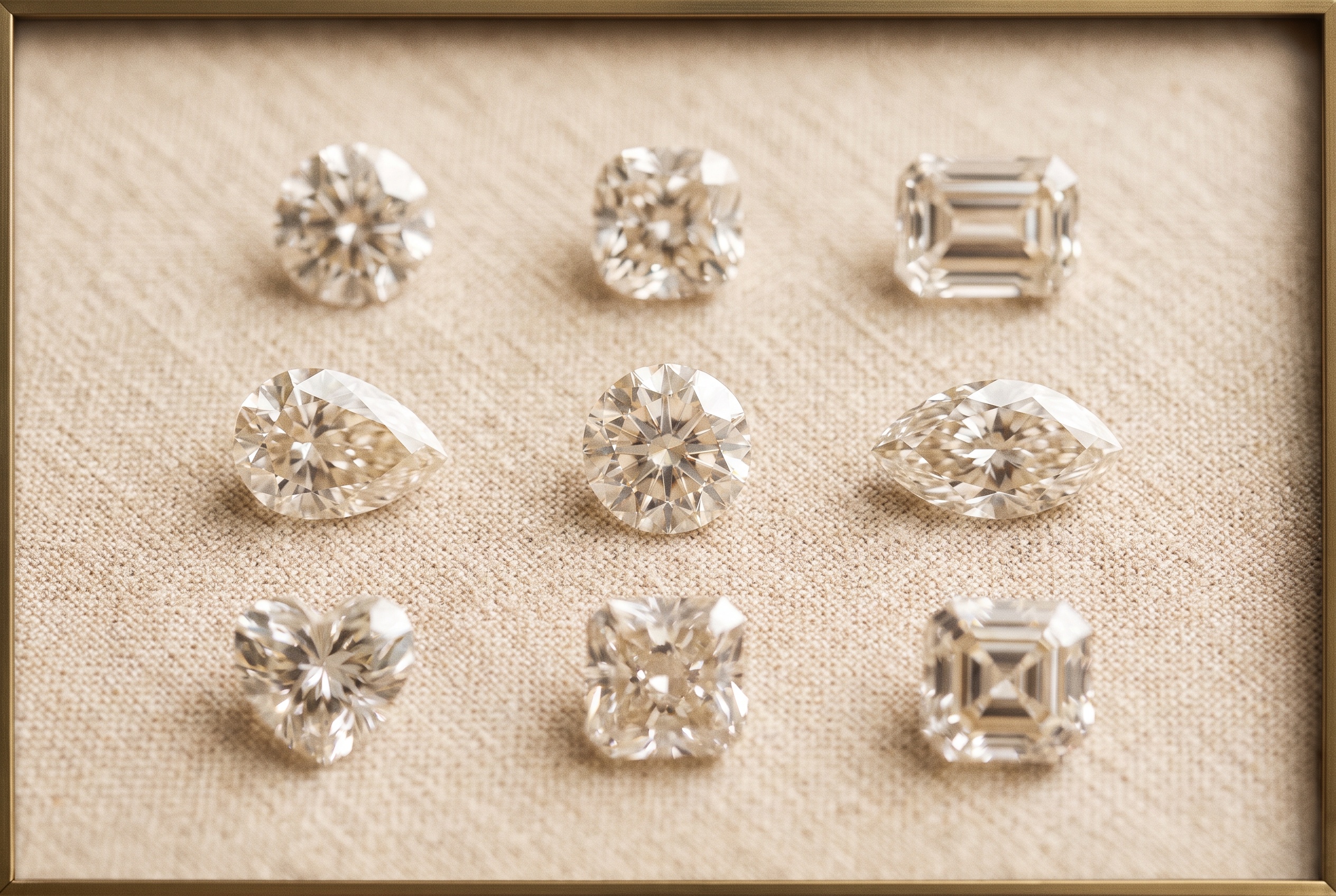

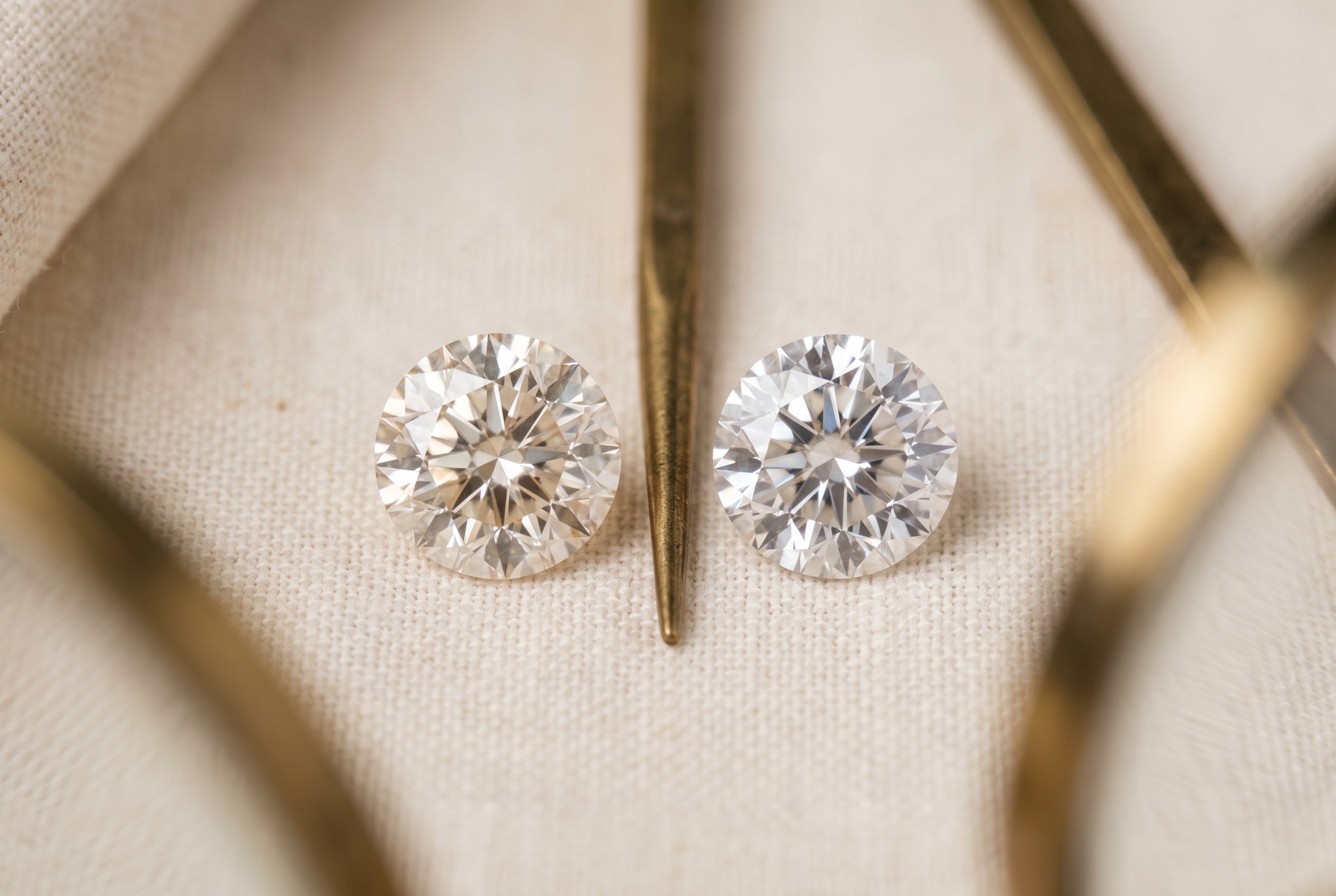
The core difference is composition: a lab-grown diamond is real diamond — pure crystallized carbon, grown via CVD, chemically and optically identical to a natural diamond — while moissanite is silicon carbide, a distinct mineral that resembles diamond but is not one. Both are durable, both are far less expensive than natural diamonds, and both are legitimate choices — but they are not interchangeable, and the differences matter for how a stone is graded, priced, and worn.
This is one of the most common questions retail jewelers field from customers who've done some online research and arrive at the counter comparing the two by price alone. It's also a question wholesale buyers need a confident, accurate answer to before stocking either category, since the two stones serve genuinely different customers. This guide covers what each material actually is, how they compare on hardness, optical properties, certification, price, durability, and long-term resale value — with no exaggeration in either direction.
What a Lab-Grown Diamond Actually Is
A lab-grown diamond is not a diamond substitute or a lower tier of diamond — it is diamond, full stop. It has the exact same crystal structure as a natural diamond: carbon atoms arranged in a cubic lattice, formed under conditions that replicate what happens naturally, just inside a controlled reactor rather than underground over geological time. The production method used across Guru Diam's catalog is Chemical Vapor Deposition (CVD), in which a diamond seed is placed in a chamber filled with carbon-rich gas, and carbon atoms deposit onto the seed layer by layer until a rough diamond crystal forms, ready to be cut and polished.
Because the material is chemically and physically identical to natural diamond, a lab-grown diamond is graded on the exact same 4Cs scale — cut, color, clarity, carat weight — used for natural stones, by the same major labs: GIA, IGI, and GCAL. A trained gemologist cannot distinguish lab-grown from natural diamond through standard visual inspection or common gemological testing; identifying growth origin requires specialized equipment designed specifically for that purpose. The stone that equipment identifies, either way, is still unambiguously a diamond.
What Moissanite Actually Is
Moissanite is silicon carbide (SiC) — a mineral first identified in meteorite fragments and now produced synthetically for gem use. It is not a form of diamond, not a lower grade of diamond, and not chemically related to carbon-crystal diamond at all. It belongs to the same broad category as cubic zirconia: a diamond simulant, meaning a material selected and cut specifically because it visually resembles diamond, without sharing diamond's composition or crystal structure.
That distinction is a factual one, not a marketing spin against moissanite. Moissanite has real, well-documented advantages of its own — it's the hardest and most diamond-like of the common simulants, and it holds up to daily wear far better than lower-tier alternatives like cubic zirconia. But it is a different mineral, and any retail-facing conversation that blurs "moissanite" and "diamond" together, even loosely, creates a representation problem that a jeweler doesn't want to be explaining after the sale.
Lab-Grown Diamond vs. Moissanite: Side-by-Side
| Attribute | Lab-Grown Diamond (CVD) | Moissanite |
|---|---|---|
| Composition | Pure carbon (real diamond) | Silicon carbide (diamond simulant) |
| Mohs hardness | 10 | ~9.25 |
| Refractive index | ~2.42 | ~2.65-2.69 |
| Dispersion (fire) | ~0.044 | ~0.104 (roughly 2.4x diamond's) |
| Certification | GIA, IGI, or GCAL diamond grading report | Not a diamond grading report; sold with separate quality documentation |
| Relative price tier | Higher than moissanite; well below natural diamond | Lower than lab-grown diamond |
| Durability for daily wear | Extremely durable; hardest known natural material | Very durable; second only to diamond among common gem materials |
Hardness: How Each Material Holds Up to Daily Wear
Diamond sits at 10 on the Mohs hardness scale, the hardest naturally occurring material on Earth, whether that diamond is lab-grown or mined. Nothing short of another diamond can scratch it under normal circumstances, which is a large part of why diamond has remained the standard for pieces meant to be worn every day for decades — an engagement ring, in particular, that goes through cooking, cleaning, gym bags, and countertops without special handling.
Moissanite comes in at roughly 9.25 on the same scale — a genuinely strong number, and meaningfully harder than cubic zirconia (8.0-8.5) or most other gemstones used in fine jewelry. In practical terms, moissanite resists scratching very well under normal daily wear and is a reasonable choice for a piece worn constantly. The gap between 9.25 and 10 is real but narrow enough that both materials are considered appropriate for daily-wear settings; the meaningful durability gap in this category is between moissanite and softer simulants like CZ, not between moissanite and diamond.
Optical Properties: Refractive Index and Fire
This is where the two materials diverge most visibly, and it's worth explaining accurately rather than framing one number as simply "better." Refractive index measures how much a material bends light passing through it; diamond's refractive index is approximately 2.42. Moissanite's is higher, in the range of 2.65 to 2.69, meaning it bends light more sharply.
Dispersion — often called "fire" — measures how much a material splits white light into visible spectral colors, producing the rainbow flashes a stone throws under bright or direct light. Diamond's dispersion is approximately 0.044. Moissanite's is roughly 0.104, more than double diamond's, and that difference is the single most noticeable optical distinction between the two stones, especially as carat weight increases. A moissanite stone, particularly at larger sizes, will typically throw more visible, more colorful flashes of rainbow fire than a diamond of comparable size and cut.
Whether that's a positive or a negative genuinely depends on the buyer. Some customers specifically want more visible sparkle and colored flash, and moissanite delivers that in a way diamond, by its nature, does not. Other customers — particularly those who want a stone that reads as a traditional, classic diamond look — find moissanite's higher fire a visual tell that departs from what they associate with "diamond," since diamond's brilliance leans more white and restrained by comparison. Neither preference is wrong; it's a legitimate tradeoff to walk a customer through rather than a point in either stone's favor.
Color and Face-Up Appearance
Colorless-grade lab-grown diamonds (D-F on the GIA color scale) present with no visible body color, exactly as a natural diamond of the same grade would, since the grading criteria and the physical material are identical. Moissanite historically carried a faint gray, green, or yellowish body tone, most noticeable at larger carat weights or under certain lighting; the highest-grade colorless moissanite available today has narrowed that gap considerably, though it remains a factor some trained eyes can pick up on, particularly in bigger stones or side-by-side comparison with a true colorless diamond.
Combined with the dispersion difference above, the overall face-up look of the two stones is genuinely distinct even when both are cut well: diamond tends to present a more even, white-dominant brilliance, while moissanite tends to present a livelier, more colorful flash pattern. Buyers and retail staff benefit from actually viewing both side by side under a few different lighting conditions before deciding, rather than relying on numbers alone.
Certification: What Documentation Actually Comes With Each Stone
Lab-grown diamonds receive standard diamond grading reports from GIA, IGI, or GCAL — the same reports, on the same 4Cs scale, issued for natural diamonds, each with a verifiable report number. This is one of the clearest, most practical differences a jeweler can point to when a customer asks "is this really a diamond": the certificate itself answers the question.
Moissanite is not graded by GIA, IGI, or GCAL, because it isn't diamond material for those labs to grade on a diamond scale. Moissanite is typically sold with its own separate quality documentation from the cutter or seller, describing cut quality and color grade on moissanite-specific terminology — useful for verifying quality within the moissanite category, but not equivalent to, and not interchangeable with, a diamond grading report. A retail customer comparing a certified lab-grown diamond against a moissanite stone should understand that the two pieces of paper answer fundamentally different questions.
Price: What the Gap Reflects
Lab-grown diamonds cost meaningfully more per carat than moissanite — that's a consistent, well-established relationship in the market, though this guide won't put specific numbers to it, since actual pricing moves with the 4Cs, market conditions, and supplier. The reason for the gap is straightforward: lab-grown diamonds are real diamond, produced through a comparatively slower, more resource-intensive CVD growth process, and they carry full diamond certification; moissanite is a synthetic material that can be manufactured more quickly and at greater scale.
What's worth emphasizing to a price-conscious customer is where both materials sit relative to natural diamond: both lab-grown diamond and moissanite cost dramatically less than a natural diamond of comparable visual size, and the gap between lab-grown and moissanite, while real, is far smaller than the gap either one has versus natural. For a buyer deciding purely on budget, that's a genuinely useful frame — moissanite is the lower-cost of the two, but "lower cost than lab-grown" and "lower cost than natural" are very different magnitudes of savings.
Durability for Daily Wear: A Closer Look
Both materials are legitimately durable enough for daily wear in a ring, which sets them apart from softer simulants. Diamond's Mohs 10 hardness means it's effectively immune to scratching from anything short of another diamond, and it also resists chipping better than moissanite in extreme impact scenarios, since diamond's toughness (resistance to fracture, a related but distinct property from hardness) is well documented. Moissanite at 9.25 is close behind and holds up very well against scratching under ordinary conditions — daily wear, most jewelry contact, and normal household surfaces won't visibly damage it.
The practical difference shows up mainly at the margins: extremely hard abrasive contact, edge-on impacts, or decades of continuous wear where diamond's slight hardness advantage compounds over time. For the large majority of daily-wear scenarios, both materials perform well, and framing moissanite as "not durable enough for daily wear" would be inaccurate — it's a legitimately durable stone, just not quite at diamond's level.
How Jewelers Actually Tell the Two Apart
Because lab-grown diamond tests identically to natural diamond on standard jeweler's equipment, the practical identification question in this comparison isn't lab-grown-vs-natural — it's diamond-vs-moissanite, and that distinction is straightforward to make on the bench. A standard thermal diamond tester measures how quickly heat conducts through a stone; diamond conducts heat exceptionally well, and older thermal-only testers can occasionally misread moissanite as diamond because moissanite's thermal conductivity happens to sit closer to diamond's than most other simulants do. For that reason, most jewelers pair a thermal tester with an electrical conductivity test, since moissanite conducts electricity in a way diamond does not — a combination that reliably sorts a stone into diamond or moissanite within a couple of minutes.
This matters beyond the sales counter. A jeweler accepting a trade-in stone, appraising a piece for insurance, or verifying inventory received from a supplier should run both tests before treating an unfamiliar stone as diamond, since visual inspection alone — even by an experienced eye — isn't always conclusive at a glance, particularly with well-cut, colorless-grade moissanite. Keeping both instruments on hand, and using them as routine practice rather than only when something looks off, is standard due diligence for any retail operation handling both categories.
Resale and Long-Term Value Considerations
Neither lab-grown diamond nor moissanite approaches the resale value retention of a natural diamond, and that should be stated plainly rather than glossed over — natural diamond's rarity and the structure of the secondary diamond market give it a resale position neither alternative currently matches. Between the two, lab-grown diamonds generally hold resale value somewhat better than moissanite, largely because they're graded and certified as diamonds on the standard 4Cs scale, which gives a resale buyer or appraiser a clear, verifiable basis for valuation that moissanite's separate documentation doesn't provide in the same way.
For most buyers, particularly those purchasing for personal wear rather than as an investment, resale value shouldn't be the deciding factor for either stone — neither is purchased primarily to be resold. But for a customer who does weigh long-term value, or a jeweler advising one, the honest answer is that certified lab-grown diamond holds a resale edge over moissanite, while both sit well below natural diamond on that specific dimension.
Helping a Customer Choose Between the Two
The most useful way to frame this decision for a retail customer isn't diamond-vs-moissanite as a simple better-or-worse ranking — it's a short set of honest questions. Does the customer want the piece to genuinely be a diamond, whether for symbolic reasons, resale considerations, or simply wanting the real material? If so, the choice is really between lab-grown and natural diamond, not between diamond and moissanite, and understanding what a lab-grown diamond actually is helps frame that comparison clearly.
If budget is the primary driver and the customer is comfortable with a different material that closely resembles diamond, moissanite is a legitimate, durable choice — and worth being upfront that it will show noticeably more colorful fire, particularly at larger sizes, which some customers love and others find less classic-looking. This is also a good moment to mention that moissanite isn't the only simulant on the market; buyers weighing the full range of alternatives, including cubic zirconia, may find the broader comparison in our simulated diamond vs. lab-grown guide useful before narrowing down to a specific material.
Center-stone size is a practical variable worth raising directly with the customer, since it changes how visible the fire difference actually is in daily wear. In smaller stones — roughly half a carat and under — moissanite's higher dispersion is present but often subtle enough that a casual observer won't immediately register it as different from diamond. In larger center stones, especially above one carat, the additional rainbow flash becomes considerably more noticeable under normal indoor and outdoor lighting, which is exactly the size range where the "is this diamond or something else" question tends to come up unprompted from people who see the piece. Retail staff who understand this size relationship can set expectations accurately before the sale rather than fielding a surprised reaction from the customer later.
Common Misconceptions Worth Correcting
- "Moissanite is just a cheaper diamond." It's a different mineral entirely — silicon carbide, not carbon — not a lower grade or budget version of diamond.
- "More fire always means a better stone." Moissanite's higher dispersion produces more visible rainbow flash, which some buyers prefer and others find less like a traditional diamond look — it's a tradeoff, not an upgrade or downgrade in either direction.
- "Lab-grown diamonds and moissanite are priced similarly." They're not. Lab-grown diamonds cost meaningfully more per carat, reflecting that they're real, certified diamond rather than a simulant.
- "Moissanite can get a GIA certificate." No — GIA, IGI, and GCAL grade diamonds on the 4Cs scale; moissanite is a different material and is documented separately, not on a diamond grading report.
- "Moissanite won't hold up to daily wear." It will. At 9.25 Mohs, it's genuinely durable for everyday jewelry, just a step below diamond's 10.
Sourcing Certified Lab-Grown Diamonds at Wholesale
Guru Diam is a trade-only wholesale supplier carrying CVD lab-grown diamonds alongside natural loose stones, fancy color diamonds, and finished jewelry — one source for buyers who need real, certified diamond inventory rather than a narrow slice of it. Every lab-grown stone in the catalog is graded by GIA, IGI, or GCAL on the standard 4Cs scale, giving retail-facing jewelers a documented, verifiable answer for any customer asking whether a stone is genuinely diamond. Guru Diam does not carry moissanite; the focus is real diamond, lab-grown and natural, across standard, antique, and exotic shapes.
Certified loose stones and matched pairs ship same-day on in-stock inventory from both the New York and Los Angeles locations — before 6pm EST in NYC, before 4pm PST in LA — and custom engagement rings built around a certified center stone finish in 4-6 days, with cutting, setting, and polishing all handled in-house. Buyers can browse current inventory in the certified diamonds category or the fancy color loose diamonds category, review trade terms at the wholesale hub, or apply for an account through trade partner. With 2,000+ active customer accounts, one supplier covering certified loose stones, antique cuts, fancy colors, and custom jewelry means one shipment and one relationship for a retail jeweler's full diamond assortment, rather than splitting sourcing across separate diamond and simulant vendors.
Frequently Asked Questions
What is the main difference between a lab-grown diamond and moissanite?
A lab-grown diamond is real diamond — pure carbon with the same crystal structure as a natural diamond, grown via CVD. Moissanite is silicon carbide, a different mineral entirely that resembles diamond visually but is not diamond and isn't graded on the diamond 4Cs scale.
Is moissanite harder or softer than a lab-grown diamond?
Moissanite is softer, though not by much. Diamond (lab-grown or natural) measures 10 on the Mohs hardness scale, the hardest known natural material, while moissanite measures approximately 9.25 — still very durable for daily wear, just a step below diamond.
Why does moissanite sparkle more than a lab-grown diamond?
Moissanite has a much higher dispersion (fire) than diamond — roughly 0.104 versus diamond's 0.044 — which means it splits light into more visible, colorful rainbow flashes, especially in larger stones. This is a genuine optical property difference, not a quality difference; some buyers prefer the extra color, others prefer diamond's more restrained white brilliance.
Can moissanite get a GIA or IGI certificate?
No. GIA, IGI, and GCAL grade diamonds on the standard 4Cs scale, and moissanite isn't diamond material for those labs to grade. Moissanite is typically sold with its own separate quality documentation from the cutter or seller, which is not the same as, or a substitute for, a diamond grading report.
Does a lab-grown diamond cost a lot more than moissanite?
Yes, meaningfully more per carat, since it's real, certified diamond rather than a simulant material. That said, both lab-grown diamond and moissanite cost dramatically less than a natural diamond of comparable size, so the gap between the two is much smaller than either one's gap versus natural.
Which holds its value better, lab-grown diamond or moissanite?
Lab-grown diamonds generally hold resale value somewhat better than moissanite, largely because they're certified and graded as diamonds on a standardized, verifiable scale. Neither, however, approaches the resale value retention of a natural diamond.
Quick Summary
Lab-grown diamond and moissanite are both durable, attractive, and dramatically less expensive than natural diamond — but they are not the same category of material. Lab-grown diamond is real, certified diamond (Mohs 10, RI ~2.42, dispersion ~0.044, graded GIA/IGI/GCAL); moissanite is silicon carbide, a diamond simulant (Mohs ~9.25, RI ~2.65-2.69, dispersion ~0.104, documented separately from diamond grading). The right choice comes down to whether the customer needs the stone to genuinely be a diamond and how they feel about moissanite's more colorful fire — both are honest, defensible answers depending on the buyer's priorities.