
Diamond drop earrings are earrings built around a stationary diamond element that hangs below the earlobe — a fixed, non-swinging drop distinguishing the category from dangle earrings, which include moving components. For a jeweler, that distinction drives real sourcing decisions: drop earrings favor stones and settings that hold a clean vertical line, while dangle earrings need components engineered for movement, and a retailer building either category needs to source accordingly rather than treating "hanging earring" as one undifferentiated segment. Search demand for the term "diamond drop earrings" frequently captures shoppers looking for both true drops and dangle-style pieces, since the terminology isn't consistently applied across retailers or by consumers themselves — but the underlying stone and hardware sourcing decisions behind each construction remain meaningfully different, which is why this guide treats them as two related but distinct sourcing problems rather than one.
This guide is written for the trade — retailers, designers, and manufacturers sourcing loose diamonds to build or expand a drop earring line — not a consumer buying guide. It covers how drops differ from dangles, matched-pair sourcing requirements specific to this category, stone shape and setting conventions, and what to look for in a wholesale diamond supplier for drop earring production.
Drop Earrings vs. Dangle Earrings: A Sourcing Distinction
The terms get used interchangeably in casual retail language, but they describe genuinely different constructions with different sourcing implications. A drop earring has a fixed, rigid connection between its components — the diamond element hangs at a set length and doesn't swing independently of the wearer's movement. A dangle earring includes at least one hinged or jump-ring connection that allows part of the piece to move freely. Drop earrings generally favor a cleaner, more graphic silhouette and work well with a single well-matched pair of larger stones, while dangle earrings can incorporate more, smaller stones across multiple moving tiers since the movement itself — not stone size — carries much of the visual interest.
| Factor | Drop Earrings | Dangle Earrings |
|---|---|---|
| Construction | Fixed, rigid connection — no independent movement | Hinged or jump-ring connection allows movement |
| Typical stone count | 1–3 stones per earring, larger individual sizes | Often more, smaller stones across tiers |
| Visual driver | Stone size, shape, and pair-matching precision | Movement and light play as the wearer moves |
| Matching priority | Very high — a fixed silhouette shows any mismatch immediately | Somewhat lower — movement partially masks minor asymmetry |
Matched-Pair Sourcing: The Core Requirement for Drop Earrings
Because a drop earring's diamond element sits in a fixed position at a fixed length, any mismatch between the two earrings in a pair — in size, color, shape, or hang angle — is immediately visible in a way it wouldn't be in a moving dangle design. This makes precise matched-pair sourcing the single most important requirement for a drop earring program: stones need to be matched not just on carat weight but on table diameter, depth, and color tone, since two stones of identical carat weight can still hang or catch light noticeably differently if their proportions diverge. Retailers building a drop earring line should prioritize a supplier who sources and sells matched pairs as a dedicated product category, graded and matched before sale, rather than pulling two similarly weighted stones from general loose inventory and hoping they read as a pair once set. In practice, this means asking a prospective supplier how matching is actually performed — whether pairs are matched visually under controlled lighting by an experienced grader, matched purely against a certificate's reported measurements, or some combination of both — since certificate-only matching can miss subtle differences in how two stones actually face up once mounted side by side, which is exactly the kind of mismatch a drop earring's fixed silhouette exposes.
Common Drop Earring Constructions
Solitaire Drop
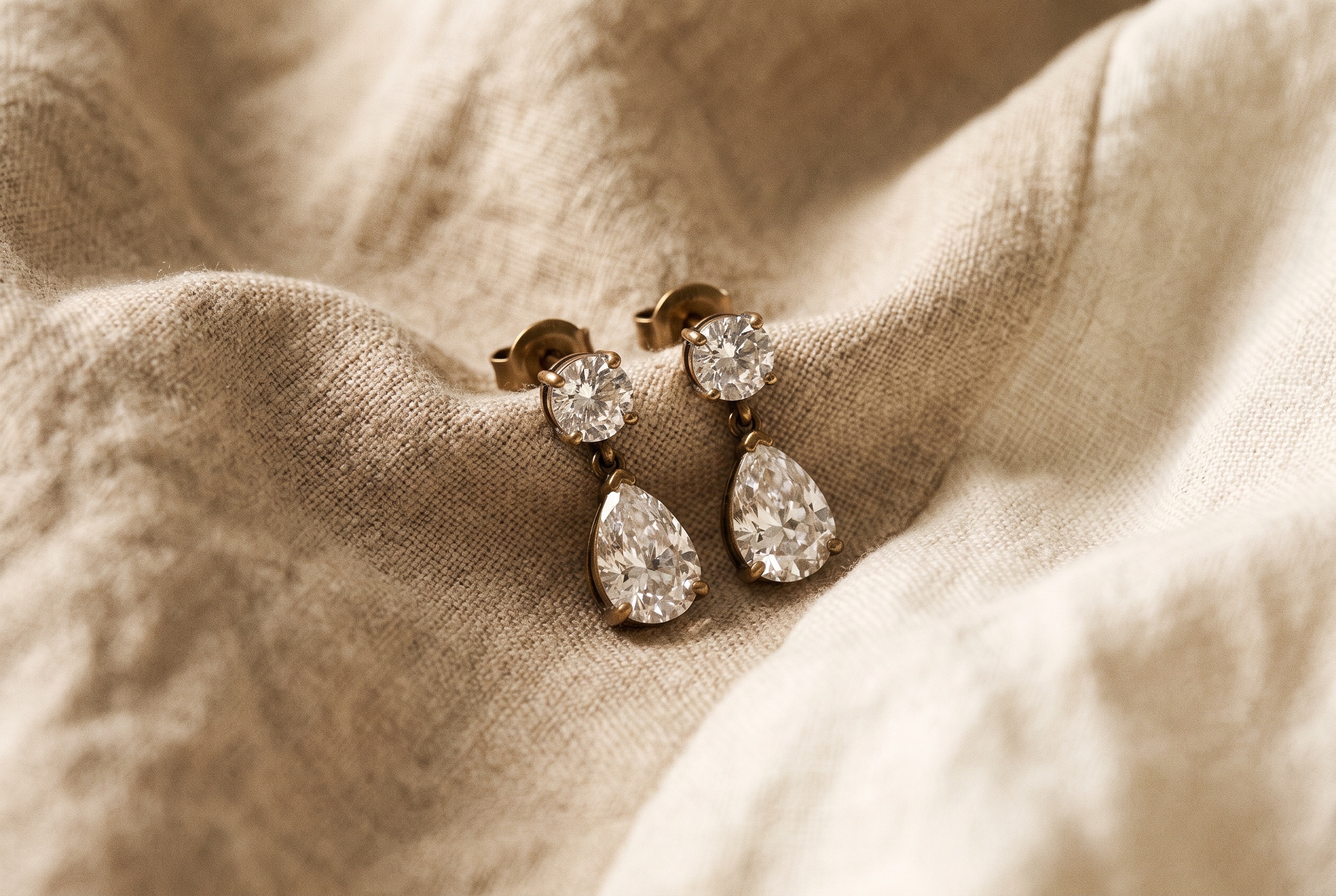
A single diamond, often prong or bezel-set, suspended below a smaller stud or a simple bail. This is the most classic drop earring construction and the one where matched-pair precision matters most, since there's no secondary design element to distract from a size or color mismatch between the two stones.
Cluster Drop
A small cluster of diamonds forming the drop element rather than a single stone — this construction is more forgiving of minor individual stone variation, since the cluster reads collectively, but still requires the two clusters in a pair to be closely matched in overall size and density.
Linear/Bar Drop
A straight line of diamonds set into a bar or line setting, hanging vertically. This construction has grown significantly in popularity as part of a broader minimalist jewelry trend, and sourcing for it prioritizes calibrated melee in a consistent size range over one or two larger feature stones.
Diamond Shape Choices for Drop Earrings
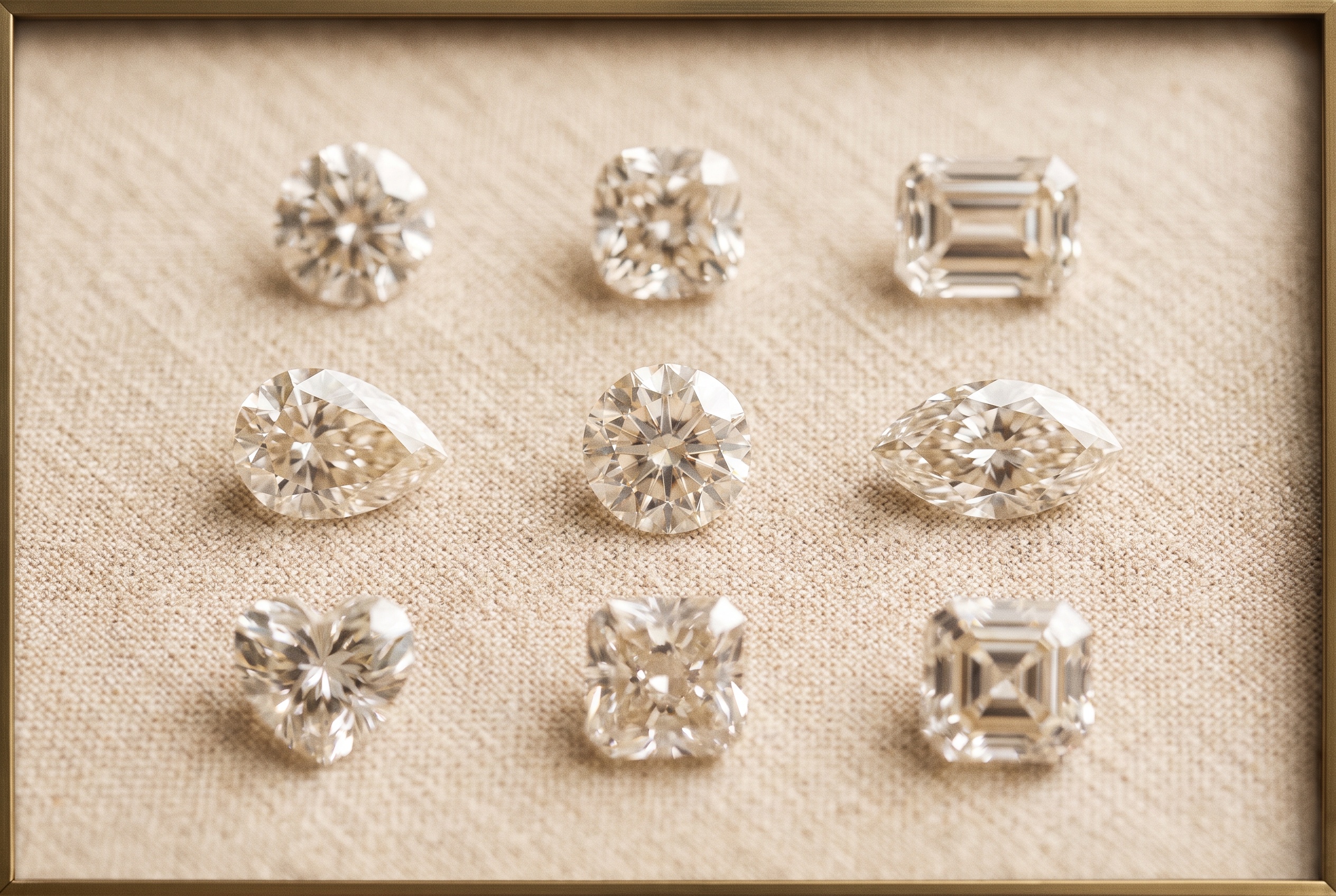
Round brilliant remains the most commonly sourced shape for drop earrings, offering maximum brilliance and the most forgiving matching tolerance since minor proportion variations are less visually obvious in a round stone than in an elongated fancy shape. Pear and marquise shapes are a strong secondary choice specifically for drop earrings, since their elongated, tapered silhouette naturally suits a vertical hanging element — a pear-shaped drop earring with the point facing down is one of the category's most enduringly popular styles. Oval and emerald cuts appear in more contemporary, geometric drop designs, while princess and cushion cuts are less common in this category since their more compact outline doesn't emphasize the vertical "drop" silhouette as effectively.
Sizing Considerations: Length and Carat Weight
Drop earring length is typically categorized into three bands that carry different sourcing implications: short drops (roughly under half an inch) that sit close to the earlobe and work well for everyday wear, mid-length drops (roughly half an inch to an inch and a half) that represent the bulk of category demand, and statement-length drops (over an inch and a half) for evening and formal wear. Stone size should scale with length — a longer drop with an undersized stone at the bottom reads as visually unbalanced, while a short drop with an oversized stone can look top-heavy. Retailers sourcing across all three length bands should plan stone inventory in proportion, rather than sourcing one stone size and simply varying the metal chain or bail length to create different products.
Color and Clarity Standards for Drop Earring Stones
Because drop earring stones are typically fewer and larger per earring than in a cluster or pavé design, individual stone quality carries more visual weight, and buyers in this category are generally more willing to pay for a higher color and clarity grade than in categories built around many small melee stones. A near-colorless G-H to D-F range with VS to VVS clarity is a common commercial standard for drop earring center stones, with the specific tier depending on price positioning — entry and mid-market drop earring lines commonly source G-H/VS commercial-grade stones, while premium lines push toward D-F/VVS for a more elevated finished product.
Lab-Grown vs. Natural Diamonds for Drop Earring Programs
Drop earrings span a wide price range depending on stone size and grade, which makes them a strong category for offering both lab-grown and natural options at different price points within the same design. CVD lab-grown diamonds let a retailer offer larger, higher-grade stones at a price point accessible to a broader customer base, which is particularly valuable in this category since stone size directly drives the visual impact of a drop design more than in categories where many small stones create the effect collectively. Natural diamonds remain the preferred choice for higher-end statement drop earrings marketed specifically on natural provenance, but lab-grown material lets a retailer offer a visually larger, more dramatic drop at the same price point a smaller natural stone would command.
Bail and Hardware Considerations
The connection between the top stud element and the hanging drop — commonly a bail, jump ring, or French wire — affects both how the earring hangs and its perceived quality, and is worth sourcing as carefully as the stones themselves. A well-fitted bail lets the drop hang straight and centered under normal wear rather than twisting or sitting at an angle, and secure, properly gauged connections reduce the risk of a drop separating from its stud component over time — a common source of warranty claims in this category if hardware is sourced as a low-cost afterthought rather than matched to the weight of the diamond element it needs to support.
Convertible and Detachable Drop Earrings
A meaningful share of the drop earring market is built around convertible designs, where the drop element detaches from a stud base, letting one earring function as either a simple stud or a full drop depending on the occasion. This construction adds real sourcing and manufacturing complexity — the detachable connection needs to be secure enough for confident everyday wear while still releasing cleanly when the wearer wants to remove the drop — but it also lets a retailer sell what is effectively two products in one purchase, which tends to justify a meaningfully higher price point than a fixed, non-convertible drop of comparable stone quality. Retailers considering a convertible line should source connection hardware specifically engineered for repeated attach-detach cycles rather than repurposing a standard fixed bail, since a fixed bail's connection point will wear and loosen faster under repeated use than hardware designed for the purpose.
Wholesale Price Positioning by Construction Type
| Construction | Relative Price Position | Key Cost Driver |
|---|---|---|
| Solitaire drop | Mid to high | Center stone size and grade |
| Cluster drop | Low to mid | Combined melee weight, moderate setting labor |
| Linear/bar drop | Low to mid | Calibrated melee consistency |
| Convertible drop | Mid to high | Stone quality plus specialized hardware |
Understanding where each construction type sits on this spectrum helps a retailer build a coherent product ladder rather than a scattered assortment — offering a linear bar drop as an accessible entry point, a solitaire drop as the core mid-tier offering, and a convertible or larger statement solitaire as the premium anchor piece gives a customer a clear reason to trade up within the category rather than shopping a competitor for a different price point — the same product-ladder logic retailers already apply to engagement ring assortments, adapted to a category where the price spread across constructions is driven as much by labor and hardware complexity as by carat weight alone.
Building a Drop Earring Program: Inventory Planning
- Source pre-matched pairs, graded on proportions as well as carat weight, rather than assembling pairs from general loose inventory.
- Stock pear and marquise shapes alongside round brilliant, since elongated shapes suit the vertical drop silhouette particularly well.
- Plan stone size in proportion to drop length across short, mid-length, and statement-length product lines.
- Offer a lab-grown and natural tier at different price points within the same design, since stone size drives visual impact heavily in this category.
- Source hardware rated for the weight of the drop element, not a generic low-cost bail across all sizes.
Trends Driving Drop Earring Demand
Drop earrings have benefited from a broader shift toward statement earrings as a primary styling focus, partly driven by more visible earring real estate in fashion photography and social media compared to other jewelry categories, and partly by a practical trend toward shorter hairstyles and updos that keep the ear area visible. Linear and bar-style drops specifically have grown alongside a broader minimalist jewelry trend, while longer, more dramatic statement drops have grown in the bridal and formal-event segment as brides increasingly choose a drop earring over a stud as their primary wedding-day earring choice.
Metal Choices and How They Interact With Stone Color
Metal choice in drop earrings does more visual work than in many other diamond jewelry categories, since the metal runs the full visible length of the piece rather than being confined to a small setting around a single stone. White metal (platinum or white gold) is the most common choice and tends to read as more seamless with near-colorless stones, since there's no warm-toned metal edge competing with the stone's color grade. Yellow and rose gold drop earrings have grown as a distinct styling choice, and pair particularly well with slightly warmer color grades (I-J range) where the warmth of the metal and the stone work together rather than the metal drawing attention to a stone that's meant to read as colorless — letting a retailer use a slightly lower, less expensive color grade in a yellow or rose gold setting without a perceptible quality tradeoff.
Retail Merchandising for Drop Earrings
Because hang and movement (or lack of it, for true drops) are core to how this category is experienced, product photography and in-store display that shows the earring at rest and in motion — rather than a flat, static photo alone — measurably improves conversion for drop earring listings compared to the flat-lay photography that works adequately for stud earrings. Retailers should also merchandise by length band explicitly (short, mid-length, statement) rather than a single undifferentiated "drop earrings" category, since buyers frequently shop with a specific length in mind tied to a specific occasion, and a clearly labeled length filter or category split makes it meaningfully easier for that buyer to find the right product quickly rather than scrolling through a mixed assortment spanning everyday studs-with-a-drop through full statement pieces.
Seasonal and Occasion-Driven Demand
Drop earring demand carries a distinct seasonal pattern tied closely to formal-event and gifting calendars: wedding season (spring through early fall in most US markets) drives strong demand for bridal-appropriate mid-length and statement drops, the holiday season drives gifting-motivated purchases concentrated in the accessible entry and mid-tier price bands, and prom and formal-event seasons drive a distinct, more price-sensitive spike in shorter, lower-cost drop styles. Retailers planning inventory depth for this category benefit from weighting stock toward each relevant tier ahead of its specific seasonal window, rather than maintaining flat inventory levels year-round across all price tiers.
Common Sourcing Mistakes in Drop Earring Programs
The most frequent sourcing error in this category is treating "matched pair" as satisfied by carat-weight matching alone — two stones of identical weight but different table diameter or depth percentage can hang at visibly different heights or catch light differently once set, which only becomes apparent after the pieces are finished and it's too late to correct cheaply. A second common mistake is under-investing in bail and connection hardware relative to stone cost, which shows up later as warranty claims when a drop separates from its stud during normal wear — a false economy, since the hardware failure typically costs more in customer goodwill and replacement labor than the small amount saved by sourcing a cheaper connector in the first place. A third is failing to differentiate inventory by length band, leading to an assortment that's overweighted in one length (commonly mid-length) while leaving gaps in the short and statement-length tiers that specific occasions and customer segments are actively shopping for.
Sourcing Diamonds for a Drop Earring Line Wholesale
Guru Diam supplies loose CVD lab-grown and natural diamonds — sold individually or as pre-matched pairs graded on proportions and color as well as carat weight — across the shapes and sizes most relevant to drop earring construction, with IGI, GIA, and GCAL certification available at 0.30ct and above. Trade buyers can review current matched-pair inventory through matching pairs and certified diamonds, and work with Guru Diam's custom jewelry team on bail and hardware construction through custom jewelry. In-stock inventory ships same-day from Guru Diam's New York and Los Angeles locations. New trade accounts can apply through trade partner, with current terms available at the wholesale hub. For related sourcing fundamentals, see our lab-grown diamond earrings guide, diamond hoop earrings guide, and men's diamond earrings guide.
Frequently Asked Questions
What is the difference between drop earrings and dangle earrings?
Drop earrings have a fixed, rigid connection with no independent movement — the diamond element hangs at a set length. Dangle earrings include a hinged or jump-ring connection that allows the piece to move freely as the wearer moves.
Why does pair matching matter more for drop earrings than other styles?
Because the drop stone sits in a fixed, static position, any mismatch in size, color, or proportions between the two earrings is immediately visible. Dangle and pavé designs are somewhat more forgiving since movement or multiple small stones partially mask minor asymmetry.
What diamond shapes work best for drop earrings?
Round brilliant is the most common choice for maximum brilliance and easier matching. Pear and marquise shapes are a strong secondary choice because their elongated, tapered outline naturally suits a vertical hanging silhouette.
Should drop earring stones be lab-grown or natural?
Both work well depending on price positioning. CVD lab-grown diamonds let a retailer offer a larger, more visually dramatic stone at an accessible price point, while natural diamonds remain preferred for premium statement pieces marketed on provenance.
What length are most drop earrings?
Mid-length drops, roughly half an inch to an inch and a half, represent the bulk of category demand. Short drops suit everyday wear, while statement-length drops over an inch and a half are more common for formal and bridal wear.
What color and clarity grade should drop earring center stones be?
A near-colorless G-H to D-F range with VS to VVS clarity is common, with the specific tier depending on price positioning — entry and mid-market lines commonly use G-H/VS, while premium lines push toward D-F/VVS.
What is a convertible drop earring?
A design where the drop element detaches from a stud base, letting the earring function as either a simple stud or a full drop. Convertible designs require hardware engineered for repeated attach-detach cycles and typically command a higher price than a fixed, non-convertible drop of comparable stone quality.
Guru Diam is a trade-only wholesale diamond supplier with locations in New York and Los Angeles, supplying loose natural and CVD lab-grown diamonds — sold individually or as pre-matched pairs — with IGI, GIA, and GCAL certification available, for jewelers building earring, ring, and finished jewelry lines. Browse current inventory in matching pairs or apply for a trade account through trade partner.