
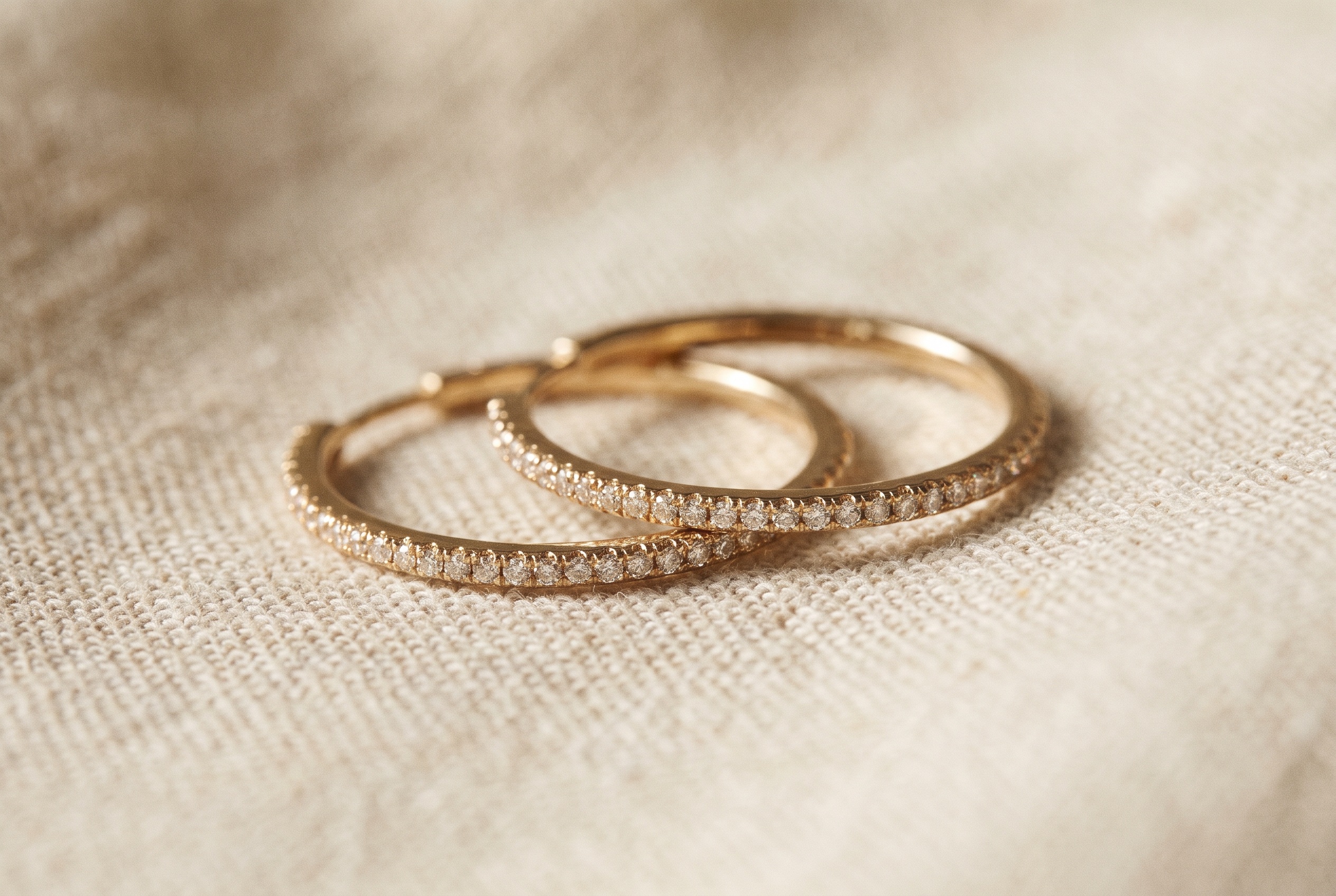
A diamond hoop earring is a circular or near-circular earring, set either partially or continuously with diamonds along its outer face, inner face, or both. For a jeweler or manufacturer building or restocking a hoop earring line, sourcing comes down to a specific set of decisions that don't apply the same way to a stud or drop earring: how much of the hoop's circumference to set, whether to place stones on the outside, inside, or both, how many individually matched stones the design requires, and how hoop diameter and stone count interact to drive both cost and finished-piece weight.
This guide is written for the trade — jewelers, designers, and manufacturers sourcing loose diamonds and diamond melee to build hoop earring lines for their own retail or wholesale inventory, not a consumer shopping guide. It covers the setting styles specific to hoops, sizing and stone-count math, matching considerations, metal and weight tradeoffs, and what to look for in a wholesale supplier for this category.
What Makes Hoop Earring Sourcing Different
Sourcing diamonds for a stud earring is largely a matched-pair decision — two stones, evaluated for consistency with each other. A hoop earring changes the math considerably: a single hoop can require anywhere from a handful of accent stones to well over 40 individually set diamonds depending on hoop diameter and how much of the circumference is set, and a pair of hoops doubles that count again. Every stone in a given hoop needs to read as visually consistent with its neighbors along the curve, and the two hoops in a pair need to match each other as an additional layer of consistency on top of that — which puts hoop earring sourcing closer to the lot-consistency requirements of a tennis bracelet or necklace than to a simple two-stone stud pair.
This also changes how grading reports factor into an order. Melee-sized stones used along a hoop's circumference are typically not individually certified — they ship as graded parcel goods against a consistent quality baseline, commonly a DEF+/VS+ standard, rather than stone-by-stone paperwork, since certifying dozens of small stones per pair individually isn't practical for either supplier or buyer. A larger center or feature stone used in a hoop design can be certified individually at 0.30ct and above the same way any loose stone would be.
Setting Styles Specific to Hoop Earrings
Outside-Set (Outward-Facing) Hoops
Diamonds are set along the outer face of the hoop, visible from the front when worn. This is the most common and most visually prominent hoop style, and the one most buyers picture when they think of a diamond hoop earring.
Inside-Out Hoops
Diamonds are set along the inner face of the hoop rather than the outer edge, so the stones face forward and outward when the hoop is worn, creating a distinctive look where the diamonds appear to float without a visible metal band around them from the front. Inside-out hoops require more careful prong or bezel engineering than outside-set hoops, since the setting has to hold securely from the inside curve of the band.
Double-Sided (Front-and-Back) Hoops
Diamonds are set on both the outer and inner faces, so the hoop reads as fully diamond-set from any viewing angle. This style roughly doubles stone count relative to a single-sided hoop of the same diameter and is priced accordingly.
Partial-Set (Bottom-Half) Hoops
Diamonds are set only along the lower, most visible portion of the hoop's circumference, with the upper portion near the earlobe left plain. This is a common cost-management choice, since it reduces stone count substantially compared to a fully set hoop while still delivering most of the visual impact, given that the lower half of a hoop is what's most visible when worn.
Hoop Diameter and Stone Count
Hoop diameter is the single biggest driver of stone count and total carat weight in this category — a larger hoop has more circumference to set, whether partially or fully, and requires proportionally more stones at a given size to maintain consistent spacing along the curve.
| Hoop Diameter | Common Style | Typical Stone Count Range (per earring, fully set) |
|---|---|---|
| 10–15mm (huggie/small) | Full or partial set | Roughly 10–20 stones |
| 16–25mm (medium) | Full, partial, or inside-out | Roughly 20–35 stones |
| 26–40mm+ (large/statement) | Full or double-sided | Roughly 35–60+ stones |
These ranges assume a common commercial melee size range for hoop work; a design using larger individual stones along the circumference reaches a given carat total with meaningfully fewer stones than one built from smaller, more numerous melee.
Matching Considerations Across a Hoop Pair
A well-matched hoop earring pair requires consistency at two levels simultaneously: within each individual hoop, where every stone along the circumference needs to read as visually uniform, and between the two hoops in the pair, which need to match each other in overall color, clarity character, and stone size. This second layer of matching is easy to underweight during sourcing but matters just as much as within-hoop consistency once the finished pair is worn side by side. Buyers ordering hoop earring melee should confirm with a supplier that the full quantity needed for a pair — not just enough for a single hoop — is being pulled from one consistent, matched lot.
Metal Weight and Structural Considerations
Because a hoop earring's metal band itself carries meaningful weight in addition to the diamonds set into it, larger diameter hoops require careful attention to overall finished-piece weight for comfortable all-day wear — a consideration that doesn't apply the same way to a stud or a shorter drop earring. Manufacturers commonly hollow the interior of a larger hoop's metal band to reduce weight while preserving the setting structure needed to hold diamonds securely along the circumference, a detail worth confirming with a setting partner before committing to a large-diameter, fully set design intended for everyday wear rather than occasional statement use.
Lab-Grown vs. Natural Diamonds for Hoop Earring Production
Because a fully set hoop's cost scales with total carat weight across dozens of stones, the natural-vs-lab-grown decision has an outsized effect on total piece cost compared to a single-stone product. CVD lab-grown diamonds let a manufacturer offer a fully diamond-set hoop, or a larger-diameter hoop, at a price point that would be difficult to reach with natural material of comparable color and clarity — a meaningful consideration for a retailer positioning a hoop earring line at a specific price tier. Both natural and lab-grown material can meet the same DEF+/VS+ commercial standard used across most hoop earring production; the origin decision is primarily a pricing and positioning choice for the retailer.
Diamond Quality Standards for Hoop Earrings
A DEF+/VS+ baseline (near-colorless to colorless, very slightly included or better) is a common commercial standard for hoop earring melee, reading as clean and bright across a circumference of stones without pricing the piece at the level of individually certified inventory. Buyers targeting a higher-end line sometimes step up to a tighter color range or a stricter clarity floor for a more uniformly white, eye-clean look along the full circumference, understanding that tightening the quality band across dozens of stones per pair meaningfully increases both sourcing cost and lead time versus a standard commercial grade.
Colored and Fancy-Shape Hoop Earrings
Fancy color hoop earrings — set with yellow, pink, blue, or green melee rather than colorless stones — are a growing sub-category offering retailers a differentiated product against an otherwise commoditized colorless hoop market. As with any fancy color line-set piece, sourcing fancy color melee for a hoop requires matching hue, tone, and saturation closely across every stone in both the individual hoop's circumference and the pair as a whole, which is a meaningfully more selective sourcing project than a colorless order at the same stone count and typically carries a longer lead time and a higher per-carat price.
Wholesale Pricing Structure for Hoop Earring Diamonds
Wholesale pricing for hoop earring diamonds is typically quoted per total carat weight at a specified quality standard, rather than per individual stone, since a manufacturer plans the finished piece around a total carat target established during design — driven by hoop diameter, setting style (partial, full, inside-out, or double-sided), and stone size. Buyers ordering at production volume, or maintaining a standing reorder for a retail hoop earring line, should expect per-carat pricing to improve with order volume and with looser size tolerance requirements, consistent with how melee is priced for other line-set jewelry categories.
Choosing a Hinge and Post Metal to Match the Diamond Setting
The hinge and post components of a hoop earring are typically cast in the same metal as the setting itself, but manufacturers sourcing components separately from a setting partner should confirm metal purity and finish match across the whole assembly — a mismatched hinge alloy can tarnish or wear at a visibly different rate than the rest of the piece over time, which becomes especially noticeable on a piece worn as frequently as a hoop earring typically is. This is a small detail relative to the diamond sourcing decisions covered above, but it's a common point of finished-piece quality complaints that's worth confirming before a full production run, particularly when working with a new components or setting partner for the first time.
What to Ask a Supplier Before Placing a Hoop Earring Order
- Is the melee sold as a matched, graded lot sufficient for a full pair, or pulled from mixed inventory that may vary between the two hoops?
- What's the size tolerance across the lot, and does it account for the tighter visual scrutiny a continuous circumference of stones receives compared to a scattered-stone design?
- Can physical samples be reviewed before a full production order, particularly for a first order with a new supplier or a new hoop diameter and stone-count combination?
- What's the reorder consistency if the same commercial grade needs to be matched again for a future production run of the same hoop style?
Common Manufacturing Defects to Screen For
A fully or partially set hoop involves a long sequence of individual prong or bezel-setting operations performed along a curved band, which creates real opportunities for manufacturing defects that a retailer should screen for before accepting a finished piece from a setting partner. Uneven spacing between stones along the curve, visible gaps where the setting line breaks continuity, prongs that are under-filed and catch on hair or fabric, and a mismatch in stone alignment between the two hoops in a pair are the most common issues found in finished hoop earring production. Requesting a physical inspection of a finished sample pair under magnification, rather than relying on photographs alone, before approving a full production run is standard practice for a manufacturer working with a new setting partner or a new hoop diameter and stone-count combination.
Hoop Earrings vs. Other Earring Styles: What Sourcing Carries Over
Hoop earrings share some sourcing logic with other line-set earring styles — drop earrings with a set gallery, and huggie earrings, which are essentially small hoops — but the continuous circumference of a true hoop introduces a stricter matching requirement than a design where set stones are confined to a smaller gallery or drop section. A manufacturer already sourcing melee for drop earring galleries can generally apply the same lot-consistency principles to hoop production, but should expect a hoop order to require proportionally more stones and a correspondingly tighter within-lot matching standard, given how much more of the finished piece is actually set with diamonds along its full curve.
Clasp and Post Mechanisms for Hoop Earrings
Because a diamond-set hoop is heavier and structurally more complex than a plain metal hoop, manufacturers typically specify a reinforced hinged snap-closure or a screw-back post rather than a simple friction-back post, particularly for larger diameter or fully set designs where the finished piece carries meaningful weight. A secure closure mechanism matters more for a diamond hoop than for a lightweight plain hoop specifically because losing a fully set piece represents a much greater material loss — a detail worth confirming with a components supplier or setting partner before finalizing a production specification, since closure failure is one of the more common warranty-claim points in this category.
Repair and Durability Considerations for Retailers
A fully or partially set hoop earring carries a structurally higher lifetime repair rate than a stud, since a continuous or near-continuous line of set stones along a circumference that flexes and catches on hair, clothing, and headphones during daily wear sees more physical stress than a fixed stud setting. Retailers building a hoop earring program should plan for this from the outset, including maintaining a small reserve of matching replacement melee from the original production lot to keep future repairs visually consistent, and communicating a clear repair policy to the end customer at the point of sale.
Building a Hoop Earring Line Across Multiple Price Tiers
Retailers building out a hoop earring category typically stock across at least three tiers to capture the full range of buyer budgets: a small, partially set huggie-style hoop as an accessible entry point, a medium fully set hoop as the core, best-selling size in most retail assortments, and a larger statement hoop — often double-sided or inside-out — positioned as a higher-margin, occasion-driven purchase. Planning diamond sourcing around this tiered structure from the outset, rather than sourcing each size independently as demand arises, lets a manufacturer negotiate melee pricing across a larger combined order and maintain consistent quality standards across the full line, which also simplifies marketing the category as a coherent size range rather than a set of unrelated individual products.
Seasonal and Gifting Demand Patterns
Diamond hoop earrings see meaningfully higher retail demand around major gifting periods — the winter holiday season and, in many markets, spring occasions tied to graduations and Mother's Day — a pattern that has a direct sourcing implication for manufacturers and retailers planning inventory. Placing a melee order early enough to have finished pairs in stock ahead of peak gifting season, rather than reacting to demand once it's already climbing, is standard practice in the category, and buyers should factor typical setting and finishing lead times into their sourcing timeline accordingly, particularly for a larger or more complex design like a fully set, double-sided statement hoop.
Sourcing Diamond Hoop Earring Inventory Wholesale
Guru Diam supplies both calibrated diamond melee and larger certified loose stones for jewelers and manufacturers building hoop earring lines, across natural and CVD lab-grown material and across the standard color and clarity ranges used in commercial-grade production. Melee is available in round brilliant and calibrated fancy shapes at DEF+/VS+ and tighter tiers, sold as consistent, gradable lots suited to full-pair, matched-hoop production rather than mixed parcel stock. In-stock inventory ships same-day from Guru Diam's New York and Los Angeles locations, and trade accounts can review current melee stock in matching pairs, browse certified larger stones in certified diamonds, or check fancy color options for a colored hoop line in fancy color loose diamonds. Manufacturers building a custom hoop design can start at custom jewelry, and new trade accounts can apply through trade partner, with current terms available at the wholesale hub. For background on sourcing calibrated melee for other continuous line-set pieces, our diamond tennis necklace sourcing guide covers similar lot-matching considerations at a larger scale.
Frequently Asked Questions
How many diamonds are in a pair of hoop earrings?
Stone count depends heavily on hoop diameter and setting style, ranging from roughly 10-20 stones per earring for a small, fully set huggie hoop up to 60 or more for a large-diameter, fully or double-sided set statement hoop. Sourcing and pricing are generally planned around total carat weight rather than stone count alone.
What's the difference between inside-out and outside-set hoops?
Outside-set hoops place diamonds along the outer face of the band, the most common and visually prominent style. Inside-out hoops set diamonds along the inner face instead, so the stones face forward when worn, creating a look where diamonds appear to float without a visible plain-metal band from the front.
What clarity and color should hoop earring melee be?
A DEF+/VS+ standard (near-colorless to colorless, very slightly included or better) is a common commercial baseline that reads clean and bright along a hoop's circumference. Higher-end lines sometimes tighten to a stricter color or clarity floor for a more uniform, eye-clean look, at additional sourcing cost.
Are hoop earring diamonds individually certified?
Melee-sized stones used along a hoop's circumference are typically not individually certified — they're sold as graded parcel goods against a consistent quality standard. A larger feature or center stone in a hoop design can be certified individually at 0.30ct and above.
Should hoop earrings use natural or lab-grown diamonds?
Either can meet the same quality standard and look identical in the finished piece. Because a fully set hoop's cost scales with total carat weight across dozens of stones, CVD lab-grown diamonds let a manufacturer offer a fully set or larger-diameter hoop at a more accessible price point, which is why lab-grown material is common in this category.
Can hoop earrings be made with fancy color diamonds?
Yes. Fancy color hoop earrings built from yellow, pink, blue, or green melee are a real, growing sub-category, though matching hue, tone, and saturation across every stone in both hoops of a pair requires more selective sourcing than a colorless order, typically meaning a longer lead time and higher per-carat cost.
What size hoop earring should a retailer stock first?
A medium-diameter (roughly 16–25mm), fully set hoop is typically the best-selling core size in most retail assortments, balancing everyday wearability with enough set stones to read as a genuine statement piece. Retailers building out the category over time generally add a smaller partially set huggie style and a larger statement size once the core size is established.
Guru Diam is a trade-only wholesale diamond supplier with locations in New York and Los Angeles, supplying calibrated diamond melee and certified loose stones — natural and CVD lab-grown — for jewelers and manufacturers producing hoop earrings and other line-set jewelry. Browse current melee inventory in matching pairs or apply for a trade account through trade partner.