
Cushion vs Princess Diamond: A Buyer's Guide
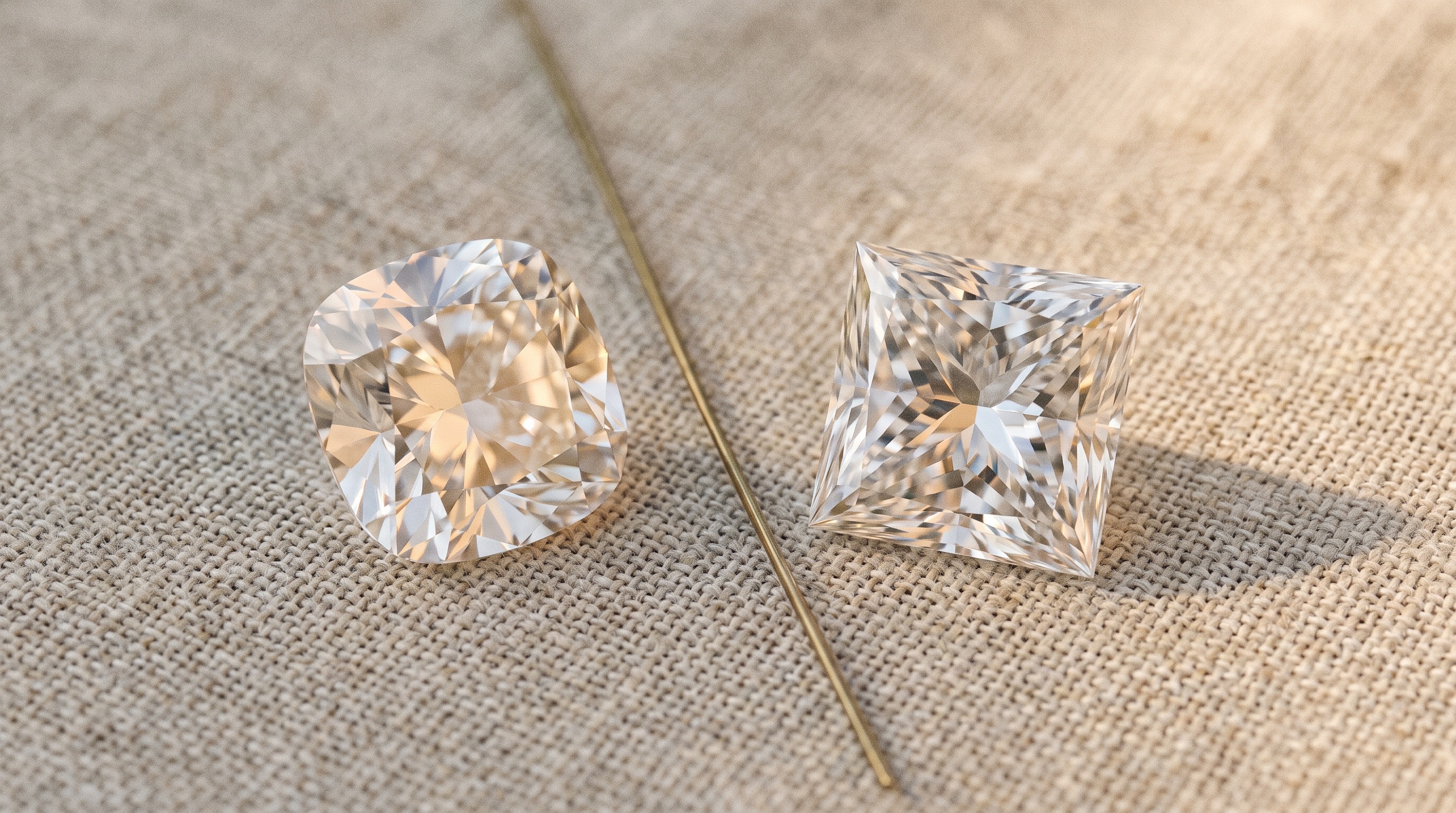
Cushion is a rounded-square "pillow" cut with soft, curved corners and a romantic, vintage-leaning look, while princess is a square brilliant cut with sharp, unfinished corners and a crisp, modern geometric outline. Both shapes start from a roughly square footprint, but the way each interprets that footprint — and the light performance, price, and durability that follow — differ enough to matter for sourcing and selling. Whether a buyer types the question as cushion vs princess diamond, cushion cut vs princess cut diamond, princess cut diamond vs cushion cut, or princess vs cushion cut diamond, it's the same underlying comparison: soft-and-rounded against sharp-and-geometric, on two shapes that otherwise sell to overlapping bridal budgets. This guide covers the full comparison — cut structure, light performance, price, face-up size, clarity forgiveness, setting requirements, and durability — plus how the two fit into a wholesale buying strategy.Cushion Cut vs Princess Cut Diamond: The Core Differences
The fastest way to separate these two shapes is by outline and facet philosophy. Cushion is a modified brilliant cut with rounded corners and gently curved sides, built to soften a square-ish outline into something that reads as antique-adjacent even in a fully modern stone. Princess is also a brilliant cut, but it keeps the corners sharp and unfinished, producing a crisp, unmistakably geometric silhouette that reads as modern rather than vintage. Both shapes use a brilliant facet arrangement rather than a step cut, which is worth noting because it separates them from square step cuts like Asscher — cushion and princess are both built primarily for sparkle, not the "hall of mirrors" flash pattern step cuts produce. Where they diverge is in how that brilliance gets framed: cushion's curved outline breaks up the geometry and softens the overall look, while princess's sharp corners sharpen it. A customer choosing between the two is rarely choosing based on sparkle alone — they're choosing a personality: warm and romantic versus clean and architectural.What Is a Cushion Diamond?
The cushion cut traces back to the 19th century, originally cut with fewer, larger facets close to what's now called an "old mine" style before evolving into the modern cushion brilliant, which adds facets for meaningfully more sparkle than its antique ancestor. The defining trait is the pillow-like outline — rounded corners and gently curved sides instead of straight edges — which softens the silhouette and gives cushion its vintage-romantic reputation, even though most cushion stock sold today is a fully modern cut rather than a true antique. Modern cushion comes in two broad facet families sold under the same name: "cushion brilliant," cut with a classic brilliant facet pattern for maximum sparkle, and "chunky" or "crushed ice" cushion, cut with more numerous, smaller facets that produce a sparkly, almost broken-glass texture across the crown. Both are labeled simply "cushion" in most listings, so knowing which facet style you're actually sourcing matters — the two look noticeably different in hand despite sharing a name.What Is a Princess Diamond?
Princess is a comparatively recent invention, developed in the 1960s and 1970s specifically to combine round-brilliant-level sparkle with a square outline. It uses a brilliant facet arrangement rather than a step cut, which is why princess diamonds sparkle far more intensely than other square shapes like Asscher or emerald cut. The signature feature of a princess cut is its four unfinished, pointed corners — the most vulnerable part of the stone, and the reason it needs corner-specific prong protection in almost every setting. Princess cutting is also notably efficient: because the shape sits close to the natural square-ish outline of much rough diamond crystal, princess typically retains more of the original rough than round cutting does, which is part of why it has historically been positioned as a value-forward alternative to round for buyers who still want strong brilliance.Light Performance: Cushion's Warm Sparkle vs Princess's Sharp Brilliance
Cushion's larger, more open facets — or, in the crushed-ice style, its dense micro-facet texture — produce broad, warm flashes of light rather than round's tight on/off contrast. A well-cut cushion brilliant throws fewer, bigger flashes with real presence; a well-cut crushed-ice cushion throws a higher volume of smaller, sugary flashes. Either way, the effect reads as textured and romantic rather than sharp. Princess, by contrast, packs a dense small-facet pattern into a compact square outline, producing intense, fragmented brilliance that's closer in character to round than cushion is. Because princess retains more brilliant-cut structure per unit of surface area than cushion's larger facets allow, it tends to throw more total flashes of light for a given carat size — the tradeoff customers are told about is corner durability, not sparkle. For a customer who wants round's light performance but is committed to a square silhouette, princess is usually the closer match; for a customer who wants a softer, more textured sparkle with a forgiving outline, cushion wins.Cushion vs Princess Diamond at a Glance
| Cushion | Princess | |
|---|---|---|
| Visual character | Soft, rounded-square "pillow" outline; romantic and vintage-leaning | Sharp-cornered square brilliant; crisp, modern, geometric |
| Light performance | Large open facets (brilliant style) or dense micro-facets (crushed ice) produce broad, warm flashes | Dense small-facet pattern produces intense, fragmented brilliance closer to round |
| Price tier (per carat, same color/clarity) | Mid-market fancy shape; price varies more by facet style than by shape alone | Mid-market fancy shape; efficient rough yield often supports competitive per-carat pricing |
| Face-up size at same carat weight | Rounded corners can read marginally smaller face-up than a squared outline | Compact square footprint reads close to its actual carat weight, similar to round |
| Clarity forgiveness | Larger facets can reveal inclusions more readily than a dense brilliant pattern | Corner and facet structure masks minor inclusions reasonably well, closer to round |
| Best for | Vintage-romantic bridal, halo settings, buyers who want antique-adjacent character | Modern minimalist bridal, channel-set and pavé bands, buyers who want round-level sparkle in a square outline |
Price Per Carat: What Actually Drives the Difference
Neither shape is consistently more expensive than the other — both sit in the same mid-market fancy-shape tier, well below round's demand-driven premium and well below true antique cuts. What moves the price needle within each shape is different, though, and it's worth knowing which lever applies before quoting a stone. For cushion, facet style is the bigger variable. A cushion brilliant and a crushed-ice cushion of identical carat weight, color, and clarity can carry different premiums depending on current demand for that particular look, and outline matters too — a more perfectly square cushion tends to price slightly firmer than an elongated rectangular cushion, similar to how square-vs-rectangular pricing plays out in radiant and emerald cut. For princess, pricing tracks closer to standard grading factors, because its cutting yield from rough is relatively efficient and consistent stone to stone. That efficiency is also why princess has historically undercut round on a per-carat basis for buyers who want brilliant-cut sparkle without round's demand premium — a genuinely useful merchandising angle when a client is choosing between round and a square alternative on a fixed budget.Carat Weight and Face-Up Size
Carat weight measures mass, not visible area, and cushion and princess don't spread that mass across the face of the stone identically. Princess retains more of its carat weight in a tight, compact square outline — similar in spirit to round — so a 1.00ct princess reads close to its actual weight when viewed face-up. Cushion's rounded, slightly softened outline can read marginally smaller face-up at the same carat weight, because material is cut away at the corners rather than left square. The gap isn't dramatic — nothing like the difference between round and an elongated shape like marquise — but it's noticeable enough at 1-carat-plus sizes that it's worth setting expectations before a customer compares the two side by side in the case. A buyer anchored to a specific visual size, rather than a specific number on the certificate, should generally be pointed toward princess or a slightly larger cushion to land on the same face-up look.Color and Clarity: How Each Cut Hides or Reveals Flaws
Facet pattern determines how forgiving a cut is toward body color and inclusions, and cushion and princess land at different points on that spectrum. Cushion's larger, more open facets — particularly in the crushed-ice style — can let body color show through more visibly than a tightly faceted shape does, so a buyer sourcing cushion for a customer who wants a bright, icy-white face-up look sometimes needs to go a color grade higher than they would for the same look in princess. Princess's smaller, denser facet pattern behaves more like round in this respect, masking a faint warm tint more effectively at the same color grade. The same logic extends to clarity: princess's corner and facet structure tends to mask minor inclusions reasonably well, while cushion's larger facets can make inclusions more visible at an equivalent grade. Neither shape is as forgiving as round, which remains the most inclusion-masking cut overall, but princess is the closer of the two to round's behavior on both fronts — a detail worth factoring into a quote whenever a customer is choosing between the shapes at a fixed budget.Cushion Facet Styles: Brilliant vs Crushed Ice
This is a sourcing wrinkle that's specific to cushion and doesn't have a princess equivalent, so it's worth calling out on its own. A parcel or a single stone labeled simply "cushion" could be a soft, large-faceted cushion brilliant or a sparkly crushed-ice cushion, and the two look different enough in hand that a customer expecting one and receiving the other will notice immediately — the crushed-ice look is denser and more textured, the cushion brilliant look is bolder and more open. Princess sourcing doesn't carry this ambiguity; the facet arrangement is far more standardized shape to shape. What princess sourcing does require instead is a corner-condition check, particularly on any previously-set or pre-owned princess stock, since chip risk concentrates specifically at the four unfinished points. Knowing which question to ask — facet style for cushion, corner condition for princess — is the fastest way to avoid a stone that technically matches its certificate but doesn't match the customer's expectation.Setting Styles and Corner Protection
Setting choice is where cushion and princess diverge most sharply, and it's the single most practical difference to flag for retail-facing staff. Princess is almost always set with a four-prong or V-prong mounting engineered to wrap and protect each of the four corners individually — skipping that protection is the single most common cause of princess-cut chipping in daily wear. That requirement narrows princess's setting range: it works best in solitaires, channel-set bands, and pavé designs where the corner-protecting prongs read as part of the design rather than a compromise. Cushion has no comparable vulnerable point, which makes it dramatically more setting-flexible. It's compatible with everything from classic four- and six-prong solitaires to bezels and full pavé halos without the corner-specific engineering princess requires. That flexibility is part of why cushion shows up across a broader range of jewelry — rings, earrings, and pendants alike — while princess skews more heavily toward rings and structured, channel-set bands where its geometry has room to read cleanly.Durability and Everyday Wear
Both shapes sit at 10 on the Mohs scale, so the durability conversation isn't about hardness — it's about exposed geometry. Princess's four sharp, unfinished corners are genuinely the most wear-vulnerable feature of any commonly sold diamond shape, more exposed even than a step cut's cropped corners, because nothing has been trimmed away to soften the point. A hard knock against a countertop or car door concentrates force directly on that corner, and a setting without full corner coverage meaningfully raises chip risk over years of daily wear. Cushion's rounded corners remove that failure point almost entirely. There's no sharp point for an impact to concentrate on, which makes cushion a lower-maintenance everyday choice than princess by a real margin — closer in practical durability to round than to princess, despite starting from the same square-ish rough. For an active daily-wear client, or a retailer stocking a case meant to hold up with minimal aftercare conversations, that's a meaningful selling point cushion has and princess doesn't.Which Shape Should You Stock? Buying Considerations for Trade Partners
A few practical filters settle the cushion-vs-princess question faster than a pure aesthetics debate. A customer who says "I want something that feels a little vintage but not a full antique cut" is almost always describing cushion. A customer who says "I want round's sparkle but I don't want round" is almost always describing princess. Knowing which sentence you're hearing is the fastest way to point a retail customer at the right shape without walking them through the full comparison every time.- Vintage-adjacent, romantic-styling buyers should be pointed to cushion, especially with a halo or a mixed-metal setting that leans into its softer light pattern.
- Modern-minimalist, geometric-styling buyers should be pointed to princess, particularly in channel-set or pavé bands where its sharp lines read as intentional.
- Low-maintenance, everyday-wear buyers generally do better with cushion, given its lack of an exposed vulnerable point.
- Budget-and-brilliance-first buyers who still want a square outline often land on princess, given its efficient rough yield and round-adjacent sparkle.
- Retailers building a broad bridal case benefit from stocking both rather than picking one — the two shapes serve genuinely different requests even though both start from a similar footprint.
Sourcing Cushion and Princess Lab-Grown Diamonds Wholesale
Guru Diam stocks both cushion and princess — in cushion's brilliant and crushed-ice facet styles, and princess in standard calibrated sizing — as part of a broader catalog that also covers every other standard, antique, and exotic diamond shape. All inventory is CVD lab-grown, certifiable through IGI, GIA, or GCAL depending on what a client's paperwork requires, so a trade partner isn't locked into a single lab's report regardless of which shape or grade a customer settles on. In-stock loose cushion and princess diamonds ship same day out of both US locations — New York before 6pm EST, Los Angeles before 4pm PST — which matters most for a retailer filling a specific carat-weight or budget request quickly rather than waiting on a multi-week reorder. When a client wants either shape finished into a piece rather than sold loose, custom engagement rings turn around in 4-6 days and ship unbranded by default, so retail partners can resell under their own name. Because Guru Diam carries the full range of shapes rather than a narrow bestseller list, cushion and princess can be sourced from the same account as antique cuts, fancy-color stones, and matched side-stone sets for three-stone or halo builds — one vendor, one shipment, one relationship instead of splitting orders across suppliers. Start with certified loose diamonds for graded stock in both shapes, matching pairs for side-stone sets, or fancy color loose diamonds if a client wants to go beyond white stones entirely. For the full catalog, see the wholesale hub; to open a trade account, see trade partner; and for custom builds around either shape, custom jewelry is the place to start. If you're comparing cushion against a different shape rather than princess specifically, our round vs cushion, radiant vs cushion, and cushion vs oval guides cover those pairings in the same depth.Frequently Asked Questions
Is cushion or princess cut more expensive per carat?
Neither shape is consistently more expensive than the other — both sit in the same mid-market fancy-shape tier. Cushion pricing varies more by facet style, since a cushion brilliant and a crushed-ice cushion can command different premiums, while princess pricing tends to track closer to standard grading factors because its cutting yield from rough is relatively efficient.
Does a princess cut diamond need special prong protection?
Yes. Princess diamonds have four unfinished, pointed corners that are the most vulnerable part of the stone, so settings need prongs positioned specifically to cover and protect each corner. A setting without adequate corner coverage significantly raises the risk of chipping over time, which is why princess is almost always sold with a four-prong or V-prong mounting.
Which cut is more forgiving of lower clarity, cushion or princess?
Princess tends to mask minor inclusions somewhat better due to its dense facet structure, while cushion's larger, more open facets — especially in the cushion brilliant style — can make inclusions more visible at the same clarity grade. Neither shape is as forgiving as round, which remains the most inclusion-masking shape overall.
Does a cushion cut diamond look smaller than a princess cut at the same carat weight?
Marginally, yes. Princess retains more of its carat weight in a compact square outline, similar to round, while cushion's rounded corners are cut away rather than left square, which can make it read slightly smaller face-up at the same weight. The difference is subtle and mostly noticeable at 1-carat-plus sizes rather than in smaller stones.
What's the difference between a cushion brilliant and a crushed ice cushion?
Cushion brilliant uses larger, more open facets that throw fewer but bigger flashes of light, while crushed ice cushion uses a denser pattern of smaller facets that produces a sparkly, textured look across the crown. Both are sold simply as "cushion," so it's worth confirming facet style specifically when sourcing or setting customer expectations.
Which shape is better for everyday wear, cushion or princess?
Cushion is generally the lower-maintenance everyday choice, since its rounded corners remove the exposed vulnerable point that princess's four sharp corners create. Princess can absolutely hold up in daily wear, but it depends on a setting with full corner protection, while cushion has no comparable failure point to protect against.