
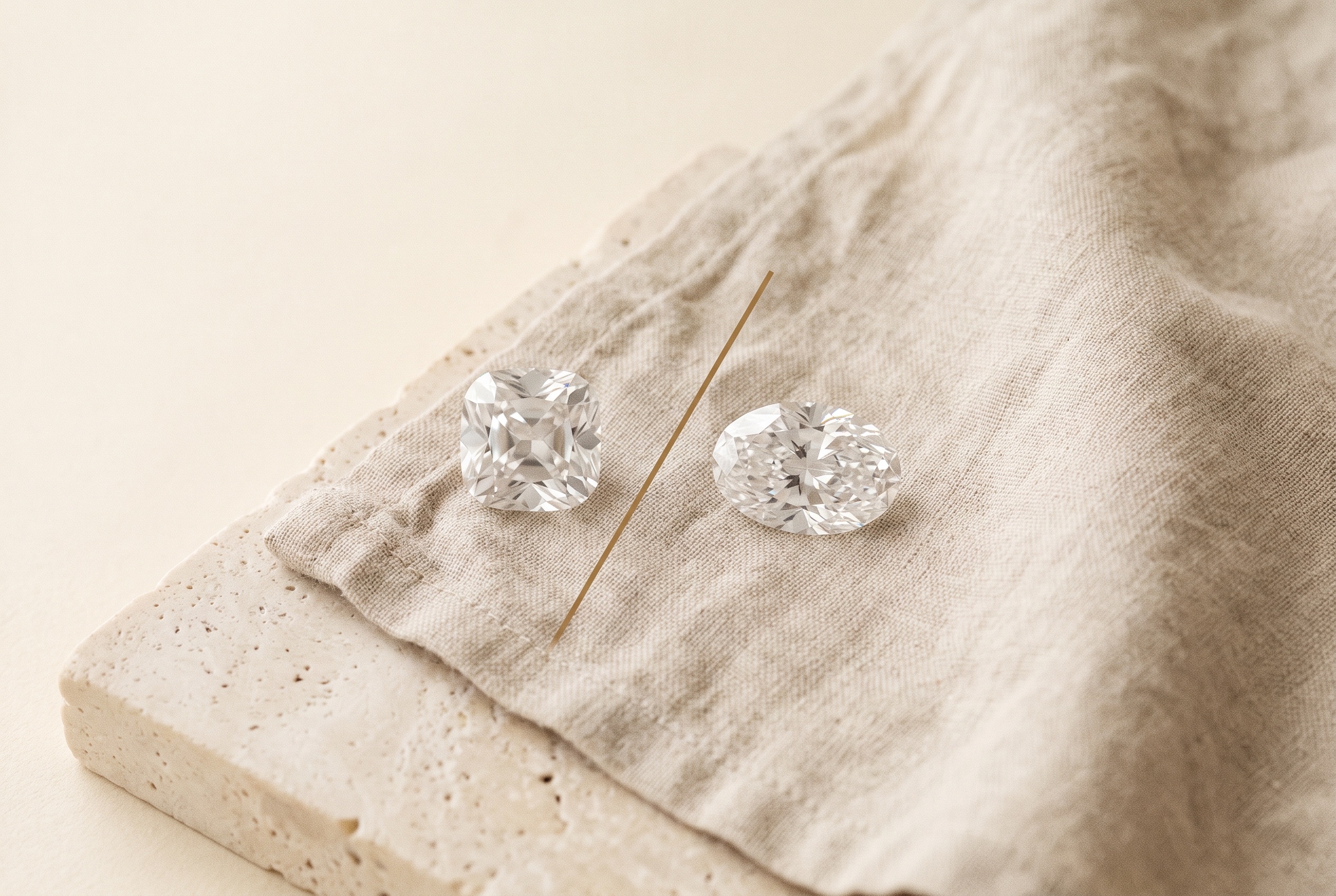
Cushion vs Oval Diamond: A Wholesale Buyer's Guide
Cushion and oval are two of the most requested fancy diamond shapes in the trade, and they solve different problems for the wearer. A cushion is a rounded-square "pillow" shape with larger facets that produce broad, soft flashes of light; an oval is an elongated brilliant that maximizes perceived carat size and delivers even, round-brilliant-level sparkle. The choice usually comes down to face-value size versus romantic, vintage-leaning character — not which shape is objectively better.
Both shapes are staples of any wholesale fancy-cut case, but they sell to different customers and pair with different hand shapes, finger lengths, and style preferences. This guide covers how cushion and oval actually differ in facet structure, light behavior, sizing illusion, and setting style, plus where each one earns its place in a jeweler's inventory.
What Is a Cushion Cut Diamond?
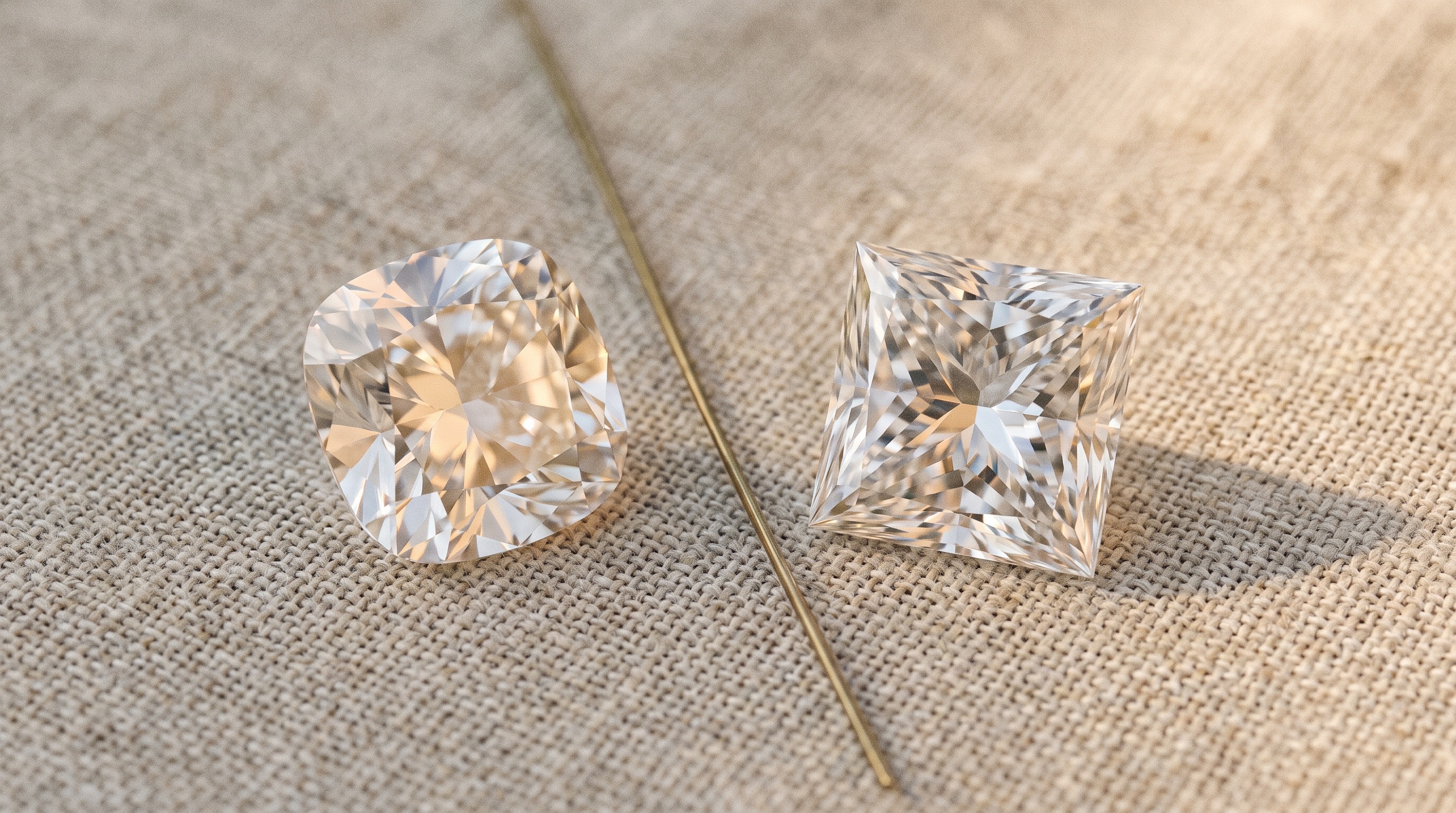
A cushion cut diamond has a square-to-rectangular outline with rounded corners — the "pillow" shape the name refers to — and is cut with fewer, larger facets than a round or oval brilliant. That larger facet structure is what gives cushion its signature look: broad, soft flashes of light rather than the tight, rapid-fire sparkle of a round brilliant. It's the modern descendant of the antique cushion and Old Mine cut styles that dominated diamond cutting before the modern round brilliant was standardized in the early 20th century.
Modern commercial cushion cuts split into two broad families. A "cushion brilliant" (sometimes called modified cushion brilliant) uses more facets and a faceting pattern closer to a round brilliant, producing crisper, more contemporary sparkle. A "cushion modified" or vintage-style cushion keeps the historically larger facets and higher crown, producing the warmer, softer glow associated with antique diamonds. Both are common in the trade; when a customer says "cushion," it's worth clarifying which style they mean, since the light performance differs meaningfully between them.
Cushion is also available in more elongated proportions (rectangular cushion) as well as the classic square cushion, giving it some of oval's elongating effect while keeping the rounded-corner pillow silhouette.
What Is an Oval Cut Diamond?
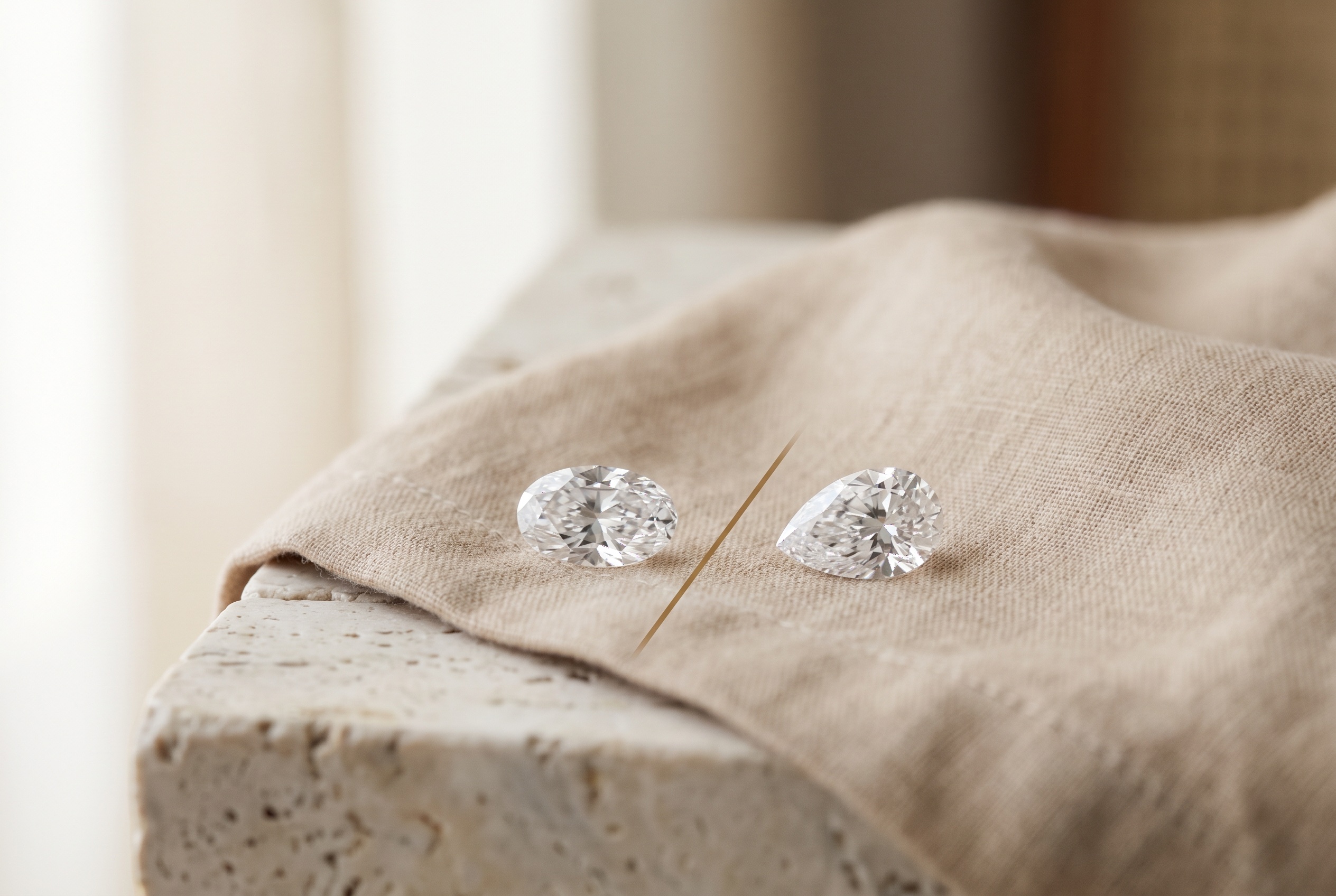
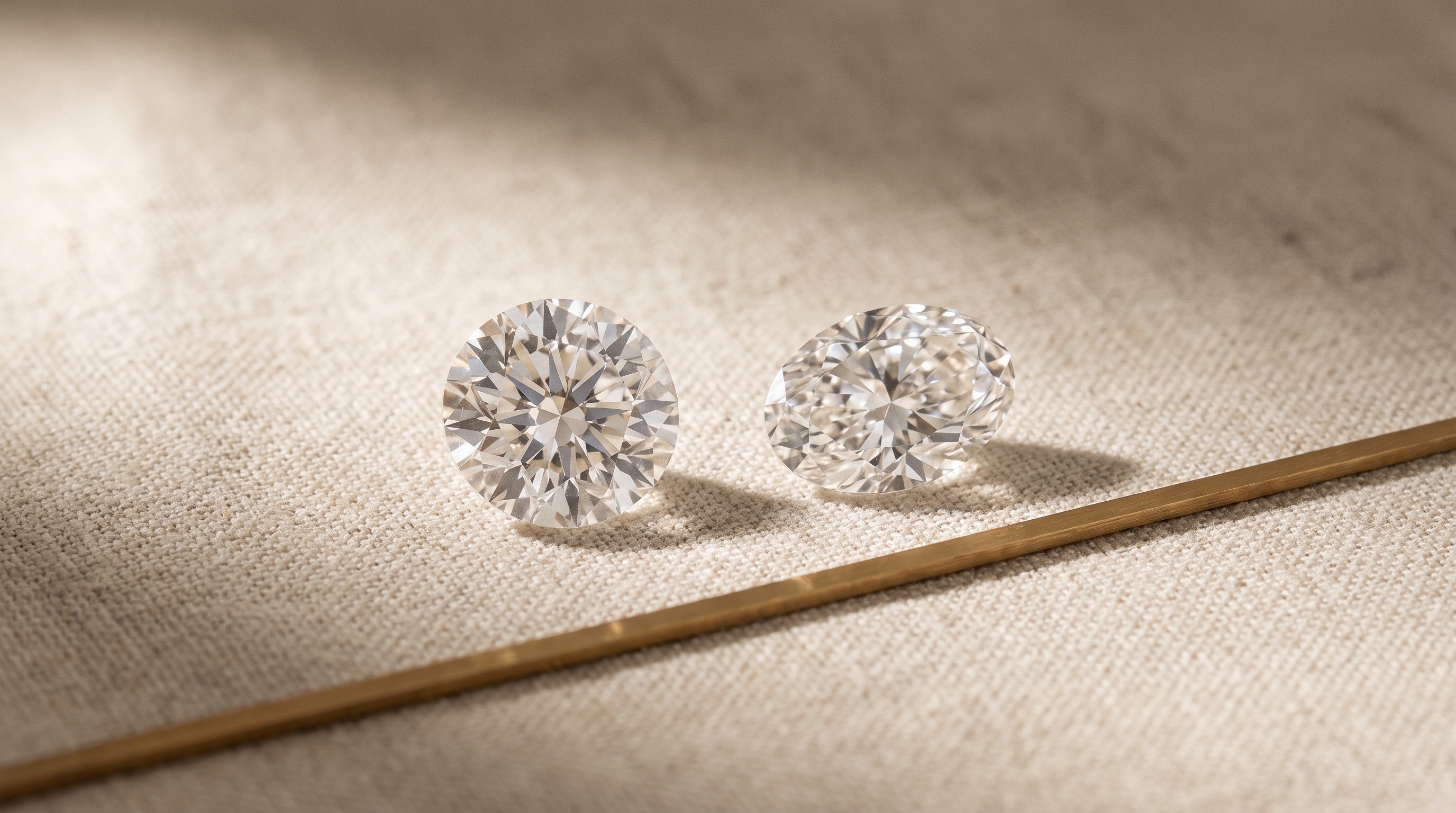
An oval cut diamond is a modified round brilliant stretched into a symmetrical, elongated ellipse — same facet logic as a round brilliant (typically 56 to 71 facets), just reshaped. Because it shares its faceting arrangement with round brilliant, a well-cut oval delivers comparable fire and scintillation to a round stone of equal quality, while its elongated outline reads larger across the top and visually lengthens the finger. It's a newer commercial shape than cushion, popularized in the 1960s specifically as a high-brilliance alternative to round.
Oval has no corners and no facet-size variation the way cushion does — it's a single continuous curve from end to end, symmetrical on both axes. That structural simplicity is a large part of why oval performs so predictably: buyers know roughly what they're getting in terms of brilliance and proportion regardless of which supplier cuts it. For a deeper look at how oval compares against a different elongated shape, see our companion guide on oval vs pear diamond.
Cushion vs Oval Diamond: Quick Comparison Table
| Attribute | Cushion | Oval |
|---|---|---|
| Visual character | Rounded-square "pillow" shape, soft romantic outline | Elongated, symmetrical ellipse |
| Light performance | Larger facets, broad soft flashes; brilliant-style cushions add crisper sparkle | Round-brilliant-level fire and scintillation, evenly distributed |
| Price tier (vs. round of same quality tier) | Regular fancy — priced below round per carat | Regular fancy — priced below round per carat, similar tier to cushion |
| Best for | Vintage and romantic styling, softer-toned color grades, rounder hand shapes | Maximum perceived size, finger-elongating effect, versatile modern styling |
| Face-value size vs. carat weight | Reads closer to true carat weight; compact footprint | Reads noticeably larger than carat weight due to elongated spread |
| Common uses | Engagement ring centers, vintage-inspired halos, antique-style jewelry | Engagement ring centers, three-stone designs, stud earrings, elongated pendants |
Facet Structure and Sparkle Style
The clearest technical difference between these two shapes is facet size and pattern. Cushion cuts use fewer, larger facets — historically as few as 58, though modern cushion brilliants add more — which produce broad, chunky flashes of light rather than a fine, scattered sparkle. This gives cushion a warmer, more romantic light signature that reads as soft rather than sharp, especially in vintage-style cushions with a higher crown.
Oval, sharing its facet pattern with the round brilliant, produces the opposite effect: many smaller, precisely angled facets generating rapid, fine-grained sparkle (often described as fire and scintillation) evenly across the stone's surface. Neither light style is objectively better — cushion's broad flashes suit a buyer drawn to antique or vintage character, while oval's fine sparkle suits a buyer who wants maximum brilliance and a more contemporary look. This is frequently the deciding factor for customers choosing between the two shapes once they've seen both side by side under the same light.
Lighting environment changes how pronounced this difference reads in practice. Under bright, direct light — a jewelry counter's spotlighting, or outdoor sun — oval's small, numerous facets throw rapid, high-contrast flashes that read as maximum sparkle. Under softer, ambient light — a restaurant, an office, most day-to-day settings — cushion's larger facets hold their broad, warm glow more consistently, while an oval's sparkle can settle into a quieter, steadier shine. It's worth showing both shapes to an undecided customer under more than one lighting condition rather than only the counter spotlight, since the two shapes can trade places for which one looks more impressive depending on where it's actually going to be worn.
Shape and Face-Value: Pillow Square vs. Elongated Silhouette
Cushion's rounded-square outline is compact — it doesn't stretch the way an elongated shape does, so a cushion diamond's face-value size tracks closer to its actual carat weight. That compactness is part of its appeal for buyers who want a shape that reads as a substantial, grounded stone rather than a shape that visually inflates size. A well-cut cushion also has a lower depth-percentage tolerance to worry about than some other fancy shapes, since a too-deep cushion can look notably smaller from the top than its carat weight suggests.
Oval's elongated silhouette does the opposite: it spreads the same carat weight across a larger visible top surface, so an oval reads meaningfully larger face-up than a cushion of identical weight. For carat-conscious buyers working within a fixed budget, this is one of the most concrete, measurable differences between the two shapes — an oval will almost always look bigger than a cushion at the same price point and quality tier.
Which Face Shapes and Hand Sizes Suit Each
Because these two shapes read so differently, they tend to flatter different hand types. Oval's elongated silhouette lengthens the finger visually, which makes it a strong match for shorter or wider fingers — the same optical elongation effect that makes it popular across nearly every hand type is at its most noticeable on hands where lengthening is the goal. Cushion's compact, rounded-square footprint doesn't add that same elongating pull; it sits more like a soft block on the finger, which can suit longer, slender fingers that don't need additional visual lengthening and instead benefit from a shape that adds presence and width.
The same logic loosely extends to face-shape pairing advice some jewelers use with retail customers when styling complementary jewelry (earrings, pendants) alongside a ring: elongated shapes like oval are often recommended to soften angular features, while rounded, structured shapes like cushion are recommended to add definition against very soft or round features. This is styling guidance, not a hard rule — but it's a useful selling point at the counter when a customer is torn between the two shapes.
Length-to-Width Ratio: What "Cushion" Actually Covers
"Cushion" isn't a single fixed outline the way round is — it's a family that spans a roughly 1:1 length-to-width ratio (classic square cushion) up through 1.5:1 or slightly beyond (rectangular or elongated cushion). That range matters wholesale because a customer asking for "a cushion" without specifying a ratio could mean either a compact, block-like square stone or a noticeably longer, more oval-adjacent silhouette — two visually different products at the same carat weight and price tier.
Oval has far less ratio variance in practice. Most commercial oval diamonds cluster in a fairly narrow 1.3:1 to 1.5:1 range considered ideal for a balanced, classic oval outline — stray much outside that band and the stone starts reading as either too round or too narrow to be recognized as a clean oval. That narrower acceptable range makes oval a more predictable spec to quote sight-unseen; cushion requires confirming the ratio (and often the corner rounding, expressed as corner radius) before an order goes out, especially for buyers matching a cushion center to cushion side stones or a cushion halo.
Bow-Tie Risk: Oval's Consideration, Not Cushion's
Oval, along with other elongated brilliant shapes like pear, marquise, and radiant, is prone to the "bow-tie effect" — a dark, bow-tie-shaped shadow across the stone's center caused by the wearer's own silhouette blocking light at certain angles combined with facet-angle proportions through the stone's midsection. A faint, movement-sensitive bow-tie is normal in a well-cut oval; a static, high-contrast one signals a cutting problem worth flagging.
Cushion, by contrast, isn't meaningfully prone to bow-tie because its more compact, less elongated proportions don't create the same facet-angle conditions. This is a genuine, practical point in cushion's favor for buyers who've had a bad experience with a poorly cut elongated stone and want to avoid the issue altogether — it's one less thing to inspect for at intake.
Color and Clarity: How Larger Facets Change What You See
Cushion's larger facets are more forgiving of minor inclusions in some respects — big, open facets can visually break up small flaws — but they can also make body color more noticeable, since larger facet faces let more of the stone's bulk color show through in a single uninterrupted plane, particularly toward the corners. Vintage-style cushions with higher crowns show this more than brilliant-cut cushions. For color-sensitive buyers, that generally means budgeting for a slightly higher color grade in cushion than in oval to achieve the same face-up whiteness.
Oval's smaller, more numerous facets scatter and mask both inclusions and body color more effectively, similar to a round brilliant — which is part of why oval performs reliably across a wider range of clarity and color grades without looking noticeably worse at lower grades the way some fancy shapes can. Buyers stocking a value-tier case will often find oval more forgiving at SI clarity and near-colorless grades than cushion at the same grades. Guru Diam's certified cushion and oval inventory ships with full IGI, GIA, or GCAL grading so these grade-to-appearance tradeoffs are documented, not guesswork.
Carat-Weight Illusion: Oval's Size Advantage
This is the single most quoted practical difference between the two shapes in the trade: oval consistently outperforms cushion on perceived size per carat because of its elongated spread. A 1.50ct oval will typically look larger across the top than a 1.50ct cushion of the same quality, sometimes dramatically so depending on the cushion's specific length-to-width ratio and depth.
Rectangular (elongated) cushions narrow this gap somewhat by borrowing some of oval's spread, so a buyer who wants cushion's facet character but a bit more visual size can be steered toward an elongated cushion rather than a classic square one. For a buyer optimizing strictly for face-value size per dollar, oval remains the stronger recommendation; for a buyer prioritizing cushion's distinct light signature and vintage character, the size tradeoff is usually an acceptable one.
Setting Styles That Complement Each Shape
Cushion pairs especially well with halo settings, which echo its rounded-corner outline and reinforce the vintage character many cushion buyers are after; milgrain detailing and split-shank designs are also common cushion pairings, leaning into the antique-inspired aesthetic. Cushion has no structurally vulnerable points the way pear does, so standard prong and bezel settings work without special reinforcement — though its slightly larger corners benefit from prongs positioned to cover them for security and to avoid catching on fabric.
Oval works cleanly across nearly every setting style — solitaire, halo, three-stone, and pavé bands all suit its symmetrical outline without looking out of place. Its main setting consideration is orientation stability: because oval has no natural "lock" point the way a square or cushion outline does against a bezel, prongs need to be positioned carefully to prevent the stone from rotating slightly out of alignment over time.
Market Positioning: Where Each Shape Fits in a Trend Cycle
Both cushion and oval are established, durable shapes rather than short-lived trend items — neither requires the kind of trend-timing risk that comes with a truly novelty cut. Oval has held a broadly steady, wide-audience position across recent years, driven largely by its size-per-carat advantage and its fit across nearly every ring style from minimalist solitaires to maximalist halos. It's a shape that performs reliably regardless of which broader style is currently in fashion, which makes it a lower-risk staple for a wholesale case.
Cushion tends to move in closer step with the broader vintage and antique jewelry trend cycle — when vintage-inspired and Art Deco-adjacent styling is in favor at retail, cushion (particularly vintage-style cushion with a higher crown) sees a corresponding lift in requests. Because Guru Diam's antique-cut range already covers Old Mine, Old European, and other true antique styles that cushion buyers frequently ask about in the same conversation, a jeweler leaning into that vintage positioning has a natural path to upsell from cushion into genuinely antique cuts, or vice versa, without switching suppliers.
Which Shape Should You Stock?
Cushion is the stronger recommendation for buyers serving a customer base drawn to vintage, antique, or romantic styling, or for a case that already leans into Guru Diam's broader antique-cut inventory (Old Mine, Old European, and other true antique styles cushion is often paired or confused with). It's also a strong choice for buyers who want a shape that doesn't require bow-tie inspection at intake.
Oval is the stronger recommendation for buyers prioritizing perceived size per carat, for a broad, versatile case that needs to move quickly across many setting styles, and for customers specifically shopping for an elongating, finger-flattering effect. Most full-range wholesale cases carry meaningful depth in both shapes rather than choosing one over the other, since they serve genuinely different customer intents rather than competing head-to-head for the same buyer.
Price point is rarely the deciding factor between the two, since both sit in the same fancy-cut tier — the more useful stocking question is which shape closes the sale faster for a given customer conversation. A customer who leads with "I want it to look as big as possible" is functionally telling you oval before they've named a shape; a customer who leads with "something that feels vintage" or "not the same ring everyone else has" is telling you cushion. Keeping meaningful depth in both, across a range of length-to-width ratios and both cushion-brilliant and vintage-style faceting, covers the two most common conversations a case needs to answer without over-committing capital to either one.
Sourcing Cushion and Oval Diamonds Wholesale
Guru Diam is a trade-only, B2B wholesale supplier working with independent jewelers, designers, and manufacturers — our lab-grown catalog is CVD-grown exclusively, with IGI, GIA, and GCAL certification all available. Cushion and oval are both part of our standard fancy-shape range, alongside the full spread of antique cuts (including Old Mine and Old European, which cushion buyers frequently ask about in the same breath) and exotic shapes, so a mixed order can move through a single relationship instead of separate vendors for antique versus modern fancy shapes.
We ship same-day on in-stock inventory from both US locations — New York before 6pm EST, Los Angeles before 4pm PST. Custom engagement ring builds using cushion or oval centers finish in 4-6 days once a design is approved. Browse our certified diamonds inventory for loose stones in either shape, or check matching pairs if you're filling an order for cushion or oval side stones and studs. Both shapes also appear regularly in our fancy color loose diamonds range for buyers looking beyond white stones. New accounts can get oriented at our wholesale hub or apply directly through trade partner onboarding, and finished designs — including cushion and oval centers — route through custom jewelry.
If pear is also on your shortlist alongside oval, our companion guide on oval vs pear diamond covers that comparison in the same depth.
Frequently Asked Questions
Which sparkles more, cushion or oval?
Oval generally produces finer, more evenly distributed sparkle because it shares its facet pattern with the round brilliant. Cushion produces fewer but broader, softer flashes of light due to its larger facets — a different sparkle character rather than objectively less brilliance, and a large part of why buyers choose one over the other.
Does oval or cushion look bigger for the same carat weight?
Oval looks noticeably bigger. Its elongated shape spreads the same carat weight across more visible surface area, while cushion's compact, rounded-square footprint reads closer to its true carat weight. This is the most commonly cited practical difference between the two shapes.
Is cushion cut more vintage than oval?
Yes. Cushion is the modern descendant of antique cushion and Old Mine cut styles that predate the standardized round brilliant, and it's frequently chosen specifically for that vintage association. Oval is a newer commercial shape, popularized in the 1960s, and reads as more contemporary.
Does a cushion or oval diamond show color more?
Cushion can show body color slightly more readily, especially at the corners of vintage-style cushions with larger facets and higher crowns. Oval's smaller, more numerous facets scatter and mask color more effectively, similar to a round brilliant, which makes it somewhat more forgiving at lower color grades.
Which shape is better for someone with short fingers?
Oval is generally the better recommendation. Its elongated silhouette visually lengthens the finger, which is especially noticeable on shorter or wider fingers. Cushion's compact footprint doesn't add that same elongating effect.
Is cushion or oval more expensive per carat?
Both sit in the same "regular fancy" price tier, below round brilliant per carat. Neither shape carries a consistent premium over the other — pricing within each shape depends more on cut quality, proportions, and certification than on cushion versus oval as a category.