
Round vs Cushion Diamond: A Buyer's Guide
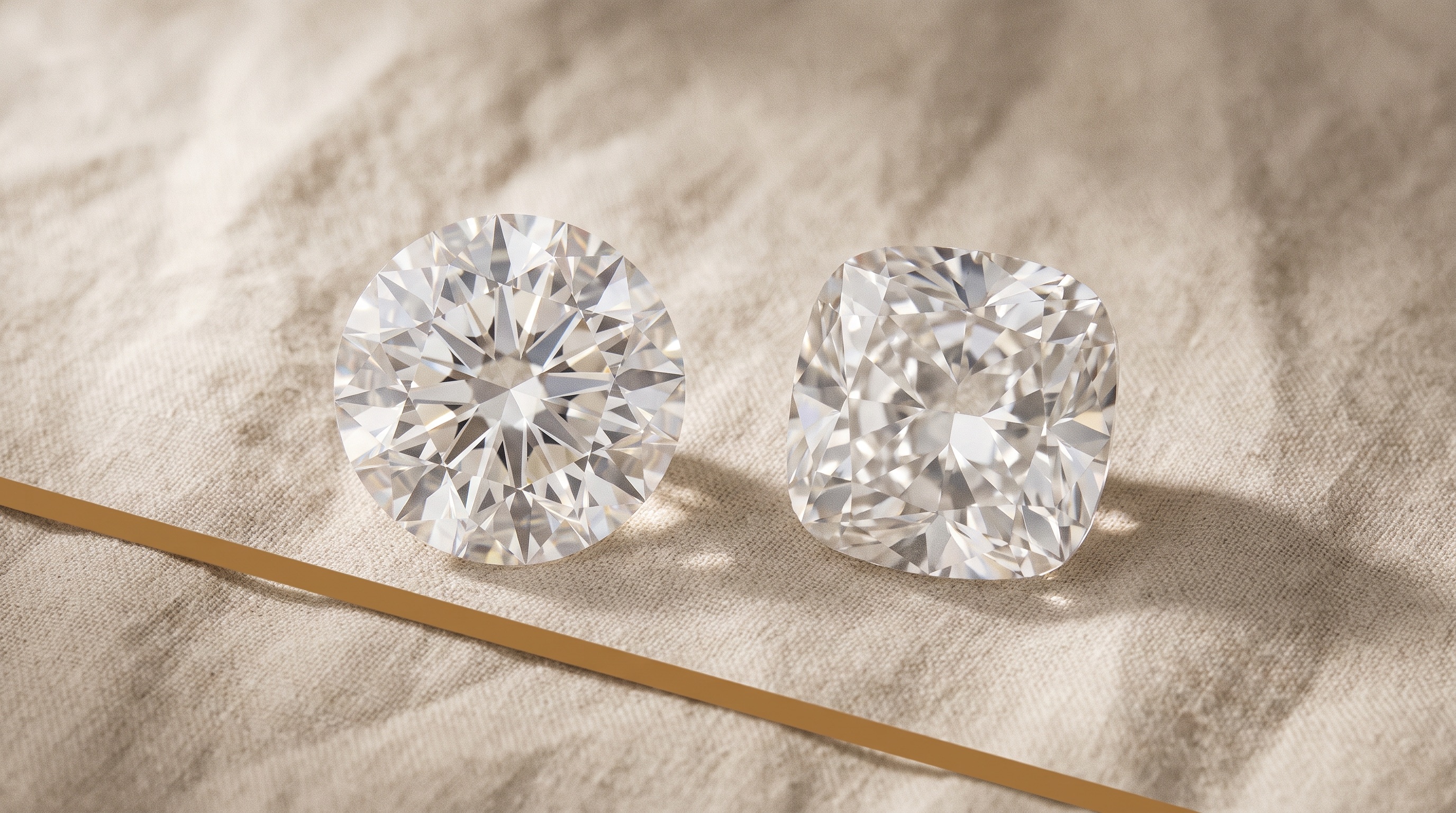
Round and cushion are two of the most requested diamond shapes in the trade, but they solve different problems. A round brilliant is cut with 58 facets in fixed, near-scientific proportions to maximize brilliance and fire — it is the industry's benchmark for sparkle. A cushion cut is a square-to-rectangular shape with rounded corners and larger, broader facets that produce a softer, more romantic light pattern and can face up larger for the same carat weight. Neither shape is objectively "better" — the right one depends on the light performance, price point, and look a customer is asking for. For wholesale buyers stocking inventory or advising retail clients, the round vs cushion decision usually comes down to four practical questions: which shape throws more visible sparkle, which one costs less per carat, which one looks bigger on the hand, and which one photographs and resells better. This guide walks through all four, plus how antique cushion inventory fits into (and differs from) the modern cushion conversation.Round Cut vs Cushion Cut: The Core Differences
The round brilliant cut is built on proportions refined over more than a century of cutting research, culminating in the modern "ideal cut" standard most labs and cutters still reference today. It has 57 or 58 facets (depending on whether a culet facet is present), arranged in a radially symmetric pattern designed to bounce light back out through the top of the stone as efficiently as possible. Because the geometry is so standardized, one well-cut round brilliant performs almost identically to another at the same cut grade — which is exactly why round is the reference point everyone else gets compared against. Cushion cut diamonds are a different animal. The outline is a rounded square or rectangle — historically descended from the antique cushion and old mine shapes of the 1800s, though the modern cushion cut sold today is a distinct, contemporary faceting style, not a true antique cut. Cushion diamonds are cut in two broad facet families:- Cushion brilliant ("crushed ice" cushion): a dense faceting pattern, often with a chunky or checkerboard-style crown, that produces many small, sparkly flashes of light rather than a few large ones. This is the more common cushion style sold today.
- Chunky-facet cushion: fewer, larger facets that throw broader, bolder flashes — closer in spirit (though not identical) to antique cushion faceting.
Light Performance: Round's Classic Sparkle vs Cushion's Crushed-Ice Look
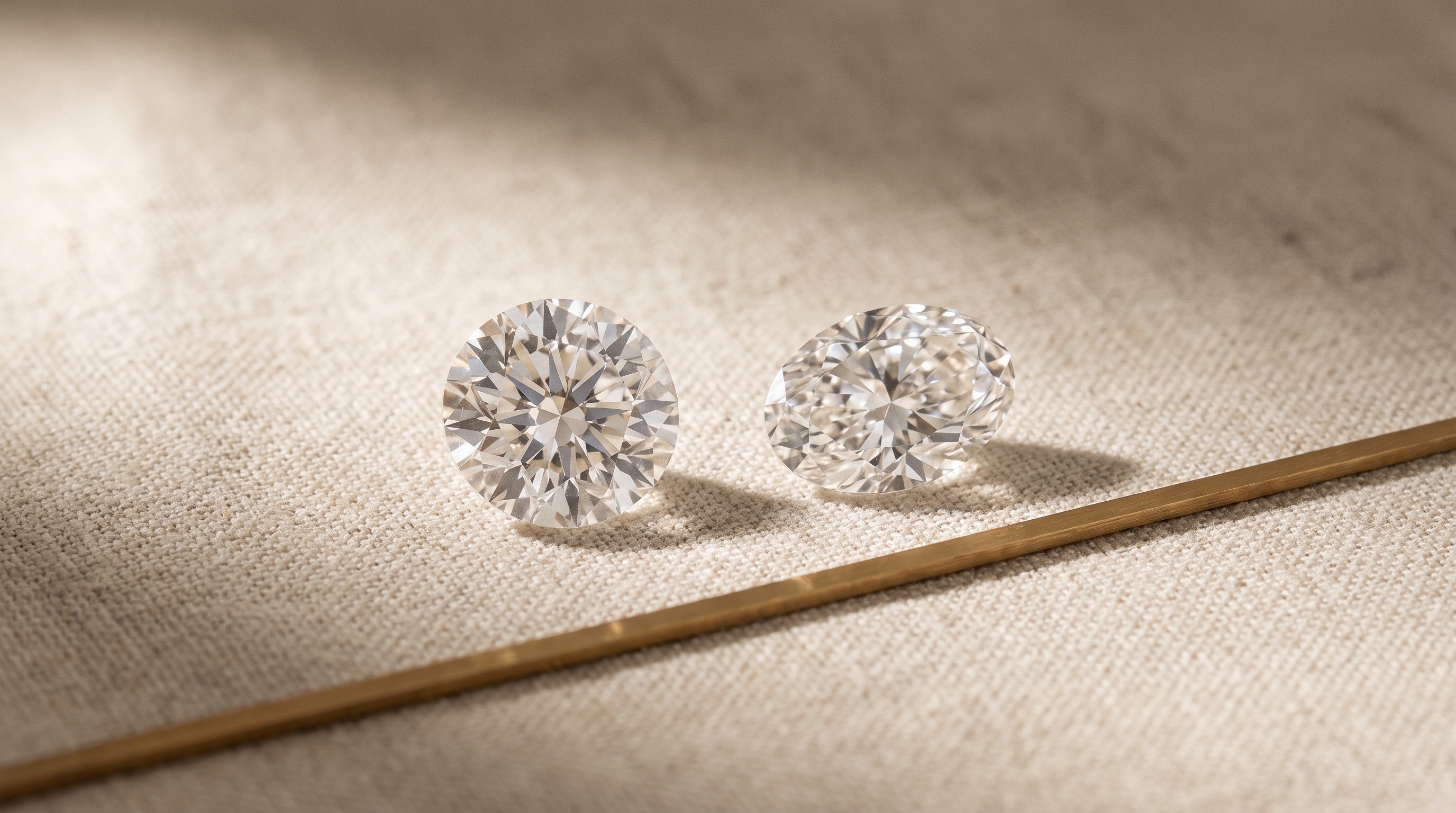
This is the single biggest reason customers choose one shape over the other. Round brilliants are engineered for maximum brilliance and fire — the "broken glass" effect of bright white light flashes combined with flashes of spectral color, visible even in low light. It is the most efficient shape at returning light to the eye, which is part of why it remains the highest-volume cut sold in engagement rings and fine jewelry. Cushion cuts trade some of that raw brilliance for a softer, more romantic light pattern. A well-cut crushed-ice cushion still sparkles heavily, but the flashes are smaller and more numerous, giving a sugary, textured look rather than round's bold on/off contrast pattern. A chunky-facet cushion sparkles less densely but throws larger, warmer-looking flashes, which is part of why cushion reads as a more "vintage" or "old-world" look even in a fully modern-cut stone. Neither look is a defect — they are different design goals. Buyers who want maximum sparkle under any lighting condition gravitate to round. Buyers who want a softer, more antique-coded look without committing to true antique faceting (and its higher price and narrower supply) gravitate to cushion.Round vs Cushion Diamond at a Glance
| Round | Cushion | |
|---|---|---|
| Visual character | Classic, crisp, maximum symmetry | Soft, romantic, pillow-shaped with rounded corners |
| Light performance | Highest brilliance and fire of any shape; bold, high-contrast sparkle | Crushed-ice sparkle (dense, small flashes) or chunky-facet sparkle (broad, warm flashes), depending on cut style |
| Price tier (per carat, same color/clarity) | Typically the most expensive shape per carat | Typically less expensive per carat than round at the same grade |
| Face-up size at same carat weight | Cut deeper for light performance; reads closer to its actual carat weight | Often cut shallower with more surface spread; can face up larger |
| Best for | Buyers prioritizing maximum sparkle, classic styling, and broad resale familiarity | Buyers prioritizing face-up size, a softer/vintage-adjacent look, or a lower price point per carat |
Price Per Carat: Why Round Typically Costs More
Round brilliants are generally the most expensive shape per carat, and it comes down to two compounding factors rather than one. First is rough yield. Diamond rough is most often mined as an octahedral crystal. Cutting that rough into a round brilliant sacrifices a large share of the original weight — cutters lose roughly 50-60% of the rough to hit round's precise proportions. Fancy shapes like cushion are cut to follow the natural crystal outline more closely, retaining a noticeably higher percentage of the original rough weight. Less wasted material means a lower cost basis per finished carat, and that savings is reflected in the wholesale price. Second is demand. Round remains the single most requested shape across bridal and fine jewelry, and pricing follows demand as much as production cost. That combination — more rough lost in cutting, plus the highest and steadiest demand — is why round commands a price premium over cushion (and most other fancy shapes) at a comparable color, clarity, and cut grade. For wholesale buyers, this price gap is a real merchandising lever: a client with a fixed budget can often move up in carat weight or color/clarity grade by choosing cushion over round, without changing the price point. Length-to-width ratio adds a second pricing variable specific to cushion that round doesn't have. A perfectly square cushion (close to a 1:1 ratio) tends to carry a small premium over an elongated rectangular cushion of the same carat weight, simply because square cushions are less common to cut cleanly from typical rough shapes and are more consistently in demand for solitaire-style settings. When quoting cushion inventory, it's worth confirming ratio alongside carat weight, color, and clarity — two cushions at the same grade and weight can still land at different price points depending on outline.Carat Weight and Face-Up Size: Why Cushion Can Look Larger
Carat weight measures mass, not visible size — and round and cushion don't convert that mass into face-up area the same way. Round brilliant proportions are cut relatively deep, because depth is part of what makes the light-return math work. That means a 1.00ct round has a fairly fixed, well-known diameter (roughly 6.4-6.5mm), and most of that diamond's weight sits below the girdle rather than spreading out across the top. Cushion cuts, especially crushed-ice cushions with shallower crowns, tend to spread more of their weight outward rather than downward. A 1.00ct cushion can measure noticeably larger across its face than a 1.00ct round, particularly on elongated rectangular cushions, which stretch length without proportionally increasing weight. In practice, this means a buyer working to a carat-weight budget can often land a cushion that looks visibly bigger on the hand than a round of the same weight — a genuinely useful selling point when a client is anchored to a size expectation rather than a specific number on the certificate. The tradeoff is that an overly shallow cushion can develop a visible "fisheye" or windowing effect (a washed-out, glassy patch where light passes straight through instead of reflecting back), so face-up size should never be evaluated separately from cut quality. A well-proportioned cushion looks larger and still holds its brilliance; a poorly proportioned one just looks flat.Color and Clarity: How Each Cut Hides or Reveals Inclusions
Facet pattern changes how forgiving a cut is toward color tint and inclusions, and round and cushion sit at different points on that spectrum. Round's small, evenly distributed facets scatter light in a way that masks minor color tint reasonably well and can help hide small inclusions by breaking up the visual field. This is one reason round diamonds are graded and priced on a very tight, well-understood curve — buyers know almost exactly what a given color/clarity combination will look like. Cushion cuts, particularly chunky-facet styles with larger facet surfaces, are less forgiving. Larger facets act more like small windows into the stone, which can make both color tint and inclusions more visible at a given grade compared to round. A cushion in the same color and clarity grade as a round may read slightly warmer or show a visible inclusion the round would have hidden. This doesn't mean cushion needs a dramatically higher grade to look clean — it means grade selection should account for facet style, not just the numbers on the report. For buyers sourcing certified stones for retail clients, IGI, GIA, and GCAL reports all note cut style and proportions, which is the detail worth checking alongside color and clarity when quoting a cushion.Setting Styles and Ring Compatibility
Round is the most setting-flexible shape in the business. Its perfect radial symmetry works in solitaires, halos, three-stone designs, pavé bands, and side-stone configurations without any special engineering — which is part of why it remains the default recommendation for a first-time buyer or a retailer stocking a broad bridal case. Cushion is more setting-dependent. Square cushions read closer to a classic solitaire silhouette and pair well with simple prong or bezel settings that let the pillow shape read clearly. Elongated rectangular cushions behave more like a soft-cornered emerald or radiant and benefit from settings that emphasize their length — east-west settings, elongated halos, or three-stone designs with tapered baguette side stones. Because cushion's outline varies more from stone to stone than round's does, it's worth confirming length-to-width ratio before committing to a specific setting, especially for a client set on an elongated look. Both shapes work well with matched side stones and pavé detailing, which matters for retailers building out full bridal sets rather than single center stones.Durability and Everyday Wear
Neither shape has a durability problem in normal wear — diamond is diamond, and both round and cushion sit at 10 on the Mohs scale regardless of how they're faceted. The differences that matter here are about girdle and corner protection, not hardness. Round brilliants have no corners at all, which removes one common failure point entirely: there's nothing on the outline that can chip from a hard knock against a countertop or car door. Cushion's rounded corners are far more wear-resistant than a true pointed shape (princess or marquise, for example), but they're still a slightly more exposed profile than round's continuous curve, so a protective setting — a prong that wraps just past the corner, or a halo that frames the outline — is worth recommending for cushion center stones in everyday rings. Girdle thickness is the other practical wear consideration for either shape, and it's a cut-quality issue rather than a shape issue: a girdle cut too thin chips more easily under impact, while one cut too thick adds hidden weight without adding visible size. This is worth checking on the certificate (GIA, IGI, and GCAL reports all note girdle thickness) regardless of which shape a client lands on, and it matters slightly more for cushion given how much cut proportions already vary stone to stone within the shape. For active daily wear — a client who works with their hands, or simply wants the lowest-maintenance option — round remains the safer recommendation. For a client willing to be a little more deliberate about setting choice, cushion's rounded-corner profile is a reasonable everyday option, not a fragile one.Antique Cushion vs. Modern Cushion: A Quick Note
It's worth flagging one common point of confusion before moving on. The cushion cut discussed throughout this guide is the modern cushion — a contemporary faceting style cut to today's proportions and light-performance standards. "Antique cushion" is a different, and often loosely used, category: sometimes it refers to a genuinely antique-style cut with true Old Mine faceting (high crown, open culet, large hand-cut-style facets), and sometimes it's used as a marketing label for a modern cushion set in a vintage-style mounting. The two aren't interchangeable, and the difference matters for buyers quoting antique-specific inventory. Guru Diam carries both modern cushion and true antique cushion styles as part of its broader antique and fancy-shape catalog. If a client is specifically asking about antique cushion versus Old Mine Cut faceting rather than modern cushion versus round, our dedicated antique cushion vs. Old Mine Cut guide covers that distinction in full.Which Shape Should You Stock? Buying Considerations for Trade Partners
For buyers deciding how to weight inventory or advise a retail client between the two, a few practical filters tend to settle it faster than a pure aesthetics debate:- Budget-first buyers generally do better with cushion — more face-up size and a lower price per carat at the same color/clarity grade, with a softer look that still reads as intentional rather than a compromise.
- Sparkle-first buyers should be pointed to round every time. No other shape matches its light return, and it remains the safest recommendation for a client who hasn't seen stones side by side yet.
- Resale and liquidity-conscious buyers (or retailers building a broad, easy-to-move case) should lean round-heavy — it is the most universally recognized and most consistently priced shape in the secondary market.
- Vintage-adjacent or personalized styling favors cushion, especially when paired with a halo or a mixed-metal setting that leans into the softer light pattern.
- Elongated-finger or elongated-silhouette requests point toward rectangular cushion (or a true antique cut, if the client wants to go further) rather than round, which cannot be stretched without becoming an oval.
Sourcing Round and Cushion Lab-Grown Diamonds Wholesale
Guru Diam stocks both round and cushion — along with the full range of antique, exotic, and fancy-color shapes — as CVD lab-grown inventory, certifiable through IGI, GIA, or GCAL depending on what a buyer's client requires. That breadth matters for a trade partner who doesn't want to split sourcing across multiple suppliers depending on which shape or certification a given order calls for: one vendor, one shipment, one relationship covers round commodity stock, cushion in both brilliant and chunky-facet styles, and true antique cushion inventory in the same order. In-stock round and cushion loose diamonds ship same day — NYC orders placed before 6pm EST and LA orders before 4pm PST go out the same business day, from either coast. That matters most for retailers filling a specific carat-weight or budget request quickly rather than waiting on a multi-week reorder cycle. For clients who want a finished piece rather than a loose stone, custom engagement rings built around either shape are finished in 4-6 days, unbranded by default so retail partners can resell under their own name. Buyers evaluating certified round or cushion stock, or looking to source matched pairs for side-stone work, can browse certified diamonds or matching pairs directly, and buyers exploring the full fancy-color range alongside standard shapes can check fancy color loose diamonds. For finished pieces built around either cut, see custom jewelry. New trade accounts can review terms and open an account through trade partner, or start broader sourcing from the wholesale hub.Frequently Asked Questions
Is a cushion cut diamond cheaper than a round diamond?
Generally, yes. At the same carat weight, color, and clarity grade, cushion cut diamonds typically cost less per carat than round brilliants. This is mostly a function of rough yield — round cutting sacrifices a larger share of the original rough crystal, while cushion retains more of it, which lowers the cost basis per finished carat.
Does a cushion cut diamond look bigger than a round diamond of the same carat weight?
Often, yes. Cushion cuts, especially crushed-ice styles with shallower crowns, tend to spread more weight outward across the face of the stone rather than downward into depth. A 1.00ct cushion can measure visibly larger face-up than a 1.00ct round, though an overly shallow cushion can lose brilliance and develop a washed-out "fisheye" effect, so cut proportions still need to be checked alongside size.
What is the difference between a "crushed ice" cushion and a chunky cushion cut?
Crushed-ice cushions have a dense faceting pattern that produces many small, sparkly flashes of light, similar to the texture of shattered ice. Chunky-facet cushions use fewer, larger facets that throw broader, warmer flashes, closer in feel to antique-style faceting. Both are modern cushion cuts, not true antique cuts.
Which sparkles more, round or cushion?
Round brilliants have the highest light return and fire of any diamond shape, thanks to proportions specifically engineered to maximize brilliance. Cushion cuts still sparkle, but the pattern is different — either a dense crushed-ice texture or broader, warmer flashes depending on the facet style — rather than round's bold, high-contrast sparkle.
Is antique cushion the same as a modern cushion cut diamond?
No. Modern cushion is a contemporary faceting style cut to current proportions and light-performance standards. "Antique cushion" is a separate, less standardized category that sometimes refers to true Old Mine-style faceting and sometimes is used as a marketing label for a modern cushion in a vintage-inspired setting — the terms aren't interchangeable.
Which diamond shape holds its value better, round or cushion?
Round brilliants are the most universally recognized and consistently priced shape in the resale and secondary market, which generally makes them the safer choice for buyers prioritizing liquidity. Cushion cuts can hold value well, particularly true antique cushion stones, but pricing is less standardized shape-to-shape than round's tightly benchmarked market.