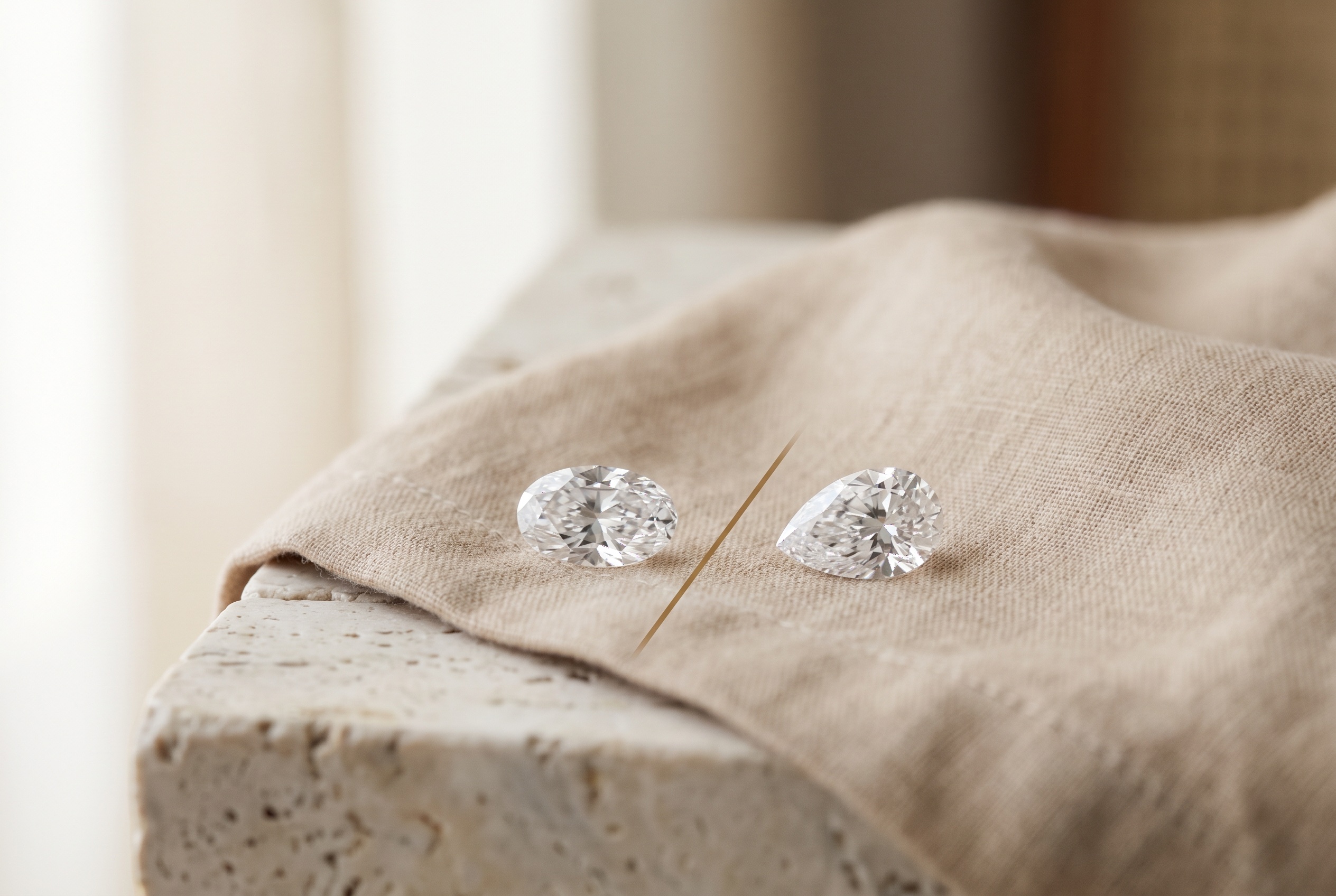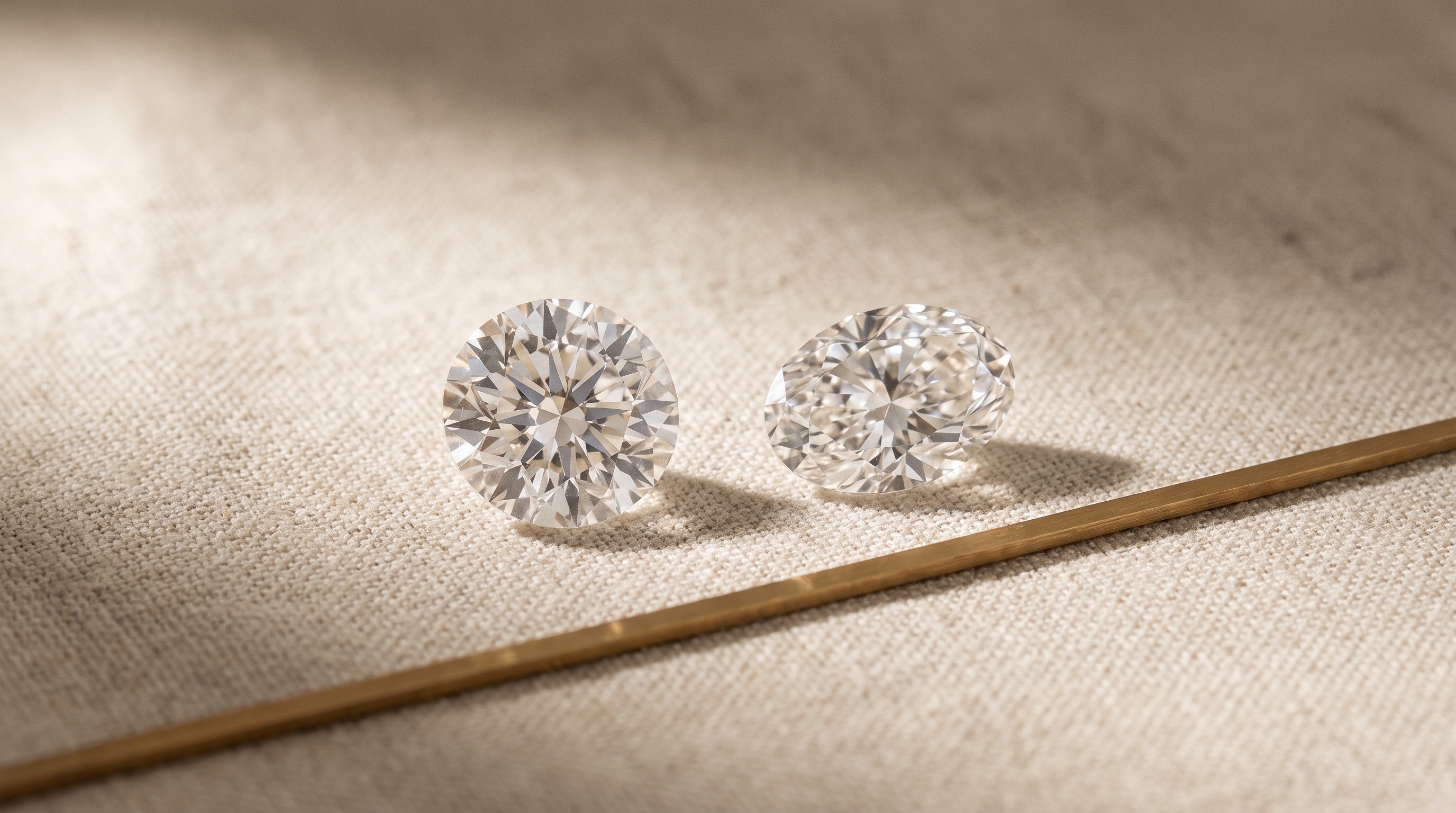

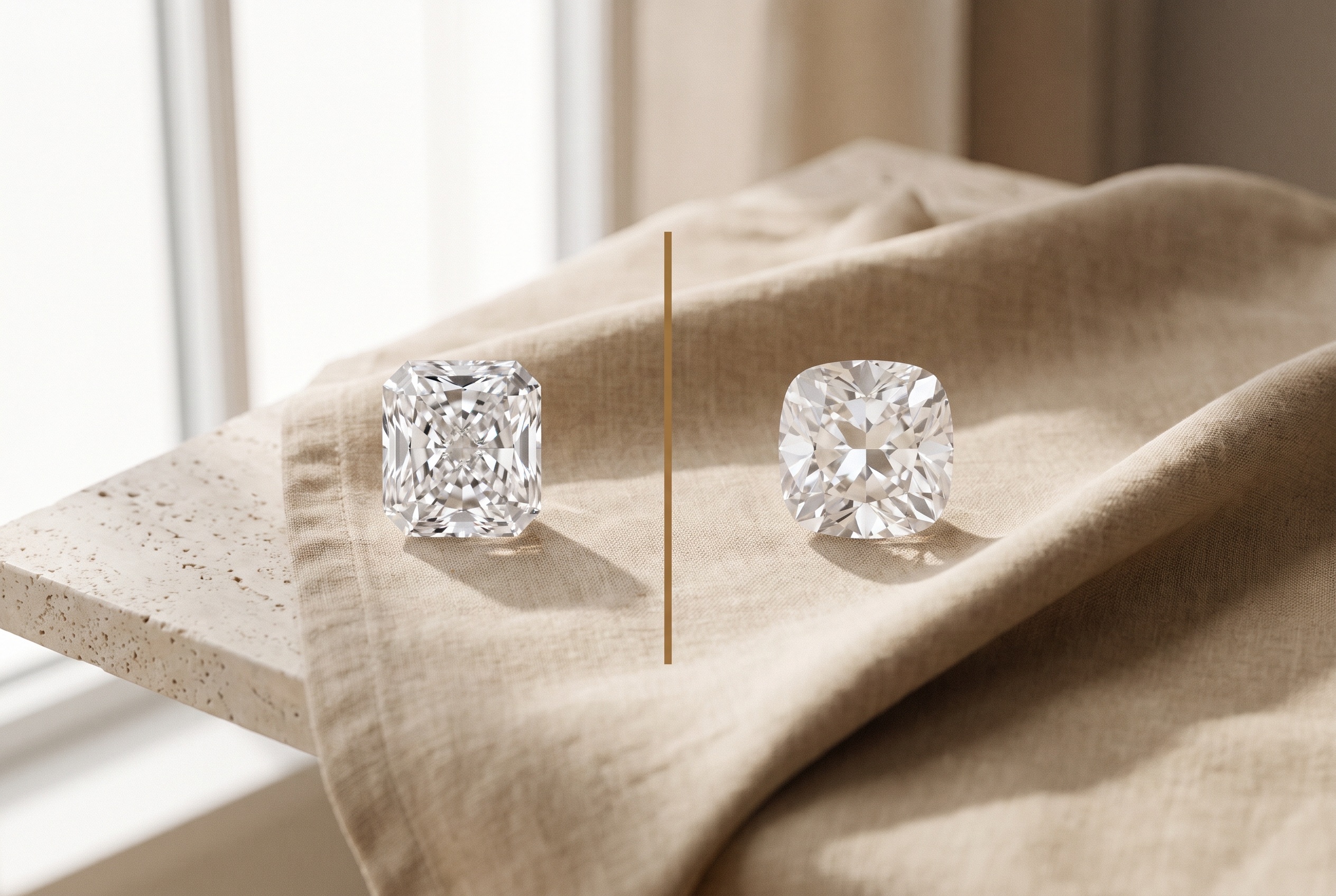
What Is a Radiant Cut Diamond?
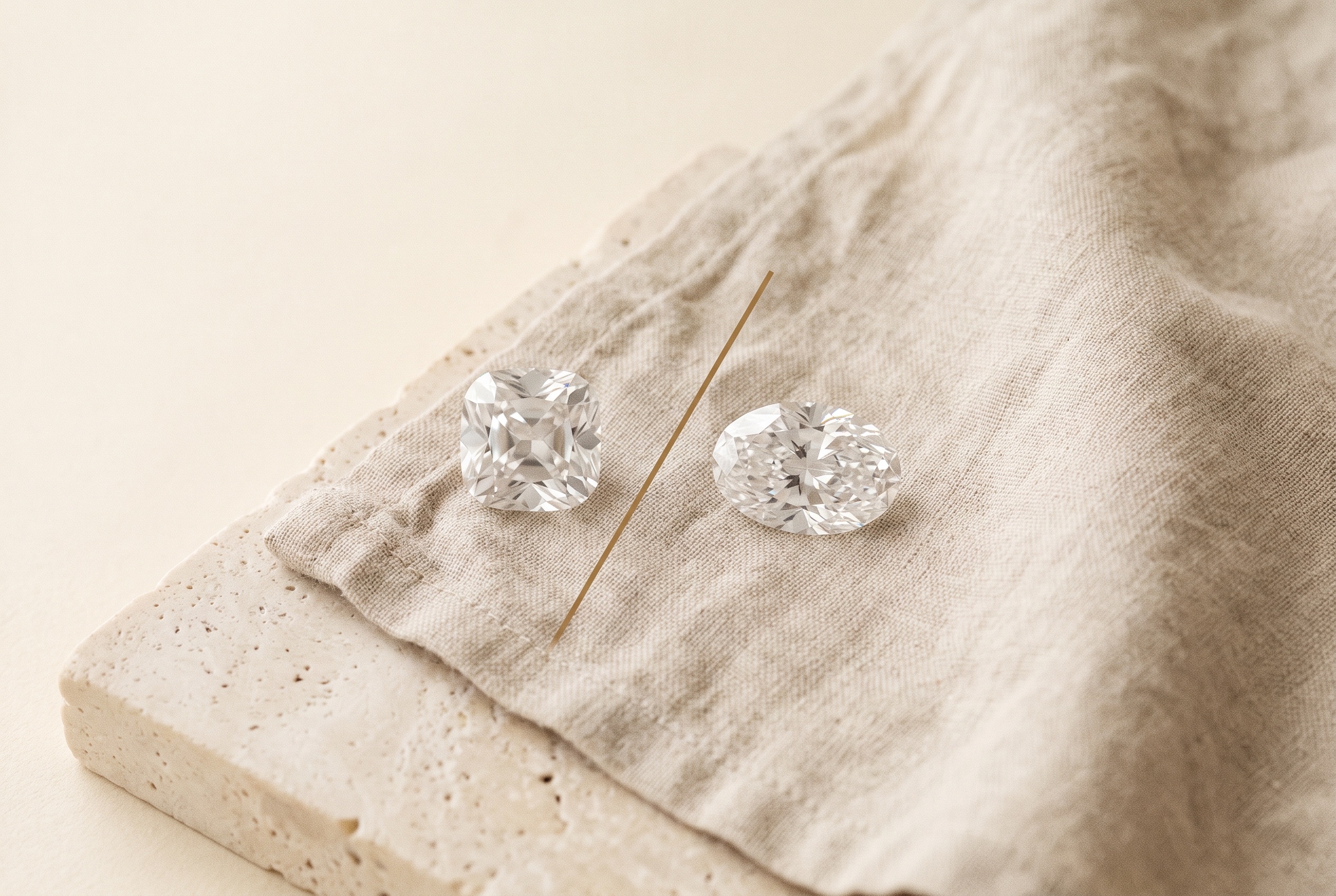
The radiant cut was developed in the late 1970s specifically to solve a problem: buyers wanted the fire of a round brilliant in a rectangular or square outline, without settling for the quieter flash of a step cut. The result borrows the brilliant-cut facet arrangement — the same triangular and kite-shaped facets that give a round diamond its scintillation — and wraps it around a rectangular or square girdle with the corners trimmed off at a consistent angle. Those cropped corners aren't just decorative. They protect the stone from chipping during setting and everyday wear, which is one reason radiant has become a practical favorite for engagement rings rather than a purely fashion-forward choice. A radiant typically carries around 70 facets between crown and pavilion, well above what a comparable step cut shows, which is what gives it that busy, high-contrast sparkle pattern even in a geometric silhouette. Buyers comparing radiant vs emerald cut are really asking the same brilliant-vs-step-cut question from the other direction: emerald is the true step cut radiant was built to out-sparkle, with long open facets that flash rather than scintillate and show inclusions more readily as a result. Radiant keeps the emerald cut's rectangular silhouette but trades its quiet elegance for brilliant-cut fire — worth stocking both if a case serves customers across that spectrum. Radiant comes in two proportions worth knowing for stocking purposes: square radiant (length-to-width ratio close to 1.00–1.05) and rectangular radiant (typically 1.20–1.50), which reads as more elongating on the finger. Buyers shopping for a bold, modern stone with maximum sparkle in a structured outline gravitate toward radiant.What Is a Cushion Cut Diamond?
Cushion is the older of the two shapes by a wide margin. It's a direct descendant of the old mine cut — one of the oldest diamond cuts still in circulation — softened over time into today's rounded-square outline. The trade nickname "pillow cut" comes directly from that silhouette: a square or rectangular shape with generously rounded corners and gently curved sides, rather than the straight sides and sharp corner-trims of a radiant. Where radiant is engineered for maximum facet count and fire, classic cushion cut leans into fewer, larger facets. That produces a different kind of sparkle — broader flashes of light rather than a dense field of tiny pinpoints, often described in the trade as a "glow" rather than "fire." Buyers who want a cushion with more brilliance closer to a radiant or round should look at "crushed ice" cushion, a modern variation that breaks the facet pattern up into smaller, more scattered facets for noticeably more scintillation. Both the classic and crushed-ice styles are available in square and elongated rectangular proportions.Radiant and Cushion as the Middle Ground
It's worth stating this positioning plainly, because it's the real reason both shapes sell well: round brilliant delivers maximum fire but no distinct personality, and it commands commodity-tier pricing precisely because it's the default. Step cuts like emerald and asscher sit at the opposite end — a quiet, hall-of-mirrors flash that reads as sophisticated but shows inclusions more readily because there are far fewer facets to break light (and camouflage) up. Radiant and cushion split that difference in two different ways. Radiant borrows the brilliant cut's facet count and fire but keeps a rectangular, corner-trimmed geometry that visually echoes a step cut — sparkle with structure. Cushion keeps the romantic, large-faceted glow associated with antique and step-cut styling, while still being brilliant-faceted enough to hide small inclusions better than a true step cut would. Neither shape asks a customer to choose between "flashy" and "elegant" — that's the sales story that makes both easy to merchandise side by side in a case.Radiant vs Cushion at a Glance
| Radiant | Cushion | |
|---|---|---|
| Visual character | Crisp, geometric, rectangular or square with trimmed corners | Soft, rounded-square "pillow" outline with curved sides |
| Light performance | High fire and scintillation; dense brilliant-cut facet pattern | Broader, glowing flashes; large facets read as soft light rather than pinpoint sparkle (crushed-ice styles sparkle more) |
| Price tier | Regular fancy / mid-market — broadly comparable to cushion per carat | Regular fancy / mid-market — broadly comparable to radiant per carat |
| Best for | Buyers who want maximum sparkle in a structured, modern silhouette | Buyers who want a romantic, vintage-adjacent look with a softer outline |
Shape, Outline, and Corners
Radiant and cushion are frequently confused with two other shapes, and it's worth clarifying the differences for your sales team. Radiant is often mistaken for princess cut — the giveaway is the corners. Princess has sharp, pointed corners; radiant has them trimmed off. That trim is a meaningful practical detail: sharp corners on a princess cut are the most vulnerable point on the stone, while radiant's cropped corners are inherently more durable in prong settings. Cushion, meanwhile, is sometimes confused with a rounded square modified brilliant, but the defining trait is the curved sides — not just rounded corners. A true cushion has gently bowed sides running the full length of the stone, giving it that pillow-like softness even before you factor in facet pattern. Both shapes are sold in square and rectangular ratios, but cushion's rectangular versions tend to run less elongated (roughly 1.15–1.25 length-to-width) than radiant's rectangular versions (1.20–1.50), which is a useful stocking distinction if a customer specifically wants an elongating effect.Light Performance and Sparkle Pattern
This is the single biggest differentiator between the two shapes, and the one your sales team should lead with. Radiant's brilliant facet arrangement produces abundant small flashes of light — fire and scintillation that move actively as the stone tilts. That same facet density is functionally useful: it breaks up light enough to camouflage minor inclusions and slight body color, which is why radiant is a popular choice for buyers trying to stretch a budget into a lower color grade without visible warmth. Classic cushion produces fewer, larger flashes — visually calmer, often described as a soft glow rather than active sparkle. That's a feature for buyers chasing a vintage or romantic look, but it does mean the classic cushion facet pattern shows color and inclusions more readily near the center of the stone, since there's less facet breakup to hide them. Crushed-ice cushion narrows that gap considerably by adding more, smaller facets closer to a brilliant pattern — a genuinely useful upsell option for customers who love the cushion outline but want radiant-level sparkle.Color, Clarity, and Inclusion Visibility
Because of the facet differences above, color and clarity buying strategy should differ slightly between the two shapes. Radiant's dense faceting is forgiving — G–I color grades typically face up bright and white, and VS2 clarity is usually eye-clean even in larger carat weights, since the abundant facet breakup masks minor inclusions well. Cushion, especially in the classic large-facet style, is less forgiving. Buyers stocking cushion in larger carat weights should lean toward G or better color and VS2 or better clarity to avoid visible warmth or inclusions pooling in the open center facet — a known trade issue sometimes called a "nailhead" when it presents as a dark or cloudy patch at the culet. Crushed-ice cushion splits the difference again, tolerating slightly lower grades than classic cushion while still not matching radiant's forgiveness. It's also worth knowing what a grading certificate does and doesn't tell you on either shape. GIA does not assign an overall cut grade to fancy shapes the way it does to round brilliant — round is the only shape with enough standardized data to support a single "Excellent to Poor" cut score. Radiant and cushion certificates instead report polish and symmetry grades individually, but proportion quality and light performance still have to be judged by eye or by face-up photo and video. That's why two stones with identical certificate numbers can look noticeably different in hand, and why buyers who rely on the paper grade alone without reviewing imagery are the ones most likely to end up with a dull or "windowed" stone in either shape.Carat Weight, Face-Up Size, and Proportions
Cushion's ancestry from the old mine cut means it's typically cut to retain more rough weight rather than maximize face-up spread, which can make a square cushion look marginally smaller per carat than an elongated radiant of the same weight. Rectangular versions of both shapes offset this — an elongated radiant or elongated cushion both create a "looks bigger" effect on the finger compared to a round or square stone of identical carat weight, which is worth mentioning to customers focused on size. On proportions, total depth in the 65–70% range is the common trade target for radiant, while cushion typically runs a touch deeper, around 65–72%. Buyers should watch for excessively deep or shallow stones in either shape — over-deep cutting creates a dark "windowing" effect in radiant and can worsen the nailhead issue in cushion, while overly shallow cutting washes out contrast in both. Table percentage is the other proportion worth flagging on both shapes. A stone cut with an unusually large table can look "spready" — a bigger face-up diameter for the carat weight — which sounds like an advantage for buyers chasing size, but it usually trades away brilliance and can leave the stone looking flat and glassy rather than lively. A moderate table, generally in the 61–68% range for radiant and cushion alike, tends to balance size and sparkle better than chasing maximum spread. It's a useful thing to flag to customers who ask specifically for the "biggest looking" stone in a given carat weight, since the biggest-looking stone and the best-performing stone aren't always the same one.Setting Styles: Which Cut Fits Which Design
Radiant sits comfortably in four-prong and bezel settings, and it pairs cleanly with baguette side stones for a modern, minimalist or Art Deco–revival look — the straight sides and trimmed corners echo step-cut geometry well. Halo settings also flatter radiant, softening its structured edges without hiding the facet pattern. Cushion is the more natural fit for halo settings generally — a rounded halo hugs the pillow outline in a way that feels architecturally correct rather than added-on. Three-stone settings with pear or half-moon side stones are a classic cushion pairing, and split-shank designs suit the shape's vintage-leaning character. For jewelers building out matched side-stone or earring programs to complement either center stone, matching pairs in calibrated sizes are worth stocking alongside your radiant and cushion centers. On metal, both shapes read well in white metals — platinum or white gold — which sharpen the contrast of radiant's fire and keep cushion's glow looking cool rather than warm. Yellow and rose gold suit cushion particularly well for customers leaning into the shape's vintage character, since warmer metal tones reinforce the antique-adjacent styling rather than fighting it. Prong count matters more than most buyers expect on radiant specifically: four prongs at the corners is standard and sufficient given the corner-trim protection, while adding prongs mid-side rarely improves security and can distract from the clean geometric line that makes radiant appealing in the first place.Durability for Everyday-Wear Rings
Both shapes hold up well to daily wear, but the failure points differ slightly, which is worth knowing if a customer specifically asks which shape survives an active lifestyle best. Radiant's trimmed corners remove the single most vulnerable point a rectangular stone can have, which is exactly why it's a common recommendation for customers with hands-on jobs or active routines — there's simply less sharp edge exposed to catch on fabric or knock against hard surfaces. Cushion's rounded corners offer similar edge protection, but its larger, more open facets can show fine surface wear — light scratching on the table facet — more visibly over years of wear than a densely faceted stone would, since there's less facet breakup to disguise it. Neither issue is a reason to steer a customer away from either shape; both are standard recommendations for a periodic professional cleaning and prong check, the same maintenance any fine diamond jewelry needs regardless of cut.Price Tier and Wholesale Considerations
Both radiant and cushion fall into the regular fancy tier — mid-market pricing, distinct from antique-premium cuts like Old Mine or Old European and from round brilliant's commodity pricing. Per-carat pricing between radiant and cushion of comparable carat, color, and clarity tends to run close; the bigger cost lever for wholesale buyers is proportion quality and the clarity grade needed to keep a given stone eye-clean, which, as covered above, skews higher for classic cushion than for radiant. Sourcing both shapes as certified CVD lab-grown stones keeps a volume stocking program accessible in a way natural-diamond equivalents in the same size and grade range typically aren't, which matters if you're building out a full case run across color and clarity combinations rather than a single hero stone.Which Shape Should Your Customers Choose?
As a rule of thumb for your floor staff: steer a customer toward radiant if they want maximum sparkle, a clean modern silhouette, and some flexibility on color grade without a visible budget hit. Steer them toward cushion if they're after a romantic or vintage-adjacent look and are willing to pay up slightly on clarity and color to keep the larger facets clean. If a customer loves the cushion outline but keeps saying the stone "isn't sparkly enough," crushed-ice cushion is almost always the answer before you talk them out of the shape entirely. Practically, most cases benefit from stocking both a square and a rectangular option in each shape — that covers customers who want an elongating effect and those who want a more compact, symmetric stone, without needing four completely different shapes on hand. If your customers are drawn to elongated fancy shapes with pointed ends instead, see our pear vs marquise diamond guide for the same side-by-side breakdown. For wholesale buyers deciding where to put budget first, the highest-turnover SKUs across both shapes tend to cluster in the 1.00–2.00ct range at G–H color and VS1–VS2 clarity for radiant, and F–G color and VS1 or better for cushion given its lower tolerance for visible inclusions. Below 1.00ct, both shapes move well as side stones and accent pieces without the same color/clarity sensitivity, since smaller stones hide minor grading differences more easily regardless of shape.Sourcing Radiant and Cushion Lab-Grown Diamonds at Guru Diam
Guru Diam is a trade-only wholesale supplier, and radiant and cushion are both stocked across the full carat, color, and clarity range as part of a catalog that covers every standard, antique, and exotic diamond shape — not just the shapes that happen to be trending. All lab-grown stones are CVD-grown (no HPHT, ever), with IGI, GIA, and GCAL certification available on loose stones so you can match certification to what your customers specifically ask for. In-stock radiant and cushion inventory ships same-day — before 6pm EST from our New York headquarters and before 4pm PST from our Los Angeles office — so a case order or a matched-pair request doesn't sit in a queue. If a customer wants their radiant or cushion center stone set into a custom engagement ring, finished pieces turn around in 4–6 days, unbranded by default so you can resell it as your own. Cutting, setting, and polishing all happen in-house, and the catalog runs through more than 2,000 active trade accounts today. Both shapes are carried across a wide carat range — from small calibrated accent stones up through multi-carat center stones — in both square and elongated proportions, and radiant or cushion side stones can be pulled as matching pairs for three-stone rings or earring programs without a separate special-order cycle. For wholesale account access, visit our wholesale hub or the trade partner page, or explore custom jewelry options for radiant and cushion centers built to order.Frequently Asked Questions
Is a radiant cut diamond more expensive than a cushion cut?
Generally no — both shapes sit in the same regular fancy, mid-market price tier, and per-carat pricing between comparably graded radiant and cushion stones tends to run close. The bigger cost factor is usually the clarity grade needed to keep the stone eye-clean, which tends to run slightly higher for classic cushion than for radiant.
What's the difference between a radiant cut and a princess cut?
The corners. Radiant has its corners trimmed at an angle, while princess cut has sharp, pointed corners. That trim makes radiant more durable in everyday settings, since sharp corners are the most vulnerable point on any diamond shape.
Does a cushion cut diamond show inclusions more than a radiant?
Classic cushion, yes — its larger, fewer facets don't break up light as much as radiant's dense brilliant-cut pattern, so inclusions and color tint can be more visible, especially in the center of the stone. Crushed-ice cushion narrows this gap by using a smaller, more scattered facet pattern closer to radiant's.
What is a "pillow cut" diamond?
Pillow cut is simply the trade nickname for cushion cut, named for its soft, rounded-square outline that resembles a pillow. It refers to the same shape, not a different cut.
Which shape looks bigger for the same carat weight, radiant or cushion?
Rectangular versions of either shape create an elongating, "looks bigger" effect compared to a round or square stone of the same weight. Between the two, cushion's ancestry from the old mine cut means it can retain slightly more rough weight in the depth of the stone, so an elongated radiant will often read marginally larger face-up than a square cushion of identical carat weight. A stone cut with an overly large table can look even spreadier, though usually at some cost to brilliance.
Can radiant and cushion diamonds be lab-grown and certified?
Yes. Guru Diam stocks both shapes as CVD lab-grown loose stones with IGI, GIA, and GCAL certification available, across the full carat, color, and clarity range carried in the wholesale catalog.