
A rough diamond is graded and traded through a classification system entirely separate from the 4Cs used for polished stones — rough is sorted into industry categories based on shape, size, color, and clarity potential, then valued according to what a skilled planner estimates it will yield once cut, not against a finished certificate. Understanding that sorting and valuation system is the practical, trade-facing side of rough diamonds: less about what a rough crystal looks like (covered in general terms elsewhere) and more about how the diamond trade actually classifies, grades, and prices rough material before it ever reaches a cutting wheel.
This is deliberately a trade and grading-focused guide, not a geology or jewelry-trend piece — it covers the standardized rough sorting categories used across the industry, how rough is classified by shape and gem-versus-industrial potential, the specific factors a professional sorter or planner evaluates, how rough diamond tenders and sales actually function, what "rough diamond certification" does and doesn't mean, and how rough valuation connects to the price of the finished, polished stone that eventually reaches a buyer.
Rough Diamond Sorting: The Industry's Classification System
Before a rough diamond is priced or sold, it passes through a sorting process that separates a mixed parcel of rough into narrower categories based on shared characteristics — this sorting is what allows dealers to price rough consistently across large volumes rather than evaluating every single stone individually from scratch. Major sorting operations (historically centered around organizations like De Beers' Diamond Trading Company and independent sorting houses) use thousands of distinct sorting categories in practice, but the broad classification structure breaks down into a few major axes:
- Gem quality vs. near-gem vs. industrial. The most fundamental split — gem-quality rough has the color, clarity potential, and size to be cut into a jewelry-grade polished stone; near-gem rough falls short of full gem quality but still has some jewelry application (smaller or lower-clarity finished stones); industrial-grade rough lacks the clarity or size for jewelry use entirely and is used in industrial abrasive and cutting-tool applications instead, where diamond's hardness matters far more than its optical clarity.
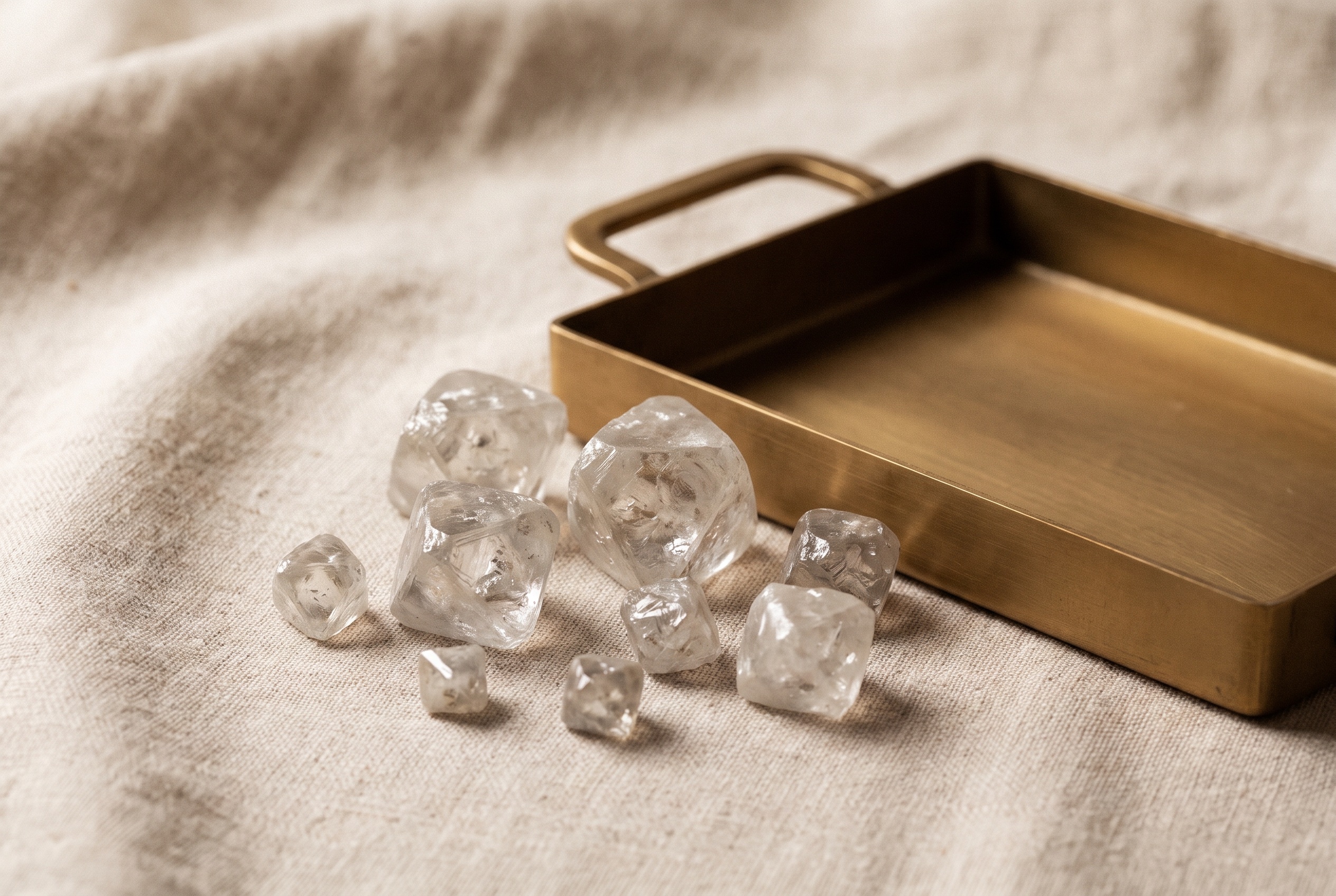
- Shape category. Rough is grouped by crystal form — octahedra, macles (twinned crystals), dodecahedra, and irregular or broken pieces, as each shape category steers toward different likely polished outcomes and carries different sorting value even at similar clarity and color.
- Size category. Rough is sorted into size ranges (often described in terms of expected polished-carat yield ranges) since size interacts heavily with both rarity and the economics of cutting — very small rough is sorted and priced in bulk parcels, while larger rough is increasingly evaluated stone by stone as size increases.
- Color and clarity potential. Sorters assess likely finished color and clarity grade by examining the rough crystal under controlled lighting and, increasingly, with specialized scanning equipment, estimating where a cut stone from that rough will likely land on standard polished grading scales.
Gem-Quality vs. Near-Gem vs. Industrial Rough
| Category | Approximate Share of Total Rough Production | End Use |
|---|---|---|
| Gem quality | Roughly 20-25% of total rough production by most industry estimates | Cut into jewelry-grade polished diamonds for the retail and wholesale trade |
| Near-gem | A meaningful additional share, varying by source and deposit | Cut into smaller, lower-grade polished stones, melee, or lower-tier jewelry applications |
| Industrial grade | The majority of total rough production by volume | Diamond grit, saw blades, drill bits, grinding wheels, and other applications relying on diamond's hardness rather than its optical properties |
This split matters because it explains why total rough production figures (frequently cited in carats mined per year across the industry) dramatically overstate how much rough actually becomes jewelry — the overwhelming majority of rough diamond material mined worldwide never becomes a polished gemstone at all, and industry-wide production statistics that don't distinguish between gem and industrial rough can be genuinely misleading if read as a proxy for jewelry-grade supply.
How a Rough Diamond Sorter or Planner Evaluates a Stone
Professional sorting and planning is a distinct skilled trade, historically learned through years of hands-on apprenticeship and increasingly supplemented today by 3D scanning technology that maps a rough crystal's interior before a human planner finalizes a cutting decision. The evaluation process weighs several factors simultaneously:
- Inclusion location and type. A sorter examines where inclusions sit inside the crystal and what kind they are — some inclusion types (certain mineral inclusions, feathers, or clouds) affect apparent clarity and durability differently, and their position relative to where a stone's pavilion, table, and girdle will eventually fall determines how much they'll actually affect the finished stone's clarity grade.
- Color saturation and distribution. Rough color isn't always uniform throughout a crystal — color can be concentrated in one zone or evenly distributed, which affects both the finished color grade and, for fancy color rough specifically, how a cutter might orient facets to maximize apparent color saturation in the finished stone.
- Crystal integrity and strain. Internal strain patterns (visible under polarized light) can indicate a higher risk of the stone cleaving or fracturing unexpectedly during cutting, which factors into both the cutting plan and the overall risk assessment for a given piece of rough.
- Expected yield percentage. Sorters and planners estimate what percentage of the rough's original weight will survive the cutting and polishing process — commonly 40-60% loss, sometimes more for a stone requiring aggressive inclusion removal — which directly affects the rough's per-carat value, since a stone with a poor expected yield is worth less per carat of rough weight even at strong color and clarity.
- Optimal shape and cutting plan. As covered in general diamond-formation content, a crystal's natural shape steers which polished outcome preserves the most value, and sorters often model multiple potential outcomes before settling on a final valuation.
Rough Diamond Tenders and How Rough Actually Changes Hands
Unlike polished diamonds, which trade through established benchmark price lists like the Rapaport Price List (covered in more depth in our diamond pricing guide), rough diamonds are more commonly sold through structured sales events called tenders or sights, run by major mining companies and rough dealers:
- Sight sales. A model historically associated with major producers, where pre-selected buyers ("sightholders") are offered curated parcels ("boxes") of rough on a scheduled basis, generally on a take-it-or-leave-it basis for the parcel as a whole rather than stone-by-stone negotiation.
- Open tenders. A competitive bidding process where rough parcels are made available for inspection and buyers submit sealed bids, with the parcel going to the highest qualifying bidder — used by a range of producers and rough trading houses as an alternative to the closed sight system.
- Direct negotiated sales. Smaller producers, independent miners, and secondary rough dealers frequently sell through direct, negotiated transactions rather than a formal tender structure, particularly for smaller parcels or individual larger stones.
In all of these models, buyers are bidding based on their own internal assessment of a parcel's or stone's cutting potential — meaning two experienced rough buyers can legitimately value the same rough differently based on their own planning expertise, cutting capacity, and target market for the eventual polished output, which is a meaningfully different dynamic from the polished trade, where a shared certificate and benchmark price list narrow the range of reasonable valuations considerably.
Does Rough Diamond Certification Exist?
This is a common point of confusion, since certification is such a central concept on the polished side of the trade. The honest answer is: not in the same standardized, universal sense as polished grading.
- No universal 4Cs-style certificate for rough. IGI, GIA, and GCAL issue grading reports for finished, polished stones based on standardized criteria — there is no equivalent universal public certificate that grades a piece of rough the way a polished report grades a finished diamond, since rough valuation depends on planning judgment about a future outcome rather than measuring a fixed, finished state.
- Kimberley Process certification is about origin, not quality. The Kimberley Process Certification Scheme, which most rough diamonds moving in legitimate international trade are required to carry, certifies that a shipment of rough diamonds is conflict-free — it says nothing about the rough's clarity, color, or cutting potential, and shouldn't be confused with a quality grade.
- Some labs offer rough assessment services. A handful of gemological labs offer origin-verification or preliminary rough assessment services for specific use cases, but these are narrower, specialized services rather than a universal, standardized rough grading system comparable to polished certification.
The practical upshot: rough diamond value is established through private, expert planning assessment (by the buyer's own sorters and planners, or by the seller's, depending on the sale structure) rather than a publicly verifiable certificate — a genuinely different trust and verification model from the polished side of the business, and one reason rough trading has historically remained concentrated among specialists with deep sorting expertise rather than opening up to a broader buyer base the way certified polished stones have.
How Lab-Grown Rough Fits Into This Classification System
CVD lab-grown rough goes through a broadly parallel sorting and planning process to natural rough once it comes out of the growth chamber — a planner still evaluates likely color, clarity, and cutting yield before a cutting plan is set. A few distinctions are worth noting for buyers and jewelers who work across both categories:
- Yield predictability tends to be higher for CVD rough than for natural rough, since growth conditions are controlled and repeatable in a way natural geological formation isn't — this doesn't eliminate planning work, but it generally narrows the range of likely outcomes compared to a natural rough crystal with unknown internal history.
- Kimberley Process certification does not apply to lab-grown material, since the scheme was built specifically to track natural rough sourcing and conflict-free origin — lab-grown rough and polished stones use separate origin-disclosure conventions instead (standard lab-grown grading reports from IGI, GIA, and GCAL explicitly disclose lab-grown origin on the certificate).
- The gem-quality-vs-industrial split still applies to lab-grown material, though CVD production processes today are generally tuned specifically toward gem-quality output for the jewelry trade, given that industrial-grade synthetic diamond material for cutting tools and abrasives is typically produced through separate, lower-cost synthesis processes optimized for that different end use rather than gem clarity.
How Rough Valuation Connects to Polished Pricing
A rough diamond's trade value is fundamentally a forward-looking estimate of the polished stone's eventual market price, discounted for cutting cost, expected yield loss, and the planner's risk margin on their own judgment call. This connection is worth understanding even for buyers who only ever purchase finished, polished stones, because it explains a few things about polished pricing that otherwise seem arbitrary:
- Why certain shapes and sizes of finished stone are scarcer and pricier than others — it traces back to which rough shapes and sizes are naturally more or less abundant and higher-yielding, as covered in the sorting sections above.
- Why fancy color diamonds carry such a steep premium relative to their rarity in rough form — color-saturated rough is sorted into a dramatically smaller category than colorless or near-colorless rough, and that scarcity compounds through the planning and cutting process into the finished stone's price.
- Why antique cutting styles, discussed in our guides on the old mine cut and old European cut, historically prioritized weight retention differently than modern cutting does — planning philosophy and priorities have shifted over different eras of the trade, even applied to similar rough material.
Common Rough Diamond Trade Terminology
Rough diamond trading carries its own specialized vocabulary, distinct from the terms buyers encounter on the polished side. A working familiarity with these terms helps in reading rough trade reporting or understanding how sorters and planners actually talk about the material they're evaluating:
| Term | Meaning |
|---|---|
| Sightholder | A buyer with standing access to a producer's periodic sight sales, typically a status built over years of trading relationship and volume commitment |
| Box / parcel | A pre-sorted grouping of rough stones offered as a single unit in a sight sale or tender, generally sold as a whole rather than split apart by the buyer at the point of sale |
| Cleavage | Diamond's tendency to split along specific crystallographic planes — a property planners must account for both as a risk during cutting and, historically, as an actual cutting technique for dividing certain rough shapes |
| Naat | A knot-like grain or flaw structure sometimes found at a crystal's surface, relevant to both sorting assessment and cutting risk |
| Bruting | The stage after initial sawing or cleaving where a rough section is rounded into the basic outline the finished polished shape will follow, before faceting begins |
| Recovery rate / yield | The percentage of a rough stone's original carat weight that survives as finished, polished carat weight — the single most consequential number in translating a rough valuation into an eventual polished outcome |
| Fancy rough | Rough exhibiting notable color saturation, sorted and valued through a separate, specialized track from colorless or near-colorless rough given the outsized premium fancy color commands once polished |
Rough Diamond Grading vs. Melee Sourcing: A Common Point of Confusion
Buyers and jewelers newer to the wholesale side sometimes conflate rough diamond grading with the parcel-based sourcing used for polished melee, since both involve buying diamond material in bulk against a quality baseline rather than stone-by-stone certification. These are genuinely different stages of the same overall pipeline, not the same thing described two ways:
- Rough parcels are pre-cutting — unpolished crystal material valued on cutting potential and yield estimate, purchased by cutters and manufacturers who will process it themselves before it becomes jewelry-ready material.
- Melee parcels are post-cutting — finished, polished, faceted diamonds already cut to standard round or fancy calibrated shapes, sold as parcel goods against a stated quality baseline (commonly DEF+/VS+ for standard white melee) because certifying each tiny finished stone individually isn't practical at that scale, not because the stones themselves are unfinished or unevaluated.
A jeweler sourcing melee for pavé or halo work is buying finished, cut diamonds sold in bulk for practical reasons — an entirely different transaction, with a different risk profile and a different set of quality assurances, than a manufacturer purchasing a rough parcel to plan and cut themselves. Confusing the two can lead to unrealistic expectations on either side — expecting rough-parcel pricing on finished melee, or expecting melee-level certainty about exact finished specs when actually purchasing unprocessed rough.
Why Rough Diamond Trading Remains a Specialist Business
Unlike the polished trade, where standardized certification from IGI, GIA, and GCAL has opened the market to a much broader range of buyers who can transact confidently off a shared, independently verified report, rough diamond trading has stayed concentrated among a relatively small number of specialized sorters, planners, and manufacturers. A few structural reasons explain why this hasn't changed the way polished trading has opened up:
- Valuation requires deep, hands-on expertise that takes years to develop, since a planner is effectively predicting a finished outcome from an unfinished crystal rather than reading a fixed, already-graded number off a report.
- The financial risk sits with the buyer's own judgment, not a third-party guarantee — a rough buyer who misjudges a parcel's yield or clarity potential absorbs that miscalculation directly, with no certificate to fall back on or dispute.
- Access to major sight sales is itself relationship-gated in the sightholder model, meaning even well-capitalized new entrants can face a real barrier to accessing the largest and most consistent rough supply channels, separate from the skill question entirely.
- Cutting infrastructure is a separate, capital-intensive investment on top of rough-buying expertise — a rough buyer generally also needs cutting capability (or a reliable cutting relationship) to actually realize the value they've assessed, which raises the practical barrier to entry further still.
This specialization is part of why the wholesale trade in finished, certified stones — where Guru Diam operates — functions so differently from the rough side: certification and standardized grading have done for polished diamonds what nothing equivalent has yet done for rough, letting a much broader range of jewelers, designers, and manufacturers transact confidently without needing rough-sorting expertise themselves.
Sourcing Certified, Cut, and Polished Diamonds at Wholesale
Everything covered in this guide — sorting, planning, tenders, rough certification's real limits — happens well before a diamond becomes a tradeable, certified polished stone. Guru Diam works exclusively on the finished side of that pipeline: certified loose diamonds, natural and CVD lab-grown, with IGI, GIA, and GCAL certification all available, so buyers are working from a standardized, independently verified grading report rather than the private planning judgment calls that govern rough valuation.
Trade buyers can browse certified inventory across standard, antique, and fancy shapes through the certified diamonds category, source matched sets through matching pairs, and look at fancy color loose diamonds for stones outside the standard white-diamond range. Trade accounts can review current terms at the wholesale hub or apply through trade partner, and buyers building a finished piece around a certified center stone can work through custom jewelry for engagement rings and other designs, with cutting, setting, and polishing all handled in-house. For a broader look at how a rough crystal's journey to a finished stone actually plays out, see our companion piece on what a raw diamond is.
Frequently Asked Questions
How is rough diamond value actually determined?
Rough is valued through expert planning assessment — a sorter or planner estimates expected color, clarity, and cutting yield based on examining the crystal's inclusions, color distribution, and shape, then prices it as a forward-looking estimate of what the finished polished stone will likely sell for, discounted for cutting cost and yield loss. There's no universal public certificate for rough the way there is for polished stones.
What percentage of mined rough diamonds are actually gem quality?
Most industry estimates put gem-quality rough at roughly 20-25% of total rough production by volume, with the remainder split between near-gem material (used for smaller or lower-grade polished stones) and industrial-grade rough used in cutting tools and abrasives rather than jewelry at all.
Is there a certificate for rough diamonds like there is for polished ones?
Not in the same standardized sense. Kimberley Process certification confirms a rough shipment is conflict-free but says nothing about quality or cutting potential, and there's no universal 4Cs-style grading report for rough comparable to an IGI, GIA, or GCAL polished certificate.
How do buyers actually purchase rough diamonds?
Primarily through structured sales events — sight sales (curated parcels offered to pre-selected buyers), open tenders (competitive sealed bidding), or direct negotiated sales between producers, dealers, and cutters — rather than through a public benchmark price list the way polished diamonds trade.
Does lab-grown rough go through the same evaluation process as natural rough?
Broadly yes — CVD lab-grown rough is planned and sorted using similar inclusion-mapping and yield-estimation principles once it leaves the growth chamber, though yield tends to be more predictable given controlled growth conditions. Kimberley Process certification doesn't apply to lab-grown material, since that scheme is specific to natural rough sourcing.
Why does rough diamond sorting matter to someone who only buys polished stones?
Because rough scarcity and sorting categories are the underlying reason certain finished shapes, sizes, and colors command higher prices than others — fancy color rough, for instance, is sorted into a dramatically smaller category than colorless rough, and that scarcity flows directly through into the steep premium fancy color polished diamonds command at retail and wholesale.