
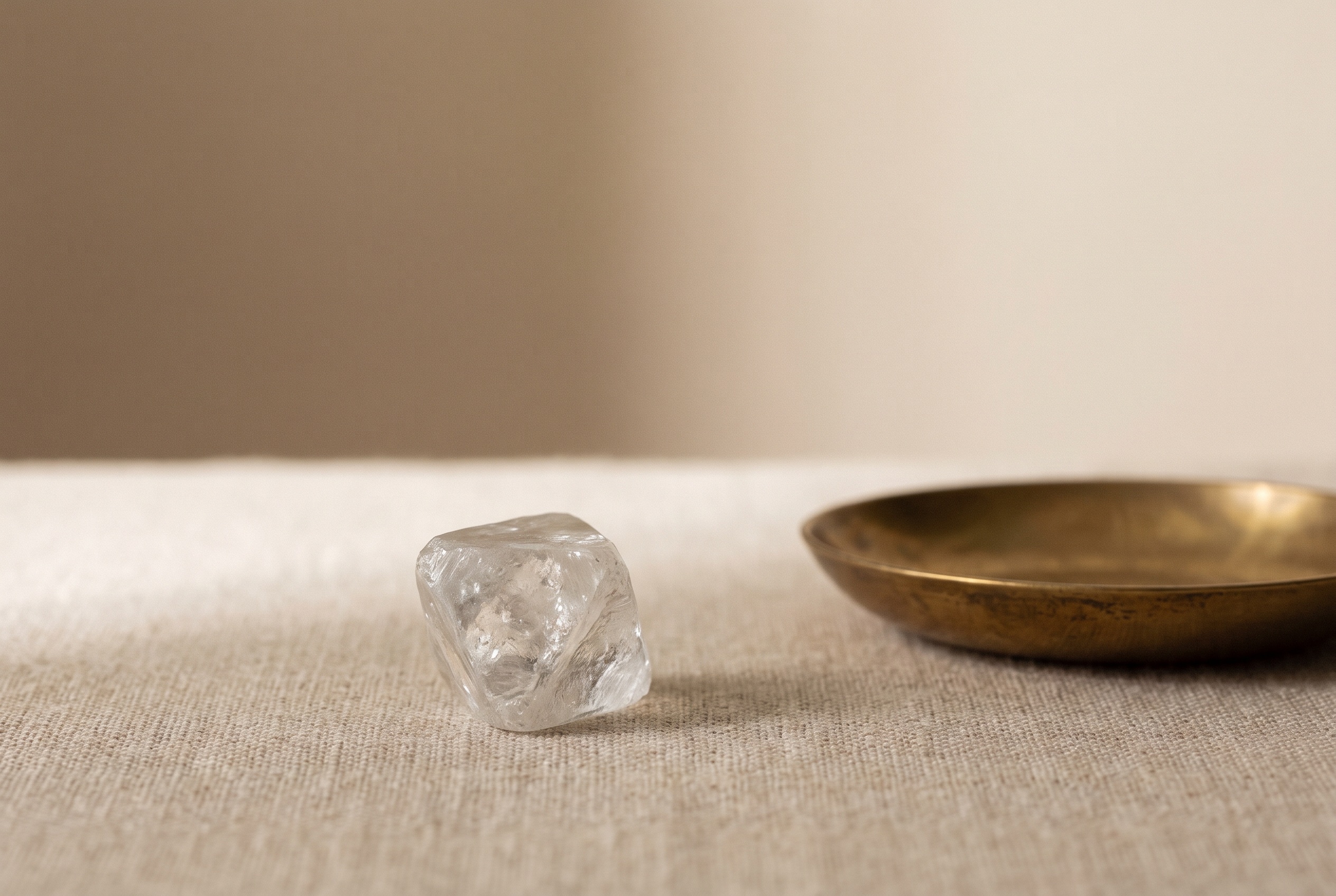
A raw diamond — also called a rough diamond — is a diamond crystal in the state it's found in nature or removed from a growth chamber, before any cutting or polishing has taken place. It typically looks nothing like the sparkling stone most people picture: rough diamonds are usually dull, frosted, and grayish or brownish on the surface, with their brilliance locked inside until a cutter facets and polishes the crystal.
"Raw diamond" is a phrase that gets searched from several different directions at once — some people want to understand the mining and formation process, some have heard about raw diamonds as a jewelry trend and want to know if an uncut stone can be worn as-is, and some are trying to figure out whether a rock someone is trying to sell them is the real thing. This guide covers all three: how rough diamonds form and get pulled out of the ground, what they actually look like and how a cutter decides what to do with one, the difference between "raw diamond" as a rustic jewelry aesthetic and the industrial rough-to-polished pipeline, how natural rough compares to lab-grown rough, and how to spot an imitation before you buy.
How Diamonds Form: The Geology Behind a Rough Stone
Natural diamonds form roughly 90 to 120 miles beneath the earth's surface, in a layer of the upper mantle where temperatures reach 1,650–2,200°F and pressure runs to around 725,000 pounds per square inch — conditions extreme enough to force pure carbon atoms into diamond's distinctive crystal lattice rather than the looser structure of graphite, which is also pure carbon but forms under far gentler conditions. This process takes an enormous span of geologic time; most natural diamonds are estimated to be between 1 billion and 3.5 billion years old, meaning the stone in a piece of jewelry today began forming long before complex life existed on the planet's surface.
Diamonds don't travel to the surface on their own. They're carried up through the mantle and crust by deep volcanic eruptions, in a type of igneous rock called kimberlite (named for the town of Kimberley, South Africa, where it was first identified). These eruptions are violent, fast, and — by geologic standards — quite rare, which is a large part of why diamonds are scarce relative to most other gem materials. The kimberlite cools into vertical, carrot-shaped rock formations called kimberlite pipes, and it's these pipes that mining operations target, either through open-pit or underground mining, to recover the rough diamonds trapped inside.
A smaller share of natural diamonds are also recovered from alluvial deposits — riverbeds, beaches, and marine sediment where diamonds eroded out of their original kimberlite source and were transported and redeposited by water over millions of years. Alluvial rough is often more heavily worn and rounded than rough pulled directly from a kimberlite pipe, since it's been tumbled and abraded during transport.
Where Rough Diamonds Are Mined
Diamond mining has shifted geographically many times over the centuries, tracking new discoveries as older deposits were exhausted. A few regions are especially significant to the industry's history:
- India (historical). India was essentially the only known source of diamonds in the world until the 18th century, and the historic Golconda mines produced some of the most famous diamonds ever recorded, prized for exceptional transparency and purity. Golconda-region stones are still referenced today as a benchmark for a particular quality of old, exceptionally clean rough.
- South Africa. The 1867 discovery of diamonds near the Orange River, followed by the Kimberley rush of the 1870s, effectively created the modern industrial diamond industry and gave kimberlite rock its name.
- Russia. Major deposits in Siberia, discovered in the mid-20th century, made Russia one of the largest producers of rough diamonds by volume in the world.
- Botswana. Since the discovery of the Orapa pipe in 1967, Botswana has become one of the most significant sources of gem-quality rough by value, known particularly for large, high-clarity stones.
- Canada, Australia, and other producers. Canada's Arctic mines and Australia's Argyle mine (closed in 2020, historically the world's largest source of rare pink and red rough) round out a global map of production that has continued to diversify over the past several decades.
These are facts about the diamond industry's history and geography broadly — not claims about where any particular supplier's inventory originates.
What a Rough Diamond Actually Looks Like
This is where expectations and reality diverge most sharply for people encountering a raw diamond for the first time. A rough diamond typically does not sparkle, does not look glassy, and does not resemble the polished stone most people associate with the word "diamond" at all. Instead, a rough crystal usually presents as:
- Dull or frosted on the surface — the outer skin of a rough diamond (sometimes called the "rind" or "naat" in trade terminology) is typically etched, pitted, or matte from its time in the earth, which scatters light rather than reflecting it cleanly.
- Grayish, brownish, or yellowish in overall tone, even in stones that will polish out to a colorless or near-colorless grade — surface coating and internal light behavior in an unfaceted crystal mask the true body color underneath.
- Geometric rather than round — rough diamonds grow as crystals with flat faces and defined edges, not the curved outline of a cut stone.
- Small relative to its eventual polished weight — cutting removes a substantial percentage of a rough stone's original weight (commonly 40–60%, sometimes more) to eliminate inclusions, correct shape, and create facets, so a rough crystal is always noticeably larger and heavier than the polished stone it becomes.
To someone who isn't looking for it specifically, a rough diamond can be genuinely easy to mistake for an unremarkable pebble or a piece of quartz — which is exactly why untrained rough sorting is a skilled trade in its own right, and why so much rough historically passed through hands without being recognized for what it was.
Common Rough Diamond Crystal Shapes
Diamond's crystal structure means rough stones tend to form into a limited set of recognizable geometric shapes, and the shape a piece of rough grows into has a major influence on what polished cut a cutter will eventually plan for it. The classic and most commercially significant rough shape is the octahedron — essentially two four-sided pyramids joined base-to-base, forming an eight-sided crystal. Other common natural rough forms include dodecahedra (twelve-sided), cubes, and macles (flattened, twinned triangular crystals formed when two octahedral crystals grow together during formation).
| Rough Crystal Shape | Typical Characteristics | Polished Cut Often Yielded |
|---|---|---|
| Octahedron | Two pyramids joined base-to-base; the most common and efficient rough shape | Round brilliant (often two round brilliants from one octahedron), princess |
| Macle (twinned crystal) | Flat, triangular, thin — formed when two crystals grow together during formation | Pear, marquise, oval — shapes that work with a flatter starting form |
| Dodecahedron | Twelve-sided, more rounded overall outline than an octahedron | Cushion, oval, radiant |
| Cube | Six flat square faces; less common in gem-quality rough | Princess, emerald (step cuts that favor a squared starting block) |
| Irregular or broken rough | Fragments from a larger crystal, or shapes distorted during formation | Whatever shape best preserves weight and avoids inclusions — often fancy shapes like pear or heart |
These pairings are common patterns, not fixed rules — the actual decision for any individual stone depends heavily on where its inclusions sit and what shape preserves the most weight and clarity, which is covered in the next section.
How Rough Diamonds Are Evaluated and Planned Before Cutting
Turning a piece of rough into a finished polished diamond starts with a planning process, not a cut. A skilled planner examines the rough crystal — historically by eye and loupe, increasingly today with the help of 3D scanning and specialized software that maps internal inclusions and models multiple possible cutting outcomes — before a single facet is placed. A few factors drive that decision:
- Inclusion mapping. Nearly every rough diamond has some internal inclusions or surface-reaching flaws. The planner's job is to identify where they sit inside the crystal and choose a cutting plan that removes or hides as many as possible within the finished stone's pavilion and girdle, rather than leaving them visible in the table.
- Yield. Cutting always sacrifices weight — often close to half the rough's original carat weight — so planners weigh options that maximize the carat weight of the finished stone (or stones; a single piece of rough sometimes yields two or more polished diamonds) against options that produce a higher-clarity or better-proportioned result from less material. A cut that recovers more weight but leaves a visible inclusion is usually worth less than a smaller stone that's clean.
- Shape suitability. As the table above illustrates, a crystal's natural shape steers which polished outline is achievable with the least waste. Fighting a rough stone's natural geometry to force an unrelated shape usually costs significant yield.
- Market value modeling. Because certain shapes, sizes, and clarity/color combinations command different prices per carat, planners frequently model several cutting scenarios and select the one that produces the highest total value — which is not always the same as the option that produces the largest single stone.
Only after this planning stage does the physical work begin: sawing or laser-cutting the rough into more manageable sections, bruting (rounding the outline), and then faceting and polishing to bring out the finished stone's proportions, symmetry, and light performance.
Raw Diamond vs. Polished Diamond: Key Differences
| Factor | Raw / Rough Diamond | Polished Diamond |
|---|---|---|
| Appearance | Dull, frosted or matte surface; geometric crystal shape; often gray or brown-toned regardless of true body color | Faceted, reflective, brilliant; shaped into a round or fancy cut |
| How it's evaluated | Planned by inclusion mapping, yield potential, and shape suitability — not yet graded on a finished 4Cs report | Graded on the 4Cs (cut, color, clarity, carat) and issued a certificate by a lab such as IGI, GIA, or GCAL |
| Typical use | Industrial cutting pipeline input; occasionally set as-is in raw/rustic-style jewelry as a decorative choice | Standard for engagement rings, fine jewelry, and most diamond retail and wholesale trade |
| Price basis | Priced per carat based on estimated yield, clarity potential, and color potential once cut — inherently speculative until cut | Priced per carat based on certified, finished 4Cs grading — known and verifiable at time of sale |
| Weight relationship | Always heavier than the finished stone it will become | Represents 40–60%+ less weight than the original rough, after cutting loss |
Natural Rough vs. Lab-Grown Rough
It isn't only natural diamonds that start out as unpolished rough — lab-grown diamonds go through the same rough-to-polished journey, just with a different origin for the crystal itself. In CVD (Chemical Vapor Deposition) production, a thin diamond seed is placed in a sealed chamber filled with carbon-rich gas, which is heated into a plasma state so that carbon atoms deposit onto the seed layer by layer, gradually building a rough diamond crystal over several weeks. That CVD-grown crystal comes out of the chamber as genuine, unpolished rough — often plate-like or block-shaped, reflecting the growth pattern of the process — and it goes through essentially the same planning, cutting, and polishing pipeline as natural rough before it becomes a finished stone. For a deeper look at how CVD production actually works and how lab-grown diamonds compare to natural ones once finished, see our guide on what a lab-grown diamond is.
The practical takeaway: "rough" describes a diamond's stage of processing, not its origin. Both a mined crystal pulled from a kimberlite pipe and a CVD crystal pulled from a growth chamber are raw, unpolished diamond material until a cutter goes to work on them — and once either one is finished, cut, and certified, standard grading (the same D-to-Z color scale, the same clarity scale) applies identically regardless of whether the stone started underground or in a lab.
"Raw Diamond" Jewelry: A Real but Niche Aesthetic
Separate from the industrial cutting pipeline, "raw diamond" has also become a recognized jewelry and decor trend — genuine uncut or minimally-shaped rough diamond crystals set as-is into rings, pendants, and earrings, prized for their organic, unpolished texture rather than for brilliance or sparkle. This rustic aesthetic sits at the opposite end of the spectrum from a faceted, light-performance-optimized stone, and it's a real, if niche, category within bridal and fashion jewelry — often marketed under names like "raw diamond ring" or "uncut diamond jewelry."
A few things are worth understanding about this category specifically:
- Raw diamond jewelry generally uses lower-value rough — pieces with heavy inclusions, poor color, or awkward shapes that wouldn't yield a commercially attractive polished stone are frequently better suited (and priced) for this decorative use than for the cutting pipeline, since their value in industrial cutting terms would be low anyway.
- The appeal is textural and aesthetic, not brilliance-driven — buyers choosing raw diamond pieces are explicitly not looking for the sparkle a cut diamond delivers; they want the crystal's natural, geometric, semi-translucent look.
- Setting raw diamond crystals requires different techniques than setting a faceted stone, since there's no girdle to grip in the way a prong or bezel setting is designed around — pieces are often wire-wrapped, bezel-set around the crystal's natural outline, or drilled for a pendant setting.
- This is a distinct market from certified, graded diamond jewelry, and pricing works differently — raw diamond jewelry isn't typically sold against a 4Cs certificate, since the whole point is that the stone hasn't been cut or formally graded.
It's a legitimate style choice, but it's worth being clear-eyed that "raw diamond jewelry" and "diamond jewelry" are answering different questions — one is about texture and novelty, the other is about the light performance and graded quality that drives most fine jewelry and nearly all bridal and engagement purchases.
How to Tell a Real Rough Diamond From an Imitation
Because rough diamonds don't sparkle the way people expect a "diamond" to, they're an easy target for misrepresentation — sellers pass off quartz, glass, cubic zirconia rough-cut fragments, or even polished industrial-grade material as gem rough to buyers who don't know what a genuine crystal should look like. A few checks that trade professionals rely on, none of which are foolproof alone but which together build a reasonable picture:
- Crystal habit. Genuine rough diamond tends to show the flat, geometric crystal faces described earlier (octahedral, dodecahedral, or twinned macle shapes) with distinct edges and vertices — quartz and glass fragments typically don't share that same crystallography.
- Hardness. Diamond is the hardest known natural material (10 on the Mohs scale) and will scratch quartz, glass, and most other minerals, though a scratch test risks damaging genuine material and isn't something to attempt casually on a stone you're trying to preserve.
- Weight (specific gravity). Diamond has a specific gravity of about 3.52, noticeably denser than glass or quartz of the same size — a rough diamond will feel heavier in the hand than a similarly sized piece of glass.
- Thermal conductivity testers. Handheld diamond testers, widely used in the trade, measure how quickly heat moves through a stone — diamond conducts heat unusually well compared to nearly every simulant, making this one of the more reliable quick field checks (though it can't distinguish natural from lab-grown, since both are genuine diamond material).
- Professional verification. For anything beyond casual curiosity, a gemologist or reputable lab can confirm whether a piece of rough is genuine diamond material, and — for higher-value pieces — whether it's natural or lab-grown, using equipment well beyond what's available outside a lab setting.
None of these checks are something a buyer should feel obligated to run through alone. The reliable path for anything beyond a curiosity purchase is sourcing from a seller who can document where the material came from and, ideally, having it independently verified before any significant money changes hands.
Safety and Authentication Considerations When Buying Raw Diamond Material
Buying rough diamond material — whether for the raw-jewelry trend, as a collector's piece, or as an entry point into learning the cutting trade — carries a different risk profile than buying a certified polished stone, precisely because there's no finished-stone certificate to lean on. A few considerations worth taking seriously:
- No standardized grading exists for rough the way it does for polished stones. A polished diamond can carry an IGI, GIA, or GCAL certificate stating its exact color, clarity, cut, and carat weight. Rough diamonds are not graded on that same public-facing certificate system — value assessment happens through the private planning process described earlier, which means a buyer has far less independently verifiable information to go on.
- Provenance and conflict-free sourcing matter. The Kimberley Process Certification Scheme was established specifically to track rough diamonds and prevent conflict ("blood") diamonds from entering the legitimate supply chain. Reputable sellers of rough material should be able to speak to how their stones are sourced and documented.
- Imitation risk is higher than with polished stones, for the reasons covered in the previous section — an unfaceted, dull-looking stone is inherently harder for an untrained buyer to sanity-check than a faceted stone whose brilliance and fire are themselves a rough (if imperfect) authenticity signal.
- Legal and import considerations can apply to rough diamond material differently than to polished, certified stones in some jurisdictions, given the Kimberley Process framework — worth confirming before any cross-border purchase.
The short version: treat a rough diamond purchase with at least as much scrutiny as a polished one, and more if there's no documentation at all — the absence of a finished certificate is normal for rough material, but it also means the burden of verification shifts more heavily onto sourcing reputation and, where the purchase justifies it, independent testing.
From Rough to Wholesale-Ready: Where Guru Diam's Catalog Picks Up
Everything covered above — formation, mining, planning, cutting, yield — happens before a diamond is a finished, tradeable stone. Guru Diam works exclusively on the other side of that line: cut, polished, and certified diamonds, ready for jewelers, designers, and manufacturers to buy and set. Once a rough crystal has been planned, cut, and graded — whether it began as natural rough pulled from a kimberlite pipe or as a CVD crystal grown in a lab — that's where our wholesale catalog picks up.
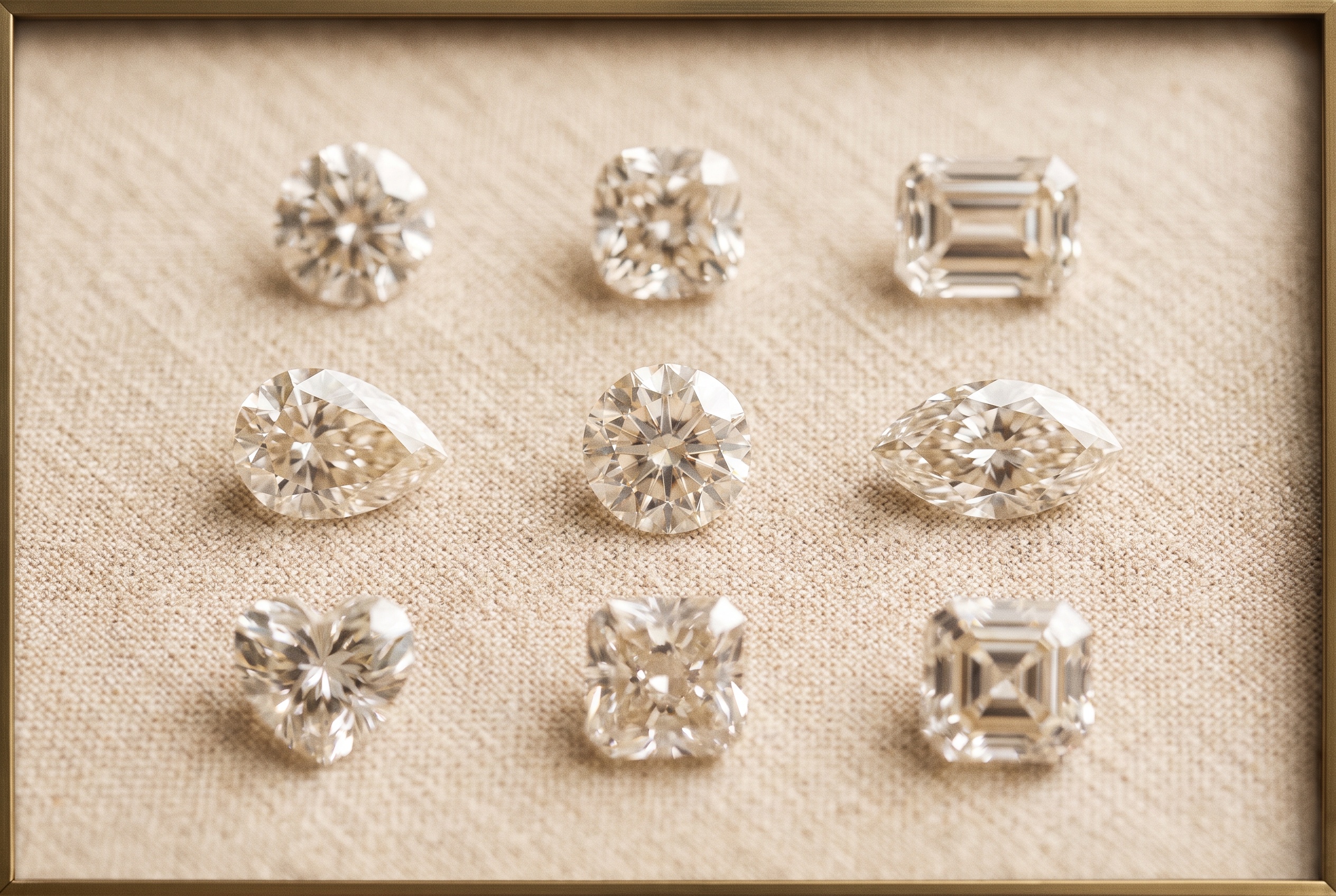
For trade buyers, that means access to certified loose diamonds with IGI, GIA, and GCAL certification all available, across natural and CVD lab-grown stock, in standard round brilliants alongside antique and fancy cuts. Buyers can browse graded inventory in the certified diamonds category, source matched sets through matching pairs, or look at fancy color loose diamonds for stones outside the standard white-diamond range. Trade accounts can review current terms at the wholesale hub or apply through trade partner, and buyers building a finished piece around a center stone can work through custom jewelry for engagement rings and other finished designs. None of this touches rough material directly — but understanding what happened to a stone before it reached a certificate is useful context for any buyer evaluating what they're actually paying for.
Frequently Asked Questions
What does a raw diamond actually look like?
A raw or rough diamond typically looks like a dull, frosted, grayish or brownish crystal with flat geometric faces — closer to an unremarkable pebble than a sparkling gem. The classic natural rough shape is an octahedron (two pyramids joined base to base), and the brilliance associated with diamonds only appears after the stone is faceted and polished.
Is a raw diamond worth anything before it's cut?
Yes — rough diamonds are bought and sold based on estimated yield, clarity potential, and color potential once cut, valued through a planning process rather than a finished certificate. Value is generally lower per carat than the finished polished stone it will become, since cutting removes a significant percentage of the original weight and adds finishing labor and expertise.
Can you wear an uncut raw diamond as jewelry?
Yes — raw diamond jewelry is a real, established niche where genuine uncut crystals are set as-is in rings, pendants, and earrings for their organic texture rather than brilliance. It's a distinct market from certified, cut diamond jewelry and typically uses lower-value rough that wouldn't yield an attractive polished stone anyway.
How can you tell if a raw diamond is real?
Genuine rough diamond shows a distinct crystal shape (octahedral or similarly geometric), is noticeably denser than glass or quartz of the same size, and will register on a thermal conductivity diamond tester. None of these checks are fully conclusive alone, so verification by a gemologist or lab is the reliable route for anything beyond casual curiosity.
Do lab-grown diamonds also start as rough?
Yes — CVD lab-grown diamonds are grown as an unpolished rough crystal inside a growth chamber before going through the same planning, cutting, and polishing process as natural rough. "Rough" describes a diamond's processing stage, not whether it formed underground or in a lab.
Are raw diamonds the same thing as blood diamonds?
No — "raw diamond" simply describes an uncut diamond's processing stage, not its sourcing history. Legitimate rough diamonds move through documented, Kimberley Process-tracked supply chains; "conflict diamond" refers specifically to rough sourced in a way that funds armed conflict, and reputable sellers should be able to document that their material isn't sourced that way.