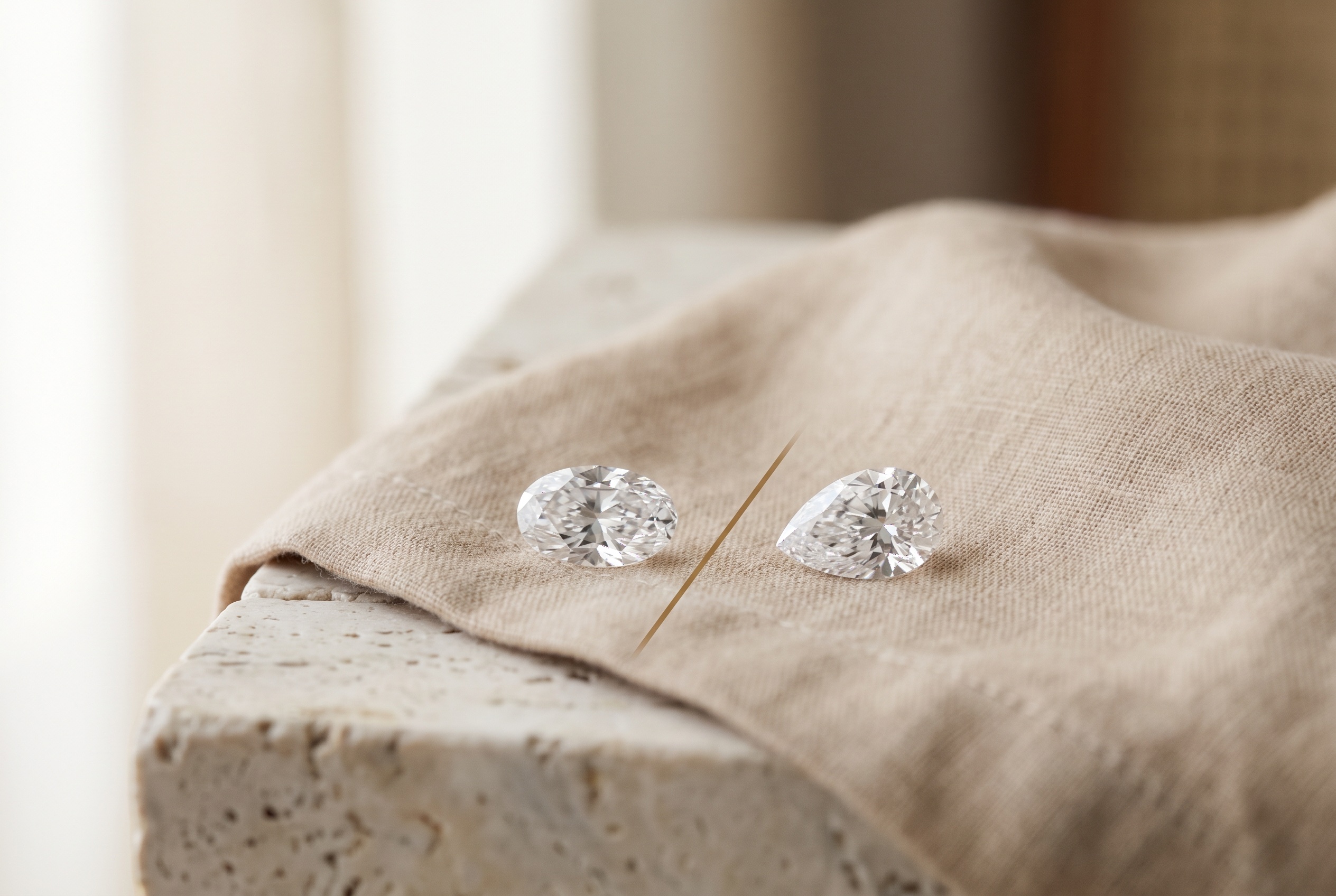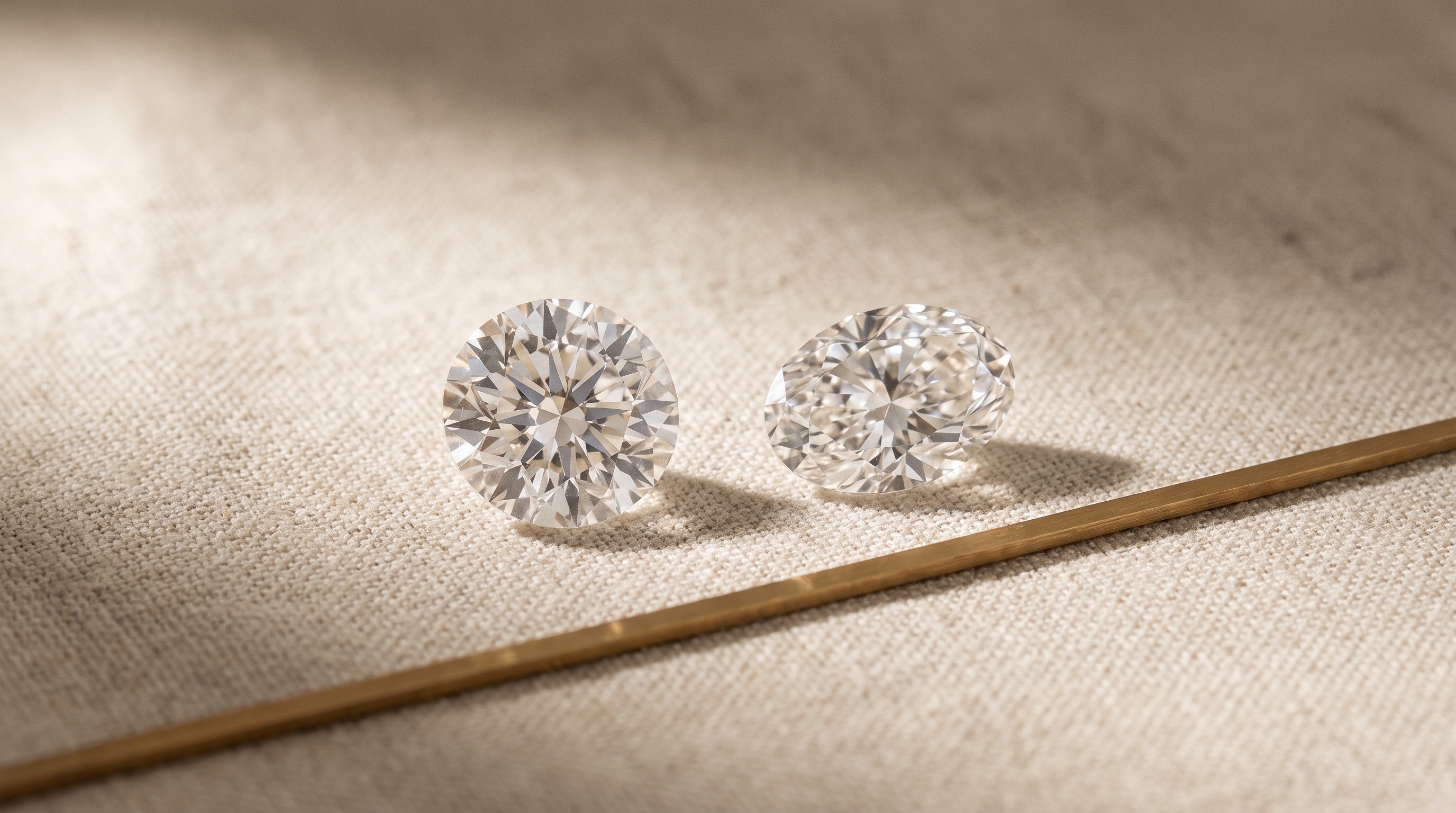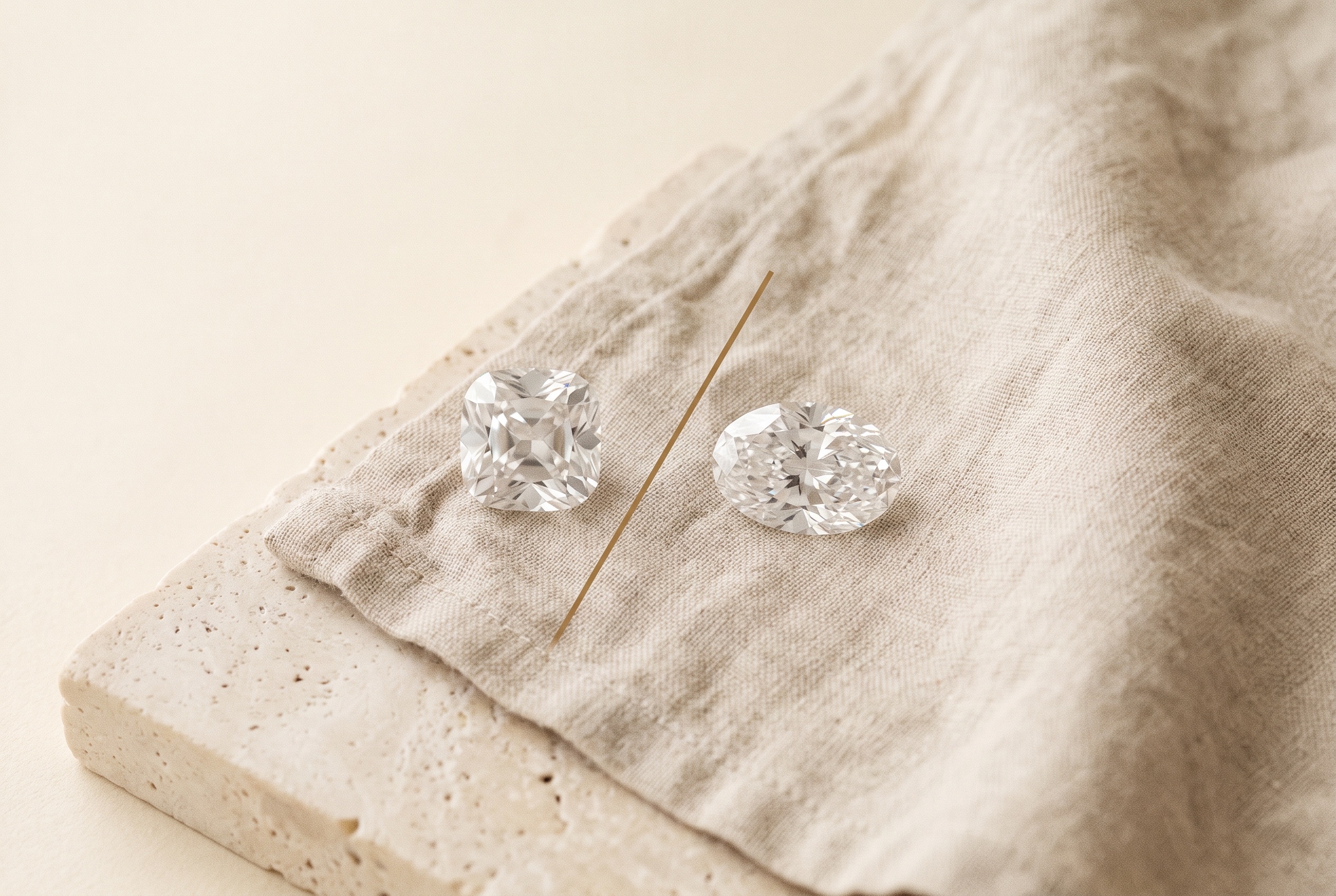

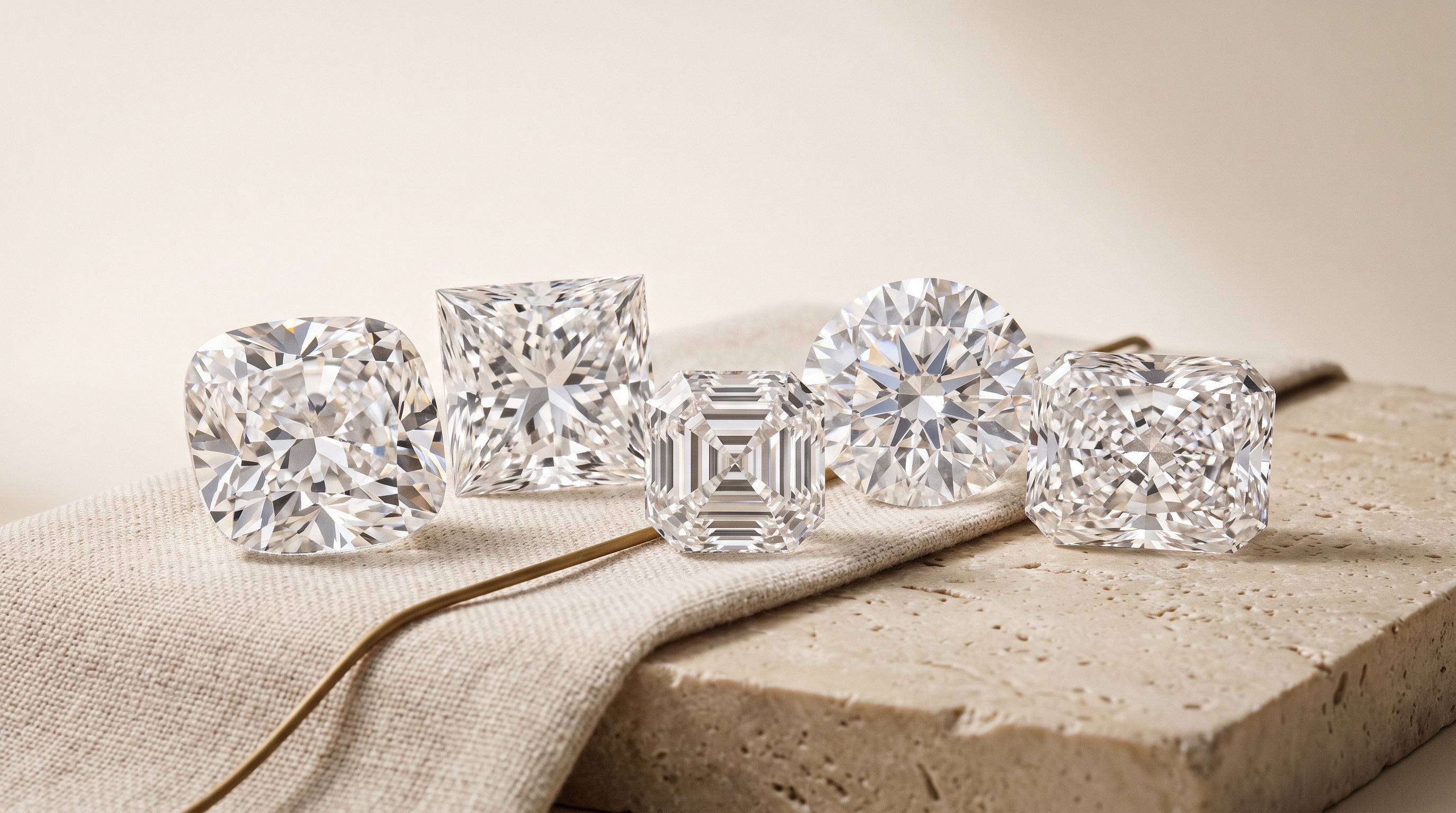
Cushion vs Princess Diamond
Cushion is a soft, rounded-square "pillow" shape with gently curved sides and rounded corners; princess is a square brilliant cut with sharp, unfinished corners and a crisp geometric outline. Both are mid-market fancy shapes with genuinely different personalities and setting requirements — cushion is more forgiving in daily wear and more setting-flexible, while princess delivers sparkle closer to round's inside a square silhouette but needs corner-protecting prongs. For the full comparison — light performance, price per carat, face-up size, clarity forgiveness, durability, and a dedicated FAQ — see our standalone cushion vs princess diamond guide.Asscher vs Cushion Diamond
Asscher is a square step-cut with deeply cropped corners and large, concentric step facets that produce a distinctive "hall of mirrors" optical effect, while cushion is a modified brilliant cut with rounded corners and a denser facet pattern built for sparkle. The comparison is really a contrast between two cutting philosophies — Asscher's step-cut clarity and geometry versus cushion's brilliant-cut fire — rather than two variations on the same idea.What Is an Asscher Diamond?
Asscher is a step cut, meaning its facets run in large, flat, parallel rows (like stair steps) rather than the small triangular and kite-shaped facets of a brilliant cut. Combined with its deeply cropped corners — cut aggressively enough that the outline reads as nearly octagonal rather than a clean square — Asscher produces what's often called a "hall of mirrors" effect: a small number of large, sharply defined flashes that seem to repeat and recede into the stone, rather than the scattered scintillation of a brilliant cut. It's worth being precise about a shape Asscher is frequently confused with: emerald cut. Both are step cuts with cropped corners, but emerald is rectangular while Asscher is square (or very close to it) — they're cousins in cutting style, not the same shape. If a customer says "emerald cut" but is describing a squarer outline, they may actually mean Asscher, and it's worth clarifying before you source or quote. Because step cuts show off the interior of the stone through large, flat facets rather than breaking up light into small flashes, inclusions are considerably more visible in Asscher than in almost any brilliant-cut shape — the "hall of mirrors" effect means a single inclusion can appear to repeat across the stone. This makes clarity a bigger factor in Asscher sourcing than it is for cushion, round, or princess at the same price point.What Is a Cushion Diamond? (Recap)
Cushion, covered in more detail in the section above, is a modified brilliant cut with a soft, rounded-square "pillow" outline. Its brilliant facet arrangement gives it meaningfully more overall sparkle than a step-cut shape like Asscher, and its rounded corners mean it carries none of the corner-protection concerns that come with square-cornered shapes. Where Asscher trades sparkle for geometric clarity and large-flash drama, cushion trades geometric drama for warmer, more forgiving brilliance.Asscher vs Cushion: Comparison Table
| Aspect | Asscher Diamond | Cushion Diamond |
|---|---|---|
| Cut style | Square step cut with deeply cropped corners; large parallel step facets | Modified brilliant cut with rounded corners; smaller, denser facet pattern |
| Visual character | Geometric, Art Deco-associated silhouette; near-octagonal outline | Soft, rounded-square "pillow" outline; vintage-romantic |
| Light performance | "Hall of mirrors" effect — fewer, larger, sharply defined flashes | Brighter overall brilliance from a denser brilliant-cut facet pattern |
| Clarity requirement | Higher — large step facets and repeated reflections expose inclusions readily | Moderate — large facets show inclusions somewhat, though less than a step cut |
| Best for | Buyers wanting a distinctive, geometric statement piece with vintage Art Deco character | Buyers wanting warm, forgiving sparkle with a softer, romantic outline |
Sourcing and Selling Notes
Asscher and cushion rarely compete for the same customer, which makes them an easy pair to stock side by side rather than choose between. A buyer drawn to Asscher has usually already decided they want the geometric, step-cut look and understands (or needs to be told) that clarity matters more here than on a brilliant-cut stone — VS2 or better is a reasonable baseline to recommend for anything you expect to sell as eye-clean, since inclusions that would be invisible in a cushion or round can be obvious in an Asscher's open facets. A buyer drawn to cushion is prioritizing sparkle and softness over geometry and can generally be sold a lower clarity grade without a visible tradeoff. On the wholesale side, Asscher parcels are worth reviewing in person or via detailed photography before committing, precisely because the "hall of mirrors" effect can make an otherwise well-graded stone look busier or cloudier than its certificate suggests. Cushion, as covered above, mainly needs a facet-style check (brilliant vs crushed ice) rather than a clarity-visibility check. Rough yield is worth understanding for pricing conversations, too. Step cuts like Asscher generally retain less of the original rough crystal than brilliant cuts do, since the deeply cropped corners and precise parallel step facets sacrifice more material than a brilliant facet arrangement requires — a factor that can support firmer per-carat pricing on Asscher relative to a similarly sized cushion at equal color and clarity. It's a useful point to have ready when a customer asks why two stones of the same carat weight and grade aren't priced identically. Setting choice reflects the two shapes' different personalities as well. Asscher's flat, open step facets make metal reflections and setting quality more visible than they would be in a brilliant cut, so a clean bezel or a well-finished four-prong setting tends to flatter it more than a busy, ornate mounting — the stone itself is already the geometric statement. Cushion is more setting-agnostic; its brilliant facet pattern and rounded corners hold up well in anything from a simple solitaire to a full pavé halo, which is part of why cushion remains one of the more versatile fancy shapes to keep in stock across multiple jewelry lines. Color grading also plays out differently between the two, and it's worth flagging alongside the clarity point above. Asscher's large, open step facets act like windows into the stone's body color in much the same way emerald cut does, so a warm tint that would be invisible in a cushion or round diamond at the same grade can be noticeably more visible in Asscher. Buyers sourcing Asscher for a customer who wants a bright, icy-white look typically need to go a color grade or two higher than they would for cushion to land on the same face-up result — a detail worth building into any Asscher quote rather than discovering after the stone is set.What makes the Asscher cut's "hall of mirrors" effect different from cushion sparkle?
Asscher's step-cut facets are large, flat, and arranged in parallel rows, which produces a small number of sharp, geometric flashes that appear to recede into the stone — the "hall of mirrors" look. Cushion uses a brilliant facet pattern with many smaller facets, producing a higher volume of smaller, brighter flashes rather than large geometric ones. Asscher reads as dramatic and architectural; cushion reads as warm and sparkly.
Is Asscher the same as Emerald cut?
No, though they're closely related. Both are step cuts with cropped corners, but emerald cut is rectangular while Asscher is square or very close to square. They're often confused because they share the same step-cut facet style and "hall of mirrors" light behavior, but the outline shape is the key distinguishing feature.
What clarity grade should I source for Asscher diamonds?
Because Asscher's large, open step facets and repeated internal reflections make inclusions more visible than in brilliant-cut shapes, VS2 or better is a reasonable baseline for stock you expect to sell as eye-clean. Lower clarity grades can still work for budget-conscious buyers, but inclusions that would be invisible in a cushion or round diamond are more likely to show in an Asscher at the same grade.
Round vs Radiant Diamond
Round is the classic circular brilliant cut, engineered purely for maximum light return and sparkle. Radiant is a rectangular or square shape with cropped corners that combines a brilliant-cut facet pattern with a step-cut-style outline — giving it a crisper, more modern silhouette than round while still delivering real brilliant-cut sparkle, unlike a pure step cut such as emerald or Asscher.What Is a Round Diamond? (Recap)
Round is a 57- or 58-facet brilliant cut whose proportions were mathematically optimized in the early 20th century specifically to maximize brilliance and fire. It's the reference shape every grading lab and every other cut gets measured against, the most standardized shape to source, and the easiest shape to set into any mounting style without shape-specific engineering. Round consistently carries the highest per-carat demand of any diamond shape, which keeps it priced at the top of the market for a given color, clarity, and cut grade.What Is a Radiant Diamond?
Radiant was developed in the early 1980s specifically to solve a problem neither round nor emerald cut solved on its own: a rectangular or square outline that still delivers strong brilliance rather than the quieter flash pattern of a pure step cut. It achieves this with a full brilliant facet arrangement — roughly 70 facets — combined with cropped corners borrowed from step-cut styling, which is why radiant is sometimes described as a hybrid between round's sparkle and emerald's geometry. Radiant is available in both rectangular and more square proportions, so it's worth confirming length-to-width ratio when sourcing or describing it to a customer — a square radiant and an elongated rectangular radiant can look meaningfully different in a setting even though both are correctly called "radiant cut." The cropped corners also give radiant a practical durability advantage over princess: it has the crisp, modern square-or-rectangular look customers associate with princess, without princess's fully exposed, unprotected points.Round vs Radiant: Comparison Table
| Aspect | Round Diamond | Radiant Diamond |
|---|---|---|
| Visual character | Classic circular brilliant; universally recognizable | Rectangular or square silhouette with cropped corners; crisp and modern |
| Light performance | Maximum brilliance and fire; the reference-standard cut | Brilliant-cut facet pattern (not a step cut) delivers strong sparkle in a more angular shape |
| Cut grading | Standardized GIA/IGI cut grade available | No standardized overall cut grade from GIA or IGI; proportions assessed directly |
| Price tier | Highest per-carat demand of any diamond shape | Efficient rough yield and cropped-corner durability often support competitive per-carat pricing versus round |
| Best for | Timeless bridal stock, resale-safe inventory, solitaire settings | Buyers wanting brilliant-cut sparkle with a modern rectangular or square silhouette |
Sourcing and Selling Notes
Round and radiant sell to genuinely different intents even though both deliver strong brilliance. Round buyers want the shape everyone recognizes and the safest resale profile in the category. Radiant buyers usually want brilliance without looking like everyone else's round diamond — a customer choosing radiant has typically already decided they want an angular outline and are comparing it against princess or emerald rather than against round directly, since round and radiant look different enough that they're rarely cross-shopped head-to-head by an undecided buyer. For wholesale sourcing, round remains the most liquid, most standardized shape in any catalog, and certificate specs alone are usually enough to buy with confidence. Radiant benefits from the same proportion-check discipline as marquise or cushion: because there's no standardized overall cut grade, checking length-to-width ratio and corner symmetry directly — rather than relying purely on the certificate — is the difference between a radiant that photographs beautifully and one that looks flat despite good color and clarity numbers. Radiant is also one of the calibrated fancy shapes available as melee alongside round, which is useful for pavé or accent work built around a radiant or round center. Face-up size follows a similar logic to the round-versus-marquise comparison, just less pronounced. An elongated rectangular radiant spreads carat weight across more visible length than round does, so it can read as slightly larger face-up at the same carat weight — though the effect is subtler than with a true elongated shape like marquise or oval, since radiant's proportions are typically closer to square than a marquise's narrow silhouette. A square-cut radiant, by contrast, faces up closer to round's compact footprint, which is another reason it's worth confirming exact proportions rather than assuming all "radiant" stock looks the same. Setting-wise, radiant's cropped corners give it a durability edge that's worth mentioning to customers weighing it against princess: the corners are already trimmed away rather than left as sharp, exposed points, so radiant tolerates everyday prong settings with less risk of chipping than a true princess cut. Round remains the least setting-sensitive shape of the two by a wide margin, simply because it has no corners or points to protect in the first place — any standard prong count and style will secure it safely. The two shapes also pair well together rather than only competing head-to-head. A round center flanked by rectangular radiant side stones, or an eternity band alternating round and radiant goods, gives a piece visual contrast — round's circular brilliance against radiant's crisper geometric edge — without requiring the sourcing complexity of an elongated shape like marquise. For a wholesale buyer building out three-stone or eternity band lines, stocking both shapes in matched calibrated sizes covers a meaningfully wider range of finished-jewelry requests than stocking round alone.Is radiant cut diamond as sparkly as round?
Radiant comes closer to round's brilliance than any other rectangular or square shape, since it uses a full brilliant facet pattern rather than a step cut. It won't quite match round's raw light return — no shape does — but it delivers substantially more sparkle than step-cut shapes like emerald or Asscher while offering a more angular, modern silhouette.
Which is more affordable, round or radiant, at the same carat and quality?
Radiant generally prices below round for comparable color, clarity, and carat weight, largely because round carries the highest consumer demand of any shape. Radiant's cutting also tends to retain more of the original rough crystal than round cutting does, which can further support more competitive per-carat pricing.
Does radiant cut work well for engagement ring centers?
Yes. Radiant is a popular center-stone choice for buyers who want strong sparkle in a rectangular or square silhouette rather than round's circular outline. Its cropped corners also make it more chip-resistant in daily wear than princess, which has fully exposed points, making radiant a practical choice for an everyday engagement ring.