
What Is a Round Diamond?
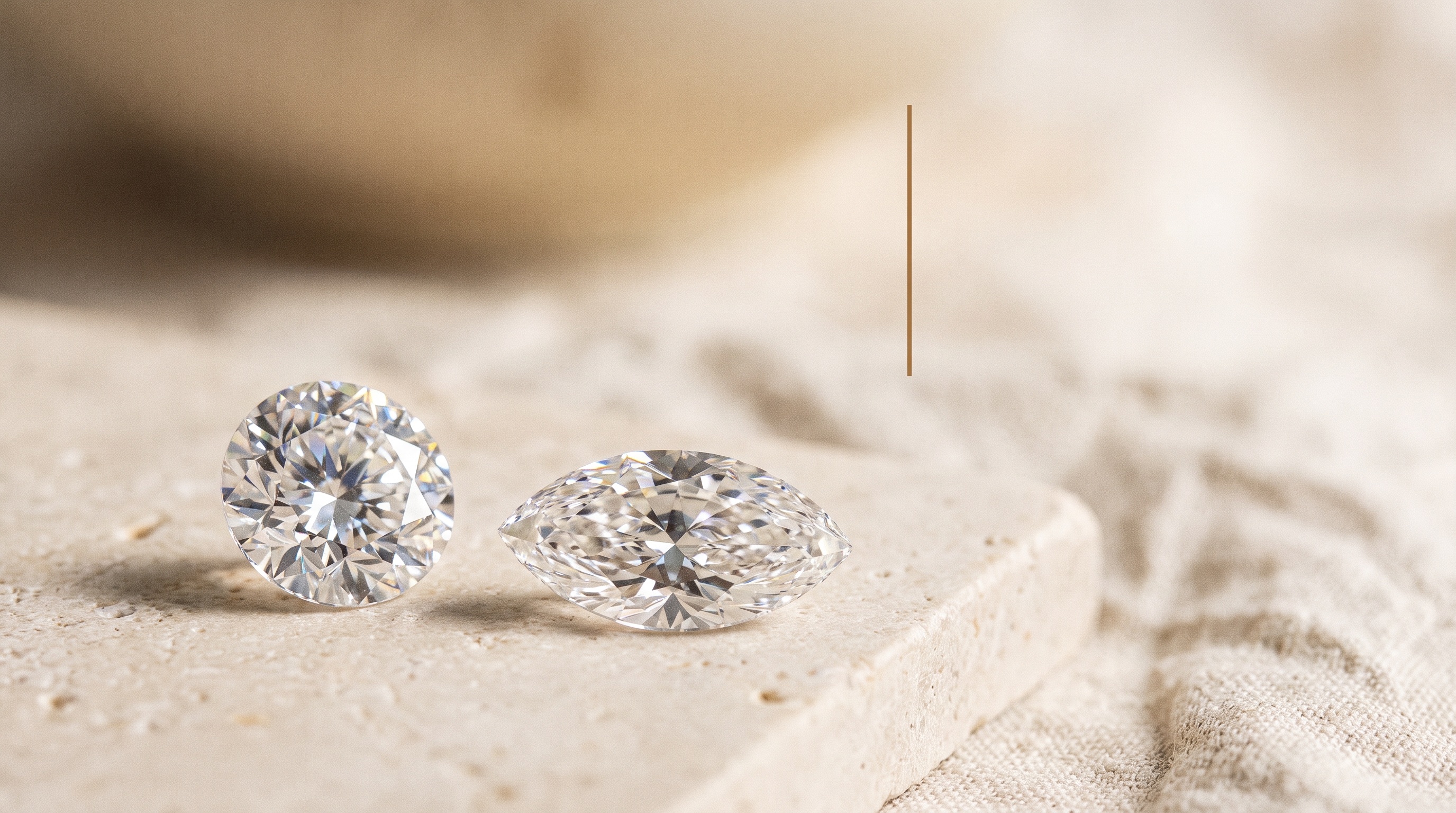
The round brilliant is the modern standard-bearer of diamond cutting: 57 or 58 facets arranged in a precise mathematical pattern designed by Marcel Tolkowsky in the 1919 study that still underpins round-cut proportioning today. Every facet angle is optimized to bounce light back up through the crown, which is why round diamonds consistently outperform every other shape on raw brilliance and fire when cut to ideal proportions. Because the round brilliant has been the reference shape for over a century, cutting houses and grading labs have built the deepest body of standardized data around it. Round is also the most forgiving shape to set — its symmetry means it drops into prong, bezel, halo, or channel settings without the shape-specific engineering that pointed or step-cut stones require. That versatility is a large part of why round remains the highest-volume shape moving through any diamond wholesaler's pipeline. Round's dominance isn't limited to center stones, either. It's the default shape for pavé, halo accents, and eternity bands, which means round demand runs through nearly every finished piece a jeweler sells — not just solitaires. A buyer stocking round inventory is stocking the one shape that shows up in accent work regardless of what the center stone ends up being.What Is a Marquise Diamond?
Marquise — also called navette, French for "little boat" — is an elongated brilliant cut with two symmetrical points at either end and a wide, gently curved belly in the middle. Trade lore credits the shape to a French king who wanted a diamond cut to resemble his mistress's smile, and while that origin story is unverifiable, the visual effect is real: the elongated silhouette creates a slender, boat-like outline unlike any other standard shape. Marquise uses the same brilliant-cut facet arrangement as round (a full brilliant facet pattern rather than a step cut), which means it delivers real sparkle rather than the quieter flash pattern of a step-cut shape. What sets marquise apart structurally is its two vulnerable points — the tips are the thinnest, most stress-prone part of any pointed diamond shape, which has direct implications for how it needs to be set and handled, covered below. Marquise has also moved in and out of mainstream demand more than round ever does. It had a strong run in mid-20th-century fine jewelry, faded from mainstream bridal for a stretch, and has come back into visible circulation in recent years as part of a broader vintage-cut revival alongside old European and old mine styling. For a wholesale buyer, that cyclical demand pattern is useful context: marquise is rarely a dead shape to carry, but it's also not a shape you want to over-stock at the volume you'd hold for round.Round vs Marquise at a Glance
| Aspect | Round Diamond | Marquise Diamond |
|---|---|---|
| Visual character | Classic, symmetrical, universally recognizable brilliant | Elongated pointed-oval "navette," dramatic and distinctive |
| Light performance | Maximum brilliance and fire; 58 facets engineered for return | Strong brilliant-cut sparkle with an elongated flash pattern; can show a "bowtie" shadow across the center |
| Face-up size per carat | Compact footprint; weight concentrated in a round outline | Elongated silhouette spreads weight across more visible length, reading larger face-up |
| Price tier | Highest per-carat demand of any diamond shape | Generally prices below round for comparable grade; strong perceived-size value |
| Cut grading | Standardized GIA/IGI cut grade (Excellent, Very Good, etc.) | No standardized cut grade from GIA or IGI; buyers assess proportions, symmetry, and bowtie manually |
| Best for | Timeless bridal stock, resale-safe inventory, solitaire settings | Jewelers wanting a distinctive, vintage-glam point of difference |
Light Performance and Sparkle Character
Round's brilliance advantage comes down to geometry: its 58 facets are arranged in concentric, symmetrical rings, so light entering from any angle has a near-identical path back out through the crown. That symmetry is why round is used as the reference point when grading cut quality on every other shape. Marquise still uses a full brilliant facet arrangement, so it isn't a quiet, step-cut sparkle — it's genuinely lively. But the elongated outline changes how that brilliance distributes across the stone. The most-cited characteristic is the "bowtie effect": a dark, bowtie-shaped shadow that can appear across the center of the stone where light escapes through the pavilion instead of reflecting back up. A well-proportioned marquise minimizes the bowtie; a poorly cut one makes it the first thing a buyer notices. This is the single biggest visual-quality variable to check when sourcing marquise stones, and it's exactly the kind of thing a standardized cut grade would flag on a round diamond but won't on a marquise — which is why manual assessment matters more here than on round goods. None of this means marquise sparkles "less" than round — it means the sparkle is distributed differently. Round produces a uniform scintillation pattern across the whole face of the stone as it moves. Marquise produces longer, more elongated flashes that travel the length of the stone, which many buyers describe as a more dramatic, attention-pulling sparkle even when total light return is comparable. Neither pattern is objectively superior; they're simply different tools for different rooms and different customers.Carat Weight, Face-Up Size, and Finger Coverage
This is where marquise earns its reputation as the "maximize the look" shape. Because carat weight in a marquise stone is stretched along its length rather than concentrated in a compact circle, a marquise diamond consistently faces up larger than a round diamond of the same carat weight — often noticeably so at typical bridal carat weights. The elongated silhouette also covers more of the finger lengthwise, which is part of why marquise has a reputation as flattering on the hand: length reads as slenderness. Round, by contrast, concentrates its weight into the most compact possible footprint for a given carat. That's a feature, not a flaw, for buyers who want a dense, substantial-looking stone rather than a shape that trades density for visual length. It's worth setting this expectation clearly with retail-facing customers: carat-for-carat, marquise will almost always look bigger, but round will read as more "solid" and centered.Cut Quality and Grading Differences
One of the most practically important differences between these two shapes is how they're graded. GIA and IGI both issue a formal cut grade — Excellent, Very Good, Good, and so on — for round brilliants, because round's proportions are standardized enough to score algorithmically. Neither lab issues an equivalent overall cut grade for marquise or most other fancy shapes. That gap means sourcing marquise well requires more hands-on judgment: table and depth percentage, length-to-width ratio, symmetry of the two points, and bowtie visibility all need to be evaluated directly rather than read off a single grade line on the certificate. For a wholesale buyer, this is the practical reason marquise sourcing benefits from a supplier who inspects proportions on every stone rather than one who ships purely against certificate specs. A useful rule of thumb when reviewing marquise stock: length-to-width ratios in the 1.75–2.25 range are generally considered the most balanced for a classic marquise silhouette, with the two points meeting at matched, symmetrical angles. Stones outside that range can still be attractive, but they read as noticeably more slender or more stubby, which matters when a customer is matching a marquise center to a specific ring style or a pair of side stones.Price Per Carat and Wholesale Margin Considerations
Round diamonds carry the highest consumer demand of any shape, and that demand consistently translates into the highest price per carat at equal color, clarity, and cut quality. It's the shape every buyer already wants, which keeps round pricing firm even as lab-grown production scales. Marquise, like most fancy shapes, typically prices below round for comparable quality — a function of lower mainstream demand rather than lower quality. For wholesale buyers, that gap is an opportunity: marquise lets you offer a stone that looks larger face-up than a same-carat round, at a lower per-carat cost, which is a compelling value story for a retail customer weighing size against budget. The tradeoff is turnover speed — round moves faster because more customers walk in already wanting it, while marquise tends to sell to a buyer who specifically seeks it out or falls for it in the case. From a margin-management perspective, the two shapes reward different strategies. Round inventory is a volume play: thinner margins per stone, offset by consistent, predictable sell-through across every carat weight and quality tier. Marquise is closer to a specialty play: it moves less often, but the buyers who do ask for it tend to be less price-sensitive and more focused on the shape itself, which supports holding marquise stock at a steadier margin rather than discounting it to move volume. Stocking both lets a wholesale account cover the fast-turning core business and the higher-margin specialty requests from the same catalog.Setting and Jewelry Design Considerations
Round's symmetry makes it the easiest shape to set. Six-prong and four-prong solitaires, bezels, halos, and pavé bands are all designed around round proportions by default, and prong protection is straightforward because there's no vulnerable point to shield. Marquise's two tips change the calculus. Those points are the thinnest, most impact-vulnerable part of the stone, so settings need V-shaped prongs or reinforced tips specifically engineered to guard them — a generic four-prong setting built for round will leave a marquise's points exposed to chipping. Marquise is also a popular choice for elongated halo settings, which both protect the tips and further exaggerate the shape's length-flattering effect, and it shows up frequently as side stones flanking a round or oval center — a three-stone silhouette that plays round's density against marquise's length on either side.Round and Marquise Across Product Lines
The two shapes earn their keep differently depending on what you're building. In solitaire engagement rings, round is the default request and rarely needs justifying to a customer — it's the shape people picture when they hear "diamond ring." Marquise solitaires sell to a narrower but more decisive buyer: someone who has usually already ruled out round and wants the elongated silhouette specifically, which makes marquise solitaire conversations shorter and higher-intent once a customer walks in asking for one. Three-stone rings are where the two shapes work best together rather than in competition. A round or oval center flanked by a pair of matched marquise side stones is one of the more durable three-stone formats in bridal jewelry, because the marquise points taper the eye outward and make the center stone look larger without the center itself needing to grow. Studs and drop earrings favor round almost exclusively at the wholesale volume level — the shape's symmetry means a matched pair is easier to source and easier to guarantee looks identical from either side. Marquise, by contrast, shows up more in statement rings, tennis-style lines, and pendants where the elongated shape itself is the selling point rather than something to be paired symmetrically.Buyer Intent: Who's Asking for Each Shape
Round buyers are, more often than not, looking for safety: a shape everyone recognizes, that holds resale value, and that never reads as trendy or dated. It's the default choice for a first-time engagement ring buyer who wants zero risk of a shape looking wrong in ten years. Marquise buyers are usually further along a different path — they've already looked at round and want something with more personality. The search intent behind "marquise diamond" skews toward buyers actively seeking vintage-glam styling, a distinctive silhouette, or a specific aesthetic they've seen on a specific piece (marquise had a visible resurgence in bridal and fine jewelry as a vintage-revival shape in recent years). As a wholesale buyer, that means round inventory should be your volume anchor, while marquise inventory is what lets you say yes to the customer who's already decided they don't want what everyone else has.Wholesale Sourcing Considerations
Both shapes are straightforward to source at the loose-stone level, but the details differ. Round is available at essentially any carat weight and quality combination a catalog can offer, with certificate specs doing most of the sourcing work for you. Marquise sourcing benefits from confirming length-to-width ratio and bowtie visibility directly — a marquise stone that reads great on paper can still show an unattractive bowtie in hand, so requesting real photos or video before committing to a parcel is worth the extra step. Marquise also shows up below the loose-stone tier as a calibrated melee shape for pavé and side-stone work, alongside round, emerald, radiant, and pear melee — useful if you're building three-stone or halo pieces that pair a marquise or round center with matching marquise or round accents. Because melee is sold as calibrated parcel goods against a color-and-clarity baseline rather than individually certified, it's worth confirming calibration tolerance with your supplier before committing to a large pavé or channel-set order — a marquise melee parcel that isn't tightly calibrated on length-to-width ratio will show visibly mismatched points once it's set in a row.Sourcing Round and Marquise Diamonds from Guru Diam
Guru Diam is a trade-only wholesale supplier working exclusively in CVD lab-grown diamonds, with IGI, GIA, and GCAL certification available across the catalog — so whichever shape a customer lands on, you're not locked into a single lab's paperwork. Round and marquise loose stones ship same-day out of both the New York HQ (before 6pm EST) and the Los Angeles office (before 4pm PST) when in stock, and if you're building a custom setting around either shape, finished custom engagement rings turn around in 4-6 days. Because Guru Diam carries the full range of standard, antique, and exotic shapes — not just the handful that move fastest — you can source round and marquise centers, matching marquise side stones, and antique or fancy-color pieces from the same account instead of splitting orders across multiple vendors. Browse certified loose diamonds for graded round and marquise stock, matching pairs for marquise or round side-stone sets, or start with the wholesale hub for the full catalog. If you're ready to open an account, the trade partner page covers onboarding, and custom jewelry is the place to start a build around either shape. For a rapid side-by-side across five more shapes — including a second look at round against a different fancy cut — see our quick diamond shape comparisons guide.Frequently Asked Questions
Is a marquise diamond cheaper than a round diamond?
Generally, yes. Round carries the highest consumer demand of any diamond shape, which keeps its per-carat price at the top of the market for a given color, clarity, and cut quality. Marquise typically prices below round for comparable specs, largely because demand is lower rather than because quality is lower.
Does a marquise diamond look bigger than a round diamond of the same carat weight?
Yes, in most cases. Marquise stretches carat weight along an elongated silhouette rather than concentrating it in a compact circle, so it faces up with more visible surface area than a round diamond of equal carat weight — often noticeably so at typical bridal sizes.
What is the bowtie effect on a marquise diamond?
The bowtie effect is a dark, bowtie-shaped shadow that can appear across the center of an elongated shape like marquise where light escapes through the pavilion instead of reflecting back to the eye. A well-proportioned marquise minimizes this shadow; poor proportions make it prominent, which is why proportions matter more for marquise sourcing than for round.
Which diamond shape is more popular for engagement rings, round or marquise?
Round remains the highest-volume shape overall and the default choice for buyers who want a timeless, resale-safe stone. Marquise has a smaller but consistent following among buyers specifically seeking a distinctive, vintage-glam or elongated look, and it has seen renewed interest as a vintage-revival shape in recent bridal trends.
Can marquise diamonds get the same certification as round diamonds?
Yes. Marquise diamonds at 0.30ct and above can be certified by IGI, GIA, or GCAL, the same labs used for round diamonds. The key sourcing difference is that GIA and IGI issue a standardized overall cut grade for round brilliants but not for marquise, so proportions and bowtie visibility need to be checked directly rather than read off a single cut-grade line.
What setting protects a marquise diamond's pointed tips?
Marquise diamonds need settings with V-shaped or reinforced prongs specifically positioned over the two points, since the tips are the thinnest and most impact-vulnerable part of the stone. A generic four-prong setting built for a round diamond will leave those points exposed to chipping, which is why marquise-specific mountings matter for durability.