Natural vs Lab-Grown Melee: Durability, Optics, and Setting Differences
Natural and lab-grown melee diamonds are the same material — carbon crystallized into a diamond lattice — so hardness, durability, and everyday wear are identical: Mohs 10 either way, verified by GIA and standard trade testing. At melee sizes, both can be cut to the same optical performance and set with the same techniques. What actually differs is origin, rarity, and price — not how the stone holds up in a mounting.
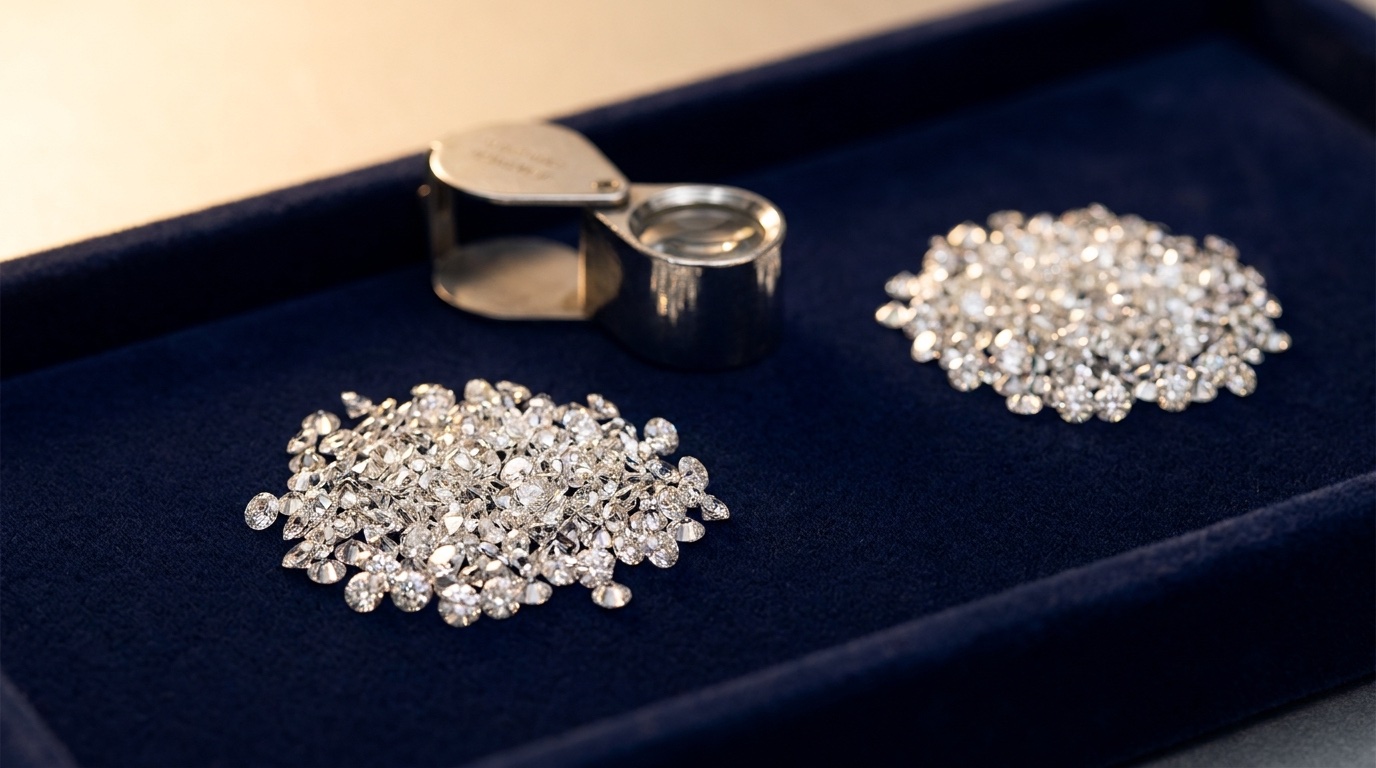
What Are Natural and Lab-Grown Melee, Physically?
Both are diamond — pure crystallized carbon in the same cubic lattice structure, full stop. Natural melee forms over geological time under heat and pressure inside the earth and is mined out of that rock. Lab-grown melee forms in weeks to months inside a lab reactor, usually via CVD (chemical vapor deposition), which builds a diamond crystal layer by layer from carbon-rich gas. HPHT (high pressure, high temperature) is the other lab-growth method used across the industry, though CVD is the more common route for melee-scale rough today.
That's the entire distinction at the atomic level: origin and growth environment. The resulting crystal — the thing that determines hardness, how light bends through it, and how it holds up to decades of wear — is the same diamond lattice either way. This isn't a Guru Diam claim; it's established gemological fact recognized by GIA and every major grading lab, and it's why lab-grown stones are graded on the same 4Cs scale as natural stones rather than a separate simulant scale.
This post is a physical and technical deep dive specifically on durability, optics, and setting behavior. For the fuller side-by-side on sourcing, pricing, and stocking decisions, see our full natural vs. lab-grown melee comparison. Guru Diam runs natural and lab-grown (CVD) melee as two separate product lines with their own size ranges, quality grids, and pricing — this post explains why that separation is about sourcing and business, not about one line performing worse than the other in a piece of jewelry.
Are Lab-Grown Melee Diamonds Really as Durable as Natural Melee?
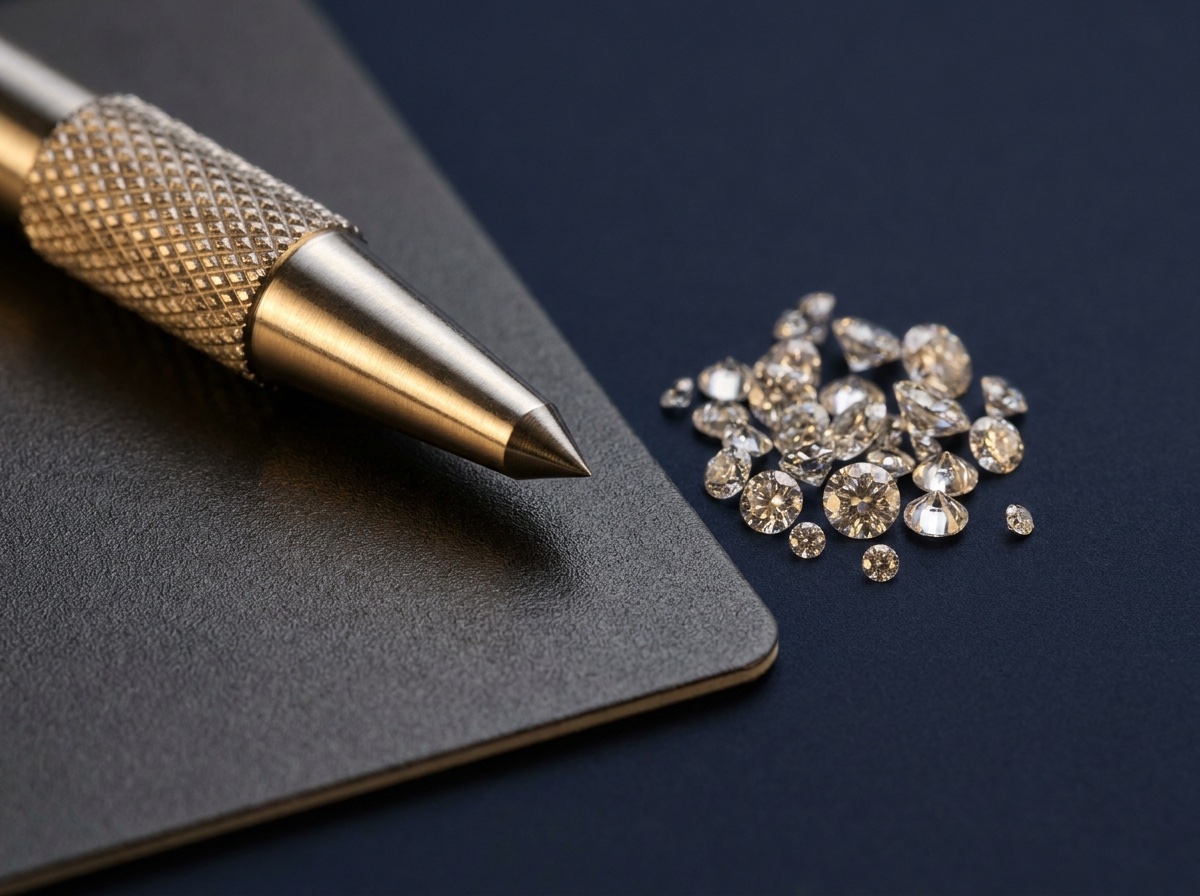
Yes. Diamond — natural or lab-grown — sits at 10 on the Mohs hardness scale, the hardest natural material known and the reference point the entire scale is built around. Hardness measures resistance to scratching, and on that measure there is no natural-vs-lab-grown gap: a lab-grown diamond scratches a natural diamond exactly as well as a natural diamond scratches a lab-grown one, because it's the same crystal structure resisting the same test.
Durability in gemology actually covers three separate properties: hardness (scratch resistance), toughness (resistance to chipping or breaking under impact), and stability (resistance to heat, light, and chemical exposure over time). Diamond scores at or near the top of all three regardless of origin, because all three properties trace back to the strength of the carbon-carbon bonds in the crystal lattice — bonds that are identical whether they formed six inches underground over a billion years or six inches inside a plasma reactor over six weeks.
This isn't a fringe claim or a lab-grown marketing line. It's standard, well-established gemological consensus, and it shows up consistently across GIA education materials and mainstream trade sourcing: hardness, refractive index, dispersion, and thermal conductivity are all functions of the diamond crystal structure itself, not of how that structure came to exist. A stone doesn't "remember" whether it grew in the earth or in a lab once the crystal is formed.
Why Does the "Lab-Grown Is Less Durable" Myth Keep Coming Up?
The misconception almost always traces back to confusion with diamond simulants, not lab-grown diamond itself. Moissanite and cubic zirconia are also lab-created, and both are genuinely softer and less durable than diamond — moissanite sits around 9.25 on the Mohs scale, cubic zirconia around 8 to 8.5. A customer who's heard "lab-created gems can be less durable" is usually thinking of those simulants, then misapplying that fact to lab-grown diamond, which is a completely different category: actual diamond, not a diamond substitute.
The naming doesn't help. "Lab-grown," "lab-created," "synthetic," and "man-made" get used loosely across the jewelry industry to describe both lab-grown diamond (chemically identical to natural diamond) and simulants like moissanite (chemically a different mineral entirely). A retail customer hearing "lab" in both contexts reasonably assumes they're the same category of risk. They aren't. If you sell or discuss simulants alongside melee, our natural melee vs. moissanite and CZ guide covers exactly where that line sits and how to explain it.
The other source of confusion is simply unfamiliarity — lab-grown diamond is a newer category to most retail buyers than natural diamond, and "newer" tends to get misread as "less proven" even when the underlying material science says otherwise. Correcting this with a customer is usually a thirty-second conversation once you have the Mohs scale and the "it's still diamond" framing ready.
Do Natural and Lab-Grown Melee Wear Differently Over Years of Daily Use?
No — over years of daily wear, natural and lab-grown melee hold up identically, because the wear mechanisms that matter (scratching, chipping, and facet wear from repeated contact) are all governed by hardness and toughness, and both properties are the same across origin. A pavé band set with natural melee and an identical band set with lab-grown melee, worn under the same conditions for the same number of years, will show the same wear pattern — because it's the same material responding to the same physical stresses.
Diamond's one real mechanical vulnerability — natural or lab-grown — is cleavage: diamond has four planes of weakness in its crystal structure where a sharp, direct blow can cause a stone to chip or split, even though the same stone would resist a scratch from almost anything else in daily life. This is a property of the diamond crystal lattice itself, present identically in natural and lab-grown stones. It's also why melee, at any origin, benefits from setting styles (bead, prong, channel) that protect the stone's girdle and avoid exposing an edge to a direct impact angle — a setting question, not an origin question.
Cut quality has a bigger practical effect on wear resistance than origin ever will. A well-proportioned girdle and properly polished facets resist chipping and abrasion better than a poorly cut stone of either origin — which means "buy well-cut melee" is more useful durability advice than "buy natural because it's more durable," a claim the material science doesn't actually support.
Are There Optical Differences Between Natural and Lab-Grown Melee at Small Sizes?
Practically, no. Refractive index, dispersion (the property that produces fire, or flashes of spectral color), and luster are all functions of the diamond crystal structure, and that structure is identical between natural and lab-grown stones. A well-cut lab-grown melee stone and a well-cut natural melee stone of the same size, color, and clarity grade will return light — brilliance, fire, and scintillation — the same way. At melee scale, where individual stones are small and set close together to build a collective sparkle across a pavé surface or eternity band, cut proportions and how the parcel is matched stone-to-stone drive the visual result far more than origin does.
Where a visible difference can show up is indirect: natural and lab-grown rough sometimes carries different typical inclusion patterns (more on that below), and inclusion type can occasionally affect how a stone handles light internally at a microscopic level. But at melee clarity grades like VS and SI — both of which read eye-clean at typical mounting distance — this is not something a customer, or usually even a jeweler without a loupe and training, would notice in a finished piece. The optical performance that actually matters to how a piece looks on someone's hand is set by cut and clarity grade, applied consistently, not by origin.
Does Setting Behavior Differ Between Natural and Lab-Grown Melee?
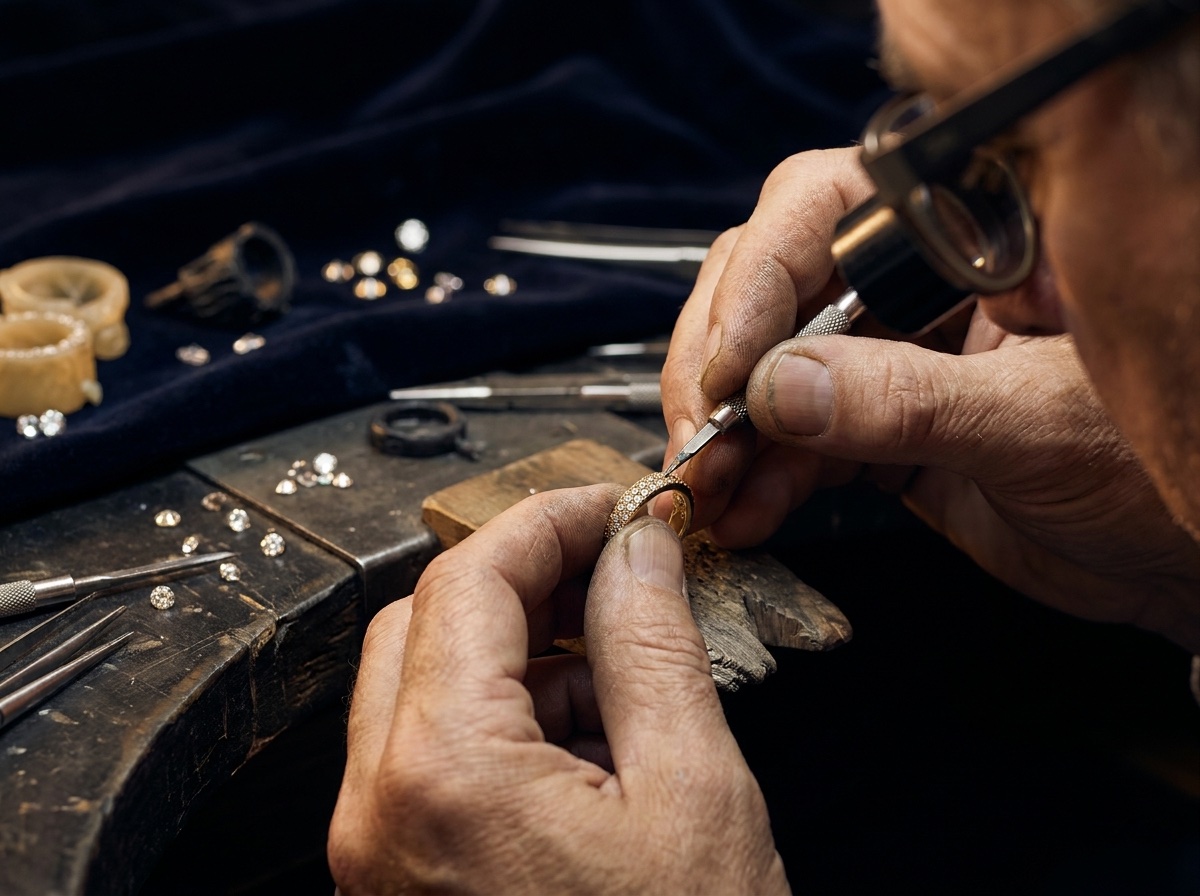
No — there's no meaningful setting-behavior difference at melee scale. Bead setting, prong setting, and channel setting all work by displacing or compressing small amounts of metal against the stone's girdle to hold it in place, and that process relies on the metal being softer than the stone, not on any property specific to natural or lab-grown diamond. Since hardness is identical, a bench jeweler setting a tray of natural melee and a tray of lab-grown melee side by side will use the same tools, the same pressure, and the same technique for both.
Heat tolerance matters in setting and repair work — soldering near a stone, using a jeweler's torch, or laser-welding a repair close to existing melee — and here too, diamond's thermal stability is a function of the crystal lattice, identical across origin. Standard bench precautions (heat sinks, boric acid, keeping direct flame off the stone) apply the same way regardless of whether the melee in that setting is natural or lab-grown.
The one place origin does interact with setting work isn't mechanical — it's inventory. Natural and lab-grown melee at Guru Diam are calibrated to the same trade-standard tolerance (±0.10mm on dimension, ±0.10ct on weight, and a 1-grade match on color and clarity within a parcel), so a bench working from either line gets the same drop-in consistency into pre-cut seats. That consistency is a sourcing and grading standard, not a property of the stone itself.
Can a Jeweler Tell Natural and Lab-Grown Melee Apart by Eye or Loupe?
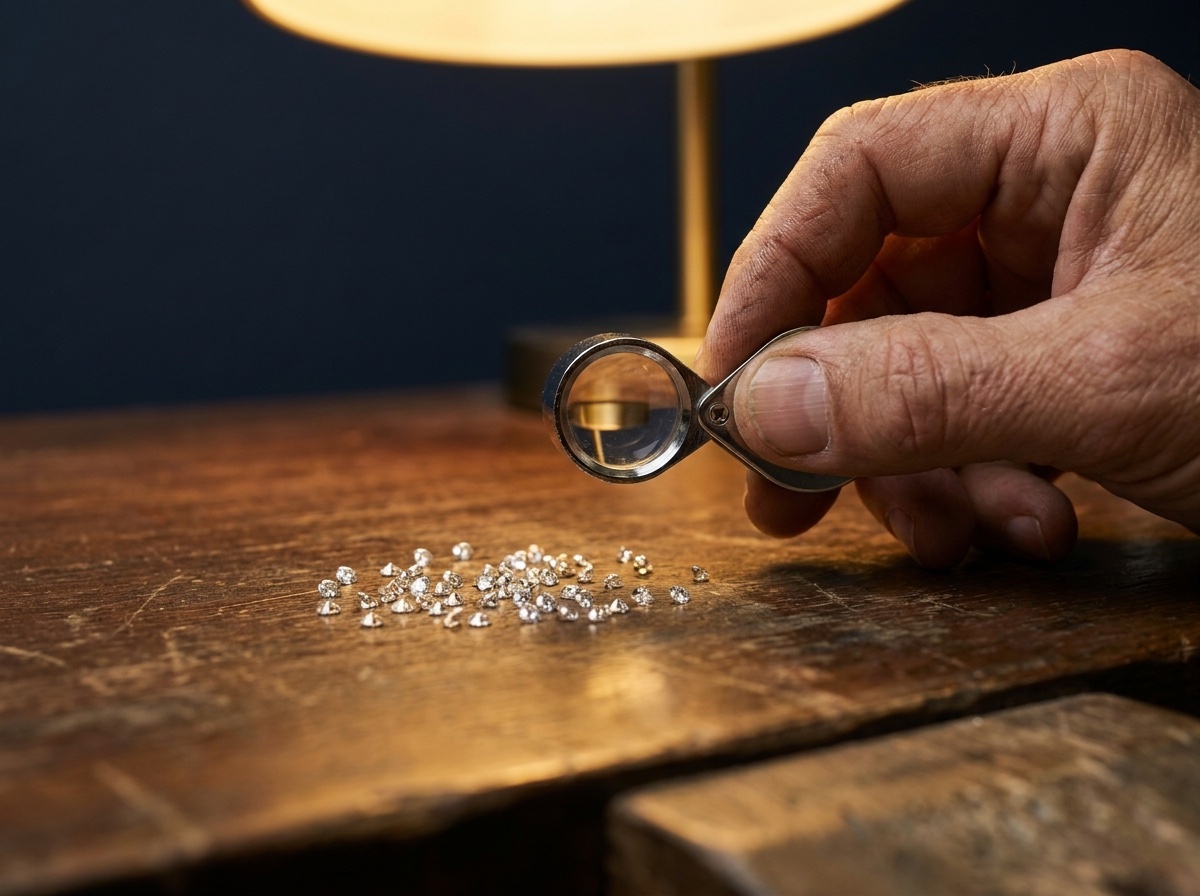
No, not reliably, and this is worth being direct about: a standard 10x loupe and trained eye cannot distinguish natural from lab-grown melee. Both are diamond, both show the same brilliance, fire, and general appearance, and at melee sizes the growth-related features that sometimes hint at origin in larger stones are usually too small or too subtle to read visually even under magnification. Any supplier or jeweler claiming they can sort natural from lab-grown melee by eye alone is overstating what's actually possible.
Telling the two apart with confidence requires diamond-type verification instrumentation — screening devices that read spectroscopic or luminescence properties invisible to the eye — not a loupe and experience. This matters most on the receiving end of the supply chain: any supplier running both natural and lab-grown melee lines should be screening incoming parcels with that kind of equipment to keep the two lines from ever mixing, rather than relying on trust or visual sorting. For the practical how-to on this, see our guide to confirming natural melee isn't lab-grown.
The inability to eyeball the difference is exactly why disclosure at the point of sale matters so much in this category — the customer, and often the jeweler, is trusting the paper trail and the supplier's sourcing controls, not what's visible under a loupe.
Do Growth-Related Inclusions Affect Durability or Appearance at Melee Sizes?
Natural and lab-grown diamonds tend to carry different characteristic inclusion types, a real and well-documented gemological fact — but at melee sizes and melee clarity grades, this has essentially no practical effect on durability or visible appearance. Natural diamonds commonly show mineral inclusions, feathers, or graining formed during geological crystallization. Lab-grown diamonds (particularly HPHT-grown stones) can show metallic flux inclusions from the growth process, while CVD-grown stones more often show strain patterns or pinpoint inclusions from the layer-by-layer growth method.
None of these inclusion types, at the sizes and clarity grades used in melee, compromise the stone's structural integrity in normal wear. Clarity grading exists to catch inclusions large or positioned badly enough to pose an actual durability risk (an inclusion that reaches the surface at a stress point, for instance) — and that grading standard applies the same way to both origins. A VS or SI melee stone, natural or lab-grown, has already been sorted to a standard where growth-related inclusions aren't a structural concern.
Where inclusion type becomes relevant is verification, not durability: it's one of several markers diamond-testing instruments use to help identify origin, alongside fluorescence patterns and other spectroscopic properties. That's a sourcing and disclosure question, covered in the screening guide linked above — not a durability or optical-performance question, which is what this post is about.
If Durability and Optics Are the Same, What Actually Differs Between Natural and Lab-Grown Melee?
Three things, and none of them are about how the stone performs in a piece of jewelry: origin, rarity, and price. Natural melee is mined and finite — every parcel traces back to material formed over geological time and pulled out of the ground, which is inherently rarity-constrained. Lab-grown melee is manufactured on a production timeline measured in weeks, which makes supply more elastic and, in the current market, typically prices lab-grown melee below natural melee at a comparable size and grade.
That price and rarity gap is the actual reason natural and lab-grown melee get sold as separate product lines and separate price sheets — not because one wears worse or sparkles less than the other. It's also why disclosure of origin at the point of sale is a legal requirement in the US regardless of which line a customer chooses: the material performs the same, but origin affects value, and a customer is entitled to know what they're buying. For the full breakdown of sourcing, pricing, and how those market dynamics play out, see our complete natural vs. lab-grown melee comparison.
How Should Jewelers Talk to Customers About Durability When Selling Either Line?
The short, accurate version: "Both are real diamond, same hardness, same durability — the difference is where it came from and what that does to price, not how it holds up." That single sentence resolves the most common objection a customer raises about lab-grown melee, and it's accurate enough to say with confidence because it reflects settled gemological fact, not a sales position.
Where jewelers get into trouble is overcorrecting in either direction — either implying lab-grown is somehow inferior to close a natural sale (which isn't accurate and can create a disclosure problem down the line), or implying natural carries some durability edge to justify its higher price (also not accurate). The honest pitch for natural melee is rarity, origin story, and market value, not a durability claim the material science doesn't support. The honest pitch for lab-grown melee is value and supply consistency at the same physical quality — not a claim that it's "better" in some performance sense either.
Disclosure language and documentation requirements around natural-vs-lab-grown sales are a separate, more detailed topic than durability — covered fully in our post on natural vs. lab-grown melee disclosure requirements if that's what you're trying to get right for your shop.
Does Guru Diam Hold Natural Melee to the Same Setting-Ready Standard as Lab-Grown?
Yes. Guru Diam's natural melee is calibrated to the same trade-standard tolerances applied across calibrated goods generally — ±0.10mm on dimension, ±0.10ct on weight, and a 1-grade color/clarity match within a parcel — so a parcel drops into pre-cut seats with the same consistency a bench expects from calibrated lab-grown goods. That consistency is a sorting and grading discipline, not a claim about the stone's physical properties, which — as this post covers — don't vary by origin in the first place.
Guru Diam's natural melee program currently covers round shapes from 0.8mm to 4.0mm, in an EF/GH color and VS/SI clarity grid, priced per carat and confirmed at quote — pricing starts around $370–450/ct in the smallest sizes and rises with size and grade. Guru Diam's separate lab-grown (CVD) melee line has its own size range and quality grid, quoted on its own price sheet. Both lines ship same day out of Guru Diam's New York (before 6pm EST) and Los Angeles (before 4pm PST) trade desks, subject to the parcel being in stock. For an exact quote against either line, reach out over WhatsApp or through Contact.
Frequently Asked Questions
Are lab-grown melee diamonds less durable than natural melee?
No. Both are diamond, both score 10 on the Mohs hardness scale, and both share identical toughness and stability. There is no durability difference tied to origin — this is established gemological fact, not a marketing claim from either side of the market.
Do lab-grown melee diamonds scratch or chip more easily than natural melee?
No. Scratch resistance (hardness) and chip resistance (toughness) are both functions of the diamond crystal lattice, which is identical between natural and lab-grown stones. Cut quality and setting style affect chip risk far more than origin does.
Can lab-grown melee be confused with moissanite or cubic zirconia because it's also "lab-made"?
It shouldn't be, but the confusion is common. Lab-grown diamond is chemically real diamond, identical to natural diamond. Moissanite and cubic zirconia are different minerals entirely and are genuinely softer and less durable than diamond. "Lab-made" describes the growth process for lab-grown diamond and the manufacturing process for simulants — it doesn't put them in the same durability category.
Does natural melee sparkle more than lab-grown melee?
No. Refractive index, dispersion, and brilliance are functions of the diamond crystal structure, identical across origin. At melee sizes, cut quality and how consistently a parcel is matched stone to stone drive the visible sparkle result — not whether the stone is natural or lab-grown.
Can a jeweler tell natural and lab-grown melee apart with a loupe?
Not reliably. The two are visually indistinguishable under standard 10x magnification. Confirming origin requires diamond-type verification instrumentation, not a loupe and trained eye — which is why suppliers running both lines should screen incoming parcels with that equipment.
Will heat from soldering or torch work near melee affect natural and lab-grown stones differently?
No. Thermal stability is a property of the diamond crystal structure and is identical between natural and lab-grown melee. Standard bench precautions for working near diamond — heat sinks, boric acid, keeping direct flame off the stone — apply the same way to both.