Natural Melee vs Simulants (Moissanite, CZ): How to Tell Them Apart
Moissanite and cubic zirconia (CZ) are not diamond at all — they're different minerals (silicon carbide and zirconium oxide) that merely look diamond-like, unlike lab-grown diamond, which is real diamond, just grown in a lab instead of mined. Telling natural melee apart from moissanite or CZ isn't a matter of opinion: the three materials have measurably different thermal and electrical conductivity, refractive index, and optical behavior under magnification — properties gemological testers and loupes are built to detect.
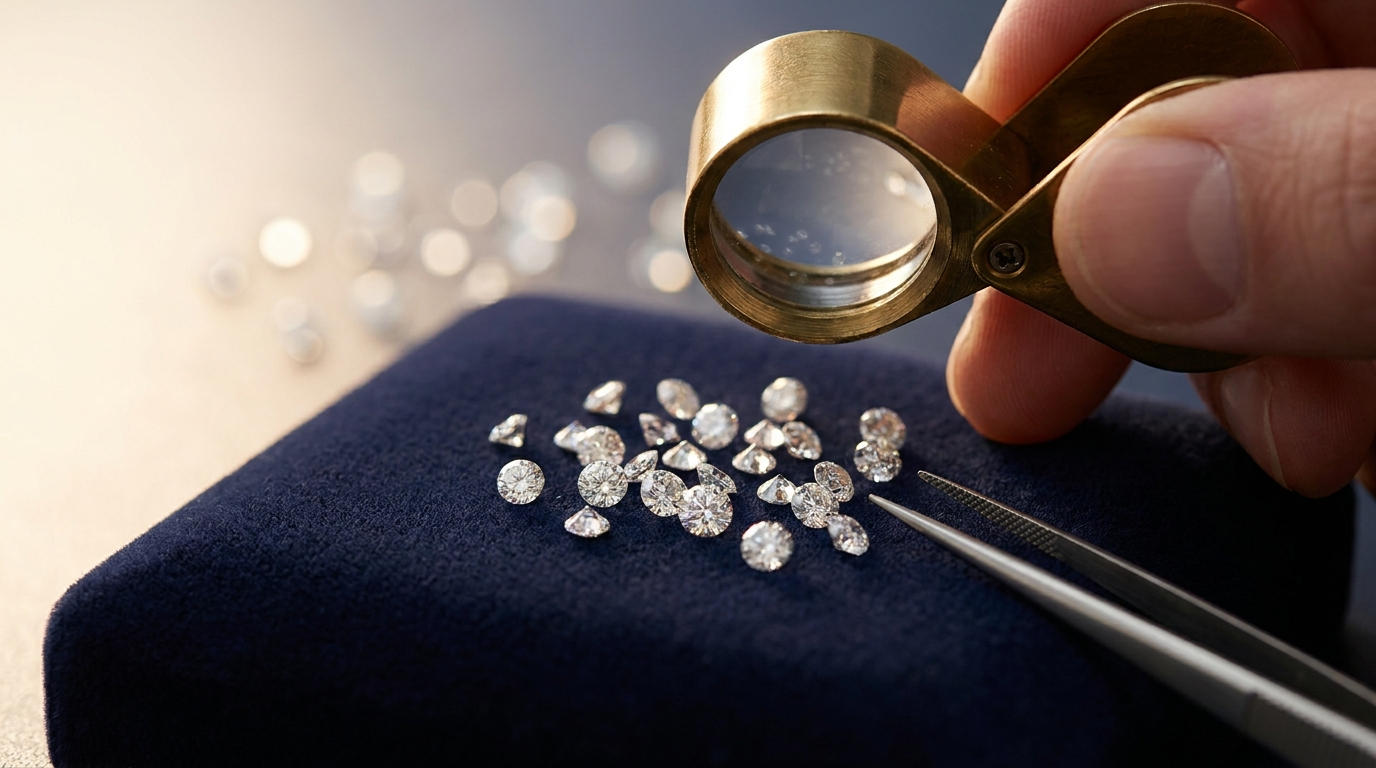
What's the Real Difference Between Natural Diamond, Lab-Grown Diamond, Moissanite, and CZ?
These four terms get flattened into one confused bucket in a lot of buyer conversations, but they split cleanly into two categories. Natural diamond and lab-grown diamond are the same material — crystallized carbon, chemically, physically, and optically identical. The only difference between them is origin: one formed underground over geologic time, the other grew in a lab in weeks. Both are real diamond by every gemological measure — hardness, refractive index, thermal conductivity, the works.
Moissanite and cubic zirconia are a different category entirely: they're not diamond, full stop. Moissanite is silicon carbide, a mineral so rare in nature that virtually all moissanite in jewelry is lab-created for the express purpose of resembling diamond. Cubic zirconia is a synthetic crystal form of zirconium oxide — it doesn't occur as a gem mineral in nature at all. Both are diamond simulants: stones chosen and cut to imitate diamond's look, built from entirely different atoms.
That distinction matters for wholesale buyers because it changes what "real" means in a customer conversation. A natural-vs-lab-grown question is a question about where a genuine diamond came from. A natural-vs-simulant question is a question about whether the stone is diamond at all. Conflating the two — telling a customer their melee is "real" when what you actually verified is that it isn't moissanite, without addressing whether it's natural or lab-grown — creates a disclosure problem down the line. This guide focuses on the second question: separating diamond (natural or lab-grown) from simulants. For the natural-vs-lab-grown question specifically, see our natural vs. lab-grown melee comparison.
Why Do Buyers Confuse Moissanite and CZ With Lab-Grown Diamond?
The confusion is understandable, and it's worth addressing head-on rather than assuming customers already know the distinction. All three — moissanite, CZ, and lab-grown diamond — get marketed as lower-cost alternatives to natural diamond, they're all manufactured rather than mined, and none of them carry the geological rarity story that natural diamond marketing leans on. Lumped together under "lab-made" or "alternative" in casual conversation, it's easy to lose track of which of the three is actually diamond.
The practical difference for a jeweler: lab-grown diamond will pass every diamond-identification test there is, because it is diamond — same hardness, same thermal and electrical behavior, same refractive index. Separating lab-grown from natural diamond requires specialized screening technology built specifically for that job (spectroscopic and fluorescence-based screening used by gem labs), not the tools covered in this guide. Moissanite and CZ, by contrast, fail one or more of diamond's basic physical tests, which is exactly what makes them identifiable with the equipment described below. If a customer asks "is this a real diamond," the honest first move is figuring out which question they're actually asking — real-diamond-vs-simulant, or natural-vs-lab-grown — because the answer and the test both differ.
Can You Tell Natural Melee From Moissanite or CZ Just by Looking at It?
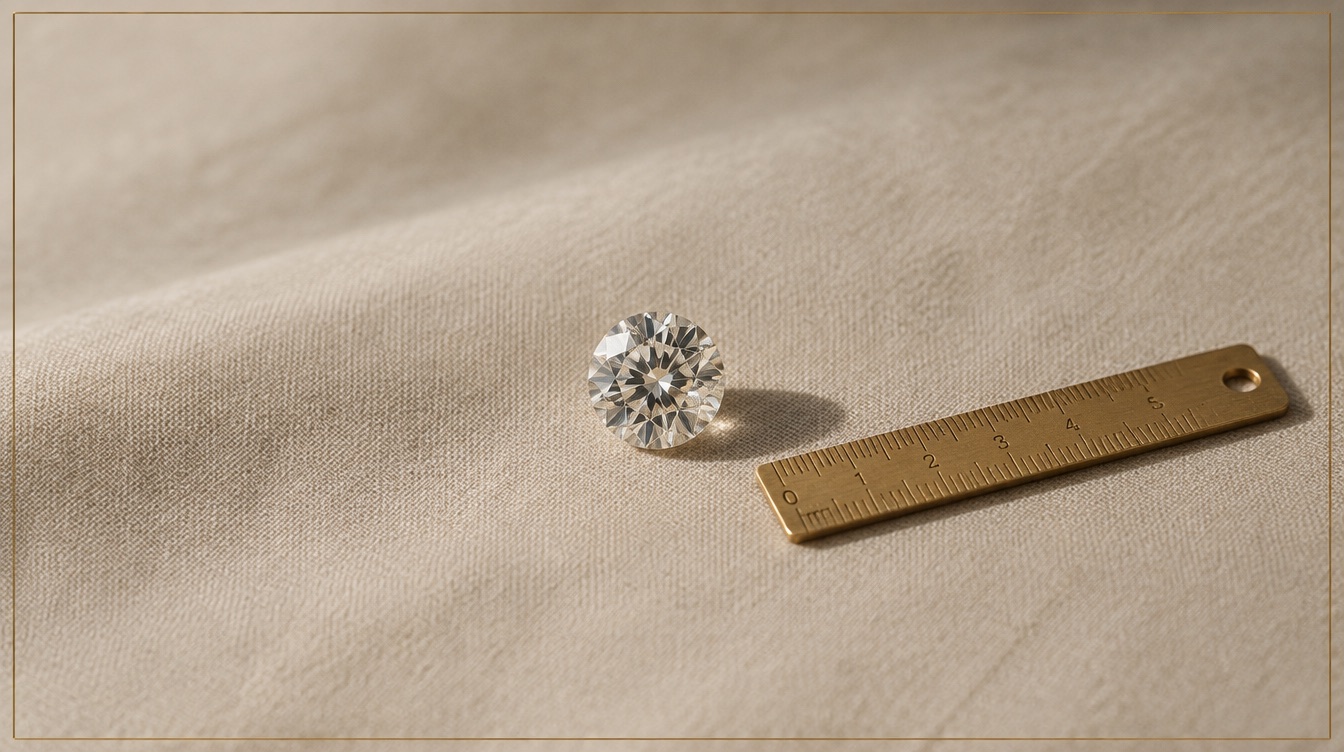
Not reliably, and especially not at melee sizes. At sub-4mm, the visual cues that sometimes tip off a trained eye on a larger stone — moissanite's extra rainbow-colored fire, CZ's slightly softer sparkle, a facet edge that looks subtly off — compress to almost nothing. A stone that small simply doesn't throw enough light for the naked eye, or even a casual loupe glance, to read those differences with confidence.
There are a few loose visual tendencies worth knowing, mostly for single, larger simulant stones rather than parcel-size melee. Moissanite tends to throw more colored ("rainbow") flashes than diamond because it disperses light more strongly — diamond's sparkle reads whiter and crisper by comparison. CZ tends to look slightly "softer" or duller in brilliance next to a well-cut diamond of the same size, though a well-cut CZ can still fool a casual glance. Neither tendency is a reliable identification method on its own, and neither holds up at all once you're looking at a tray of sub-2mm stones under normal light. Visual impression is a first-pass sanity check at best — the tests below are what actually settle the question.
What Is a Thermal Diamond Tester, and Why Doesn't It Catch Moissanite?
A thermal (or "thermal conductivity") tester is the handheld probe most jewelers already own — touch the tip to a stone, and it reads how fast heat moves through the material. Diamond conducts heat exceptionally well, far better than almost any other gem material, which is what made thermal testers a fast, reliable diamond-vs-everything-else check for decades.
The gap: moissanite also conducts heat at a rate close enough to diamond's that a thermal-only tester reads it as diamond. This isn't a flaw specific to one brand of tester — it's a physical limitation of thermal conductivity as a single measurement, and it's the reason moissanite could pass as "diamond" on old-style single-function testers for years after it entered the jewelry market. Cubic zirconia doesn't have this problem: CZ is a comparatively poor heat conductor, so it fails a thermal test outright and reads clearly as non-diamond on a basic thermal probe alone. Thermal conductivity alone separates CZ from diamond reliably. It does not separate moissanite from diamond — that requires a second test.
How Does an Electrical Conductivity (Moissanite) Tester Work?
Because thermal testers can't distinguish moissanite from diamond, the trade added a second measurement: electrical conductivity. Most gem-quality diamonds conduct electricity poorly — they're effectively insulators. Moissanite, because of how it's grown and the trace elements introduced in that process, conducts electricity at a measurably higher, detectable level. A dedicated moissanite tester (or a combined thermal-plus-electrical unit, which is now the standard in the trade) checks electrical conductivity specifically to catch what the thermal reading alone misses.
The practical takeaway for a wholesale buyer: a single-function thermal tester is not sufficient equipment for verifying diamond identity anymore, and hasn't been since moissanite became commercially available. Any testing protocol — whether run by a supplier before goods ship or by a jeweler on incoming stock — needs both readings, thermal and electrical, run in sequence, to rule out both CZ and moissanite with one pass.
What Is Refractive Index, and How Does It Separate Diamond, Moissanite, and CZ?
Refractive index (RI) measures how strongly a material bends light passing through it — it's one of the core numbers gemologists use to identify any stone, listed in standard gemological reference tables alongside hardness and specific gravity. Diamond, moissanite, and CZ each sit at a different point on that scale: diamond around 2.42, moissanite higher at roughly 2.65–2.69, and CZ noticeably lower at around 2.15–2.18.
In a full gem lab, RI is read directly on a refractometer. In practice, that instrument is built for flat-faceted stones viewed a specific way and has real limits on small, mounted, or heavily faceted material — melee-size stones and set jewelry are exactly the case where a direct refractometer reading gets difficult or impossible. RI is still useful as a concept for understanding why the other tests work — moissanite's higher RI is part of why it throws more fire than diamond, and CZ's lower RI is part of why it looks comparatively duller — but for melee-scale, mounted, or bulk-parcel verification, the practical tools are the conductivity testers and magnification checks covered elsewhere in this guide, not a benchtop refractometer.
What Is "Doubling," and Why Does It Expose Moissanite Under Magnification?
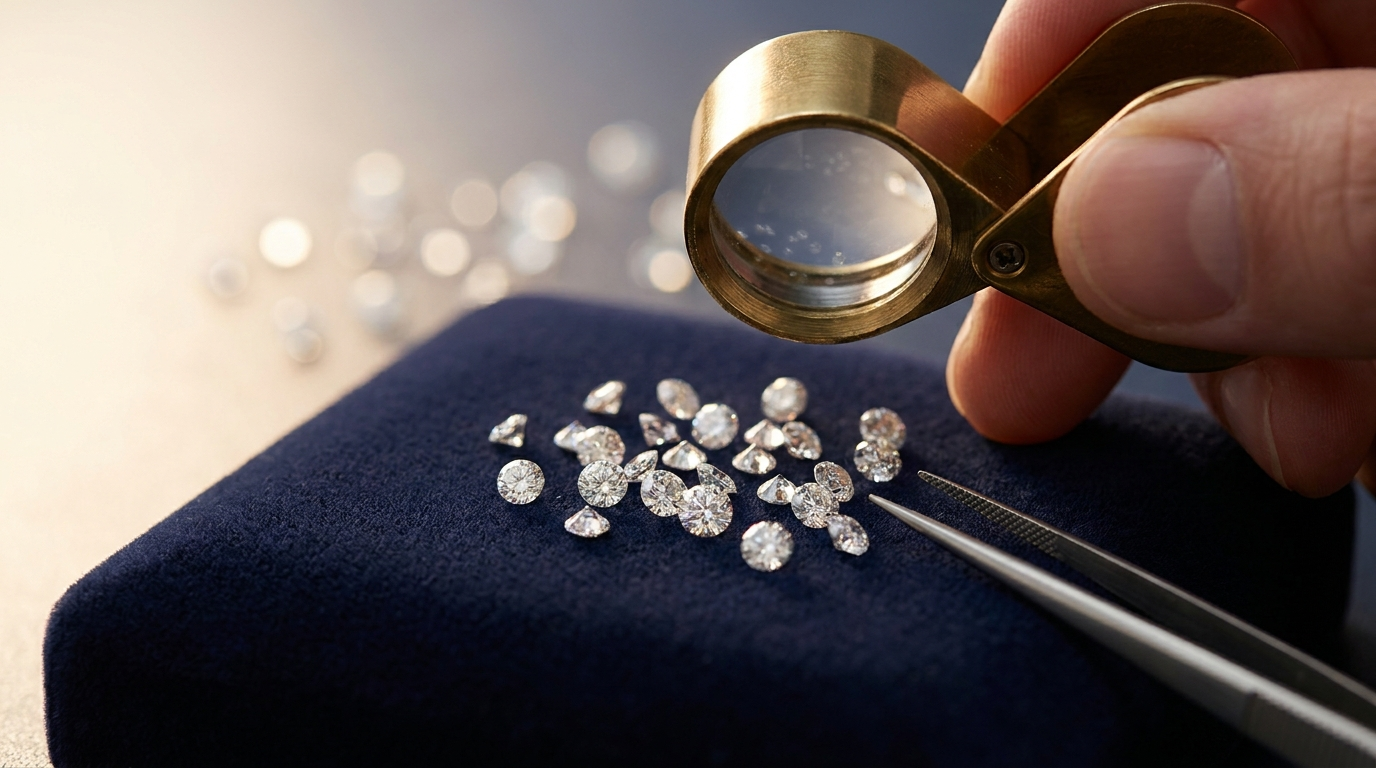
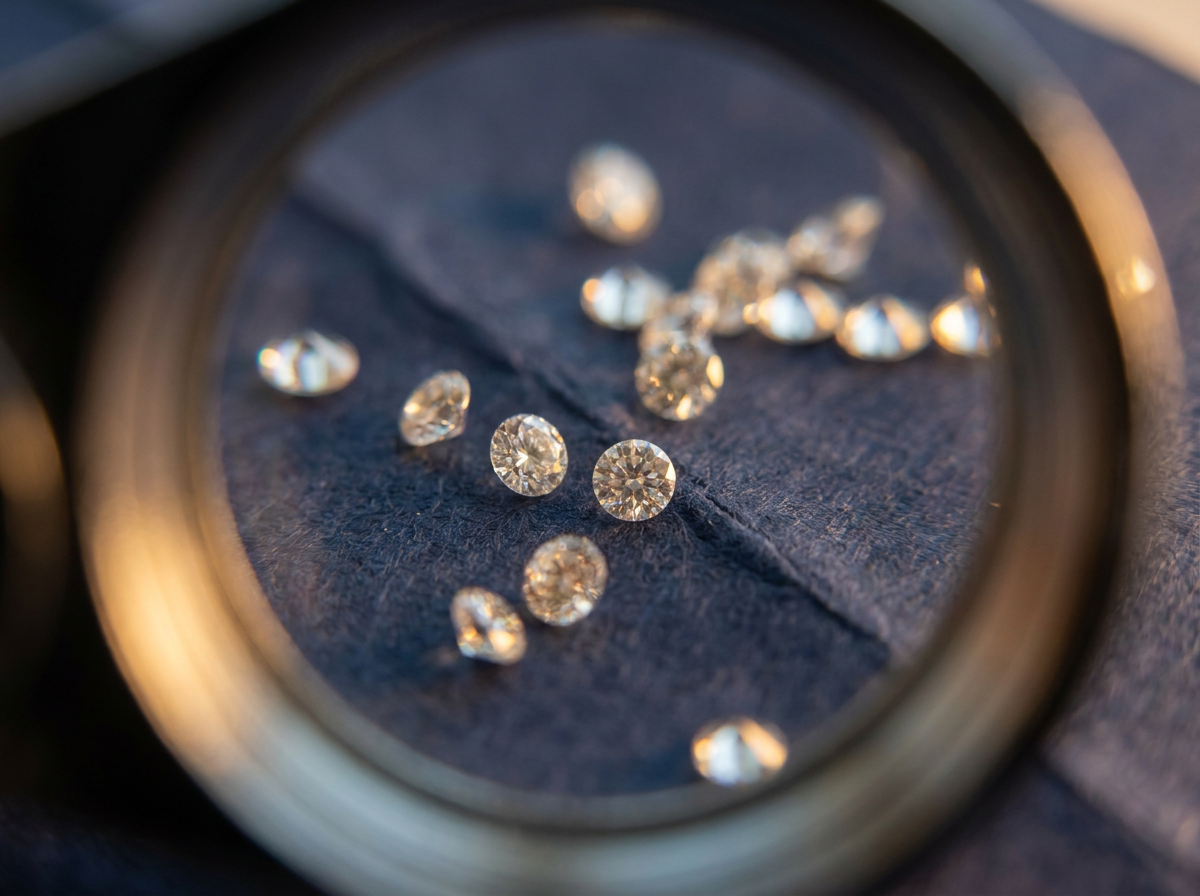
This is one of the more reliable low-tech checks available, and it works because of a structural difference between the materials. Diamond is optically isotropic — light passes through it the same way regardless of direction, so looking through the stone at its facet edges shows a single, clean line. Moissanite is optically anisotropic and birefringent, meaning light splits into two rays traveling at slightly different speeds as it passes through the crystal. The visible result, under a loupe or microscope at roughly 10x magnification, is "doubling": the back facet edges appear faintly duplicated or blurred when viewed through the front of the stone, especially looking at an angle rather than straight down the table.
Doubling is genuinely diagnostic for moissanite — diamond never shows it, because diamond doesn't split light that way. CZ, like diamond, is optically isotropic and also shows no doubling, so this specific check separates moissanite from both diamond and CZ, but doesn't distinguish CZ from diamond on its own (that's what the thermal test is for). The practical catch: doubling is easiest to see on a larger stone viewed at an angle through the pavilion. On melee-size material, particularly anything under 2mm, facet junctions are tiny enough that reliably spotting doubling takes a trained eye, good lighting, and often more magnification than a standard 10x loupe offers — it's a real check, but not always a fast one at the smallest sizes.
Does Weight (Specific Gravity) Help Identify a Simulant?
Specific gravity (SG) — how dense a material is relative to water — is another standard gemological identifier, and it's where CZ stands out most sharply. Diamond's SG sits around 3.52; moissanite is close to it at roughly 3.2; CZ is dramatically denser, in the 5.6–5.9 range. A CZ stone weighs noticeably more than a diamond of the same physical dimensions — often described in the trade as feeling distinctly "heavy" for its size when handled loose.
That heft difference is a genuinely useful spot-check for loose, unmounted stones of a reasonable size — pick one up, and a CZ often just feels wrong. It stops being practical the moment a stone is set (mounting weight swamps the difference) or once you're below a couple millimeters, where the total weight involved is too small for hand or even careful scale comparison to register reliably against a single reference stone. SG is a real, sourced-from-reference-tables property difference, useful context for understanding why CZ behaves the way it does — not a stand-alone field test for melee-size goods.
Where SG does earn its keep at scale is upstream, at parcel intake rather than the sales counter: a bulk lot contaminated with CZ will register an off total weight against its expected stone count and size band, because CZ's density is so far outside diamond's range that even a modest contamination shows up as a measurable weight anomaly across a large enough sample. That kind of aggregate check is a coarse first-pass screen, not proof on its own — it flags a lot worth a closer look rather than clearing or condemning any individual stone in it.
Why Is Stone-by-Stone Testing Impractical for Wholesale Melee?
Every method above — thermal, electrical, refractive index, doubling under magnification, specific gravity — was developed and is still primarily used on single, individually handled stones: a center diamond, a loose stone at a bench, a mounted ring brought in for appraisal. None of them scale cleanly to a parcel of several hundred or several thousand melee-size stones sold by total carat weight rather than by the piece.
A thermal or electrical probe test takes real seconds per stone and requires isolating each stone individually — multiply that by a multi-thousand-stone parcel and the testing time exceeds any reasonable turnaround. Doubling checks need magnification and careful angle-viewing per stone. None of this is how melee parcels move through the trade, and it's not how quality gets verified on this size of goods generally — the same economic logic that makes individual certification impractical below roughly 0.20ct (covered in our guide to how natural melee is graded and matched) applies just as directly to per-stone diamond-type testing. The practical answer is verification at the parcel and sourcing level, not the individual-stone level — which is exactly what the next section covers.
How Does Guru Diam Verify Natural Melee Isn't a Simulant or Substitute?
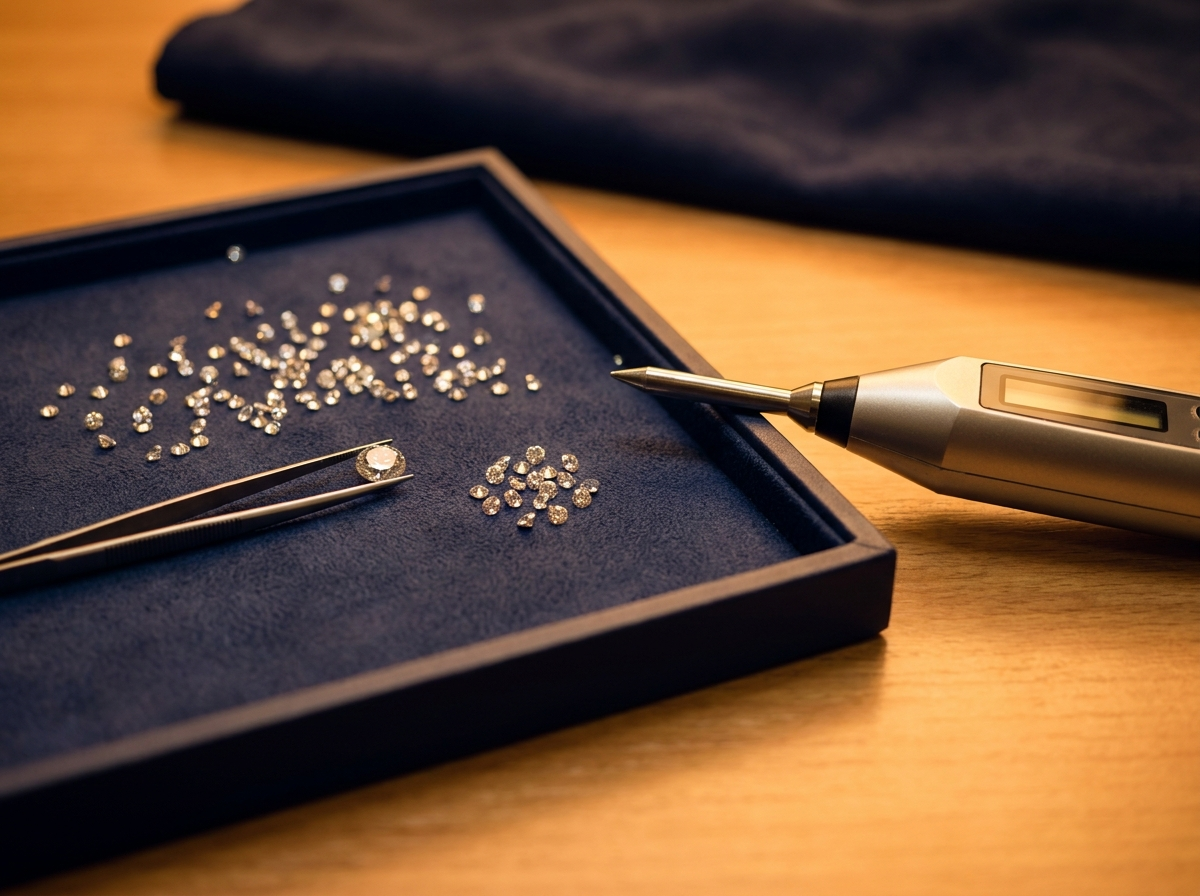
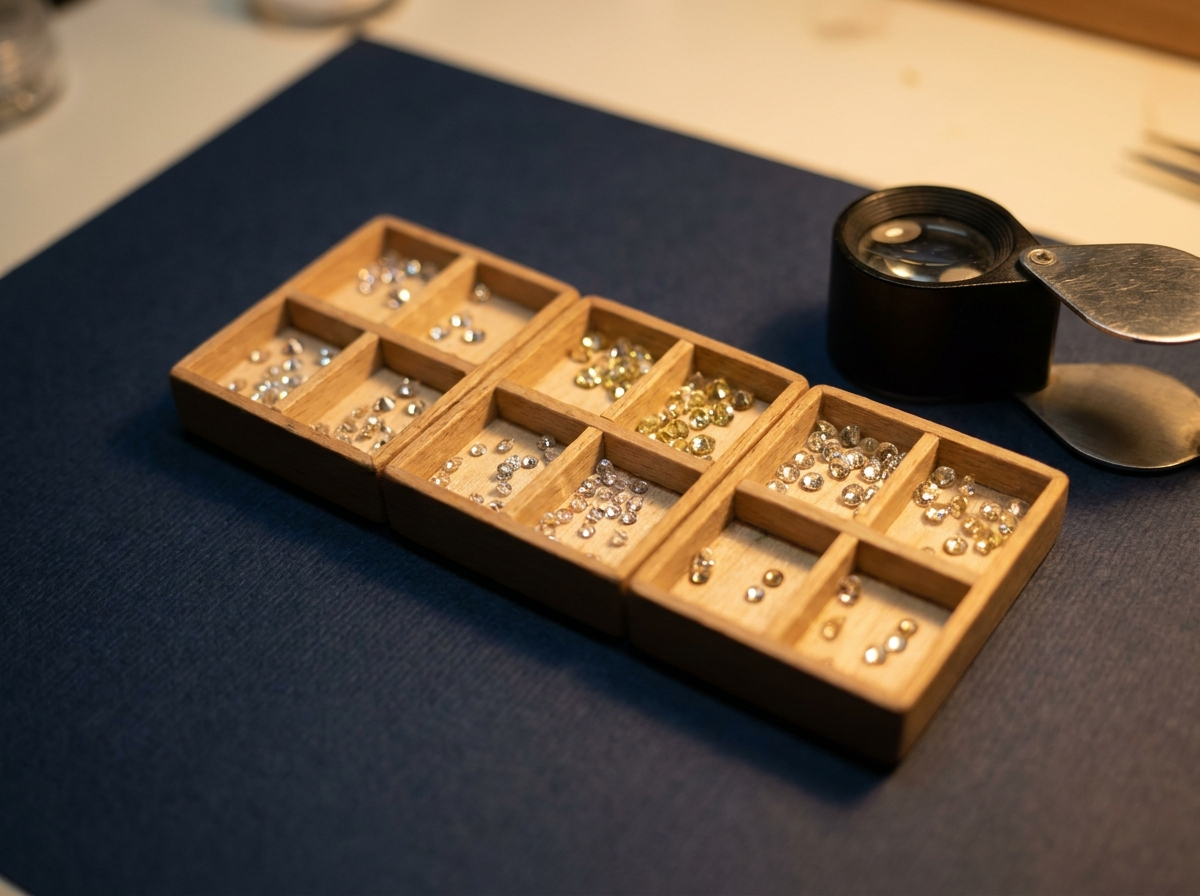
Because per-stone testing doesn't scale to parcel goods, verification has to happen upstream, before a parcel is sorted and packed. Guru Diam screens incoming natural melee stock for diamond identity as part of the same sourcing and sorting process used to grade color, clarity, and size — the master-stone comparison and sieve-sizing process described in our guide to how natural melee is graded — rather than relying on a per-stone check at the point of sale. A parcel that shows up mixed with simulant material or unverified origin doesn't get sorted into inventory as natural melee.
This is a sourcing-and-process answer, not an equipment-brand claim — no melee-size parcel carries individual paperwork the way a 0.30ct+ certified loose stone does, and no honest supplier should claim otherwise on goods this small. What a buyer should expect instead is a supplier who can describe their screening process plainly: how incoming goods get checked before they're sorted into a sellable grade, and what happens to a lot that doesn't verify clean. For the specific question of confirming natural origin (as opposed to lab-grown, a different question from the simulant question this guide covers), see our natural melee screening guide.
What Should You Tell a Customer Who Asks If Their Melee Is "Real"?
Start by identifying which question they're actually asking — it usually isn't the one they phrase. "Is this real" from a retail-facing customer often means "is this a simulant," while from a trade buyer sourcing goods it more often means "is this natural or lab-grown." Answering the wrong version of the question, confidently, is how disclosure problems start.
Be precise about what your process actually verifies. If your supplier screens for diamond identity at the sourcing stage — the way described above — you can accurately say the goods were verified as diamond before they were sorted into inventory. That is a true, defensible statement. It is a different statement from "this specific stone was individually tested," which usually isn't true for melee-size goods and shouldn't be implied. And it's a different statement again from confirming natural origin specifically, which is its own separate verification question. Precision here isn't a technicality — origin and material disclosure on diamond goods is a real compliance obligation in the US, not optional marketing language, and melee's small size doesn't exempt it.
The safest version of this conversation is also the simplest: describe your sourcing and screening process in plain terms, name which question it actually answers, and don't stretch a parcel-level verification into an individual-stone guarantee it can't back up. A customer pressing for more certainty than melee-size goods can practically offer is asking a question better answered by moving up to certified loose stones at 0.30ct and above, where individual paperwork exists — not by overstating what a melee parcel's screening covers.
If a specific parcel or customer situation genuinely calls for stone-level diamond identity questions beyond what standard sourcing verification covers, reach out directly — WhatsApp or Contact — and we can walk through what's practical for the size and quantity of goods involved.
Quick Reference: Natural Diamond vs Moissanite vs CZ at a Glance
| Property | Diamond (natural or lab-grown) | Moissanite | Cubic Zirconia (CZ) |
|---|---|---|---|
| Material | Crystallized carbon | Silicon carbide | Zirconium oxide |
| Hardness (Mohs) | 10 | ~9.25 | ~8–8.5 |
| Refractive index | ~2.42 | ~2.65–2.69 | ~2.15–2.18 |
| Specific gravity | ~3.52 | ~3.2 | ~5.6–5.9 |
| Optical character | Isotropic — no doubling | Birefringent — doubling visible under magnification | Isotropic — no doubling |
| Thermal tester read | Passes (high conductivity) | Passes (also high conductivity) | Fails (low conductivity) |
| Electrical conductivity | Low | Measurably higher — the moissanite-tester differentiator | Low |
Values above reflect standard gemological reference figures for each material and are presented as general ranges, not laboratory-precision constants — actual readings vary slightly by instrument and individual stone. Note that this table separates diamond from its two simulants; it does not address natural-vs-lab-grown, which is a different question covered in the guides linked above.
Frequently Asked Questions
Is moissanite a type of diamond?
No. Moissanite is silicon carbide, a completely different mineral from diamond, which is crystallized carbon. It's a diamond simulant — cut and marketed to resemble diamond — not a variety or grade of diamond.
Will a regular diamond tester catch moissanite?
A basic thermal-only tester won't. Moissanite's thermal conductivity is close enough to diamond's that it reads as "diamond" on a thermal-only probe. Catching moissanite requires an electrical conductivity reading as well, which is why combined thermal-plus-electrical testers are now the trade standard.
Does cubic zirconia pass a diamond tester?
No. CZ is a poor thermal conductor and fails a basic thermal probe test outright, unlike moissanite. A simple thermal tester alone is enough to rule out CZ, though it's not enough to rule out moissanite.
What is "doubling" and how do I see it?
Doubling is the faint duplication of back-facet edges visible when viewing a birefringent stone like moissanite under magnification, typically 10x, especially at an angle through the pavilion rather than straight down the table. Diamond and CZ are both optically isotropic and never show this effect.
Is lab-grown diamond a simulant like moissanite or CZ?
No — this is the most common point of confusion. Lab-grown diamond is chemically, physically, and optically real diamond; the only difference from natural diamond is where it formed. It will pass every test described in this guide, because those tests detect diamond material generally, not origin. Separating natural from lab-grown diamond is a different question requiring different, specialized screening methods.
Can natural melee diamonds be individually tested for identity before I buy them?
Not practically, at the individual-stone level — melee-size goods move as parcels, not single stones, for the same economic reasons they aren't individually certified. Verification happens upstream, during sourcing and sorting, rather than stone by stone at the point of sale. Ask your supplier how their screening process works before goods are sorted into inventory.