
A men's diamond bracelet is a finished jewelry piece — most commonly a chain, cuban link, tennis, or cuff-style bracelet set with diamonds, either as a full pavé line of stones or as accent detailing on a heavier metal base — built for a men's jewelry market that has grown substantially as diamond styling has moved well beyond rings and studs. For jewelers and designers, sourcing men's diamond bracelets at wholesale means understanding both the stone specs this category demands (durability-focused clarity and setting choices) and the styling conventions that separate it from women's diamond bracelet lines.
This guide covers the main men's diamond bracelet styles, the stone and metal specs that matter most for sourcing, and how to think about stocking this category as demand for men's fine jewelry continues to expand — whether the goal is a single flagship piece or a full assortment spanning multiple price points and aesthetics.
Why Men's Diamond Bracelets Are a Growing Wholesale Category
Men's fine jewelry has expanded well past the traditional watch-and-wedding-band baseline over the past several years, with diamond-set chains, bracelets, and rings becoming mainstream rather than niche. Diamond bracelets specifically have benefited from this shift because they read as everyday, stackable pieces rather than occasion-only jewelry — a men's diamond tennis or cuban-link bracelet gets worn daily in a way a formal piece typically doesn't, which drives repeat purchasing and layering behavior (multiple bracelets worn together) that retailers can merchandise around and use to build recurring, rather than one-time, customer relationships. For jewelers building out a men's category, diamond bracelets are frequently one of the highest-velocity entry points because they don't carry the same purchase-occasion friction as engagement or wedding jewelry.
Main Men's Diamond Bracelet Styles
The men's diamond bracelet market breaks down into a handful of core styles, each with different stone-sourcing implications:
- Diamond tennis bracelet (men's version) — a continuous line of individually set round or fancy-shape diamonds around the full circumference. In men's styling, tennis bracelets typically run in heavier gauge metal and larger stone sizes than the women's equivalent, with a bolder, less delicate overall profile.
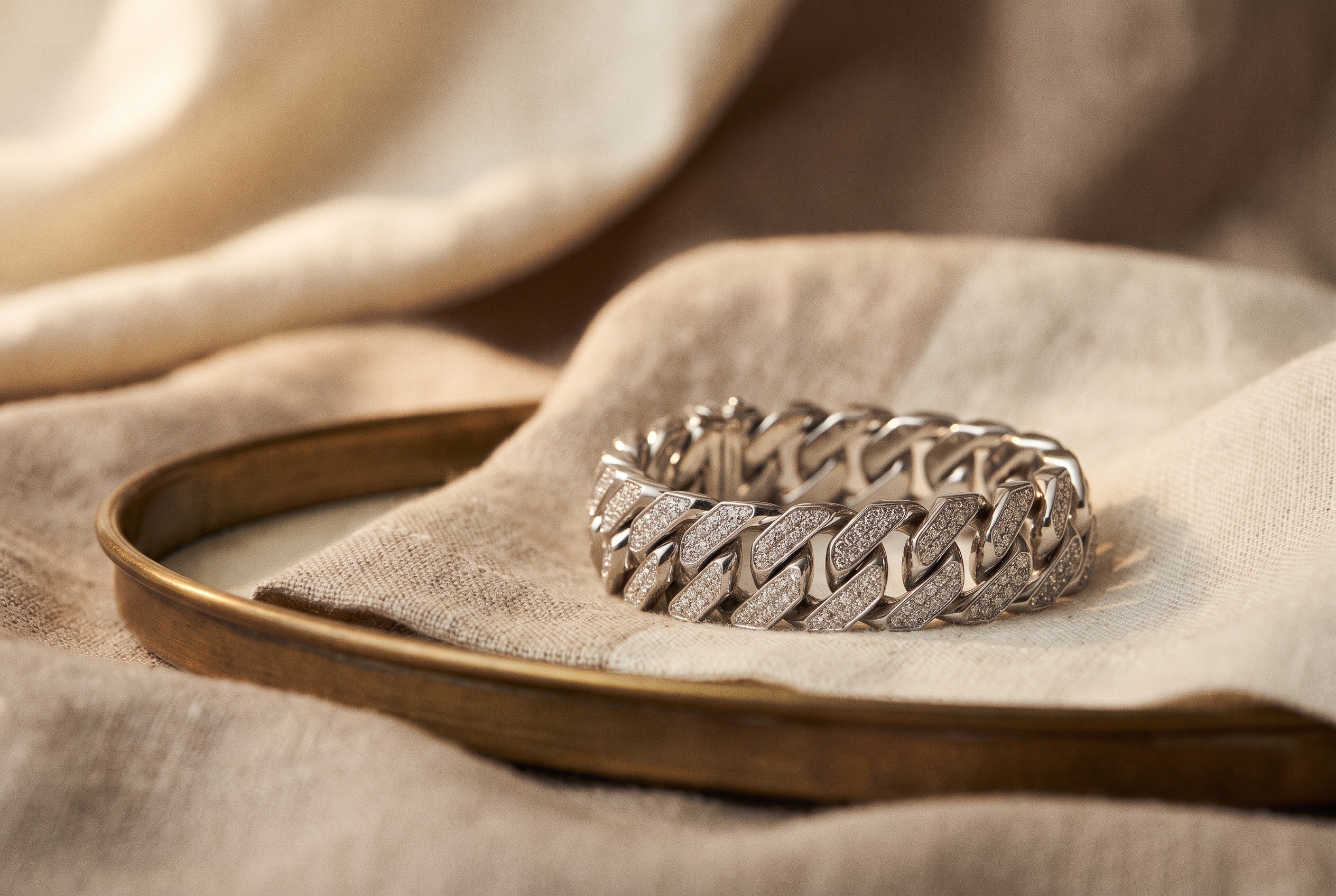
- Diamond cuban link bracelet — a chunky, interlocking chain-link bracelet, either fully iced (every link pavé-set with diamonds) or with diamonds set only on select links or a center row. This is currently the single most requested men's diamond bracelet style, driven heavily by hip-hop and streetwear-adjacent styling trends.
- Diamond cuff bracelet — a rigid, open-ended band, often with diamonds set in a channel or bezel pattern along the front face. Reads as more formal/minimal than a cuban link, appealing to a different customer segment.
- Diamond chain bracelet (rope, figaro, box-link) — a lighter chain style with diamond accents rather than full pavé coverage, often paired with a matching chain necklace for a coordinated set.
- Diamond bolo/adjustable bracelet — a sliding-clasp style that adjusts to fit, growing in popularity for its comfort and universal sizing, typically set with a smaller diamond count than a tennis or cuban style.
Stone Sourcing: What's Different About Men's Bracelet Diamonds
Men's diamond bracelets are typically built around melee-scale calibrated diamonds rather than a single large center stone — a fully iced cuban link or tennis bracelet can require anywhere from several dozen to several hundred individual stones depending on link count, bracelet length, and coverage density. This makes consistent parcel matching (color and clarity uniformity across every stone) the primary sourcing challenge, more so than any single stone's grade. A visibly mismatched stone in the middle of a continuous pavé line stands out far more than a similar inconsistency would in a piece using only a handful of diamonds, which is why calibrated melee sourced and QC'd as a matched parcel — DEF+/VS+ is a common baseline for this category — matters more here than individual stone certification.
Durability: Why Clarity and Setting Choice Matter More for Men's Pieces
Men's jewelry generally sees harder daily wear than women's — more direct contact with tools, gym equipment, car doors, and general activity — which has real implications for both stone and setting choice. Bezel and channel settings, which fully or partially enclose each stone's girdle in metal, are more common in men's diamond bracelets than the more exposed prong settings typical of women's tennis bracelets, specifically because they offer better protection against chipping and snagging during rougher daily wear. On the stone side, sourcing toward the higher end of the SI clarity range (rather than pushing into lower clarity to save cost) is a reasonable trade-off for this category, since a diamond with a larger or poorly positioned inclusion is at somewhat greater risk of becoming a visible weak point in a piece that sees more physical stress than typical women's jewelry.
| Style | Typical Stone Count | Common Setting | Metal Weight |
|---|---|---|---|
| Tennis bracelet (men's) | High — continuous line | Prong or shared-prong | Heavier gauge than women's equivalent |
| Cuban link (fully iced) | Very high — every link | Pavé/micro-pavé within each link | Heavy — link-based chain construction |
| Cuban link (accent rows) | Moderate — select links only | Channel or bezel along center row | Heavy — link-based chain construction |
| Cuff bracelet | Low to moderate | Channel or bezel | Heavy — rigid band construction |
| Chain/rope bracelet | Low | Bezel or small prong accents | Light to moderate |
Metal Choices for Men's Diamond Bracelets
Yellow gold and white gold remain the two dominant metal choices for men's diamond bracelets, with yellow gold currently the stronger trend driver in the cuban-link and iced-out segment specifically, reflecting broader men's jewelry style movement back toward warmer, more visible gold tones after a long period of white-metal dominance. Platinum appears less frequently in this category than in men's wedding bands, largely on cost grounds given the higher metal weight men's bracelet styles typically use compared to more delicate women's pieces. Two-tone and mixed-metal designs (white gold diamonds set against a yellow gold chain, for instance) are a smaller but growing niche, giving retailers a way to merchandise a distinct look within the category.
Lab-Grown vs. Natural for Men's Diamond Bracelets
Because men's diamond bracelets frequently use a high total stone count, the cost difference between lab-grown and natural melee compounds quickly across a full piece — a fully iced cuban link bracelet in natural melee can cost dramatically more than the identical design executed in CVD lab-grown melee of comparable color and clarity. This makes lab-grown a particularly strong fit for this category specifically, letting retailers offer a fully iced, high-stone-count look at a price point that would be difficult to reach with natural melee at the same visual density, without asking the customer to compromise on how dense or bold the finished piece looks. Guru Diam's lab-grown melee catalog (0.8mm–9.0mm, round brilliant and calibrated fancy shapes, DEF+/VS+, CVD only) is sized specifically to support high-density pieces like fully iced cuban links and tennis bracelets.
Sizing and Fit Considerations
Men's wrist sizes run larger on average than women's, and men's diamond bracelets are typically sized and stocked accordingly — a men's-specific size run (commonly 7.5"–9.5", compared to a women's-line 6"–7.5") is standard practice for jewelers stocking this category rather than simply offering a women's bracelet in a larger size, since proportions (link width, stone size, overall visual weight) also scale up for a men's-market piece rather than staying identical and just extending in length. Adjustable clasps — box clasps with a safety closure, or bolo-style sliding adjusters — are common in men's bracelet construction specifically because they accommodate wrist-size variation and the seasonal wrist-size fluctuation some wearers experience, reducing the need to carry as many discrete size options in inventory.
Diamond Shape Choices for Men's Bracelet Stones
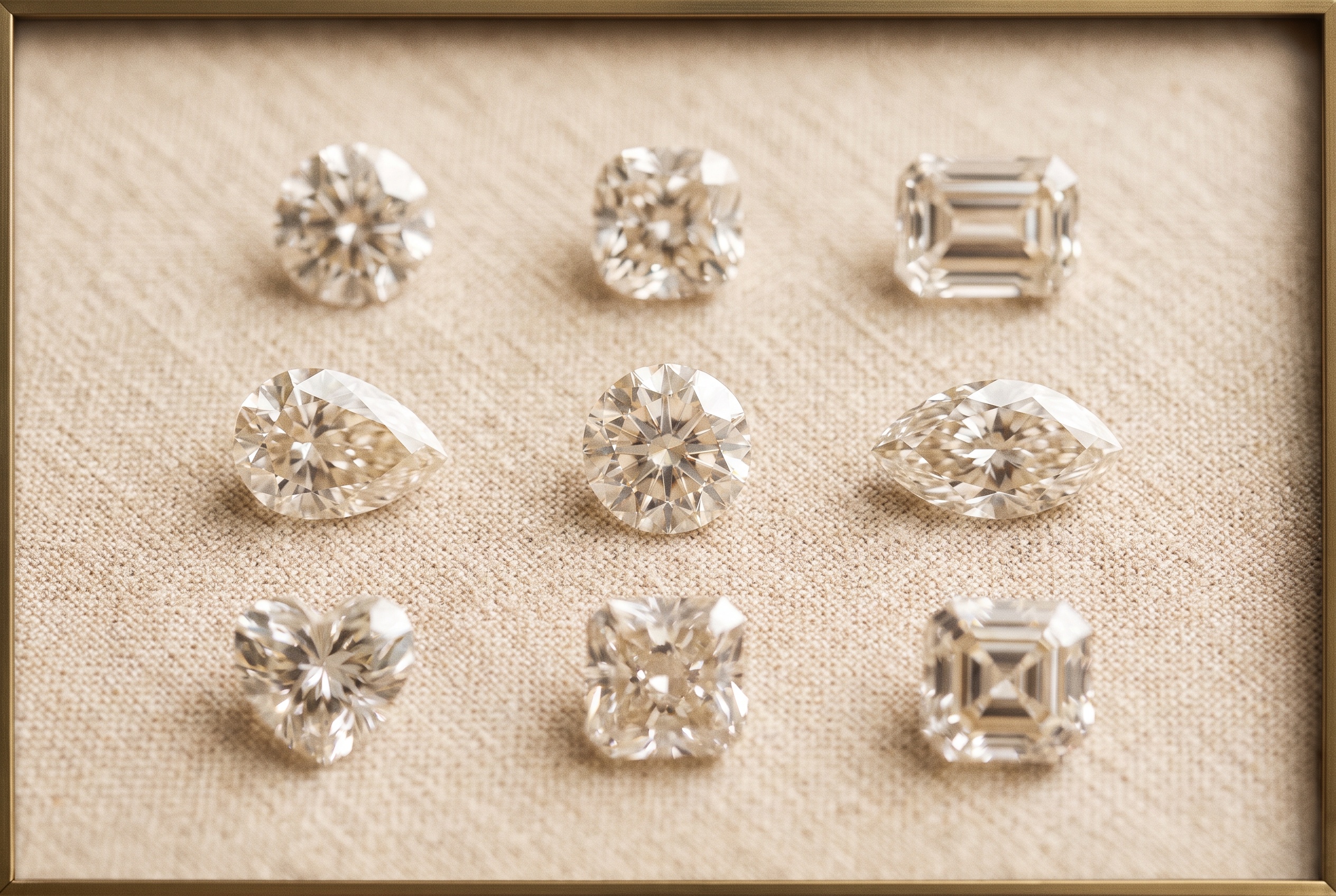
Round brilliant remains the dominant shape for men's diamond bracelet melee, largely because its facet pattern reads clearly and evenly even at small sizes and under the more casual, everyday viewing conditions men's jewelry tends to be seen in (as opposed to close, deliberate inspection). Baguette-cut stones — set in a channel, often alternating with round brilliants — appear frequently in cuff bracelets and select cuban-link designs specifically, since the elongated rectangular shape complements a geometric, architectural link or channel pattern in a way round stones don't. Princess and radiant-cut melee show up occasionally in more contemporary bracelet designs but remain a smaller share of the category compared to round and baguette. Buyers should confirm which shapes a given design calls for before placing a melee order, since shape mix directly affects both sourcing lead time and total stone count needed to fill a given design, and a design calling for multiple shapes in combination naturally takes longer to source than a single-shape order.
How Wholesale Cost Structure Works for This Category
Pricing a men's diamond bracelet at wholesale comes down to three compounding factors: total carat weight across all stones, metal weight (men's pieces run heavier gauge than women's equivalents), and labor — particularly for fully iced designs where every link requires individual pavé setting work. Of the three, total diamond carat weight is usually the largest cost driver for a heavily set piece, which is exactly why the lab-grown-versus-natural melee choice has such an outsized effect on final price for this category compared to, say, a single-stone ring where metal and labor make up a larger share of total cost. Jewelers quoting men's diamond bracelets to retail customers benefit from breaking out these three cost components explicitly, since it helps customers understand why two visually similar bracelets — one natural melee, one lab-grown — can carry meaningfully different price tags despite looking nearly identical.
Common QC Issues to Watch For in Men's Diamond Bracelets
- Inconsistent stone color across the parcel. A visible tonal shift partway through a continuous pavé line is one of the most common — and most visible — quality issues in this category, and the main reason calibrated parcel matching matters more here than for lower-stone-count pieces.
- Loose or shallow-set prongs on tennis-style bracelets. Given the heavier daily wear men's pieces see, prong security deserves closer QC scrutiny than it might on a piece worn more occasionally.
- Clasp durability. Box clasps and sliding adjusters on heavier men's pieces see more mechanical stress than the lighter clasps used on delicate women's bracelets — a weak clasp is a common point of failure and warranty claims.
- Link wear points on cuban-link designs. The connection points between links in a fully iced cuban bracelet are subject to more flex and wear than a solid-band cuff, and are worth specific QC attention on incoming inventory.
Caring for a Men's Diamond Bracelet
Men's diamond bracelets, worn more continuously and through more physical activity than most women's jewelry, benefit from more frequent cleaning and inspection than the category sometimes receives. Everyday oils, gym chalk, and general activity buildup dull sparkle faster in a piece worn daily than in an occasion-only piece, and prong or channel settings should be checked periodically for security, particularly on tennis-style designs where a loose prong risks losing a stone entirely rather than just looking less bright. Retailers selling into this category can add real value — and build repeat traffic — by offering or recommending a periodic professional cleaning and inspection service specifically for men's bracelet customers, whose pieces see meaningfully more wear than the retail average.
Merchandising Men's Diamond Bracelets Alongside Chains and Rings
Men's diamond bracelets sell strongly as part of a coordinated set with a matching chain, ring, or earrings — stacking and layering multiple pieces (a cuban link bracelet with a matching chain, for instance) is a well-established purchasing pattern in this category, more so than in most women's jewelry lines where pieces are more often purchased individually. Retailers merchandising men's diamond bracelets benefit from displaying them alongside matching men's chains and rings specifically, rather than isolating the bracelet case from the rest of the men's line, since this cross-category browsing behavior tends to increase basket size meaningfully compared to single-piece purchases.
Current Demand Patterns in Men's Diamond Bracelets
Demand within the men's diamond bracelet category has shifted noticeably toward bolder, higher-stone-density designs over the past few years, tracking broader trends in men's streetwear and hip-hop-adjacent styling where fully iced pieces read as a status marker in their own right. Younger buyers in particular tend to favor cuban link and heavier tennis styles over the more minimal chain-and-accent designs that dominated men's fine jewelry a decade ago. That said, the minimal end of the category hasn't disappeared — cuff bracelets and lighter chain styles with modest diamond accents remain a steady seller for a more conservative, professional-context customer who wants a subtle diamond detail rather than a statement piece. Retailers building out a men's bracelet assortment benefit from stocking across this full spectrum — from fully iced cuban links to minimal accent chains — rather than betting the category on a single aesthetic, since the customer base for men's diamond jewelry spans a genuinely wide range of styling preferences.
Custom and White-Label Sourcing for Men's Diamond Bracelets
Because men's diamond bracelets are largely calibrated melee assembled into a custom design rather than built around a single graded center stone, this category lends itself particularly well to white-label sourcing arrangements, where a wholesale supplier produces a finished piece to a retailer's or designer's specifications for resale under the retailer's own branding. This matters specifically for jewelers looking to build a distinct, differentiated men's line rather than reselling an identical design also available from competitors — custom link patterns, exclusive stone density levels, or a specific metal-and-diamond combination unique to one retailer's assortment. Sourcing through a supplier that finishes custom pieces unbranded by default, rather than requiring a retailer to strip existing branding, simplifies this process considerably for jewelers building a men's category from scratch.
Wholesale Sourcing Checklist for Men's Diamond Bracelets
- Match melee to a consistent parcel spec. Color and clarity uniformity across the full stone count matters more than any single stone's grade for continuous pavé styles.
- Favor protective settings. Bezel and channel settings hold up better than exposed prongs under the heavier daily wear men's pieces typically see.
- Lean lab-grown for high-density pieces. Fully iced cuban link and tennis styles carry a large total stone count where the natural-versus-lab-grown cost gap compounds significantly.
- Stock men's-specific sizing. A 7.5"–9.5" range with adjustable clasp options, rather than extending a women's line.
- Coordinate with chains and rings. Men's bracelets sell strongest as part of a stackable, matched set rather than in isolation.
Sourcing Men's Diamond Bracelets at Guru Diam
Guru Diam is a trade-only wholesale diamond supplier with locations in New York and Los Angeles, sourcing calibrated melee and custom finished jewelry — including men's diamond bracelets — across CVD lab-grown and natural inventory. Melee is sourced and QC'd as consistent, calibrated parcels (DEF+/VS+, 0.8mm–9.0mm, round and calibrated fancy shapes) built specifically for high-stone-count pieces like cuban link and tennis bracelets, and custom pieces are unbranded by default so jewelers can resell finished bracelets as their own. Guru Diam's team works directly with a jeweler's design specifications — link pattern, stone density, metal weight — to produce a piece unique to that retailer's assortment rather than a generic catalog design. Custom jewelry orders are finished in 4–6 days. For related men's category sourcing, see our men's diamond chain guide and men's diamond ring guide.
Frequently Asked Questions
What is the most popular men's diamond bracelet style?
The diamond cuban link bracelet is currently the most requested style, whether fully iced with pavé-set links or with diamonds set only on select links or a center row. Diamond tennis bracelets in a heavier, men's-proportioned build are the next most common style.
What clarity grade is typical for men's diamond bracelet stones?
DEF+/VS+ is a common baseline for calibrated melee used in men's diamond bracelets, favoring the higher end of the commercially standard range given the heavier daily wear men's pieces typically see.
Is lab-grown or natural more common for men's diamond bracelets?
Lab-grown melee is increasingly the dominant choice for high-stone-count styles like fully iced cuban links and tennis bracelets, since the cost gap between lab-grown and natural melee compounds significantly across a large total stone count.
What metal is most common for men's diamond bracelets?
Yellow gold and white gold are the two dominant choices, with yellow gold currently the stronger trend in the cuban-link and fully iced segment specifically, reflecting a broader shift in men's jewelry back toward warmer gold tones.
What size range should jewelers stock for men's diamond bracelets?
A men's-specific size range, commonly 7.5"–9.5", is standard, paired with adjustable clasp options (box clasps with safety closures, or bolo-style sliders) to accommodate wrist-size variation without carrying excessive discrete size inventory.
Should men's diamond bracelets use prong or bezel settings?
Bezel and channel settings are more common in men's diamond bracelets than the exposed prong settings typical of women's tennis bracelets, since they offer better protection against chipping and snagging during the heavier daily wear men's pieces tend to see.
What diamond shape is most common in men's diamond bracelets?
Round brilliant is the dominant shape for men's bracelet melee, since it reads clearly at small sizes under everyday viewing conditions. Baguette-cut stones appear frequently as channel-set accents in cuff and select cuban-link designs, complementing a more geometric, architectural look.
Can men's diamond bracelets be custom-designed for a retailer's own line?
Yes. Because this category is largely built from calibrated melee assembled into a custom design rather than a single graded center stone, it's well suited to white-label sourcing, where a supplier produces a finished piece to a retailer's specifications for resale under the retailer's own branding.
Guru Diam is a trade-only wholesale diamond supplier with locations in New York and Los Angeles, carrying certified loose diamonds, CVD lab-grown and natural stones, calibrated melee, and finished jewelry across every standard, antique, and exotic diamond shape. Browse calibrated melee in the matching pairs category, source certified stones through cert diamonds, or build a custom piece through custom jewelry. Trade accounts can review current inventory and terms at the wholesale hub or apply through trade partner.