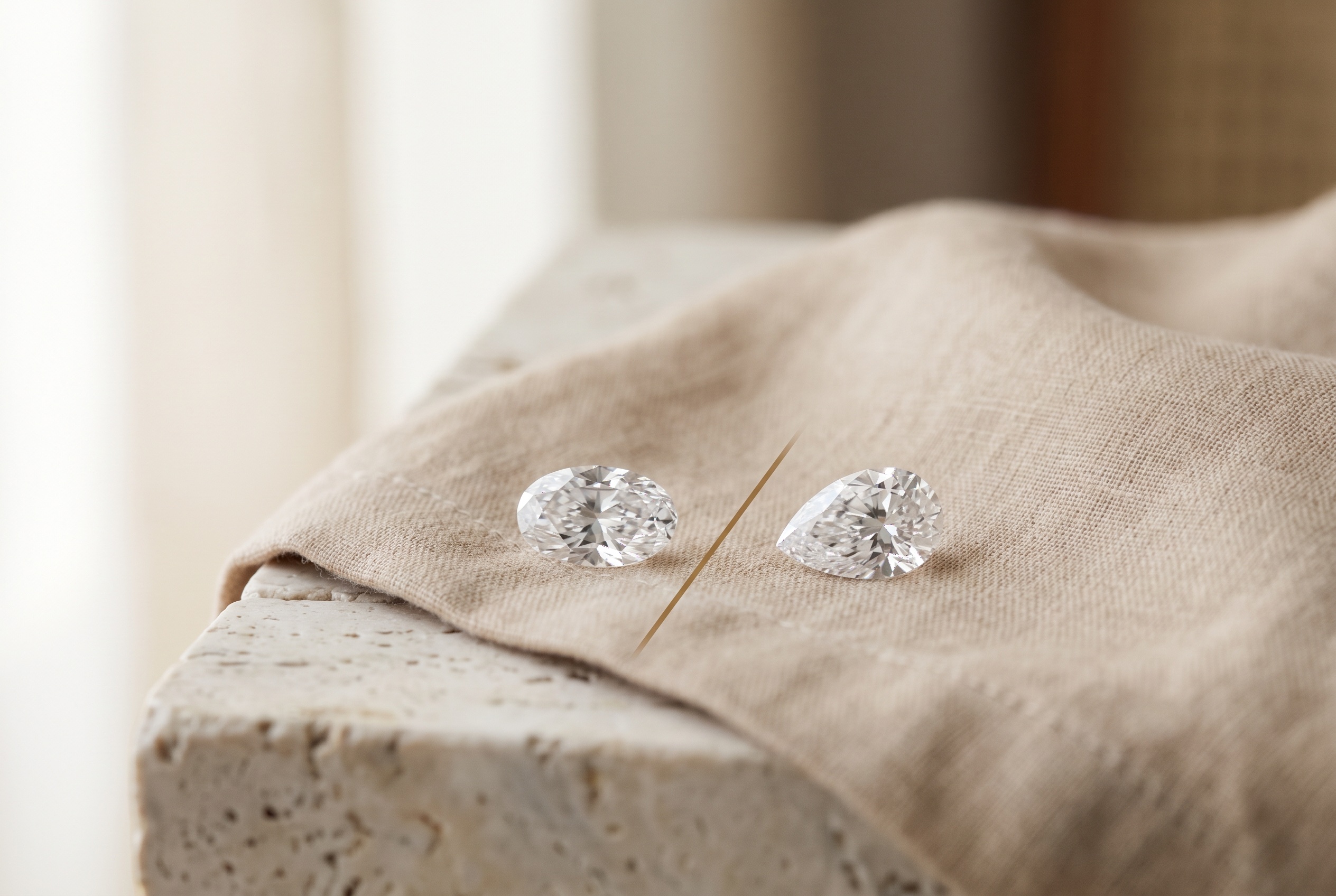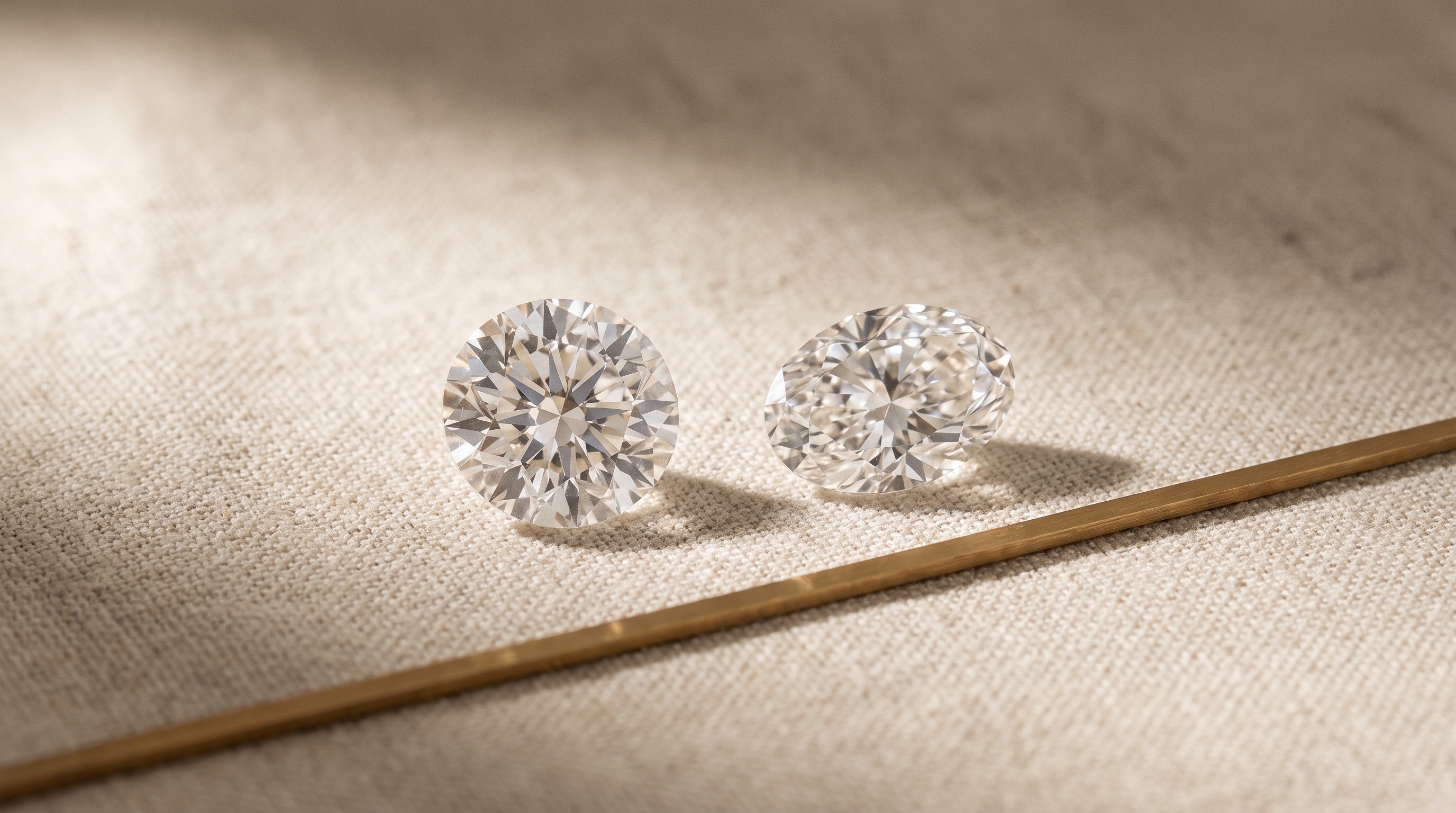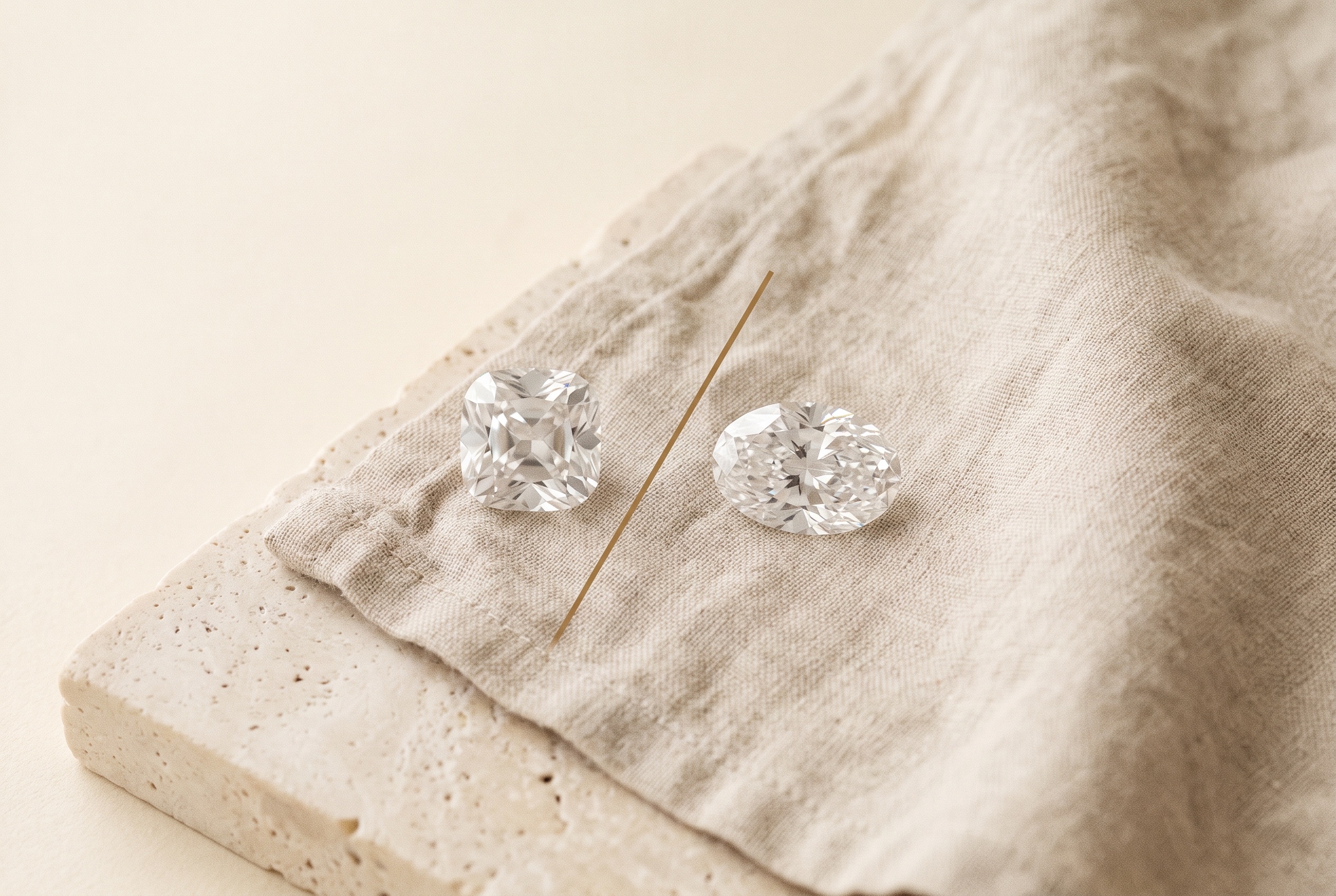

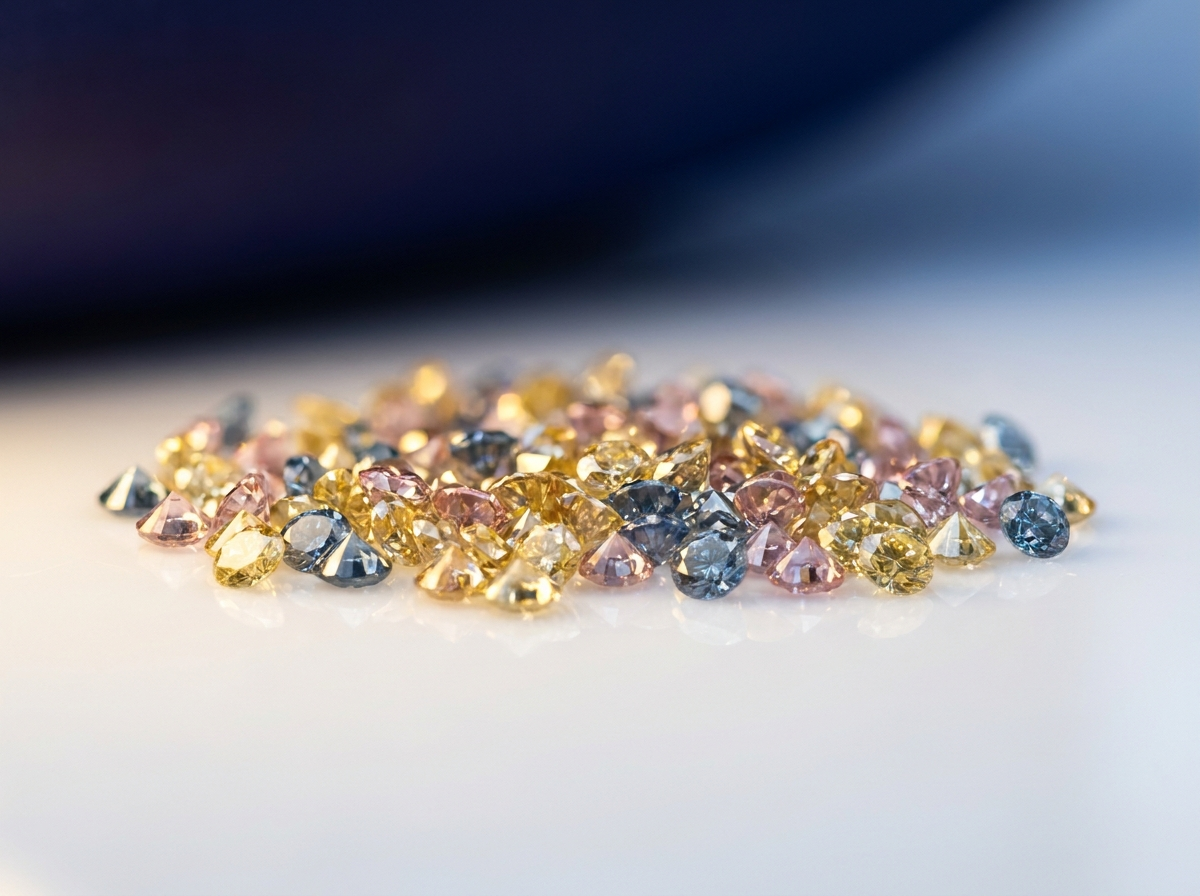
Fancy color melee is calibrated lab-grown diamond parcel goods cut in an intentional hue — Yellow, Pink, Blue, or Green — sold by size range and color range for pavé, halo, and eternity work, not as individually certified stones. Guru Diam holds roughly 6,790 carats of fancy color melee on hand across Round and seven fancy shapes, spanning 0.8mm to 9.0mm, cut and color-matched in-house and sourced from our New York Diamond District desk.
Most sourcing content that mentions "fancy color diamonds" is actually describing single certified stones — a pink center, a yellow accent stone for a solitaire. That's a real category, and Guru Diam carries it in depth (see our fancy color diamonds overview for certified singles, graded and sold individually in Yellow, Pink, Blue, and Green). It's a different buying motion, though, from what a bench jeweler needs when a design calls for fifty small yellow accents around a halo, or a run of blue baguettes down an eternity band. That's melee — parcel goods, bought by size and color range rather than by certificate — and fancy color melee specifically is a category almost nobody stocks with real depth.
This page is the hub for that category: what fancy color melee is, why it's genuinely hard to source well, how a parcel actually gets built and quality-checked, what drives pricing, and what's on hand right now. For shape-specific depth, our fancy color round melee guide and fancy color fancy-shape melee guide go deeper on each side of the category than a single overview can.
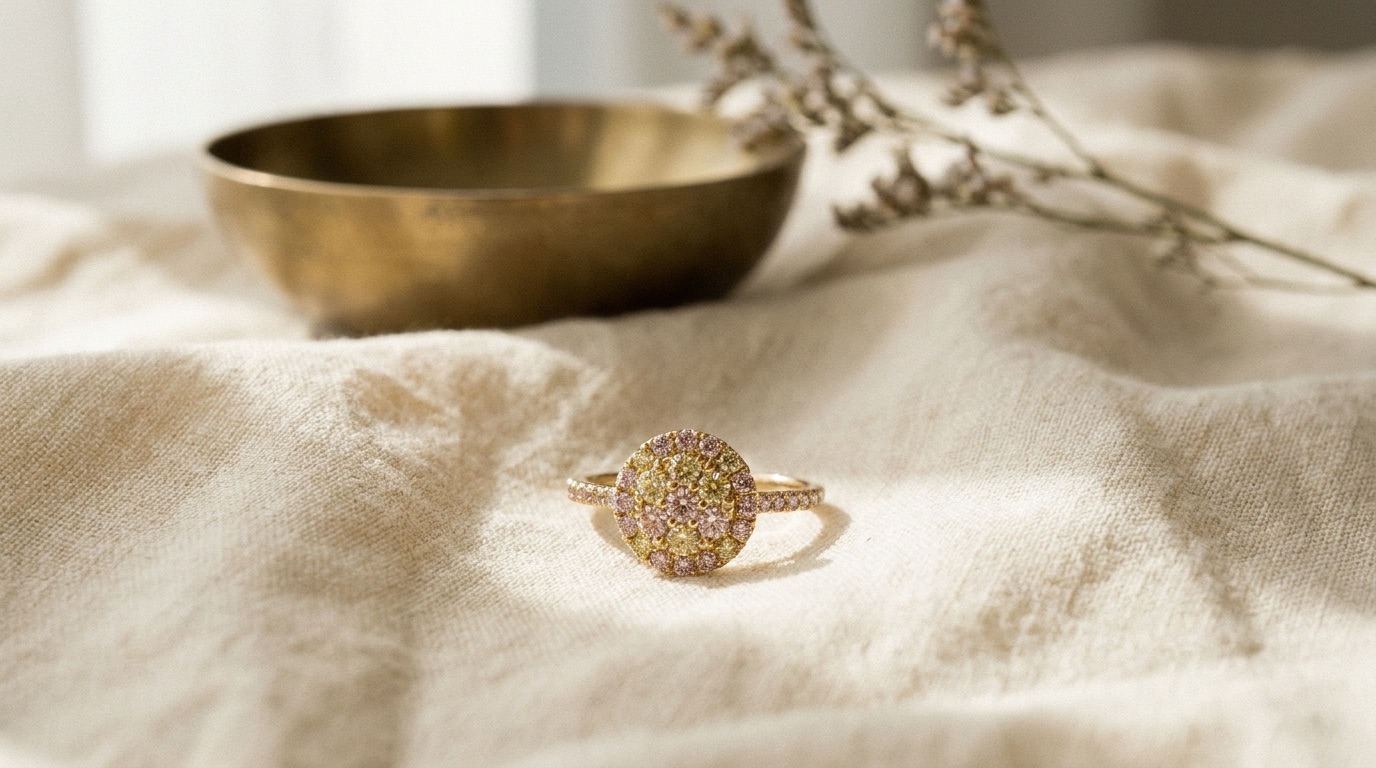
What Is Fancy Color Melee, and How Is It Different from a Fancy Color Center Stone?
Fancy color melee is small accent diamonds — generally under about 0.18 ct, and ranging from roughly 0.8mm up to 9.0mm across both round and fancy calibrated shapes — cut in an intentional hue and sold as a calibrated parcel: a size range (millimeter diameter for round, length × width for fancy shapes) plus a color range, for example Fancy Yellow to Fancy Intense Yellow, rather than one stone with one certificate. A fancy color center stone, by contrast, is graded, certified, and sold individually, because it's the focal point of the piece.
The two products do different jobs. A certified single fancy color stone anchors a ring or pendant as the thing the eye goes to first. Fancy color melee does supporting work — it fills a pavé field, wraps a halo, or lines an eternity band — and it does that by disappearing into a consistent field of color, not by standing out individually. The buying decision follows from that: a single stone gets chosen on its own certificate and its own cut proportions; a parcel gets chosen on how tightly every stone in it holds together, side by side, under one light source, once it's set.
That distinction matters more than it sounds like it should, because the two products get confused constantly in sourcing conversations. A buyer asking for "fancy color diamonds" for a pavé design and a buyer asking for "a fancy color diamond" for a center stone are asking two different suppliers two different questions, even when they use identical language. If you need a single fancy color stone, start with our fancy color diamonds overview; for parcel goods, this page and the shape guides linked throughout are the right starting point.
The Fancy Color Melee Palette: Yellow, Pink, Blue, and Green
Guru Diam's fancy color melee program covers four hues — Yellow, Pink, Blue, and Green — across both Round and calibrated fancy shapes, in sizes from 0.8mm through 9.0mm. That's a narrower palette than what a natural-diamond broker might advertise, and it's narrow on purpose: those four hues are what CVD growth reliably produces at genuinely fancy saturation, in volume, with the color consistency a parcel demands. Brown-family tones — champagne, cognac — sit outside this program, on loose stones and in melee alike, at any size.
Within each hue, grading language still applies the way it would to a single stone — Fancy Light through Fancy, Fancy Intense, and Fancy Vivid for the strongest saturations — but a melee parcel is sold to a band within that range (say, Fancy to Fancy Intense Yellow) rather than to one exact grade, because holding hundreds of stones to a single grade line isn't how parcel goods work. A parcel spec reads more like "Fancy Pink to Fancy Intense Pink, 1.3mm–1.5mm round" than "Fancy Vivid Pink" — the range is the product.
Round carries the deepest volume across all three of the primary colors — Yellow, Pink, and Blue — because it's the highest-demand shape for pavé and halo work generally, colored or colorless. Green is the rarest of the four: genuinely fancy-saturated green rough is limited across the industry, lab-grown included, so green fancy color melee runs through made-to-order calibration cutting rather than sitting in open stock at the same depth as yellow, pink, or blue. That's a rough-availability constraint, not a demand or grading issue — green simply doesn't come out of production at yellow-and-pink volume.
Why Fancy Color Melee Is Genuinely Hard to Source
Grading and selling one fancy color stone is a solved problem across the trade — plenty of wholesalers carry fancy color as certified singles. Building a parcel where dozens or hundreds of small stones all read as the same hue, side by side, under the same light, is a much harder QC problem, and it's the real reason most wholesalers who claim to carry fancy color don't actually stock it as calibrated parcel goods.
Color-matching one stone is a grading exercise. Color-matching a parcel is a manufacturing discipline: every stone in a size-and-color group has to hold the same visual tone, not just fall into the same broad grading term, because melee is set touching or nearly touching its neighbors. One stone that leans a shade warmer or cooler in an otherwise consistent yellow parcel is exactly the flaw a bench jeweler catches immediately — usually after it's already set, which is the expensive time to catch it. That discipline compounds at melee scale: a single fancy color stone is one QC decision; a parcel is hundreds of them, held against each other, one at a time.
That's why the trade splits cleanly here: dealers who carry fancy color as certified singles are common; dealers who carry it as genuinely color-matched, calibrated parcel goods across multiple shapes are rare. It requires in-house cutting and color-sorting, not brokering loose stones from a third party, because matching has to happen at the point of production, not after the fact — once a mixed batch of finished melee lands on a dealer's desk, there's no practical way to re-sort it by hand at parcel scale.
How Guru Diam Sources, Cuts, and Color-Matches Fancy Color Melee In-House
Rough Selection and Sourcing
Fancy color melee starts as a sourcing decision, not a cutting one. CVD rough destined for fancy color melee is selected specifically for the saturation and clarity floor a calibrated parcel needs — rough that reads as a genuinely fancy hue, not a faint tint that would grade out below the parcel's target color band. Rough that doesn't clear that bar gets routed to other production lines rather than forced into a fancy color parcel it can't hold up in over time, which is how a supplier ends up with a parcel that looks consistent on day one and drifts once it's set under real light.
Cutting, Calibration, and Color-Sorting
From there, every stone is cut and calibrated in-house — held to the millimeter tolerances a parcel spec requires, whether that's a round diameter or a fancy shape's length-to-width ratio. Color-sorting happens after cutting, under consistent lighting, stone by stone, against the color range a given parcel is being built to. A stone that cuts clean but drifts outside the target hue or tone gets pulled and reassigned to a different color band rather than shipped in a parcel it doesn't actually match. That sorting step is the one most brokered inventory skips entirely — a dealer buying finished melee from a third-party cutter has no practical way to re-sort it by hand at volume, so what ships is whatever color mix the original production run happened to produce.
Guru Diam's Fancy Color Melee Inventory: What's On Hand
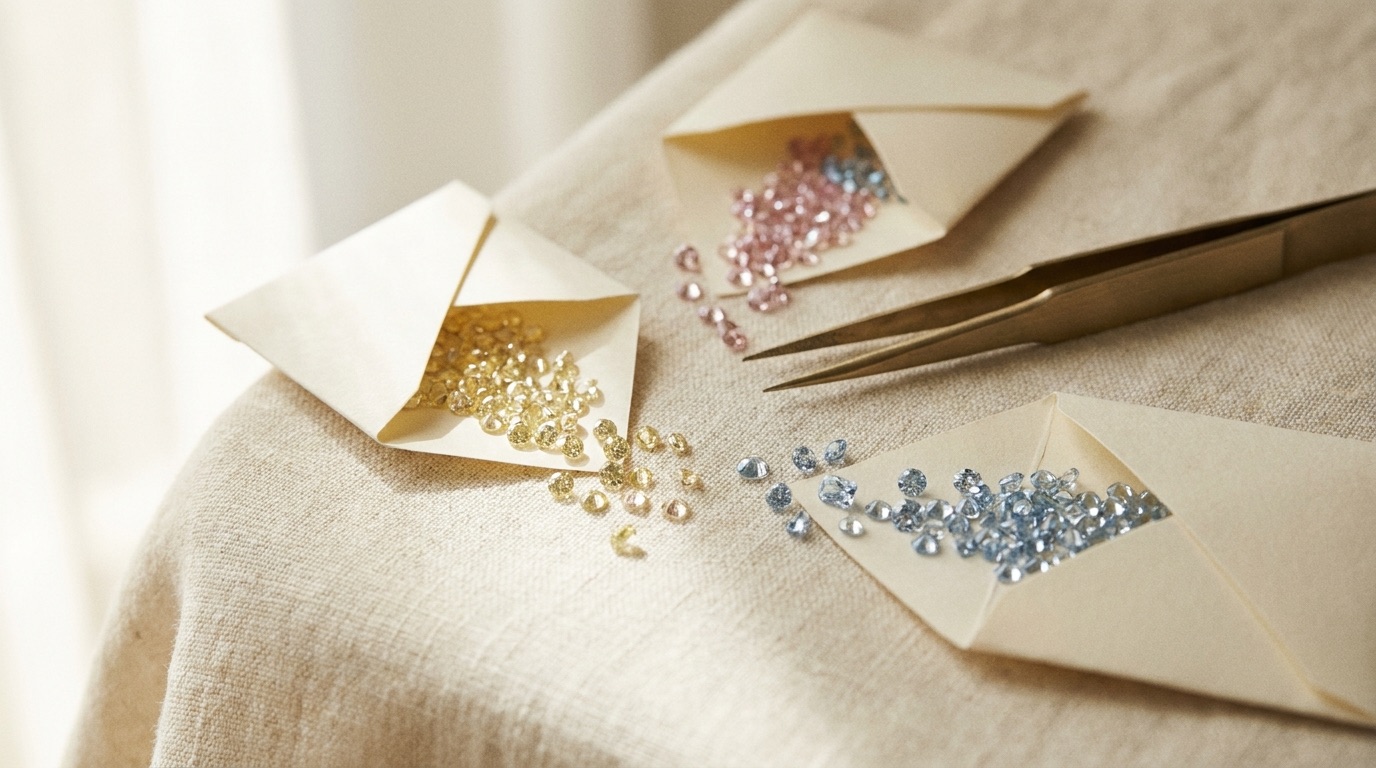
Guru Diam cuts and color-sorts fancy color melee in-house across eight shapes, concentrated in Yellow, Pink, and Blue, with Green available through made-to-order calibration cutting given how limited genuinely fancy-saturated green rough is industry-wide.
| Shape | On-hand (approx. ct) | Colors on hand | Typical use |
|---|---|---|---|
| Round | 2,010 | Yellow, Pink, Blue | Pavé, halo — dominant volume shape |
| Pear | 1,355 | Yellow, Pink, Blue | Graduated eternity lines, halos |
| Oval | 1,255 | Yellow, Pink, Blue | Eternity bands, halo accents |
| Radiant | 955 | Yellow, Pink, Blue | Eternity, channel work |
| Marquise | 515 | Yellow, Pink, Blue | Tapered eternity, channel work |
| Cushion | 515 | Yellow, Pink | Halo, eternity |
| Emerald | 175 | Yellow, Pink, Blue | Step-cut eternity lines, channel work |
| Baguette | 8 | Blue, Pink | Channel, eternity |
Round carries the deepest bench by a wide margin — it's the shape used in the highest volume across pavé and halo work, colorless or fancy color. The fancy shapes above fill the calibrated eternity-band and color-blocked side of the category. On-hand figures move with production and orders; treat the table as a directional read of where depth sits rather than a live count, and confirm current availability with a gemologist before finalizing a parcel spec. See our matching and grading guide for how a parcel actually gets held to a color range.
Round vs. Fancy Shapes: Where to Go Deeper
This page covers the category as a whole; the shape-specific buying decision is different enough on each side that it earns its own guide.
Fancy color round melee is the volume shape — it's what fills a pavé field or a straightforward halo, and it's the shape with the deepest on-hand depth across Yellow, Pink, and Blue. If a design calls for uniform small round accents in one color, that guide covers sizing, calibration, and color-band selection at a level of detail a category overview can't.
Fancy color fancy-shape melee — Pear, Oval, Radiant, Marquise, Cushion, Emerald, Baguette — is the graduated and channel-set side of the category: tapered eternity lines, color-blocked halos, step-cut channel work. Fancy shapes carry more cutting complexity per stone than round, which shows up both in lead time on made-to-order sizes and in how tightly a parcel can be calibrated to a single length-to-width ratio. That guide breaks down which fancy shapes hold the deepest current stock and which run primarily through made-to-order cutting.
Quality, Consistency, and Documentation: What to Check Before You Buy a Parcel
Fancy color melee is QC'd against a color and clarity baseline rather than individually certified — that's true of the category everywhere it's sold well, not just at Guru Diam. What separates a well-built parcel from a loosely sorted one comes down to a short list of checks, and they're worth asking about wherever a parcel comes from, not just here.
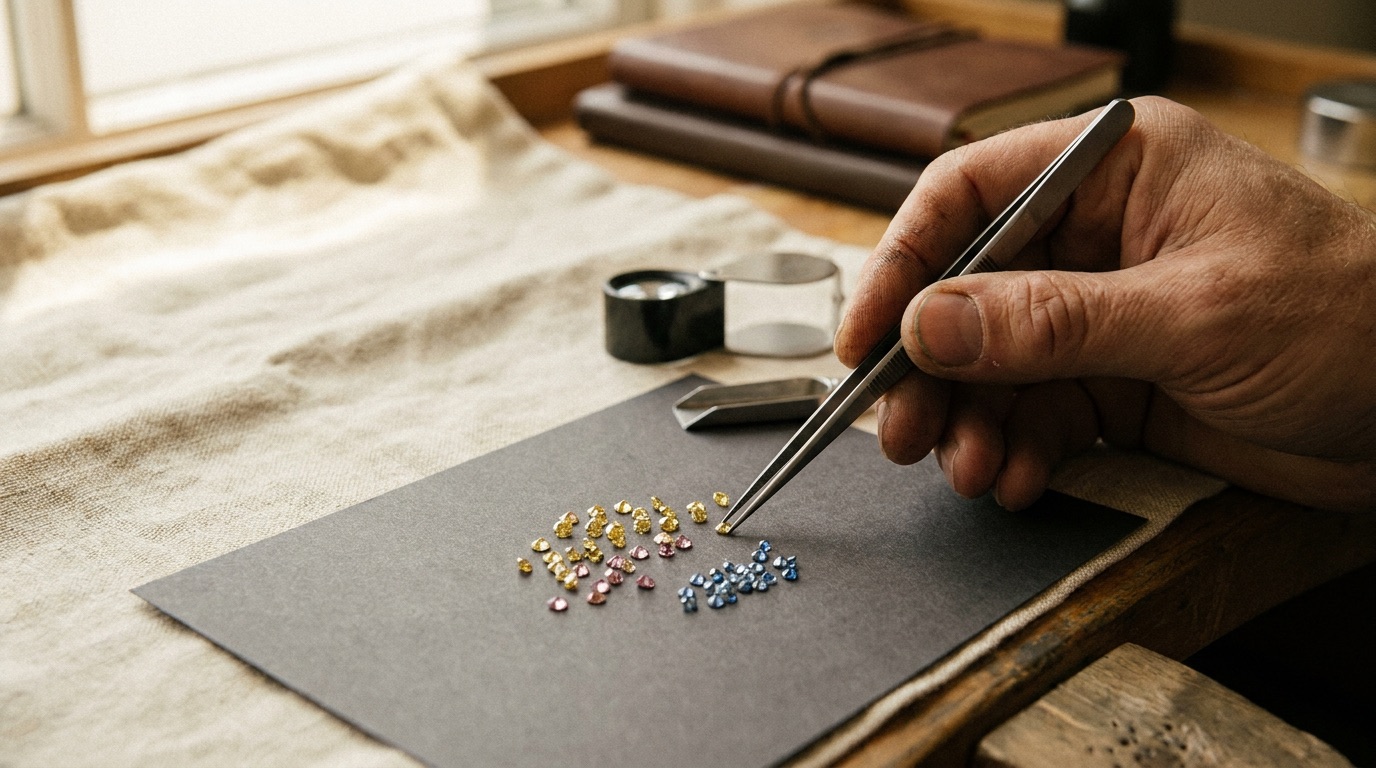
Hue and tone consistency across the whole parcel. Ask for a sample spread — a working quantity of the actual parcel, laid out on white or on a tray, under consistent light — before committing to the full order. A parcel that's been color-sorted correctly will read as one hue across the spread; one that hasn't will show visible warm-cool drift the moment it's compared stone to stone rather than glanced at in a bag.
Clarity floor appropriate for set work. Inclusions read differently in a colored stone than in a white one, and a clarity floor that's fine for a loose colored stone photographed under magnification isn't automatically fine for melee set close together under normal light. The relevant question is whether the parcel is eye-clean at setting distance, not whether it clears a specific clarity grade on paper.
Size calibration tolerance. Round diameters and fancy-shape length-to-width ratios both carry a stated tolerance band — ask what it is, and hold the supplier to it, because a parcel that drifts outside its stated calibration will show as uneven spacing once it's set in a pavé field or a graduated eternity line.
Documentation. Fancy color melee is never sold as "IGI certified" — it's uncertified parcel goods, QC'd in-house against the checks above. IGI grading is available on request when a parcel needs supporting documentation for a client or an appraisal. That's a different product from Guru Diam's certified single fancy color stones (0.30 ct and up), which ship with IGI, GIA, or GCAL certification. Melee and certified singles are different products with different paperwork by design, and conflating the two in a client-facing quote is one of the more common sourcing mistakes in this category.
What Drives Fancy Color Melee Pricing
Fancy color melee doesn't price off a single published rate card the way a colorless commodity might; a handful of factors move the number, and knowing which ones apply to a given order makes for a faster, more accurate quote conversation.
Color saturation tier is the largest lever. A parcel spec'd to Fancy Light or Fancy costs less per carat than the same shape and size spec'd to Fancy Intense or Fancy Vivid, because the deeper saturation bands are a smaller slice of what any cutting run produces — fewer stones clear the bar, so the ones that do carry more of the parcel's value.
Shape matters next. Round is the category's commodity baseline — highest volume, most straightforward to calibrate. Fancy shapes carry a premium tied to cutting complexity: a step-cut emerald or a tapered marquise takes more precision per stone to hold a consistent length-to-width ratio across a parcel than a round diameter does.
Size cuts both ways. Very small pavé sizes near the bottom of the 0.8mm range price on cutting yield — more stones per carat, more handling per carat. Larger melee sizes approaching 9.0mm start to price closer to loose-stone logic than pure melee logic, since fewer stones fill the same carat weight and each one gets individually assessed.
Clarity floor requested and parcel depth requested round out the list — a tighter clarity floor than the standard baseline, or a request for depth beyond current on-hand stock, both route toward a made-to-order quote rather than an off-the-shelf parcel price. Guru Diam quotes fancy color melee by parcel spec rather than publishing a flat per-carat rate, because the color, shape, size, and depth variables above genuinely do move the number — a gemologist can turn a spec sheet into a real quote faster than a published rate card could approximate one.
Styling and Use-Case Guidance: Where Fancy Color Melee Goes to Work
Fancy color melee shows up in a narrower set of applications than colorless melee, mostly because color reads best in specific settings rather than everywhere.
Pavé fields in a single hue — a yellow pavé band, a pink pavé halo — are the most common application, and the one where color-matching consistency matters most, since the eye is scanning a continuous field rather than a single accent.
Halo settings use fancy color melee to frame a center stone in contrasting or complementary color: a blue melee halo around a white or fancy yellow center, for instance, or a pink halo around a fancy color pink center for a tonal design.
Graduated eternity bands lean on the fancy shapes — pear and oval melee tapering in size around the band — where consistent color across a graduated size run is the whole point; a single off-hue stone in a graduated line is far more visible than the same stone lost in a pavé field.
Channel-set step cuts — emerald and baguette fancy color melee — go into channel work and structured eternity lines, where the flat, linear facet pattern of a step cut makes tone inconsistency between neighboring stones especially easy to spot.
Color-blocking and mixed-hue designs — combining two or three of the four hues within one piece, or pairing fancy color melee with a certified fancy color or colorless center stone — are increasingly common requests, and they raise the sourcing bar further, since each color block needs to hold its own internal consistency while also reading well next to the others. One practical note worth building into any production plan: order full parcel depth for a size-and-color band up front rather than in stages. A later top-up, even sourced from the same supplier, is a fresh color-sort against the same target — close, but rarely identical to a batch already set into finished pieces.
How to Order Fancy Color Melee Wholesale
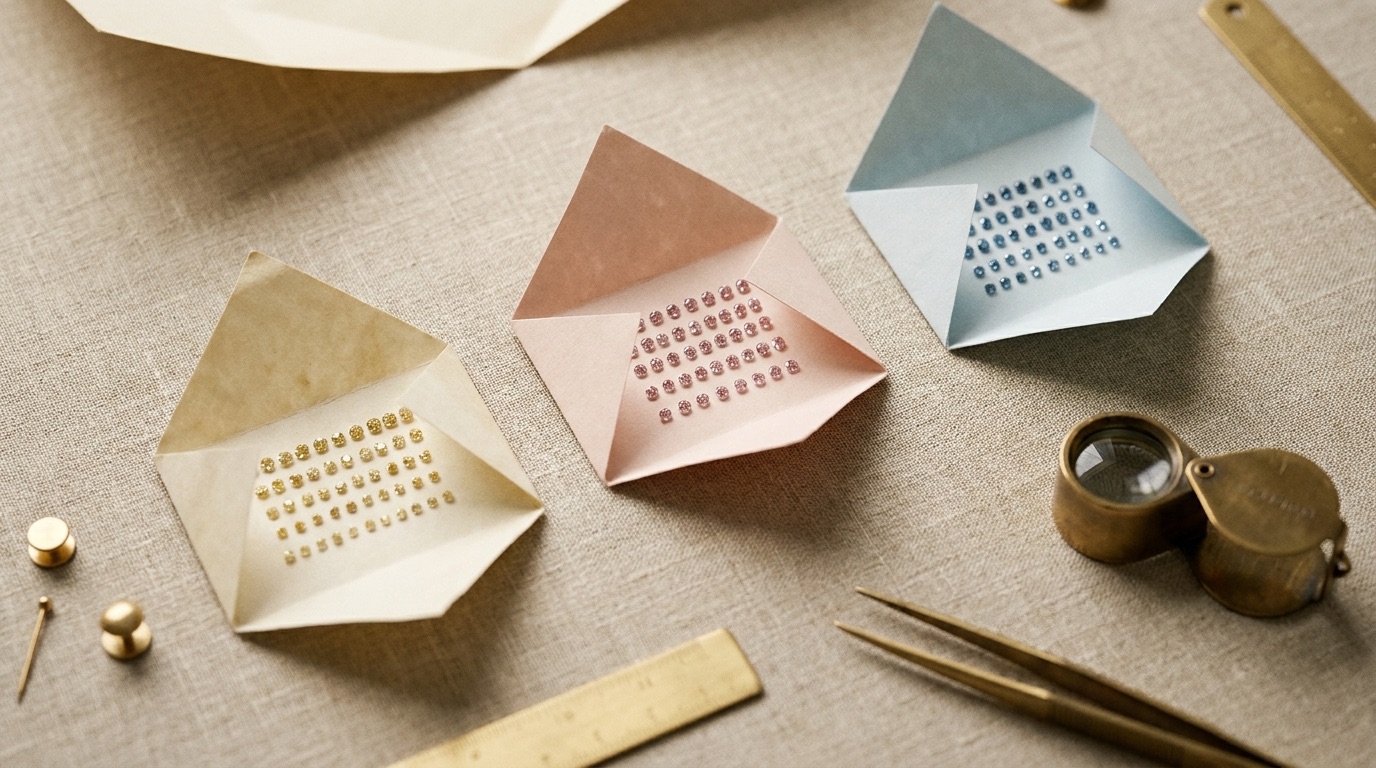
Guru Diam sources fancy color melee as wholesale, trade-only inventory — no retail markup — from our New York Diamond District desk (36 West 47th Street, Suite 601A, New York, NY 10036) and our Los Angeles office (607 South Hill Street, Suite 241, Los Angeles, CA 90014). In-stock parcels ship same-day from New York before 6pm EST, and same-day from Los Angeles before 4pm PST.
For a shape, size, or color combination outside current stock — including green fancy color melee, larger calibrated sizes, or a specific color band cut to spec — made-to-order calibration cutting is a direct conversation with the cutting floor rather than a published SKU. The more specific the spec sheet going into that conversation — shape, size range, color band, clarity floor, and total carat depth needed — the faster it turns into a firm quote.
Ready to buy? Open a verified wholesale account at gurudiam.com/signup and book time with a gemologist at gurudiam.com/book-appointment to review a sample spread before committing to a full parcel.
FAQ
What is fancy color melee?
Fancy color melee is small, calibrated lab-grown diamond accent stones — generally under about 0.18 ct, sized roughly 0.8mm to 9.0mm — cut in an intentional hue and sold as a parcel specified by size range and color range, for pavé, halo, and eternity band work. It is not individually or parcel-level certified the way a single stone is.
How is fancy color melee different from a certified fancy color diamond?
A certified fancy color diamond is a single graded stone sold as the focal point of a piece. Fancy color melee is parcel goods — many small stones color-matched to each other — sold to fill a supporting role: pavé fields, halos, and eternity lines. See our fancy color diamonds overview for certified singles.
Is fancy color melee certified?
No, not individually or at the parcel level. It's CVD-grown and QC'd in-house against a color and clarity baseline. IGI grading is available on request; melee is never sold as "IGI certified."
Why is fancy color melee harder to find than fancy color singles?
Grading one stone is a solved problem across the trade. Matching dozens or hundreds of small stones to the same visual hue and tone across a parcel is a manufacturing and sorting discipline, and it requires in-house cutting and color-sorting rather than brokered inventory. Most wholesalers who carry fancy color at all only carry it as certified singles.
What colors and shapes are available in fancy color melee?
Guru Diam's fancy color melee palette spans Yellow, Pink, Blue, and Green, cut across Round (the highest-volume shape) plus Pear, Oval, Radiant, Marquise, Cushion, Emerald, and Baguette, in sizes from 0.8mm to 9.0mm. Current on-hand depth is concentrated in Yellow, Pink, and Blue; Green is available through made-to-order calibration cutting. Champagne and Cognac are not part of the fancy color melee program.
Can I order a color, size, or shape combination that isn't currently in stock?
Yes. Combinations outside current on-hand inventory — including green fancy color melee or a specific size-and-color band cut to spec — go through made-to-order calibration cutting, a direct conversation with the cutting floor rather than a published SKU. Book time with a gemologist to scope a spec and get a firm quote.