
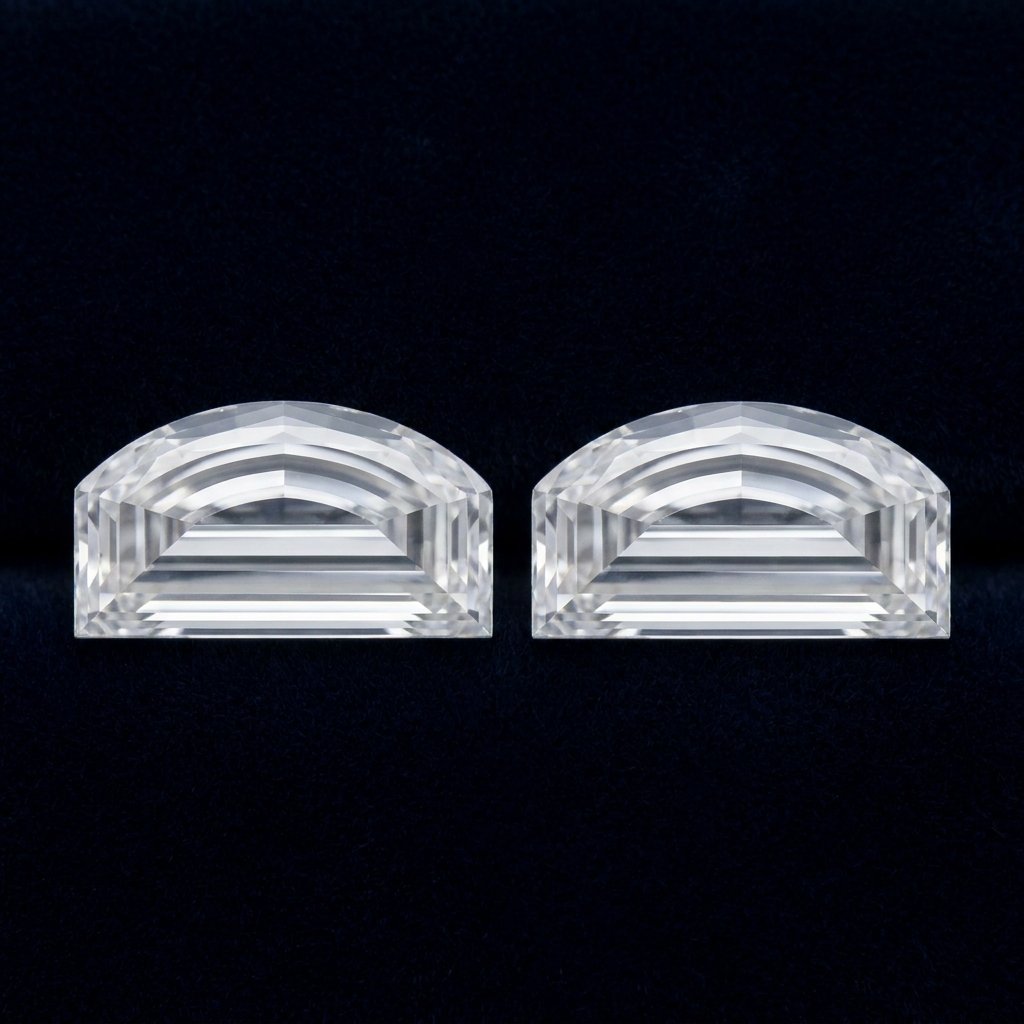
Matched pairs fancy shapes wholesale refers to two diamonds of the same fancy outline — trapezoid, half-moon, shield, bullet, kite, or epaulette — cut and selected to mirror each other in dimension, color, clarity, and cut so they flank a center stone as a balanced pair. They are the workhorse of three-stone and side-stone rings, and the hardest geometric SKU to source on demand.
Matched Pairs Fancy Shapes Wholesale: Sourcing Trapezoids, Half-Moons, Shields & Kites for Side Stones

If you build three-stone rings, you already know the bottleneck. The center is the easy part — you can pull a single round or oval from any feed. The job dies on the sides. A jeweler can sit on a beautiful 2.50 ct cushion center for three weeks because they cannot find two trapezoids that read as a pair against it. This is the most underserved corner of the wholesale market, and it is the corner where a bad source costs you a remake, a refund, or a lost commission.
This guide is written for the buyer who needs the exact geometric pair a custom three-stone demands — not a generic "matched diamonds" pitch. We will walk the shapes, the tolerances that actually matter to the eye, the certificate questions to ask before you wire money, and how to read a fancy-shape pair on a real inventory feed. For the broader spec framework, pair this with our wholesale tolerance guide to sourcing matched pairs.
Why are fancy-shape side stones so hard to match?
A round brilliant is forgiving. It is radially symmetric, sieve-gradable, and produced in enormous volume, so finding two that match in diameter and color is mostly a sorting problem. A trapezoid is not. It has a long edge, a short edge, two angled sides, and a depth profile that all have to agree across two separate stones — and fancy-shape cutting is far less standardized than round-brilliant cutting. Two cutters making "trapezoids" can produce wildly different length-to-width ratios and corner angles.
That means matching is a four-axis problem instead of a one-axis problem:
- Outline geometry — length, width, and the ratio between them, plus corner/angle agreement.
- Color — within roughly one grade, and consistent in tone, not just letter grade.
- Clarity and transparency — comparable clarity, and no mismatched milkiness or graining that the eye catches before the grade does.
- Cut and symmetry — the facet pattern, table size, and especially the step-cut vs. brilliant-cut facet style must agree. This is the axis most buyers under-weight and the one the eye notices first.
When a pair fails on the bench, it almost always failed on geometry or cut style, not on a color grade. Two stones can both be G/VS2 and still look like strangers because one is cut deeper and returns light differently. Cut and symmetry matching matters most to the eye — internalize that and you will reject fewer good pairs and accept fewer bad ones.
Lab-grown has genuinely loosened this constraint. Because growers can plan rough around a target finished shape, fancy-shape pairs in CVD and HPHT material are more available and more affordable than the natural equivalent ever was — which is part of why fancy-shape side stones have become a viable everyday SKU rather than a special order. (For background on how that material is produced, see how colored lab-grown diamonds are made.)
What are the fancy side-stone shapes, and where does each one belong?
Each fancy shape solves a specific design geometry. Knowing which shape the ring wants before you source saves a round of back-and-forth with the bench. Here is the working vocabulary, oriented to how they sit beside a center.
- Trapezoid — a four-sided stone with one long parallel edge and one short, angled sides. The default flanking stone for emerald, radiant, and cushion centers. Usually step-cut to echo an emerald-cut center. The long edge can face in or out depending on the silhouette you want.
- Half-moon (half-moon / demi-lune) — a flat edge with a rounded arc. Soft, classic; pairs beautifully with round and oval centers where you want continuity of curve.
- Shield — a three-sided stone with a curved or pointed base, like a heraldic shield. More architectural; works with pear, marquise, and shield centers, and with angular settings.
- Bullet — a stone with two parallel sides and a pointed or rounded tip, resembling a bullet profile. Strong directional energy; used to taper away from a center and toward the shank.
- Epaulette — an elongated, angular stepped shape (named for a military shoulder board) that hugs and "shoulders" the center. Premium art-deco look.
- Kite — a four-sided rhombus/kite outline set on point. Modern, geometric; popular with designers building asymmetric or cluster pieces.
These shapes overlap with the broader exotic-cut family — hexagon, lozenge, criss cut — which we cover in the jeweler's guide to exotic diamond shapes. The difference here is intent: these six are bought as pairs to flank something, so every spec is relative to its twin and to the center.
What tolerances make a fancy-shape pair actually match?
This is the heart of the buy. "Matched" is not a marketing word; it is a measurable spec band. Industry-accepted matching tolerance for a pair sits in this range:
| Spec axis | Matching tolerance (pair) | Why it matters on the bench |
|---|---|---|
| Diameter / length dimension | ~±0.1–0.2 mm | Larger gaps make one side stone visibly bigger; the eye catches asymmetry fast |
| Color | Within ~1 grade | Beyond one grade the warmer stone reads off, especially in white metal |
| Clarity | Comparable grade | Match transparency/character, not just the letter; avoid one eye-clean + one with a visible inclusion |
| Cut & symmetry | Matching facet style + symmetry | The single most eye-critical axis; step-cut must pair with step-cut |
| Outline ratio (L:W) | As tight as possible | Two trapezoids at different ratios won't sit symmetrically around the center |
A few field notes that don't fit in a table:
- The center sets the side-stone color ceiling. Sides should match each other and not out-white the center. A pair that is one grade whiter than the center will make the center look tinted. Match the pair to each other first, then sanity-check both against the center stone.
- Step-cut vs. brilliant-cut is a hard gate. A step-cut (emerald/baguette-style) trapezoid next to a brilliant-faceted one will never read as a pair regardless of grade. Confirm facet style explicitly.
- Depth and table drive the height match. Two stones at the same outline but different depth percentages will sit at different heights in the setting and catch light differently. Ask for depth/table if the design is low-profile.
- Tolerance follows the metal. Platinum and white gold are unforgiving of color drift; yellow gold hides a half-grade. Tighten your color band for white-metal jobs.
If you are matching color and shape — say, a pair of Fancy Yellow trapezoids around a yellow center — the matching problem compounds, because you are now also matching intensity level on the GIA fancy-color scale. We break that out in how to match a fancy color diamond set.
How should a fancy-shape pair be certified?
Certification is where pairs get murky, so make your rule explicit before the first memo. A properly documented pair comes one of two ways:
- Paired certificate — a single report covering both stones as a set, with combined and individual measurements. Cleaner for the customer, common on smaller side-stone pairs.
- Individual certificates — one report per stone. Standard on larger or higher-value sides; let you verify each stone independently and confirm the two reports actually agree.
Either is acceptable; no documentation is not, especially once you are repping the pair to a retail client. For lab-grown side stones, IGI grades the large majority of lab-grown diamonds — roughly 95%+ — and is the practical trade default, issuing full 4Cs you can match across two stones. Note that as of late 2025 GIA moved its lab-grown reports toward a two-tier "Premium"/"Standard" descriptive system rather than the full letter color/clarity 4Cs, which makes IGI's letter grades the more workable reference when you are matching color and clarity across a pair. Whatever you choose, compare reports from the same lab — a stone can grade up to about one color grade differently between labs, and a cross-lab pair can look mismatched on paper even when it isn't. You can confirm lab grading methodology directly at GIA and IGI.
One more discipline that protects you downstream: melee and small side stones are a known vector for undisclosed lab-grown "salting" in natural parcels. If you run a mixed natural/lab-grown bench, screen incoming small goods. Our melee screening guide covers the detection workflow.

How do I read fancy-shape pairs on a wholesale inventory feed?
This is where most buyers waste time — filtering a feed built for rounds and getting nothing back. A few practical moves when working a live trade inventory or API/CSV feed:
- Filter by shape first, then by measurement, not by carat. Fancy side stones live or die on millimeter dimensions and ratio. Two trapezoids at the same weight can be different lengths. Search on length × width and L:W ratio when the feed supports it.
- Look for a "pair" or "matched" flag, and confirm what it means. Some feeds tag pairs as a single line item with a combined weight; others list two singles a vendor believes match. Ask the desk to confirm the pairing is verified, not inferred.
- Request video and a side-by-side still. A 360° video of each stone, plus one image of the two together, tells you in five seconds what a spec sheet can't — whether the cut style and brightness actually agree.
- Reserve the pair, then size the center to it (or vice versa). Because pairs are scarce, the smart workflow is often to lock the harder-to-find element first. If you have an unusual center, find the sides and build around them.
For high-volume side-stone programs — eternity, halo, three-stone runs — calibration discipline matters as much as pairing. The same tolerance thinking that governs a single pair scales up to a parcel; see calibrated melee for pavé, halo, tennis & eternity.
How does this fit a fast-turnaround custom build?
Fancy-shape pairs are the reason custom three-stone jobs stall, so the sourcing decision is really a lead-time decision. The industry-typical custom timeline runs roughly 9–19 days end to end (CAD 1–5, casting 1–2, setting and finishing 2–4) — and that clock usually doesn't even start until the side stones are in hand. If you are hunting trapezoids across three vendors for a week before CAD begins, the customer's "two-week" ring becomes a five-week ring.
Sourcing pairs from a supplier holding US inventory collapses that. Guru Diam delivers CAD to finished jewelry in 4–6 days because the stones — center and matched sides — come from one verified, on-hand inventory rather than a chain of memo'd parcels. Lock the pair, start CAD same day. If you place custom work without an in-house bench, this is the model that makes it viable; see how to offer custom without an in-house bench.
There is a cost angle here too. A proposed, still-evolving 2026 US–India trade framework has reportedly differentiated loose natural goods (lower or zero) from finished goods and lab-grown (a higher figure, with ~18% circulating in trade discussion). None of this is settled law, and it should be treated as uncertain. But for a buyer planning side-stone inventory, US-held stock in New York and Los Angeles is a real landed-cost and lead-time hedge against that uncertainty — you are buying from goods already on US soil. For the full breakdown, see what 2026 tariffs mean for your diamond costs. You can track official US trade rulemaking at the Federal Trade Commission and ongoing trade reporting at National Jeweler.
Source your fancy-shape pairs from one US-held desk
Fancy-shape pairs reward buyers who source them from a single, verified inventory rather than stitching them together across vendors. Browse live matched-pair stock on our matched pairs category, where trapezoids, half-moons, shields, bullets, epaulettes, and kites are documented with the dimensions and certificates your bench actually needs.
When you're ready to build: open a verified wholesale account at /signup and book a working session at /book-appointment. Our New York Diamond District and Los Angeles desks hold 11,000+ IGI and GIA certified stones across natural and lab-grown — centers, sides, and color melee — so you can match a complete three-stone set in one sitting. Antique cuts, fancy color, calibrated melee, exotic shapes, and in-house custom, All Under One Roof.
Frequently Asked Questions
What tolerance counts as a "matched" fancy-shape pair?
Industry-accepted matching is roughly ±0.1–0.2 mm in the key dimension, within about one color grade, comparable clarity, and matching cut and symmetry — including the same facet style (step-cut paired with step-cut). Cut and symmetry matter most to the eye, so prioritize those over a single shared color letter.
Should side stones match each other or the center stone?
Both, in that order. Match the two side stones to each other first so the pair reads as balanced, then sanity-check them against the center. Sides should not be whiter than the center, or they will make the center look tinted — especially in platinum or white gold.
Do fancy-shape pairs come with certificates?
Yes. A documented pair comes either as a single paired certificate covering both stones with combined and individual measurements, or as individual certificates, one per stone. Larger or higher-value pairs are usually certified individually. Always compare reports from the same lab, since a stone can grade up to about one color grade differently between labs.
Which fancy shape works for an emerald-cut three-stone ring?
Step-cut trapezoids are the classic choice for emerald, radiant, and cushion centers because the step faceting echoes the center. Epaulettes give a more art-deco, shouldered look. Confirm the trapezoids are step-cut, not brilliant-faceted, so they read as a pair with the center.
Are lab-grown fancy-shape pairs easier to source than natural?
Generally yes. Because growers can plan rough around a target finished shape, matched fancy-shape pairs in CVD and HPHT material are more available and more affordable than natural equivalents, which has turned fancy side stones into an everyday SKU rather than a rare special order. Lab-grown shares the same physical, chemical, and optical properties as mined diamond.
How fast can I get a finished three-stone ring built around a matched pair?
The industry-typical custom timeline is roughly 9–19 days, and it usually doesn't start until the side stones are in hand. Sourcing the matched pair and center from one US-held inventory lets Guru Diam deliver CAD to finished jewelry in 4–6 days, because there's no waiting on memo'd parcels from multiple vendors.