
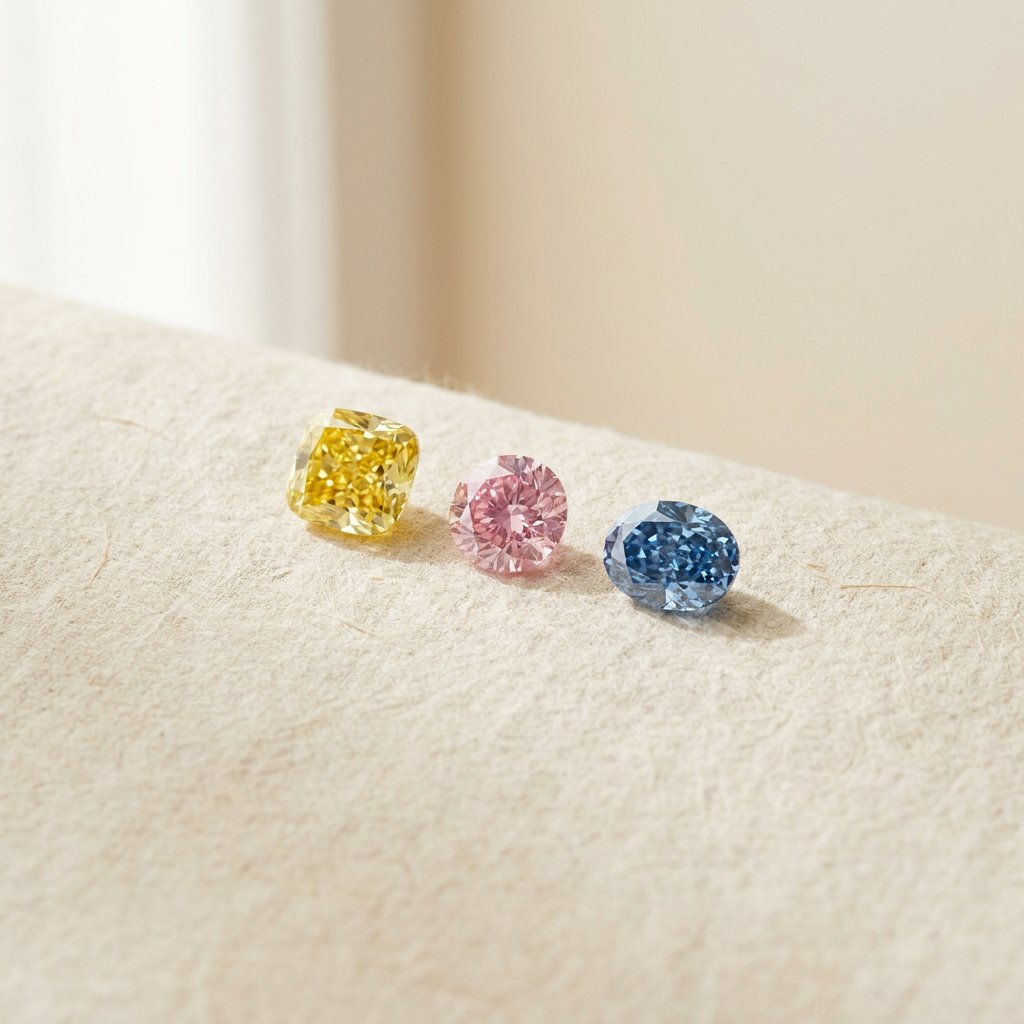
How Colored Lab-Grown Diamonds Are Made: A Jeweler's Guide to Sourcing Fancy Color

How are fancy color diamonds made in a lab? Color comes from three controllable mechanisms: nitrogen added during growth yields yellow, boron yields blue, and pink comes from nitrogen-vacancy centers created through post-growth irradiation and annealing. For the trade, that genesis directly controls saturation, cost, and what photographs well enough to sell.
For an independent jeweler or designer, fancy color used to be a special-order conversation reserved for clients with deep pockets and patience. Lab-grown changed the math. The same physics that produces a six-figure natural Fancy Vivid yellow can now be dialed in a reactor, certified by IGI, and stocked at a price that lets you build a margin instead of just a memo. But "made in a lab" does not mean "all the same." Understanding the genesis of each color is the difference between buying a parcel that sells through and one that sits in the case looking muddy under your lights. This guide breaks down the chemistry in trade terms, maps it to saturation tiers and certification language, and gives you a sourcing framework you can use on your next buy.
What actually creates color in a lab-grown diamond?
A colorless diamond is pure carbon in a flawless lattice. Color appears when something interrupts that lattice — either a foreign atom slotting in where a carbon atom should be, or a structural defect that absorbs part of the visible spectrum. Whatever wavelengths get absorbed, the rest is what your eye reads as the stone's hue.
In lab growth — whether CVD or HPHT — producers control this on purpose. They introduce specific trace elements into the growth chamber, or they treat a finished crystal afterward, to land on a target color. Three mechanisms cover almost everything you will stock:
- Nitrogen makes yellow. Nitrogen atoms substitute for carbon and absorb blue light, leaving a yellow appearance. More nitrogen, deeper yellow. According to GIA's overview of how lab-grown diamonds are made, nitrogen is the easiest impurity to manage in a growth environment, which is why yellows have the deepest, cheapest supply of any fancy color.
- Boron makes blue. Boron atoms absorb red, orange, and yellow light, transmitting blue. Boron-doped blues are also slightly electrically conductive — a quirk that helps gemologists identify them, and a reason true blues are scarcer and pricier than yellows.
- Structure and defects make pink. Pink is not a "drop in an element" color. It comes from nitrogen-vacancy (N-V) centers — a nitrogen atom sitting next to a missing carbon atom. As GIA's lab research notes describe, producers create these by irradiating a nitrogen-bearing crystal and then annealing (controlled heating), which forms the N-V centers that absorb green and yellow light and leave pink to red.
That last point matters commercially: pinks — along with many reds and purples — are treated after growth, not simply "doped" during growth. It is legitimate, disclosed, and standard for the category, but it is a step you should be able to explain to a retail client without flinching.
A quick map of color to mechanism
| Hue family | Primary mechanism | Created during or after growth? | Trade notes |
|---|---|---|---|
| Yellow / orange-yellow | Nitrogen substitution | During growth | Easiest, deepest supply, best price-per-carat |
| Blue / blue-green | Boron substitution | During growth | Scarcer, conductive, commands a premium |
| Pink / red / purple-pink | N-V centers (irradiation + annealing) | After growth (post-treatment) | Strongest retail demand; disclose treatment |
| Green | GR1 defects / irradiation | Often after growth | Less common in jewelry runs; verify stability |
| Black / gray | Inclusions / graphitization | During or after | Cheap, fashion-driven, easy melee plays |
Green deserves a flag: irradiation-induced green can be surface-limited, and its stability has historically been a grading challenge. For any lab-grown green you stock, confirm the cert language and ask your supplier whether the color is bodycolor-stable.
How does saturation work, and which tiers actually sell?
Color grading for fancy diamonds is not the D-to-Z scale you use for colorless goods. GIA grades fancy color on three attributes: hue (the basic color — yellow, blue, pink), tone (how light or dark it is), and saturation (how strong or pure the color is). Those combine into the intensity grades that drive price.
GIA's fancy-color scale spans nine grades: Faint, Very Light, Light, Fancy Light, Fancy, Fancy Intense, Fancy Vivid, Fancy Dark, and Fancy Deep. Roughly from weakest to strongest saturation, Fancy Vivid is the top premium grade, while Fancy Dark and Fancy Deep describe darker-toned, highly saturated color rather than a simple "more than Vivid" step. For your purposes, the commercially meaningful tiers cluster like this:
| Intensity tier | What the client sees | Sells best as | Sourcing read |
|---|---|---|---|
| Faint – Light | Barely-there wash of color | Budget / novelty, often "near-colorless reject" territory | Cheap, but easy to mistake for a tinted white — buy on cert, not photos |
| Fancy Light – Fancy | Clear, pleasant, unmistakable color | Everyday fashion, side-stone accents, color melee | The volume play: strong margin, fast turn |
| Fancy Intense | Rich, eye-catching, photographs beautifully | Center stones, statement pieces | Sweet spot for AOV — looks expensive, costs reasonable in lab-grown |
| Fancy Vivid (+ Fancy Deep / Dark) | Maximum punch — Vivid is the top premium grade; Deep/Dark are darker-toned | Hero pieces, custom commissions | Highest price, strongest social proof, slower turn at retail |
The practical lesson for a buyer: intensity is what photographs and what sells. A Fancy Light yellow looks great in person but can read as a tinted white in a phone photo under mixed lighting. A Fancy Intense or Fancy Vivid yellow holds its color across cameras, screens, and showroom lights — which is exactly why it converts in social posts and online listings. If you are building a fancy-color program for the first time, weight your buy toward Fancy and Fancy Intense; they give you visible color without the slow-turn premium of Vivid hero stones.
Hue purity is a margin lever
Two yellows at the same intensity grade can trade at very different prices because of modifying hues. A clean "Fancy Yellow" outsells a "Fancy Brownish Yellow" or "Fancy Greenish Yellow" at the same tier, because the secondary hue mutes the color. When you read a cert, the descriptors before the main color word are the discount — or the premium. Train yourself and your staff to read "Fancy Orangy Pink" versus "Fancy Pink" the way you read VS1 versus VS2: same neighborhood, different money.
How do you certify and disclose fancy color intensity?
This is where lab-grown fancy color gets simpler than natural — and where you protect yourself legally.
Every fancy color stone you stock should carry a report that states (a) it is laboratory-grown, (b) its color grade in hue / tone / saturation terms, and (c) any post-growth treatment. For lab-grown, IGI remains the de facto certification leader for the category — IGI grades an estimated 95%-plus of lab-grown diamonds and still issues full 4Cs reports, making it the trade default. That position firmed up after GIA moved, in late 2025 (October 2025), to a two-tier "Premium / Standard" descriptive system for most of its D-to-Z lab-grown reports rather than the full 4Cs nomenclature. Note that the GIA change targets the colorless continuum; fancy color grading on its three-attribute system remains the reference framework the whole trade reads against. Expect that the same stone can grade up to roughly one color grade differently between labs, so buy on the report in hand and verify it.
A few certification habits worth building:
- Disclosure is not optional. The FTC Jewelry Guides require that lab-grown origin be clearly disclosed, and treated color must be disclosed as treatment. "Lab-grown" plus "color treated" (where applicable) belongs on your tags, your listings, and your invoices.
- Match the cert to the stone. For fancy color, verify the report's hue / tone / saturation language matches what you see under neutral light. If the paper says Fancy Vivid and the stone reads Fancy in your case, photograph it and ask your supplier before you pay.
- Keep treatment language clean for pinks. Because lab-grown pink almost always involves post-growth treatment, your retail talk track should be confident: "This is a lab-grown diamond, color-enhanced through a controlled process — the same physics that creates natural pink, done on purpose." For more on vetting reports and suppliers before you buy, see our guide on how to vet a wholesale diamond supplier.
Buy verified, build margin. Fancy color is one of the few corners of lab-grown where supply is still thin enough to protect price. Request a wholesale account to see live, trade-only pricing on certified fancy color in stock.

Why is fancy color a smart stocking play right now?
Two market forces make this category worth a hard look in 2026.
First, base lab-grown prices have compressed and are stabilizing. Wholesale lab-grown prices fell sharply through 2025 — reported by Edahn Golan's market data at roughly a quarter year-over-year — but quarterly declines have since slowed to their smallest since the category began, with some smaller goods ticking up after producers held the line on rough. [FLAG: verify the exact 2025 wholesale-decline percentage against the cited Edahn Golan source before publishing; figure is reported, not independently confirmed.] For a retailer, that means the floor under colorless commodity goods is thin — differentiation, not price, is where margin lives. Fancy color is differentiation.
Second, color reads as value. A well-cut Fancy Intense yellow or pink lab-grown center looks like a five-figure natural to a retail client, photographs like a hero, and costs you a fraction of the natural. That gap is your margin and your story. Custom and personalized pieces — exactly the kind fancy color invites — also tend to carry higher average order value than stock designs, so a color program tends to pull your whole AOV up, not just the one sale.
Where it slots into a real inventory:
- Color melee for accent rows, halos, and pavé where a punch of yellow or pink lifts an otherwise standard design. Browse fancy color loose diamonds for the trade.
- Calibrated fancy-shape side stones in matching color for three-stone and toi-et-moi work — pair matched yellow trapezoids or epaulettes around a colorless center.
- Certified center stones in Fancy / Fancy Intense for custom commissions, turned around fast. See our certified fancy color inventory.
Matching matters more than in colorless
When you stock fancy color for sets — studs, three-stones, eternity bands — the matching tolerance is tighter than colorless, because the eye is far more sensitive to a color mismatch than a clarity one. For matched fancy-shape pairs, aim for diameter within roughly 0.1–0.2 mm, within about one color/intensity step, and the same hue descriptor, with cut, symmetry, and tone consistent; well-matched sets carry paired certs. A Fancy Yellow paired with a Fancy Light Yellow will look "off" even if both are beautiful alone. The cleanest approach is to buy matched parcels from one growth run where you can, rather than assembling singles. For accent-stone sizing, remember that fancy color melee follows the same mm-to-carat anchors as colorless (a 2.0 mm round is roughly 0.03 ct, a 3.0 mm round roughly 0.10 ct), so spec your rows by diameter to keep a halo or pavé even.
What should you ask before buying a fancy color parcel?
Use this as a quick vetting checklist with any supplier:
- What is the exact hue / tone / saturation on the report — not just "yellow," but the full descriptor including any modifying hues?
- Is the color from growth doping or post-growth treatment? (Expect treatment on most pinks; that is normal — you just need it disclosed.)
- Is the color stable? Some treated greens and browns can be less stable; ask directly.
- Can you supply matched parcels for sets, within one intensity step and the same hue?
- Lab and report number — a verifiable IGI / GIA report you can look up?
- MOQ, memo terms, and same-day availability so you can turn a custom order without parking cash.
If a supplier can answer all six crisply and show you HD video plus the cert before you commit, you are dealing with a real wholesale desk. If they cannot, walk. For the full version of this discipline, see our guide on how to add lab-grown diamonds to your jewelry store.
Frequently Asked Questions
How are fancy color diamonds made in a lab?
Lab-grown fancy color comes from three controllable mechanisms. Nitrogen introduced during growth produces yellow because it absorbs blue light; boron produces blue because it absorbs red, orange, and yellow light; and pink comes from nitrogen-vacancy centers created by irradiating a nitrogen-bearing crystal and then annealing it. Yellows and blues are doped during growth, while pinks and most reds are color-enhanced after growth. All of it is achievable in both CVD and HPHT processes and should be disclosed on the certificate.
Which trace element makes a lab-grown diamond yellow versus blue?
Nitrogen makes a lab-grown diamond yellow, and boron makes it blue. Nitrogen atoms slot into the carbon lattice and absorb blue light, leaving a yellow appearance — more nitrogen means deeper yellow. Boron atoms absorb red, orange, and yellow light and transmit blue. Boron-doped blues are also slightly electrically conductive, which helps gemologists identify them, and they are scarcer and more expensive than yellows.
What does Fancy Vivid mean, and is it worth the premium for a jeweler?
Fancy Vivid is one of the highest intensity grades on GIA's fancy-color scale, indicating very strong, pure color. It photographs powerfully and works as a hero or custom center stone, but it carries the highest price and the slowest turn. For most retailers building a color program, Fancy and Fancy Intense are the sweet spot — visibly rich color that holds up across cameras and showroom lighting, at a price that turns faster and protects margin.
Do lab-grown pink diamonds require treatment to get their color?
Yes, almost always. Pink color in diamonds comes from nitrogen-vacancy centers in the crystal lattice, which lab producers create through post-growth irradiation and controlled annealing rather than by adding an element during growth. This is a legitimate, standard, and disclosed process for the category. Your tags, listings, and invoices should state both lab-grown origin and color treatment, consistent with the FTC Jewelry Guides.
Who certifies lab-grown fancy color diamonds — IGI or GIA?
Both certify lab-grown diamonds, and IGI is the de facto leader for the lab-grown category, grading an estimated 95%-plus of lab-grown stones with full 4Cs reports. GIA's late-2025 (October 2025) update moved most colorless D-to-Z lab-grown reports to a two-tier "Premium / Standard" descriptive system, but its three-attribute fancy-color framework (hue, tone, saturation) remains what the trade reads against. For stocking, verify a lookup-able report that states lab-grown origin, the full color descriptor, and any treatment.
How do I match fancy color diamonds for studs or three-stone sets?
Match within one intensity step and keep the same hue descriptor, with consistent tone and cut. The eye notices color mismatches far more than clarity differences, so a Fancy Yellow next to a Fancy Light Yellow will look uneven even if each is attractive alone. The cleanest approach is buying matched parcels from a single growth run rather than assembling singles, which keeps hue and saturation aligned across the set.
Fancy color is one of the few corners of lab-grown that still rewards a buyer who knows the chemistry — supply is thinner, hue purity is a real margin lever, and color is the differentiation that flat colorless pricing no longer gives you. Guru Diam carries certified fancy color loose stones, color melee, and matched fancy-shape pairs across our New York and Los Angeles desks, with HD video, live wholesale pricing, and custom turnaround in 4–6 days. Request a verified wholesale account to see live pricing, or book an appointment with our trade desk to build your first color parcel.