
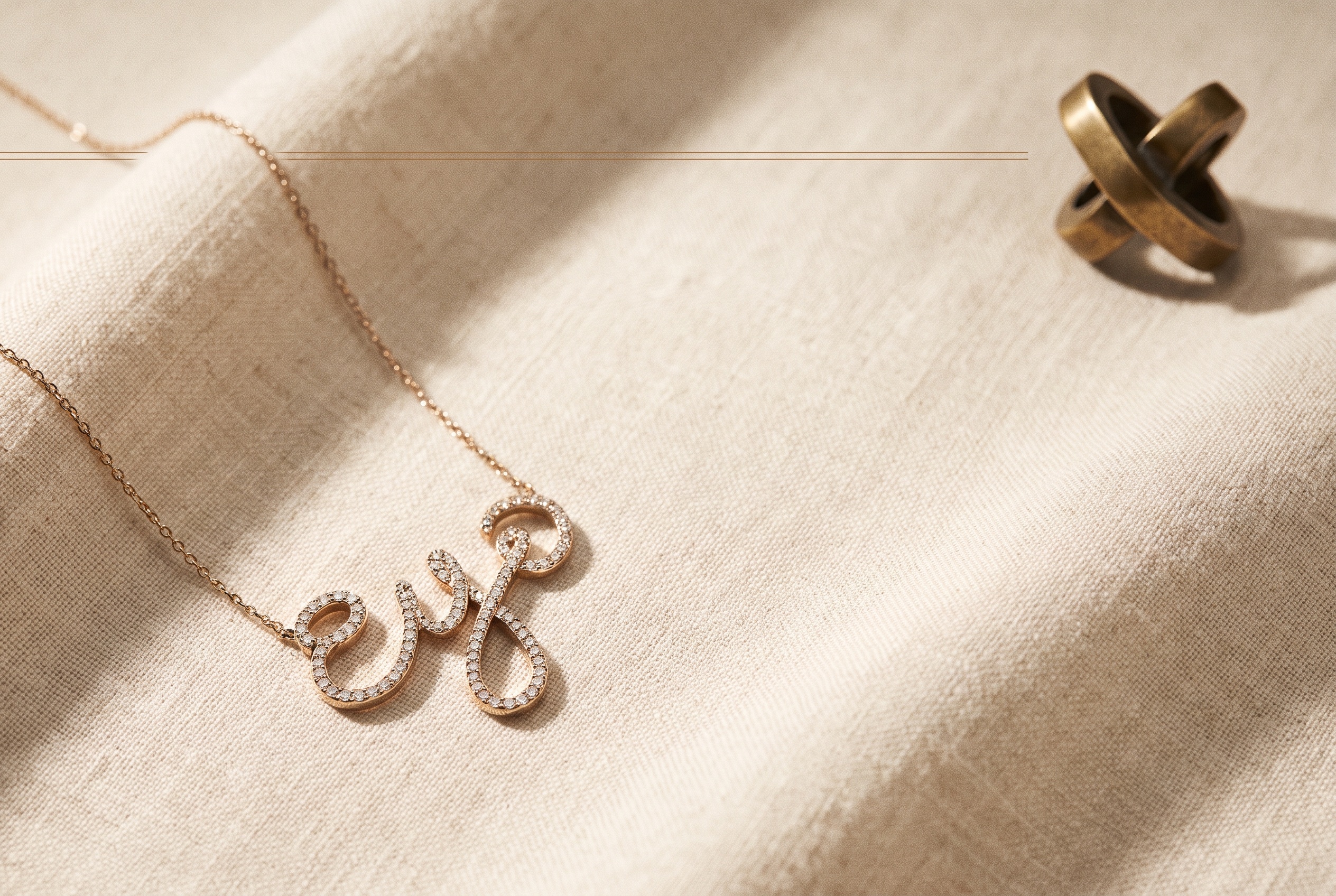
A diamond name necklace is a pendant necklace spelling out a full name or word in script or block lettering, with diamonds set along part or all of the lettering — distinct from a single-letter initial pendant, which uses one character rather than a full word. For a jeweler, the defining commercial feature of the category is that most orders are personalized to an individual customer's name, which means the sourcing and production workflow looks more like a bespoke fabrication process than a standard stocked-SKU category.
This guide is written for the trade — retailers, designers, and manufacturers sourcing loose diamonds and melee to build or run a name necklace program — not a consumer shopping guide. It covers what separates a name necklace from an initial pendant, common construction styles, production workflow for personalized orders, and what to look for in a wholesale diamond supplier for this category.
What Defines a Name Necklace
A name necklace is defined by spelling out a complete word — typically a first name, but also nicknames, a couple's combined names, a child's name, or a short meaningful word — rather than a single letter. This distinguishes it structurally from an initial necklace, which uses one character as a standalone pendant. The name necklace category is almost entirely custom or semi-custom by nature, since the specific letters, their order, and the overall pendant width all vary with each customer's name, whereas an initial necklace program can be built around a standing 26-letter core alphabet stocked in advance.
Name Necklaces vs. Initial Necklaces: Where the Category Splits
Though both fall under personalized diamond pendant jewelry, name necklaces and initial necklaces have meaningfully different sourcing and production profiles. An initial necklace can be manufactured ahead of demand across a fixed 26-letter run and held as stocked inventory; a name necklace generally cannot, since the near-infinite combination of names makes true pre-production impractical beyond a handful of the most common names. This pushes name necklaces toward a made-to-order production model by default, while initial necklaces can support a hybrid model of stocked common letters plus made-to-order less common ones.
| Factor | Diamond Name Necklace | Diamond Initial Necklace |
|---|---|---|
| Content | Full name or word, multiple letters | Single letter |
| Production model | Almost always made-to-order | Hybrid — stocked core alphabet plus made-to-order |
| Pendant width | Varies significantly by name length | Fixed, consistent across the alphabet |
| Typical stone count | Higher, scales with letter count | Lower, fixed per letter |
| Lead time | Longer — full custom fabrication | Shorter for stocked letters |
Common Name Necklace Construction Styles
Diamond-Outlined Script Nameplate
A single continuous script rendering of the name, with a line of small melee tracing the outline of the letters or set along the top edge of the script. This is the most recognizable name necklace format and generally the highest-cost construction, since the diamond line has to follow a curved, connected script path rather than sitting in a uniform straight or circular setting.
Diamond-Accented Block Lettering
Individual block or sans-serif letters, either connected in a single bar or strung separately along a chain, each accented with one or more diamonds — commonly a single stone per letter rather than a continuous outline. This construction is faster and less labor-intensive to produce than a full script outline, making it a common lower-cost entry point into the category.
Diamond Bar with Engraved Name
A plain metal bar pendant with the name engraved rather than diamond-set, paired with one or more diamond accents elsewhere on the bar or chain. This hybrid approach lets a retailer offer a personalized piece at a lower diamond-content price point than a fully diamond-traced name.
Combined-Name or Couple's Pendant
Two names, initials, or a name plus a symbol (such as a small diamond heart) combined into a single pendant — a popular gifting format for anniversaries, engagements, and family pieces, generally following the same script or block construction logic as a single-name piece but at a proportionally larger pendant width.
Chain and Pendant Construction Considerations
Because name necklace pendants vary in width with the name's length, chain gauge and connection points need to be selected to properly support pendants of meaningfully different sizes without a heavier, longer name pulling unevenly on a chain sized for a shorter one. Retailers running a name necklace program benefit from offering at least two chain gauge options — a finer chain for shorter names and lighter constructions, a sturdier one for longer names or fully diamond-outlined script pendants — rather than a single fixed chain spec across all name lengths.
Typical Stone Sizes and Carat Weight by Name Length
Melee used in diamond-outlined script name necklaces typically runs in the 0.01ct to 0.03ct range per stone, small enough to follow the tight curves of connected cursive lettering without disrupting the script's legibility. Total carat weight scales directly with name length and construction style — a short, single-syllable name in outlined script might use 0.15ct to 0.30ct combined, while a longer name or a full couple's combined pendant can run 0.40ct to 0.75ct or more. Block-letter constructions using one accent stone per letter typically use larger individual stones (0.02ct to 0.05ct each) but fewer total stones per letter than a continuous outline, landing in a broadly similar total carat range for a name of comparable length.
Diamond Shape Choices for Name Necklace Construction
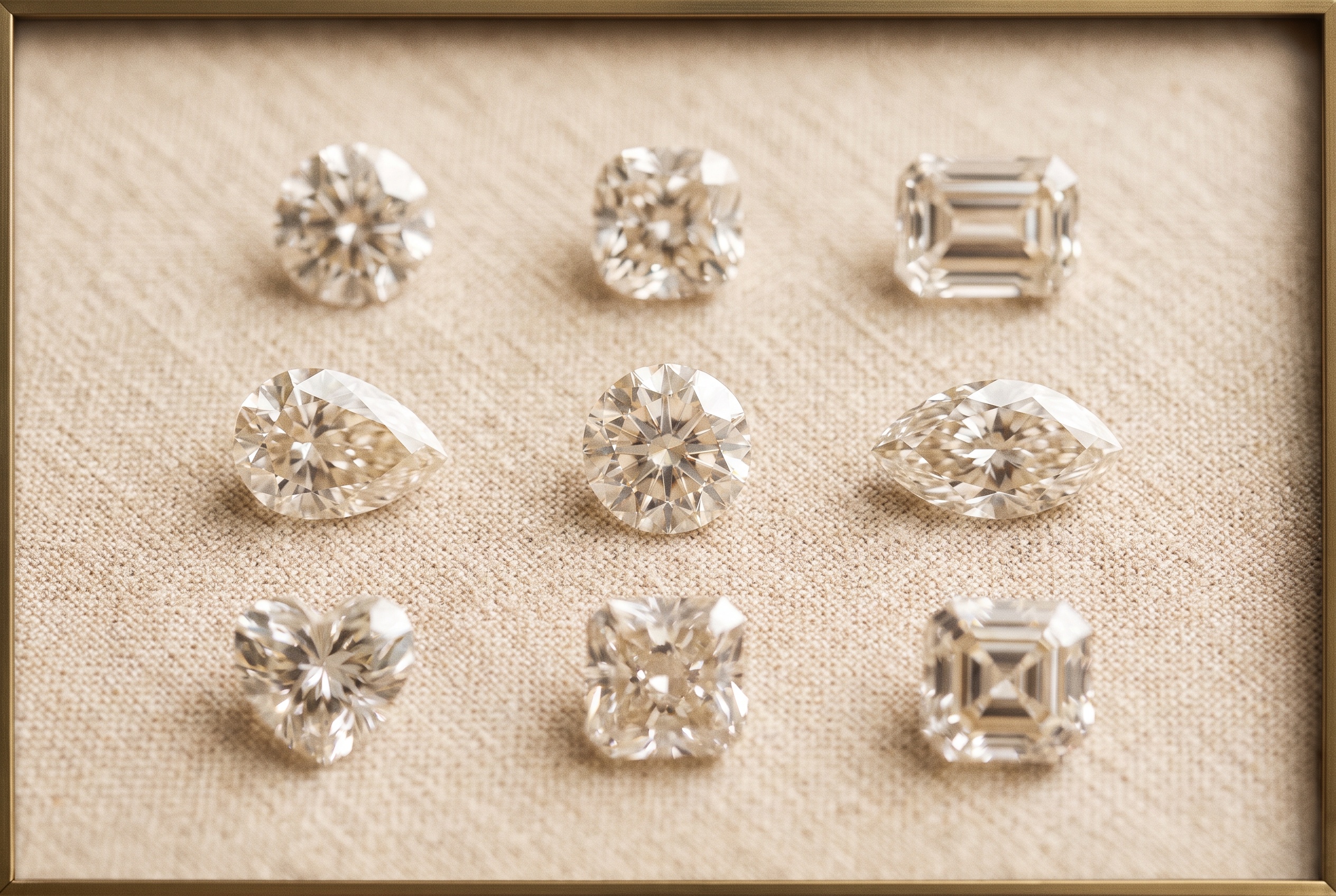
Round brilliant is by far the dominant shape for name necklace melee, chosen for the same reasons it dominates other continuous-line diamond-set jewelry: consistent brilliance and a symmetrical outline that tracks a curved script path more cleanly than an elongated shape would. Occasionally a single larger accent stone — often marquise or pear — is added at the start or end of a name, or centered above it, as a design flourish distinct from the letter-tracing melee itself.
Color and Clarity Standards for Name Necklace Melee
Because the melee in a diamond-outlined name sits in a continuous, closely viewed line along the lettering, consistency across the parcel matters more than any individual stone's grade — a visibly warmer or more included stone breaks the visual continuity of the script line in a way that's immediately noticeable at normal viewing distance. A DEF+/VS+ commercial melee standard, sorted and shipped consistently, is the right baseline for this construction, matching the standard used across other continuous-line diamond jewelry categories.
Lab-Grown vs. Natural Diamonds for Name Necklaces
CVD lab-grown melee is the practical default for name necklace construction, given that most pieces are gift-purchased at a moderate price point rather than positioned as a major investment piece, and given that the personalized, made-to-order nature of the category already adds labor cost on top of material cost. Lab-grown material keeps the finished piece accessible at a price point that supports the category's gift-driven demand pattern, without the added cost premium natural melee would add to an already labor-intensive custom production process.
The Made-to-Order Production Workflow
Because a name necklace is fabricated around a specific customer's requested name, the production workflow differs meaningfully from a standard stocked-SKU category. It typically starts with a script or font proof — a digital rendering of the requested name in the retailer's chosen lettering style, shown to the customer for approval before fabrication begins — since correcting a spelling or spacing error after a piece is already diamond-set is far more costly than catching it at the proof stage. Retailers running a name necklace program should build this approval step into their standard workflow as a non-negotiable checkpoint, not an optional step skipped for rush orders.
Quality Control Considerations Specific to Name Production
Alongside standard diamond-setting and metalwork inspection, name necklace production carries an added quality-control dimension: verifying the finished piece actually spells the requested name correctly, with correct letter order and spacing, before it ships. This sounds obvious, but at the production-line level, where a bench worker may be executing several personalized orders in a shift, a transposed letter or a missed character is a real and recurring failure mode. A dedicated proofreading check against the original customer order, separate from the general jewelry-quality inspection, is a worthwhile standing step for any supplier or manufacturer running volume in this category.
Building a Name Necklace Program: Inventory Planning
- Stock melee sized for script-line construction (0.01ct–0.03ct) as a standing inventory line, since this category's demand is steady rather than seasonal-spike-driven.
- Offer at least two script styles (connected cursive and block lettering) to cover different aesthetic preferences and price points.
- Build a proof-and-approval step into standard workflow for every personalized order, regardless of order size.
- Weight sourcing toward CVD lab-grown to keep the finished, labor-intensive piece commercially accessible.
- Offer multiple chain gauge options to properly support pendants of varying width across different name lengths.
Pricing a Diamond Name Necklace: What Drives the Final Cost
Name length and construction style are the two biggest cost drivers in this category — a longer name in fully diamond-outlined script carries meaningfully more total carat weight and setting labor than a short name in block-letter accents. Beyond material cost, labor is a larger share of total cost in name necklaces than in most stocked jewelry categories, since every piece requires individual layout, proofing, and setting work rather than being produced against a repeatable fixed template. Retailers should price this labor component transparently into the category rather than pricing purely off carat weight the way they might for a standard, non-personalized piece.
Turnaround Time Expectations for Name Necklace Orders
Because name necklaces are almost always gift purchases, often tied to a specific occasion date (a birthday, anniversary, or holiday), turnaround time is a genuine competitive factor in this category rather than a background operational detail. A retailer who can only fulfill a personalized name order on a multi-week production cycle risks losing time-sensitive gift purchases to a faster competitor. Guru Diam finishes custom pieces, name necklaces included, in 4-6 days — fast enough to support genuine gift-occasion demand without customers needing to plan weeks in advance.
Common Sourcing Mistakes in Name Necklace Programs
A frequent mistake retailers make entering this category is underbuilding the proofing step, assuming spelling and spacing errors are rare enough not to warrant a dedicated checkpoint — until a wrong letter ships and the piece has to be remade, eating the full margin on that order and delaying delivery past a gift date. A second common mistake is stocking only one chain gauge, leading to visibly mismatched proportion on longer names paired with a chain sized for short ones. A third is underestimating how much labor, rather than material, drives total cost in this category, leading to underpricing relative to the actual production time a personalized piece requires.
Font and Script Selection: A Practical Consideration Retailers Overlook
The choice of script or font a retailer offers isn't purely aesthetic — it has direct production implications. A highly connected, flourish-heavy cursive script is visually distinctive but harder to render legibly at small pendant scale, particularly for names with several tall or descending letters (a lowercase "j," "g," or "y" can crowd an adjacent letter's diamond outline if the script isn't drafted with enough spacing). A cleaner, more restrained script or a block-letter format is more forgiving to produce consistently across a wide range of names and generally faster to fabricate, since the digital proof-to-production translation has fewer ambiguous curve points for a setter to interpret. Retailers offering more than one script option should test each against a range of representative names — short ones, long ones, names with several ascenders and descenders — before committing to it as a standing catalog option, rather than assuming a script that looks good in a single sample name will scale cleanly across the full range of customer requests.
Returns and Exchanges on Personalized Pieces
Because a name necklace is fabricated to a specific customer's name, it isn't a resellable, restockable item the way a standard stocked piece is, which changes how returns and exchanges need to be handled relative to most other jewelry categories. Retailers should set clear expectations with customers before an order is placed — typically final sale once production begins, with exceptions carved out specifically for a supplier-side fabrication error (a misspelled name, a construction defect) rather than a change of mind after approval. This policy needs to be communicated at the point of sale, not discovered by a customer after the fact, since a surprised customer disputing a final-sale personalized order creates far more friction than one who understood the policy going in. A wholesale supplier fabricating on a retailer's behalf should mirror this same final-sale logic in its own terms with the retailer, while still standing behind genuine fabrication errors on the supplier's side.
Merchandising and Presenting Name Necklaces at Retail
Because a name necklace can't be displayed pre-made in a case the way a standard stocked piece can, retailers need a different merchandising approach: a sample piece (often spelling a generic or placeholder name) to show construction quality and script style, paired with a clear, simple ordering process a customer can complete on the spot or online. In-store, a digital proofing tool or a staff member trained to sketch or mock up a requested name quickly helps close a sale in the moment rather than losing a customer who has to wait days just to see what their own piece would look like. Online, offering a live text-to-preview tool that renders the customer's requested name in the actual script before checkout meaningfully reduces post-purchase spelling and font disputes, since the customer approves a specific visual rendering rather than trusting a generic product photo to represent their personalized piece.
Name Necklaces as Part of a Broader Personalization Trend
Diamond name necklaces sit within the same broader personalized-jewelry demand trend as initial necklaces and birthstone jewelry, all of which share a customer base drawn to pieces that reflect a specific, individual identity rather than a generic design. Retailers who merchandise these three personalization categories together — cross-selling a customer shopping for one into considering the others — generally see stronger category performance than treating each as an isolated product line, since the underlying buyer motivation and gift-occasion timing overlap closely across all three.
Scaling Name Necklace Production Without Losing Consistency
As demand for a name necklace program grows past occasional one-off orders into steady, repeatable volume, retailers and their manufacturing partners face a real tension: the category's made-to-order nature resists the kind of batch efficiency that drives down cost in stocked-SKU jewelry, but treating every order as a fully bespoke, from-scratch project doesn't scale either. The practical middle ground most successful programs land on is standardizing the inputs that can be standardized — a fixed set of script and font options, a fixed melee size and quality baseline, a fixed set of chain gauge tiers — while leaving only the actual letter sequence and pendant width genuinely custom per order. This lets a manufacturing partner build a repeatable production process around those fixed inputs, cutting labor time per piece without sacrificing the personalization that defines the category, rather than re-deriving construction decisions from scratch on every single order that comes through.
Retailers evaluating a wholesale partner for a growing name necklace program should ask directly how that partner handles this standardization — whether they have documented, repeatable specs for script styles and melee sizing, or whether every order genuinely starts as a blank-slate custom project. The former scales; the latter tends to produce inconsistent turnaround times and quality as volume increases, since production speed and consistency depend heavily on how much of the process is genuinely repeatable versus reinvented order by order.
Sourcing Diamonds for a Name Necklace Line Wholesale
Guru Diam supplies calibrated CVD lab-grown melee suited to both script-outline and block-letter name necklace construction, with cutting, setting, and polishing handled in-house and finished custom pieces delivered in 4-6 days. Trade buyers can review melee and matched-pair inventory through matching pairs and work with Guru Diam's custom jewelry team on personalized production through custom jewelry. In-stock materials ship same-day from Guru Diam's New York and Los Angeles locations. New trade accounts can apply through trade partner, with current terms available at the wholesale hub. For related personalized-jewelry sourcing guides, see our initial necklace sourcing guide and birthstone jewelry sourcing guide.
Frequently Asked Questions
What is the difference between a name necklace and an initial necklace?
A name necklace spells out a full name or word in multiple letters, while an initial necklace uses a single character. Name necklaces are almost always made-to-order, while initial necklaces can be stocked in advance across a fixed alphabet.
How many carats are in a diamond name necklace?
Total carat weight scales with name length and construction style, typically ranging from 0.15ct to 0.30ct for a short name in outlined script up to 0.40ct to 0.75ct or more for a longer name or combined couple's pendant.
What diamond shape is used in name necklaces?
Round brilliant dominates name necklace melee, since its symmetrical outline follows a curved script path more cleanly than an elongated shape. A single larger accent stone, often marquise or pear, sometimes appears as a design flourish.
Should a diamond name necklace be lab-grown or natural?
CVD lab-grown melee is the practical default, since it keeps the finished, labor-intensive personalized piece commercially accessible without adding a natural-material cost premium on top of already significant fabrication labor.
How long does it take to make a custom diamond name necklace?
Guru Diam finishes custom name necklaces in 4-6 days, fast enough to support gift-occasion demand without customers needing to plan far in advance.
Why is quality control different for name necklaces than other jewelry?
Beyond standard diamond-setting inspection, name necklace production requires verifying the finished piece spells the requested name correctly — a proofreading check against the original order that most standard jewelry categories don't need.
Guru Diam is a trade-only wholesale diamond supplier with locations in New York and Los Angeles, supplying calibrated CVD lab-grown melee and custom jewelry production for retailers building name necklace, initial necklace, and other personalized diamond jewelry lines. Browse matched-pair inventory in matching pairs or apply for a trade account through trade partner.