
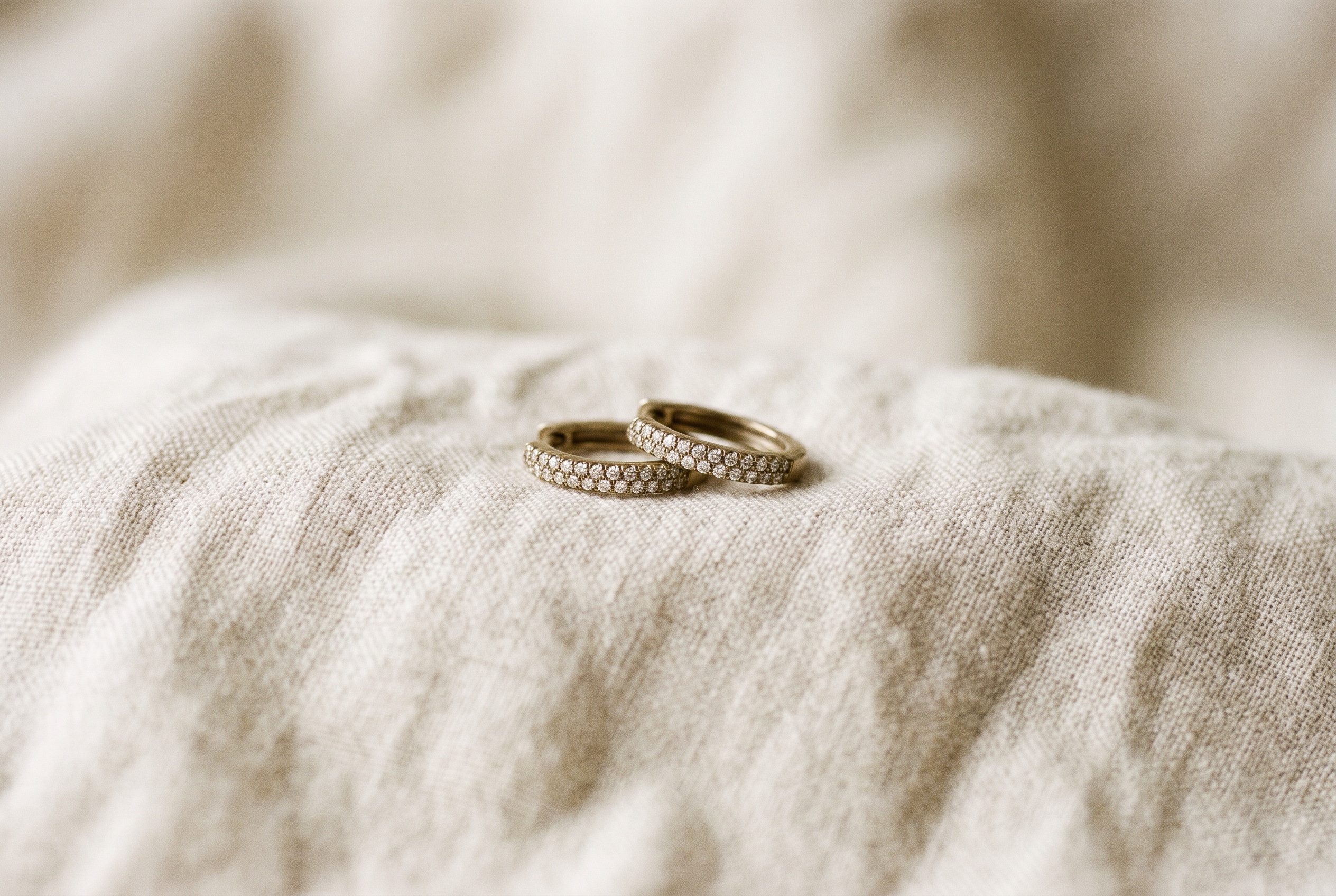
Diamond huggie earrings are a small, close-fitting hoop style — typically 8mm to 15mm in diameter — designed to sit snugly against the earlobe rather than dangling below it, usually set with a single row of pavé or channel-set diamonds around the outer edge. For a jeweler, huggies occupy a specific commercial niche: they're a compact, everyday-wear piece that requires far less carat weight than a full-size hoop or a drop earring, which changes both the sourcing math and the price point a retailer can hit.
This guide is written for the trade — retailers, designers, and manufacturers sourcing loose diamonds to build or restock a huggie earring line — not a consumer shopping guide. It covers what distinguishes a huggie from a standard hoop, typical stone sizes and setting styles, and what to look for in a wholesale diamond supplier for this category.
What Makes an Earring a "Huggie"
A huggie earring is defined by its fit and proportion rather than by a fixed diameter: the hoop sits close enough to the earlobe that it appears to "hug" it, with minimal gap between the metal and the skin, and the hoop itself is small enough — generally under 15mm — that it reads as a subtle, everyday piece rather than a statement one. The hinged closure is typically a click-top or lever-back mechanism designed for comfortable, secure all-day wear, which is part of why huggies have become a staple of layered, stacked-earring styling where a customer wears several small pieces up the ear at once rather than one larger pair.
Huggies vs. Standard Hoops: Where the Category Splits
The two styles get grouped together constantly in casual conversation and consumer search, but they represent different sourcing profiles for a retailer. A standard hoop — covered in more depth in our hoop earrings sourcing guide — ranges from roughly 15mm up to 40mm or more and is worn with visible space between the hoop and the ear, prioritizing scale and movement. A huggie stays small and tight to the lobe, prioritizing a clean, minimal silhouette over scale. That distinction drives real differences in stone requirements: a huggie's total diamond count and carat weight run meaningfully lower than a comparable hoop simply because there's less physical hoop surface to set.
| Factor | Huggie Earring | Standard Hoop |
|---|---|---|
| Typical diameter | 8mm–15mm | 15mm–40mm+ |
| Fit | Close to the earlobe, minimal gap | Visible space between hoop and ear |
| Stone count (single row pavé) | ~10–20 stones per earring | ~20–40+ stones per earring |
| Styling context | Stacked/layered ear looks, everyday wear | Standalone statement piece |
| Total carat weight (pair) | ~0.10ct–0.40ct | ~0.30ct–1.00ct+ |
Typical Stone Sizes and Counts for Huggie Construction
Most huggie designs use melee in the 0.005ct to 0.02ct range set in a single row around the front-facing portion of the hoop, with total stone count per earring landing somewhere between ten and twenty depending on hoop diameter and setting density. Combined carat weight for a pair commonly falls between 0.10ct and 0.40ct, which is meaningfully lower than most other diamond earring styles — a factor that keeps huggies accessible as a lower-price-point entry piece into a retailer's diamond earring line, useful for building a broader customer base before upselling into larger pieces.
Setting Styles Common in Huggie Construction
Pavé Huggie
The dominant style — small stones set in a continuous row using shared or individual prongs, or bead-set directly into the metal, running around the visible outer face of the hoop. Pavé construction maximizes visual sparkle relative to total carat weight, which suits the huggie's compact scale well.
Channel-Set Huggie
Stones set between two parallel metal walls rather than individual prongs, giving a smoother, more protected profile — a practical advantage for an everyday-wear piece, since there are no raised prongs to catch on hair or fabric during daily activity.
Huggie with Dangle Drop
A hybrid style that keeps the close-fitting huggie base but adds a small diamond or gemstone drop hanging from the bottom, giving a retailer a way to offer a slightly more elevated piece within the same close-fit hoop category.
Diamond Shape Choices for Huggie Settings
Round brilliant dominates huggie construction for the same reason it dominates most pavé and channel work: its symmetrical outline sets efficiently in a continuous row with minimal visible gap between stones, which matters for maintaining a clean line along a small hoop's limited surface area. Baguette-cut melee appears in channel-set huggies specifically, where the rectangular shape's straight edges fit cleanly against the channel walls and give a more architectural, linear look than round pavé. Fancy calibrated shapes beyond baguette are uncommon in huggie work — the hoop's small scale doesn't leave enough room for shape variety to read clearly.
Color and Clarity Standards for Huggie Melee
Because huggies are worn close to the face and viewed at conversational distance, color and clarity consistency across the row matters more to the finished look than pushing any single stone to an unusually high individual grade. A DEF+/VS+ commercial melee standard, sorted and shipped consistently across the parcel, produces a cleaner, more uniform sparkle than a wider mixed-grade lot — and since a huggie's total carat weight is low to begin with, the cost difference between a DEF+/VS+ standard and a lower grade is a small absolute number per pair, making it an easy upgrade for retailers to standardize on.
Lab-Grown vs. Natural Diamonds for Huggie Earrings
Given the huggie's positioning as an accessible, everyday-wear entry piece, CVD lab-grown melee is a strong default for the category — it delivers the same DEF+/VS+ commercial standard at a meaningfully lower cost basis than natural material, which helps a retailer hit the lower price points that make huggies an effective volume seller and a gateway into a customer's broader diamond jewelry purchases. Natural diamond huggies remain a reasonable offering for retailers building a natural-only product line, but for the core of a huggie earring program aimed at accessible, frequent-repeat purchase, lab-grown material is generally the more efficient sourcing choice.
Metal and Closure Considerations
14k and 18k gold — yellow, white, and rose — cover the large majority of huggie earring production, with platinum appearing occasionally in premium lines. Closure mechanism matters more for huggies than for most earring styles because of how they're worn: a secure click-top or lever-back closure that doesn't require a separate earring back is preferred for a piece meant for all-day, stacked wear, since a loose or fiddly closure is a more common source of customer complaint on a small everyday piece than on a larger occasional-wear earring.
Building a Huggie Earring Program: Inventory Planning
- Stock melee in the 0.005ct–0.02ct range, the core size band for single-row huggie pavé.
- Weight inventory toward round brilliant, with a smaller baguette allocation for channel-set designs.
- Default to a DEF+/VS+ consistent grade band — the low total carat weight per pair makes this an inexpensive standard to hold across the whole line.
- Lean on CVD lab-grown material for the bulk of the program to support accessible, repeat-purchase price points.
- Offer huggies across multiple diameters (8mm, 10mm, 12mm, 15mm) to support layered, stacked-ear styling, which drives multi-pair purchases from the same customer.
Pricing a Huggie Earring: What Drives the Final Cost
Because total carat weight per pair is low relative to most other diamond earring categories, huggie pricing is driven more by metal weight, closure mechanism quality, and setting labor per stone than by the stones themselves — the opposite cost structure from a large solitaire piece. A retailer pricing a huggie line should account for the fact that setting labor on a small, densely packed pavé row can represent a larger share of total cost than the melee itself, particularly at the smaller 8mm–10mm end of the size range where stone count per earring is still meaningful despite the compact scale.
Huggies Across the Layered-Ear Trend
Huggie earrings have grown substantially alongside the broader multi-piercing, curated-ear trend, where customers build a layered look across several piercings using a mix of huggies, small studs, and cartilage pieces rather than a single pair of statement earrings. This shift favors retailers who can offer huggies in a range of diameters and finishes as a coordinated set rather than a single standard size — a customer building a curated ear typically returns multiple times to add pieces, which makes huggies a strong repeat-purchase category once a retailer establishes the initial sale. Diamond huggies specifically compete well in this space against plain gold or gemstone alternatives because the sparkle reads clearly even at the huggie's small scale, unlike some colored stones that lose visual impact below a certain size.
Quality Control for Incoming Huggie Melee
Because huggie pavé is viewed up close and the stones sit in a tight, continuous row, incoming melee deserves the same careful check applied to other close-set categories like cluster rings: size consistency within stated calibration tolerance, color consistency across the parcel, cut consistency in faceting pattern, and a visual check for surface-reaching inclusions visible without magnification. A supplier who sorts to these standards before shipping reduces re-sorting time for a retailer's bench jeweler, which matters more on a high-volume, lower-margin-per-unit category like huggies than it might on a single large custom piece.
Matching Huggies Across a Curated-Ear Collection
Because huggies are increasingly sold and worn as part of a coordinated multi-piece ear look rather than a single standalone pair, retailers benefit from thinking about melee sourcing across an entire huggie collection rather than one SKU at a time. If a line offers the same huggie design across three or four diameters, keeping color and clarity grade consistent across all of them — even though they're technically separate products — matters for a customer who buys one size initially and returns later to add a second or third. A visible grade mismatch between an existing huggie and a newly purchased one in a customer's stack is a worse outcome for repeat business than a slightly higher blended melee cost across the whole collection, since it undermines the coordinated look the entire purchase pattern is built around.
Common Sourcing Mistakes in Huggie Programs
The most common mistake retailers make with huggie sourcing is treating the category as simply "a smaller hoop" and pulling melee from general hoop or pavé inventory without regard to the tighter size tolerances a small-diameter huggie demands — a size variance that would be barely noticeable on a 30mm hoop becomes visually obvious on a 10mm huggie, where the total row length is much shorter and any inconsistency is compressed into a smaller visual space. A second common mistake is under-investing in closure quality relative to stone quality, since huggies are worn continuously rather than removed daily; a beautifully set huggie with a weak or fiddly closure generates more customer complaints and returns than the stone quality alone would predict. A third mistake is stocking only one or two diameters rather than a fuller range, which limits a retailer's ability to capture the layered, multi-pair purchase pattern that drives much of the category's current growth.
Huggie Earrings as an Entry Point to Higher-Value Purchases
Because huggies sit at a genuinely accessible price point relative to most other diamond earring styles, they function well as a customer's first diamond jewelry purchase from a retailer — a lower-risk way to try a brand or a store before committing to a larger purchase. Retailers who track this pattern often find that huggie buyers return within a relatively short window to purchase a second pair (for a different piercing or ear position) or to upgrade into a larger earring or another jewelry category entirely, making the huggie line's value to a retailer's overall business somewhat larger than its per-unit margin alone would suggest. This makes consistent quality and a positive first-wear experience — secure closures, comfortable fit, verified grade consistency — a meaningfully strategic priority for the category, not just a cost-control one.
Manufacturing Considerations for High-Volume Huggie Production
Because huggies typically sell at higher unit volume and lower price per piece than most other diamond earring categories, production efficiency matters more here than on a lower-volume, higher-margin product line. A manufacturing partner who has streamlined tooling and casting specifically for small hoop production — rather than adapting equipment built for larger jewelry pieces — can meaningfully affect both unit cost and consistency across a large production run. Retailers placing recurring bulk orders for a huggie line benefit from working with a supplier who can maintain matched melee sourcing and consistent setting quality across repeated production batches, since a customer purchasing a second or third huggie later expects it to visually match earlier purchases from the same product line, even if the batches were produced months apart.
Packaging and Presentation for a Volume Category
Because huggies are frequently purchased as a lower-consideration, higher-frequency item compared to a bridal piece, packaging and presentation play a proportionally larger role in perceived value than they might for a single significant purchase where the ring or necklace itself carries most of the emotional weight. A retailer offering a compact, well-designed presentation box for a huggie purchase — sized appropriately for a small piece rather than an oversized box that reads as a mismatch for a modest-priced item — reinforces a premium feel even at an accessible price point, which supports both the immediate sale and the likelihood of a customer returning for a second pair. This is a lower-cost lever than stone quality for improving a huggie line's perceived value, and one that's easy for retailers focused primarily on sourcing to underweight relative to its actual impact on repeat purchase behavior.
Seasonal and Gifting Demand Patterns for Huggie Earrings
Huggie earrings see a distinct demand pattern relative to bridal jewelry, tracking more closely with general gifting occasions — holiday season, graduation, birthdays — than with engagement or wedding timing. This makes the category a useful counterbalance for retailers whose bridal business is more seasonally lumpy, since a well-stocked huggie assortment can drive meaningful volume during gifting windows that don't otherwise correlate with engagement ring sales cycles. Retailers planning inventory around these gifting peaks benefit from ensuring adequate stock across the most popular diameters and metal colors ahead of the relevant season, since a stockout on a popular huggie SKU during a high-gifting week represents a more immediate lost-sale risk than the same stockout would during a slower period.
Comparing Huggie Construction Methods: Prong vs. Bead-Set vs. Channel
Beyond the broad pavé, channel, and dangle-drop categories, the specific construction method used within a pavé-style huggie affects both cost and durability in ways worth understanding before committing to a production approach. Individual-prong pavé, where each stone has its own small prong, offers slightly more light exposure per stone and a marginally more sparkly finished look, but takes more bench time to set than shared-prong construction, where adjacent stones share a single prong between them. Bead-set pavé, using small raised beads of metal pushed up from the band itself rather than separate prongs, gives the cleanest, most streamlined profile with minimal visible metal — well suited to the tight, minimal aesthetic huggies are typically going for — but generally requires the most skilled bench work of the three methods to execute without stones sitting unevenly. A retailer choosing between these methods should weigh the finished-look difference against both setting labor cost and their manufacturing partner's specific skill level with each technique, since a bead-set huggie executed poorly looks worse than a well-executed shared-prong piece, even though bead-setting is the more premium technique on paper.
Sourcing Diamonds for a Huggie Earring Line Wholesale
Guru Diam supplies CVD lab-grown and natural melee in calibrated parcels across the size range used in huggie pavé and channel construction, sorted to a consistent DEF+/VS+ quality baseline, alongside certified loose stones for premium huggie-with-drop designs. Trade buyers can review current melee and certified inventory through certified diamonds and matching pairs, and work with Guru Diam's custom jewelry team on setting construction through custom jewelry. In-stock inventory ships same-day from Guru Diam's New York and Los Angeles locations. New trade accounts can apply through trade partner, with current terms available at the wholesale hub. For related earring-sourcing fundamentals, see our hoop earrings sourcing guide and drop earrings sourcing guide.
Frequently Asked Questions
What is the difference between huggie earrings and hoop earrings?
Huggies are small, close-fitting hoops (typically 8mm–15mm) that sit snugly against the earlobe with minimal gap. Standard hoops run larger (15mm–40mm+) and are worn with visible space between the hoop and the ear.
How many diamonds are in a pair of huggie earrings?
A single-row pavé huggie typically uses ten to twenty stones per earring, with combined carat weight for a pair commonly between 0.10ct and 0.40ct depending on hoop diameter and setting density.
What shape diamonds are used in huggie earrings?
Round brilliant dominates huggie pavé construction for its clean, gap-minimal fit in a continuous row. Baguette-cut melee appears specifically in channel-set huggie designs.
Should huggie earring diamonds be lab-grown or natural?
CVD lab-grown melee is a strong default for the category, delivering the same commercial grade standard at a lower cost that supports the accessible, everyday price points huggies are built around.
What closure works best for huggie earrings?
A secure click-top or lever-back closure is preferred for all-day, stacked wear, since huggies are typically worn continuously rather than removed daily like drop or statement earrings.
What color and clarity grade should huggie earring melee be?
A consistent DEF+/VS+ grade band across the row produces the cleanest, most uniform sparkle. Because total carat weight per pair is low, this standard is inexpensive to hold across an entire huggie program.
Guru Diam is a trade-only wholesale diamond supplier with locations in New York and Los Angeles, supplying calibrated CVD lab-grown and natural melee alongside certified loose diamonds, for jewelers building huggie, hoop, and other earring lines. Browse current inventory in certified diamonds or apply for a trade account through trade partner.