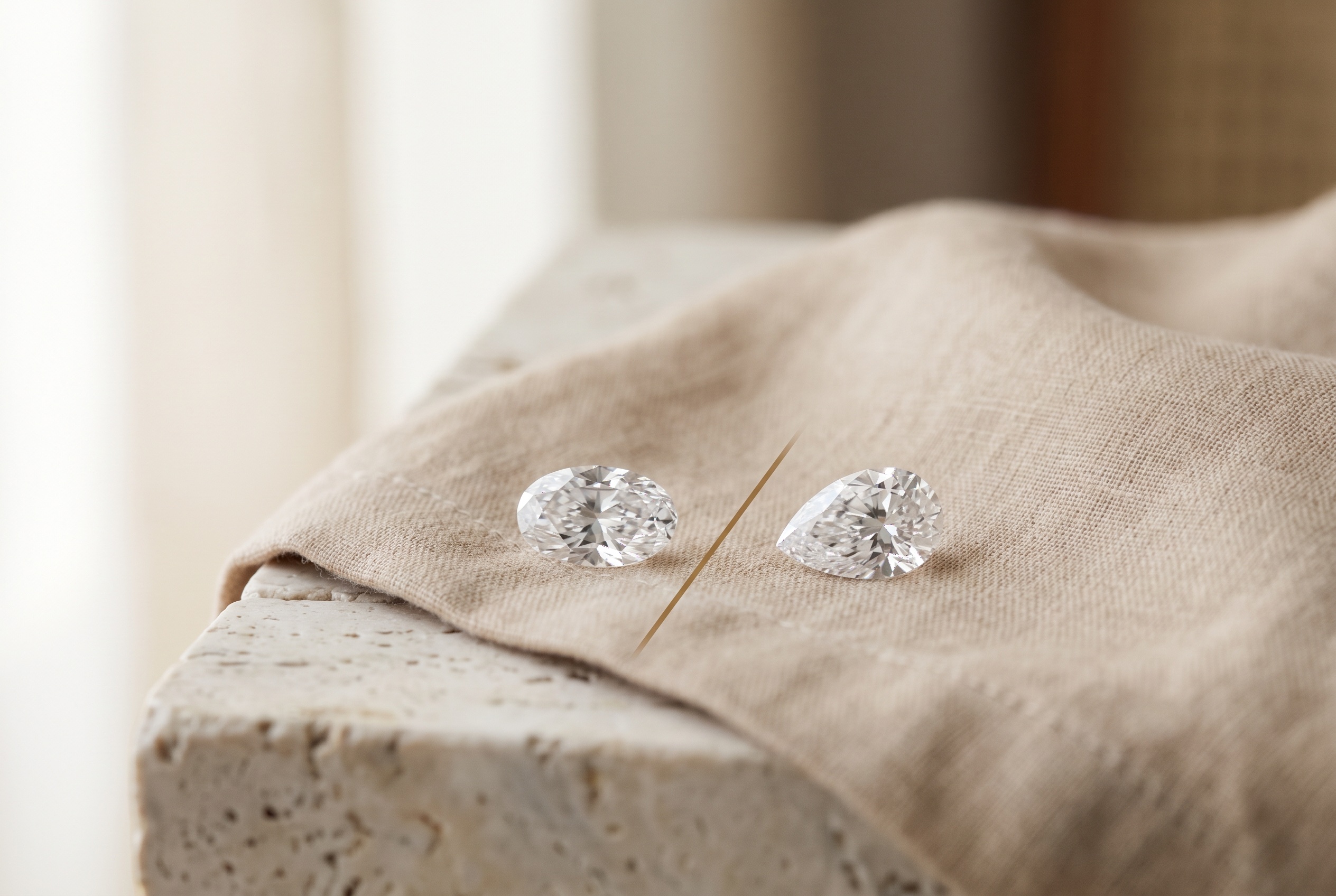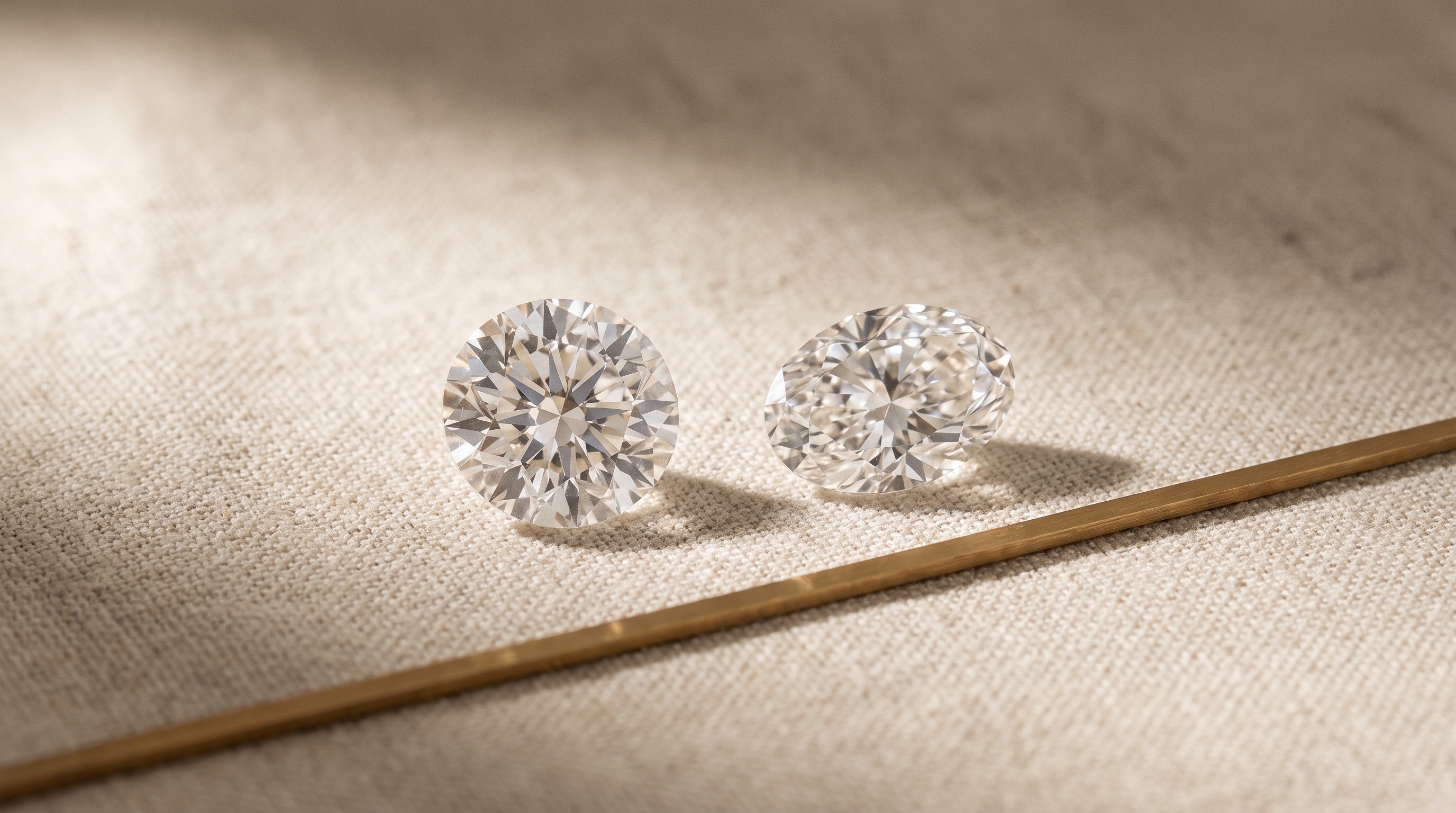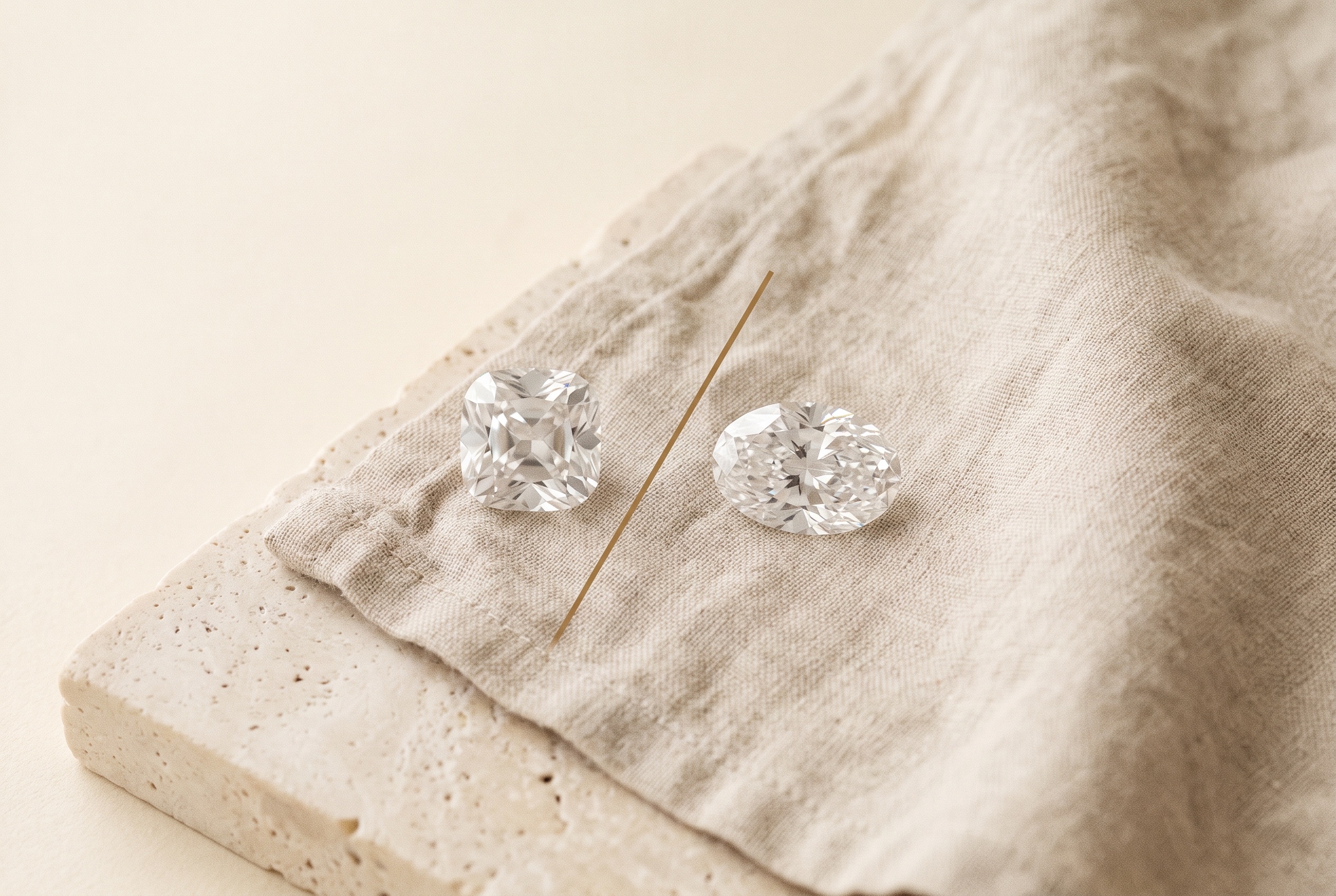

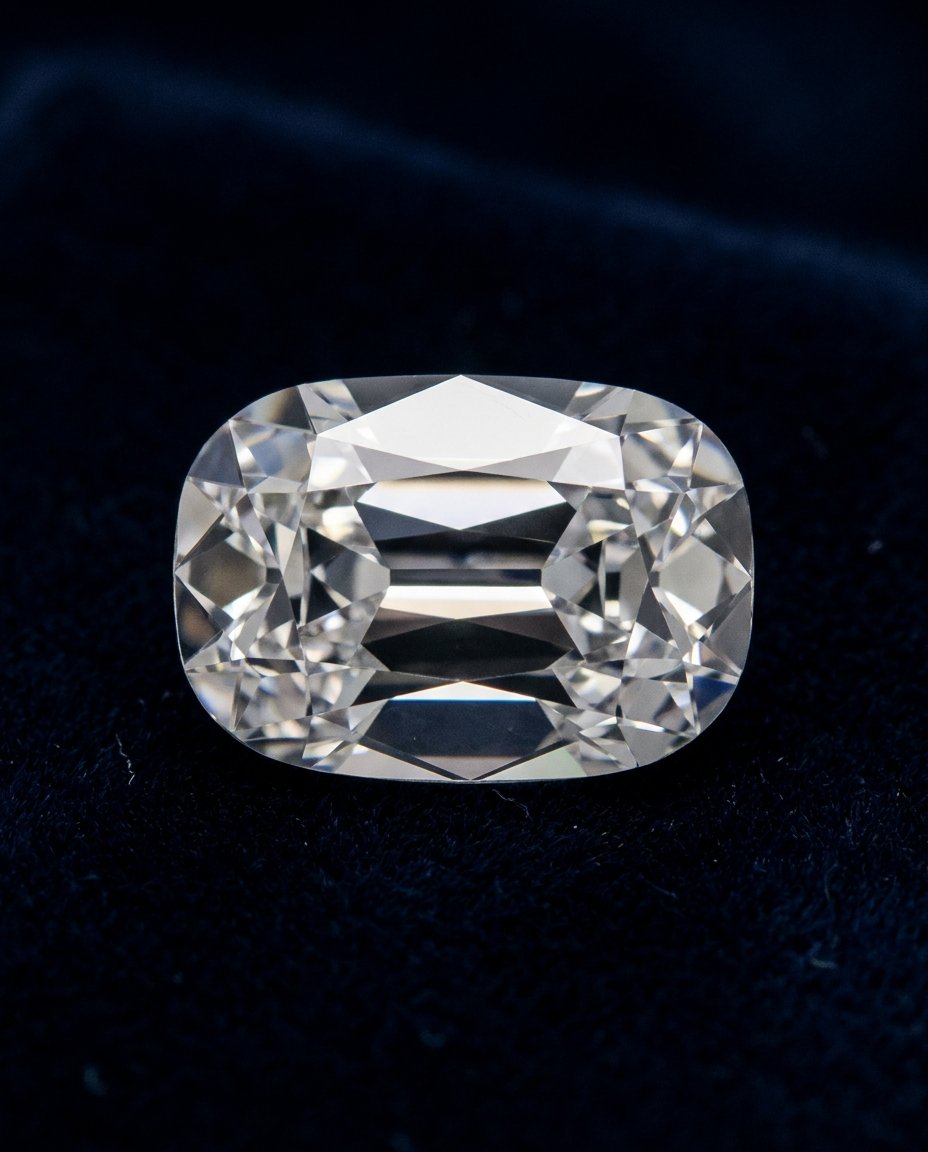
The old mine cut vs old european cut decision comes down to outline, faceting, and culet: old mine cuts are squarish-cushion stones with a high crown, large open culet, and chunky hand-cut facets, while old european cuts are round with a smaller culet and tighter, more symmetrical faceting. Both predate the modern round brilliant and read warm, glowy, and candlelit rather than bright-white.
Old Mine Cut vs Old European Cut: The Definitive Sourcing Guide for Jewelers (2026)

If you sell to the vintage-bridal buyer, you have probably watched a client point at a celebrity engagement ring and say "I want that look" — and then watched the sale stall because nobody in the room could name the cut, spec it, or source it at a margin that works. That gap is where independent jewelers lose antique-cut business to specialists. This guide closes it. It is written operator-to-operator: what actually distinguishes an old mine cut from an old european cut, how to read each one against a client's hand and a client's brief, and how to source either one trade-priced without guessing.
Most consumer-facing guides stop at "they're both antique and sparkly." That is useless at the counter. Below you will get the facet-by-facet, culet-by-culet, era-by-era comparison the snippet results are missing — the kind of breakdown you can lean on when you are quoting a custom mounting and need to commit to a shape before you have the stone in hand.
What is the difference between an old mine cut and an old european cut?
Both are hand-cut antique diamonds from the pre-modern era, optimized for candlelight rather than the bright LED-lit retail cases we sell from today. The fastest way to tell them apart is the outline: an old mine cut has a squarish, cushion-like silhouette with rounded corners, while an old european cut is round. Everything else — facet count, crown height, culet size — follows from the technology available when each was cut.
The old mine cut is the older of the two, broadly the dominant antique cut of the late 1700s through the 1800s, cut by hand and by eye before bruting machines could true a stone to a perfect circle. Its squarish outline is essentially a consequence of following the natural octahedral rough rather than fighting it. The old european cut emerged later, broadly from the 1890s into the 1930s, once bruting allowed cutters to round the girdle reliably. It is the direct ancestor of the modern round brilliant: same 57–58 facet family, but with proportions tuned for fire over brightness.
For the trade, the practical takeaway is this. When a client wants the cushion-y, pillowy, "soft square" antique look, you are sourcing an old mine cut. When they want the round antique look — a vintage circle with a visible culet and big, lazy flashes of color — you are sourcing an old european cut. Get that one decision right at the brief stage and the rest of the spec falls into place.
The trade comparison table: facets, culet, era, and light performance
Here is the side-by-side most consumer guides never publish. Use it to spec confidently before the stone is in your hand.
| Spec | Old Mine Cut | Old European Cut | Transitional Cut | Modern Round Brilliant (reference) |
|---|---|---|---|---|
| Outline / silhouette | Squarish cushion, rounded corners | Round | Round | Round |
| Era (broad) | Late 1700s–1800s | ~1890s–1930s | ~1920s–1940s | 1950s–present |
| Facet count | ~58, hand-cut, irregular | 57–58, more symmetrical | 57–58 | 57–58, precision-cut |
| Crown height | High | High | Medium-high | Medium |
| Table size | Small | Small | Larger than OEC | Large |
| Culet | Large, open (visible "hole") | Small-to-medium, often visible | Small, often closed | Pointed / none visible |
| Girdle | Often thin, sometimes wavy (hand-bruted) | Rounder, more even | Even | Even, faceted/polished |
| Symmetry | Irregular by modern standards | Better, still hand-tuned | Improving | Tight, machine-precise |
| Light behavior | Broad, chunky flashes; warm; candlelit glow | Big bold flashes; high fire; "crushed ice" depth | Between OEC and brilliant | Bright, white, high brilliance |
| Best read in | Warm / low light | Warm / mixed light | Mixed light | Bright retail / LED |
| Modern lookalike | Antique cushion | "Old european cut" / antique round | — | Round brilliant |
A few notes for the bench and the counter. The culet is your single most reliable tell: hold the stone table-up under a loupe and an open culet shows as a small window or "hole" at the bottom — large on old mine cuts, smaller but usually present on old european cuts, and absent on modern brilliants. The high crown plus small table on both antique cuts is what produces the deep, dimensional flash buyers describe as "chunky" or "candlelit," versus the flat, edge-to-edge white brightness of a modern brilliant. And because both were cut by hand, expect — and disclose — more variation in symmetry than a modern stone. That variation is the look, not a defect.
What is a transitional cut diamond, and where does it fit?
The transitional cut diamond is the bridge between the old european cut and the modern round brilliant, broadly cut from the 1920s into the 1940s as cutters chased more brilliance without fully abandoning the antique character. Practically, a transitional cut is a round diamond with a larger table and a smaller culet than a classic old european cut, but still more "old-world" depth and crown than a modern brilliant.
Why does this matter to a buyer at the wholesale level? Two reasons. First, dealers and grading reports are not always consistent about where "old european" ends and "transitional" begins, so when you are sourcing remotely you should confirm the actual measurements — table percentage, crown angle, culet size — rather than trusting the label alone. Second, the transitional cut is a genuinely useful middle option for a client who loves the antique vibe but works in bright-light environments and finds a true old mine cut too "soft" or too dark for their eye. If a client keeps saying they want vintage but keeps gravitating to the brightest stone in the tray, a transitional or a well-cut old european is usually the resolution.
For a fuller treatment of how the whole antique family is moving in 2026, see our antique-cut engagement ring stocking playbook, which covers which cuts are turning fastest at retail right now.
How do I help a client choose between an old mine cut and an old european cut?
This is a counter conversation, not a gemology lecture. Run it on three axes.
Shape preference. Square-ish and pillowy means old mine cut; round means old european cut. This is the fastest filter and it resolves most clients in one question. Lay a cushion next to a round and let them point.
Light environment. Ask where they live their life. An old mine cut, with its larger culet and chunkier faceting, reads gorgeously in warm and candlelit settings and can look slightly sleepier under harsh office LEDs. An old european cut, and especially a transitional cut, holds up better across mixed lighting. A buyer who works under bright light all day and wants more "life" is often happier with an old european or transitional than a deep old mine cut.
Authenticity vs. consistency. If the client specifically wants a genuine antique character — visible asymmetry, a true open culet, the romance of an irregular hand-cut stone — lean into it and price the look accordingly. If the client wants the antique aesthetic but expects modern matching, repeatability, and clean grading (common for matched studs, three-stone designs, or a customer who will come back wanting "the same thing again"), this is exactly where lab-grown antique cuts have changed the math. You can deliver the candlelit look with consistent, gradeable, repeatable stones.
For the studs and side-stone use cases specifically, where matching tolerance is the whole job, see how to source matched pairs of diamonds and our deep dive on matched pairs in fancy shapes for side stones.
Why lab-grown changed antique-cut sourcing for independent jewelers
For most of modern history, antique cuts meant the secondary market: estate parcels, auction lots, recut salvage, and the patience to wait for the right stone to surface. That is fine for a one-off bespoke piece. It is a nightmare for a jeweler who wants to stock the look, match a pair, or promise a customer a repeat. Genuine antique stones are by definition finite, inconsistent, and priced by scarcity rather than spec.
Lab-grown reopened the category because lab-grown diamonds are produced by CVD (chemical vapor deposition) and HPHT (high pressure / high temperature) and are physically, chemically, and optically the same material as mined diamond — so a cutter can faithfully execute an old mine cut or an old european cut in fresh rough, on demand, to a target spec. That means you can order an old mine cut lab grown diamond wholesale in the size, color, and clarity a client actually asked for, instead of hunting the estate market and hoping. It means a reliable old european cut lab grown supplier can deliver matched pairs and consistent re-orders. And it means the antique look becomes a stockable, marginable category rather than a series of lucky finds.
We cover the economics and the merchandising case in depth in why lab-grown reopened the antique-cut category. The short version: the look that used to require an estate buyer is now something you can spec and reorder.

How are lab-grown antique cuts certified, and what should I check?
Certification is where a lot of jewelers get tripped up moving into this category, so be precise with your clients. IGI grades the large majority of lab-grown diamonds — roughly 95%-plus of the market — with full 4Cs, and it is the practical trade default for lab-grown. As of late 2025, GIA shifted its lab-grown reporting toward a two-tier descriptive system ("Premium" / "Standard") rather than the full letter-grade color and clarity 4Cs it uses for natural diamonds. Both are legitimate; they are simply different frameworks.
Three things to check before you commit, especially on antique cuts where proportions vary:
- Compare reports from the same lab. A stone can grade up to roughly one color grade differently between labs, so do not cross-shop an IGI color against a GIA color and assume they are identical. Match lab to lab.
- Read the actual measurements, not just the cut name. As noted above, "old european" vs "transitional" labeling is inconsistent across dealers. Confirm table %, crown, depth, and culet size so you know what you are mounting.
- Confirm origin disclosure is clean. Lab-grown should be reported and described as lab-grown end to end. The FTC jewelry guides govern disclosure language in the US, and your own invoices and tags need to mirror the report.
If you are also buying natural antique stones, the same comparison discipline applies — read the report, not the romance. And if you are sourcing small accent diamonds for an antique-style mounting, screening matters; see melee screening 101 on avoiding undisclosed lab-grown salting in natural parcels.
How should I price and position antique cuts at retail?
Antique cuts are not a discount category and you should not sell them like one. The 2026 market is showing what industry observers describe as a "K-shaped" recovery: distinctive luxury looks — fancy shapes, antique cuts, custom — are holding value and commanding attention, while commodity round lab-grown is under genuine price pressure. (Treat that as an industry estimate, not a guarantee.) The strategic implication for an independent jeweler is clear: antique cuts let you compete on character and story rather than racing the chain stores to the bottom on a generic round.
There is also a real demand tailwind. Industry commentary points to a strong antique- and vintage-cut revival driven in large part by high-profile celebrity engagement rings, and personalization/custom work tends to carry a higher average order value than off-the-shelf stones. An old mine cut or old european cut center, set in a bespoke mounting, is exactly the kind of higher-AOV, harder-to-comparison-shop piece that protects your margin.
Position it accordingly at the counter: this is a deliberate aesthetic choice with history behind it, not a cheaper version of a brilliant. Sell the candlelit glow, the hand-cut character, and the fact that you can build it custom around their stone.
How fast can I turn an antique-cut custom piece?
This is often the real objection behind "let me think about it." Clients assume custom means a month of waiting. Set the expectation correctly: industry-typical custom turnaround runs roughly 9–19 days (CAD 1–5 days, casting 1–2, setting and finishing 2–4). Guru Diam delivers CAD-to-finished jewelry in 4–6 days, which changes what you can promise a client standing at your counter — especially around proposal deadlines and seasonal rushes.
That speed is what makes antique-cut custom a viable everyday offer rather than a special-occasion gamble. You can spec the old mine cut or old european cut center, design the mounting, and have a finished piece in days, not weeks. For the full mechanics of how fast-turn custom actually works, see from CAD to finished ring in 4–6 days. If you do not run an in-house bench, that is not a blocker — see how independent jewelers can offer custom without an in-house bench.
A note on the 2026 tariff picture and US-held inventory
One more thing worth understanding as you build out an antique-cut program, because it affects landed cost and lead time. There is a proposed, still-evolving US–India trade framework that has been reported to treat loose natural diamonds differently (lower, in some discussions 0%) from finished goods and lab-grown (higher — an ~18% figure has circulated). This is proposed and uncertain, not settled law, and you should track it rather than budget around it as fact.
The practical hedge is inventory location. Guru Diam holds its inventory in the US across two desks — New York's Diamond District and Los Angeles — which insulates your landed cost and your lead time from a lot of cross-border uncertainty. When you are committing to a custom antique-cut piece with a delivery date, sourcing from US-held stock means the stone is already here. We unpack the full hedge in what 2026 tariffs mean for your diamond costs.
Source antique cuts trade-priced, all under one roof
Whether your client wants the squarish glow of an old mine cut or the round candlelit fire of an old european cut, you can spec it confidently from this guide and source it from live, certified, US-held inventory. Our antique and rare-cut diamond category carries the cuts covered here — in both natural and lab-grown tracks — with real-time online inventory and API/CSV feed tools so you can list and quote without phone tag.
Ready to buy? Open a verified wholesale account at /signup and book time with a gemologist at /book-appointment. Work directly with our New York and Los Angeles desks — antique cuts, matched pairs, fancy color, calibrated melee, and in-house custom, all under one roof.
Frequently Asked Questions
Is an old mine cut or an old european cut more valuable? Neither commands a fixed premium over the other; value tracks the individual stone's size, color, clarity, cut quality, and — for genuine antiques — provenance and demand. In the current market, distinctive antique cuts of either type tend to hold value better than commodity modern rounds. With lab-grown, pricing is driven by spec and size rather than scarcity, so you are buying the look at a predictable trade cost.
How can I tell an old mine cut from an old european cut at the counter? Look at the outline first: squarish cushion with rounded corners is an old mine cut; round is an old european cut. Then check the culet under a loupe — both typically show an open culet, larger on the old mine cut. Both have high crowns and small tables compared to a modern brilliant, which is what gives them their warm, chunky flash.
Can I get old mine cut and old european cut diamonds as lab-grown? Yes. Because lab-grown diamonds are the same material as mined and are cut from fresh rough, cutters can execute both antique cuts faithfully and to a target spec. That makes it practical to source an old mine cut lab grown diamond wholesale, or to work with an old european cut lab grown supplier for consistent, repeatable, and matchable stones — something the finite estate market cannot reliably offer.
What is a transitional cut diamond and is it the same as an old european cut? A transitional cut is the bridge between the old european cut and the modern round brilliant, broadly from the 1920s to 1940s. It is round like an old european cut but typically has a larger table and a smaller culet, putting it between antique character and modern brilliance. Dealer and report labeling between "old european" and "transitional" is inconsistent, so confirm the actual measurements when sourcing.
Which lab grades antique-cut lab-grown diamonds, IGI or GIA? IGI grades the large majority of lab-grown diamonds with full 4Cs and is the practical trade default. As of late 2025, GIA moved lab-grown reports toward a two-tier "Premium"/"Standard" descriptive system rather than full letter grades. Both are legitimate frameworks — just compare reports from the same lab, since a stone can grade up to about one color grade differently between labs.
How fast can a custom antique-cut ring be made? Industry-typical custom turnaround is roughly 9–19 days end to end. Guru Diam delivers CAD-to-finished jewelry in 4–6 days from US-held inventory, which lets you commit to proposal and event deadlines with confidence rather than padding weeks of lead time into the quote.