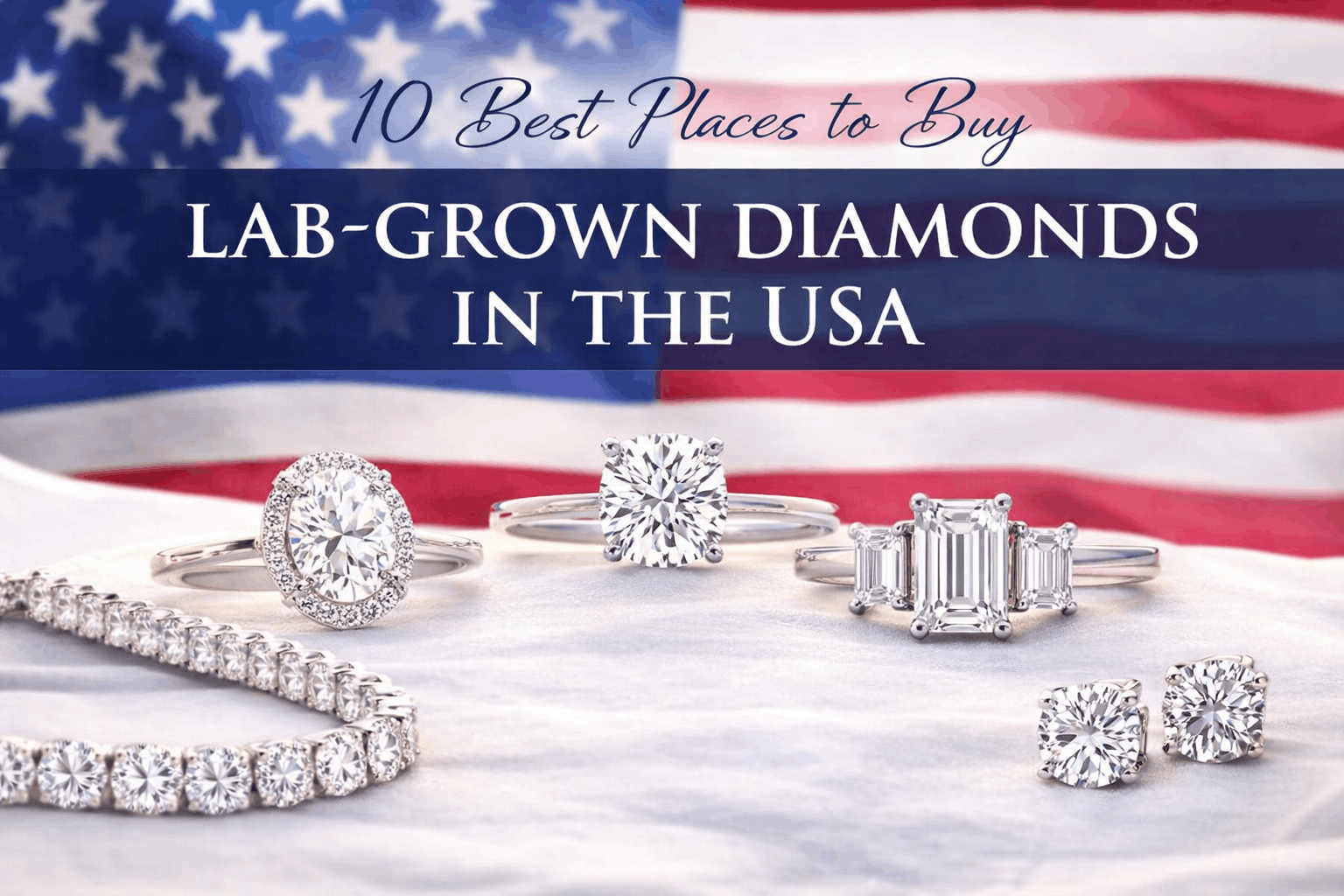
"Where you buy" matters as much as "what you buy" when it comes to lab-grown diamonds — the same certified diamond can carry wildly different pricing and service depending on which type of seller you're standing in front of.
Lab-grown diamonds are chemically, physically, and optically identical to mined diamonds — same crystal structure, same hardness, same fire and brilliance — at a fraction of the cost. That part of the pitch is settled. What's less settled, and what actually determines whether you're happy with a purchase a year later, is who you buy from.
"Buy from a trustworthy source" is easy advice and hard to act on, because "source" isn't one thing. A wholesale trade supplier, a large online retailer, a boutique lab-grown-only brand, and a neighborhood jeweler are different businesses with different pricing models, different certification practices, and different reasons to exist. Comparing them like they're interchangeable is how buyers end up either overpaying for a diamond they could have sourced at cost, or underpaying for something whose paperwork doesn't hold up.
This guide breaks the market into eight distinct channels — not eight competing brands, but eight different ways lab-grown diamonds actually move from the growing facility to your finger, ring box, or display case. For each one, we cover what it's genuinely good for, where it falls short, and who it's built for. Then we compare all eight side by side on the three things that matter most: price transparency, certification access, and who each channel is actually designed to serve.
A quick note before you start comparing: none of these eight channels is inherently more "legitimate" than another. A large online retailer isn't automatically better just because it's more familiar, and a wholesale trade supplier isn't automatically cheaper just because it skips the storefront. What separates a good purchase from a disappointing one is whether the channel you picked actually matches what you're trying to accomplish — a single engagement ring, a restocked inventory line, or a one-of-a-kind custom piece each point toward a different answer.
1. Wholesale Trade Suppliers
Wholesale suppliers sell lab-grown diamonds directly to the trade — independent jewelers, private designers, and manufacturers who are building inventory or filling custom orders, not buying a single diamond for themselves. This is a business-to-business relationship, not a retail transaction, and the pricing reflects it: because there's no consumer-facing markup layered on top, trade pricing on a comparable diamond typically runs well below what a standalone retail jeweler would quote for the same specifications.
Guru Diam operates this way. Buyers work with the supplier directly rather than through a showroom intermediary, certified diamonds carry IGI or GIA reports (lab-grown diamonds are IGI-certified), and the catalog spans everything from commodity round brilliants to fancy color melee and antique cuts that most retail channels don't stock at all. The appeal for a repeat buyer is being able to source engagement ring diamonds, matched side diamonds, and finished jewelry from one vendor instead of managing several separate supplier relationships.
This channel is best for recurring bulk purchases, matched melee and parcel goods, and category-specific inventory — fancy colors, antique cuts — that generalist retailers simply don't carry. The tradeoff is that most wholesale suppliers expect a buyer to set up a trade account rather than complete a one-click checkout, and pricing is typically quote-based rather than published on a public price list. It's the right fit for independent jewelers, custom designers, and manufacturers who buy repeatedly and want consolidated sourcing rather than a single one-off purchase — not for someone buying one diamond for personal use.
2. In-Person Diamond District Sourcing
New York's Diamond District is still the densest concentration of diamond wholesalers, cutters, and trade suppliers in the country, packed into a few blocks where a buyer can walk between multiple sources in an afternoon. For lab-grown diamonds specifically, that density means you can physically compare diamonds side by side under the same lighting before committing — something no amount of photography fully replicates, especially for fancy colors and antique cuts, where subtle differences in face-up appearance matter.
Guru Diam sources and sells out of this district, with a second office on the West Coast in Los Angeles, so buyers on either coast have an in-person option rather than working purely by phone or email. Walking in also shortens the feedback loop on custom requests — if you need a specific cut proportion, or want to see three comparable diamonds before choosing, an in-person visit resolves that in one sitting instead of several rounds of photos and messages back and forth.
The tradeoff is obvious: this channel only works if you can get to New York or Los Angeles, and even then, quality varies enormously between individual storefronts in a district that houses everyone from established wholesalers to short-term dealers — vetting who you're actually buying from still matters. This suits local jewelers, first-time bulk buyers who want to build a relationship they can revisit, and anyone purchasing a large or unusual diamond who doesn't want to commit sight-unseen. It's a poor fit for someone who just wants to order online from another state.

3. Large Multi-Brand Online Retailers
This is the channel most consumers picture first: large e-commerce platforms with tens of thousands of diamonds in inventory, searchable across every combination of carat, cut, color, and clarity, backed by HD photography or video for each individual diamond. These platforms built the modern online diamond-buying experience, and for sheer selection and browsing convenience, nothing else on this list comes close — you can filter your way to a shortlist without leaving your couch.
What that convenience costs is baked into the price. Large online retailers typically don't grow or cut their own diamonds; they buy from suppliers and wholesalers, then add the markup that funds the photography studio, the customer service team, the return-processing infrastructure, and the marketing budget that got you to their site in the first place. Certification is standard — IGI and GIA are the norm across this category — but transparency about markup varies retailer to retailer, and published prices are rarely negotiable.
This channel is a strong fit for individual shoppers who want to browse independently, value a published return policy, and aren't set up to buy trade. It's a weaker fit for anyone buying in volume, sourcing an unusual shape or fancy color, or trying to get as close to production cost as possible — that buyer is better served further down this list.
4. Boutique Lab-Grown Specialists
A newer category has grown alongside the generalist online retailers: smaller, direct-to-consumer brands that sell lab-grown diamonds exclusively, with no mined inventory at all. Because the entire business is built around one product category, these specialists tend to invest heavily in buyer education — clear explainers on the 4Cs as they apply to lab-grown diamonds, straightforward comparison charts, and customer service reps who field lab-grown questions all day rather than splitting attention across mined and lab-grown lines.
The branding usually leans minimalist and sustainability-forward, and return policies in this category tend to be generous, since a confident specialist has less to lose by giving buyers a long window to decide. Curated inventory also means less decision fatigue than a sprawling catalog — a real advantage for a first-time buyer who finds unlimited choice paralyzing rather than helpful.
The curation cuts both ways, though: selection thins out fast at unusual carat weights, fancy shapes, or fancy colors, and "direct-to-consumer" doesn't mean "at production cost" — retail overhead is still built into the price even without a mined-diamond division to support. This channel suits first-time buyers who want guidance and a simple, well-explained choice. It's not the right channel for a buyer who already knows exactly what they want and is optimizing purely for price.

5. Direct-From-Manufacturer Channels
Every lab-grown diamond eventually traces back to a facility that actually grows and cuts the rough into a finished diamond. Most of the market never talks to that facility directly — diamonds pass through one or more resellers before reaching a showroom or website. Buying direct-from-manufacturer means working with the entity doing the cutting and polishing itself, which removes a layer of markup and, more importantly, opens the door to genuine customization instead of picking from what's already on a shelf.
Guru Diam falls into this category: cutting, setting, and polishing all happen in-house, which means a buyer who wants a specific cut proportion, an antique shape like an Old Mine or Hexagonal cut, or a fancy color combination that isn't a standard catalog item can actually request it rather than settling for the closest available substitute. Custom engagement rings built this way are typically finished in 4–6 days, not the multi-week timelines common at retailers who outsource setting to a third party.
The tradeoff is that this channel doesn't offer the one-click convenience of a large retail site — you're working with a supplier, not a shopping cart, and the process involves more back-and-forth than adding an item to checkout. It's the right channel for buyers who want a diamond or setting that doesn't exist off the shelf, for jewelers who want to resell finished pieces under their own name rather than a branded box, and for anyone comparing prices against the markup layers built into other channels.
6. Jewelry Trade Shows (JCK and Beyond)
Trade shows compress months of supplier research into a few days. JCK Las Vegas is the flagship U.S. show for the jewelry trade, drawing wholesalers, cutters, and manufacturers from across the lab-grown and mined diamond markets into one convention center — a buyer can walk hundreds of booths, compare inventory and pricing side by side, and start account conversations with multiple suppliers in a single trip instead of stringing outreach out over months.
Guru Diam exhibits at trade shows such as JIS and JA New York, where returning buyers can check in on new inventory, fancy color availability, or custom cutting capacity in person. For a jeweler or designer evaluating whether to add or switch a supplier, seeing the actual diamonds and meeting the people who'll be handling the account in person carries more weight than a website ever will.
This channel only works on the show's schedule — it isn't a year-round sourcing option, and the value depends on doing homework before arriving rather than making cold decisions on the floor. It's built for retailers and designers actively building or re-evaluating their supplier relationships, not for someone shopping for a single personal diamond — that buyer should look further up this list.

7. Local Independent Jewelers
The neighborhood jeweler is the oldest channel in this list and still a meaningful one: a physical storefront that sources diamonds — usually from wholesalers, sometimes from trade shows — and adds design, setting, and service on top. For lab-grown diamonds specifically, more independent jewelers now stock or special-order them alongside mined inventory, though depth of lab-grown expertise still varies a lot from store to store.
The advantage is proximity and accountability: there's a person to walk in and talk to, a physical location for resizing or repairs down the line, and help navigating insurance appraisals that an online-only retailer can't offer in the same way. For a buyer who values an ongoing relationship with someone local, that's worth something no comparison chart captures.
The tradeoff is pricing and selection. A local jeweler's inventory is limited to what they stock or can order in, and full retail markup applies since they're adding their own margin on top of whatever they paid their supplier. This channel is best for buyers who want an ongoing local relationship and don't mind paying for it. It's a poor fit for anyone chasing the lowest possible price or an unusual diamond their local store doesn't have a line on.
8. Custom-Design Studios
Custom-design studios flip the usual order of operations: instead of picking a diamond and then a setting, you start with a designer or CAD artist and build the piece from a blank page, with the diamond sourced as part of that process rather than chosen off a shelf first. This is the channel for someone who has looked at existing ring styles and not found the one they want to propose with.
Some wholesale suppliers, Guru Diam included, offer this directly rather than requiring a separate design studio relationship — the same supplier that sources the diamond can also render, cut, set, and finish the piece in-house, which keeps the design conversation and the diamond sourcing under one roof instead of coordinating between two separate businesses. That consolidation tends to matter most for buyers with a specific vision: a particular antique cut, an unusual metal treatment, a family diamond reset into a new design.
Jewelers who want this under one account can start with our custom jewelry manufacturing for jewelers: a CAD within 24 hours and a finished piece 4–6 working days after approval. For how to judge a manufacturing partner in New York, see our NYC custom jewelry manufacturer guide, and for the wider trade picture, our guide to the best custom jewelry manufacturers for the wholesale trade.
The tradeoff is cost and process: custom work costs more than an off-the-shelf setting, and it requires a real consultation rather than an instant checkout. This channel is built for buyers who want something genuinely one-of-a-kind and are willing to invest the time in getting there. It's overkill for someone who's happy with a well-made standard setting and just wants to order and move on.
How the Eight Channels Compare
No single channel is "best" independent of what you're trying to do — a jeweler restocking melee and a first-time buyer picking a single engagement ring diamond should not be shopping the same way. The table below lines up all eight channels on the three factors that matter most: how transparent pricing is before you commit, how consistently certification is available, and who each channel is actually built to serve.
| Channel | Price Transparency | Certification Access | Best Buyer Type |
|---|---|---|---|
| Wholesale trade suppliers | Quote-based; trade pricing isn't published publicly | IGI and GIA standard | Jewelers, designers, manufacturers |
| In-person Diamond District sourcing | Negotiable; varies by individual dealer | Varies — confirm before buying | Buyers who want to inspect diamonds in person |
| Large multi-brand online retailers | Published, filterable pricing | IGI and GIA typically included | Individual consumer shoppers |
| Boutique lab-grown specialists | Published direct-to-consumer pricing | IGI and GIA typically included | First-time buyers wanting guidance |
| Direct-from-manufacturer | Lower markup; typically quote-based | IGI and GIA available | Buyers wanting custom cuts or margin control |
| Jewelry trade shows (JCK) | Negotiated on the show floor | Varies by exhibitor | Retailers and designers building supplier relationships |
| Local independent jewelers | Full retail markup applies | Depends on the store's own sourcing | Buyers wanting an ongoing local relationship |
| Custom-design studios | Project-based quote | IGI and GIA on the diamond itself | Buyers wanting a one-of-a-kind piece |
A few patterns stand out. Certification is close to universal across every legitimate channel at this point — IGI and GIA paperwork should be treated as a baseline requirement, not a selling point, no matter which channel you're using. Price transparency splits much more cleanly along one line: channels built around a published catalog (large retailers, boutique specialists) show you a number upfront, while channels built around a direct trade relationship (wholesale suppliers, direct-from-manufacturer, trade shows) trade that upfront number for a lower quoted price once you actually engage. Neither approach is wrong; they're built for different buyers.
Buyer type follows a similar split. Channels built for individual consumers optimize for browsing, education, and reassurance — return windows, chat support, HD video. Channels built for the trade optimize for repeat business and depth of catalog instead, which is why a wholesale supplier can carry antique cuts and fancy color melee that never show up on a generalist retail site: the assortment is built for buyers who order again next quarter, not for a one-time purchase.
FAQs: Sourcing Lab-Grown Diamonds
What are the best places to buy lab-grown diamonds in 2026?
The best places to buy lab-grown diamonds in 2026 fall into a few channel types: established wholesale trade suppliers for jewelers and designers buying in volume, boutique lab-grown specialists for curated selection, direct-from-manufacturer channels for the tightest margins, and reputable local or custom-design studios for finished pieces. Trade buyers get the most consistent value and inventory access through an established wholesale supplier offering same-day shipping and multiple certification options.
Are lab-grown diamonds real diamonds?
Yes. Lab-grown diamonds are chemically, physically, and optically identical to mined diamonds — the same crystal structure, the same hardness on the Mohs scale, and the same fire and brilliance. The only difference is origin: one formed underground over a long span of time, the other formed in a controlled growing environment. Gemologists need specialized equipment to tell them apart; the naked eye can't.
Will a lab-grown diamond lose value over time?
Resale value on lab-grown diamonds tends to run lower than on mined diamonds, mainly because lab-grown production keeps scaling and per-carat prices have been trending down industry-wide — the opposite of a scarcity-driven market. That mostly matters if resale is part of your plan. Most buyers choose lab-grown specifically to get more diamond for the budget and treat it as jewelry to wear, not an investment vehicle.
How much can I typically save buying lab-grown instead of mined?
Savings in the 30–40% range on a comparable diamond — matched carat, cut, color, and clarity — are common across the market, though the exact number depends on the specific diamond and which channel you're buying through. Wholesale and direct-from-manufacturer channels generally land at the lower end of that range, since fewer markup layers sit between the grower and the buyer.
Do I need a trade account to buy from a wholesale supplier?
Usually, yes. Wholesale suppliers are built around recurring trade relationships with jewelers, designers, and manufacturers, and most expect a buyer to set up an account rather than complete a single anonymous checkout. If you're an individual buyer interested in trade pricing, it's worth asking directly whether the supplier accommodates retail orders — some do alongside their wholesale business.
What's the difference between IGI and GIA certification?
Both are independent gemological laboratories that grade diamonds on the same core factors — carat, cut, color, and clarity — and both certify lab-grown diamonds as clearly labeled lab-grown. They differ mainly in grading methodology and regional recognition; neither certificate makes a diamond "more real" than the other. What matters is that the diamond you're buying has one of them, not which one specifically.
Should I buy in person or online?
Both are legitimate, and plenty of buyers do both in sequence — research and compare specifications online, then finalize the purchase in person once they've narrowed down what they want, or the reverse, viewing diamonds in person before placing a custom or larger order remotely. The right approach depends on how much you trust photography and video alone for a purchase this size, and whether an in-person channel is geographically realistic for you.
The Bottom Line
There's no universal "best place" to buy a lab-grown diamond — there's a best channel for what you're actually trying to do. A jeweler restocking calibrated melee needs a wholesale trade relationship, not a consumer-facing website. A first-time buyer picking one engagement ring diamond is often better served by a boutique specialist or a large online retailer with a clear return policy. A designer chasing an antique cut that doesn't exist on anyone's shelf needs a direct-from-manufacturer relationship willing to cut to order.
Start by being honest about which of those you are, then match the channel to it. Whichever channel you choose, treat IGI or GIA certification as non-negotiable, get the same 4C specifications in writing before comparing prices across sources, and don't mistake a lower sticker price for a better deal until you know what's actually included — setting, warranty, and service can vary as much as the diamond does.