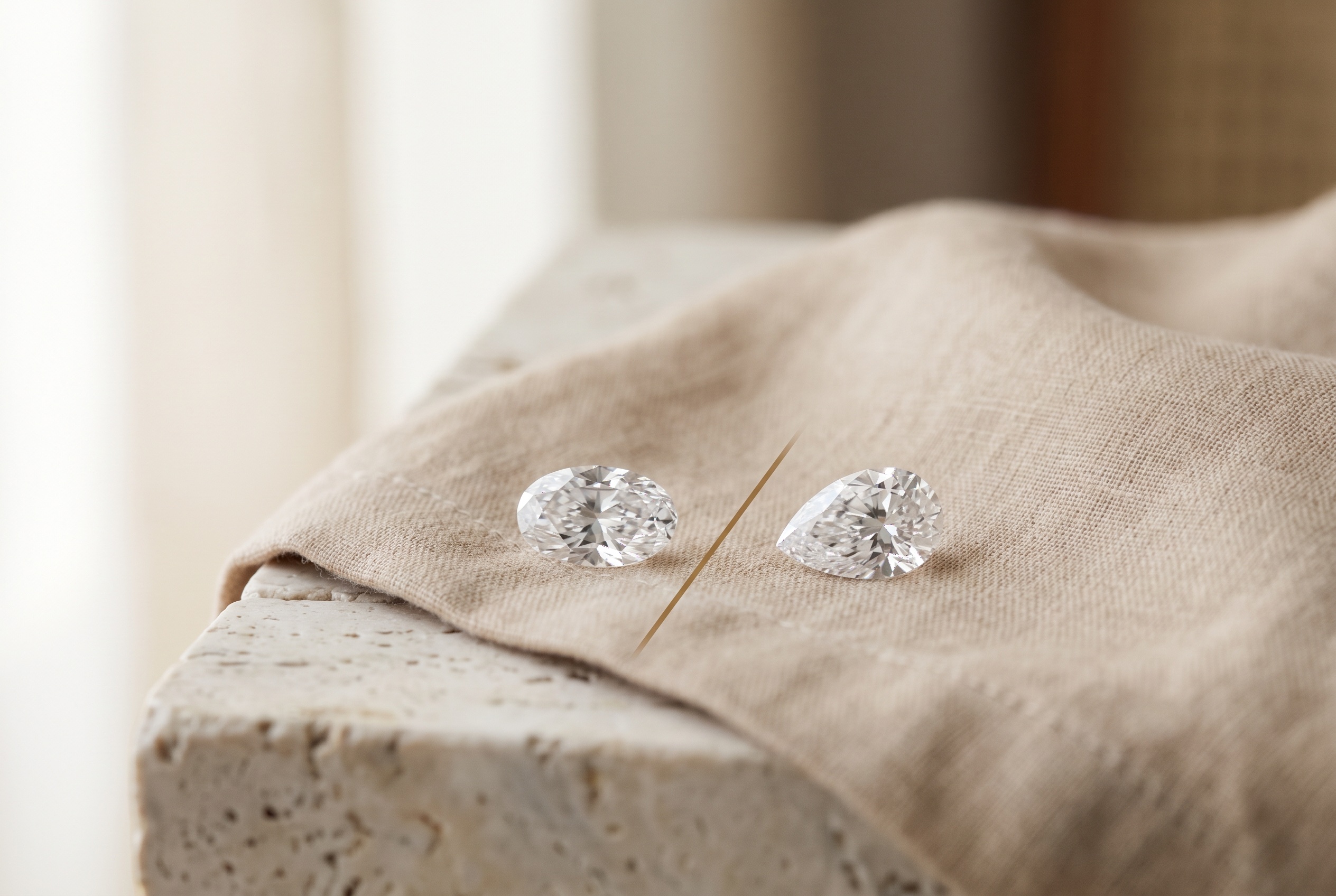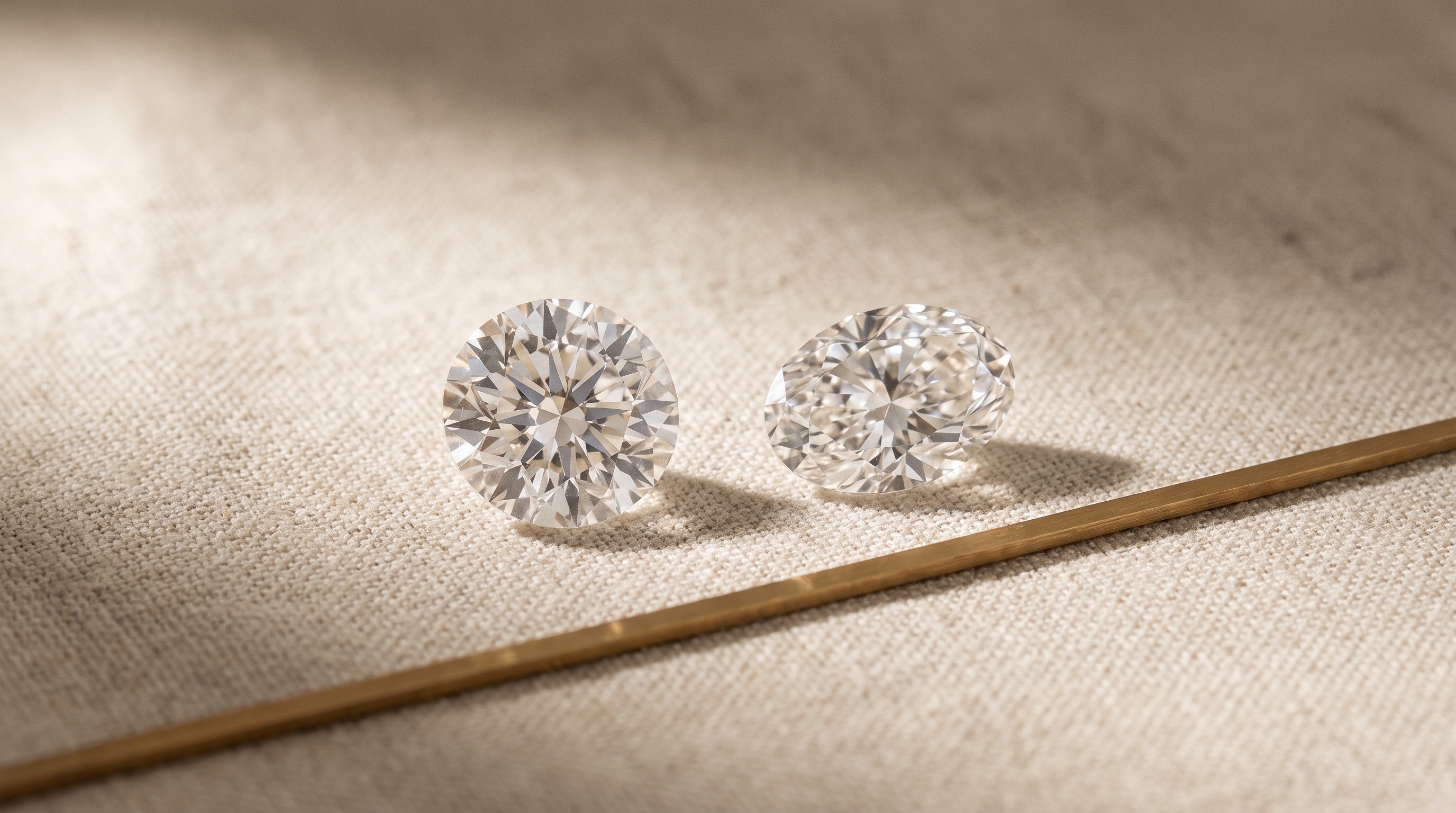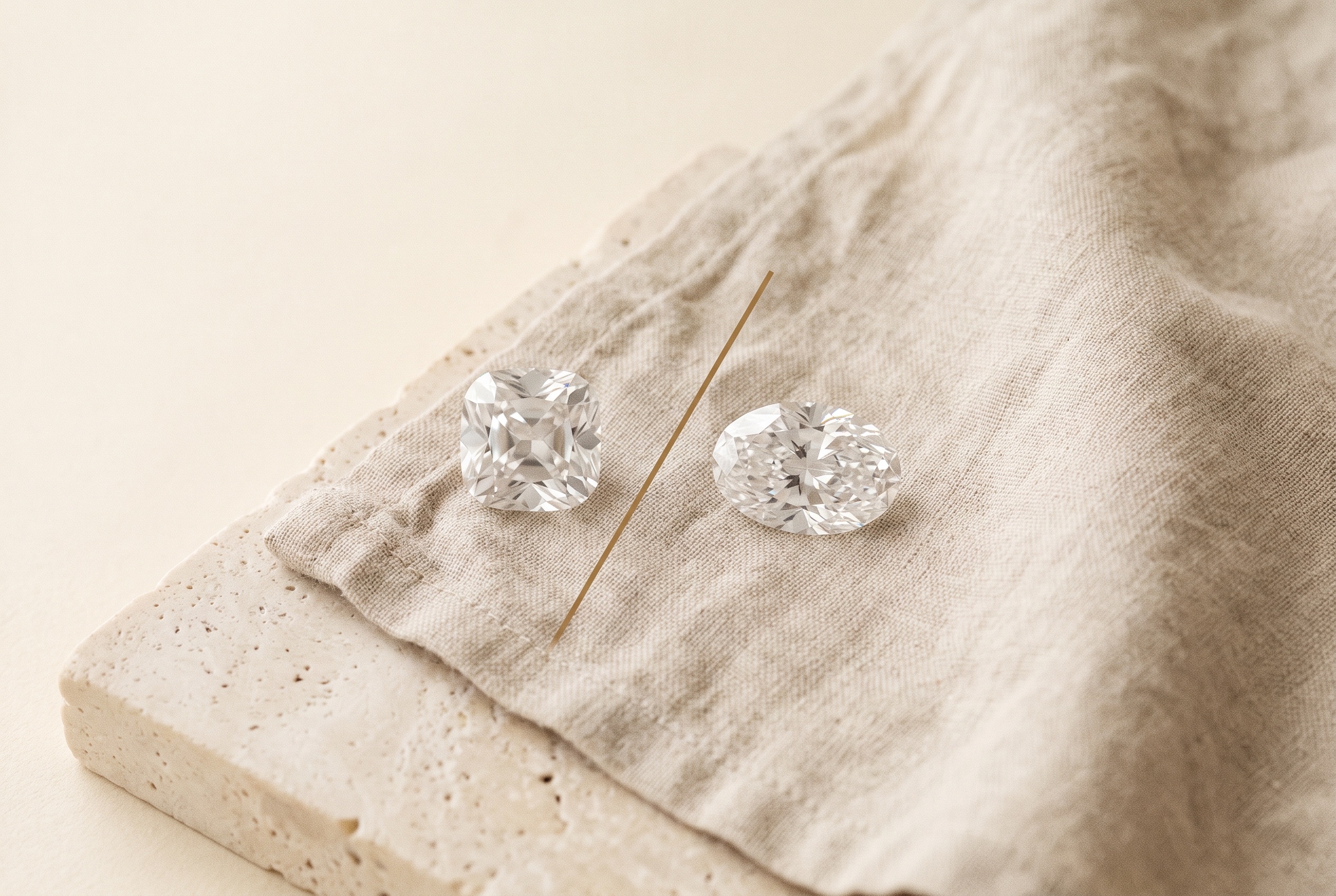

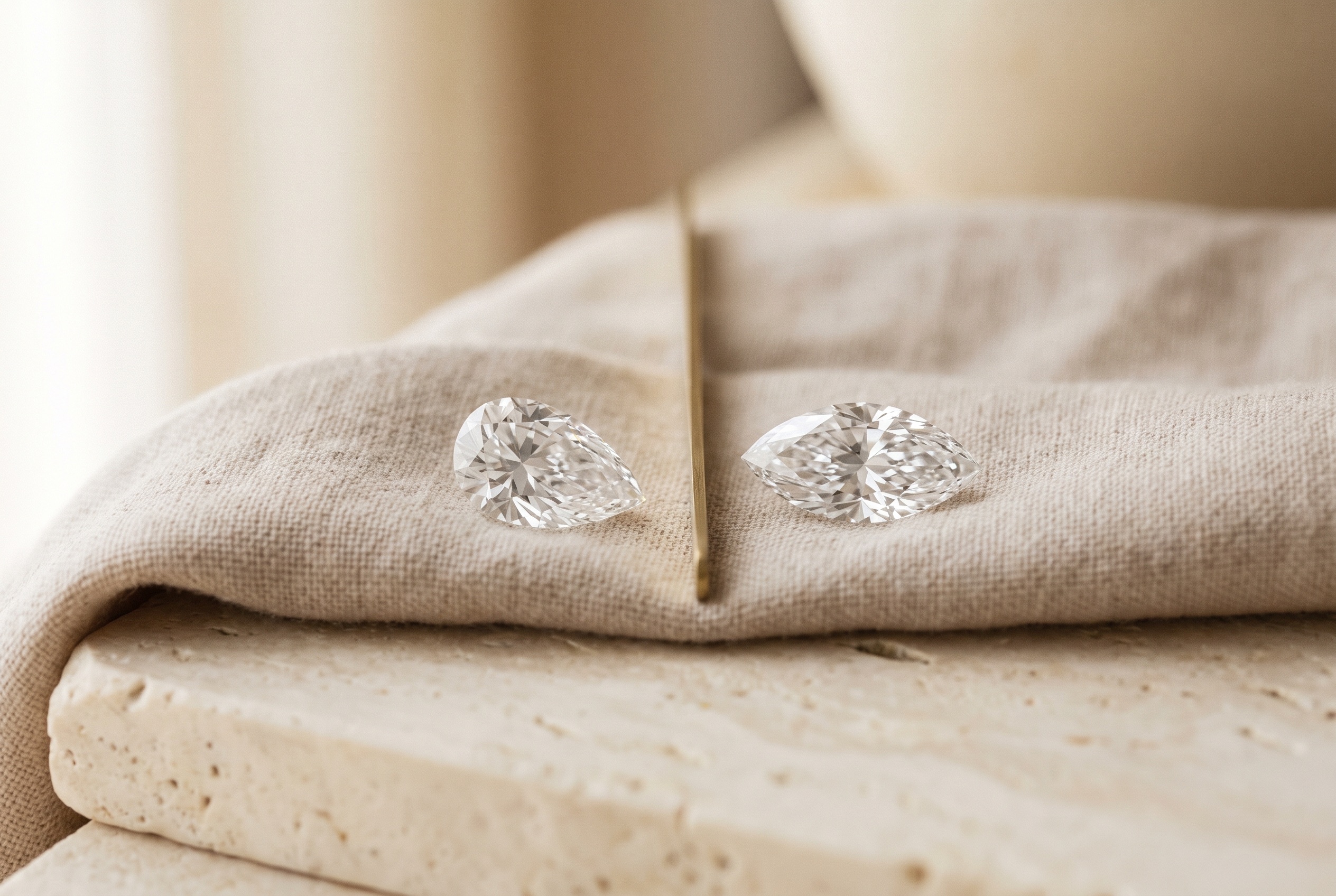
What Is a Pear Cut Diamond?
Pear cut combines the facet structure of a round brilliant with the tapering point of a marquise, ending in a single rounded curve at one end and a single sharp point at the other — hence its trade nickname, "teardrop." It's typically cut with around 58 facets, the same count as a standard round brilliant, adapted to the asymmetric outline. That single point is what makes pear so functional beyond rings. Worn point-down in a ring, it elongates the finger the way any elongated shape does. But the rounded end also gives it a natural place to attach a bail or setting for a pendant, which is a big part of why pear shows up constantly in drop earrings and necklaces, not just engagement rings. It's a shape that does double duty across a full jewelry line rather than being a ring-only cut.What Is a Marquise Cut Diamond?
Marquise is the older of the two shapes, and the trade lore around it is worth knowing even if it's unverifiable folklore rather than fact: the cut is popularly said to have been commissioned by King Louis XV to echo the smile of the Marquise de Pompadour, and the French nickname "navette" — little boat — describes the same elongated, symmetric outline with a point at each end. Where pear tapers to a point on only one side, marquise is fully symmetric along its long axis — two matching points, no rounded end. That symmetry is exactly what gives marquise its dramatic, statement-piece character: there's no "soft" side to the shape, which is why it reads as bolder and more vintage-coded than pear, and why it's a go-to for cocktail rings, eternity bands, and other pieces meant to be noticed.Pear vs Marquise at a Glance
| Pear | Marquise | |
|---|---|---|
| Visual character | Teardrop — one pointed end, one rounded end | Navette/boat shape — two pointed ends, fully symmetric |
| Light performance | Balanced brilliance with a softer flash at the rounded end | Strong brilliance across the full length; more contrast near the points |
| Price tier | Regular fancy / mid-market | Regular fancy / mid-market |
| Best for | Versatile — rings, pendants, and drop earrings | Statement rings, vintage-inspired and dramatic designs |
Shape and Silhouette: One Point vs Two
The single clearest way to tell these shapes apart at a glance is point count — pear has one, marquise has two. That difference drives how each shape is graded for symmetry, too. A well-cut pear needs its point centered on the long axis with even "wings" on either side of the curve; a well-cut marquise needs both points aligned exactly on the center line, since any deviation reads immediately in a symmetric shape with nothing to visually balance it. Both shapes are typically stocked in a length-to-width ratio between roughly 1.50 and 1.75, which is the range most buyers associate with a classically elongated look. Ratios outside that range exist — more elongated for a dramatic, narrow look, or closer to 1.3–1.4 for a fuller, rounder appearance — and it's worth stocking a small range of ratios in both shapes rather than a single default, since customer preference varies more on this dimension than on almost any other. There's a technical detail worth knowing when evaluating either shape in person: the keel line, the ridge running along the bottom of the pavilion where the facets meet. On a well-cut pear or marquise, the keel line runs perfectly straight down the center. If it's off-center or curved, the stone will look visibly tilted or lopsided face-up even when the certificate's stated symmetry grade looks fine on paper — it's one of the fastest visual checks for catching a poorly cut stone in either shape before it goes into a customer's hands.Light Performance and Sparkle
Both pear and marquise use a modified brilliant facet pattern, so overall fire and scintillation are comparable between them. The difference is in how that sparkle distributes across the stone. Pear's rounded end produces a softer, more even flash, while the point stays comparatively quiet — light performance is balanced across the shape rather than concentrated. Marquise, by contrast, concentrates more visual energy near its two points, where the facets meet at sharper angles and light exits at a wider range of angles. That's part of what gives marquise its more dramatic presence — the sparkle reads as more active and more attention-grabbing across the full length of the stone, which suits its role as a statement shape.Color and Clarity: What to Watch For at the Points
Both shapes carry a buying consideration that round and squarer shapes mostly avoid: color and inclusions can concentrate visibly near the points. Light travels through more material at a pointed tip than it does through the broader body of the stone, which means faint body color can look slightly more saturated right at the point even when the overall color grade is the same across the whole stone. It's a subtle effect, but it's the reason many wholesale buyers stock pear and marquise a half-grade higher in color than they would a round or cushion of the same target price. Inclusions matter here too, for a different reason — a stone with an inclusion positioned near either point is a much bigger durability and appearance risk than the same inclusion sitting safely in the body of the stone, since it sits closest to the most stressed, most exposed part of the cut. Reviewing an inclusion plot alongside the clarity grade, not just the grade number alone, is worth the extra minute on any pear or marquise lot before it goes into inventory.Elongation and "Looks Bigger" Carat Effect
Both shapes are popular specifically because elongated outlines create a larger face-up appearance than a round or square stone of the same carat weight — a well-known selling point worth reinforcing with customers who are carat-weight-conscious on a budget. Between the two, marquise typically carries the highest length-to-width ratio of any shape commonly stocked in a wholesale case, which means it usually delivers the largest apparent size per carat of any fancy shape available. If a customer's priority is maximizing visual size within a set budget, marquise is usually the strongest recommendation you can make. Pear delivers a similar elongation effect, though slightly less pronounced than marquise at equivalent carat weight, since one end of the stone curves back in rather than tapering to a matching point. It's still a meaningfully bigger-looking shape than round or cushion at the same weight — just not quite marquise's ceiling.The Bow-Tie Effect: What Buyers Need to Know
This is the genuine tradeoff worth flagging honestly to any customer considering either shape. Elongated fancy cuts — pear, marquise, oval, and elongated cushion — are prone to a "bow-tie": a dark shadow crossing the center of the stone, caused by light leaking out through the pavilion at the pointed ends instead of reflecting back up. It's more commonly visible in marquise, since both ends taper to a point and both can leak light, whereas pear's single rounded end limits the effect to one side of the stone. The fix is proportion quality, not shape avoidance. A well-cut stone with correctly angled pavilion facets at the points will show little to no visible bow-tie in either shape. The practical buying guidance: review face-up video or photos on any pear or marquise lot before committing, rather than relying on the certificate alone — clarity and color grades don't capture bow-tie visibility, and it's the single biggest quality variable buyers overlook on these two shapes specifically. This is also where it helps to understand what a grading certificate does and doesn't cover on either shape. GIA reserves an overall cut grade for round brilliant only — pear and marquise certificates report polish and symmetry individually, but there's no single "Excellent to Poor" score standing in for overall light performance the way there is on round. That's precisely why bow-tie and keel-line issues can exist on a stone with strong individual grades across the board, and why a buyer sourcing pear or marquise sight-unseen off a certificate alone is taking on real risk that a quick look at face-up imagery would remove.Versatility: Rings, Pendants, and Earrings
This is where the two shapes diverge most for a wholesale buyer building out a full case. Pear's rounded end gives it a natural hang point, which is exactly why it's the more versatile shape across product categories — rings, pendants, and especially drop earrings, where a matched pair of pear-shaped stones is one of the most consistently requested earring formats in the trade. Marquise, with points on both ends, doesn't have that same natural drop or hang point, which limits its practical use mostly to rings and other set-in-place pieces like eternity bands or cocktail rings rather than pendants and earrings. That's not a downside — it's simply a different lane. If your case is built around versatility across a full jewelry line, weight pear more heavily; if it's built around statement rings and dramatic vintage-inspired pieces, marquise earns its shelf space there. Both shapes also work well as side stones flanking a round or cushion center in a three-stone ring, a design that's stayed consistently popular because it lets a customer combine two shape personalities in one piece. A pair of pear side stones set point-in toward the center is the more common configuration and reads as softer overall, while marquise side stones add a sharper, more architectural frame around the center stone. Toi-et-moi styling — two stones of different shapes set side by side rather than in a traditional solitaire — is another current trend where pear and marquise both show up frequently, often paired against each other or against a round or oval center.Setting Styles and Prong Protection for Points
Pointed corners are the most vulnerable part of any diamond, and both shapes need setting choices that account for it. Pear typically needs a V-prong or a protective bezel tip at its single point, with the rounded end handled by standard prongs. Marquise needs the same protection at both ends — commonly a five-prong setting with V-prongs at each tip, since an unprotected marquise point is genuinely more prone to chipping during everyday wear than almost any other shape in the regular fancy tier. One current setting trend worth knowing for both shapes: east-west settings, which rotate the stone horizontally instead of the traditional north-south orientation. It's especially popular right now with pear, giving a familiar shape a noticeably modern look without changing the stone itself — a useful upsell conversation for customers who want something distinctive without paying antique-tier pricing. Hidden-halo settings — a halo tucked beneath the crown rather than surrounding it visibly — work well on both shapes too, adding perceived size and sparkle without competing with the elongated silhouette the customer chose the shape for in the first place. On metal, platinum and white gold remain the safer default for both shapes since they sharpen the visible contrast at the points, though yellow gold pairs well with marquise specifically for customers leaning into the shape's vintage, statement-piece character.Durability for Everyday Wear
If a customer specifically asks which shape holds up better day to day, the honest answer is that marquise needs more careful setting and more frequent prong checks. Two exposed points instead of one means twice the risk of a chip catching on fabric, a car door, or a workout, which is exactly why the V-prong or bezel-tip protection covered above isn't optional on marquise the way it might feel optional on other shapes. Pear splits the difference — one protected point to worry about instead of two, with the rounded end behaving essentially like any round-brilliant edge in terms of durability. For customers with active jobs or lifestyles who still want an elongated, dramatic shape, that single-point risk profile is a genuine reason to recommend pear over marquise, separate from styling preference. Either way, both shapes benefit from a prong check at routine jewelry cleanings, since a loosened prong at a point is the most common way either stone actually gets damaged.Price Tier and Wholesale Buying Considerations
Pear and marquise both sit in the regular fancy tier alongside radiant, cushion, and oval — mid-market pricing, not antique-premium and not round's commodity pricing. Per-carat pricing between the two shapes runs broadly comparable at matched carat, color, and clarity, and elongated shapes generally make efficient use of rough, which is part of why both are practical shapes to stock across a wide carat range rather than reserving for a handful of hero pieces. CVD lab-grown sourcing keeps both shapes accessible across the full range wholesale buyers typically need — from smaller accent and side-stone sizes up through 3-carat-plus center stones — without the supply constraints and price premiums that come with natural-diamond equivalents in the same size and grade combinations.How to Stock and Order Pear and Marquise Diamonds from Guru Diam
If you're ready to fill a case or a specific customer order, here's what's actually available. Guru Diam is a trade-only wholesale supplier carrying pear and marquise across the full carat, color, and clarity range, as part of a catalog that covers every standard, antique, and exotic diamond shape — so you're not sourcing these two shapes from one vendor and everything else from another. All lab-grown stones are CVD-grown only, with IGI, GIA, and GCAL certification available so you can match certification to exactly what your customer is asking for. In-stock pear and marquise inventory ships same-day — before 6pm EST out of our New York headquarters and before 4pm PST out of our Los Angeles office — which matters most on this pair of shapes, since matched pairs for earrings and time-sensitive custom orders don't have room for a multi-day wait. If the stone is going into a custom engagement ring, finished pieces are ready in 4–6 days, unbranded by default so you resell it as your own. Cutting, setting, and polishing all happen in-house, backed by more than 2,000 active trade accounts and now in our fifth consecutive year exhibiting at JCK. Both shapes are carried across the full carat range wholesale buyers actually order against — small calibrated accents through multi-carat statement centers — in a spread of length-to-width ratios rather than one default cut. Matched pear pairs for earrings are sized and graded together for consistency before they ship, so a drop-earring order arrives as a true pair rather than two stones that happen to be close. If you have a specific carat, color, clarity, or ratio combination in mind, our trade team can confirm availability directly rather than making you dig through listings. Ready to order or check current pear and marquise inventory? Start at the wholesale hub to browse in-stock stones, apply for account access through trade partner, or go straight to certified diamonds to filter by shape, carat, and certification. Building a drop-earring or side-stone program around pear? Matching pairs has calibrated sets ready to ship. Need either shape set into a ring? Custom jewelry turns finished pieces around in 4–6 days. And if your customers are also asking about softer, rounded-square shapes, our radiant vs cushion diamond guide covers that comparison in the same depth.Frequently Asked Questions
Which is more expensive, a pear or marquise diamond?
Neither shape commands a consistent premium over the other — both sit in the same regular fancy, mid-market price tier, and per-carat pricing runs broadly comparable at matched carat, color, and clarity. The bigger price variable on either shape is cut quality, since a poorly proportioned stone with visible bow-tie sells for less regardless of shape.
Why do marquise diamonds look bigger than other shapes?
Marquise typically has the highest length-to-width ratio of any commonly stocked fancy shape, which spreads the same carat weight across more visible surface area than a round, cushion, or even pear cut of equal weight. That's why it's often the strongest recommendation for customers prioritizing apparent size on a set budget, though pear delivers a similar, slightly smaller elongation effect.
Does a pear cut diamond need a special setting?
Yes — the single point needs a protective V-prong or bezel tip, since it's the most vulnerable part of the stone. The rounded end can typically be held with standard prongs, which is part of why pear is considered easier to set than marquise, which needs point protection on both ends.
What does the "bow-tie effect" mean on a pear or marquise diamond?
It's a dark shadow that can appear across the center of an elongated diamond, caused by light escaping through the pavilion near the pointed ends instead of reflecting back to the eye. It's more common in marquise, which has two points, than in pear, which has only one — and a well-proportioned stone minimizes or eliminates it in either shape.
Can I order matched pear or marquise diamonds for earrings?
Yes. Pear is the more commonly requested shape for matched drop-earring pairs given its natural hang point, and calibrated matched pairs in both shapes are available through Guru Diam's wholesale catalog for buyers building out an earring or side-stone program.
Are pear and marquise diamonds available lab-grown and certified?
Yes. Both shapes are stocked as CVD lab-grown loose stones with IGI, GIA, and GCAL certification available, across the full carat, color, and clarity range, with in-stock inventory shipping same-day.