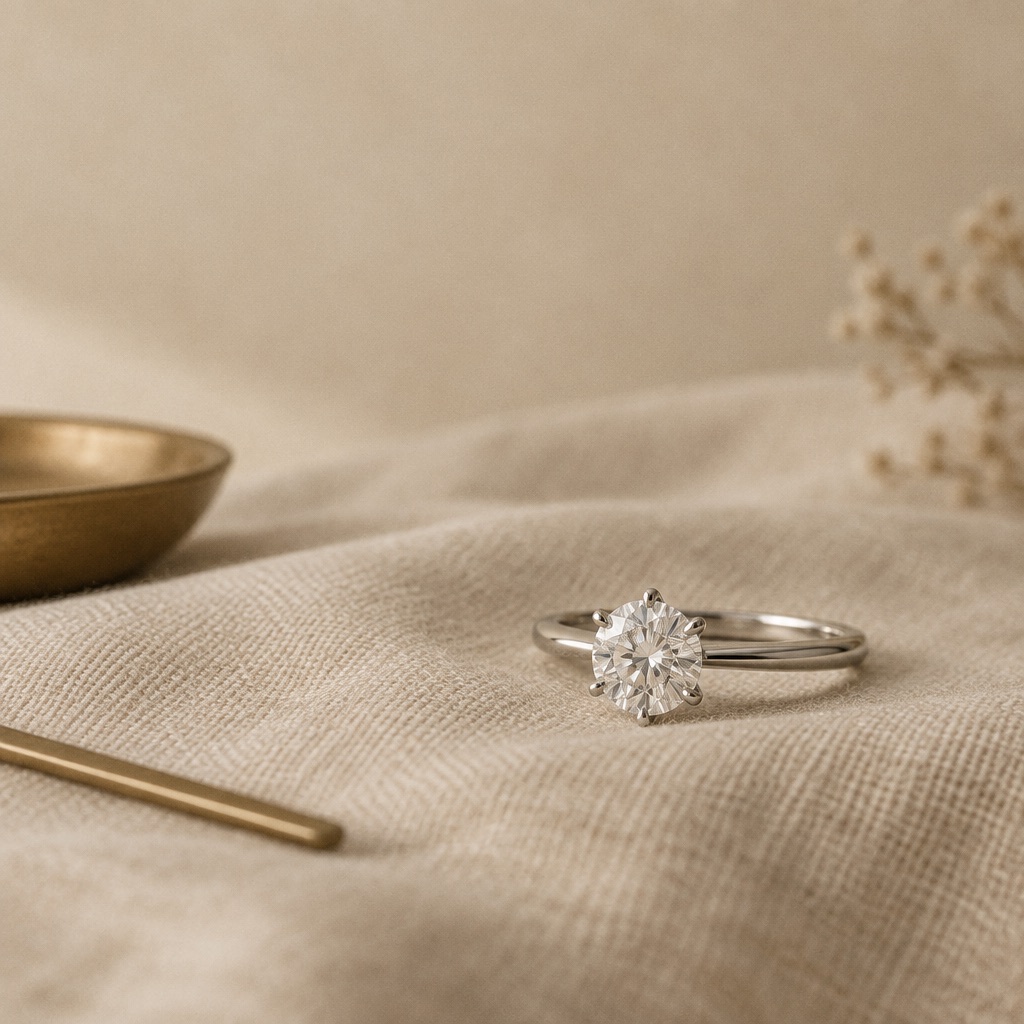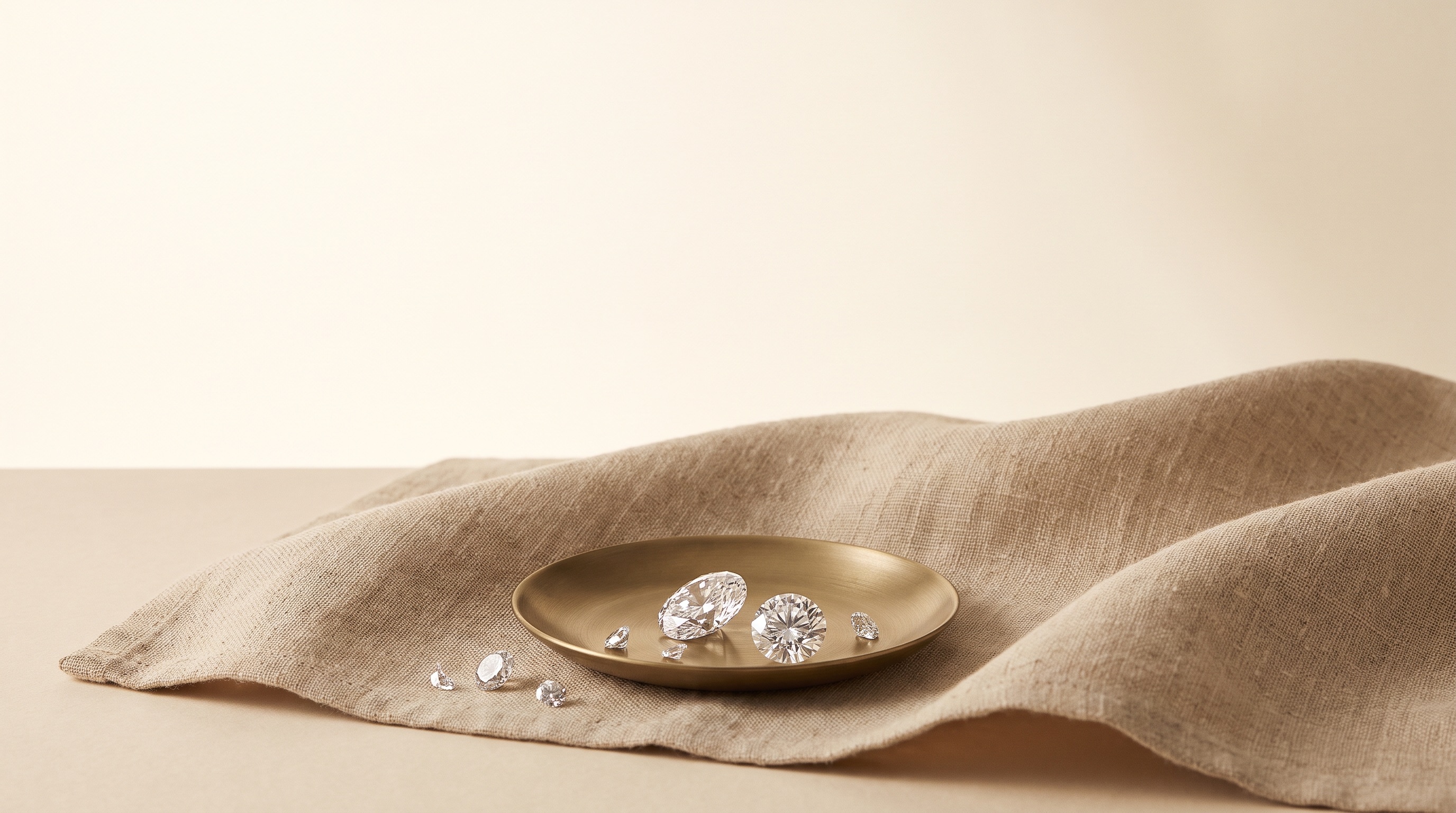
A round diamond is a circular brilliant cut with roughly 58 facets engineered specifically to maximize light return, making it the industry benchmark for fire and scintillation, while an oval diamond is an elongated brilliant cut that shares the round's facet logic but stretches it into a lengthened silhouette, trading a small amount of light performance for a larger face-up appearance per carat and a distinctive, elongated look on the hand.
This guide compares the two cuts on the dimensions that actually matter to a wholesale buyer: light performance, the oval's bow-tie effect and how to evaluate it, carat efficiency, clarity and color forgiveness, pricing, and how each cut performs across different retail customer segments.
Oval vs. Round: Quick Comparison
| Round Brilliant | Oval | |
|---|---|---|
| Facet count | ~58 facets, standardized | ~56-64 facets, brilliant-style, elongated |
| GIA cut grade | Assigned (Excellent through Poor) | Not assigned a standard numeric cut grade (fancy shape) |
| Light performance | Maximum, industry benchmark | Strong, slightly less concentrated than round |
| Face-up size per carat | Standard reference point | Appears larger due to elongated outline |
| Rough yield / waste | Lower yield — most waste of any shape from octahedral rough | Higher yield — less rough wasted |
| Known visual issue | None specific to shape | Bow-tie effect (a shadow across the center) |
| Price relative to round | Reference point, typically highest per-carat price of any shape | Typically 10-25% less per carat at comparable grades |
Why Round Brilliant Commands a Premium
Round brilliant is the most extensively studied and optically optimized diamond cut in the trade, with facet angles and proportions refined over more than a century of research (most famously Marcel Tolkowsky's 1919 mathematical analysis of ideal proportions) specifically to maximize brightness, fire, and scintillation. That optimization comes at a material cost: cutting a round brilliant from typical octahedral rough diamond crystal wastes more of the original rough than almost any other shape, since a circle inscribed inside an octahedral crystal leaves substantially more material on the cutting-room floor than an elongated shape would.
That lower yield is the primary driver behind round brilliant's higher per-carat price relative to fancy shapes at comparable grades — a cutter recovers meaningfully less finished carat weight from the same rough, and that lost yield gets priced into the finished stone. Buyers sometimes assume round's premium reflects superior quality; it more accurately reflects cutting economics and sustained consumer demand for the shape, which together keep round brilliant the most expensive cut per carat in the wholesale market.
The Oval's Elongation Advantage
Because an oval diamond stretches a round brilliant's proportions into an elongated outline rather than a circle, it fits more efficiently inside typical rough diamond crystal shapes, translating to meaningfully higher rough-to-polished yield than round brilliant. That efficiency, combined with oval carrying less inherent "brand premium" in consumer demand than round, is the primary reason oval diamonds typically price 10-25% lower per carat than a comparable-grade round brilliant.
The elongated outline itself also does visual work a circular shape can't: an oval reads larger face-up than a round brilliant of the same carat weight, because it spreads its surface area lengthwise across the finger rather than concentrating it into a compact circle. For a buyer optimizing for maximum visual size per dollar spent, this combination of lower per-carat pricing and larger face-up appearance is oval's single biggest selling point over round.
Light Performance Compared
Round brilliant remains the reference standard for light return, and a well-cut round brilliant at Excellent or Very Good cut grade delivers more concentrated brightness and fire than almost any fancy shape can match, including oval. Cut grade is a formal, GIA-assigned metric for round brilliant specifically — no equivalent standardized numeric cut grade exists for oval or other fancy shapes, which makes reviewing actual photos or video of an individual oval stone considerably more important than it is for a round, where the printed cut grade alone tells a buyer most of what they need to know.
A well-proportioned oval still performs strongly — it uses the same brilliant faceting logic as round, just stretched — but the elongation itself introduces the shape's one well-known optical quirk, covered next, which round brilliant simply doesn't have to contend with.
The Bow-Tie Effect, Explained
A bow-tie effect is a dark, shadowed area running across the center of an elongated brilliant-cut diamond — oval, marquise, and pear cuts are all susceptible — caused by the viewer's own head and shoulders blocking light from reaching that part of the stone at typical viewing angles, combined with facet arrangement that doesn't fully compensate for it. Round brilliant, having no elongation, simply doesn't produce this effect; it's a structural consequence specific to elongated shapes.
A mild bow-tie is present to some degree in essentially every oval diamond and generally isn't considered a defect — trade buyers treat a faint bow-tie as normal and even expected. A pronounced, dark bow-tie that dominates the stone's face-up appearance, however, does meaningfully reduce a stone's visual appeal and should be evaluated directly from video or in person before a wholesale purchase, since it's not something a standard grading report captures or discloses. Well-cut ovals from experienced cutters minimize bow-tie through careful facet angle and length-to-width ratio choices; buyers sourcing oval inventory at scale should factor bow-tie severity into their internal quality review process the same way they'd review any other shape-specific optical characteristic.
Length-to-Width Ratio: A Key Oval Spec
Unlike round brilliant, which has essentially one silhouette, oval diamonds come in a meaningful range of length-to-width ratios, from a rounder, more compact oval (roughly 1.3:1) to a noticeably slender, elongated oval (1.5:1 or higher). This ratio is a matter of buyer and retail-customer preference rather than a quality metric, but it materially affects both the stone's look and its susceptibility to bow-tie — more elongated ovals tend to show a slightly more pronounced bow-tie than rounder ones, all else equal.
| Length-to-Width Ratio | Visual Character |
|---|---|
| 1.30 - 1.40 | Rounder, more compact oval — closer visually to a rounded rectangle |
| 1.40 - 1.50 | Classic, balanced oval — the most commonly requested range |
| 1.50 - 1.65+ | Slender, elongated oval — a distinctive, fashion-forward look |
Clarity and Color: How Forgiving Is Each Cut?
Round brilliant's dense, multi-directional faceting does significant visual work hiding small inclusions and body color, making it one of the more forgiving shapes at a given clarity or color grade. Oval, sharing the same brilliant faceting logic, is similarly forgiving through most of the stone, though the elongated shape does concentrate a bit more visible surface area near the pointed ends, where inclusions can occasionally be marginally more noticeable than in a round of the same clarity grade.
Neither cut requires the meaningfully higher clarity or color floor that a step-cut shape like emerald does — both round and oval buyers can typically source comfortably at SI1 or a clean SI2 clarity and H-I color for a face-up eye-clean result at mainstream price points, a real advantage over step cuts for buyers optimizing cost per carat against visual quality.
Carat Weight and Face-Up Size
Because oval spreads its mass lengthwise, it consistently reads larger face-up than a round brilliant of identical carat weight — a widely cited rule of thumb in the trade is that a well-cut oval can appear roughly 10-15% larger face-up than a round of the same weight, though the exact figure depends on the oval's specific length-to-width ratio and depth proportions.
| Carat Weight | Round Brilliant — Approx. Diameter (mm) | Oval — Approx. Face-Up (mm) |
|---|---|---|
| 1.00 ct | 6.4 | 7.7 x 5.7 |
| 1.50 ct | 7.4 | 8.8 x 6.5 |
| 2.00 ct | 8.1 | 9.7 x 7.1 |
| 3.00 ct | 9.3 | 11.1 x 8.2 |
Retail Positioning and Settings
Round brilliant remains the default choice for a wide swath of buyers who want the safest, most universally recognized engagement ring look, and it pairs with essentially any setting style without any shape-specific quirks to manage. Oval has grown substantially as a fashion-forward alternative over the past several years — driven in part by celebrity engagement rings — appealing to buyers who want a distinctive, elongated silhouette and the larger face-up appearance per carat, while still keeping the brilliant-cut sparkle that a step cut like emerald doesn't offer.
Oval pairs especially well with a hidden halo or a subtly tapered baguette three-stone design, both of which help visually balance the elongated shape and can soften a pronounced bow-tie if present. Retailers stocking oval should expect more customer questions about the bow-tie effect than about any comparable round brilliant characteristic, and having clear, honest language ready to explain it (as a normal characteristic of elongated cuts, not a defect) heads off avoidable return requests.
Sourcing Oval and Round Diamonds Wholesale
Round brilliant remains the highest-volume, most consistently stocked shape in Guru Diam's wholesale catalog, available in CVD lab-grown and natural material with IGI, GIA, and GCAL certification. Oval inventory is reviewed individually for bow-tie severity and length-to-width ratio before listing, since — unlike round — a printed grade alone doesn't fully capture an individual oval stone's face-up character. Both shapes ship same-day on in-stock inventory from New York (orders before 6pm EST) and Los Angeles (orders before 4pm PST), and either cut can be built into a finished custom ring in 4-6 days, unbranded by default for retailer resale.
Common Buyer Mistakes
The most common mistake with oval sourcing is buying strictly against a spec sheet without reviewing actual video, then discovering a pronounced bow-tie that a certificate's printed numbers never disclosed — bow-tie severity simply isn't a graded, reportable characteristic the way clarity or color is. A second common mistake is assuming round brilliant's higher per-carat price reflects proportionally higher quality rather than cutting yield economics and demand, which can lead a buyer to under-price an equally well-cut oval relative to what the market will actually support for its larger face-up size and comparable brilliance.
A Brief History of Both Cuts
Round brilliant's modern form traces most directly to Marcel Tolkowsky's 1919 mathematical analysis, "Diamond Design," which calculated the facet angles and proportions that maximize a round diamond's brightness and fire based on how light behaves inside diamond's specific refractive properties. Tolkowsky's proportions, refined further over subsequent decades, became the foundation for the "ideal cut" round brilliant that remains the trade benchmark today — round brilliant is arguably the most rigorously engineered diamond shape in the entire trade, which is a meaningful part of why it commands both the strongest light performance and the highest per-carat price.
Oval cut has existed in some form since at least the 18th century, but its modern brilliant-faceted version owes much to cutter Lazare Kaplan, who in the 1960s adapted round brilliant's facet logic to an elongated outline, aiming to preserve as much of round's light performance as possible while improving rough yield and offering a distinctive silhouette. Oval's popularity has fluctuated over the decades since, with a particularly strong resurgence over the past several years driven heavily by high-profile celebrity engagement rings.
Symmetry and Proportions: What to Check on Each Cut
Round brilliant is the only diamond shape with a full, standardized GIA cut grade (Excellent through Poor) that synthesizes proportion, symmetry, and polish into one overall assessment — a genuinely useful shortcut for buyers, since an Excellent-cut round brilliant reliably performs well without needing to independently verify every underlying proportion. Oval, like every other fancy shape, receives no equivalent overall cut grade, which means proportion evaluation falls more heavily on the buyer reviewing individual measurements: depth percentage (commonly in a 58-62% range for well-proportioned ovals), table percentage, and — critically for oval specifically — length-to-width ratio and facet symmetry around the stone's long axis, where asymmetry is more visually obvious than it would be on a circular round brilliant.
Polish and symmetry grades (Excellent through Poor, assigned independently of the overall cut grade) still appear on both round and oval certificates, and for oval in particular, a Very Good or better symmetry grade is worth holding as a floor, since visible symmetry issues — one side of the oval slightly larger than the other, for instance — are more noticeable on an elongated shape than on a circular one.
Durability Comparison
Round brilliant has no inherent shape-specific durability concern — its facet structure and rounded outline distribute wear evenly with no vulnerable points, which is part of why it remains a popular choice for buyers prioritizing long-term daily-wear resilience with minimal setting-related durability considerations. Oval's two pointed ends (where the elongated shape comes to a rounded point, though less sharply than a marquise or pear) carry marginally more vulnerability than round's continuous curve, though considerably less than a genuinely pointed shape like marquise or a hard-cornered shape like princess cut.
In practice, oval's durability profile sits closer to round brilliant's than to princess or marquise cut's, and most jewelers don't consider oval-specific corner protection a mandatory setting requirement the way they would for princess cut's sharp square corners. A standard four- or six-prong setting adequately protects an oval's end points for typical daily wear, without needing the specialized V-tip prong approach princess cut requires.
Choosing Between Oval and Round for a Specific Customer
A useful practical framework for retail staff: a customer who wants the safest, most universally flattering, highest-performance option with zero shape-specific considerations to explain is best served by round brilliant. A customer who's specifically drawn to a more elongated, finger-flattering silhouette, wants a larger face-up appearance for their budget, or has expressed interest in a "not round but still sparkly" look is well served by oval — provided the specific stone being offered has been reviewed for bow-tie severity, since that's the one characteristic oval buyers should never source purely against a spec sheet.
Certification Considerations for Each Shape
Round brilliant's standardized cut grade means a GIA or IGI certificate alone gives a buyer most of what they need to evaluate the stone's light performance without additional review — the combination of cut, color, and clarity grades on the report is a genuinely reliable predictor of how the stone will look. Oval's certificate carries the same color and clarity information but, lacking a standardized cut grade, tells a buyer less on its own about two of the shape's most important characteristics: bow-tie severity and overall brilliance, neither of which shows up as a graded field on a standard report.
This is a specific reason experienced oval buyers request video or high-resolution imagery as standard practice before committing to a purchase, treating the certificate as necessary but not sufficient information — a discipline that matters less for round brilliant, where the certificate does more of the evaluative work on its own. Buyers building out a wholesale oval program for the first time should budget for this additional review step as a normal part of the sourcing process, not an optional extra.
Market Demand Trends for Oval vs. Round
Round brilliant has remained the single most requested diamond shape across essentially every market segment for decades, a position reinforced by its strong light performance, universal recognizability, and lack of any shape-specific durability or evaluation quirks retail staff need to explain. That consistent demand is part of why round brilliant commands its price premium — cutting economics alone don't fully explain it, sustained consumer preference plays a real role too.
Oval has seen a genuine and sustained demand increase over the past several years, moving from a secondary "alternative shape" position toward one of the more commonly requested fancy shapes in many markets, particularly among buyers who've specifically researched engagement ring shapes online before visiting a retailer. Wholesale buyers report oval inventory turning over at a healthy pace in markets with this more research-driven customer base, making it a reasonable shape to stock proactively rather than only sourcing reactively against specific customer requests.
Metal Choice and Prong Count Considerations
Prong count is a more active decision for oval than for round brilliant, since oval's elongated outline benefits from prongs placed to support both the stone's length and its width evenly. A four-prong setting is common for smaller ovals, while larger center stones (roughly 1.5 carats and up) more often use six prongs specifically to add support along the stone's longer axis, reducing the risk of the stone shifting or the girdle chipping under an unevenly distributed prong load. Round brilliant, needing to support weight evenly around a single consistent radius, sees less variation in prong-count recommendations by size — four or six prongs both perform reliably across most round brilliant carat weights without the same length-versus-width consideration oval introduces.
Frequently Asked Questions
Is an oval diamond cheaper than a round diamond?
Yes, typically. At comparable carat weight, clarity, and color, an oval diamond usually costs 10-25% less per carat than a round brilliant, mainly because oval yields more efficiently from rough diamond crystal and carries less inherent shape-driven demand premium than round.
What is the bow-tie effect on an oval diamond?
A bow-tie effect is a shadowed, darker area across the center of an oval (or other elongated) diamond, caused by the viewer's own head blocking light at typical viewing angles combined with the stone's facet arrangement. A faint bow-tie is normal in almost every oval; a pronounced, dark one reduces visual appeal and should be checked from video before purchase.
Does an oval diamond look bigger than a round diamond of the same carat weight?
Yes. Because an oval spreads its weight along an elongated outline rather than a compact circle, it typically appears roughly 10-15% larger face-up than a round diamond of identical carat weight, depending on the oval's specific length-to-width ratio.
What length-to-width ratio is best for an oval diamond?
There's no universally "best" ratio — it's a matter of preference. A ratio around 1.40-1.50 is considered the classic, most commonly requested balanced oval shape, while ratios above 1.50 produce a more slender, elongated look that some buyers specifically seek out.
Why is round brilliant more expensive than other diamond shapes?
Round brilliant wastes more rough diamond material during cutting than most fancy shapes, since a circular outline is less efficient to carve from typical octahedral rough than an elongated shape. That lower yield, combined with round's sustained position as the most consistently demanded shape, keeps it priced higher per carat than most alternatives, including oval.
Can you get a lab-grown oval or round diamond?
Yes. Both shapes are widely available in CVD lab-grown material with the same considerations around cut, bow-tie (for oval), clarity, and color that apply to natural stones. Guru Diam stocks both in CVD lab-grown and natural material with IGI, GIA, and GCAL certification options.
Browse current round and oval inventory, lab-grown and natural, through the wholesale hub, or review certified stones by grade through certified diamonds. Matched pairs for three-stone or halo designs are available under matching pairs. Set up a trade account through trade partner, or start a custom build around either shape through custom jewelry.