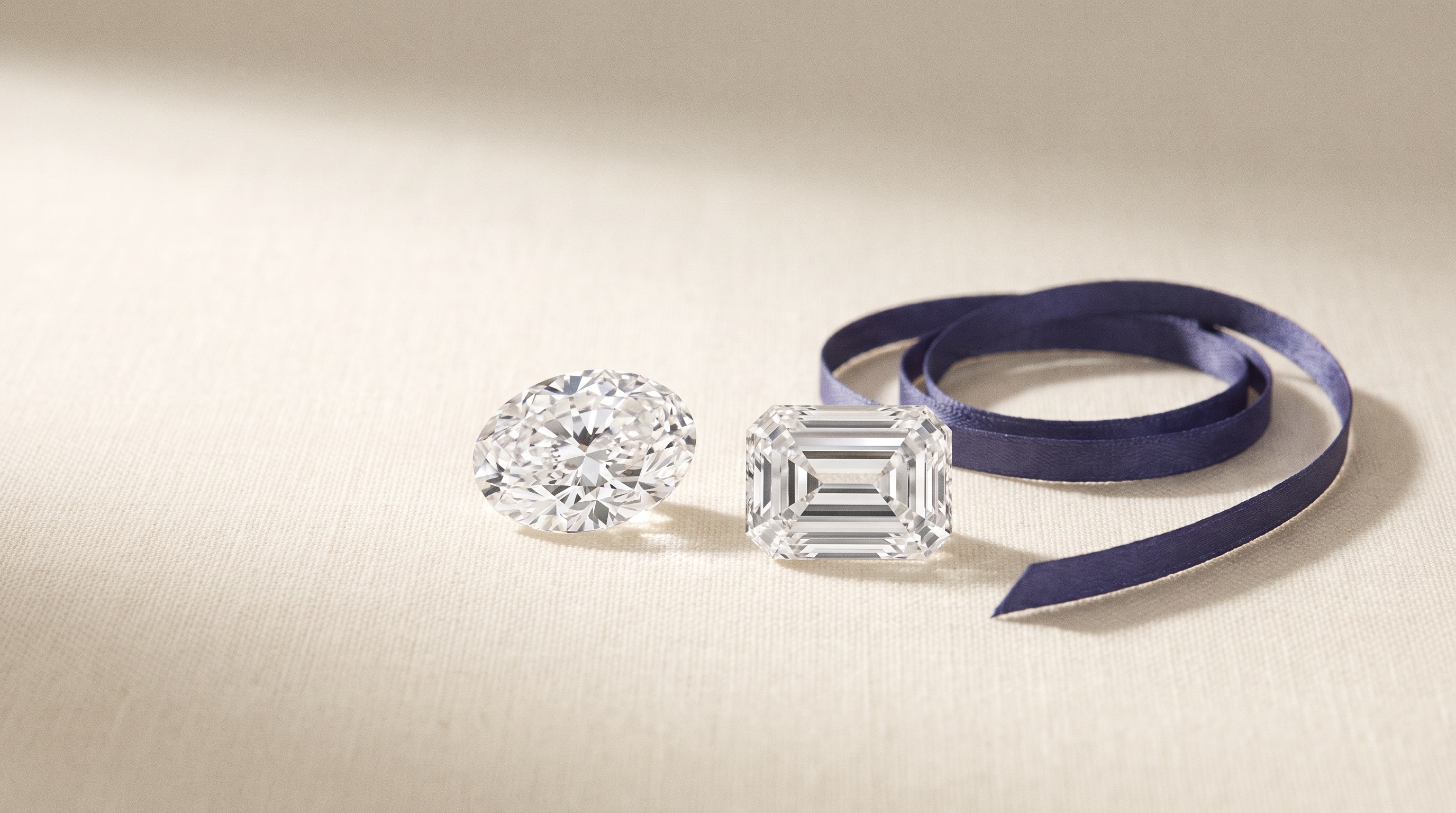
Oval and emerald cut diamonds are both elongated fancy shapes, but they use fundamentally different facet structures: oval is a brilliant-faceted cut that produces scattered sparkle similar to a round brilliant, while emerald is a step-faceted cut that produces broad, flat flashes of light and demands higher clarity because its open facets show inclusions far more readily. The two shapes read very differently face-up despite both being elongated silhouettes that visually lengthen the finger.
This guide compares oval and emerald cut diamonds on facet structure and light performance, clarity and color requirements, the oval's bow-tie effect versus the emerald's "hall of mirrors" clarity demands, carat weight and face-up size, pricing, and setting considerations — so a wholesale buyer can match the right shape to a specific customer request or inventory need.
What Makes an Oval Cut Diamond
The oval cut is a brilliant-faceted, elongated shape developed in the 1960s specifically to combine a round brilliant's fire and scintillation with a shape that visually elongates the finger and can appear larger than its actual carat weight due to its greater surface-area spread. Cut with a brilliant facet pattern similar in principle to the round brilliant (typically 56-64 facets depending on the specific cutting style), an oval produces the same kind of scattered scintillation a round brilliant does, just distributed across an elongated rather than circular outline.
What Makes an Emerald Cut Diamond
The emerald cut is a rectangular step-cut shape — one of the oldest cutting styles still in wide use today, originally developed for cutting emeralds (hence the name) before being adapted to diamonds. Its defining feature is a series of long, parallel, rectangular facets arranged in concentric rows on the crown and pavilion, cut with truncated (cropped) corners, rather than the triangular and kite-shaped facets a brilliant cut uses. This step-cut structure produces the emerald cut's signature "hall of mirrors" optical effect — broad, alternating flashes of light and dark rather than the scattered pinpoint sparkle a brilliant cut produces.
Oval vs. Emerald Cut: Side-by-Side Comparison
| Factor | Oval Cut | Emerald Cut |
|---|---|---|
| Facet style | Brilliant-faceted (triangular/kite facets) | Step-faceted (long, parallel rectangular facets) |
| Light behavior | Scattered scintillation, similar to round brilliant | Broad "hall of mirrors" flashes, less scattered sparkle |
| Clarity forgiveness | High — scattered light masks minor inclusions | Low — open facets show inclusions clearly, needs higher clarity for a clean look |
| Color forgiveness | Moderate to high | Lower — step facets can make body color more visible, especially near the corners |
| Common visual issue | Bow-tie shadow effect across the center | Visible inclusions if clarity isn't high enough; can look "glassy" if cut too shallow |
| Face-up size | Appears larger than weight due to elongated surface spread | Also appears larger than weight, elongated spread similar to oval |
| Setting vulnerability | Low — no sharp corners | Moderate — cropped corners still need some protection, less than a sharp-cornered shape |
Light Performance: Scattered Sparkle vs. Hall of Mirrors
This is the most fundamental difference between the two shapes. An oval's brilliant facets break up incoming light into many small, scattered flashes across the stone's face, similar in character to a round brilliant — a lively, sparkly look that's forgiving of minor imperfections because the eye is drawn to the movement of light rather than settling on any one facet. An emerald's step facets work opposite: long, flat, parallel planes act like a series of mirrors, producing fewer but much broader flashes as the stone or viewer moves. This produces an elegant, sophisticated look many buyers specifically seek out, but it also means there's nowhere for a flaw to hide — every facet is a large, flat window into the stone, which is why clarity matters so much more for a clean-looking emerald cut than it does for a comparably graded oval.
The Oval's Bow-Tie Effect
Ovals (along with other elongated brilliant shapes like marquise and pear) can show a "bow-tie" — a dark, bowtie-shaped shadow across the center of the stone caused by the viewer's own head blocking light from reaching that part of the pavilion, made more visible by cutting proportions that don't manage light return well in the stone's central portion. A well-cut oval minimizes bow-tie visibility, but it can't be eliminated entirely due to the geometry involved — buyers evaluating oval inventory should check bow-tie visibility directly (in person or via video) as part of quality assessment, since it isn't consistently captured by standard certificate grading.
The Emerald's Clarity Demands
Because an emerald cut's open step facets don't scatter light the way a brilliant cut does, inclusions and even minor color tinting are far more visible face-up in an emerald cut than in an equivalently graded oval, princess, or round brilliant. Buyers building emerald cut inventory should generally target higher minimum clarity (VS2 or better is a common trade benchmark, though the right floor depends on the buyer's specific price tier) than they would for a brilliant-faceted shape of the same size, and should pay close attention to inclusion location specifically — a small inclusion sitting under one of the large step facets is far more visible than the same inclusion would be scattered among a brilliant cut's many small facets.
Carat Weight and Face-Up Size
Both oval and emerald cuts tend to face up larger than their actual carat weight compared to a round brilliant or a compact shape like princess or cushion, since elongating a stone's outline spreads the same weight across more visible surface area. This makes both shapes attractive to buyers and end customers prioritizing apparent size per carat, and it's one of the reasons both shapes have maintained strong, steady demand independent of current styling trends — the visual-size efficiency is a durable, practical draw rather than a fashion-cycle-dependent one.
Pricing: Oval vs. Emerald Cut
Pricing between the two shapes depends heavily on the specific quality tier being compared rather than one shape being categorically more expensive than the other. Because emerald cut requires higher clarity to look clean face-up, a buyer sourcing emerald cut inventory at a quality level that actually performs well for the shape often ends up paying more per carat than sourcing an oval at a lower clarity that would still look clean in that shape's more forgiving brilliant faceting — the price difference is driven by the clarity requirement gap between the shapes more than by the cutting style itself. At matched clarity and color grades, the two shapes trade in a broadly similar range, with current styling demand and rough utilization efficiency as secondary factors.
Origins and History of Each Cut
The emerald cut has the older lineage of the two by a wide margin — step-cutting techniques date back to the 1500s, originally developed to facet emeralds (hence the name), which are more brittle than diamond and benefit from the step cut's broad, stress-reducing flat facets rather than the sharper angles a brilliant cut requires. The technique was adapted to diamond cutting over subsequent centuries and became especially associated with Art Deco jewelry design in the 1920s and 1930s, an association that persists strongly in how the shape is marketed and perceived today. The oval cut, by contrast, is a much more recent development — credited to Lazare Kaplan in the 1960s, who applied modern round-brilliant faceting principles to an elongated outline specifically to maximize brilliance in a non-round shape, decades after the emerald cut's step-cut tradition was already well established.
Evaluating Cut Quality for Both Shapes
Neither oval nor emerald cut has a single formal, universally applied cut-grade scale equivalent to round brilliant's Excellent-to-Poor system, so evaluating cut quality for both relies more on direct proportion and visual review. For oval, buyers check length-to-width ratio against the specific look they're targeting (more circular ratios read closer to a round brilliant's proportions, while more elongated ratios maximize the finger-lengthening visual effect), along with bow-tie visibility and overall facet symmetry across the curved outline. For emerald cut, buyers check table and depth percentage carefully, since a poorly proportioned step cut can look either "glassy" and washed out (too shallow) or dark in the center (too deep), along with facet alignment precision, which is far more visible in a step cut's large flat facets than it would be in a brilliant-faceted shape. Some labs, including IGI, have extended formal cut grading to certain popular fancy shapes, which buyers should confirm on a specific certificate rather than assume.
Popularity Trends and Styling Influence
Both oval and emerald cut have seen renewed, sustained demand in recent bridal and fashion jewelry cycles, often amplified by high-profile celebrity engagement rings and red-carpet jewelry that put a specific shape in front of a large consumer audience. Oval in particular saw a significant demand surge over the past decade, becoming one of the most requested fancy shapes behind round brilliant and princess cut in many markets, driven by its combination of strong brilliance, flattering elongated silhouette, and efficient visual size per carat. Emerald cut's demand has been steadier and more consistently tied to buyers specifically seeking its vintage, Art Deco-associated aesthetic rather than experiencing the same kind of demand spikes oval has seen — a buyer drawn to emerald cut is typically seeking that specific sophisticated look deliberately, rather than following a broader current styling trend the way some oval cut demand has been driven.
Matched Side Stones in Both Shapes
Both oval and emerald cut diamonds are also sourced as side or accent stones in three-stone and multi-stone ring designs, in addition to their common use as center stones. For emerald cut side stones flanking an emerald or other center stone, matching clarity performance between the stones matters more than it would for a brilliant-faceted pairing, since any visible difference in how cleanly two step-cut stones read face-up is immediately obvious placed side by side. Oval side stones are comparatively more forgiving to match, given the brilliant facet structure's tendency to mask minor inconsistencies, though outline proportion and length-to-width ratio still need to be reasonably consistent across a matched set for the overall design to read as intentional.
Setting Considerations
- Oval settings typically use a simple four- or six-prong design; since ovals have no sharp corners, corner protection isn't a concern the way it is for princess or radiant cut, though prong placement along the curve affects how much of the stone's outline is visible.
- Emerald cut settings generally use four prongs positioned over the cropped corners, since those corners — while not as sharp as a princess cut's — are still a relative weak point on an otherwise straight-edged stone. A step-cut emerald also benefits from a setting that doesn't put pressure on the long, thin girdle edges along its sides.
- Bezel settings work well for both shapes when maximum durability is the priority, and are a common styling choice for emerald cut specifically, since a bezel's clean geometric line complements the emerald's Art Deco-associated aesthetic.
Choosing Between Oval and Emerald for Inventory
A buyer stocking for broad bridal and fashion demand generally wants both shapes represented, since they serve genuinely different customer preferences rather than competing for the same buyer. Oval suits customers wanting maximum sparkle and forgiveness on clarity budget, while emerald suits customers specifically drawn to its sophisticated, vintage-associated look and willing to pay for the higher clarity the shape needs to look its best. Buyers with limited inventory budget for elongated shapes should weigh current demand data for their specific customer base rather than assuming either shape is universally the stronger seller, since regional and demographic preference between the two can vary meaningfully.
Metal Pairing for Both Shapes
Oval and emerald cut interact differently with metal choice given their different light behaviors. Emerald cut's broad, mirror-like facets pick up reflected color from the surrounding metal more noticeably than a brilliant-faceted shape does, which means a warmer metal — yellow or rose gold — will visibly warm an emerald cut's face-up color more than it would an oval of the same grade, something buyers should factor in when matching a specific color grade to a specific metal setting for this shape. Oval, with its more scattered brilliant light behavior, is comparatively less sensitive to this effect, giving buyers more flexibility across white, yellow, and rose gold or platinum without as pronounced a shift in the stone's apparent color. Both shapes pair well with halo settings, which are especially popular for oval to help minimize bow-tie visibility by adding surrounding brilliance that draws the eye outward from the center of the stone.
Common Sourcing Mistakes When Stocking These Shapes
- Applying the same clarity floor to both shapes. Buyers who set a single clarity purchasing standard across all fancy shapes risk over-paying for oval inventory that didn't need the higher clarity, or under-delivering on emerald cut inventory that looks visibly included at a clarity grade that would look perfectly clean in a brilliant-faceted shape.
- Not checking bow-tie visibility on oval inventory before purchase. Since bow-tie isn't consistently captured on a standard certificate, skipping direct visual review of oval stones before committing to inventory risks stocking pieces with a distracting dark shadow that certificate data alone wouldn't reveal.
- Underestimating emerald cut's slower sell-through in markets less familiar with the shape. Emerald cut's sophisticated look has a devoted following but doesn't have oval's broad current-trend demand in every market — buyers should calibrate emerald cut inventory levels to their specific customer base's demonstrated interest rather than assuming uniform demand.
CVD Lab-Grown and Natural Availability
Both oval and emerald cut are cut across Guru Diam's CVD lab-grown and natural diamond catalogs, with faceting and grading standards identical regardless of origin — the higher clarity requirement for a clean-looking emerald cut applies the same way whether sourcing lab-grown or natural material. Both shapes are gradable by GIA, IGI, and GCAL.
Sourcing Oval and Emerald Cut Diamonds Wholesale
Guru Diam stocks both oval and emerald cut diamonds across its lab-grown and natural catalogs, alongside the rest of Guru Diam's standard, antique, and exotic shape range, certified loose stones, and finished jewelry. The diamonds are cut and polished in India before final grading and shipment from Guru Diam's New York and Los Angeles locations, with IGI, GIA, and GCAL certification available. In-stock inventory ships same-day (before 6pm EST from New York, before 4pm PST from Los Angeles), and Guru Diam can source specific clarity tiers for emerald cut buyers who need to hit a strict clean-face-up threshold. Trade buyers can browse certified inventory through certified diamonds, source matched oval or emerald cut side stones through matching pairs, review sourcing terms at the wholesale hub, or apply for a trade account through trade partner.
Regional and Customer Segment Preference
Demand between oval and emerald cut can vary meaningfully across regions and customer demographics, which is worth tracking separately rather than assuming uniform preference across an entire customer base. Oval's recent strong demand growth has been especially pronounced in markets and customer segments highly influenced by social media and celebrity engagement ring visibility, while emerald cut maintains steadier, more demographically consistent demand among customers specifically drawn to its vintage aesthetic independent of current broader trend cycles. Buyers serving a wide customer base benefit from tracking sell-through by shape at the segment level, since a blended demand figure across dissimilar customer groups can obscure meaningfully different actual purchasing patterns between the two shapes.
How Jewelers Guide Customers Between the Two Shapes
Experienced bridal jewelry consultants typically guide a customer's choice between oval and emerald cut based on the look and priorities the customer describes rather than leading with a technical features comparison — a customer describing wanting maximum sparkle, a classic-but-not-traditional look, and flexibility on budget is often steered toward oval, while a customer specifically referencing vintage, Art Deco, or old-Hollywood inspiration, and prepared to prioritize clarity in their budget allocation, is steered toward emerald cut. This design-goal-first approach tends to produce a better final match than starting from a technical comparison of facet structure and light performance, since most customers are shopping for a specific aesthetic and feeling rather than optimizing a technical spec sheet.
Frequently Asked Questions
What's the main difference between oval and emerald cut diamonds?
Oval is brilliant-faceted and produces scattered sparkle similar to a round brilliant, while emerald is step-faceted and produces broad "hall of mirrors" flashes rather than scattered sparkle. This also means emerald cut shows inclusions much more readily than oval does.
Which shape needs higher clarity, oval or emerald cut?
Emerald cut needs meaningfully higher clarity to look clean face-up, since its open step facets don't scatter light the way an oval's brilliant facets do. Oval is considerably more forgiving of minor inclusions.
Does oval cut show a bow-tie effect?
Yes — ovals can show a dark bow-tie-shaped shadow across the center caused by the viewer's head blocking light, though a well-cut oval minimizes its visibility. Emerald cut doesn't show this same effect due to its different facet structure.
Which is more expensive, oval or emerald cut diamonds?
It depends on the quality tier — emerald cut often costs more in practice because it requires higher clarity to look clean, not because the cutting style itself carries a fixed premium over oval.
Do oval and emerald cut diamonds appear larger than their carat weight?
Yes — both shapes are elongated and spread the same carat weight across more visible surface area than a round or compact shape like princess or cushion, making both appear larger face-up than their actual weight.
Which cut is more durable for daily wear, oval or emerald?
Oval has no sharp corners and is generally more chip-resistant. Emerald cut's cropped corners are a relative weak point, though less vulnerable than a sharp-cornered shape like princess, and a properly pronged setting addresses most of the risk.
Is oval or emerald cut a better choice for a first fancy-shape purchase?
Oval is generally the more forgiving and lower-risk choice for a buyer or customer new to fancy shapes, given its strong brilliance and clarity forgiveness. Emerald cut rewards a buyer who specifically wants its vintage aesthetic and is prepared to prioritize clarity in sourcing or budget.
Which cut has a longer history, oval or emerald?
Emerald cut, by a wide margin — step-cutting techniques date back to the 1500s, while the oval cut as it's commonly known today was developed by Lazare Kaplan in the 1960s, applying modern brilliant-faceting principles to an elongated outline.