
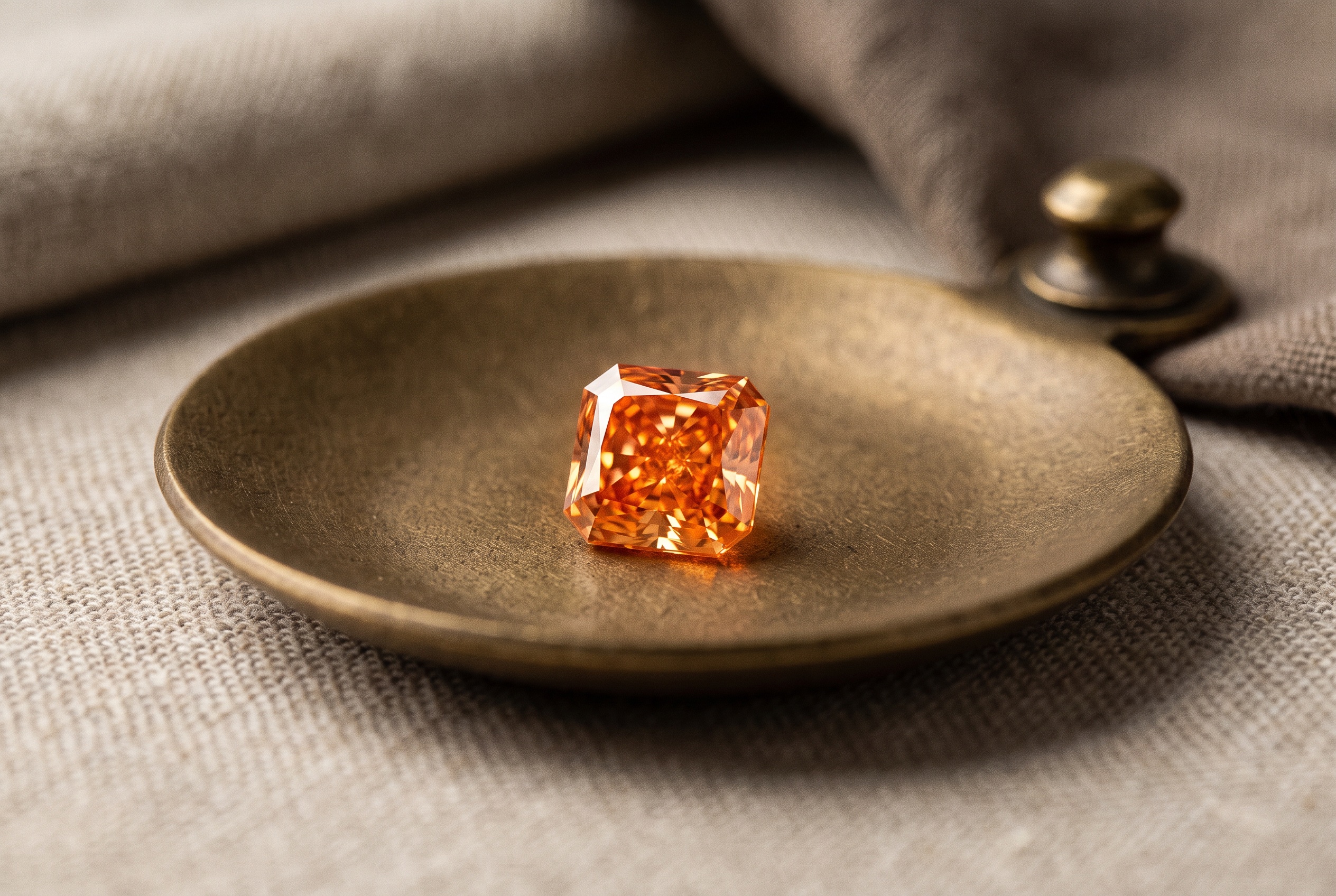
An orange diamond is a natural or lab-grown diamond whose crystal structure contains a specific combination of trace nitrogen defects that scatter light to produce a warm orange hue, ranging from a subtle brownish-orange to a vivid, saturated pure orange. Pure orange diamonds, free of a strong secondary brown or yellow modifier, are among the rarest fancy colors in nature — considerably scarcer than yellow or brown, and closer in rarity to pink than to the more common warm fancy colors.
What Causes Orange Color in Diamonds
Orange coloration in diamonds results from a specific structural arrangement of nitrogen-related defects in the crystal lattice, distinct from the simpler nitrogen substitution that produces yellow color. Because this precise combination of structural conditions is uncommon, pure orange diamonds — meaning stones with orange as the clearly dominant hue rather than a secondary modifier on a brown or yellow base — occur far less frequently in nature than either yellow or brown diamonds, which is the primary reason pure orange commands a significant rarity premium within the fancy color category.
The GIA Orange Diamond Color Scale
GIA grades orange diamonds using its standard fancy color grading scale, assessing hue, tone, and saturation together. Grades run from Faint and Light through Fancy Light, Fancy, Fancy Intense, and Fancy Vivid, with Fancy Vivid representing the purest, most saturated expression of orange color and commanding the highest premium. Because pure, strongly saturated orange with minimal brown or yellow secondary modifier is genuinely rare, a GIA report is essential for any meaningful orange diamond purchase — it's the only reliable way to confirm exactly how much of a given stone's color is pure orange versus a secondary hue described alongside it, such as "Fancy Brownish Orange" or "Fancy Yellowish Orange."
| GIA Grade | General Appearance | Market Position |
|---|---|---|
| Faint / Light Orange | Subtle warm tint, close to colorless with an orange cast | Entry-level, most affordable |
| Fancy Light / Fancy Orange | Clear, moderate orange, often with brown or yellow undertone | Mid-market |
| Fancy Intense Orange | Strong, saturated orange | Premium |
| Fancy Vivid Orange | Purest, most vivid orange with minimal secondary hue | Rarest, highest premium |
Pure Orange vs. Modified Orange: Why the Distinction Matters
Most diamonds described casually as "orange" in the trade actually carry a secondary color modifier — brownish orange and yellowish orange are both considerably more common than a pure, unmodified orange with no secondary hue at all. A GIA report will describe this precisely: "Fancy Orange" with no modifier indicates a stone close to pure orange, while "Fancy Brownish Orange" or "Fancy Yellowish Orange" indicates a genuine secondary color influence that affects both appearance and value. A true pure orange diamond, with orange as the sole dominant hue and no meaningful secondary modifier, is exceptionally rare — rare enough that some gemologists consider unmodified pure orange the rarest single fancy color diamond hue that exists in appreciable market quantity, rarer even than red in terms of documented stones, though red diamonds command higher per-carat prices at the extreme high end due to their own even smaller total known population.
Orange Diamonds vs. Other Fancy Colors: A Rarity and Value Comparison
| Fancy Color | Relative Rarity | Relative Price per Carat | Primary Color Cause |
|---|---|---|---|
| Orange (pure) | Extremely rare | Very high | Specific nitrogen defect structure |
| Yellow | Common | Low to moderate | Trace nitrogen (simple substitution) |
| Brown | Most common fancy color | Lowest among major fancy colors | Structural graining/deformation |
| Pink | Rare | High | Structural deformation |
Natural vs. Treated Orange Color
The overwhelming majority of orange diamonds on the market occur naturally, though color enhancement through irradiation and subsequent heat treatment can also produce orange or orange-related coloration in certain diamonds, typically starting from lower-color-grade material. GIA and other major labs disclose treatment status clearly on grading reports, and treatment status has an outsized effect on value in this specific color, given how much of pure natural orange's price premium is tied directly to its extreme natural rarity — a treated stone, however visually similar, doesn't carry that same rarity basis and should be priced and represented accordingly, at a substantial discount to a natural, untreated stone of comparable face-up appearance.
Lab-Grown Orange Diamonds
Lab-grown diamond production has focused overwhelmingly on colorless to near-colorless material and, secondarily, on the more commercially established fancy colors — yellow, blue, pink, and green — where grower demand and technical process control are both well established. Orange remains a genuinely niche segment even within lab-grown fancy color production, reflecting both the technical difficulty of reliably producing the specific defect structure that yields pure orange color and the comparatively smaller market demand for the color relative to the four colors that dominate commercial lab-grown fancy color output.
Where Orange Diamonds Are Found
Orange diamonds have been recovered from a range of diamond-producing regions, including South Africa, Brazil, and various African deposits, without a single dominant historical source the way the Argyle mine was for brown and pink diamonds. Because pure orange is rare across essentially every major producing region rather than concentrated in one now-depleted source, its rarity is a more structural, ongoing market condition than a supply-shock story tied to a single mine's closure — pure orange diamonds have simply always been scarce, everywhere they're found, and that scarcity isn't expected to meaningfully change with any single deposit's future output.
Orange Diamond Clarity Characteristics
As with other fancy colors, a strong, saturated orange body color can help mask minor inclusions that would be more noticeable in a colorless stone, giving buyers some room to select a slightly lower clarity grade without a significant visual penalty. That said, because pure orange diamonds are already commanding a substantial rarity premium, buyers purchasing at this tier typically also expect reasonably clean clarity, and a well-matched combination of strong color saturation and solid clarity is what drives the very top of the orange diamond market rather than color alone.
Famous Orange Diamonds
The best-known orange diamond in the gem trade is "The Pumpkin Diamond," a 5.54-carat Fancy Vivid Orange diamond that has sold at high-profile auction and been worn by celebrities on red carpets, widely cited as one of the largest and finest pure Fancy Vivid Orange diamonds ever graded. Its market visibility has done much to establish orange as a recognized, desirable fancy color in its own right among collectors and high-end buyers, distinct from being treated as merely an unusual variant of yellow or brown.
Cut Styles That Work Well With Orange Diamonds
Cushion and radiant cuts are particularly popular for orange diamonds, since their broad facet structure showcases color saturation effectively across the stone's face, producing a rich, warm glow. Round brilliant and oval cuts are also used and tend to distribute the orange color with more overall sparkle, at some tradeoff in color evenness compared to a step-cut or cushion-cut treatment. Because pure orange stones are typically cut from already-rare rough, cutters often prioritize retaining carat weight and maximizing color over achieving a perfectly standardized cut proportion, which is part of why orange diamonds show somewhat more cut-style variation than commodity colorless round brilliants.
Jewelry Styling With Orange Diamonds
Orange diamonds pair well with warm-toned metals — yellow gold and rose gold — which reinforce rather than contrast the stone's warm hue, similar to styling conventions for yellow and brown diamonds. Because pure orange stones are rare and expensive, they're most often used as a center stone in a focal piece rather than as melee or accent stones, unlike more abundant fancy colors that show up regularly in both roles. A well-cut, well-graded orange diamond is typically presented as a standalone statement piece specifically because its rarity is central to its appeal.
Comparing Orange Diamonds to Other Orange Gemstones
| Stone | Hardness (Mohs) | Relative Cost | Key Distinguishing Trait |
|---|---|---|---|
| Orange diamond | 10 | Highest of this group by a wide margin | True diamond fire and brilliance, extreme rarity |
| Spessartite garnet | 7–7.5 | Low to moderate | More widely available, softer, less brilliant |
| Orange sapphire (padparadscha-adjacent) | 9 | Moderate to high | Distinct pink-orange sapphire category, own rarity dynamics |
| Citrine | 7 | Low | Much softer and more affordable, common natural quartz |
Buyers occasionally encounter more affordable orange gemstones marketed alongside or near orange diamonds in casual retail settings. The key distinguishing factors remain hardness (diamond's 10 on the Mohs scale is unmatched) and diamond's distinctive fire and brilliance under light. Any orange stone represented and priced as a diamond should always come with lab documentation confirming it as such, particularly given how much of a genuine orange diamond's value depends on its documented rarity.
Why Orange Diamonds Command Such High Prices
Orange diamond pricing reflects a combination of genuine natural scarcity and comparatively small total market supply relative to demand from collectors and fancy color specialists specifically seeking the color. Unlike brown or yellow, where large total known supply keeps prices accessible even at sizable carat weights, orange diamonds of any meaningful size and strong, unmodified saturation are scarce enough that per-carat pricing can rival or approach that of other rare fancy colors like pink, particularly at the Fancy Vivid grade level with minimal secondary hue.
Orange Diamond Carat Weight and Size Availability
Given their extreme rarity, orange diamonds of any substantial carat weight are exceptionally uncommon — most documented pure orange diamonds in the gem trade fall well under two carats, and stones approaching or exceeding five carats, like the Pumpkin Diamond, are considered exceptional finds worthy of individual naming and public documentation, a treatment reserved for only the rarest fancy color stones across any hue. This size scarcity compounds the color's already high per-carat value, since larger orange diamonds aren't simply more expensive versions of smaller ones on a linear scale — the jump in rarity, and therefore price, from a one-carat to a three-carat pure orange diamond is considerably steeper than the equivalent jump would be for a more commonly available fancy color.
Common Misconceptions About Orange Diamonds
A frequent misconception is that any warm-toned fancy diamond can be marketed as "orange," when in practice most warm fancy-color stones carry a dominant brown or yellow hue with orange, if present at all, only as a secondary modifier — genuine, GIA-graded pure orange is considerably rarer than the loose, informal use of the word "orange" in casual retail descriptions might suggest. A second misconception conflates orange diamonds with the more commonly available "champagne" or "cognac" brown diamonds, which share a general warm-color family but result from an entirely different structural cause and occur at a very different rarity level. Buyers should always confirm the actual GIA color description — not a marketing name — before assuming a stone is genuinely orange rather than a brown or yellow stone with orange undertones.
Evaluating an Orange Diamond: A Practical Checklist
- Confirm the GIA grade and hue description precisely, distinguishing pure "Fancy Orange" from modified descriptions like "Fancy Brownish Orange" or "Fancy Yellowish Orange."
- Verify natural vs. treated color status on the grading report — natural rarity is central to value in this color specifically.
- Consider cushion or radiant cuts for strong, even color saturation across the stone's face.
- Understand that clarity still matters at this price tier, alongside strong color, unlike some more accessible fancy colors where color alone can carry the value.
- Pair with warm-toned metal (yellow or rose gold) for a cohesive, color-reinforcing setting.
Grading Report Considerations Specific to Orange Diamonds
When reviewing a grading report for an orange diamond, the color description field deserves the closest read of any field on the report. GIA describes fancy color diamonds with a hue, a set of modifiers (if any secondary hues are present), and an intensity grade — for orange specifically, the presence or absence of a "brownish" or "yellowish" modifier is the single detail that most affects both the stone's visual character and its value. Two stones both described loosely as "orange" in casual conversation can carry very different formal grades and correspondingly different prices once the modifier is accounted for, which is why buyers evaluating an orange diamond should always request and read the full grading report rather than relying on a seller's verbal color description alone. The report's origin field (natural vs. laboratory-grown) and any comments field noting treatment should also be checked directly, given how heavily orange diamond value depends on natural, untreated origin specifically.
Orange Diamonds as a Collector and Investment Category
Because of their combination of genuine rarity and comparatively small total market supply, orange diamonds — particularly larger stones at Fancy Intense or Fancy Vivid grade with minimal secondary hue — attract a collector and specialist-investor audience distinct from the broader fine jewelry consumer market. This audience typically evaluates a stone with more emphasis on documented provenance, grading report completeness, and comparison against known auction results for similarly graded stones than a typical jewelry buyer would apply to a more common fancy color purchase. Dealers and jewelers serving this collector segment should be prepared to provide the level of documentation and market context this buyer expects — auction comparables, detailed grading report review, and clear communication about what specifically drives the stone's rarity — rather than presenting an orange diamond with the same sales approach used for more accessible, higher-volume fancy color categories.
How Orange Diamonds Reach the Market
Given their rarity, orange diamonds of meaningful size and quality are more likely to surface through specialist auction houses, established fancy color diamond dealers, and estate or collection sales than through standard retail or even typical wholesale diamond-trade channels, where the color simply doesn't appear with enough regularity to support a standing dedicated inventory the way yellow or blue fancy color programs can. A jeweler or designer looking to source a genuine orange diamond for a specific client commission should expect a more bespoke sourcing process — working through specialist contacts and monitoring auction and dealer networks for available stones — rather than expecting to select from an on-hand assortment the way they might for more commercially established fancy colors.
Historical and Market Context
Orange diamonds have a shorter, less developed marketing history than brown or yellow diamonds, largely because their extreme rarity kept them out of mainstream commercial jewelry marketing for most of the 20th century, appearing primarily in specialist collector and auction contexts rather than broad consumer retail. High-profile sales like the Pumpkin Diamond's auction and celebrity red-carpet appearances have raised the color's visibility considerably in recent decades, introducing pure orange diamonds to a wider collector and high-end jewelry audience than the color previously reached, though it remains a genuinely specialist category compared to more widely available fancy colors.
Where Orange Fits in the Broader Fancy Color Diamond Market
Orange occupies a position at the rarer, higher-value end of the fancy color diamond spectrum, closer in market character to pink or red than to the more accessible yellow and brown end. For collectors and specialists, that rarity is precisely the appeal — a genuine, GIA-documented pure orange diamond represents one of the scarcer fancy color acquisitions available, and its price reflects that scarcity directly. For jewelers and designers, orange diamonds are generally a specialist offering rather than a volume category, best positioned to a collector-oriented clientele specifically seeking rare fancy colors rather than merchandised as part of a broad, accessible fancy color assortment.
Storage and Care for Orange Diamond Jewelry
Orange diamonds require no special care beyond standard diamond maintenance, since their color comes from an internal structural defect rather than a surface treatment vulnerable to wear. Regular cleaning with warm water, mild soap, and a soft brush is sufficient to maintain brilliance, and periodic professional inspection of prongs and settings is worthwhile — a standard recommendation for any diamond jewelry, but one worth taking especially seriously given the significant value a genuine, well-documented orange diamond represents relative to its size. Given that most orange diamonds sourced by collectors are worn as focal center stones in occasion-driven statement pieces rather than daily-wear jewelry, many owners also choose more limited wear occasions specifically to minimize everyday exposure risk to an especially rare and valuable stone.
Frequently Asked Questions
What is an orange diamond?
An orange diamond is a diamond whose color, ranging from a subtle brownish-orange to a vivid pure orange, results from a specific nitrogen-related defect structure in the crystal lattice. Pure, strongly saturated orange is among the rarest fancy diamond colors.
Why are orange diamonds so expensive?
Pure orange diamonds are genuinely scarce in nature, with a comparatively small total known supply relative to collector and specialist demand. This scarcity, especially at Fancy Vivid grades with minimal secondary hue, drives pricing that can rival other rare fancy colors like pink.
What is the difference between orange and brown diamonds?
They result from different structural causes — orange from a specific nitrogen defect configuration, brown from structural graining and deformation. Brown is the most common fancy color, while pure orange is among the rarest, and the two are graded and priced very differently.
Are orange diamonds natural or treated?
Most orange diamonds on the market occur naturally, though irradiation and heat treatment can also produce orange coloration. Treatment status significantly affects value in this color, since natural rarity is central to pure orange's price premium.
What is the most famous orange diamond?
The Pumpkin Diamond, a 5.54-carat Fancy Vivid Orange diamond, is the best-known example, widely cited as one of the largest and finest pure Fancy Vivid Orange diamonds ever graded and worn on high-profile red carpets.
What cut is best for an orange diamond?
Cushion and radiant cuts showcase orange color saturation effectively across broad facets. Round brilliant and oval cuts distribute more sparkle, at some tradeoff in color evenness.
Guru Diam's fancy color diamond line currently focuses on yellow, pink, blue, and green — loose stones, calibrated melee, and fancy color jewelry. Buyers interested in fancy color diamonds can explore Guru Diam's fancy color loose diamonds, with certification available through certified diamonds. For a comparison of related fancy colors, see our yellow diamond guide and brown diamond guide. Trade buyers can apply for an account through trade partner or review terms at the wholesale hub.