
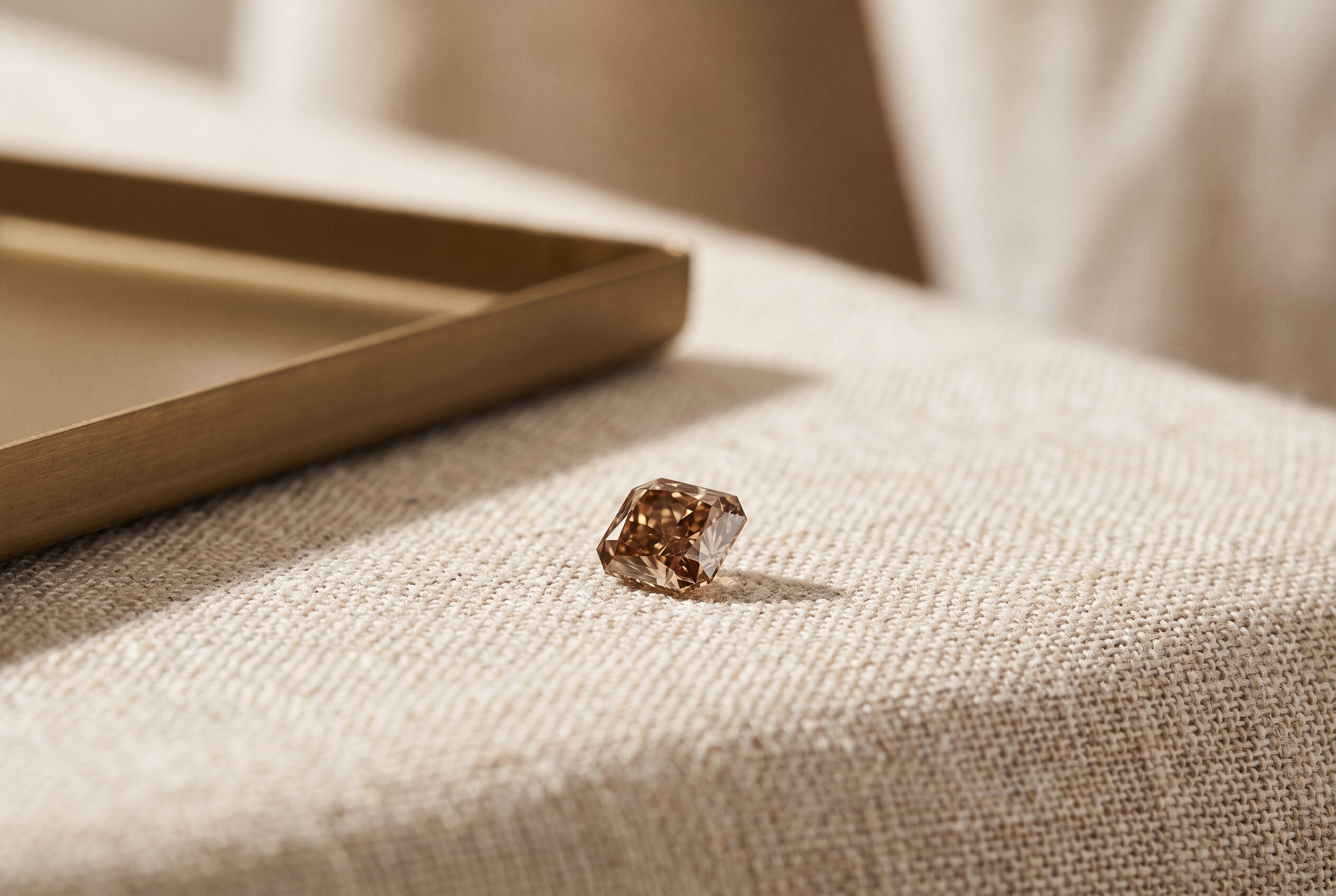
A brown diamond is a natural or lab-grown diamond whose crystal structure contains graining or trace defects that scatter light to produce a warm brown hue, ranging from a light champagne tone to a deep, near-black cognac color. Brown is one of the more common fancy diamond colors — far more abundant in nature than blue, pink, or red — which historically kept it priced lower than rarer fancy colors despite genuine visual appeal in its own right.
What Causes Brown Color in Diamonds
Unlike blue diamonds (caused by trace boron) or yellow diamonds (caused by trace nitrogen), brown coloration in diamonds is primarily caused by structural graining and plastic deformation of the crystal lattice that occurred deep underground under intense heat and pressure, rather than by a chemical impurity. This structural origin is part of why brown diamonds are considerably more common than most other fancy colors — the deformation process that produces brown color is a relatively common geological occurrence, whereas the trace-element or radiation exposure that produces colors like blue, pink, or green requires much rarer conditions.
The GIA Brown Diamond Color Scale
GIA grades brown diamonds using its standard fancy color grading scale, describing both hue and saturation intensity. Brown diamonds are graded from Faint and Light through Fancy Light, Fancy, Fancy Dark, and Fancy Deep, with saturation increasing at each step. Because brown is a comparatively common fancy color, GIA's grading reports for brown diamonds are correspondingly more affordable to obtain relative to the stone's value than for rarer colors, though full documentation remains worthwhile for any brown diamond purchase above modest carat weight, since it establishes an objective, third-party record of color grade and origin (natural vs. treated).
| GIA Grade | General Appearance | Common Trade Name |
|---|---|---|
| Faint / Light Brown | Subtle warm tint, close to colorless | Light champagne |
| Fancy Light Brown | Clear light champagne/tan tone | Champagne |
| Fancy Brown | Medium, warm caramel-brown | Cognac |
| Fancy Dark / Fancy Deep Brown | Deep, rich chocolate to near-black brown | Chocolate / dark cognac |
Champagne, Cognac, and Chocolate: Trade Naming Explained
Much of the confusion around brown diamonds comes from trade and marketing names layered on top of GIA's formal grading scale. "Champagne diamond" is a trade term generally applied to lighter brown tones (roughly Faint through Fancy Light on the GIA scale), evoking the pale golden-tan color of the beverage. "Cognac diamond" typically refers to medium-to-darker brown tones, named for the amber-brown color of the spirit. "Chocolate diamond" is a trademarked marketing term (associated with a specific major jewelry brand) applied to darker brown stones, generally in the Fancy Dark to Fancy Deep range. None of these trade names map to a precise, universally agreed GIA grade boundary — they're marketing conventions layered on top of the underlying formal grade, and a buyer should always confirm the actual GIA grade rather than relying on a trade name alone to understand a specific stone's color intensity.
Brown Diamond Clarity Characteristics
Brown diamonds, particularly at the darker end of the color range, are somewhat more forgiving of visible inclusions than colorless diamonds, since the body color itself already draws the eye and can mask minor inclusions that would be more noticeable in a colorless stone. This gives buyers meaningful room to choose a slightly lower clarity grade in a brown diamond without a significant visual penalty, which is one of the practical value advantages of the color relative to colorless diamonds of comparable size and cut quality.
Brown Diamonds vs. Other Fancy Colors: A Rarity and Value Comparison
| Fancy Color | Relative Rarity | Relative Price per Carat | Primary Color Cause |
|---|---|---|---|
| Brown | Most common fancy color | Lowest among major fancy colors | Structural graining/deformation |
| Yellow | Common | Low to moderate | Trace nitrogen |
| Pink | Rare | High | Structural deformation (different mechanism than brown) |
| Blue | Very rare | Very high | Trace boron |
Natural vs. Treated Brown Color
Most brown diamonds on the market occur naturally, but brown color can also be produced through treatment — most commonly HPHT (high pressure, high temperature) processing applied to certain lower-color-grade colorless diamonds, which can shift their appearance toward a brown or other fancy color. GIA and other major labs disclose treatment status clearly on grading reports, and a treated stone should always be priced and sold as such, at a meaningful discount to a natural, untreated stone of comparable visual appearance — treatment status is one of the most important things a buyer should confirm before purchasing any brown diamond represented as natural.
Lab-Grown Brown Diamonds
Lab-grown diamonds are most commonly produced in colorless to near-colorless grades, since that's where the bulk of commercial demand sits, but brown coloration can occur in CVD-grown material as an unintended byproduct of certain growth conditions, similar to how it occurs naturally through structural deformation. Dedicated, intentionally-grown brown lab-grown diamonds are a fairly niche market segment compared to lab-grown yellow, blue, or pink production, reflecting brown's already-low price point in natural material — there's less commercial incentive to intentionally engineer a color that's already abundant and affordable in its natural form.
Where Brown Diamonds Are Mined
The Argyle mine in Western Australia, which operated from 1983 until its closure in 2020, was historically the single largest global source of brown diamonds, producing them in far greater volume than any other fancy color from the same deposit. Argyle's closure removed a major supply source from the market, though brown diamonds continue to be recovered from diamond deposits across Africa, Russia, and Canada in meaningful quantities, since the geological conditions that produce brown coloration are widespread compared to the rarer conditions behind colors like blue or pink. Unlike Argyle pink diamonds, which saw values rise noticeably after the mine's closure due to their extreme rarity, brown diamond supply remained broad enough across other sources that the closure had comparatively little effect on brown diamond pricing.
Brown Diamond Carat Weight and Size Availability
Because brown diamonds are recovered in significantly higher volume than most other fancy colors, they're available across a wider range of carat weights — including larger sizes (2ct, 3ct, and above) at price points that would be prohibitive for a comparably sized blue or pink diamond. This makes brown a practical choice for buyers wanting a larger, visually substantial fancy color stone without the cost of a rarer color at the same size. Smaller brown melee (used as accent stones) is also widely available and calibrated in standard size ranges, similar to how white melee is sourced and sorted for jewelry production.
Common Misconceptions About Brown Diamonds
A persistent misconception is that brown diamonds are simply "lower quality" colorless diamonds rather than a genuine, intentional fancy color category — in reality, a well-graded brown diamond with strong, even saturation and a flattering cut is a deliberately selected and marketed fancy color stone, not a colorless diamond that failed to make a higher color grade. A second common misconception conflates brown with the industrial-grade material historically used in cutting tools and abrasives; while lower-quality brown rough has industrial uses, gem-quality brown diamonds cut and graded for jewelry are a distinct market segment, evaluated on the same cut, clarity, and carat criteria as any other diamond. A third misconception is that "chocolate diamond" is a formal grading term — it's a trademarked marketing name used by a specific jewelry brand, not a GIA classification, and buyers should understand that distinction when comparing prices or shopping across retailers.
Cut Styles That Work Well With Brown Diamonds
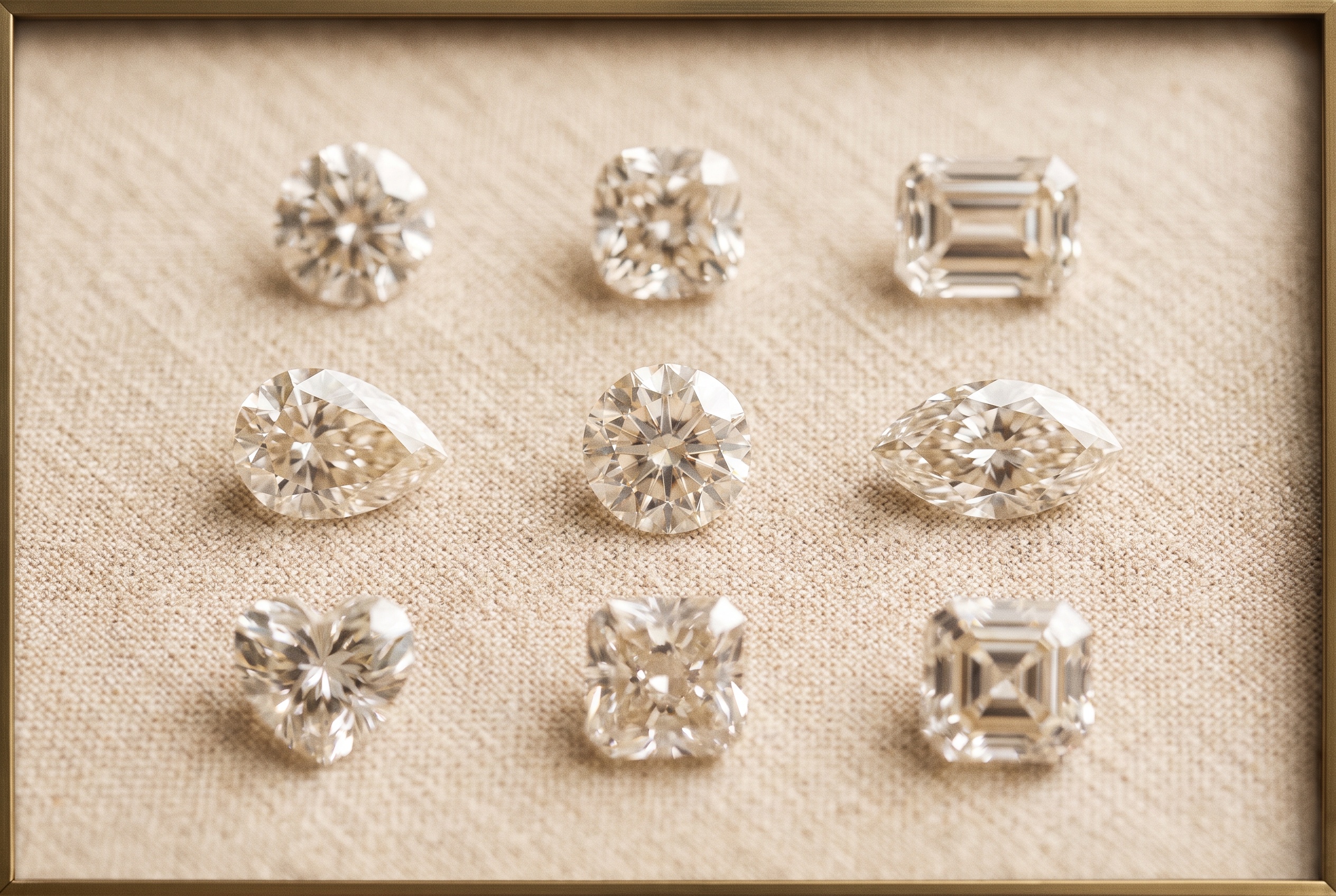
Step cuts (emerald and radiant in particular) are a popular choice for brown diamonds, since their broad, open facets showcase body color evenly across the stone's face, producing a rich, saturated look. Round brilliant and cushion cuts are also common and tend to distribute the brown color with more sparkle and light play than a step cut, at some cost to color saturation and evenness. Darker Fancy Dark and Fancy Deep brown stones in particular benefit from cutting styles that maximize light return, since very dark stones can otherwise read as visually flat or lifeless without enough facet structure to generate sparkle through the body color.
Jewelry Styling With Brown Diamonds
Brown diamonds pair particularly well with warm-toned metals — yellow gold and rose gold especially — which echo and reinforce the stone's warm color rather than creating visual contrast against it. Brown diamonds are also frequently used as accent or melee stones alongside white diamonds or other fancy colors, adding warmth and visual depth to a mixed-stone design without the cost premium of a rarer fancy color accent. Champagne-toned lighter browns work particularly well as a neutral, versatile accent stone that reads as warm and interesting without dominating a design the way a more saturated fancy color would.
Grading Report Considerations Specific to Brown Diamonds
When reviewing a grading report for a brown diamond, a few fields deserve closer attention than they might on a colorless stone. The color description field will typically include both the GIA color grade (Fancy Light, Fancy, Fancy Dark, etc.) and a modifying descriptor — terms like "Fancy Yellowish Brown" or "Fancy Orangy Brown" indicate a secondary color influence that affects how the stone is marketed and valued, since a pure, even brown without a strong secondary tint is generally considered the more classic and desirable expression of the color. The clarity grade should be read alongside the plotted diagram, since brown's greater tolerance for visible inclusions means it's worth confirming an inclusion's actual position and visibility relative to the stone's face-up appearance, not just its formal clarity grade in isolation. Finally, any comments field noting treatment (HPHT or otherwise) should always be checked directly rather than assumed absent — treatment disclosure is a formal reporting requirement at major labs, but the responsibility for confirming it before purchase sits with the buyer.
Brown Diamonds in Antique and Estate Jewelry
Brown diamonds appear with some regularity in antique and estate jewelry, particularly in Victorian and Georgian-era pieces, since period cutting and grading standards were considerably less focused on achieving pure colorless material than modern standards, and warmer, naturally tinted stones were used without the same premium placed on colorless material that developed in the 20th century. This gives brown diamonds a genuine historical and antique-market presence distinct from their more recent repositioning as a deliberately marketed modern fancy color, and antique dealers and buyers specifically interested in period-accurate pieces should be aware that a warm-toned stone in a genuinely antique setting may simply reflect period sourcing norms rather than a deliberate fancy color choice by the original jeweler.
Comparing Brown Diamonds to Smoky Quartz and Other Brown Gemstones
| Stone | Hardness (Mohs) | Relative Cost | Key Distinguishing Trait |
|---|---|---|---|
| Brown diamond | 10 | Highest of this group | True diamond fire and brilliance |
| Smoky quartz | 7 | Low | Much softer, less brilliant, far more affordable |
| Andalusite | 7.5 | Low to moderate | Pleochroic — shows different colors from different angles |
| Brown zircon | 6–7.5 | Low to moderate | High brilliance for a non-diamond, but noticeably softer |
Buyers occasionally confuse brown diamonds with other, considerably more affordable brown gemstones like smoky quartz, especially in casual retail or online marketplace listings where terminology isn't always used precisely. The practical distinguishing factors are hardness (diamond's 10 on the Mohs scale is unmatched by any of these alternatives, meaning far superior scratch resistance for daily wear) and a genuine diamond's distinctive fire and brilliance under light, which a trained eye — or basic gemological testing — can distinguish from lower-dispersion alternatives fairly easily. Any brown stone represented and priced as a diamond should come with lab documentation confirming it as such.
Building a Brown Diamond Assortment: Considerations for Jewelers
For a jeweler or designer considering brown diamonds as part of a fancy color offering, the category's core commercial appeal is accessibility — brown diamonds let a retailer offer a genuine, certified fancy color diamond at a price point close to or only modestly above a comparable colorless stone, which opens fancy color diamond jewelry to a meaningfully broader customer base than rarer colors can reach. A well-curated brown diamond assortment typically spans the lighter champagne end (for a subtle, versatile everyday piece) through the deeper cognac and chocolate end (for a bolder statement piece), giving customers a genuine choice across the color's full range rather than stocking only one narrow band of the spectrum. Pairing brown diamonds with the retailer's existing white diamond and other fancy color offerings — rather than merchandising brown as an entirely separate, isolated category — also tends to perform well, since many customers are introduced to brown as an accent or secondary stone before considering it as a primary center stone choice.
Historical and Market Context
Brown diamonds were, for much of the 20th century, considered an industrial-grade byproduct with limited jewelry value, until a major marketing push in the 1980s (associated with the discovery of the Argyle mine in Australia, historically the largest single source of brown and pink diamonds) successfully repositioned brown diamonds as a desirable fancy color under trade names like champagne and cognac. This history is a useful illustration of how much of a fancy diamond color's perceived value is shaped by marketing and branding on top of its underlying rarity, rather than rarity alone — brown remained geologically just as common before and after that repositioning, but consumer perception and market demand shifted substantially, and prices for well-marketed champagne and cognac material rose accordingly even though the underlying mine output hadn't changed.
Evaluating a Brown Diamond: A Practical Checklist
- Confirm the GIA (or equivalent lab) grade rather than relying on a trade name like champagne or cognac alone, since these names don't map to precise, standardized grade boundaries.
- Verify natural vs. treated color status on the grading report — treated stones should be priced meaningfully lower than natural stones of comparable appearance.
- Consider a step cut (emerald or radiant) for even color saturation, or round/cushion for more sparkle at some cost to color evenness.
- Take advantage of brown's clarity tolerance — a slightly lower clarity grade often shows minimal visual difference, offering real value versus a higher clarity grade.
- Pair with warm-toned metal (yellow or rose gold) for a cohesive, color-reinforcing finished look.
Where Brown Fits in the Broader Fancy Color Diamond Market
Brown occupies a distinct position in the fancy color diamond market as the accessible, abundant end of the spectrum — the color that lets a buyer own a genuine fancy-color diamond, with all the visual interest that comes with a distinctly colored stone, at a price point far below rarer colors like blue, pink, or red. For jewelers and designers, this makes brown diamonds a practical entry point into fancy color diamond merchandising: a way to introduce customers to fancy color diamonds generally, at a price point accessible enough to drive real volume, potentially building future demand for the rarer, higher-value fancy colors that a broader color education naturally leads customers toward over time.
Storage and Care for Brown Diamond Jewelry
Brown diamonds require no special care beyond standard diamond maintenance, since color in this case comes from internal structural graining rather than a surface coating or treatment vulnerable to wear. Regular cleaning with warm water, mild soap, and a soft brush removes the same oils and residue buildup that dull any diamond's brilliance over time, and periodic professional inspection of prongs and settings — the same recommendation that applies to any diamond jewelry piece — is the most useful routine maintenance step an owner can take. Buyers should simply confirm, at time of purchase, whether their stone's color is natural or treated, since that distinction (covered above) is the one factor that could theoretically affect long-term color stability under extreme conditions, though well-documented treated stones sold by reputable dealers are stable under normal wear and care.
Frequently Asked Questions
What is a brown diamond?
A brown diamond is a diamond whose color, ranging from light champagne to deep chocolate-brown, results from structural graining and deformation in the crystal lattice rather than a trace chemical element. It's the most common fancy color found in nature.
What is the difference between champagne and cognac diamonds?
These are trade marketing names, not formal GIA grades. Champagne generally refers to lighter brown tones, while cognac refers to medium-to-darker brown tones. Always check the actual GIA grade to understand a specific stone's true color intensity.
Are brown diamonds real diamonds?
Yes — brown diamonds are chemically and structurally identical to colorless diamonds, differing only in the graining that produces their warm color. They're graded, certified, and sold through the same major labs (GIA, IGI) as colorless and other fancy color diamonds.
Why are brown diamonds cheaper than other fancy colors?
Brown is the most abundant fancy diamond color in nature, caused by a relatively common structural deformation process rather than the rarer trace-element or radiation-exposure conditions that produce colors like blue, pink, or green. Greater supply keeps the price meaningfully lower per carat.
Can brown diamond color be treated or enhanced?
Yes — HPHT treatment can shift certain lower-color-grade colorless diamonds toward brown or other fancy colors. Reputable grading reports disclose treatment status clearly, and treated stones should be priced at a meaningful discount to natural, untreated brown diamonds.
What cut is best for a brown diamond?
Step cuts like emerald and radiant showcase color evenly across broad facets, producing a rich, saturated look. Round brilliant and cushion cuts add more sparkle at some cost to color evenness, and work particularly well on lighter champagne tones.
Where do brown diamonds come from?
The Argyle mine in Australia was historically the largest single source before closing in 2020, but brown diamonds continue to be recovered from deposits across Africa, Russia, and Canada in meaningful quantities, since the deformation process that produces brown color is geologically widespread.
Guru Diam's fancy color diamond line currently focuses on yellow, pink, blue, and green — loose stones, calibrated melee, and fancy color jewelry. Buyers interested in warm fancy color tones can explore Guru Diam's fancy color loose diamonds, with certification available through certified diamonds. For a comparison of related fancy colors, see our yellow diamond guide and salt and pepper diamond guide. Trade buyers can apply for an account through trade partner or review terms at the wholesale hub.