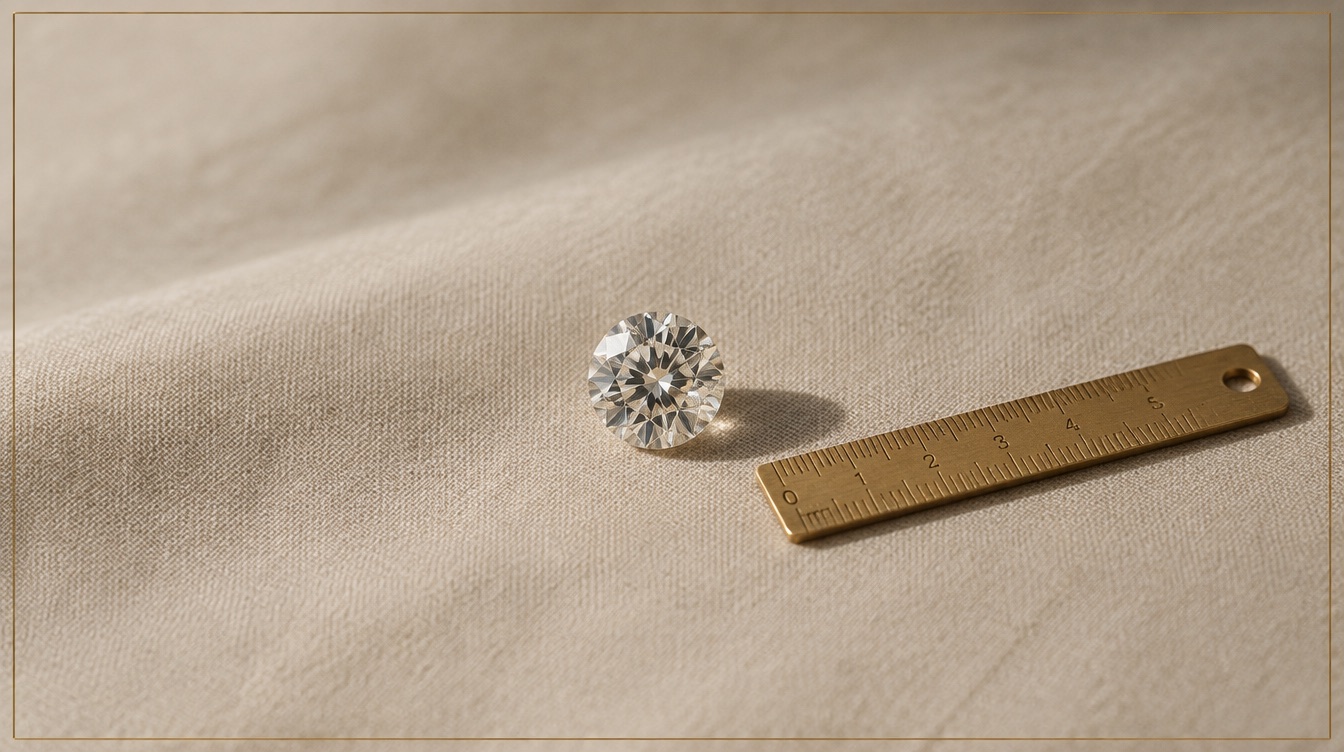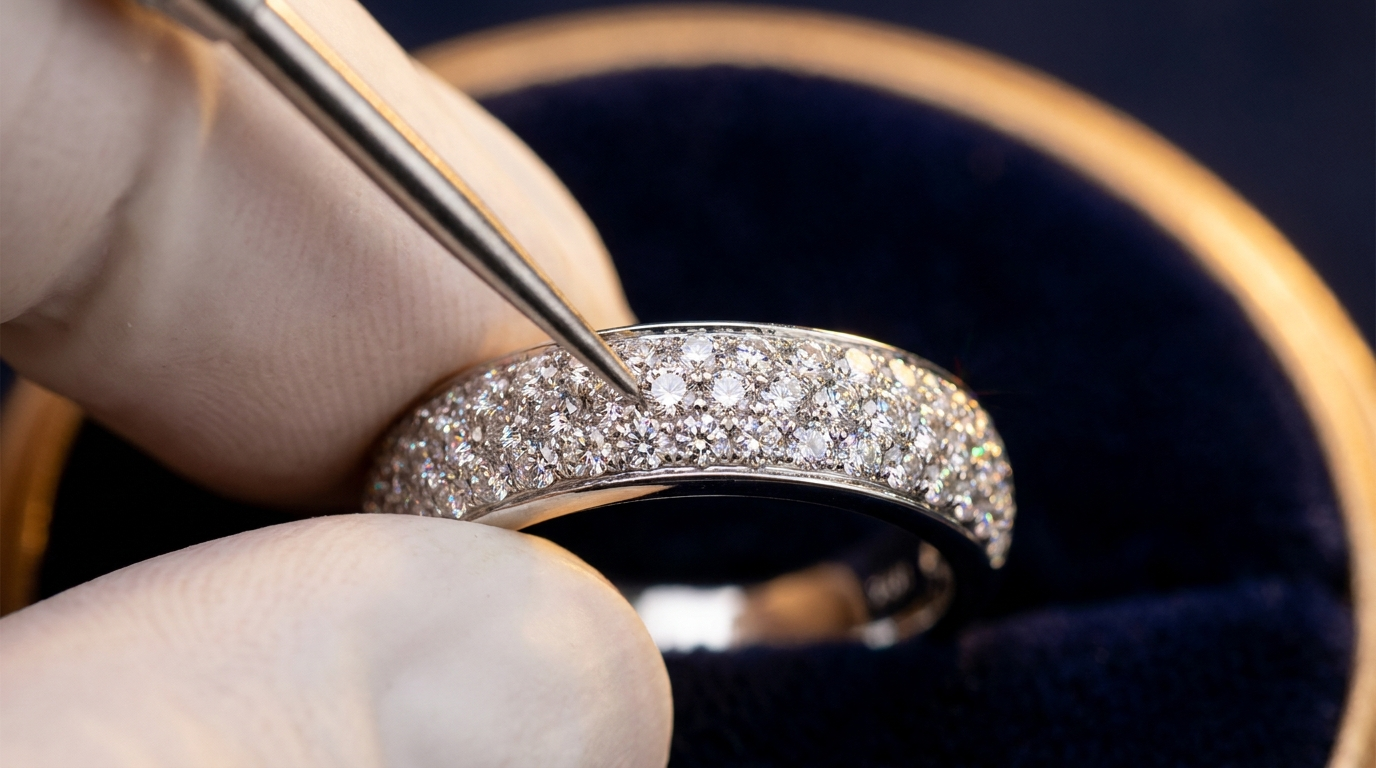
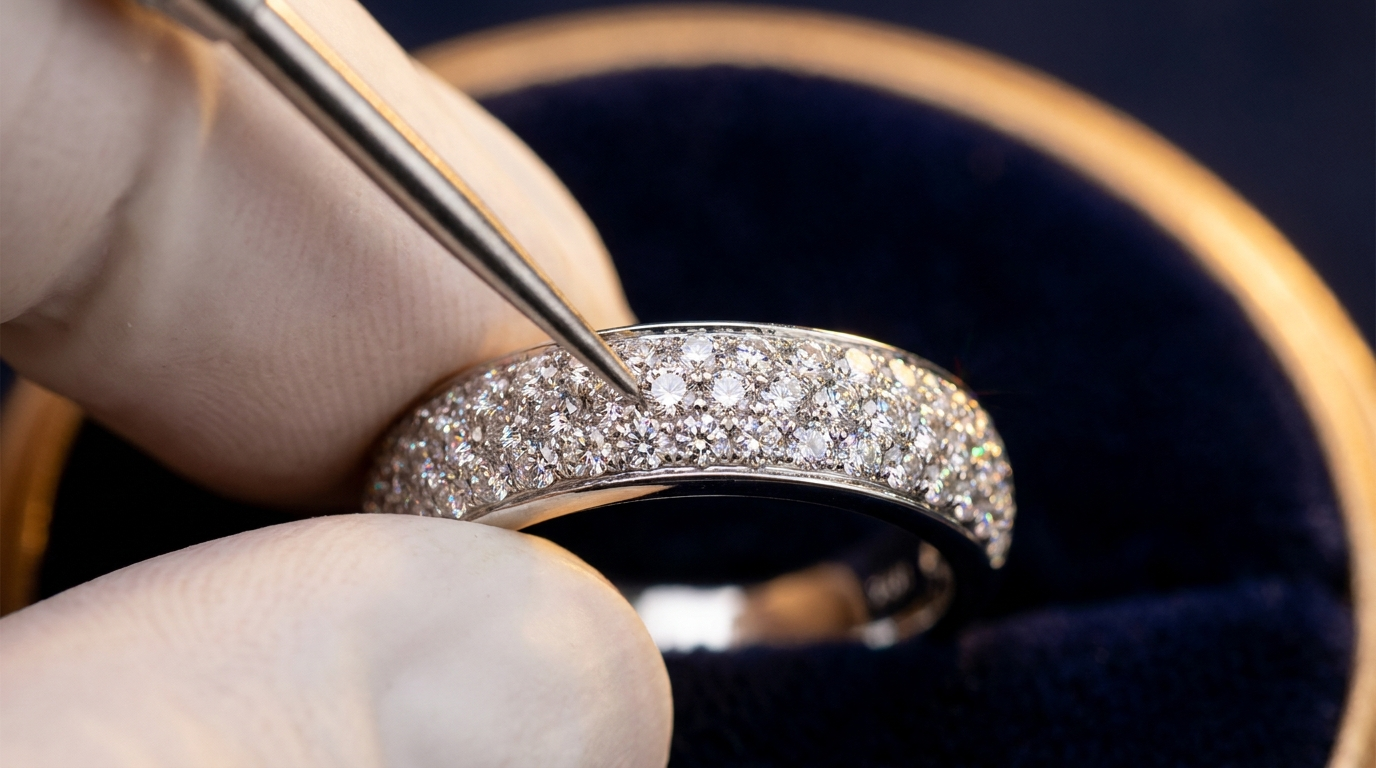
For most pavé work, natural melee in the 0.8mm–2.2mm range performs best — small enough to sit tight with minimal visible metal, large enough to source and set consistently. Within Guru Diam's EF and GH color grid (VS or SI clarity), matching color and clarity consistency across the full parcel matters more than upgrading any single stone's grade — because pavé reads as one continuous surface of sparkle, not as individual stones.
What Size Melee Diamonds Work Best for Pavé Settings?
Pavé setting relies on rows of small stones held by shared beads or prongs, with as little metal showing as possible. That constrains size on both ends. Go too large and the prongs needed to hold each stone start eating into the "paved" look you're trying to create — you end up with something closer to a cluster or channel setting. Go too small and you're fighting practical limits on setting labor, breakage risk, and how visible the sparkle actually reads at arm's length.
In practice, most pavé work draws from the 0.8mm–2.2mm band. Micro-pavé — the tightest, most continuous look, common on engagement ring shanks and halo surrounds — tends to sit at the smaller end of that range, roughly 0.8mm–1.3mm. Standard pavé, used on wider bands, cluster settings, and statement pieces, more often runs 1.3mm–2.2mm, sometimes stepping up toward 2.6mm on bolder designs where the piece can support slightly larger stones without losing the paved effect.
Guru Diam's currently priced natural melee range runs roughly 0.8mm–4.0mm, so the sizes that matter most for pavé sit comfortably inside that window. If a design calls for something above 4.0mm, that's outside what's sourced today — worth flagging before you commit a design to a size that can't be filled.
EF vs. GH, VS vs. SI — Which Grade Combination Suits Pavé Work?
Guru Diam natural melee sells across a 2x2 quality grid: EF (E–F color) and GH (G–H color), each available in VS or SI clarity. These are blended-range grades, standard trade practice for parcel goods — not a guarantee that every stone in a parcel is an exact single grade.
For pavé specifically, the grade decision usually comes down to what the piece is set into and next to. A few practical patterns:
- Pavé bordering or leading into a larger center stone (halo shoulders, side-stone pavé) — match color reasonably close to the center stone's grade so the transition doesn't look like two different pieces of jewelry welded together. If the center stone is higher color, lean EF for the pavé; if it's a warmer white or fancy color, GH pavé usually reads fine.
- Standalone pavé bands, eternity-style pieces, or fashion jewelry with no dominant center stone — GH VS or GH SI is the workhorse combination. At this size, color and small inclusions are far less visible to the eye than they'd be in a 1ct+ solitaire, and the savings versus EF are real.
- White metal (platinum, white gold) vs. yellow or rose gold — yellow and rose metals mask lower color naturally, which is part of why GH performs well set into warmer metals. White metal shows color faster, which is where stepping up to EF earns its keep.
Clarity follows a similar logic: SI clarity in melee sizes is chosen almost entirely on eye-clean performance, not on a grading report, since these stones aren't individually certified (more on that below). VS buys a margin of safety on eye-cleanliness; SI is the more price-efficient choice for the vast majority of pavé work where stones are viewed at normal distance, not under a loupe.
Why Color and Clarity Consistency Matters More Than Any Single Stone's Grade
This is the point that trips up buyers who are used to shopping center stones. When you buy one diamond for a solitaire, the grade of that one stone is the whole story. Pavé doesn't work that way.
A pavé surface is dozens to hundreds of stones sitting side by side, read by the eye as a single field of sparkle. If one stone in that field is noticeably warmer in color or more included than its neighbors, it doesn't just lower the "average" — it creates a visible dead spot. The eye is extremely good at catching a mismatched stone in an otherwise even row, even when it would never flag that same stone as a problem on its own. A single GH-SI stone set alone in a pendant looks fine. That same stone set next to nineteen EF-VS stones looks like a mistake.
That's why the real quality lever for pavé isn't "buy the highest grade you can afford" — it's "buy a parcel sorted tightly enough that every stone reads the same." A consistent GH-SI parcel, evenly matched stone to stone, will out-perform visually against a mixed parcel that averages out to EF on paper but has real spread within it. Sieve-and-master-stone sorting (see below) is what makes that consistency possible at scale — and it's a bigger lever on how a finished pavé piece looks than chasing one grade tier higher.
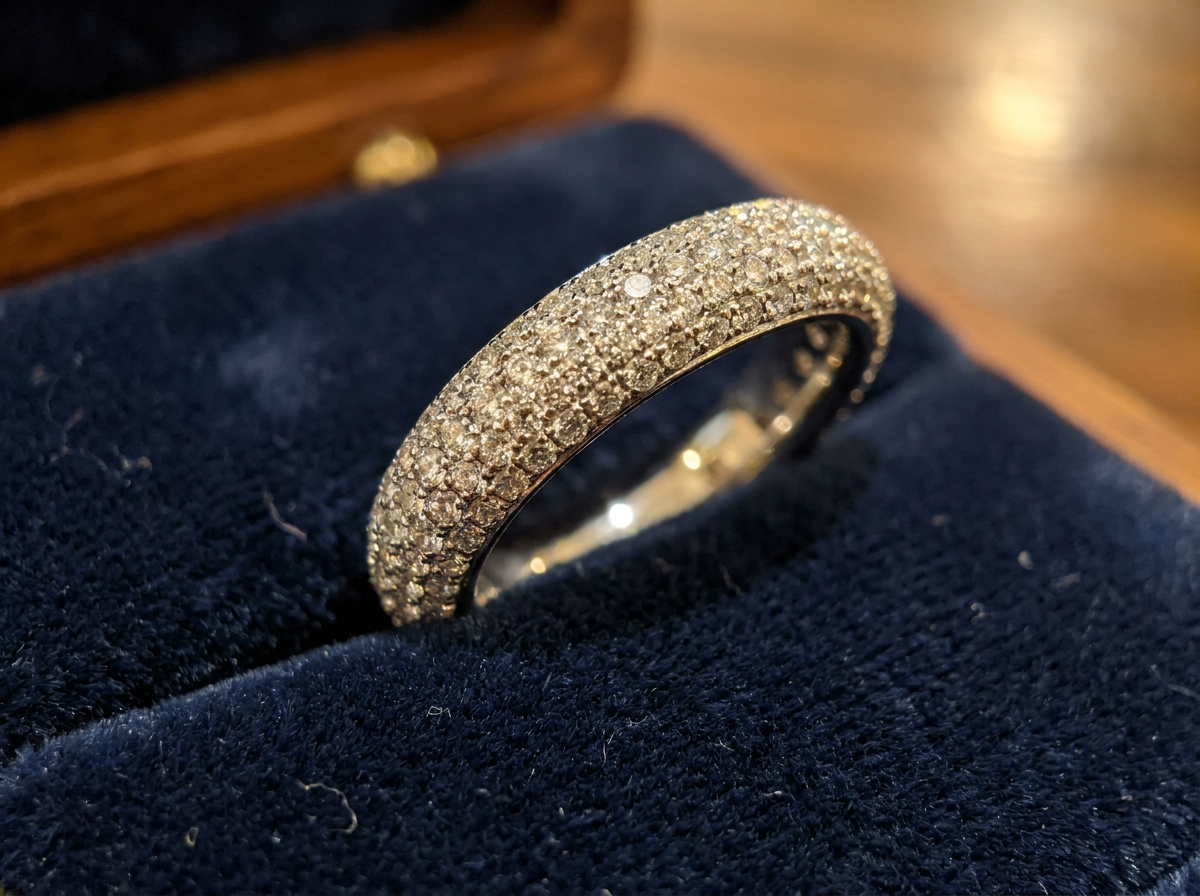
Picture two 40-stone eternity bands laid side by side, both nominally graded GH-SI. One comes from a single, tightly sorted parcel; the other was pieced together from three separate smaller orders placed months apart. On paper, both bands are "GH-SI." In hand, the tightly sorted band reads as one even ring of light. The pieced-together band shows visible banding — three slightly different tones shifting every dozen stones or so — even though every individual stone would pass a GH-SI check on its own. That's the practical cost of prioritizing convenience over parcel consistency, and it's the single most common quality complaint that traces back to how a pavé piece was sourced rather than how it was set.
How Many Melee Diamonds Do You Need for a Pavé Piece?
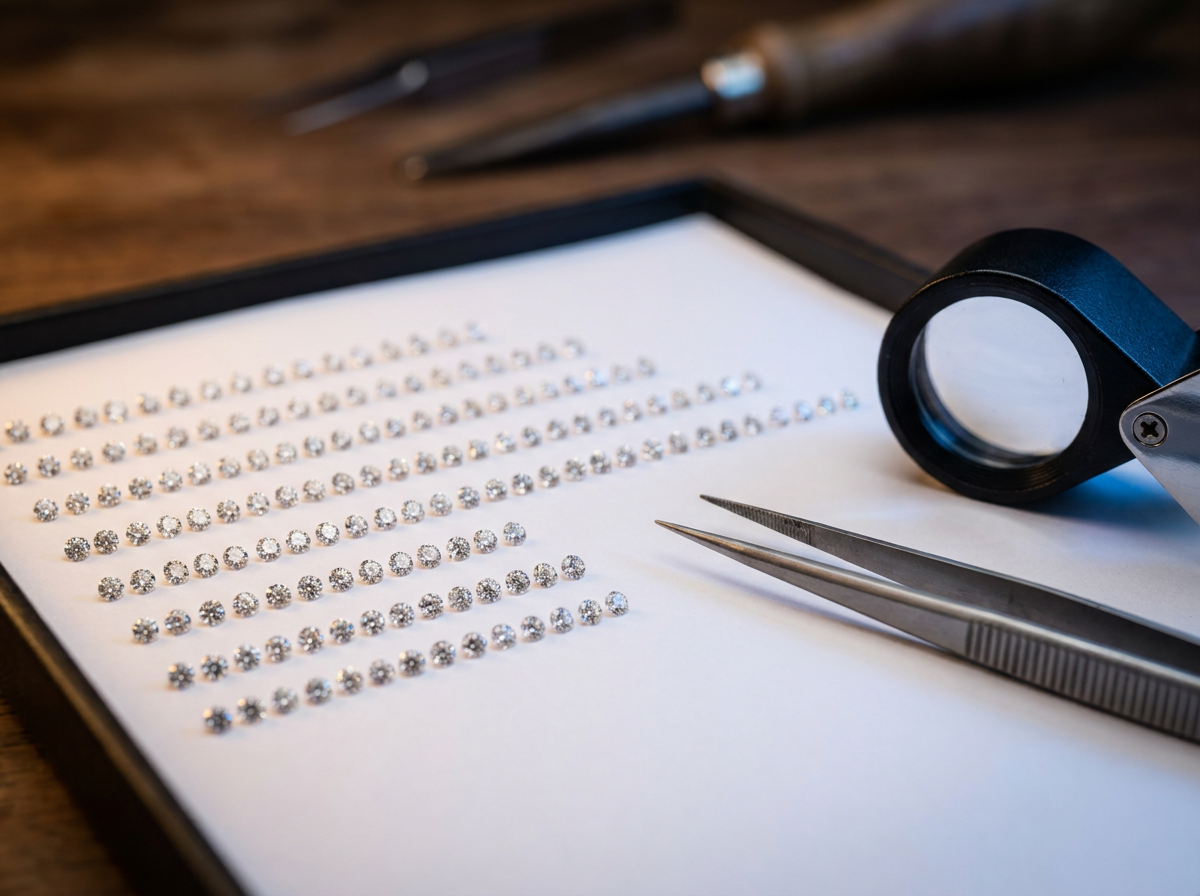
Melee is bought and quoted by total carat weight per parcel, not by stone count — but stone count is what actually determines how many rows and how much surface a given carat weight will cover, so it's worth converting. The math is straightforward once you know the average weight per stone at your chosen size:
| Approx. size (mm) | Approx. weight/stone | Approx. stones per carat |
|---|---|---|
| 1.0mm | ~0.005ct | ~200 |
| 1.3mm | ~0.01ct | ~100 |
| 1.5mm | ~0.015ct | ~65 |
| 2.0mm | ~0.03ct | ~33 |
These are approximate — actual stones-per-carat will vary slightly by cut and depth within a parcel. For example, a pavé engagement ring shank calling for 60 stone positions at 1.5mm needs roughly 60 × 0.015ct ≈ 0.9ct of base melee, before overage. A wider eternity band with 140 positions at 1.3mm needs roughly 140 × 0.01ct ≈ 1.4ct base. These are back-of-envelope figures useful for sanity-checking a quote before it arrives — final stone counts should always be confirmed against the actual CAD or mounting file.
For a full breakdown across the entire size range, with sieve numbers included, see How to Calculate How Many Carats of Melee You Need. The short version for pavé: count the stone positions your CAD or mounting calls for, multiply by the average weight at your chosen size, and that's your base carat requirement — before allowance (next section).
How Much Extra Should You Order for Breakage and Loss?
Base carat requirement is the floor, not the order quantity. Pavé setting is hands-on, stone-by-stone work, and a few things eat into your usable count between parcel arrival and finished piece:
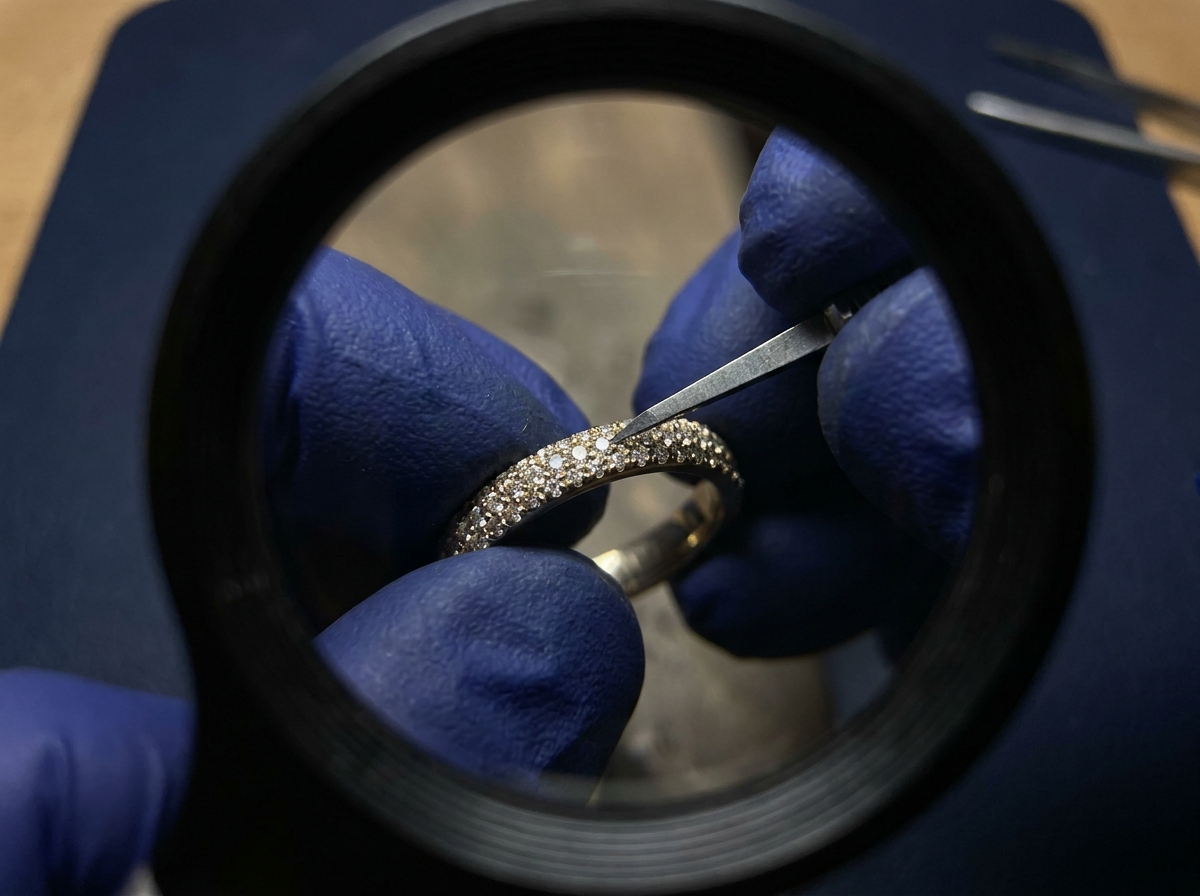
- Setting breakage. Bead-setting and micro-pavé work involves pushing metal directly against small stones under a microscope. Even careful setters chip or crack a stone occasionally, especially on the smallest sizes.
- Sorting rejects. Once your setter lays out the parcel next to the mounting, a handful of stones may get set aside for being slightly off-color, off-size, or oddly shaped relative to the rest of the row — the same consistency principle from above, applied stone by stone at the bench.
- Repairs and future matching. Keeping a small reserve from the same parcel means a future repair or a lost stone can be replaced with a matching stone instead of trying to color-match a new parcel months later.
Many pavé setters build in roughly a 10–15% carat overage on top of the base requirement to cover this, more on the smallest micro-pavé sizes where breakage risk runs higher, less on larger stones that are easier to handle. Ordering the overage from the same parcel as your base order — rather than reordering later — is what actually protects your color/clarity consistency; a second order placed weeks later, even at the same nominal grade, won't sort against the same master stone.
What Calibration Tolerance Should You Specify for Pavé Setting?
Calibration tolerance controls how tightly stones within a parcel match each other in actual millimeter size, which directly affects how even a pavé row sits. Standard trade tolerance runs roughly ±0.05mm to ±0.10mm on dimension, with a matching ±0.10ct weight tolerance and a one-grade color/clarity match window.
For pavé specifically, ask for the tighter end of that range — ±0.05mm — on micro-pavé and any continuous row where stones sit shoulder to shoulder with no metal break between them. A stone that's even slightly oversized in a tight row will sit proud of its neighbors; slightly undersized, and it'll sit low, creating a visible dip. Wider-set or more scattered pavé, with more metal visible between stones, has more tolerance to work with and can use the standard ±0.10mm range without a visible penalty.
Single-Cut vs. Full-Cut Melee — Which Should You Use for Pavé?
Melee comes in two facet patterns. Single-cut stones have 17–18 facets and a calmer, broader flash; full-cut stones have the standard 57–58 facets of a full round brilliant and a livelier, more textured sparkle. Full-cut is the default for the great majority of modern pavé work — it's what most current mountings and CAD files are designed around, and it matches the sparkle character of a full-cut center stone.
Single-cut still has a place: on the smallest end of the size range, where cutting a full facet pattern into a sub-0.8mm stone yields diminishing returns, and on vintage or estate-style repair work where matching an existing older piece means matching its original facet pattern rather than upgrading it. If you're not restoring or matching an existing piece, default to full-cut.
How Much Metal Border Does Pavé Setting Need Around Each Stone?
Size choice for pavé isn't only about the finished look — it also has to hold up under wear. Trade convention calls for a minimum metal border of roughly 0.50mm around a pavé-set stone to keep the setting structurally sound; channel-set stones, which sit between two metal walls rather than shared beads, typically call for closer to 1.00mm of wall thickness. That border requirement is part of why pavé skews toward smaller stones in the first place — a design with rows of 2.5mm+ stones needs meaningfully more metal per stone to stay durable, which starts working against the "minimal metal" look pavé is chosen for.
This matters for melee buyers specifically because it's easy to spec a size off a rendering or a reference photo without checking whether the mounting's metal thickness can actually support it. Before finalizing a size, confirm with whoever is building or casting the piece that the seat depth and surrounding metal match what the chosen millimeter size needs — a stone that's technically in stock doesn't help if the mounting can't hold it securely.
Common Mistakes Buyers Make When Ordering Pavé Melee
A few patterns show up repeatedly with buyers new to sourcing melee at volume:
- Ordering by grade alone, without specifying size or tolerance. "GH-SI" isn't a complete order for pavé — without a millimeter size and a calibration tolerance, you're leaving the two variables that most affect how the finished row looks up to the parcel you happen to receive.
- Treating the quality grid as a single exact grade. EF and GH are blended-range trade grades, not a single certified grade repeated hundreds of times. Expect normal, tight variation within the range — that's standard practice, not a defect.
- Skipping the overage and reordering mid-job. As covered above, a second parcel weeks later won't match the first as closely as ordering enough up front.
- Designing a piece around a size that isn't currently sourced. Natural melee above 4.0mm isn't priced or stocked yet — confirm size against what's actually available before it's locked into a CAD file or a customer quote.
- Assuming melee ships with per-stone certificates. It doesn't — see the certification section below. Promising a customer "certified melee" on a pavé piece sets up a conversation that doesn't match how this tier of goods is actually sold anywhere in the trade.
What Certification Should You Expect on Natural Melee for Pavé?
None, and that's normal. Across the trade — natural or lab-grown — melee-sized stones aren't individually or parcel-certified. Certification cost exceeds the value of a stone below roughly 0.20ct, so grading labs don't certify at this tier. Natural melee ships as sieve- and size-graded parcel goods, sorted comparatively against a master stone rather than issued individual reports.
This is different from Guru Diam's loose certified diamonds at 0.30ct and above, which do carry IGI or GIA certificates — a separate product tier, not something that extends down into melee sizes. If a pavé quote or spec sheet claims "certified melee," that's worth double-checking against how the stones were actually sourced.
How Is Pavé Melee Priced?
Natural melee pricing moves with size and grade: pricing starts around $370–$450/ct in the smallest sizes and rises with size and grade combination. Because melee is quoted per parcel against sieve bands rather than stone by stone, treat any published number as approximate, confirmed at quote — not an exact-to-the-cent figure. For the full size-by-grade pricing table, see the complete natural melee wholesale buying guide, or message Guru Diam on WhatsApp for a quote against your exact pavé specs.
Natural vs. Lab-Grown Melee for Pavé — Does It Change the Buying Approach?
The sizing, sorting, and tolerance logic in this guide applies the same way whether the melee is natural or lab-grown — the physical setting math doesn't change by origin. What does change is the grade grid and price point, which are genuinely separate product lines with separate specs; Guru Diam's lab-grown (CVD) melee runs its own color/clarity range and size window, distinct from the natural EF/GH grid covered here. If a piece is being priced both ways, see Calibrated Melee for Pavé, Tennis, and Eternity Wholesale for the lab-grown side of that comparison, rather than assuming the two specs are interchangeable.
How to Order Natural Melee for Pavé Work from Guru Diam
Guru Diam supplies natural melee out of both its New York (36 West 47th Street, Suite 601A, New York, NY 10036) and Los Angeles (607 S Hill Street, Suite 241, Los Angeles, CA 90014) offices, with same-day fulfillment available on orders placed before 6pm EST (NYC) or 4pm PST (LA). There's no live product page for natural melee yet, so the fastest path to a quote is direct: send your size, grade combination, and total carat requirement (base plus overage) over WhatsApp, or reach out through the contact page, and expect pricing confirmed against current parcel availability.
Frequently Asked Questions
What size natural melee is best for micro-pavé specifically?
Micro-pavé typically draws from the smallest end of the range, roughly 0.8mm–1.3mm, since the look depends on rows sitting tight with almost no visible metal between stones. Confirm the exact size against your CAD file's seat diameter before ordering.
Should I choose EF or GH color for a pavé engagement ring band next to a white-metal solitaire?
Lean toward EF if the center stone is a high color and the metal is platinum or white gold, since white metal shows color contrast more readily. GH is a strong, cost-efficient choice when the center stone is warmer or the metal is yellow or rose gold, which naturally masks lower color.
How much natural melee should I order for a full eternity band?
It depends on the stone size and the band's inner circumference, since that determines how many stone positions the design needs. Convert stone count to carats using an average weight-per-stone figure for your chosen size (see the size table above), then add your breakage/loss overage on top of that base figure.
Is natural melee certified for pavé settings?
No — melee-sized stones, natural or lab-grown, aren't individually or parcel-certified anywhere in the trade, since certification cost exceeds stone value below roughly 0.20ct. Natural melee ships as sieve- and size-graded parcel goods, sorted against a master stone rather than issued a report.
Can I get fancy-shaped natural melee for pavé, like princess or pear?
Not yet. Guru Diam's natural melee program currently covers round shapes only; fancy natural melee shapes aren't priced or sourced at this time. Round remains the standard choice for pavé work regardless.
What's the biggest mistake buyers make ordering melee for pavé work?
Ordering by grade alone without specifying millimeter size and calibration tolerance, and not building in a breakage/loss overage. Both leave the variables that most affect how a finished pavé row looks up to whatever the parcel happens to contain.