Natural Melee Diamonds: Certified vs Uncertified Parcel Goods Explained
Are melee diamonds certified? No — natural melee diamonds under roughly 0.20ct aren't individually or parcel-certified anywhere in the trade, because grading and paperwork cost more per stone than the stone itself is worth at that size. Instead, natural melee is sorted comparatively against a master stone and shipped as sieve/size-graded parcel goods. That's standard trade practice, not a shortcut — and it's different from loose diamonds at 0.30ct and up, which do ship IGI or GIA certified.
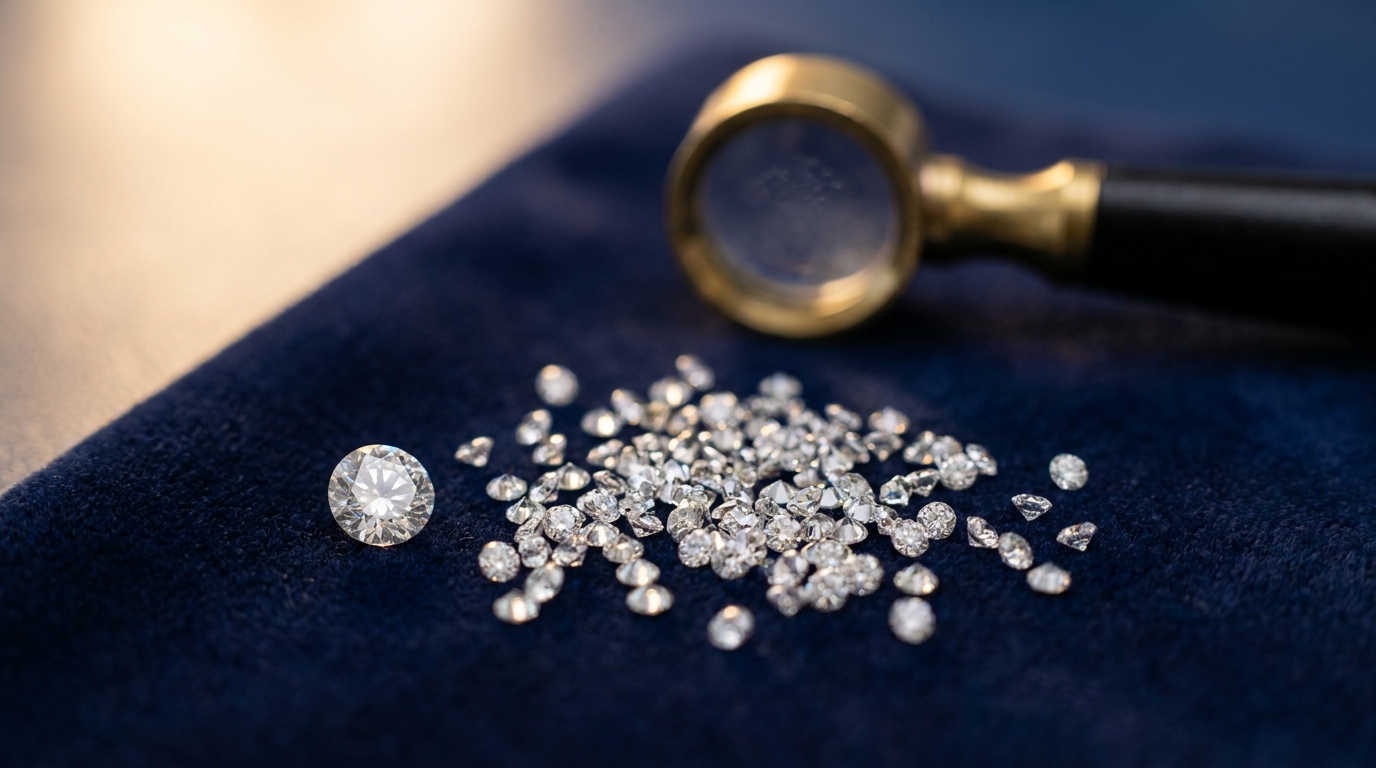
Are Natural Melee Diamonds Certified?
Straight answer: no. Natural melee — loose, mined round diamonds under 1 carat, typically sold in the 0.8mm to 4.0mm range — doesn't come with an individual grading certificate, and it doesn't come with a per-parcel certificate either. This is true of natural melee specifically and true of melee generally across the entire trade, lab-grown included. No supplier, however reputable, is issuing a GIA or IGI report for a 1.5mm diamond.
That answer surprises some buyers, especially jewelers whose main experience is on the loose-stone side of the business, where a certificate is the default and its absence is a red flag. Melee runs on a different model entirely. The stones are real, natural, mined diamonds — they're just sold, verified, and quality-controlled through a different mechanism than paperwork tied to one stone. The rest of this guide walks through why that mechanism exists, what it actually looks like in practice, and how to tell normal trade practice from an actual quality problem.
If you're buying natural melee wholesale for the first time, this is one of the most common points of confusion — right alongside sizing and grading. For the full buying picture, see our complete wholesale buying guide.
Why Doesn't Certification Make Sense Below About 0.20 Carat?
Certification is a service, and like any service it has a cost — a lab has to receive the stone, examine it under controlled conditions, measure it, plot inclusions, assign grades across multiple criteria, write a report, and issue paperwork that's traceable back to that specific stone. That process costs real money per stone, regardless of the stone's size.
A center stone or a loose diamond weighing a carat or more can absorb that cost easily — the certification fee is a small fraction of the stone's value, and buyers expect to pay for it. A melee-sized stone below roughly 0.20ct can't absorb it at all. The grading and paperwork cost for a single stone that small would often exceed what the stone itself sells for. At that point, certifying it isn't quality assurance — it's a guaranteed loss on every stone in the parcel.
This isn't a natural-melee-specific issue, and it isn't unique to Guru Diam. It's arithmetic that applies to every melee-sized diamond sold anywhere in the trade, natural or lab-grown. Any supplier claiming individual certification on true melee-sized goods is either misdescribing a different product tier or making a claim that doesn't hold up to what certification actually costs to produce.
The threshold isn't a hard line carved in stone — it's a practical one. Somewhere around 0.20ct, the economics flip from "certification is a small percentage add-on" to "certification costs more than the stone." Below that line, the trade has settled on a different, parcel-based way of controlling quality — which is the subject of the next section.
What Replaces a Certificate on Melee-Sized Goods?
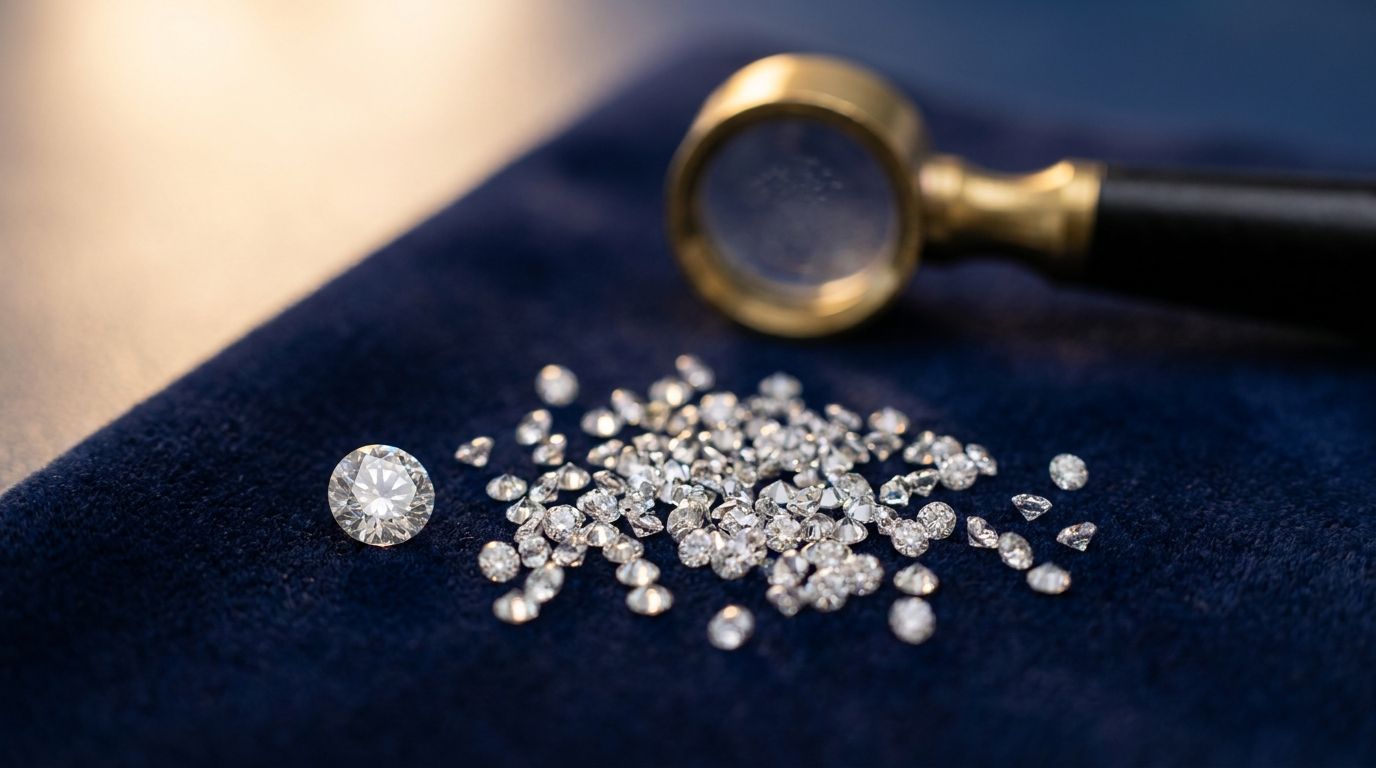
Instead of a certificate per stone, natural melee ships as sieve/size-graded parcel goods, sorted comparatively against a master stone. Two separate sorting steps happen before a parcel is packaged for sale: size sorting and quality sorting.
Size sorting runs stones through graduated sieve plates — metal plates with progressively smaller openings that separate stones by millimeter diameter with far more precision and consistency than sorting by eye. A stone that passes through a 2.0mm opening but not a 1.9mm opening gets grouped with other stones in that same narrow size band.
Quality sorting — color and clarity — works by comparison rather than isolated measurement. A trained sorter holds each stone up against a master stone, a reference diamond that has already been graded and anchors the call for that batch. If a stone reads the same color and clarity as the master stone (or within the accepted tolerance), it goes into that parcel. This happens fast, at volume, and consistently enough that a parcel graded GH VS is actually GH VS stone to stone — not a loose mix that happens to average out to that label.
The result is a parcel, not a certificate: a bulk carat weight of stones that all fall within a stated millimeter size and a stated color/clarity band, sold and confirmed at quote rather than accompanied by individual paperwork. It's a different deliverable than what a loose-stone buyer is used to, but it's the deliverable the entire melee trade is built around.
How Does Master-Stone Grading Actually Work in Practice?
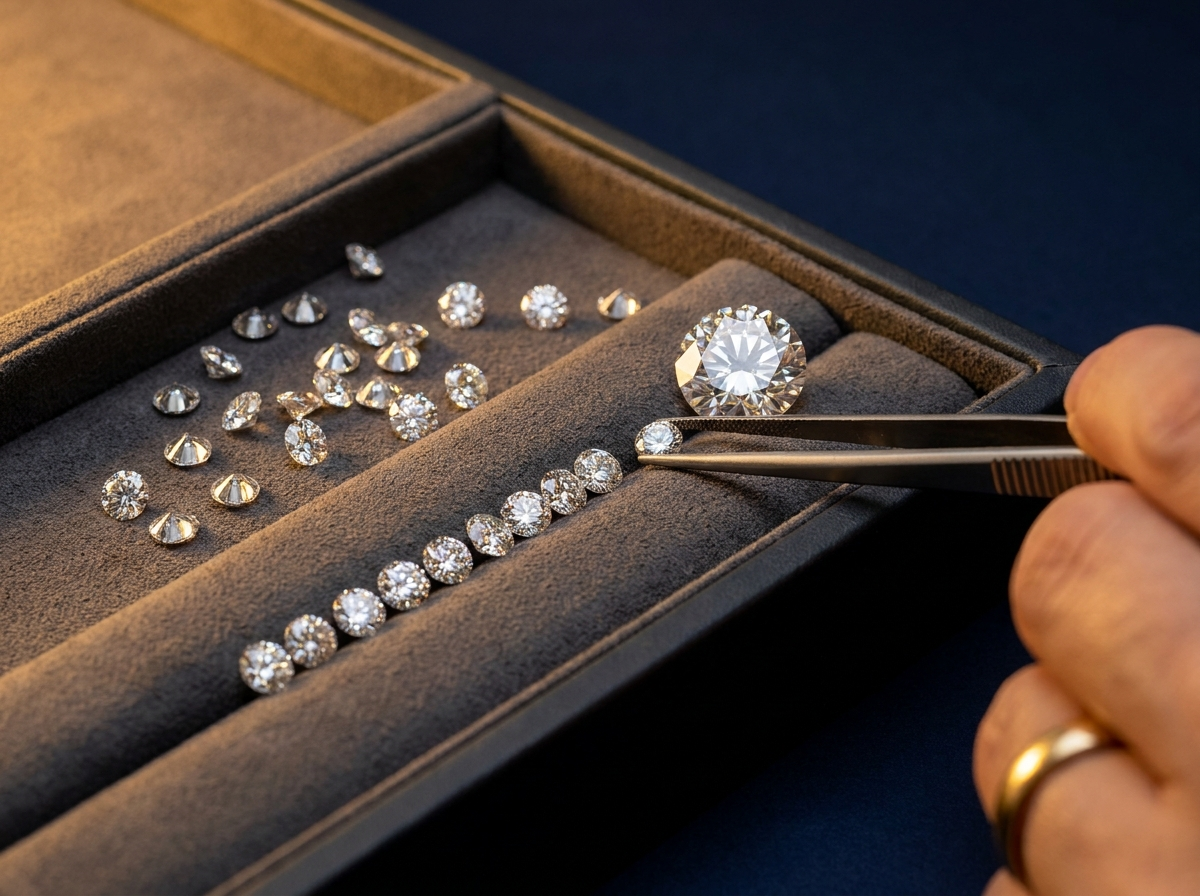
A master stone is a physical reference diamond, already graded and held constant, that a sorter uses as the benchmark for an entire batch. Instead of independently grading each melee stone from scratch — the way a lab grades a certified loose diamond — a sorter compares incoming stones directly against that one fixed reference, side by side, under consistent lighting.
This is faster than isolated grading by an order of magnitude, and speed matters, because a single melee order can involve hundreds or thousands of stones. But speed isn't the only reason the method exists — comparative sorting against a fixed reference is also more consistent across a large batch than independently eyeballing each stone would be. Every stone gets checked against the same anchor, which is what makes a parcel graded to a specific band actually hold to that band stone to stone.
The output is a blended-range grade, not a single exact grade guaranteed on every individual stone. A parcel graded EF VS falls within the E-to-F color range and the VS clarity range as sorted against the master stone — it isn't a claim that every stone in that parcel, if pulled out and independently graded by a lab, would land at exactly the same point on the scale. That's standard, disclosed trade practice for parcel goods at melee sizes, and it's the reason melee is sold in grade bands (EF, GH; VS, SI) rather than single point grades the way loose certified stones are.
Calibration tolerance works alongside master-stone grading to keep a parcel consistent: standard trade tolerance runs ±0.10mm on dimension, ±0.10ct on weight, and a 1-grade match on color and clarity within a parcel. Together, sieve sorting, master-stone grading, and calibration tolerance are what stand in for a certificate — three layers of comparative control instead of one document per stone. For a deeper look at how grading and matching actually happens at scale across a full order, see how natural melee diamonds are graded and matched at scale.
Is There a "GIA Certified Melee" Service — and Is That the Same Thing?

This is worth addressing directly, because it's a genuine source of confusion in melee buying — and some listings across the trade blur the line on purpose. GIA does offer an automated melee analysis service, built to sort and screen melee-size diamonds quickly and at volume. It's real technology, and it's useful. But it is not the same thing as the individual grading report GIA issues for a loose stone, and it doesn't put a certificate number on any single melee stone.
The distinction matters: a grading report is a document tied to one specific, identifiable stone, describing its individual 4Cs. A melee analysis or screening service operates on a batch — it sorts, separates, and verifies characteristics like natural-versus-lab-grown origin across a large quantity of small stones, quickly. That's a sorting and verification tool, not a certification product, and it doesn't come with a document you can hand a customer and say "this is stone number X's paperwork."
Some sellers describe melee as "GIA certified" when what actually happened is that the goods passed through automated screening or sorting equipment, or that the parcel was pulled from a larger batch that had certified stones elsewhere in it. If you see that phrase attached to true melee-sized goods, it's worth asking the seller exactly what document they mean — a real per-stone GIA or IGI report on a sub-0.20ct diamond is not something the trade actually produces, for the cost reasons covered above.
Natural-origin verification is a separate, related concern from certification, and it's a real one — natural and lab-grown melee are visually indistinguishable to the naked eye, so screening technology that confirms origin matters even without a per-stone certificate. That's covered in full in our guide to natural melee screening and confirming it's not lab-grown.
How Is This Different from Loose Diamonds at 0.30ct and Up?
Loose diamonds at 0.30ct and above are a different product tier, and they do ship IGI or GIA certified — that's a real, standard part of that tier, not something to expect on melee. The line isn't arbitrary: at 0.30ct and above, the certification cost is a manageable fraction of the stone's value, so paying for individual grading makes economic sense for both the seller and the buyer. Below roughly 0.20ct, that math doesn't work, which is exactly the certification gap this whole post is about.
Between roughly 0.20ct and 0.30ct sits a gray zone where practice varies by seller and by stone — some individual stones in that range get certified, some don't, depending on value and what the buyer's asking for. But melee, in the sense this guide covers — the small accent stones used in pavé, halo, eternity, and tennis work — sits well under that range. If your job calls for a true melee-sized parcel, budget for parcel goods sorted against a master stone, not a stack of individual certificates.
Guru Diam runs both tiers as genuinely separate products: melee-sized natural diamonds, sold as sieve/size-graded parcel goods with no per-stone certificate, and loose natural diamonds at 0.30ct and above, sold individually with IGI or GIA certification. Don't expect one tier's paperwork on the other — a supplier who tries to attach loose-stone-style certification claims to melee-sized goods is stretching a fact that only applies to the larger tier.
Is Uncertified Melee a Red Flag, or Is This Normal?
Normal. It's worth stating plainly, because "uncertified" can sound like a euphemism for "unverified" or "lower quality" if you're used to loose-stone buying — and it isn't either of those things here. The absence of a certificate on melee reflects the economics of grading small stones, not a gap in how carefully the goods were sourced or checked.
Every reputable melee supplier in the trade — natural or lab-grown — operates the same way: sieve sizing, master-stone comparative grading, and calibration tolerances, with no individual certificate. If a natural melee listing anywhere claims individual or full-parcel certification the way a loose stone would carry it, that's the detail worth double-checking, not the other way around. A parcel that actually is certified stone by stone at true melee sizes would be priced accordingly — certification cost doesn't disappear, it gets passed through, and at melee sizes that pass-through cost would dwarf the stone value itself.
The real question to ask a melee supplier isn't "where's the certificate" — it's "how do you sort and verify this parcel, and can you tell me the tolerance you're holding it to." That question gets you the actual quality-control information a certificate would have given you on a larger stone, just delivered through the mechanism that actually applies at this size.
How Do You Verify Quality Without a Certificate?
Three things stand in for a certificate on melee-sized goods, and a buyer can ask about all three before placing an order: the sieve/size sorting method, the master-stone grading standard used for color and clarity, and the calibration tolerance the parcel is held to. A supplier who can speak clearly to all three — in millimeters, in named grade bands, and in a stated tolerance like ±0.10mm/±0.10ct — is working to a real, checkable standard, even without a per-stone document.
Origin verification is the other piece worth confirming separately from grading. Since natural and lab-grown diamonds are chemically real diamond in both cases and visually indistinguishable to the eye, a natural melee supplier should be screening incoming parcels with diamond-type verification technology to confirm natural origin — not simply asserting it. This is a distinct question from color/clarity grading, and it's worth asking about directly, especially for a natural-specific order where origin is the entire point of the purchase.
Consistency across reorders is a practical, ongoing check too. A parcel you reorder at the same size and grade should read the same as the one you approved the first time, because it's sorted against the same master-stone standard every time. If a reorder visibly drifts from a prior shipment at the same stated grade, that's a real quality signal worth raising with your supplier — a much more useful check, in practice, than the absence of a piece of paper.
What Should You Ask a Supplier About Their Grading Process?
A few direct questions separate a supplier working to a real, disclosed standard from one asking you to trust their eye with no way to check it:
- What sieve or millimeter tolerance do you hold parcels to? A real answer is a number — ±0.10mm is standard trade tolerance — not "close enough."
- Is every parcel sorted against a master stone, or graded loosely by whoever's on the bench? Consistent master-stone sorting is what makes a grade band mean the same thing parcel to parcel.
- How do you verify natural origin on incoming goods? Look for a specific answer involving diamond-type screening technology, not just "we know our source."
- What happens to stones that fall outside the stated tolerance? A supplier working to a real standard resorts or recuts out-of-spec stones before a batch ships, rather than shipping whatever came off the last sorting pass.
- Will a reorder at the same size and grade match what I received the first time? This is the practical, ongoing version of "is this certified" — consistency you can verify shipment to shipment.
A supplier who answers these plainly, with real numbers and named methods, is giving you the functional equivalent of a certificate's quality assurance — just structured around a parcel instead of a single stone.
Does the Lack of Certification Affect Melee Pricing?
Indirectly, yes — but not in the direction some buyers expect. Melee pricing runs per carat and rises with size and grade; it doesn't carry a certification line item the way a loose stone's price sometimes implicitly does, because there's no certification cost to pass through. Guru Diam's current natural melee pricing starts around $370–450 per carat in the smallest sizes and rises with size and color/clarity grade — presented as approximate, per carat, and confirmed at quote, since melee is priced per parcel against sieve bands rather than sold off a fixed price list. For the full size-by-grade pricing table, see our wholesale buying guide or the dedicated pricing guide.
What the absence of certification does affect is how you should read a quoted price against a loose-stone price. A per-carat melee number and a per-carat loose-stone number aren't measuring the same deliverable — one includes the cost of individual grading and paperwork, the other doesn't, because that paperwork isn't produced at melee sizes in the first place. Comparing them directly, dollar for dollar per carat, isn't a fair read of either tier.
What Should You Expect on Your Melee Parcel Instead of a Certificate?
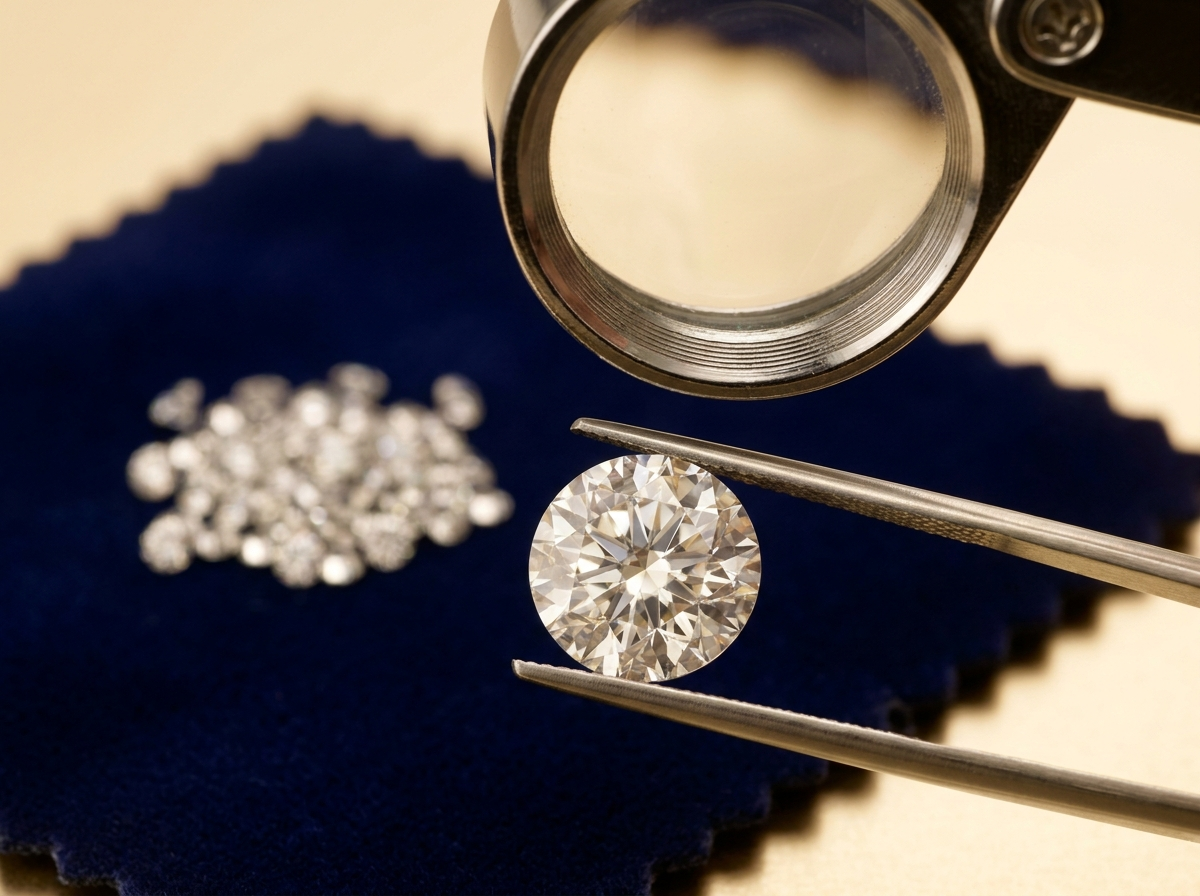
A natural melee order from Guru Diam ships with a stated millimeter size (or size range), a stated color/clarity grade (EF VS, EF SI, GH VS, or GH SI), the total carat weight, and the calibration tolerance the parcel was sorted to — parcel paper documentation of the spec you ordered against, not a lab report tied to any individual stone. That's the standard, disclosed deliverable for melee-sized goods across the trade, natural or lab-grown, and it's what you should expect from any legitimate melee supplier.
If your job later needs a larger, individually certified stone alongside your melee — a center stone for a halo setting, for instance — that's a separate order against Guru Diam's loose certified inventory at 0.30ct and up, with its own IGI or GIA paperwork. The two don't get bundled into one document, because they're genuinely two different products sold two different ways.
To confirm current pricing, size availability, or calibration tolerance on a specific natural melee order, reach out on WhatsApp or through Contact — Guru Diam operates trade desks in New York and Los Angeles, with same-day shipping (before 6pm EST from New York, before 4pm PST from Los Angeles) subject to the parcel being in stock at your size and grade.
Frequently Asked Questions
Are natural melee diamonds certified?
No. Natural melee under roughly 0.20ct isn't individually or parcel-certified anywhere in the trade — certification cost exceeds stone value at that size. It's sorted comparatively against a master stone and shipped as sieve/size-graded parcel goods instead.
Why can't melee diamonds get a GIA or IGI certificate?
Cost. Grading and issuing paperwork for one stone costs real money regardless of the stone's size, and below roughly 0.20ct that cost exceeds what the stone itself is worth. Certifying it wouldn't be quality control — it would guarantee a loss on every stone.
What is GIA's melee analysis service, and does it certify melee stones?
It's an automated sorting and screening service built to process melee-size diamonds at volume — real technology, but not the same as an individual grading report. It doesn't put a certificate number on any single melee stone the way a loose-stone report does.
How do I know melee diamond quality without a certificate?
Through sieve/size sorting, comparative master-stone grading for color and clarity, and stated calibration tolerance (typically ±0.10mm/±0.10ct). Ask any supplier to state their method and tolerance in specific terms — that's the functional equivalent of a certificate at this size.
At what carat weight do loose diamonds start getting certified?
Roughly 0.30ct and up is where individual IGI or GIA certification is standard and economically practical. Between about 0.20ct and 0.30ct, practice varies by stone and seller. True melee-sized goods sit well under that range.
Is uncertified melee a sign of lower quality or a scam?
No — it's normal, standard trade practice across every reputable melee supplier, natural or lab-grown. The red flag runs the other way: a listing claiming individual or full-parcel certification on true melee-sized stones is worth a second look, since that cost structure doesn't exist at this size.