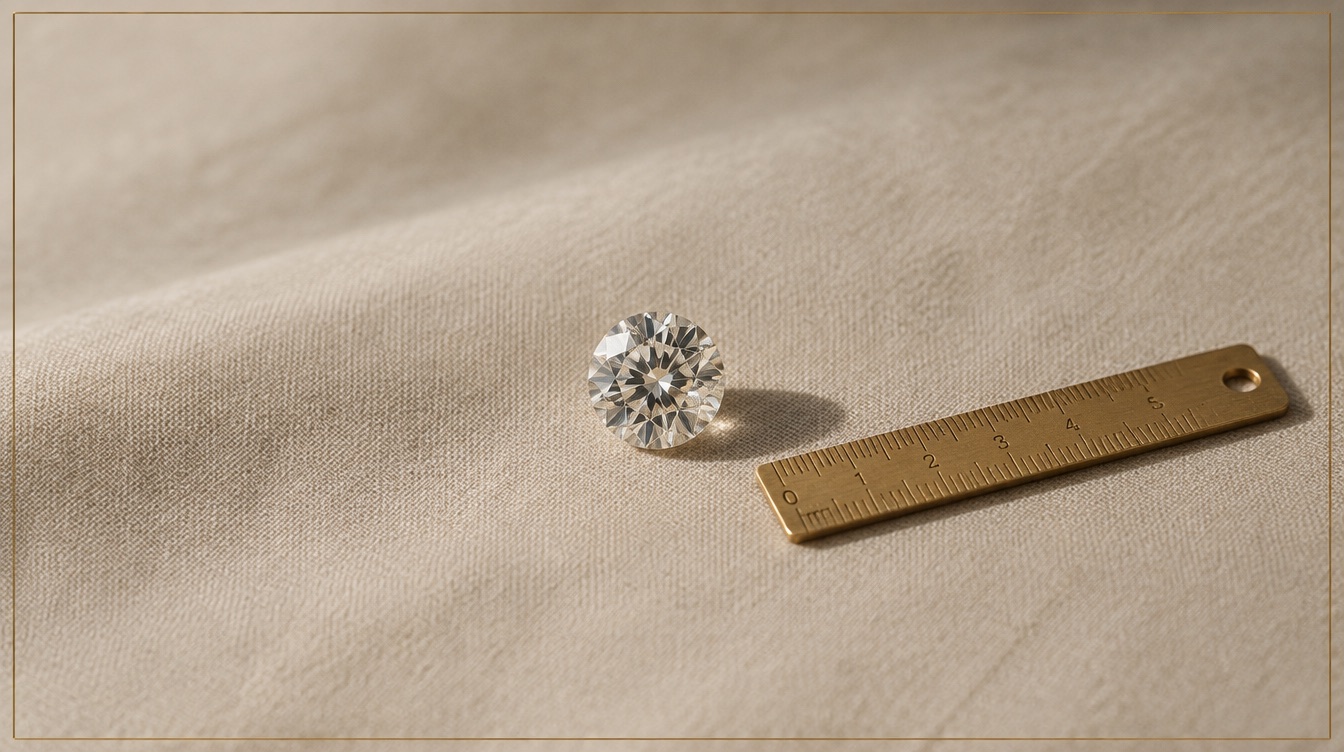
How Natural Melee Diamonds Are Graded and Matched at Scale

Natural melee diamonds are graded comparatively, not individually certified. A trained sorter holds each stone next to a graded master stone under controlled lighting to place it in a color and clarity band, while a sieve plate separates stones by millimeter size. The two processes run side by side, and the matched stones are pooled into a parcel that reads as one consistent grade — the standard method across the trade for diamonds too small to certify economically, one stone at a time.
If you buy natural melee by the parcel, the grade on your invoice was never assigned to any single stone inside it — it describes the band the whole parcel was sorted to hold. That is normal, well-established trade practice, not a shortcut unique to one supplier, and it applies the same way whether the melee is natural or lab-grown. This piece walks through exactly how that sort happens: the master-stone comparison method, where sieve-based sizing fits in, how a parcel gets assembled to a stated grade, and the quality-control checks that catch drift before a parcel ships.
What Is Master-Stone Comparative Grading?
A master stone is a diamond (or a small matched set) whose color and clarity have been fixed as the reference point for a given grade band — one master for the EF range, another for the GH range, and so on. Instead of grading a loose melee stone against an abstract verbal scale, a sorter lays it face-up next to the master under a diffused, daylight-equivalent light source and compares the two directly: same lighting, same background, same angle, side by side.
Color is read by comparing body color against the master, typically viewed table-down against a white tray or gauge so the color shows through the pavilion rather than getting masked by facet sparkle. Clarity is checked at loupe or low-power microscope magnification, looking for inclusions that would push a stone out of the VS range and into SI, or vice versa. Because the comparison is stone-to-stone rather than stone-to-scale, it is fast enough to run at parcel volume — which is the entire point. A center diamond gets minutes of individual attention against a written scale; a melee parcel of several hundred or several thousand stones does not have that kind of time budget, so the trade solved it by comparing directly against a fixed physical reference instead.
This is also why melee quality is described in bands — EF, GH, VS, SI — rather than single-point grades like a certified stone's report. A master-stone comparison has real, honest resolution: it can reliably tell you a stone belongs in the EF range versus the GH range, or VS versus SI. It was never built to resolve the finer distinctions a full gemological lab makes on a stone worth grading individually. Reputable sorting desks keep master sets under lock, check them periodically against a calibrated reference, and retire a master if it shows wear or handling damage — a scratched or clouded master stone drifts the whole grading line without anyone necessarily noticing until a customer flags an inconsistent parcel.
How Does Sieve-Based Sorting Fit Into the Process?
Size and quality are graded separately, and size comes first. Loose melee is poured onto a stacked set of sieve plates — flat discs machined with a grid of precisely sized round holes, largest opening on top, smallest at the bottom. The stack is shaken by hand or on a vibratory sieve shaker, and each stone falls through every hole larger than its own diameter until it lands on the first plate whose openings are too small to pass it. That plate becomes the stone's size band.
Sieving has to happen before color comparison, not after, because a master-stone read is only reliable within a consistent size band. A tiny 0.9mm stone and a 3.5mm stone reflect and transmit light differently even at the same true body color — mixing sizes on the sorting tray introduces a variable the comparison was never designed to correct for. So the practical sequence on a working desk is: rough-sort to size first, then, within each size band, compare color and clarity against the master calibrated for that band. A spot-check with a hand micrometer or leaf gauge afterward confirms the sieve plate did its job — plates wear slightly with repeated use, and a worn plate can drift a few hundredths of a millimeter out of spec over time.
The physical mechanics of sieve sizing are the same whether the melee is natural or lab-grown — see our melee size chart, mm to carat to sieve for the full conversion table. What differs for natural melee is what happens after the size sort: no equivalent individual certificate exists to fall back on, so the color/clarity comparison against the master carries the full weight of the quality claim.

Who Actually Grades a Melee Parcel?
Trained sorters, working at a trade desk with a master stone set, a loupe or microscope, and a controlled light source. On very high-volume lots, optical color-sorting equipment can do a first pass to bucket stones roughly by body color, but the final call — especially on borderline stones sitting near a band edge — stays with a human sorter comparing directly against the master. Melee sorting is a hands-on trade skill built through repetition on the floor rather than a credential issued by an outside body; there is no equivalent of a GIA diploma specifically for melee sorting the way there is for stone grading generally.
Because of that, process discipline matters more than any single sorter's individual eye. The desks that hold quality consistently use a second-eye check: one sorter grades, a second independently spot-checks a sample of the same lot against the same master, and any disagreement gets resolved before the parcel is packed. A single sorter working a long run without that second check is the most common point where a grade quietly drifts — fatigue and eye strain are real variables in a manual comparison process, which is exactly why the check exists.
How Is a Parcel Assembled to a Consistent Grade?
Once stones have passed both sorts — sized to a sieve band, graded to a color/clarity band — they pool into a bulk lot for that specific combination, for example a run of 2.30–2.60mm stones graded GH VS. That pooled lot gets weighed and packed into trade paper packets (folded diamond papers, or larger parcel envelopes for bulk lots) labeled with size, grade, and weight. When an order comes in, the quantity drawn is measured out to the ordered total carat weight, not counted stone by stone — melee is bought and sold by the carat, and the stone count per carat is a byproduct of size, not the ordering unit.
Because the quality grid is a blended range — EF and GH color, VS and SI clarity — rather than an exact single grade, a finished parcel legitimately contains natural variation within its stated band. A GH VS parcel can include stones that individually would sit closer to G or closer to H, closer to a clean VS1 impression or a heavier VS2 impression, matched so the parcel as a whole reads consistently inside that band. That is expected trade tolerance, not an inconsistency to flag — the same way a calibrated size band carries a working tolerance rather than a single exact millimeter. General trade calibration convention applies here too: roughly ±0.10mm on dimension, ±0.10ct on total weight, and a one-grade color/clarity match within the stated band.

What Quality Control Happens Before a Parcel Ships?
Because no individual stone in a melee parcel carries its own paperwork, the pre-ship QC pass is what actually backs the stated grade. A working checklist typically covers:
- Second-eye re-grading. A random sample pulled from the finished parcel and re-checked against the same master stone by a second sorter, independent of whoever ran the original sort.
- Size verification. A micrometer or leaf-gauge spot-check confirming the sieve plate held its stated band — plates wear, and a drifted plate is easier to catch on a sample than on every stone.
- Weight verification. The parcel's total carat weight confirmed on a calibrated scale against the invoice figure and cross-checked as reasonable for the size band and stone count.
- Outlier culling. A visual pass to pull any stone that is obviously off-color or over-included relative to the stated band — the handful of stones a bulk sort can miss on the first pass.
- Screening for undisclosed mixed material. A pass to confirm a natural-melee parcel hasn't picked up any undisclosed synthetic material — a disclosure and integrity check, not a grading step, but part of what "quality control" means for a natural line specifically.
None of this produces per-stone paperwork — that is not how melee works, and it is not a Guru Diam shortcoming. It is standard practice across the trade for stones this small, natural or lab-grown, and the parcel-level QC pass is what stands in for the individual report a larger stone would carry. For the fuller breakdown of what "certified" actually means at melee size versus at loose-stone size, see Natural Melee Diamonds: Certified vs Uncertified Parcel Goods Explained.

Why Aren't Individual Melee Stones Certified?
Cost, plain and simple. A gemological lab certificate carries a real fee and real handling time, and below roughly 0.20ct that cost exceeds the value of the stone itself — there is no economic case for spending more on paperwork than the diamond is worth. This is not specific to Guru Diam or to natural melee; it is a trade-wide constraint that applies to lab-grown melee at the same size range too. The trade's answer is exactly the process described above: sieve-based sizing plus master-stone comparative grading, applied at the parcel level instead of the stone level.
It is worth being precise about where the line actually falls. Loose diamonds at roughly 0.30ct and above are routinely certified individually by labs such as GIA or IGI — that is a genuinely different product tier, with its own report number and plotted clarity diagram for one identified stone. Melee is not that product, and no melee parcel should be marketed as if it carries that kind of individual paperwork. If a size falls in the gap between "clearly melee" and "clearly certifiable," ask your supplier directly which grading method applies to that specific stone rather than assuming.
How Does Comparative Grading Differ From Individual Lab Certification?
The two methods are built for different jobs, not competing versions of the same job.
| Grading method | Applies to | How the check happens | What you get |
|---|---|---|---|
| Individual lab certification (GIA, IGI) | Loose stones, generally 0.30ct+ | One stone, examined solo under gemological instruments, multiple graders' input | A permanent report number and plotted grade for that single stone |
| Master-stone comparative grading | Melee, generally sub-0.20ct | Stone-to-stone comparison against a fixed physical reference, at volume | A parcel-level grade band the whole lot was sorted to hold |
Neither approach is the lesser version of the other — each is matched to what the stone is actually worth and how it gets used. A center stone is inspected, appraised, and often re-sold as that specific stone; melee is set in bulk as an accent and is never handled or valued individually again once it's on the mounting. Spending certification-level time and cost per stone at melee prices would multiply the cost of the goods many times over for a precision the end use doesn't call for.
What Do EF/GH and VS/SI Actually Mean Inside a Graded Parcel?
Guru Diam's natural melee ships against a two-color, two-clarity grid: EF (E–F color) and GH (G–H color), each available in VS and SI clarity. As covered above, this is a blended-range grid — standard trade practice — not four exact single grades. A parcel graded EF VS sits in the near-colorless band with a predominantly clean-to-VS clarity impression against the master; a parcel graded GH SI runs warmer in body color with inclusions visible at loupe magnification, at a correspondingly lower price point.
Because comparative grading resolves to a band rather than a pinpoint, asking a supplier for finer resolution than EF-vs-GH or VS-vs-SI at melee size is asking the method for more precision than it is built to deliver economically. For the full picture of what each band looks like in practice, how to choose between them by end use, and where the price gap between them actually comes from, see Natural Melee Color & Clarity Grades Explained. One scope note worth stating plainly here: EF has no meaningful supply below roughly 1.70mm — no vendor in the trade quotes a genuine E-color parcel at the smallest sizes — so EF at those sizes is not a gap in Guru Diam's sourcing specifically, it is a gap in what the trade produces at that size.
What Can Go Wrong in Melee Grading — and How Buyers Screen for It?
Comparative grading is reliable when the process is disciplined, and it drifts in a handful of predictable ways when it isn't:
- An uncalibrated or worn master stone. A master that hasn't been checked against a fresh reference in a while can quietly shift what "EF" or "GH" means on that particular desk.
- Inconsistent lighting between sessions. Color comparison is lighting-dependent; a warmer or cooler bulb than the desk's standard reads color differently and skews the sort.
- Grading before sizing is finished. Comparing color across mixed sizes, rather than within a sieved band, introduces error the master-stone method wasn't designed to absorb.
- No second-eye check on long runs. A single sorter's judgment on a large lot, without an independent spot-check, is the most common place a grade drifts without anyone catching it before ship.
- Outlier stones not fully culled from a bulk buy. A handful of off-band stones slipping through is a QC-pass failure, not a grading-method failure.
On the buyer side, the most common issue isn't a supplier error at all — it's assuming "graded" means "individually inspected" and being surprised that a parcel legitimately contains a natural range within its stated band. The fix is the same on both sides of the transaction: ask a new supplier how they run the process above — master stone calibration, sizing sequence, second-eye QC — before committing to a full parcel, and request a small sample card to check against your own reference first.
How Should You Verify a Parcel's Grade When It Arrives?
A short receiving check catches most issues before stones ever hit a mounting:
- Check color under consistent lighting. Compare a sample against your own reference stones (or a known-grade sample) under a daylight-equivalent light source, not under warm showroom lighting.
- Loupe-check a sample for clarity. Confirm the inclusion level you see is consistent with the stated VS or SI band across the sample, not just the first few stones you look at.
- Weigh the parcel against the invoice. Total carat weight should match what you were quoted and billed for.
- Spot-check size with calipers or a leaf gauge. A handful of stones measured against the expected millimeter range for that sieve size confirms the sizing held.
- Flag outliers before you set anything. If a noticeable share of a sample falls outside the stated band, raise it with your supplier before the parcel goes on the bench — that is a normal, expected part of the relationship, not an accusation.
This is the same discipline that protects both sides of any melee order: a documented spec going out, and a documented check coming in.
Order Natural Melee Graded to a Spec You Can Trust
Guru Diam's natural melee ships sieve-sorted and comparatively graded against the EF/GH, VS/SI grid described above, in the currently priced size range of roughly 0.8mm to 4.0mm, round shapes only for now. Both our New York and Los Angeles desks keep physical master stone sets on hand, so you can review a sample against them before committing to a full parcel. Pricing runs roughly in the $370–450 per carat range at the smallest sizes and rises with size and grade — for exact figures and the full pricing table, see the complete natural melee buying guide, or get pricing confirmed against your specific parcel need on WhatsApp.
- Message our trade desk directly on WhatsApp: +1 347 812 2006
- Or reach out through /contact and a member of our NY or LA team will follow up
New York — 36 West 47th Street, Suite 601A, New York, NY 10036. Los Angeles — 607 S Hill Street, Suite 241, Los Angeles, CA 90014.
Frequently Asked Questions
How is natural melee diamond quality graded without a certificate? Each stone is compared directly against a graded master stone under controlled lighting to confirm its color and clarity band, while a separate sieve-plate pass confirms its size. The stones that pass both checks are pooled into a parcel that carries the resulting grade — a parcel-level grade, not a certificate for any individual stone.
What is a master stone in diamond grading? A master stone is a diamond (or small matched set) whose color and clarity have been fixed as the reference point for a specific grade band. Sorters place loose melee next to it under the same lighting and background to judge whether a stone belongs in that band, rather than grading against an abstract written scale.
Does sieve sorting happen before or after color and clarity grading? Before. Color comparison against a master stone is only reliable within a consistent size band, since stones of different diameters reflect light differently even at the same true body color. Melee is sieved to size first, then color- and clarity-graded within each size band.
Can two parcels of the same stated grade look slightly different? Yes, and that's expected. EF, GH, VS, and SI are blended ranges, not single exact grades, so a parcel legitimately contains natural variation within its stated band. Meaningful differences between parcels — not minor in-band variation — are what a receiving check is meant to catch.
How do I verify a melee parcel's grade when it arrives? Check a sample's color under consistent daylight-equivalent lighting, loupe-check clarity across the sample rather than just a few stones, weigh the total parcel against your invoice, and spot-check size with calipers or a leaf gauge. Flag anything that falls outside the stated band before setting.
Is comparative grading less accurate than individual certification? It resolves to a band rather than a pinpoint grade, which is a different kind of precision, not a lower-quality substitute. Individual certification is built for stones valuable enough to justify the cost of grading one at a time; comparative grading is built to hold a consistent, checkable standard across hundreds or thousands of stones at once, which is what melee actually requires.