What Counts as a Men's Wedding Band, and Why It's a Distinct Stocking Category
A men's wedding band is a ring, typically 6mm to 9mm wide, worn to signify marriage and built for daily wear under working hands. It differs from a women's band mainly in scale and finish preference, not in construction. For jewelers, that difference in sizing, width, and customer expectation is enough to justify treating men's bands as their own merchandising category rather than a smaller version of the bridal case.
Men's bands have historically been treated as an afterthought in bridal buying — a quick add-on sale after the engagement ring and women's band are chosen. That is changing. Wider finish variety, the rise of diamond-set men's bands, and a younger generation of grooms who are willing to spend more on their own ring have made this a category worth planning inventory around, not just reacting to on a case-by-case basis. A jeweler who understands the width ranges, metal mix, and diamond-set options that move in this category can convert more same-visit sales and avoid special-order delays that push the sale to a competitor.
Metals Worth Stocking for Men's Bands
The metal decision is the single biggest driver of price point, durability perception, and reorder frequency in this category. Because Guru Diam's own catalog is built around precious metals and diamonds, this guide focuses on platinum and gold — but it's worth understanding where alternative metals fit in the broader market before deciding what goes in the case.
Platinum
Platinum is the default premium choice for men's bands. It's naturally white, dense (heavier in hand, which many male customers read as a quality cue), hypoallergenic, and develops a soft patina over years rather than losing material the way gold alloys can. It costs more per gram than gold and is harder to size, which matters for a category where exact fit is already trickier than on women's rings.
18k and 14k White, Yellow, and Rose Gold
Gold remains the volume driver. 14k is the more durable, more affordable choice for a men's band that will see daily wear — higher alloy content means more resistance to scratching and bending than 18k. 18k carries a richer color and higher perceived value, which matters more for a diamond-set statement band than for an everyday plain band. White gold needs rhodium replating over time; yellow and rose gold do not, which is worth mentioning to a customer comparing long-term maintenance.
Where Tungsten, Titanium, and Cobalt Fit — Briefly
Tungsten carbide, titanium, and cobalt chrome bands exist in the market primarily as a lower-price, industrial-look alternative, often sold through big-box and online channels rather than through fine jewelers. They can't be resized (tungsten and cobalt can't be resized at all; titanium only minimally), can't easily carry a diamond setting with the same security as precious metal, and don't hold resale or sentimental value the way gold or platinum does. For a trade buyer stocking precious-metal and diamond inventory, these materials are useful to know as category context — a customer may ask about them — but they aren't a natural fit for a case built around platinum, gold, and diamonds.
Metal Comparison for Men's Bands
| Metal | Typical Price Tier | Durability for Daily Wear | Resizing | Maintenance |
|---|---|---|---|---|
| Platinum | Highest | Excellent; dents rather than chips, patinas over time | Possible but labor-intensive | Occasional re-polish to restore shine |
| 18k White Gold | High | Good | Standard | Rhodium replating every 1-2 years |
| 18k Yellow/Rose Gold | High | Good | Standard | Occasional re-polish |
| 14k White Gold | Mid | Very good; harder alloy than 18k | Standard | Rhodium replating every 1-2 years |
| 14k Yellow/Rose Gold | Mid | Very good | Standard | Occasional re-polish |
| Tungsten/Titanium/Cobalt (context only) | Low-mid | Very hard but brittle; can crack on impact | Little to none | Minimal, but cannot be refinished like precious metal |
Widths: What Actually Sells in Men's Bands
Width is the first thing most male customers notice and comment on, and it's the easiest filter for a sales associate to use when narrowing a case full of options. Most men's wedding bands sold at retail fall between 6mm and 9mm, with 8mm being the single most common width for a standard men's band and 6mm reading as a slightly more understated, transitional width between a traditional women's-scale band and a true men's statement piece.
Hand size, finger length, and personal style all factor in, but so does the band's role on the finger — a plain everyday band tends to run narrower than a diamond-set or textured statement band, where more surface width gives the design more to work with. Stocking a run of widths within each popular metal and finish, rather than a single default width, reduces special orders and lets a sales associate upsell a customer from a 6mm plain band to an 8mm textured one without losing the sale to a competitor who happens to have the wider option in stock.
Width-to-Use-Case Guide
| Width | Typical Buyer Profile | Common Pairing |
|---|---|---|
| 6mm | Slimmer hands, understated style, first-time band buyers | Comfort-fit plain band, light brushed finish |
| 7mm | Most versatile; the safe recommendation when unsure | Brushed or matte finish, optional single-row diamond accent |
| 8mm | Standard men's band; largest single-width seller | Hammered or brushed finish, diamond-set statement options |
| 9mm | Larger hands, customers wanting a bold presence | Two-tone metal, heavier diamond-set designs |
Profile and Comfort Fit — A Brief Note
Profile (flat, court, or comfort-fit) and the tradeoffs between them are covered in depth in our dedicated Wedding Band Styles Guide, so we won't re-tread that ground here. For men's bands specifically, the one point worth flagging at the counter is that comfort-fit profiles — a domed interior that reduces surface contact with the finger — are disproportionately popular with male customers precisely because wider bands (7mm and up) can feel bulky or tight without that interior curve. When a customer is deciding between two widths, steering them toward a comfort-fit profile on the wider option often resolves the hesitation faster than discussing width alone.
Finishes: Brushed, Hammered, and Matte
Finish is where men's bands have differentiated the most from traditional polished bridal jewelry over the past several years, and it's a major lever for both price point and perceived personality of the piece.
Brushed (Satin) Finish
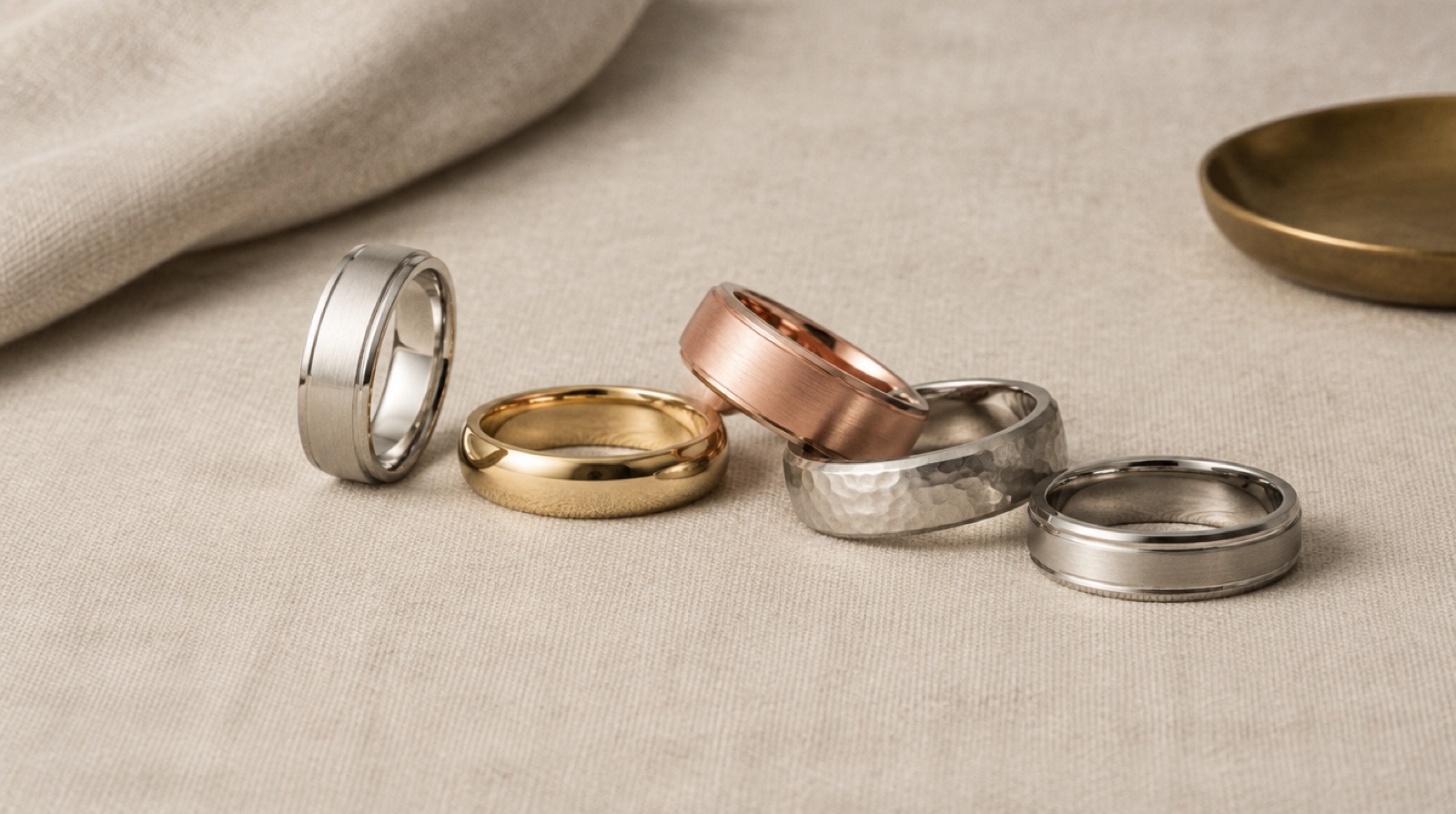
A uniform, low-sheen texture created with a fine abrasive wheel. It's the most popular finish in the category because it hides everyday scratches better than high polish and reads as more masculine and understated. It pairs well with every metal and every width.
Hammered Finish
An irregular, faceted texture created by physically hammering the metal surface. It's a strong seller for customers who want a visibly handcrafted, organic look, and it hides wear even better than brushed since the surface is already irregular. It works best on wider bands (7mm+) where there's enough surface area for the texture to read clearly.
Matte Finish
A flat, non-reflective surface, often achieved with a different abrasive process than brushed and sometimes combined with a sandblasted effect. It's the most understated of the three and tends to appeal to customers who work with their hands and want minimal reflectivity.
Polished (high-shine) finishes haven't disappeared, but in men's bands specifically they now trail brushed and matte in volume at most independent jewelers. Stocking a mix — rather than defaulting to polished across the men's case — better matches current demand.
Diamond-Set Men's Bands: A Growing Trend Worth Planning For
Diamond-set men's bands are the fastest-growing sub-segment of this category. What used to be a niche request — a single channel-set row of small stones — has broadened into a real range of designs: single-row pavé, offset accent stones, black diamond or mixed-color accents, and asymmetric settings that read more like fine jewelry than a traditional band.
For stocking and pricing purposes, a few practical points matter. First, setting security is non-negotiable on a men's band — these rings see more daily impact than a women's band, so bezel and channel settings, which protect the stone edge, tend to outperform prong settings for this customer. Second, melee size and quality should be calibrated to the width and finish of the band; a 7-8mm brushed band with small, well-matched melee in a channel setting is a far easier sell (and a far easier reorder) than a one-off custom stone mix. Third, price the diamond-set line with enough range to cover both an entry statement piece and a higher-end option — most shops see the bulk of volume in the middle of that range, with the top end serving as an aspirational upsell that also lifts the average sale on adjacent pieces.
Because diamond-set men's bands are finished jewelry rather than loose stones, lead time and sourcing consistency matter more here than almost anywhere else in the men's case — a customer picking a band for a date-certain wedding won't wait weeks for a re-order.
Sizing Considerations Specific to Men's Bands
Men's band sizing has a few quirks that don't apply the same way to women's rings, and getting them wrong is one of the more common (and avoidable) causes of a return or a frustrated reorder.
The most important one: as band width increases, the effective fit tightens for a given finger circumference, because more metal surface contacts the sides of the finger. A customer who normally wears a size 10 in a thin band may need to size up half a size or more in an 8-9mm band to feel the same comfort. This is especially true without a comfort-fit interior profile. Sales staff should size men specifically on the width they're buying, not on a generic sizer, and should account for knuckle size versus base-of-finger size — many men have a knuckle that's noticeably larger than the base of the finger, which a standard sizing stick can miss.
Seasonal and activity-related finger swelling is also more pronounced for men in physically active jobs or hot climates; sizing at the end of a workday or after physical activity, rather than first thing in the morning, tends to produce a more realistic long-term fit. Finally, metal choice affects resizing flexibility: a platinum band in a popular wide width is a bigger resizing job than the equivalent gold band, which is worth factoring into how much safety margin to size with before cutting metal.
Durability and Maintenance: What to Tell Customers
Men's bands are worn harder than almost any other piece of jewelry a customer will own, which makes the maintenance conversation at the point of sale genuinely useful rather than just upsell filler.
A few points are worth covering consistently with every men's band sale. Brushed and matte finishes will soften toward a slight sheen over months of wear as daily friction smooths the texture — this is normal and can be refreshed in-store rather than requiring a full remake. Platinum develops a patina rather than losing metal the way gold alloys can, so a customer who prefers the bright original finish should know that periodic re-polishing is a maintenance step, not a defect. White gold needs rhodium replating on a cycle of roughly one to two years depending on wear; setting that expectation up front avoids a surprised customer later. For diamond-set bands, recommending an annual prong and setting check (even on bezel and channel settings) catches a loosened stone before it's lost, and it's a natural reason to bring the customer back into the store. Band removal for manual labor, gym work, or contact sports is worth mentioning once, briefly, without turning it into a lecture — most of the damage and loss claims jewelers see on men's bands trace back to exactly those situations.
Merchandising and Stocking Decisions for the Men's Case
Treating men's bands as their own planogram, rather than a few stray SKUs tucked into the bridal case, tends to lift both attach-rate sales (selling the band alongside the engagement ring) and standalone sales from men shopping without a partner present.
A practical core assortment covers: two to three widths per popular metal (commonly 6mm, 7-8mm, and 9mm), both 14k and 18k options in white and yellow gold plus at least one platinum SKU, and a finish spread across brushed, matte, and at least one hammered or textured option. Layered on top of that plain-band core, a smaller but well-chosen run of diamond-set bands — spanning a modest entry price point up through a clear statement piece — covers the fastest-growing part of the category without overcommitting capital to it. Reorder velocity data, where available, should guide which width-metal-finish combinations get the deepest stock versus which stay as special-order or sample-only options.
Display placement matters almost as much as the assortment itself. Men's bands sold in a dedicated case or section — rather than scattered among women's bridal styles — tend to see higher conversion, likely because male customers (and the partners shopping alongside them) can browse width and finish side by side without wading through unrelated styles. Grouping by finish rather than strictly by metal also helps: a customer who has already decided they want a brushed look can compare platinum, 14k, and 18k options in that finish directly, which shortens the decision and reduces the odds of walking out to "think about it." Seasonal timing is worth factoring in too — engagement season (the weeks around major holidays) drives a surge in women's ring sales but a slower, steadier lift in men's band interest that often peaks closer to the actual wedding date, so replenishment timing for the men's case doesn't need to mirror the engagement ring case exactly.
Sample stock versus special-order policy should be decided deliberately rather than improvised at the counter. A narrow core of fast-moving width-metal-finish combinations held in actual inventory, backed by a broader catalog of sizeable and finish variants available to special-order within a short, clearly communicated lead time, tends to outperform either extreme — carrying everything in depth ties up capital in slow-moving combinations, while carrying nothing in depth pushes every sale into a wait that risks losing the customer to a competitor with the piece on hand.
Sourcing Men's Band Inventory and Custom Options
Because men's bands span a wide combination of metal, width, finish, and diamond-set variables, a jeweler's ability to react quickly to what's actually selling depends heavily on supplier reliability. Guru Diam supplies the trade with certified diamonds and finished jewelry from offices in New York and Los Angeles, with same-day shipping on in-stock inventory when orders come in before 6pm EST from NYC or 4pm PST from LA — useful for restocking a fast-moving width or finish without a multi-week gap in the case.
For diamond-set men's bands specifically, all lab-grown stones are CVD, with IGI, GIA, and GCAL certification all available depending on what a retail customer wants to see on paper. Custom men's band orders — a specific width, finish, metal, or diamond layout a customer requests that isn't sitting in standard stock — are finished in 4-6 days as finished jewelry, which keeps a custom order inside the same sales cycle as an in-stock piece rather than losing the sale to a longer lead time elsewhere. Cutting, setting, and polishing are all handled in-house, and the same relationship that supplies men's band inventory can also cover antique cuts, fancy color stones, fancy color melee, and other custom engagement and bridal jewelry — useful for a jeweler who'd rather consolidate sourcing than manage separate vendors for separate categories.
Retailers evaluating a new or supplemental supplier for this category can review certified diamond options and finished jewelry capabilities directly, or get in touch to discuss trade terms for the men's band and bridal lines specifically.
Frequently Asked Questions
What is the most popular width for a men's wedding band?
8mm is generally the single most common width sold for men's wedding bands, with 6mm and 7mm also selling well as more understated options. Width tends to scale with hand size and how bold a look the customer wants, so stocking a range from 6mm to 9mm covers most demand.
What metal is best for a men's wedding band?
There's no single best metal — platinum offers the most durability and a naturally white color but costs more, while 14k gold is more affordable and resists scratching better than 18k for daily wear. The right choice depends on the customer's budget, activity level, and color preference between white, yellow, and rose gold.
Do men's wedding bands need to be a bigger ring size than usual?
Often yes. Wider bands (7mm and up) fit more tightly than narrow bands at the same marked size because more metal contacts the finger, so many men need to size up half a size or more compared to a thin band. Sizing on the actual width being purchased, rather than a generic sizer, avoids this mismatch.
Are diamond-set men's wedding bands a real trend or a niche request?
Diamond-set men's bands have moved from a rare custom request to a genuine, growing stocking category, with designs ranging from a single discreet row of melee to bolder asymmetric or mixed-color settings. Jewelers who stock even a small, well-chosen range of these alongside plain bands are capturing demand that used to go unmet or get special-ordered elsewhere.
How should jewelers price diamond-set men's bands?
Pricing should span an accessible entry point (a narrow channel or bezel setting with small, calibrated melee) up through a clear statement piece with larger or more elaborate stonework, since most sales volume tends to land in the middle of that range. Setting security — bezel or channel over exposed prongs — matters more for pricing and sourcing decisions on men's bands than on comparable women's pieces, given how much more daily impact these rings see.
What finish is most requested for men's wedding bands right now?
Brushed (satin) finishes currently lead the category because they hide everyday scratching better than high polish and read as more understated and masculine, with matte and hammered finishes also selling strongly. High-polish finishes haven't disappeared but now represent a smaller share of men's band sales than textured finishes at most independent jewelers.
Explore certified diamonds and matched pairs for men's band assortments, browse fancy color loose diamonds for distinctive accent stones, and visit the wholesale hub to review current men's band inventory. Jewelers ready to discuss stocking terms can reach out through trade partner, and retailers needing a specific width, finish, or diamond layout can start a request through custom jewelry.