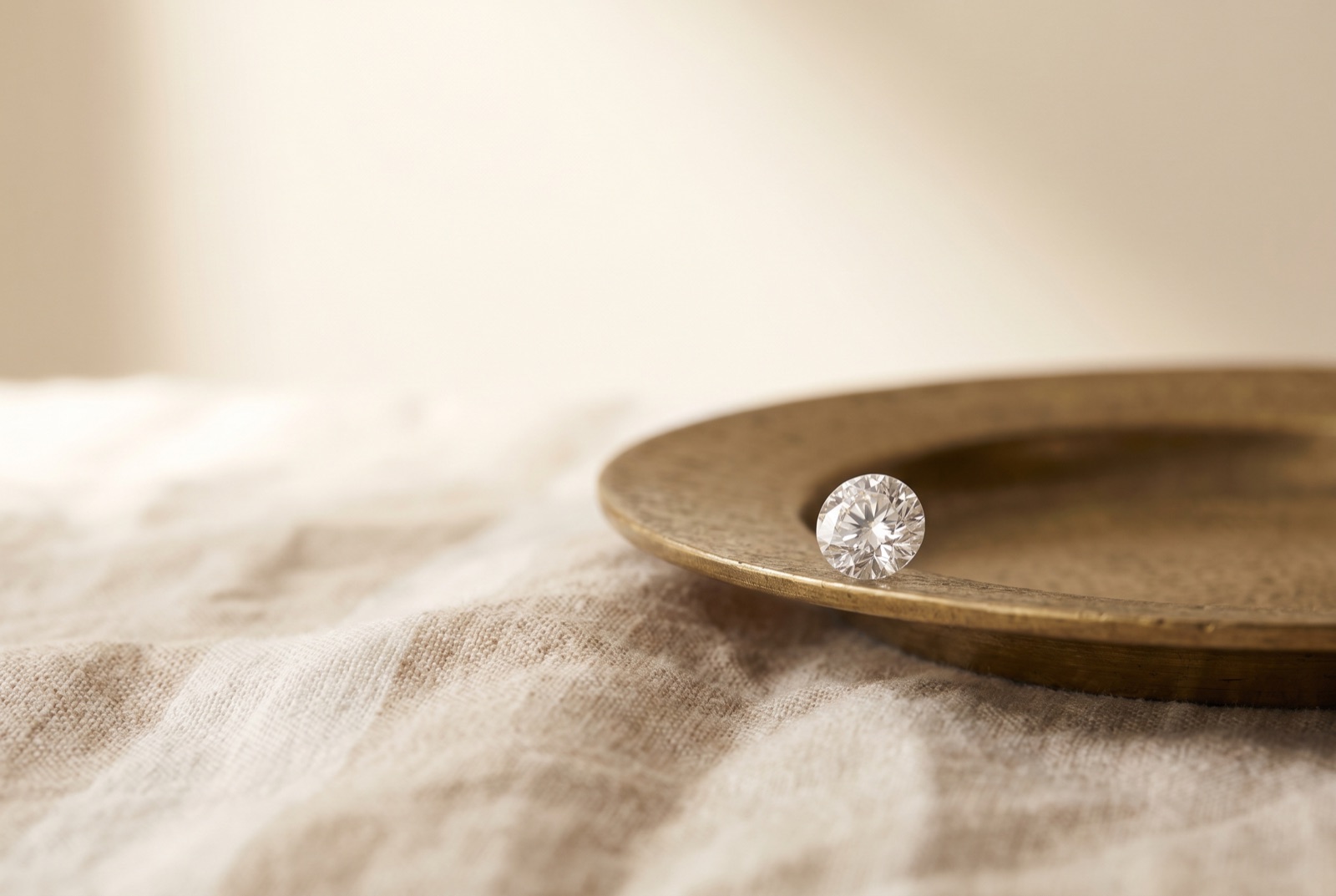
A cultured diamond is a lab-grown diamond — the two terms describe the exact same product, a diamond grown in a controlled laboratory environment rather than mined from the earth, with the same crystal structure, hardness, and optical properties as a natural stone. "Cultured" is simply an alternate, FTC-sanctioned term some retailers use instead of "lab-grown" or "lab-created," chosen for marketing reasons rather than any difference in the underlying product.
For trade buyers, the terminology question matters more than it might seem, because the FTC's Jewelry Guides set real rules for which words can and can't be used, and getting it wrong creates compliance risk for a jeweler's own listings and advertising. This guide covers what "cultured" actually means, where the term came from, how it fits alongside "lab-grown" and "synthetic," what the FTC actually requires, and how a wholesale buyer should think about terminology when sourcing and reselling these stones.
What "Cultured Diamond" Actually Means
A cultured diamond is grown in a laboratory using a process such as Chemical Vapor Deposition (CVD), which replicates the natural conditions under which diamonds form, compressed into a period of weeks rather than the one to three billion years natural diamond formation takes underground. The resulting crystal has the same carbon-lattice structure as a mined diamond: same hardness (10 on the Mohs scale), same refractive index, same fire and brilliance, same thermal conductivity. A gemologist examining a cut and polished stone cannot distinguish a cultured diamond from a mined one without specialized equipment designed specifically to detect growth-pattern differences invisible to the naked eye.
The word "cultured" is borrowed from an older, more established market: cultured pearls, which have used this exact terminology for over a century to describe pearls grown with human intervention rather than found naturally in wild oysters. The analogy is deliberate — both terms signal "grown with human involvement, but chemically and physically identical to the naturally occurring version," as opposed to something like cubic zirconia or moissanite, which are genuinely different materials simulating a diamond's appearance.
Cultured vs. Lab-Grown vs. Synthetic: Same Product, Different Words
These three terms — cultured, lab-grown, and lab-created — all refer to the identical product category under current FTC guidance, and a buyer or retailer can use any of them interchangeably without misrepresenting the stone, provided the term used clearly communicates that the diamond was created in a laboratory rather than mined. "Synthetic" is technically accurate and used in gemological and certification contexts (it appears on some lab reports), but it carries a slightly colder, more clinical connotation in consumer marketing, which is part of why "cultured" gained traction as a warmer alternative.
What none of these terms can be paired with, under FTC rules, is a word implying natural origin without a clear qualifier. A listing cannot simply say "diamond" with no modifier if the stone is lab-grown — the qualifying term (lab-grown, lab-created, or cultured) has to appear clearly and conspicuously at the point of sale, not buried in fine print or only in a separate specifications tab a customer might not open.
The FTC Jewelry Guides: What the Rule Actually Says
The Federal Trade Commission's Guides for the Jewelry, Precious Metals, and Pewter Industries govern how diamonds (and other gemstones) can be described in the United States. The 2018 revision specifically removed the word "natural" from the FTC's definition of "diamond," acknowledging that lab-grown stones are chemically, physically, and optically diamonds — not simulants — while requiring that any lab-grown stone be clearly disclosed as such wherever it's described or sold.
In practice, this means a listing, hangtag, invoice, or advertisement for a lab-grown stone needs a qualifying term (lab-grown, lab-created, cultured, or similarly clear language) placed immediately next to the word "diamond" — not as a footnote, not only in a product category filter, and not relegated to a certificate the customer has to separately request. The FTC has pursued enforcement actions against retailers who omitted or minimized this disclosure, so for a wholesale buyer reselling lab-grown inventory, getting the point-of-sale language right isn't just good practice — it's a real compliance requirement with financial exposure attached to getting it wrong.
Why Some Retailers Prefer "Cultured" Over "Lab-Grown"
Both terms satisfy the FTC's disclosure requirement equally, so the choice between them is purely about consumer perception and brand positioning, not compliance. "Lab-grown" emphasizes the technical, scientific nature of the process and tends to resonate with buyers who value transparency and a clear technical story. "Cultured" leans on the established, century-old precedent of cultured pearls to signal that human-assisted growth doesn't diminish authenticity — the diamond is still a real diamond, just as a cultured pearl is still a real pearl.
Some retailers A/B test both terms directly in their marketing and product copy, since buyer response varies by demographic and by how the jewelry is positioned (bridal vs. fashion vs. investment framing). There's no universally "better" choice — a jeweler should pick whichever term their own customer research shows performs best for their shop's base and positioning, as long as whichever term is chosen appears clearly next to every use of the word "diamond" for that inventory.
What "Cultured" Does Not Mean
It's worth being explicit about what the term doesn't cover, since customer confusion here is common. A cultured diamond is not a simulant — it is not cubic zirconia, moissanite, or white sapphire, all of which are different materials with different chemical compositions imitating a diamond's look. It is not treated or enhanced natural diamond (a separate category requiring its own distinct disclosure, such as "clarity enhanced" or "treated natural"). And it is not a lower grade of diamond — cultured stones are graded on the same 4Cs scale (cut, color, clarity, carat) using the same standards as natural diamonds, and can be found across the full quality range from commercial to top color and clarity grades.
It's also worth noting that within the lab-grown category itself, growth method matters for trade buyers even though it doesn't affect the FTC terminology question: different lab-growth processes produce stones with different typical characteristics and are sometimes preferred for different applications. A buyer vetting a lab-grown supplier should still ask which method is used, even though all legitimate methods fall under the same "cultured" or "lab-grown" umbrella term.
Price and Value: How Cultured Diamonds Compare
Cultured diamonds typically sell at 60-85% below the price of a comparable natural diamond at the same carat, color, clarity, and cut grade, with the exact discount varying by carat size (the gap tends to widen at larger carat weights, where natural diamond pricing increases non-linearly) and by current supply conditions in the lab-grown market, which has seen production costs continue to fall as growing technology matures. This price difference is the single biggest driver of lab-grown/cultured diamond adoption across both bridal and fashion jewelry categories.
The value conversation does come with a caveat worth passing on to retail customers honestly: because lab-grown production capacity continues to scale and per-carat production costs continue to fall, cultured diamonds have generally not held resale value as a investment-grade asset the way some natural fancy color diamonds have — a fact worth mentioning candidly rather than overselling investment framing on a category that primarily competes on size-for-price value rather than appreciation.
Cultured Diamonds and Certification
Cultured diamonds at typical consumer carat weights (roughly 0.30ct and above) are routinely certified by the same major gemological labs that certify natural diamonds, including IGI, GIA, and GCAL — each lab issues a distinct report format for lab-grown stones, typically with "laboratory-grown" or equivalent language printed clearly on the report itself, satisfying both consumer expectations and FTC disclosure requirements in one document. A certificate is also the clearest way for a retailer to document, to their own customer, exactly what they're buying — carat, color, clarity, cut grade, and growth method, all verified by an independent lab rather than taken on the seller's word alone.
Terminology Comparison at a Glance
| Term | What It Means | FTC Status | Common Use |
|---|---|---|---|
| Cultured diamond | Lab-grown diamond, same chemical/physical makeup as natural | Compliant qualifier, used with "diamond" | Retail marketing, warmer positioning |
| Lab-grown diamond | Same as cultured — identical product | Compliant qualifier | Technical/transparent positioning |
| Lab-created diamond | Same as cultured/lab-grown | Compliant qualifier | Interchangeable with the above |
| Synthetic diamond | Same product, more clinical term | Compliant, common on lab reports | Gemological/certification language |
| Diamond (no qualifier) | Implies natural origin | Not compliant for lab-grown stones | Reserved for natural diamonds only |
| Diamond simulant (CZ, moissanite) | Different material, not a diamond at all | Must be disclosed as not being a diamond | Budget jewelry, costume pieces |
What This Means for Wholesale Buyers
For a jeweler or retailer sourcing cultured diamonds wholesale, the terminology question translates into a few concrete practices worth building into a standard workflow: confirm the exact growth method and certification lab with every supplier, make sure every invoice and internal record uses a compliant qualifying term rather than "diamond" alone, and carry that same clear language through to point-of-sale listings, hangtags, and advertising. A supplier who can't answer the growth-method question clearly, or who ships stones without consistent, compliant terminology on paperwork, is a flag worth taking seriously before building a recurring order relationship. It's also worth auditing a shop's own historical listings periodically, since terminology standards and enforcement emphasis can shift over time, and older listings created before a staff member fully understood the disclosure requirement are a common, easily overlooked source of compliance risk that costs little to fix once identified.
How Cultured Diamonds Are Actually Grown
The leading commercial growth method behind cultured diamonds today is Chemical Vapor Deposition (CVD), which starts with a thin diamond "seed" plate placed inside a sealed chamber filled with carbon-rich gas, typically methane, heated to extreme temperatures until the carbon atoms break free of the gas molecules and deposit themselves layer by layer onto the seed, building the crystal upward over several weeks. Other lab-growth methods exist in the broader market as well, using different pressure-and-heat conditions to achieve a similar result, which is part of why a wholesale buyer should always confirm a supplier's specific growth process rather than assuming "lab-grown" or "cultured" describes a single, uniform production method. Each legitimate method produces a genuine diamond meeting the same FTC definition, so the terminology question discussed throughout this guide applies identically regardless of which specific growth process a given supplier uses.
Different growth methods tend to leave subtly different internal growth signatures — differences that matter to gemological labs for identification purposes but have no bearing on the finished stone's hardness, brilliance, or durability. A buyer doesn't need to understand the metallurgy in depth, but knowing which growth method a supplier uses is a reasonable, standard question to ask, since some buyers and markets have a stated preference for CVD specifically, and since consistent terminology from a supplier is itself a useful signal of how carefully that supplier handles compliance documentation more broadly.
How Labs and Retailers Tell Cultured Diamonds Apart From Natural Ones
Because a cultured diamond is chemically and optically identical to a natural one, no standard jeweler's loupe, handheld tester, or visual inspection can reliably separate the two — a fact that occasionally surprises retail customers who assume there's some obvious visible "tell." Reliable identification requires specialized equipment that reads the internal growth pattern or certain trace characteristics left behind by each growth method: devices like a DiamondView imaging system (which fluoresces the stone under UV light to reveal its internal growth structure) or spectroscopic screening tools used by gemological labs and some larger retail and wholesale operations.
This is precisely why third-party certification matters so much in the cultured diamond trade. A standard diamond tester (the kind used to screen for moissanite) will correctly identify a cultured diamond as a genuine diamond, since it is one — it simply won't tell you whether that diamond is natural or lab-grown. Retailers without in-house gemological screening equipment should treat a current, lab-issued certificate as the only reliable way to confirm origin on any individual stone, rather than relying on visual inspection or standard testers.
Market Growth and Where Demand Is Headed
Cultured diamond adoption has grown rapidly across the past several years, moving from a niche alternative into a mainstream share of bridal and fashion jewelry sales in the US market, driven primarily by the price advantage described above combined with growing consumer comfort with the terminology and growing retailer confidence in presenting it without apology. Younger buyers in particular have shown strong, consistent preference for larger carat weights at accessible price points over smaller natural stones at the same budget, a tradeoff cultured diamonds make straightforward.
For wholesale buyers, this growth trajectory has practical sourcing implications: production capacity has scaled fast enough that supply has remained healthy even as demand grows, which is part of why per-carat cultured diamond prices have continued trending downward rather than tightening with demand the way a supply-constrained natural diamond market might. A retailer building out a cultured diamond offering should expect this downward price trend to continue rather than plan around price stability, and should price inventory turnover accordingly rather than holding cultured stock the way they might hold slower-moving natural inventory.
Common Customer Misunderstandings Worth Addressing at the Counter
A few misconceptions come up often enough with retail customers that it's worth a jeweler having a clear, ready answer. Some customers assume "cultured" or "lab-grown" means artificial in the sense of fake or simulated — worth correcting directly with the chemistry: same carbon structure, same hardness, same optical performance, just grown rather than mined. Others assume a lower price automatically signals lower quality, when in fact cultured diamonds are graded on the identical 4Cs scale and available across the same full range of color and clarity grades as natural stones, from commercial to top-tier. And some customers, having heard the term "synthetic" in passing, assume it's a different, lesser category than "lab-grown" or "cultured" — worth clarifying that all three terms describe the exact same product, just with different word choices for the same thing.
Terminology Outside the US
The FTC's Jewelry Guides govern US advertising and point-of-sale disclosure specifically, but the same underlying disclosure principle — clearly distinguishing lab-grown from mined stones rather than using the unqualified word "diamond" for both — shows up in comparable form across most major diamond markets, including the EU, UK, and India, each with its own regulatory body and specific wording requirements. A US-based wholesale buyer sourcing internationally, or a retailer selling into international markets, should confirm the local disclosure standard for that specific market rather than assuming US-compliant terminology automatically satisfies a different country's rules, since the acceptable qualifying terms and exact placement requirements can differ in the details even where the underlying principle is the same.
India in particular, as both a major cutting and polishing center and a large and growing cultured diamond consumer market in its own right, has developed its own labeling conventions alongside strong domestic demand for the category — a detail worth knowing for any buyer whose supply chain touches Indian cutting and polishing facilities, which is common across the trade regardless of where the finished stone is ultimately certified or sold.
Sourcing Cultured Diamonds Through Guru Diam
Guru Diam's lab-grown catalog is grown using CVD only, across the full range of shapes the company carries, from commodity round brilliants to the antique and exotic cuts (Old Mine, Old European, Kite, Trillion, and others) that make up a meaningful share of its wholesale business. Every stone ships with the buyer's choice of IGI, GIA, or GCAL certification, each clearly marked as laboratory-grown on the report, so retail partners have compliant paperwork to pass along to their own customers without extra work.
Guru Diam also carries natural diamonds and finished jewelry alongside the lab-grown catalog, so a buyer sourcing a mixed natural-and-cultured inventory doesn't need a separate vendor relationship for each category, and can keep terminology and certification documentation consistent across an entire order rather than reconciling two different suppliers' paperwork conventions. In-stock certified inventory ships same-day when ordered before 6pm EST from New York or 4pm PST from Los Angeles. Browse certified cultured and natural stones under certified diamonds, explore the full catalog through the wholesale hub, or apply for a standing account through trade partner for recurring wholesale pricing.
Frequently Asked Questions
Is a cultured diamond a real diamond?
Yes. A cultured diamond has the same carbon crystal structure, hardness, and optical properties as a mined diamond — the only difference is where and how it formed. It is not a simulant like cubic zirconia or moissanite, which are chemically different materials.
Is "cultured diamond" the same as "lab-grown diamond"?
Yes, they describe the identical product. "Cultured," "lab-grown," and "lab-created" are all FTC-compliant qualifying terms for the same category of laboratory-grown diamond, and retailers choose between them for marketing and positioning reasons, not because of any difference in the stone itself.
Why did the term "cultured diamond" become popular?
It borrows from the century-old "cultured pearl" category, which uses the same term to describe pearls grown with human assistance rather than found in the wild. Retailers adopted it for lab-grown diamonds to signal the same idea: grown with human involvement, but still fully authentic.
Does the FTC require disclosure when selling cultured diamonds?
Yes. Under the FTC's Jewelry Guides, any lab-grown stone must be clearly and conspicuously described with a qualifying term like "lab-grown," "lab-created," or "cultured" placed next to the word "diamond" — in listings, advertising, and at the point of sale — not buried in fine print.
Are cultured diamonds cheaper than natural diamonds?
Yes, typically 60-85% less at the same carat, color, clarity, and cut grade, with the exact gap varying by carat size and current market supply. This price advantage is the primary reason for the category's growth in both bridal and fashion jewelry.
Can cultured diamonds be certified?
Yes. Major gemological labs including IGI, GIA, and GCAL certify cultured diamonds at typical consumer carat weights, issuing reports that clearly state the stone is laboratory-grown alongside its standard 4Cs grading.