What the Gold Spot Price Actually Means
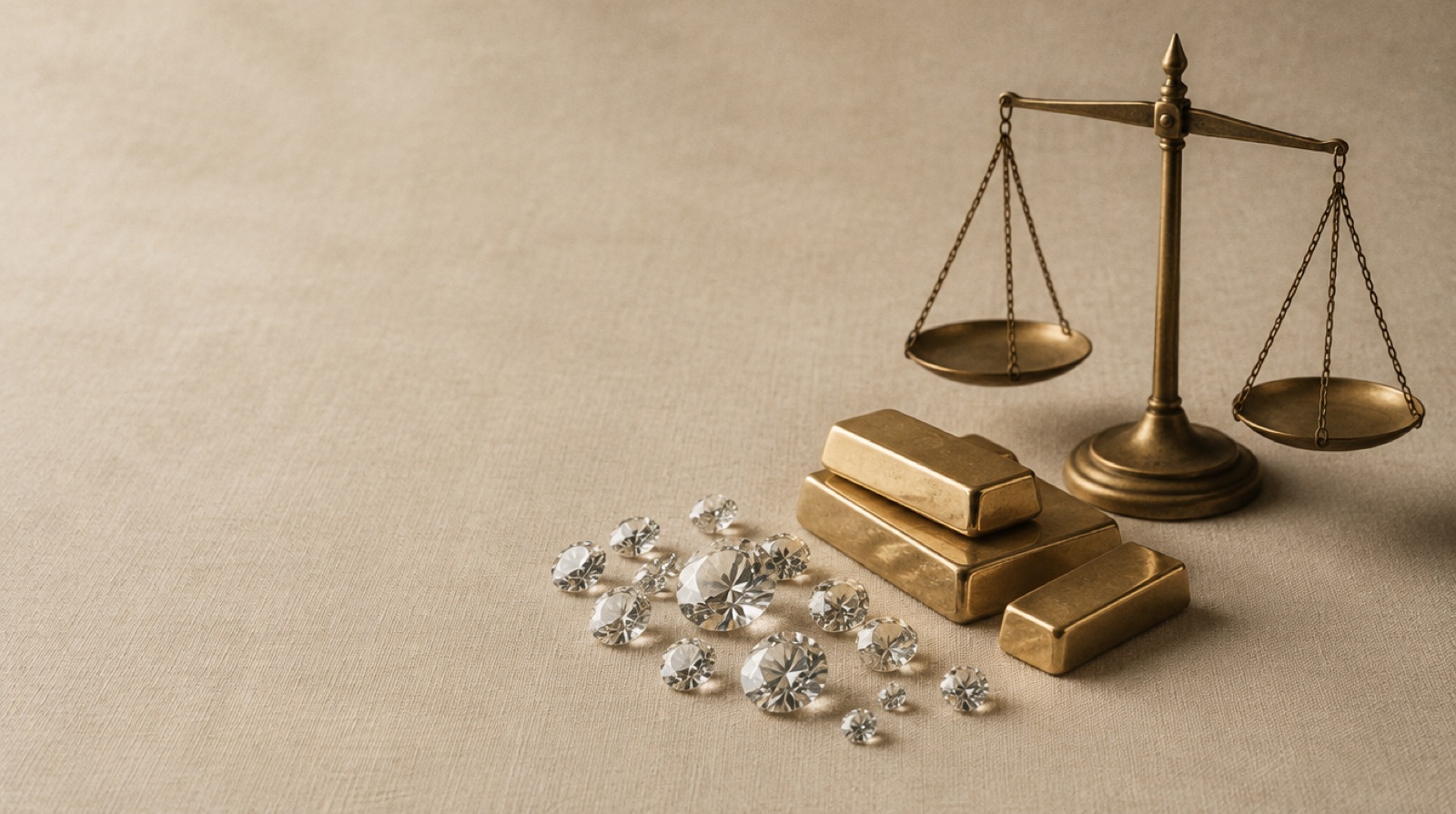
The gold spot price is the current market price to buy or sell one troy ounce of pure (24 karat) gold for immediate delivery, as traded on global commodity exchanges. It updates continuously during market hours and serves as the reference point jewelers use to price raw metal, cost finished pieces, and time purchasing decisions. Every karat conversion, casting calculation, and metal markup a workshop runs traces back to this one number.
For a wholesale jeweler, designer, or manufacturer, spot price isn't an abstract financial headline — it's a working input that touches almost every piece of fine jewelry that leaves the bench. A ring, bracelet, or chain is priced from a combination of metal weight, metal purity, labor, stones, and margin, and the metal portion of that equation starts with spot. Get the spot-to-retail math wrong and you either underprice work you can't afford to make, or overprice it and lose the quote to a competitor who did the arithmetic correctly.
This guide is written for people who buy, melt, cast, and resell gold as part of running a jewelry business — not for individuals weighing whether to add gold to an investment portfolio. We'll cover how the spot price is quoted and calculated, how to convert it to a price per gram at every common karat, how to build it into job costing and retail pricing, and how shops manage the timing risk that comes with a metal whose price moves every day.
How the Gold Spot Price Is Quoted and Calculated
Gold trades on a handful of major markets, and the "spot price" you see quoted is typically an aggregate of real-time trading activity across those venues rather than a single fixed number from one source.
- COMEX (New York): The primary U.S. futures exchange for gold. Front-month futures contracts are the most commonly cited reference for U.S. spot pricing, even though futures and true spot are technically distinct instruments.
- LBMA (London): The London Bullion Market Association runs the twice-daily LBMA Gold Price auction, long used as a benchmark for physical bullion contracts, refiners, and central banks worldwide.
- Shanghai Gold Exchange: A growing reference point for gold priced in yuan, increasingly relevant given Asian demand's share of global consumption.
Regardless of venue, spot price is always quoted against two fixed units: the troy ounce (31.1035 grams — not the standard 28.35-gram avoirdupois ounce used for food or body weight) and 24 karat purity, meaning 99.9% or higher pure gold with no alloy content. Every karat below 24k is a fraction of that base price, scaled down by purity. We'll walk through that math in the next section.
Spot price moves on the same drivers as any globally traded commodity: U.S. dollar strength, interest rate expectations, inflation data, central bank buying and selling, and geopolitical risk appetite. None of that requires action from a working jeweler day to day — what matters operationally is simply that the number moves, sometimes by meaningful amounts within a single trading session, and your costing process needs to account for that movement rather than assume a static metal cost.
Spot Price vs. Fix Price vs. Scrap or Melt Price
Jewelers and suppliers use several closely related but distinct terms, and mixing them up leads to costing errors.
| Term | What It Means | Where You'll See It |
|---|---|---|
| Spot price | The real-time trading price of 24k gold per troy ounce | Market data feeds, bullion dealer sites, metal ticker widgets |
| Fix price | A benchmark price set at specific times of day (e.g., the LBMA AM/PM auction) | Refiner contracts, large bullion settlements, some vendor invoices |
| Melt value | Spot price adjusted for an item's actual karat and weight — what the raw metal in a piece is worth if reduced to bullion | Scrap buying, trade-in valuation, casting-loss accounting |
| Dealer buy/sell price | Spot price plus or minus the dealer's spread — what you actually pay or receive | Refiner and bullion supplier invoices |
A shop quoting a custom piece against "today's gold price" is almost always working from spot, then applying a karat and weight adjustment to get to melt value, then adding labor and margin on top. A refiner buying your scrap, by contrast, quotes you a price below spot — the spread covers their refining cost and margin. Knowing which number you're looking at prevents the common mistake of comparing a supplier's buy price to the spot ticker and assuming you're being shorted, when in fact a spread is normal and expected on physical transactions.
Converting Spot Price to Price Per Gram
Since spot is quoted per troy ounce of 24k gold, converting it into something usable at the bench — a price per gram at the karat you're actually casting — takes two steps.
Step 1: Convert troy ounces to grams. Divide the spot price by 31.1035 to get the price per gram of 24k gold.
Step 2: Apply the karat purity factor. Multiply that 24k gram price by the fineness of the karat you're working in. Karat is a fraction of 24, so 18k gold is 18/24 (0.75) pure, 14k is 14/24 (0.5833) pure, and so on. Common alloys also substitute slightly different ratios depending on local standards (for example, 18k can be stamped 750, 14k as 585, and 10k as 417 under millesimal fineness marking), but the 24-parts logic is the one to know for quick mental math.
Here's the formula in full:
Price per gram at karat X = (Spot price per troy ounce ÷ 31.1035) × (X ÷ 24)
To make this concrete, the table below works through an illustrative spot price of $2,000 per troy ounce. This number is for illustration only — always pull the live spot price at the moment you're quoting or buying, since gold can move meaningfully within a single business day.
Karat-to-Price-Per-Gram Conversion Table
| Karat | Purity (Fineness) | Price per Gram (at $2,000/oz spot) | Common Use |
|---|---|---|---|
| 24k | 99.9%+ (.999) | $64.33 | Bullion, some Asian market bridal jewelry |
| 22k | 91.7% (.917) | $58.97 | South Asian and Middle Eastern bridal gold |
| 18k | 75.0% (.750) | $48.24 | Fine jewelry, engagement rings, Western bridal |
| 14k | 58.3% (.583) | $37.52 | Everyday fine jewelry, U.S. mass bridal market |
| 10k | 41.7% (.417) | $26.80 | Class rings, lower-cost costume-adjacent fine jewelry |
Two things are worth noting about this table. First, the relationship is linear — if spot moves to $2,100/oz, every row in that table scales up by the same 5% proportionally. Second, this is pure metal value only. It does not include labor, casting loss, findings, stones, or margin, all of which get added on top to arrive at an actual wholesale or retail price. Treat this table as your raw material cost basis, not your sell price.
Why Karat Purity Changes More Than Just the Math
The purity factor isn't only a pricing variable — it also explains why different karats behave and sell differently in the case.
Higher karat gold (22k, 24k) is softer and more yellow, prized in markets where gold is treated partly as a store of value alongside its decorative role — hence its dominance in South Asian and Middle Eastern bridal gold. Lower karat gold (10k, 14k) is harder, more durable, and holds fine detail and prong-set stones better, which is why it dominates U.S. fine jewelry and engagement ring manufacturing. 18k sits in between and is the standard "fine jewelry" karat across much of Europe and increasingly the U.S. bridal market, balancing color, durability, and metal value.
From a costing standpoint, this means karat choice is a design decision with a direct cost consequence, not just a quality label. Moving a ring line from 14k to 18k doesn't just change the hallmark — it raises the metal cost per gram by roughly 29% at any given spot price, which has to be reflected in the quote or absorbed in margin.
Using Spot Price to Cost Fine and Custom Jewelry
A complete piece of jewelry costing has several layers stacked on top of the raw metal value derived from spot:
- Metal weight and karat: The gram weight of the finished piece (or the casting weight before polishing loss) multiplied by the price-per-gram figure for that karat.
- Casting and finishing loss: Metal lost in sprues, investment, polishing dust, and rhodium plating prep. Shops typically budget 2–8% of metal weight for this, depending on design complexity and whether metal is reclaimed and refined back into stock.
- Labor: Wax carving or CAD/CAM modeling, casting, stone setting, polishing, and quality control. Labor is usually quoted as a flat rate or hourly rate independent of the metal market.
- Stones: Diamonds and colored stones are priced on their own market entirely separate from gold — carat weight, color, clarity, cut, and certification drive stone cost, and this line item needs to be sourced and quoted independently of the metal calculation.
- Findings and components: Clasps, jump rings, posts, and prefabricated settings, typically a smaller but non-trivial add-on.
- Overhead and margin: Shop rent, insurance, and the business's target profit margin on top of the hard-cost total.
The practical workflow most shops use is to re-price their metal cost basis against current spot at defined intervals — daily for high-volume production, or at the point of quote for custom and bridal work — rather than letting a stale metal price sit in a quoting spreadsheet for weeks. A quote built on a two-week-old spot price can be meaningfully wrong by the time a customer says yes, especially during a volatile stretch for gold.
From Melt Value to Retail: A Markup Framework
Once the raw melt value is established, jewelers typically build toward a wholesale or retail number in stages rather than applying one blended multiplier to everything. The table below shows a general framework — actual figures vary widely by shop, market segment, and whether a piece is production stock or fully custom.
| Cost Layer | Typical Range Added | Notes |
|---|---|---|
| Melt value (metal only) | Base cost | From spot price × weight × karat purity |
| Casting/finishing loss | +2–8% of metal cost | Varies by design complexity and in-house reclaim practices |
| Labor (casting, setting, polish) | +15–40% of hard cost | Higher for hand-finished or heavily set pieces |
| Findings/components | +5–15% of hard cost | Lower for simple bands, higher for multi-component pieces |
| Wholesale margin | 1.5x–2.2x total hard cost | Varies by order volume and relationship terms |
| Retail markup (if selling direct) | 2x–2.5x wholesale cost | Standard keystone-plus pricing in independent fine jewelry retail |
The key operational discipline is separating the metal line from everything else so that when spot moves, you can reprice just that component instead of recalculating an entire blended markup from scratch. Shops that quote a single "all-in" multiplier on top of melt value tend to either erode margin when gold rises or leave money on the table when it falls, because the multiplier was calibrated to a spot price that no longer applies.
Timing Purchases and Managing Gold Price Volatility
Gold's daily price movement is the single biggest variable a jewelry business can't control but has to plan around. A few practical approaches wholesale buyers use to manage that exposure, none of which require treating gold as a personal investment:
- Buy against confirmed orders. For custom and bridal work, many shops lock metal purchase timing to the point of deposit or order confirmation rather than stockpiling speculative inventory, limiting exposure to the window between quote and fulfillment.
- Memo and consignment arrangements. Some bullion and findings suppliers offer memo terms that let a shop draw metal stock without fully committing capital until it's used, smoothing out timing risk on production runs.
- Forward pricing with your bullion supplier. Larger manufacturers sometimes lock in a metal price for a future delivery date through their refiner or bullion dealer, which functions as a hedge against a production run that spans weeks.
- Price escalation clauses in custom quotes. Many shops build a clause into custom and bridal contracts noting that final price is subject to adjustment if spot moves beyond a defined band (for example, more than 3–5%) between deposit and delivery, rather than absorbing the full swing or risking the sale with an inflated buffer upfront.
- Batching production runs. Casting several jobs in one metal pour rather than one-off castings reduces the number of separate purchase points exposed to day-to-day price swings.
None of this is about predicting where gold is headed — it's about building a purchasing and quoting process that doesn't get blindsided by normal day-to-day volatility. A shop that re-prices metal at the point of quote, builds in a reasonable escalation clause for long production timelines, and times bullion purchases to confirmed orders is protected regardless of which direction spot moves next.
Common Costing Mistakes Jewelers Make With Spot Price
A handful of errors show up repeatedly in shops that are new to formalizing their metal costing process:
- Quoting from a stale spot price. Using last week's number because it's what's written on a price list, rather than pulling current spot at the point of sale.
- Forgetting casting loss. Pricing only the finished piece's weight and absorbing the metal lost to sprues and polishing as an unplanned cost.
- Blending metal and stone cost into one number. Treating a piece's total cost as one figure makes it impossible to reprice accurately when either gold or diamond markets move independently of each other.
- Using the wrong troy-ounce-to-gram conversion. Confusing the 31.1035g troy ounce with the 28.35g standard ounce understates metal cost by roughly 10%.
- Applying one markup multiplier to every karat. Because higher-karat metal is a larger share of total piece cost, a flat percentage markup across 14k and 18k lines distorts margin differently on each.
Sourcing Metal and Stones Together for Custom and Fine Jewelry
Gold spot price only tells half the cost story on most fine jewelry — the other half is the stone, and the two markets move completely independently of each other. A shop building custom engagement rings or bridal lines needs a reliable process on both sides: a disciplined metal costing workflow like the one above, and a stone supplier who can deliver consistent, certified inventory without adding its own timing risk to the quote.
This is where working with a dedicated trade supplier for the stone side of the build pays off. Guru Diam operates as a wholesale partner for independent jewelers, designers, and manufacturers, with IGI, GIA, and GCAL certification all available depending on the piece and budget. Because sourcing spans antique cuts, fancy color stones, fancy color melee, custom engagement rings, and finished jewelry under one relationship, a shop pricing a gold-and-diamond piece can lock the stone cost and certification details in parallel with the metal calculation, rather than juggling separate vendor timelines for each component. Browse certified loose diamonds or fancy color stones to see current stock available for a build.
For custom work specifically, Guru Diam finishes custom engagement rings in 4–6 days once the design and stone are confirmed — fast enough that the metal cost locked at the point of order is unlikely to drift far before the piece ships, which narrows the volatility window discussed earlier in this guide. Cutting, setting, and polishing are handled in-house, and with NYC and LA offices, in-stock inventory ships same-day (before 6pm EST from New York, before 4pm PST from Los Angeles). Shops building out a recurring custom program can explore custom jewelry options or start a trade account to get wholesale pricing and lead times for both stones and finished pieces. For buyers sourcing at volume across multiple product categories, the wholesale hub is the starting point for account setup and catalog access, and matched-pair inventory for symmetrical designs like stud earrings or three-stone rings is available under matching pairs.
Building a Repeatable Gold Pricing Workflow
Pulling everything together, a workable process for a wholesale jewelry operation looks roughly like this: pull current spot price at the point of quoting or production, convert it to a price-per-gram figure for the specific karat being used, add casting loss, labor, findings, and stone cost as separate line items, apply margin on top of the fully loaded hard cost, and build in a price-adjustment clause for any custom or bridal order with a production timeline long enough to carry meaningful metal price risk. Documenting this as a standard operating procedure — rather than relying on informal "gut check" pricing against whatever the metal market did that morning — is what separates shops with consistent margins from shops whose profitability swings with the price of gold itself.
Frequently Asked Questions
What is the difference between gold spot price and gold market price?
They refer to the same thing in most jewelry trade contexts: the current trading price of 24k gold per troy ounce for immediate delivery. "Spot" specifically distinguishes this from futures contracts priced for delivery at a later date, though in casual use jewelers often say "today's gold price" to mean the same number.
How do I convert gold spot price to price per gram?
Divide the spot price per troy ounce by 31.1035 to get the 24k price per gram, then multiply by the karat's fineness (karat ÷ 24) to get the price per gram at 18k, 14k, 10k, or any other karat. For example, at $2,000/oz spot, 18k gold works out to roughly $48.24 per gram before labor, casting loss, or stones are added.
Why is gold priced in troy ounces instead of regular ounces?
Troy weight is the historical standard for precious metals trading and equals 31.1035 grams, compared to 28.35 grams for a standard avoirdupois ounce. Using the wrong conversion understates gold's true gram value by about 10%, which is a common and costly mistake in manual costing spreadsheets.
Does a higher gold spot price mean I should raise my jewelry prices immediately?
For production inventory already cast, most shops don't retroactively reprice stock on hand every time spot moves, since that metal was already purchased at a known cost. For new quotes, custom orders, and future production runs, current spot should be used to recalculate the metal cost component before quoting, so pricing stays aligned with the market at the time of the actual transaction.
What's the difference between spot price and the price a refiner or bullion dealer quotes me?
Spot price is the raw market reference number; a dealer's buy or sell price is spot plus or minus a spread that covers their refining, handling, and margin. Expect to receive somewhat below spot when selling scrap and pay somewhat above spot when buying bullion or findings stock — the spread itself is normal and not a sign of being shorted.
Should jewelers hedge against gold price swings the way investors do?
Most independent jewelers don't need investment-style hedging instruments. Simpler operational tools — pricing custom quotes at point of order, adding escalation clauses for long production timelines, and timing bullion purchases to confirmed orders — cover the practical volatility risk that affects day-to-day costing without requiring a trading desk or futures position.