
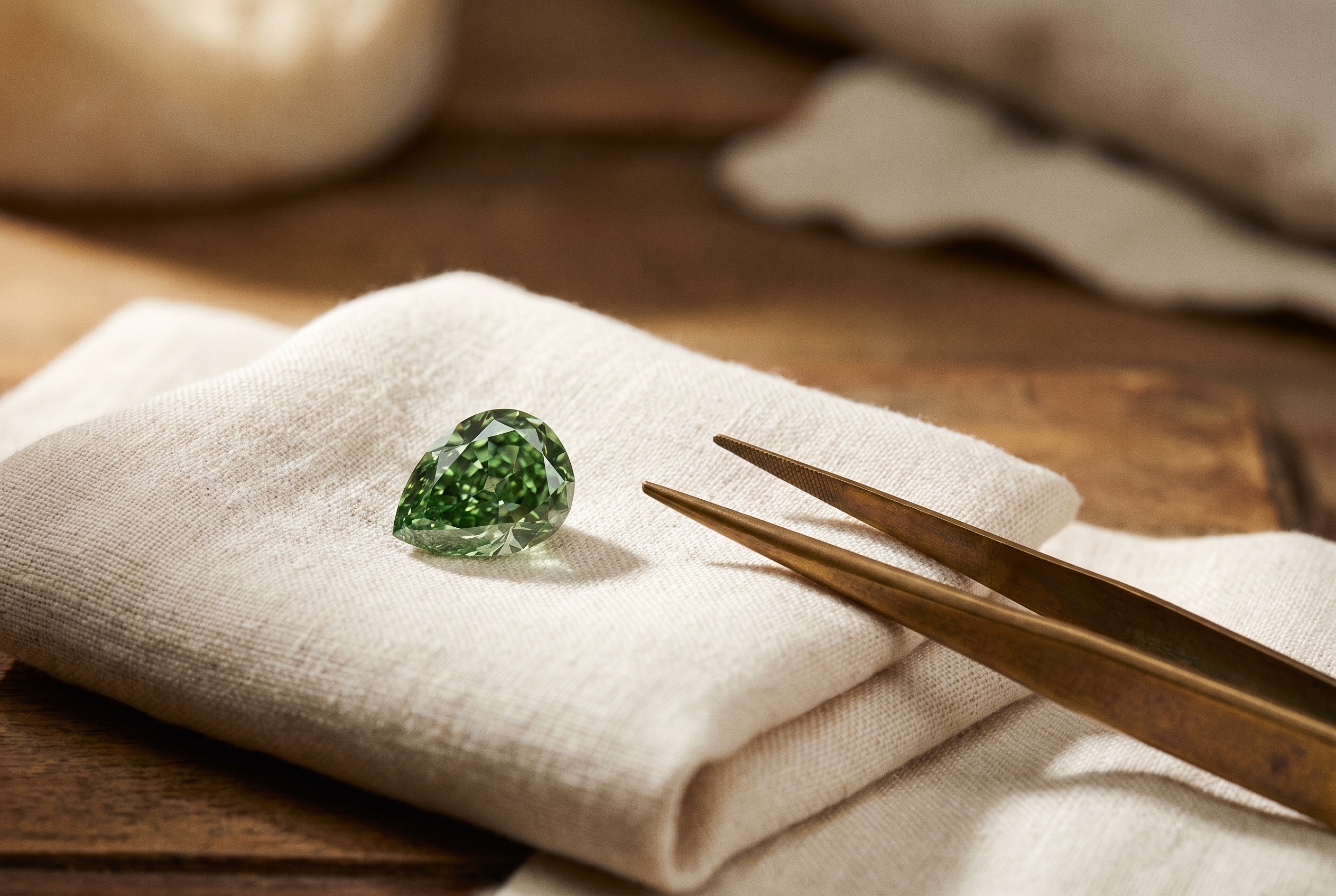
A green diamond is a diamond whose color comes from natural radiation exposure that displaces carbon atoms within the crystal lattice, producing a green surface or, less commonly, a green body color. Natural green diamonds are among the rarest fancy colors in the world specifically because genuine, all-over green saturation is unusual, while CVD lab-grown green diamonds reproduce a comparable green appearance under controlled lab conditions, making green a color trade buyers can now source at wholesale-viable volume and price.
This guide covers what actually causes green color in a diamond, how natural and lab-grown green diamonds differ, how grading labs classify green color and depth, what drives price in this category, and what a wholesale buyer needs to know before sourcing green diamonds for retail, custom design, or resale.
What Actually Makes a Diamond Green
Diamond in its purest form is a lattice of carbon atoms with no color at all. Natural green color in a diamond most commonly comes from exposure to natural radiation over geologic time, which displaces electrons within the crystal lattice and creates color centers that absorb light in a way that produces a green appearance. This is a meaningfully different mechanism from the trace-element causes behind blue (boron) and yellow (nitrogen) diamonds — green color is typically a surface or near-surface phenomenon caused by radiation exposure rather than an element incorporated evenly throughout the crystal during formation.
Because natural radiation exposure tends to affect a diamond unevenly, genuine natural green diamonds frequently show color concentrated in a thin surface layer or in patches rather than uniformly throughout the stone — a detail that has a direct, practical effect on how the stone must be cut, discussed further below.
Natural Green Diamonds: Formation and Rarity
Natural green diamonds form when a diamond, already crystallized, sits in proximity to radioactive minerals in the surrounding rock for an extended geologic period, allowing radiation to gradually alter the crystal's surface structure. Because this requires a specific and somewhat coincidental geological circumstance — the right radioactive minerals present near an already-formed diamond over a very long timescale — genuine natural green diamonds with even, gem-quality color throughout are extremely rare, rarer at comparable saturation than blue or pink in most gemological references. Most natural green diamond color that does occur is confined to a thin surface layer, which historically limited how such stones could be cut without losing the color entirely, since faceting typically removes a meaningful layer of surface material.
Because of that rarity, natural green diamonds with well-distributed, gem-quality color command prices among the highest in the fancy color category. Most buyers seeking green diamonds at a usable wholesale volume are, as a practical matter, looking at lab-grown material instead.
Lab-Grown Green Diamonds: How CVD Reproduces the Color
CVD (chemical vapor deposition) is the process used to grow lab-grown diamonds by depositing carbon atoms, layer by layer, onto a diamond seed inside a controlled growth chamber. Lab-grown green diamonds are produced through a controlled process that replicates a comparable color-center mechanism to the one responsible for natural green color, achieved through a combination of controlled growth conditions and, in many cases, a disclosed post-growth treatment step — a detail that a legitimate lab report will always state explicitly. The resulting stone is chemically and structurally a real diamond, with color produced through mechanisms comparable to what occurs in nature, just achieved under controlled lab conditions rather than by chance over geologic time.
This is the development that has made green diamonds newly relevant to wholesale buyers. A color that was previously accessible only at extraordinary natural-diamond prices, and even then usually only as a thin surface-color stone, is now available as CVD lab-grown material with even, all-over color at a cost structure that supports retail and custom-design use.
Natural vs. Lab-Grown Green Diamonds: Key Differences
| Factor | Natural Green Diamond | CVD Lab-Grown Green Diamond |
|---|---|---|
| Origin of color | Natural radiation exposure over geologic time, often surface-concentrated | Controlled growth process, in many cases with a disclosed treatment step, producing even color |
| Color distribution | Frequently confined to a thin surface layer or patches | Can be produced with even, all-over saturation |
| Rarity | Among the rarest fancy colors in nature | Reproducible at commercial wholesale volume |
| Typical price position | Among the highest per-carat prices in the fancy color market | A fraction of natural green pricing at comparable color and clarity |
| Certification | GIA is the dominant reference lab for natural fancy color | GIA, IGI, and GCAL all grade and certify lab-grown fancy color, clearly labeled by origin and treatment status |
| Availability at scale | Effectively unavailable in consistent wholesale quantity | Available as loose stones (0.30ct+) and as calibrated melee |
How Green Diamonds Are Graded
Fancy color diamonds, including green, are graded on a different system from the standard D-to-Z scale used for colorless-range diamonds. Instead of measuring the absence of color, fancy color grading measures hue, tone, and saturation together, combined into an overall fancy color grade describing the visual strength of the color present.
The Fancy Color Grade Scale for Green Diamonds
- Faint / Very Light Green — barely perceptible green tint
- Fancy Light Green — clearly visible but soft, understated green
- Fancy Green — a solid, well-saturated green that reads clearly as a colored stone
- Fancy Intense Green — a strong, vivid green with high saturation
- Fancy Vivid Green — the most saturated, most sought-after grade, commanding the highest premium at any given size
- Fancy Dark Green / Fancy Deep Green — a darker-toned green, often with a gray or olive undertone
A grading report for a natural green diamond will also typically note whether the color is described as surface-related or distributed throughout the stone, a distinction that matters considerably more for green than for most other fancy colors given how the underlying color mechanism works.
Clarity Considerations Specific to Green Diamonds
Clarity grading for green diamonds follows the same 10x-magnification standard used for any diamond, but green presents a specific practical wrinkle: because natural green color is frequently surface-concentrated, cutting decisions have to balance clarity improvement against preserving the color layer itself, sometimes resulting in a finished stone with a clarity grade a cutter might otherwise have improved further if color preservation weren't also a priority. For lab-grown green diamonds with even, all-over color, this tradeoff is less of a factor, and clarity can be evaluated and optimized more independently of color preservation, similar to how other fancy colors are approached.
Shapes and Cuts for Green Diamonds
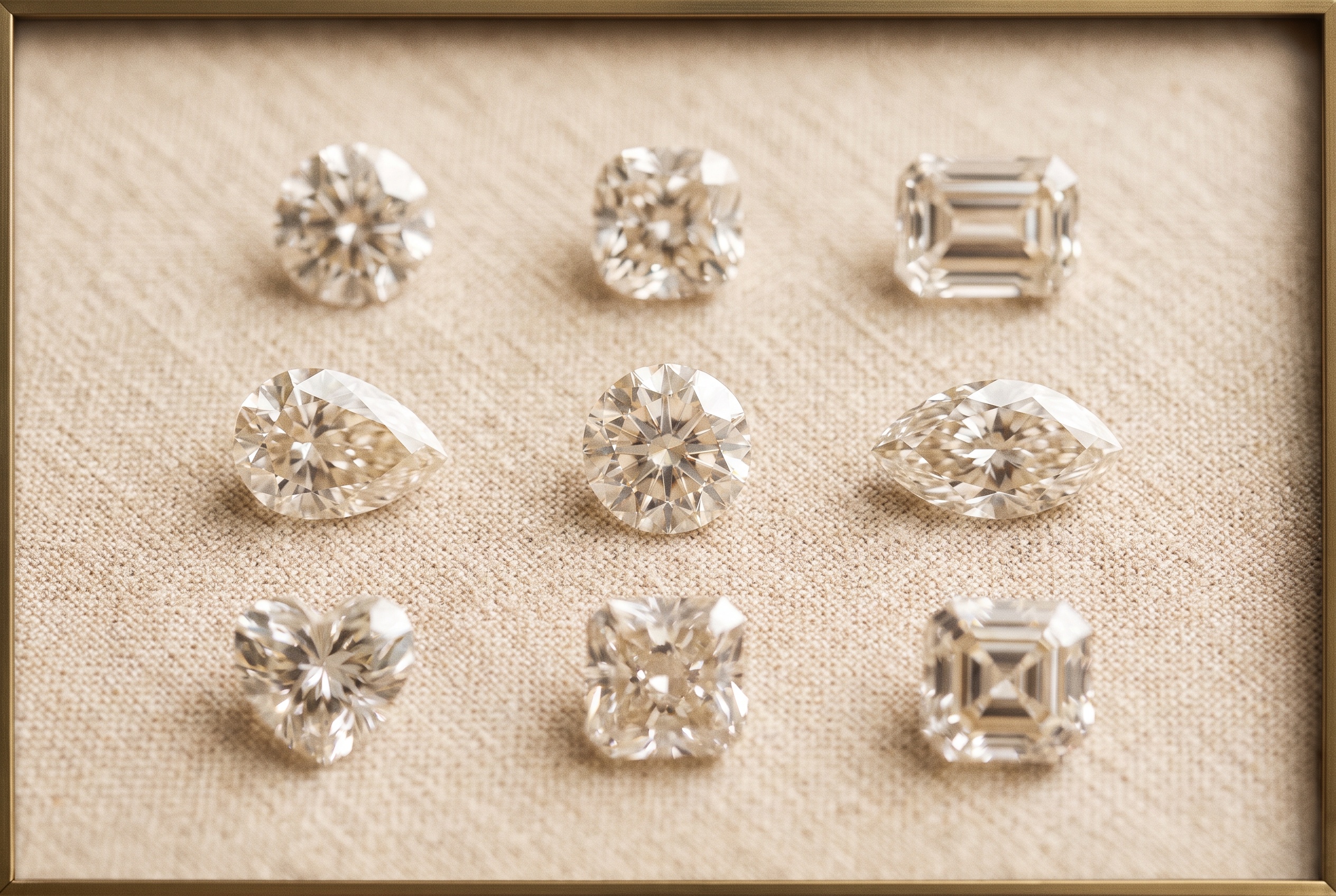
Green diamonds are cut across a range of shapes, though cutting decisions for natural green material are historically more constrained than for other colors because of the surface-color issue described above — a cutter working a natural green rough stone has to plan facets specifically to retain as much of the color-bearing surface layer as possible, which sometimes results in less conventional proportions than a cutter would choose for a colorless stone of the same rough. Lab-grown green diamonds, with even color throughout, can be cut into any standard shape — round brilliant, cushion, emerald, oval, radiant, and other fancy shapes — using the same proportion and light-performance priorities applied to any other diamond, without the same color-preservation constraint.
What Drives Green Diamond Pricing
For lab-grown green diamonds, several factors combine to set price at a given carat weight: color grade (saturation is the single biggest lever), clarity, cut quality, carat weight (with per-carat price accelerating at common milestone weights), and certifying lab. Because green is a genuinely rare color even in lab-grown form relative to yellow or blue, per-carat pricing at a given saturation tends to sit above yellow and closer to blue or pink at comparable saturation, reflecting both real production complexity and the category's relative scarcity even among lab-grown fancy colors.
Secondary Hues: Not Every Green Diamond Is Pure Green
Few green diamonds show a perfectly pure green with no other color influence — most carry a secondary hue modifier noted on a grading report. Yellowish-green and grayish-green are the two most common variants. A yellowish-green stone reads warmer, sometimes described in the trade as a chartreuse or olive tone, while a grayish-green stone reads cooler and more muted. A cleaner, more saturated pure green generally commands a stronger premium than a stone with a pronounced yellow or gray modifier at the same overall saturation grade, though secondary hue is a factual description rather than a defect — it's simply part of understanding why two stones sharing a color grade can look noticeably different side by side.
How to Evaluate a Green Diamond in Person
Photographs and even professional lab imagery consistently struggle to capture a fancy color diamond's true appearance, since saturation and secondary hue both shift depending on lighting conditions and camera settings. For any purchase above a token size, viewing the physical stone under multiple lighting conditions — daylight-equivalent lab lighting, typical showroom spot lighting, and ordinary indoor light — gives a far more reliable sense of how the stone will actually look once set and worn. Buyers should view a candidate green diamond face-up, as it will sit in a finished piece, and comparing two or three candidate stones side by side is the most reliable way to judge relative color strength before committing to an order.
Green Diamonds in Jewelry Design: Metal and Setting Pairings
Metal choice has a real, visible effect on how a green diamond reads once mounted. White metals — platinum and white gold — are a common pairing for green diamonds, providing a neutral backdrop that lets a cooler-toned green read at full strength. Yellow gold pairs particularly well with a yellowish-green stone, since the warm metal tone harmonizes with the stone's own secondary hue rather than competing with it. Rose gold is a less common but increasingly popular pairing for green diamonds among designers seeking a more unconventional, contrast-forward look. Halo settings using small white melee remain a popular design choice for amplifying a green center stone's perceived size and color intensity.
Carat Milestones and Price Scaling
As with colorless diamonds, green diamond pricing accelerates disproportionately at common carat milestones — a stone just over 1.00ct or 2.00ct commands a meaningfully higher per-carat price than one just under that threshold, even though the visual size difference is negligible. For lab-grown green diamonds specifically, this milestone effect is somewhat softer than for natural stones, since lab-grown supply doesn't carry the same scarcity premium tied to any particular carat weight — but buyers assembling inventory across a range of sizes should still expect some step-up in per-carat pricing at each half-carat and full-carat threshold.
Common Misconceptions About Green Diamonds
- "All green diamonds are dyed or coated." Genuine green diamonds, natural or lab-grown, derive their color from radiation-related color centers within the crystal lattice itself, not a surface dye or coating. Some lab-grown green diamonds do involve a disclosed post-growth treatment step as part of achieving even color, which is different from a superficial coating and will always be stated on a legitimate lab report.
- "Green diamonds are the same as green gemstones like emerald or peridot." A green diamond is chemically and structurally diamond (pure carbon), sharing none of the mineral composition of emerald (a beryl) or peridot (an olivine) — the shared color is coincidental, not a sign of any material relationship.
- "Green diamonds are only available as center stones." Calibrated green diamond melee exists at commercial wholesale scale for jewelers producing halo, pavé, and accent designs, in addition to certified loose center stones.
Certification for Green Diamonds
GIA remains the most widely referenced lab for natural fancy color diamonds, with a fancy color grading system the rest of the trade has largely adopted as reference — GIA reports for natural green diamonds will also typically comment on whether color appears surface-related. For lab-grown green diamonds, GIA, IGI, and GCAL all grade and issue reports that clearly state the color grade, growth origin, and any treatment involved in achieving the color. Buyers should always confirm a lab-grown fancy color stone's report explicitly discloses CVD origin and treatment status rather than relying on price or appearance alone to infer it.
Notable Green Diamonds
The most famous natural green diamond in the world is the Dresden Green, a roughly 41-carat pear-shaped stone with documented history dating back to the 18th century, currently held in a museum collection in Germany. It's one of the largest and best-documented examples of natural green color anywhere, and the surface-color mechanism described earlier in this guide is well illustrated by its history — gemological study of the stone has long served as a reference point for understanding how natural radiation exposure produces green color in diamond. This kind of historical and gemological background is standard, publicly available diamond-education content rather than a claim about any particular supplier's current inventory, but it's useful context for a retailer fielding customer questions about why green diamonds are such an unusual category.
Green Diamonds vs. Other Rare Fancy Colors: A Quick Comparison
Buyers building out a fancy color assortment often want a quick sense of where green sits relative to the other colors in a typical case. Relative to yellow, green is meaningfully rarer and commands a higher per-carat price at comparable saturation, reflecting yellow's more abundant nitrogen-based color mechanism versus green's more complex, less common radiation-based one. Relative to blue, the two colors are closer in rarity and price, though blue's boron-based mechanism is somewhat better understood and more consistently reproducible in CVD growth than green's, which can make well-matched, evenly colored green lab-grown melee a slightly more selective sourcing project for a supplier assembling a large matched lot. Relative to pink, green and pink are both genuinely rare, high-value colors, though the two rarely compete directly for the same buyer, since they read as visually and stylistically distinct choices for a finished piece.
Green Diamonds as a Retail Category: Positioning Considerations
For a retailer building out a fancy color case, green diamonds occupy a distinctive niche: the color is genuinely rare and visually unusual even among fancy colors, which supports premium positioning and a strong "you won't find this everywhere" pitch to a customer specifically looking for something different from the more familiar yellow, pink, or blue options. Green also pairs unusually well with nature-inspired or botanical jewelry design themes, a positioning angle worth considering for a retailer building a distinct fancy color merchandising story around the stone.
Sourcing Green Diamonds Wholesale
Green is one of four fancy colors — alongside yellow, pink, and blue — that Guru Diam carries as CVD lab-grown material, both as loose certified stones at 0.30ct and above and as calibrated fancy color melee in round and fancy shapes for setters building color-forward pieces at scale. Every certified green diamond in Guru Diam's inventory ships with a choice of IGI, GIA, or GCAL certification, clearly documenting hue, tone, saturation, and CVD origin, and the same wholesale account structure applies across green as it does across the rest of the catalog — one supplier for fancy color, antique cuts, natural diamonds, and finished jewelry rather than a narrow single-category source. In-stock green diamond inventory ships same-day from Guru Diam's New York and Los Angeles locations. Trade buyers can browse current stock in the fancy color loose diamonds category, source calibrated melee for larger production runs, review certified inventory generally in certified diamonds, or apply for a trade account through trade partner. Current terms are available at the wholesale hub, and buyers designing a custom piece around a green center stone can start at custom jewelry. For companion colors, our yellow diamond buying guide and blue diamond buying guide cover the same ground for two of Guru Diam's other flagship fancy colors.
Frequently Asked Questions
What causes a diamond to be green?
Natural green color most commonly comes from exposure to natural radiation over geologic time, which alters the crystal lattice and produces color centers that absorb light in a way that creates a green appearance — often concentrated near the stone's surface. Lab-grown green diamonds achieve a comparable appearance through controlled growth conditions and, frequently, a disclosed post-growth treatment step.
Are lab-grown green diamonds real diamonds?
Yes. A CVD lab-grown green diamond is chemically and structurally a real diamond — the same carbon crystal structure as a natural diamond, just produced under controlled lab conditions with color achieved through mechanisms comparable to what occurs in nature.
Why are natural green diamonds so rare?
Natural green color requires a specific and somewhat coincidental geological circumstance — radioactive minerals present near an already-formed diamond over an extended geologic timescale. This makes genuine, evenly colored natural green diamonds rarer than most other fancy colors, and much of the natural green material that does exist shows color concentrated in a thin surface layer rather than throughout the stone.
What is the best color grade for a green diamond?
Fancy Vivid Green and Fancy Intense Green represent the highest saturation grades and command the strongest per-carat premiums. A lighter Fancy Green or Fancy Light Green stone still reads clearly as a colored diamond at a more accessible price point.
Can green diamonds be certified?
Yes. GIA is the primary reference lab for natural fancy color grading and will typically note whether a natural green diamond's color appears surface-related. GIA, IGI, and GCAL all grade and certify lab-grown green diamonds, with reports documenting hue, tone, saturation, growth origin, and treatment status.
Is a green diamond the same as an emerald?
No. A green diamond is chemically and structurally diamond, pure carbon, while an emerald is a completely different mineral (a beryl). The two share only a coincidental color resemblance, not any material relationship.
Guru Diam is a trade-only wholesale diamond supplier with locations in New York and Los Angeles, carrying CVD lab-grown fancy color diamonds — including green, yellow, pink, and blue — alongside natural diamonds, antique and standard cuts, and finished jewelry, with IGI, GIA, and GCAL certification available. Browse current fancy color inventory in the fancy color loose diamonds category or apply for a trade account through trade partner.