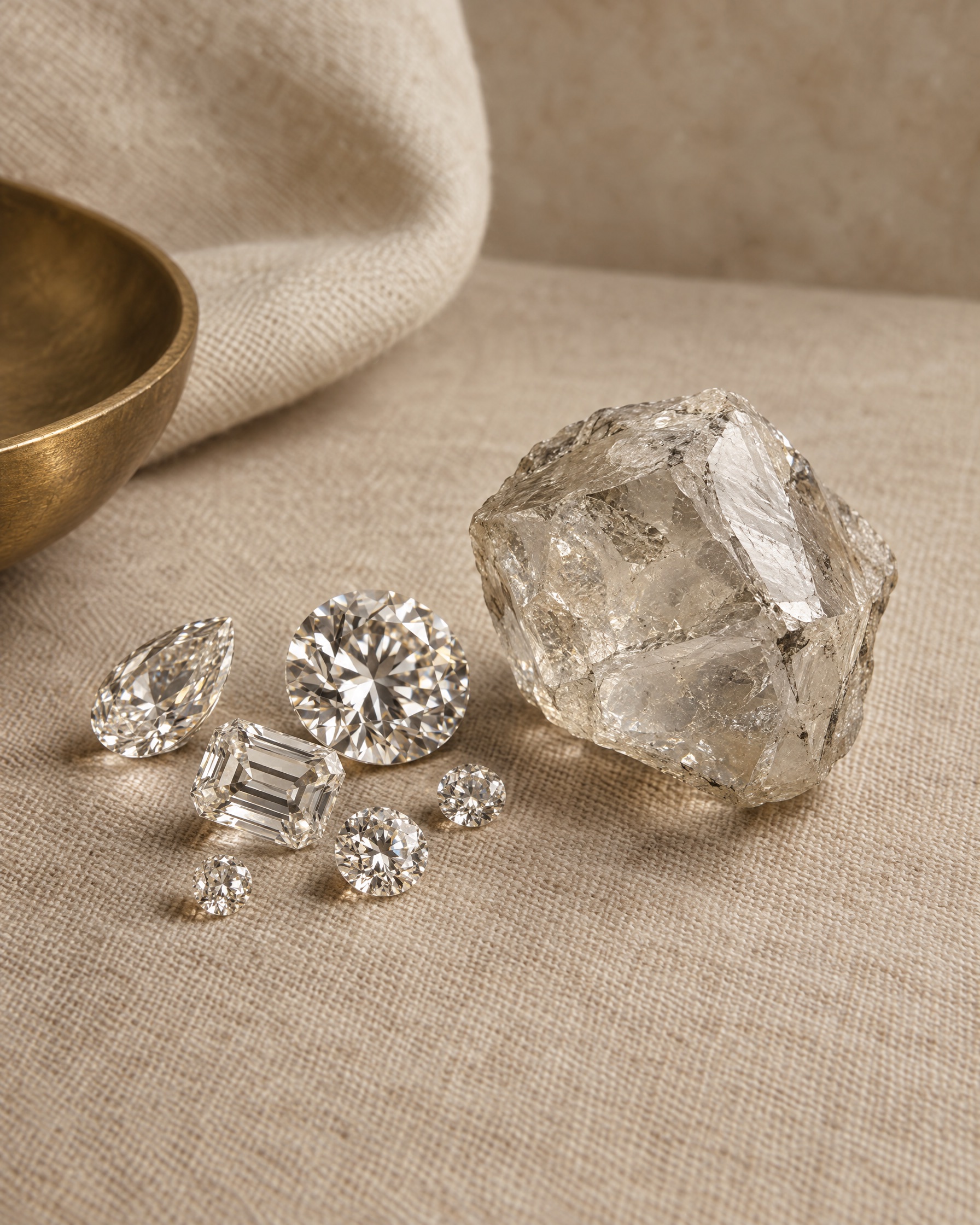
The Finsch diamond mine is a major kimberlite diamond mine located near Lime Acres in the Northern Cape province of South Africa, discovered in 1961 and developed into one of the country's largest and most productive diamond operations, historically ranking among the top handful of South African mines by carat output. Originally developed by De Beers, Finsch transitioned to underground block-cave mining after decades of open-pit operation and was sold to Petra Diamonds in 2011, remaining a significant contributor to South Africa's natural diamond production. This guide covers Finsch's history, how it's mined, what it's produced, how it compares to South Africa's other major mines, and how natural production from operations like Finsch fits alongside modern lab-grown sourcing for a wholesale buyer.
Where the Finsch Mine Is Located
Finsch sits roughly 150 kilometers northwest of Kimberley, near the small settlement of Lime Acres in South Africa's Northern Cape province — the same broader diamond-bearing region that includes the historic Kimberley "Big Hole" mines that launched South Africa's diamond industry in the 1870s. The mine takes its name from Finsch Diamonds Limited, the original prospecting and development company that identified and named the kimberlite pipe before it was developed into a full-scale mining operation. The Northern Cape more broadly hosts several of South Africa's most historically significant kimberlite pipes, a concentration explained by the underlying geology of the Kaapvaal Craton, an ancient and unusually stable section of the earth's crust that extends across much of the province and provided the specific deep-mantle conditions diamonds require to form and later be carried to the surface through volcanic activity.
That geological backdrop is worth understanding on its own terms: diamonds form roughly 150 to 200 kilometers below the earth's surface, under pressure and temperature conditions found only within old, thick sections of continental crust like the Kaapvaal Craton. Kimberlite pipes are the volcanic conduits that, over geologic time, brought that deep material — diamonds included — up to depths shallow enough for mining. The Northern Cape's unusual concentration of productive kimberlite pipes, Finsch among them, is a direct consequence of sitting atop one of the world's most diamond-favorable geological formations.
Finsch's discovery in 1961 came during a period of active kimberlite prospecting across the region, as mining companies used increasingly systematic geological survey techniques to identify pipes that earlier, more opportunistic prospecting methods had missed.
Discovery and Early History
The Finsch kimberlite pipe was discovered in 1961, more than 80 years after the original Kimberley rush, at a time when South Africa's diamond industry had already matured into large-scale, capital-intensive kimberlite mining rather than the individual-claim digging of the 19th century. De Beers acquired a controlling interest and began open-pit development soon after discovery, and the mine entered full production in the mid-1960s. For several decades, Finsch operated as one of De Beers's flagship South African assets, developed with the surface open-pit methods standard for large kimberlite operations at the time.
From Open-Pit to Underground Block-Cave Mining
Like most large kimberlite mines, Finsch eventually reached the practical depth limit for open-pit extraction, where continuing to mine downward would require removing an increasingly large and costly volume of surrounding waste rock relative to the diamond-bearing ore recovered. Finsch's operators transitioned the mine to underground block-cave mining, a method where ore is undercut from below and allowed to gradually collapse under its own weight into extraction points, rather than being excavated from an open pit. Finsch's underground operation is one of the largest of its kind in the world, reflecting the substantial scale of the kimberlite pipe beneath the original open pit.
Ownership History: De Beers to Petra Diamonds
De Beers operated Finsch as part of its South African portfolio for decades before selling the mine to Petra Diamonds in 2011, a transaction that was part of a broader period of De Beers divesting several older South African assets to smaller, more specialized operators focused on maximizing the remaining life of established mines. Petra Diamonds has continued underground development at Finsch since the acquisition, with the mine remaining one of the company's core producing assets in its portfolio alongside operations including Cullinan and Koffiefontein. That transaction pattern — a major diversified mining group divesting a mature, single-commodity asset to a smaller, more focused operator — has repeated across several South African mines over the past two decades, as large conglomerates increasingly prioritize newer, larger-scale projects elsewhere over incremental extensions of century-old kimberlite pipes.
What Finsch Has Produced
Finsch has historically been one of South Africa's highest-volume diamond mines by carat count, though — consistent with many large kimberlite operations — its output skews toward smaller, commercial-grade stones rather than the large exceptional rough that mines like Cullinan and Letšeng are known for producing. That said, Finsch has periodically produced larger, higher-value stones as well, and its overall production has made it a consistent contributor to South Africa's aggregate rough diamond output across more than six decades of near-continuous operation, a rare longevity for a single kimberlite pipe.
How Diamonds Are Actually Recovered From Finsch's Ore
Kimberlite ore extracted from Finsch's underground workings goes through a multi-stage processing sequence before any diamond is recovered. Crushing and screening first reduce the ore to a manageable size range, after which dense media separation — a process that suspends crushed ore in a ferrosilicon slurry calibrated to a specific density — separates the heavier diamond-bearing concentrate from the lighter waste rock, since diamonds are considerably denser than most of the surrounding kimberlite material. The resulting concentrate then passes through X-ray fluorescence sorting, which identifies individual diamonds by their distinctive response to X-ray exposure and physically diverts them out of the ore stream. Only after this multi-stage process does a small volume of rough diamond emerge from what was, at the start, thousands of tons of raw kimberlite ore — a ratio that illustrates just how resource-intensive natural diamond mining is relative to the finished product it yields.
Finsch's Place in Petra Diamonds' Broader Portfolio
Since acquiring Finsch in 2011, Petra Diamonds has operated it alongside several other established South African and regional assets, including the historic Cullinan mine and the Koffiefontein mine, as well as the Williamson mine in Tanzania. This portfolio strategy — acquiring mature, already-developed mines from larger players like De Beers rather than pursuing new greenfield exploration — has let a smaller, more specialized operator extend the productive life of established kimberlite pipes through continued underground investment, rather than those assets being wound down once they no longer fit a larger conglomerate's strategic priorities. Finsch has remained one of the more consistently productive mines in that portfolio across the period of Petra's ownership.
Regional Economic Role
Large kimberlite mines like Finsch are typically significant employers and economic anchors for the surrounding region — in Finsch's case, the Lime Acres area of the Northern Cape, a sparsely populated part of South Africa where large-scale industrial mining represents a disproportionate share of local formal employment and municipal economic activity. This pattern is common across South Africa's diamond mining regions and is part of why continued investment in extending an established mine's underground life, rather than closing it once open-pit extraction becomes uneconomical, carries economic significance well beyond the mining company's own balance sheet.
Why Mines Like Finsch Rarely Produce Record-Setting Rough
Unlike Cullinan, which is specifically famous for yielding exceptionally large rough diamonds including the 3,106-carat Cullinan Diamond, Finsch's kimberlite has historically trended toward a higher volume of smaller, commercial-grade stones rather than rare outsized rough. This isn't a quality shortfall — it reflects genuine geological variation between different kimberlite pipes, since the size distribution of diamonds within a given deposit is a function of that specific pipe's formation history rather than something a mining operation can influence. A high-volume, commercially consistent mine like Finsch and a rare-large-stone mine like Cullinan both play distinct, complementary roles in South Africa's overall diamond output.
Table: Finsch vs. Other Major South African Diamond Mines
| Mine | Discovered | Mining Method | Known For |
|---|---|---|---|
| Finsch | 1961 | Underground block cave (formerly open pit) | High-volume, long-running production |
| Cullinan (Premier) | 1902 | Underground block cave (formerly open pit) | Source of the largest gem-quality rough diamond ever found, the 3,106-carat Cullinan Diamond |
| Venetia | 1980s | Transitioning open pit to underground | South Africa's largest diamond mine by value in recent decades |
| Kimberley (Big Hole) | 1871 | Historic open pit, now a mining museum | Birthplace of South Africa's modern diamond industry |
| Koffiefontein | 1870 | Underground | One of the country's oldest continuously worked kimberlite sites |
Why Underground Block Caving Matters for Long-Term Supply
The shift from open-pit to underground block-cave mining is directly relevant to how long a mine like Finsch can keep contributing to global supply. Open-pit mining eventually becomes uneconomical as the pit deepens, since the ratio of waste rock that must be removed to reach each additional ton of ore climbs steeply with depth — a relationship mining engineers call the stripping ratio. A well-developed underground block-cave operation sidesteps that problem by undercutting ore from below and letting gravity do much of the extraction work, which can extend a kimberlite pipe's productive life by decades relative to what open-pit mining alone would allow, accessing ore that would otherwise be left in the ground as economically unreachable.
This is one reason South Africa, despite being one of the diamond industry's oldest producing regions, continues to be a meaningful natural diamond source today rather than having been fully depleted — established mines like Finsch, Cullinan, and Venetia have continued producing well past the point where a purely open-pit operation would have closed, and the capital investment required to develop underground block-cave infrastructure is itself a signal of how much remaining value operators believe these century-plus-old kimberlite pipes still hold.
Finsch's Role in South Africa's Broader Diamond Industry
South Africa remains one of the historically significant natural diamond producing countries, and mines like Finsch are part of why the industry there has proven more durable than a simple "gold rush and decline" narrative would suggest. Continued investment in underground development at established mines, rather than only chasing newly discovered deposits, has let South Africa sustain meaningful diamond output across more than 150 years since the original Kimberley discoveries, even as the largest and easiest-to-reach deposits were worked out generations ago.
South Africa's diamond industry has also shifted structurally over that period, from an early era dominated almost entirely by De Beers to a more fragmented landscape where specialized mid-tier operators like Petra Diamonds now run several of the country's historically significant mines. That shift has generally meant more capital directed specifically toward extending the life of mature assets like Finsch, rather than those mines competing for investment against a much larger conglomerate's newer, higher-priority projects elsewhere in the world.
Rough Diamond Export and the Kimberley Process
Rough diamonds recovered from Finsch, like all rough diamonds exported from South Africa, move through the country's Kimberley Process certification system before leaving for international cutting and polishing centers, primarily Surat, India, which handles the large majority of the world's diamonds by volume regardless of original mining country. This certification documents the shipment's country of export and is intended to prevent conflict diamonds from entering the legitimate international supply chain — South Africa has been a Kimberley Process participant since the scheme's creation in the early 2000s, reflecting the country's status as an established, formally regulated producer rather than a source of concern for illicit diamond trade. That regulatory maturity is itself part of what makes established South African mines attractive to specialized operators like Petra Diamonds: the compliance infrastructure, export documentation systems, and regulatory relationships are already in place, unlike in newer or less formally regulated producing regions.
How Natural Mine Output Compares to Lab-Grown CVD Production
A mine like Finsch illustrates just how capital- and infrastructure-intensive natural diamond production is: a single kimberlite pipe requires decades of geological survey, billions of dollars in mining infrastructure, and ongoing underground development to keep producing, and even then yields a relatively low concentration of diamonds per ton of ore processed — commonly cited industry figures put average ore grades at just a few carats per hundred tons for many kimberlite operations. CVD lab-grown diamond production works on an entirely different model — diamonds are grown in controlled reactor chambers rather than extracted from geological deposits, which decouples supply from the location, depth, or remaining life of any specific ore body, and removes the multi-decade lead time between initial exploration and full production that a project like Finsch required.
This is a structural difference in how each category is produced, not a claim that one method is inherently superior for every buyer's needs; natural stones from established mines like Finsch and CVD lab-grown stones serve different segments of demand and are often stocked side by side by the same wholesale buyers. A jeweler sourcing loose stones for a natural-diamond-focused client benefits from understanding that a natural stone's supply chain traces back through a genuinely finite, geologically constrained resource, while a lab-grown stone's supply is a function of manufacturing capacity that can, in principle, scale with demand in a way mining output cannot.
What a Wholesale Buyer Should Take From Finsch's History
For a jeweler or wholesale buyer, understanding a mine like Finsch matters less for day-to-day sourcing decisions (individual polished stones are rarely traceable to a specific mine on standard grading documentation) and more for general trade literacy — being able to speak knowledgeably about where natural diamond supply actually comes from, why certain producing countries and mines remain relevant after a century or more of operation, and how that supply chain differs structurally from lab-grown production. That context is useful when fielding customer questions about origin, sustainability, or supply reliability across both natural and lab-grown categories.
It's also a useful reference point when a customer raises concerns about natural diamond mining's environmental footprint or labor practices, since those concerns vary enormously by jurisdiction and by individual mine. A well-established, formally regulated, Kimberley Process-compliant operation like Finsch, operating under South African mining and labor law with decades of continuous formal-sector employment, is a fundamentally different conversation than the artisanal or informally regulated mining that draws most of the industry's negative attention. Being able to speak specifically about how a mine like Finsch actually operates — rather than treating "natural diamond mining" as a single undifferentiated category — helps a jeweler answer those questions credibly instead of falling back on vague reassurance.
Comparing Finsch to Lesser-Known Regional Mines
Not every diamond-bearing kimberlite pipe develops into a mine on Finsch's scale. South Africa and neighboring producing countries have dozens of documented kimberlite occurrences that were explored and, for reasons ranging from insufficient diamond concentration to poor stone quality to unfavorable economics, never developed into full commercial operations. Finsch's transition from initial 1961 discovery through decades of open-pit production and into a major underground operation represents the exception rather than the rule — most kimberlite discoveries never reach that level of sustained investment, which is part of why a small number of long-lived mines like Finsch, Cullinan, and Kimberley account for a disproportionate share of South Africa's total historical diamond output relative to the much larger number of pipes that were identified but never fully developed.
Sourcing Natural and Lab-Grown Diamonds Through Guru Diam
Guru Diam supplies both certified natural diamonds and CVD lab-grown diamonds, with IGI, GIA, and GCAL certification available across the catalog. Certified loose stones can be browsed through the certified diamonds category, and buyers assembling matched sets can review the matching pairs category. Trade accounts can review wholesale terms at the wholesale hub or apply through trade partner, and jewelers building a finished piece can work through custom jewelry, with rings finished in 4-6 days. In-stock inventory ships same-day from New York (before 6pm EST) and Los Angeles (before 4pm PST).
Frequently Asked Questions
Where is the Finsch diamond mine located?
Near Lime Acres in South Africa's Northern Cape province, roughly 150 kilometers northwest of Kimberley, in the same broader diamond-bearing region as the historic Kimberley mines.
Who owns the Finsch diamond mine?
De Beers originally developed and operated Finsch after its 1961 discovery, then sold the mine to Petra Diamonds in 2011. Petra Diamonds has continued underground development at the site since acquiring it.
Is Finsch an open-pit or underground mine?
Both, at different points in its history. Finsch began as an open-pit operation in the 1960s and later transitioned to underground block-cave mining as the pit reached its practical depth limit, extending the mine's productive life significantly.
What is Finsch known for producing?
Finsch has been one of South Africa's higher-volume diamond mines by carat count across more than six decades of operation, with output skewing toward commercial-grade stones, though it has periodically produced larger, higher-value rough as well.
How does a natural diamond from a mine like Finsch differ from a CVD lab-grown diamond?
Natural diamonds from Finsch formed over geologic time and are extracted through capital-intensive mining infrastructure tied to a specific ore body. CVD lab-grown diamonds are grown in controlled reactor facilities, decoupling production from mining geology and geographic ore-body constraints entirely.
Can a jeweler trace a specific polished diamond back to the Finsch mine?
Generally, no. Standard grading reports document a diamond's 4Cs and other quality characteristics, not a traceable mine-of-origin history, except through specialty traceability programs that some suppliers offer at an additional cost for specific marketing purposes.
Is Finsch a Kimberley Process-compliant mine?
Yes. Rough diamonds exported from South Africa, including Finsch's production, move through the country's Kimberley Process certification system, which documents the shipment's country of export as part of the international framework intended to keep conflict diamonds out of the legitimate supply chain.
Why did De Beers sell Finsch instead of continuing to operate it?
The 2011 sale to Petra Diamonds was part of a broader pattern of De Beers divesting mature South African assets to smaller, more specialized operators, allowing De Beers to focus capital on other priorities while a company like Petra concentrates specifically on extending the productive life of established kimberlite pipes.