
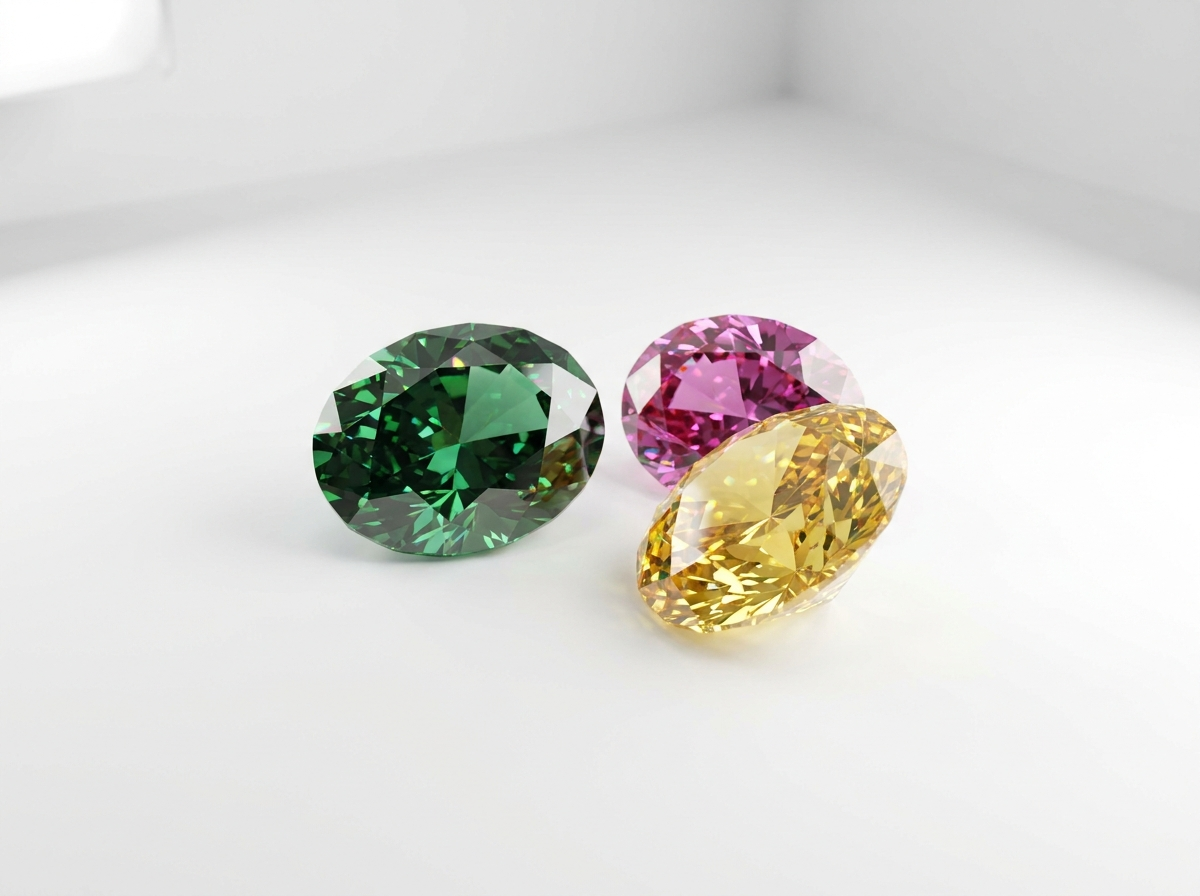
A fancy color oval diamond is an elongated brilliant-cut shape with no points — a stretched round brilliant, essentially — that spreads color evenly across a larger face-up area than a round of the same carat weight. Guru Diam stocks 105+ IGI-certified, CVD-grown fancy color ovals on hand, across yellow, pink, blue, and green.
Oval is the shape buyers pull when a client wants the elongated look without committing to a pointed end — no bow-tie risk to manage at the tip, no chip-prone corner, just a longer brilliant that reads bigger than its carat weight suggests. It's also one of the more forgiving fancy color shapes to buy wholesale, because the same round-brilliant facet logic that governs a colorless oval governs a colored one — once you understand how hue, tone, and saturation interact with that facet pattern, evaluating any oval on a grading report gets a lot faster.
What is a fancy color oval diamond?
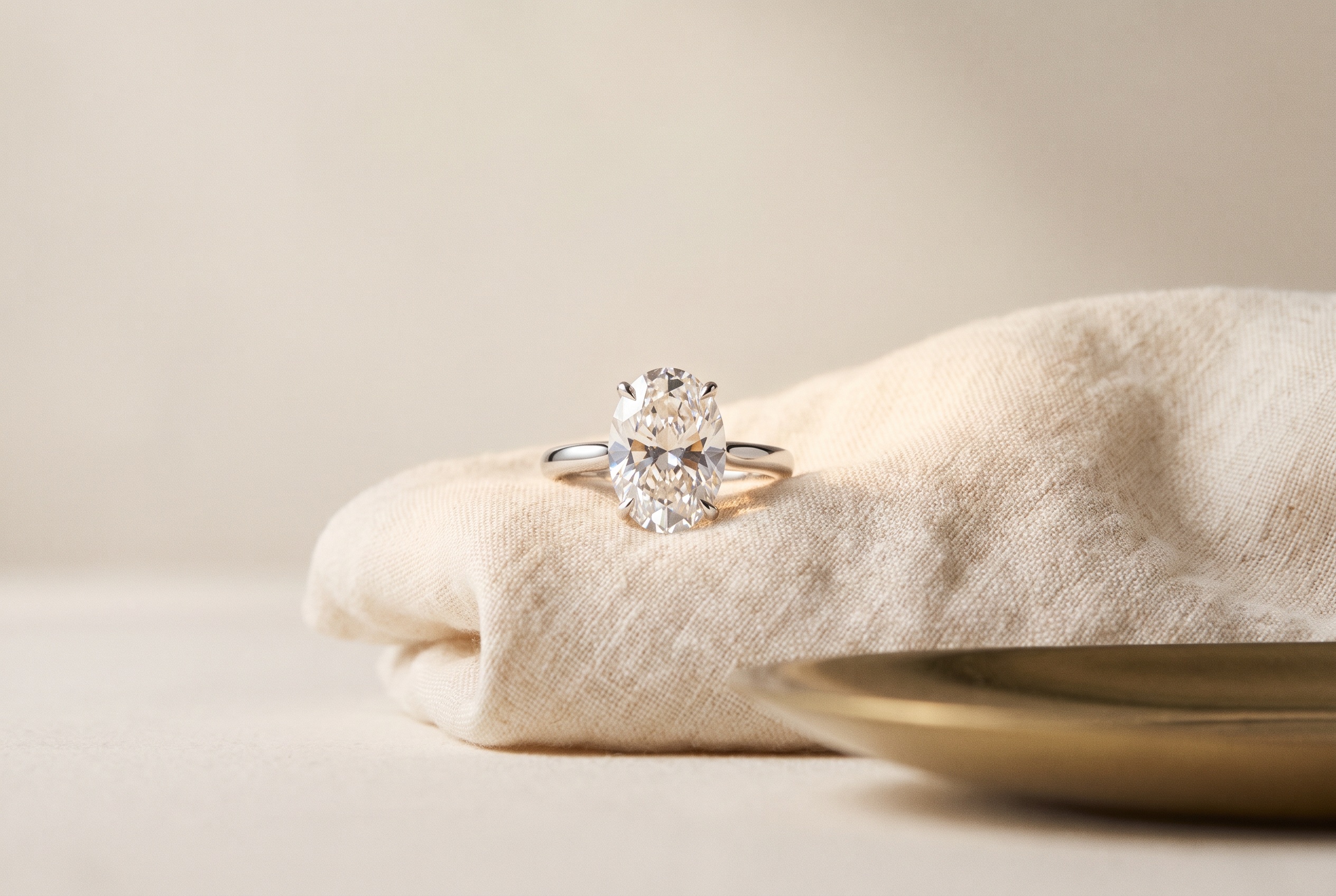
An oval cut is a full brilliant facet pattern applied to an elongated, rounded outline — essentially a round brilliant stretched along one axis, with no corners or points anywhere on the stone. That's what makes it one of the most versatile fancy color shapes: it works as a center stone in a ring, sits cleanly in a pendant bail, and pairs easily as a matched set for earrings, all without the setting considerations a pointed shape requires.
The oval brilliant as a modern cut dates to the mid-20th century, when diamond cutters began adapting the round brilliant's facet math to elongated outlines to improve yield from certain rough shapes. In fancy color material specifically, that elongation turned out to matter for a second reason beyond yield: stretching the outline increases face-up surface area, which increases how much color the eye registers per carat. That's the mechanical reason ovals became a go-to shape for colored stone buyers, independent of any brand or era.
Guru Diam's fancy color oval inventory spans the locked palette — yellow, pink, blue, and green — cut in-house and certified IGI as standard, with GIA and GCAL available on request. These are certified single stones, not melee: each one carries its own grading report and ships with full documentation, distinct from Guru Diam's calibrated fancy color melee program, which is a separate uncertified parcel-goods category.
Fancy color grading 101: hue, tone, and saturation
Grading a fancy color diamond works almost opposite to grading a colorless one. On the D-to-Z scale, less body color means a higher grade. On the fancy color scale, more color — up to a point — means a higher grade. Labs like IGI and GIA assess three separate variables, and wholesale buyers who can speak to all three read a certificate faster than buyers who only look at the headline color name.
Hue is the color family itself — yellow, pink, blue, green, and the modifying hues that sit between them (a yellow-green, a purplish-pink). Most fancy color diamonds aren't a pure single hue; they carry a dominant hue plus a secondary modifier, and the certificate lists both. A stone graded "Fancy Intense Yellow" is closer to pure yellow than one graded "Fancy Light Brownish Yellow," even though both are technically in the yellow family.
Tone is how light or dark the color reads, independent of hue — think of it as where the color sits on a black-to-white value scale. Two stones can share the same hue and saturation but differ in tone, and that difference changes how the stone photographs and how it reads face-up in different lighting.
Saturation is color intensity — how much of that hue is packed into the stone versus how diluted or grayed-out it looks. This is the variable that does the most work in fancy color pricing. The GIA/IGI fancy grade scale runs roughly: Faint, Very Light, Light, Fancy Light, Fancy, Fancy Intense, Fancy Vivid, with Fancy Dark and Fancy Deep as separate tone-driven categories for darker stones. Vivid and Intense grades carry the strongest, purest saturation and command the steepest premiums over Light and Fancy Light material.
The practical takeaway for a wholesale buyer: two stones with the identical color name on a report can still look meaningfully different face-up because of how their secondary hue and tone interact. Always request the full certificate scan plus a face-up photo or video shot under a consistent light source before committing to a stone sight-unseen — the grade name alone doesn't tell you everything the eye will see.
Oval cut facet structure and light performance in fancy color
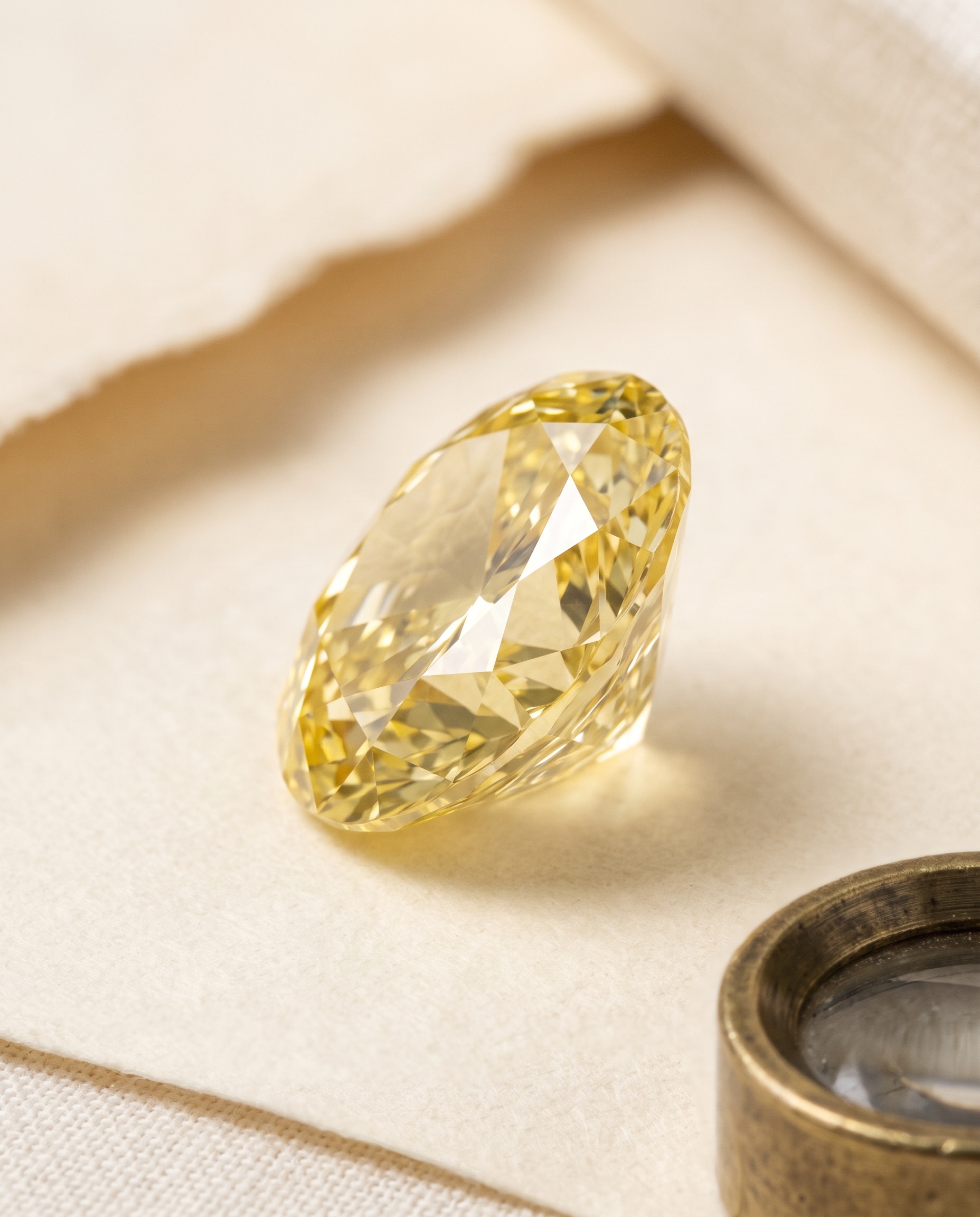
An oval brilliant typically carries the same facet count logic as a round — a table, a crown ring of kite and star facets, a girdle, and a pavilion of main and lower-girdle facets, usually landing around 56 to 58 facets total — stretched along one axis rather than arranged around a perfect circle. The length-to-width ratio is what defines the oval's character: a ratio around 1.3 to 1.5 tends to read as a balanced, classically proportioned oval, while ratios outside that range start to look either stubby or overly narrow.
Where fancy color cutting genuinely diverges from colorless cutting is in what the cutter is optimizing for. A colorless diamond is cut to maximize brilliance and fire — bouncing the maximum amount of white light back to the eye. A fancy color stone is cut to maximize and retain body color, which sometimes means different proportion choices than a colorless ideal-cut chart would recommend: a deeper pavilion, for instance, can hold light inside the stone longer, concentrating and intensifying the face-up color rather than letting it exit quickly the way a colorless cutter wants it to. Rough orientation matters too, since color concentration inside the rough crystal isn't always uniform — where the cutter places the table relative to that internal color zoning affects how saturated the finished stone looks.
This is also why fancy color cutting is a different discipline from cutting for brilliance alone, and why the same rough can yield very different finished results depending on the cutter's priorities.
The bow-tie effect in fancy color ovals
Because an oval has no points or hard corners to anchor the eye, a poorly proportioned stone can show a "bow-tie" — a dark, shadow-shaped band across the stone's center, named for its resemblance to a bow-tie knot. It happens when the facets in the middle of an elongated cut fail to return light to the eye at certain viewing angles, usually from an outline that's too shallow, too elongated, or asymmetrical.
In a colorless diamond, a bow-tie is a straightforward flaw — it reads as a gray or dark patch that interrupts brilliance. In a fancy color stone, the effect is more situational. A faint bow-tie in a strongly saturated stone can sometimes blend into the body color and go largely unnoticed, since the eye is already reading color rather than scanning for sparkle the way it does with a colorless stone. But a pronounced bow-tie in a lighter-saturation stone is a different story — it interrupts the even, edge-to-edge color distribution that's the entire selling point of choosing an oval for fancy color in the first place, and it will read as an obvious flaw to any buyer who knows what to look for.
For wholesale evaluation, the practical fix is simple: don't rely on the certificate number alone. Ask for a face-up video or a clear photo taken under a standard light source, and ask the seller directly to characterize bow-tie severity — none, faint, moderate, or strong. Length-to-width ratio is a rough proxy (extreme ratios correlate with a higher bow-tie risk) but it isn't a substitute for actually looking at the stone.
How Guru Diam sources and matches fancy color quality
Sourcing starts at the rough stage: rough selected for fancy color production is evaluated for internal color zoning before it's ever cut, since that zoning determines where the table gets placed and how much saturated color the finished stone will carry. Cutting happens in-house, with proportions decided per stone rather than against a single universal chart — a deeper pavilion for a lighter-saturation rough, a more standard cut for material that's already saturated enough to spare the trade-off.
Every finished stone is graded against IGI as the standard certification, with GIA and GCAL available on request for buyers who need a specific lab for their own downstream customers. For earring and pendant-pair orders, Guru Diam runs a matching pass beyond the individual certificate — pairing stones by hue, tone, and saturation band rather than assuming two stones with the same color name will actually look identical side by side, since (as covered above) they often don't.
All of this happens on a wholesale, trade-only basis — no retail markup layered in, and no minimum order complexity standing between a verified account and the stone they need.
Quality considerations when buying fancy color oval wholesale
Color grade carries more weight in a fancy color purchase than it does in a colorless one, but it isn't the only variable worth checking before committing to a stone:
Clarity matters less than in a colorless diamond — saturated body color naturally masks small inclusions that would be obvious in a white stone — but eye-clean clarity still matters for resale, especially in lighter-saturation stones where there's less color to hide behind.
Cut proportions and bow-tie severity, as covered above, directly affect how even the color reads face-up. This matters more in oval than in round, since round has no elongation axis to manage.
Color consistency across a set is its own line item for any order involving more than one stone — earrings, a three-stone ring, a pair of accent stones flanking a center. Buy matched sets as matched sets rather than assembling loose stones independently and hoping they align.
Growth method is worth confirming on paper. Guru Diam's fancy color program is CVD-grown exclusively — color develops through the growth and post-growth process and is disclosed on the certificate, the same way a natural stone's color origin is disclosed. Buyers sourcing across multiple vendors should always confirm growth method explicitly rather than assume, since CVD and other lab-growth methods aren't interchangeable on a certificate or in downstream customer disclosure.
Girdle thickness and faceting precision matter more on an elongated outline than a round one, since an oval's proportions are easier to throw off-balance during cutting and easier to spot as uneven once the stone is set.
Pricing factors for fancy color oval diamonds
Fancy color pricing runs on a different logic than colorless pricing, and understanding the factor hierarchy helps a wholesale buyer read a price quote instead of just accepting it:
Saturation is the primary driver. A Fancy Vivid stone commands a real premium over a Fancy Light stone of the same hue, carat weight, and clarity — saturation moves price more than any other single variable in fancy color.
Hue purity affects price within a color family. A stone closer to a pure, unmodified hue typically prices above one with a strong secondary modifying hue, all else equal, though secondary hues aren't a flaw — they're simply a different look that some buyers actively prefer.
Cut quality and bow-tie severity factor in directly, since a stone that shows an obvious dark patch face-up is a harder resell regardless of what the certificate says.
Carat weight scales price, but not on the same steep curve as colorless diamonds at the common size breakpoints (0.50ct, 1.00ct, 2.00ct) — color and saturation carry more of the pricing weight throughout the size range than they do in white goods.
Production complexity varies by color. Different fancy colors require different growth conditions — some hues are more straightforward to produce consistently at scale than others — and that production complexity shows up in wholesale pricing across the palette, independent of any single stone's individual grade.
Certification lab can shift price slightly depending on which lab a buyer's own customers expect to see on the paperwork; this is a smaller factor than the four above but worth confirming before finalizing a quote.
Styling and use-case guidance for fancy color ovals
An oval's lack of points changes what settings make sense compared to a pointed fancy color shape. A few patterns that come up repeatedly across wholesale orders:
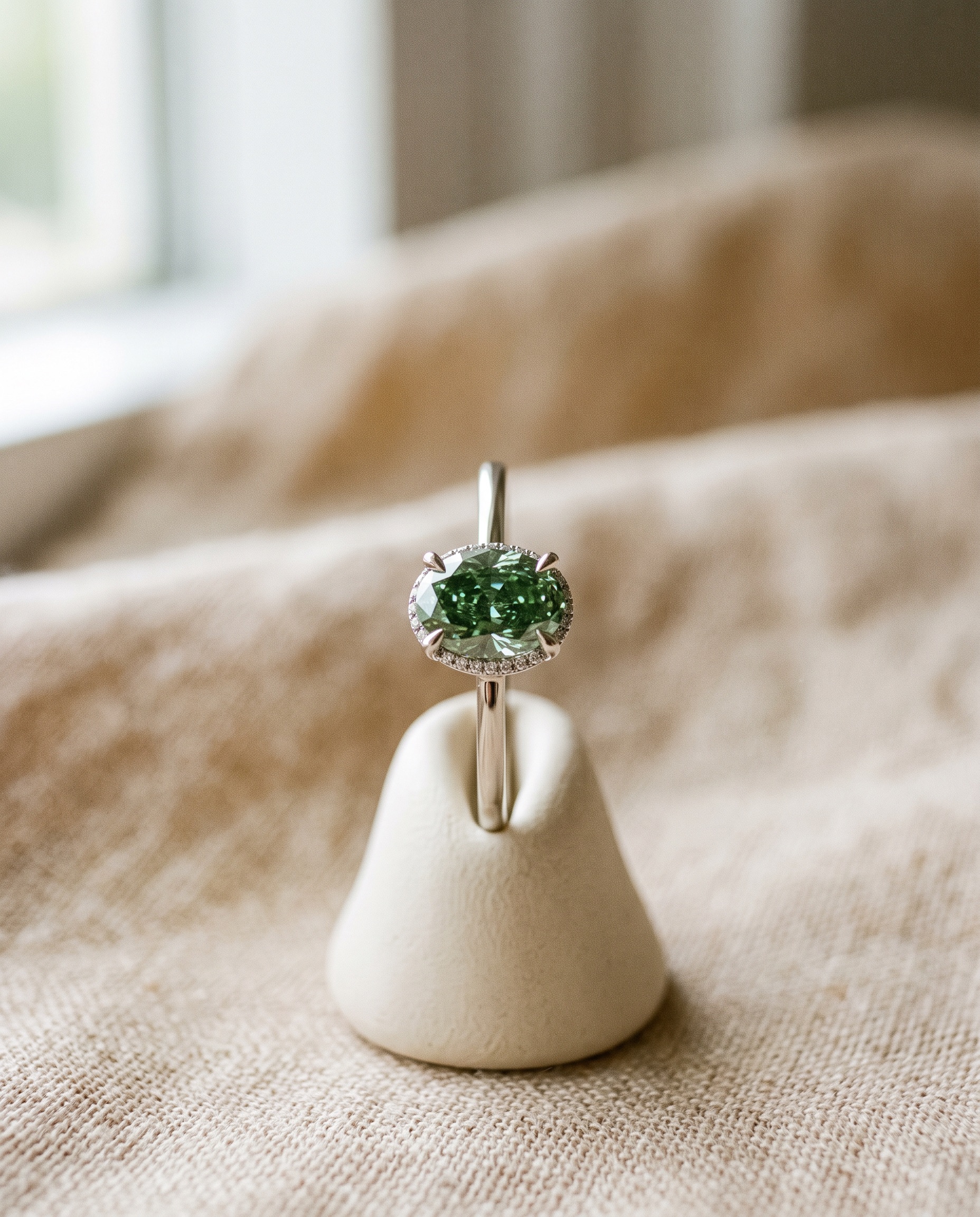
Engagement and statement rings: hidden halos and thin pavé shanks let the color carry the design without competing metal detail. East-west settings — the oval turned sideways across the finger — have been a consistent request for buyers looking for something distinct from the standard north-south orientation. Because an oval has no point to protect, prong or bezel choice is mostly aesthetic rather than structural, unlike a pear or marquise where the point genuinely needs protecting.
Pendants: the elongated, pointless outline sits naturally in a bail without requiring a specialized prong setup, which is part of why oval performs well as a pendant center stone across price points.
Earrings: matched pairs are the default request here, and — as covered in the sourcing section — matching on hue, tone, and saturation band matters more than matching on carat weight or shape alone.
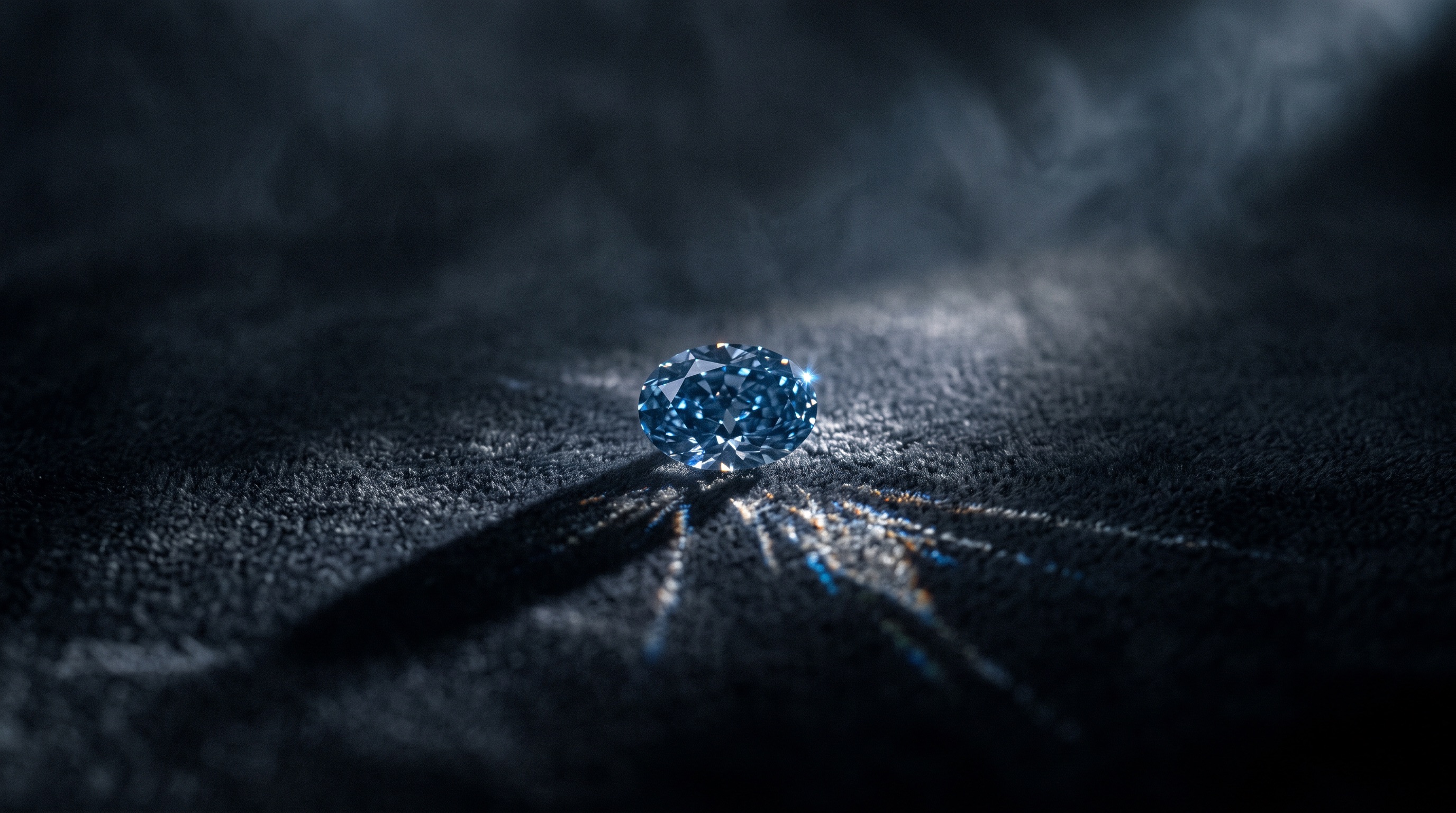
Metal pairing: rose gold tends to flatter pink stones by echoing the warm undertone; white gold or platinum creates deliberate contrast against blue and green stones, making the color read as the clear focal point; yellow gold pairs naturally with yellow stones for a tonal, monochromatic look.
Three-stone and side-stone layouts: a fancy color oval center flanked by colorless or lighter-tone side stones is a common way to let a single strong-saturation stone anchor a piece without pricing the entire design at fancy color rates.
Fancy color oval: spec and availability
| Spec | Detail |
|---|---|
| Outline | Elongated, no points or corners |
| Facet style | Full brilliant, ~56–58 facets |
| Typical L/W ratio | 1.3–1.5 for balanced proportions |
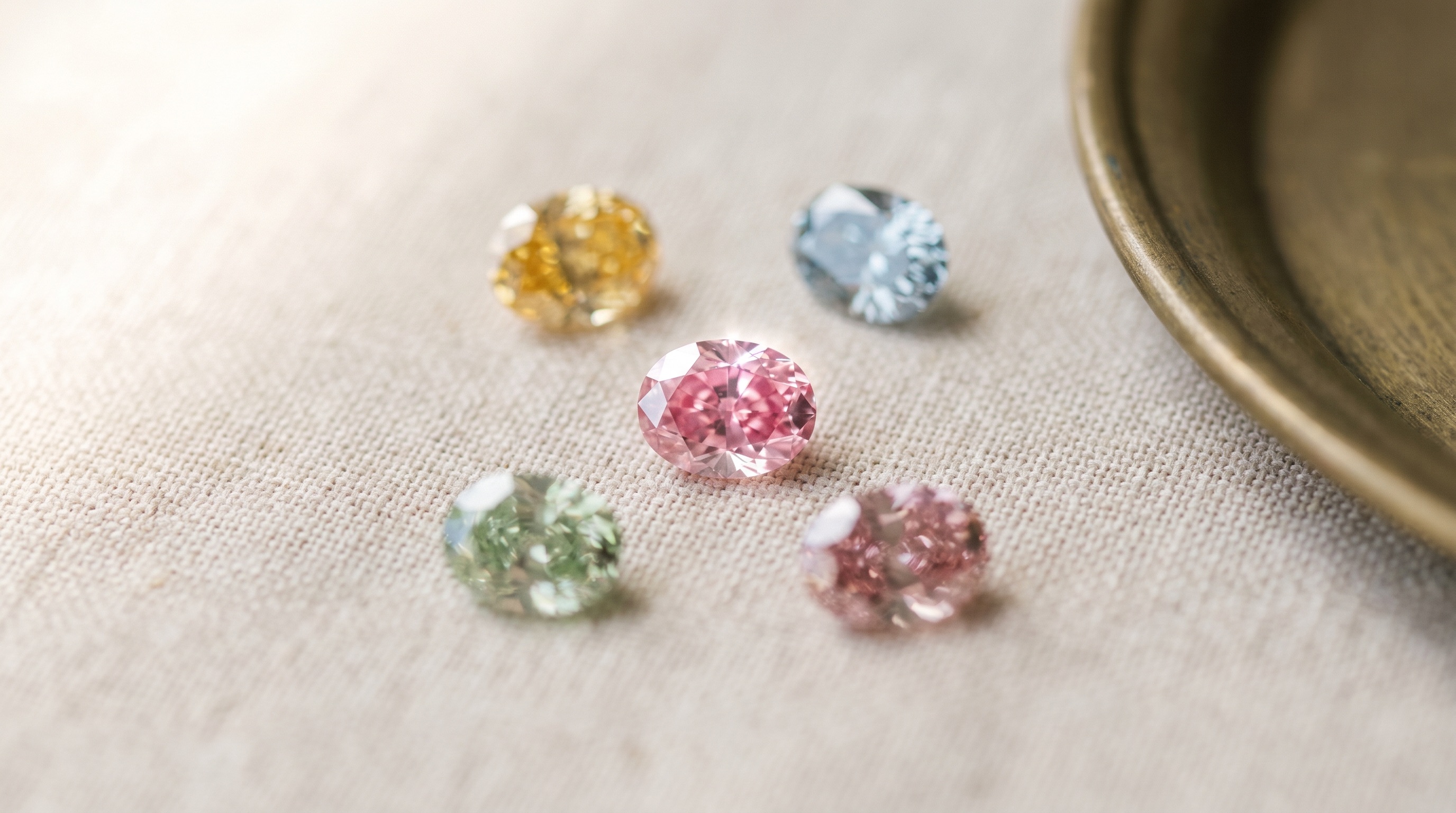
| Color palette (Guru Diam) | Yellow, Pink, Blue, Green |
| Growth method | CVD-grown |
| Certification | IGI standard; GIA and GCAL available on request |
| Stone type | Certified single stones (not melee) |
| On-hand count | 105+ pieces |
| Typical uses | Engagement ring center stones, pendants, matched earring pairs, three-stone side settings |
With 105+ pieces on hand across yellow, pink, blue, and green, fancy color oval covers a solid range of size and saturation for standard ring, pendant, and earring requests. Because ovals are more sensitive to cut-proportion issues like bow-tie shadowing than rounder shapes, ask for light-performance details alongside color grade when reviewing a stone, not just the certificate numbers.
Worth noting for buyers comparing across the broader colored-diamond market: champagne and cognac diamonds — warm brown-hued stones — are a familiar category in the natural fancy color trade, but they sit outside Guru Diam's certified loose fancy color palette. The four-color program above (yellow, pink, blue, green) is the full locked palette for certified single stones; the separate fancy color melee program covers the same four colors in calibrated round and fancy shapes.
How to order fancy color oval diamonds wholesale
Guru Diam sources fancy color oval diamonds as wholesale, trade-only inventory — no retail markup — from our New York Diamond District desk (36 West 47th Street, Suite 601A) and our Los Angeles office (607 South Hill Street, Suite 241). Both locations serve the full national trade base; Guru Diam is not a New York-only supplier.
In-stock loose stones ship same-day: from New York before 6pm EST, from Los Angeles before 4pm PST. For a custom setting built around a fancy color oval, CAD-to-finished-piece turnaround runs 4–6 days from either desk — that timeline applies to finished jewelry, not to the loose stone order itself, which ships as soon as the piece is picked and packed.
To buy: open a verified wholesale account at /signup and book time with a gemologist at /book-appointment to review specific stones, discuss a matched-set request, or start a custom setting. Guru Diam's trade desk also takes inbound requests over WhatsApp Business at +1 (347) 812-2006 for buyers who want to send a quick spec or reference photo before booking a full appointment. Guru Diam works with 2,000+ active wholesale accounts across independent jewelers, designers, and manufacturers — one vendor, one shipment, one relationship, rather than splitting a single order across multiple suppliers for shape or color coverage.
For the full fancy color category across every shape, see our fancy color lab-grown diamonds overview.
Fancy color oval vs. fancy color pear
Pear is oval's closest relative in the fancy color lineup — same brilliant facet logic, but with one end tapered to a single point instead of rounded at both ends. That point changes the calculus in a few ways. Color tends to concentrate more visibly at the tip in a pear, which some buyers actively want (a deeper-looking point can read as extra saturation) and others find uneven compared to an oval's edge-to-edge consistency. Pear also carries a structurally higher bow-tie risk than oval, since the taper toward the point creates more opportunity for light-return gaps across the center.
Setting-wise, a pear's point needs real protection — a V-prong or bezel at the tip to guard against chipping — where an oval has no vulnerable point to manage at all, making it the lower-maintenance choice for daily-wear rings. Pear tends to get pulled more often for drop earrings and pendants where the tapered silhouette is the whole point (literally), while oval is the more flexible all-purpose center stone across ring, pendant, and earring requests alike.
Fancy color oval vs. fancy color cushion
Cushion is a different facet family entirely — a rounded-square or rounded-rectangular outline, often cut with larger, blockier facets (sometimes called a "crushed ice" pattern in its more modern variants) rather than oval's fine, round-brilliant-style faceting. That larger facet structure tends to show color in bigger, more concentrated blocks, which can read as a bolder, more saturated look face-up compared to an oval of the same grade — but it also means cushion typically looks more compact per carat, since a squarer outline doesn't spread surface area the way an elongated one does.
Cushion's larger facets are also more forgiving of small inclusions, similar to how oval's brilliant faceting handles clarity, though for a different structural reason. Where oval reads modern and elongating — the shape buyers pull to visually lengthen a finger or maximize face-up size per carat — cushion reads softer and more vintage, which is why the two shapes tend to serve different design briefs rather than compete head-to-head for the same order.
Frequently Asked Questions
What is a fancy color oval diamond? A fancy color oval diamond is a colored diamond cut in an elongated brilliant shape with no points or corners — essentially a round brilliant stretched along one axis. It spreads color evenly across a larger face-up area than a round diamond of the same carat weight.
Why does an oval cut show more visible color per carat than a round? Elongating the outline increases the stone's face-up surface area without changing its carat weight, so more of the diamond's color is on display per carat. The facet arrangement inherits the round brilliant's even light distribution, so color reads consistently across the stone's length rather than concentrating at one point.
Are fancy color oval diamonds lab-grown, and are they certified? Yes. Guru Diam's fancy color oval inventory is CVD-grown and IGI-certified as standard, with GIA and GCAL certification available on request. All pieces are certified single stones, not melee.
What colors are available in fancy color oval cut? Guru Diam carries fancy color oval diamonds in yellow, pink, blue, and green — the full locked fancy color palette across both certified single stones and calibrated fancy color melee.
What causes a bow-tie in an oval diamond, and does it matter in fancy color? A bow-tie is a dark shadow band across an elongated cut's center, caused by facets in the middle failing to return light at certain angles — most common in outlines that are too shallow or too elongated. In fancy color stones, a faint bow-tie can blend into strong body color, but a pronounced one still interrupts the even color spread that's the main reason to choose an oval, so it's worth checking on any stone before purchase.
How fast can I get a fancy color oval stone or a finished custom piece? In-stock loose stones ship same-day — before 6pm EST from New York, before 4pm PST from Los Angeles. For a custom setting, CAD-to-finished-piece turnaround runs 4–6 days from either desk; that timeline is for finished jewelry, not the loose stone itself.