
Dutch Marquise vs Marquise Diamond: A Wholesale Buyer's Guide
A Dutch Marquise and a standard Marquise are two different diamond cuts that share a confusing name. The Dutch Marquise — also called a Brilliant Hexagon — is an antique, elongated hexagonal cut with pointed ends and broad brilliant faceting. The standard Marquise is the modern, pointed-oval "navette" shape most jewelers already stock. They are not the same cut. That shared name is exactly why buyers land on this comparison. A client or sourcing contact says "marquise," a search turns up a Dutch Marquise listing instead, and suddenly two visually distinct diamonds — from two different pricing tiers — look like they might be interchangeable. They aren't, and quoting the wrong one costs you either margin or a client's trust. This guide walks through what separates the two cuts, why the naming overlap happened in the first place, and how to source either one — or both — for a live order.What Is a Standard Marquise Diamond?
The standard Marquise is a modern fancy-shape cut: an elongated, pointed-oval outline, sometimes called a "navette" (French for "little boat") because of its resemblance to a boat's hull. It's brilliant-faceted, meaning it's cut with a large number of small, angled facets designed to maximize fire and scintillation rather than the broad flat flashes of a step cut. Typical length-to-width ratio runs 1.75–2.25, and that elongation is the whole point of the shape — a well-cut Marquise makes a finger look longer and a carat weight look larger than the same weight in a round or cushion. It's a familiar shape in bridal and fashion jewelry, used both as a center stone and, in smaller calibrated sizes, as a melee shape for pavé and side-stone work. In Guru Diam's cut taxonomy, Marquise sits in the regular fancy tier — the same mid-market category as Oval, Pear, Cushion, Emerald, Radiant, and Princess. These are modern cuts, not antique ones, and they're priced and stocked accordingly: widely available, consistent supply, no scarcity premium.What Is a Dutch Marquise Diamond?
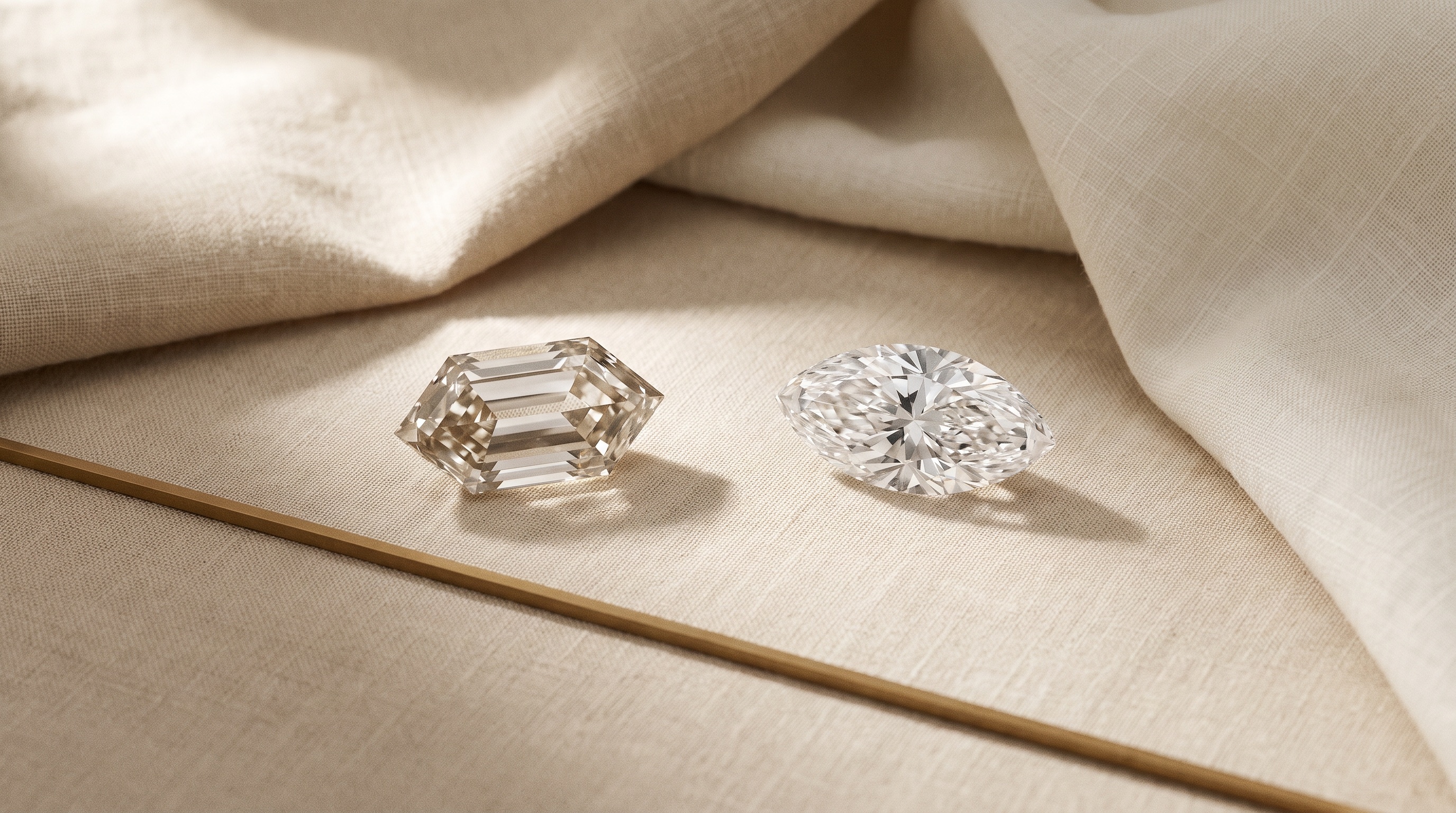
The Dutch Marquise is a different animal. It's an antique, elongated hexagonal cut — six sides, two pointed ends, brilliant faceting rather than step faceting. What makes the outline read as "hexagonal" instead of "boat-shaped" is the long edge: on a Dutch Marquise, each long side breaks into two angled facets instead of one continuous curve. That single structural difference is the entire distinction between this cut and a standard Marquise, and it's also why the Dutch Marquise is sold under a second name, Brilliant Hexagon — same stone, two names in active trade use. Dutch Marquise sits in Guru Diam's antique tier, alongside Old Mine, Old European, Kite, Moval, Lozenge, Trillion, and Criss-Cut. It carries genuine period pedigree from Art Deco and Edwardian jewelry, and it's historically been close to unsourceable in any volume — a genuinely rare cut, not a marketing rarity claim. Guru Diam currently holds 164+ Dutch Marquise pieces in stock, which is a meaningfully deep position for a shape most wholesalers don't carry at all. We've written a full sourcing guide dedicated to this cut — certification detail, L:W ratio guidance, and matched-pair mechanics — at Dutch Marquise lab-grown diamonds wholesale. This post's job is narrower: making sure you never confuse it with a standard Marquise again.Dutch Marquise vs. Marquise: The Core Differences
| Dutch Marquise (Brilliant Hexagon) | Standard Marquise | |
|---|---|---|
| Visual character | Elongated hexagon; pointed ends broken by angled facets along each long edge — broader, more geometric silhouette | Elongated pointed oval ("navette"); smooth, continuously curved long edges — softer, more familiar silhouette |
| Light performance | High fire and scintillation, with a more segmented, geometric sparkle pattern from the faceted edges | High fire and an elongated "flash," with a more fluid, continuous sparkle pattern from the curved edges |
| Price tier | Antique/premium tier — commands a rarity and cutting-difficulty premium over a comparable-size standard fancy cut | Regular fancy/mid-market tier — priced in line with other modern fancy shapes like Oval, Pear, and Cushion |
| Best for | Vintage-inspired and Art Deco-style designs, buyers who want a rare or differentiated cut, matched-pair statement pieces | Everyday bridal and fashion inventory, buyers who want a familiar elongated shape at accessible, predictable pricing |
Why the Two Names Get Confused
Both cuts have a pointed, elongated outline, and both have "Marquise" in the name — that's the entire source of the confusion, and it's precisely why this comparison gets searched. A few naming details make it worse:- "Dutch Marquise" isn't the only name for the antique cut. It's also called Brilliant Hexagon, and less commonly, Hexagonal Marquise or Rupee cut — the last name a direct nod to its resemblance to old Dutch and colonial-era coin shapes.
- "Navette" is the other name for the standard cut. Older cut sheets, European suppliers, and some CAD houses use "navette" instead of "marquise" for the same modern shape, which means a buyer searching either term can land on either cut depending on which supplier's taxonomy they hit first.
- Both are elongated with pointed ends. At a glance, in a thumbnail photo or a rough sketch, the two shapes really can look similar — the hexagonal facet break on the Dutch Marquise's long edges is the detail that gets lost at small scale.
How Wholesale Listings Get This Wrong
The confusion isn't just a buyer-side problem — it shows up in how the trade lists these stones, too. Three patterns come up often enough to watch for:- Generic shape tags on marketplaces and B2B portals. Some listing systems only offer a limited shape dropdown, and "Marquise" is the closest available option for a Dutch Marquise, so it gets tagged that way even though the actual outline is hexagonal. The cert or the physical stone will show the truth; the listing tag might not.
- Photography at a scale that hides the facet break. A small thumbnail or a heavily cropped product photo can make a Dutch Marquise's angled long edge look like a smooth curve, especially at lower resolution. Always ask for a full, unedited image (or the physical stone under a loupe) before assuming shape from a thumbnail.
- Sellers using "Dutch Marquise" as a premium label on a standard cut. Because the antique cut commands a rarity premium, occasionally a standard Marquise gets marketed with "Dutch" attached to justify a higher price, without the stone actually having the hexagonal facet break. This is the direction that costs a buyer real money, and it's the reason the L:W ratio and facet-structure check in the section above matters more than the label on the invoice.
Visual Character Side by Side
Outline and Silhouette
Look at the long edges. A standard Marquise has one smooth, continuous curve running from point to point on each side — the classic "boat hull" profile. A Dutch Marquise has a visible break partway down each long edge, where the angle changes, giving the stone a subtly six-sided, more architectural outline. From a few feet away both read as "elongated and pointed." Under a loupe or in a macro product photo, the difference is unmistakable.Faceting and Light Performance
Both cuts are brilliant-faceted, which means both are built for fire over the broad, flat flashes you'd get from a step cut. The difference is in pattern, not intensity. The standard Marquise's continuous curved outline produces a more fluid, sweeping scintillation pattern as the stone moves. The Dutch Marquise's angled facet breaks segment that pattern slightly, producing a more geometric, faceted sparkle — many buyers describe it as "busier" or "more textured" light, which reads as more distinctive in person and photographs with more visual complexity.Length-to-Width Ratio and Finger Look
Standard Marquise typically runs a 1.75–2.25 length-to-width ratio — the more elongated end of that range is prized specifically for the finger-lengthening effect. Dutch Marquise runs a somewhat tighter 1.60–1.70 ratio, which means it reads as slightly broader and softer in proportion than a standard Marquise of the same carat weight. That's a genuine visual tradeoff, not just a naming one: buyers who want the most dramatic elongation should lean standard Marquise; buyers who want a broader, more substantial-looking antique silhouette should lean Dutch Marquise.Category Tier: Antique vs. Regular Fancy — Why It Matters
Guru Diam's cut taxonomy splits shapes into three tiers: antique (premium), regular fancy (mid-market), and round (commodity). Dutch Marquise sits in antique; standard Marquise sits in regular fancy. That tier placement isn't cosmetic — it drives pricing, availability, and how you should position each stone to a client. Regular fancy cuts like the standard Marquise are modern, well-established shapes with consistent cutting standards and broad supply across the trade. Pricing tracks size, color, and clarity in a fairly predictable way, the same as any other mainstream fancy shape. Antique cuts like the Dutch Marquise carry a rarity and cutting-difficulty premium on top of size, color, and clarity. Cutting a symmetrical hexagonal outline with clean facet breaks at both points is meaningfully harder than cutting a curved marquise outline, and very few cutters do it at all — which is exactly why almost no wholesaler stocks it in any depth. Lab-grown production is what reopened this cut for the trade: because CVD rough is cut to spec rather than salvaged from whatever an estate parcel happens to contain, a Dutch Marquise can be produced on demand, in a target size and color, rather than depending on a natural antique stone surfacing on the estate market. That's the same dynamic that brought Old Mine and Old European cuts back into regular wholesale supply.Setting and Durability Considerations
Both cuts share one structural vulnerability: pointed ends are the most chip-prone part of any elongated diamond, and both shapes need the same setting discipline — V-prongs or protective bezel tips at each point, never a plain prong that leaves the tip exposed. Where they differ slightly is in the angle at the point itself. A standard Marquise's smooth curve tapers to a relatively acute point, which is part of what makes it look so elongated — and also what makes that tip a genuine stress concentration under impact. The Dutch Marquise's broader, more hexagonal proportions produce a marginally less acute point angle, which in practice means a slightly more forgiving tip, though "slightly more forgiving" is not a substitute for proper protective setting on either cut. Neither shape is a good fit for a client who wants a stone for daily heavy-impact wear without a protective setting — that's a conversation worth having regardless of which cut they land on.Which Shape Should You Recommend? Buyer Use Cases
- Client wants the classic elongated look, at a price point that supports volume production. Standard Marquise. It's familiar, well-supplied, and priced to support repeat bridal and fashion orders.
- Client wants "something different" but can't articulate what. Ask if they've seen vintage or Art Deco pieces they liked — that's usually a Dutch Marquise conversation. The hexagonal outline and segmented sparkle read as distinctive without looking unfamiliar.
- Client is building a matched-pair piece — studs, side stones, a three-stone ring. Both cuts work, but sourcing constraints differ. Standard Marquise matched pairs are straightforward given broad supply. Dutch Marquise matched pairs depend on made-to-order cutting to spec, since natural antique supply for this shape is essentially nonexistent.
- Client wants a piece that differentiates their collection from competitors carrying the same standard fancy shapes everyone stocks. Dutch Marquise is the stronger differentiator — most wholesalers simply don't carry it.
- Budget is the primary constraint. Standard Marquise, straightforwardly — regular fancy tier pricing without the antique-cut premium.
Matched Pairs and Melee Availability
Standard Marquise is available from Guru Diam both as certified loose stones and as a fancy calibrated melee shape (0.8mm–9.0mm, DEF+/VS+, CVD-grown) for pavé and side-stone work — it's one of the standard calibrated melee shapes we carry alongside Emerald, Radiant, and Pear. Dutch Marquise is sourced as certified loose stones at 0.30ct and up; because it's an on-demand, made-to-spec antique cut, it isn't part of the standard calibrated melee lineup, though larger custom runs are possible on request. For matched-pair work — studs, side stones, or a symmetrical three-stone setting — Dutch Marquise pairs are cut to the same spec rather than matched from existing inventory, which is the same mechanism that made this cut sourceable again in the first place. See matched pairs for what's currently available across both shapes.Certification and Verifying What You're Buying
Guru Diam's loose diamond inventory, across both cuts, is available with IGI, GIA, or GCAL certification — all three labs are supported, so certification preference doesn't limit which shape or supplier you can work with. Because shape naming drifts across dealers, especially on the antique side, confirm two things on any quote regardless of which cut is on the table:- The actual length-to-width ratio, not just the shape name printed on the cert or listing. A "marquise" quoted at 1.65 L:W is very likely a Dutch Marquise; one at 2.0 L:W is a standard Marquise.
- The facet structure, if you're working from a photo rather than the physical stone. A continuous curved edge is standard Marquise; a visible angle break partway down the edge is Dutch Marquise.
Sourcing Both Shapes Wholesale from Guru Diam
Guru Diam carries the full range of standard, antique, and exotic diamond shapes, so this isn't a choice between suppliers — both the standard Marquise and the Dutch Marquise are on-hand and orderable from the same account. Dutch Marquise currently sits at 164+ pieces in stock across size and color; standard Marquise is stocked at typical regular-fancy depth across the common size and grade range. In-stock inventory on either shape ships same-day — before 6pm EST from our New York desk, before 4pm PST from our Los Angeles desk. If you're setting either shape into a finished piece, custom engagement rings run 4–6 days from CAD to completed jewelry, so a client decision between the two cuts doesn't have to slow down a build timeline once the stone is selected. This is trade-only, B2B inventory — loose stones, matched pairs, and made-to-order cutting for anything outside current stock, all available through a verified wholesale account. If you're weighing both cuts for the same client or the same collection slot, the fastest way to decide is to see them side by side rather than compare specs on a screen. Ready to compare Dutch Marquise and standard Marquise inventory directly? Open a wholesale account through trade partner, browse live stock at the wholesale hub, or start a piece with either cut through custom jewelry.Frequently Asked Questions
Is a Dutch Marquise the same as a regular Marquise diamond?
No. They're different cuts that share part of a name. A standard Marquise is a modern, pointed-oval "navette" shape with smooth curved edges. A Dutch Marquise (also called a Brilliant Hexagon) is an antique elongated hexagon with pointed ends and angled facet breaks along each long edge. The shapes look similar at a glance but are structurally and categorically distinct.
What is a Dutch Marquise diamond also called?
Brilliant Hexagon is the most common alternate name, used interchangeably in the trade. Less commonly it's called Hexagonal Marquise or Rupee cut. All four names refer to the same antique elongated hexagonal cut.
Is Dutch Marquise more expensive than a standard Marquise?
Generally yes, for a comparable size and grade. Dutch Marquise sits in Guru Diam's antique cut tier and carries a rarity and cutting-difficulty premium, while standard Marquise sits in the regular fancy tier and prices in line with other common modern shapes like Oval and Pear.
Can I get both Dutch Marquise and standard Marquise as lab-grown diamonds?
Yes. Both are available as CVD lab-grown loose diamonds, certifiable through IGI, GIA, or GCAL. Guru Diam carries both shapes in stock, with Dutch Marquise currently at 164+ pieces on hand and made-to-order cutting available for either shape outside current inventory.
Which is more durable, Dutch Marquise or standard Marquise?
Both have pointed ends that need protective setting — V-prongs or protective tips, never a bare prong at the point. The Dutch Marquise's broader, more hexagonal proportions produce a marginally less acute point angle than the standard Marquise's tighter curve, but proper protective setting matters more than the small difference between the two on either cut.
Where can I buy Dutch Marquise or Marquise diamonds wholesale?
Guru Diam stocks both shapes as CVD lab-grown, trade-only inventory from New York and Los Angeles, with same-day shipping on in-stock stones and made-to-order cutting for custom sizes. Open a wholesale account through the trade partner page to see live inventory for both cuts.