
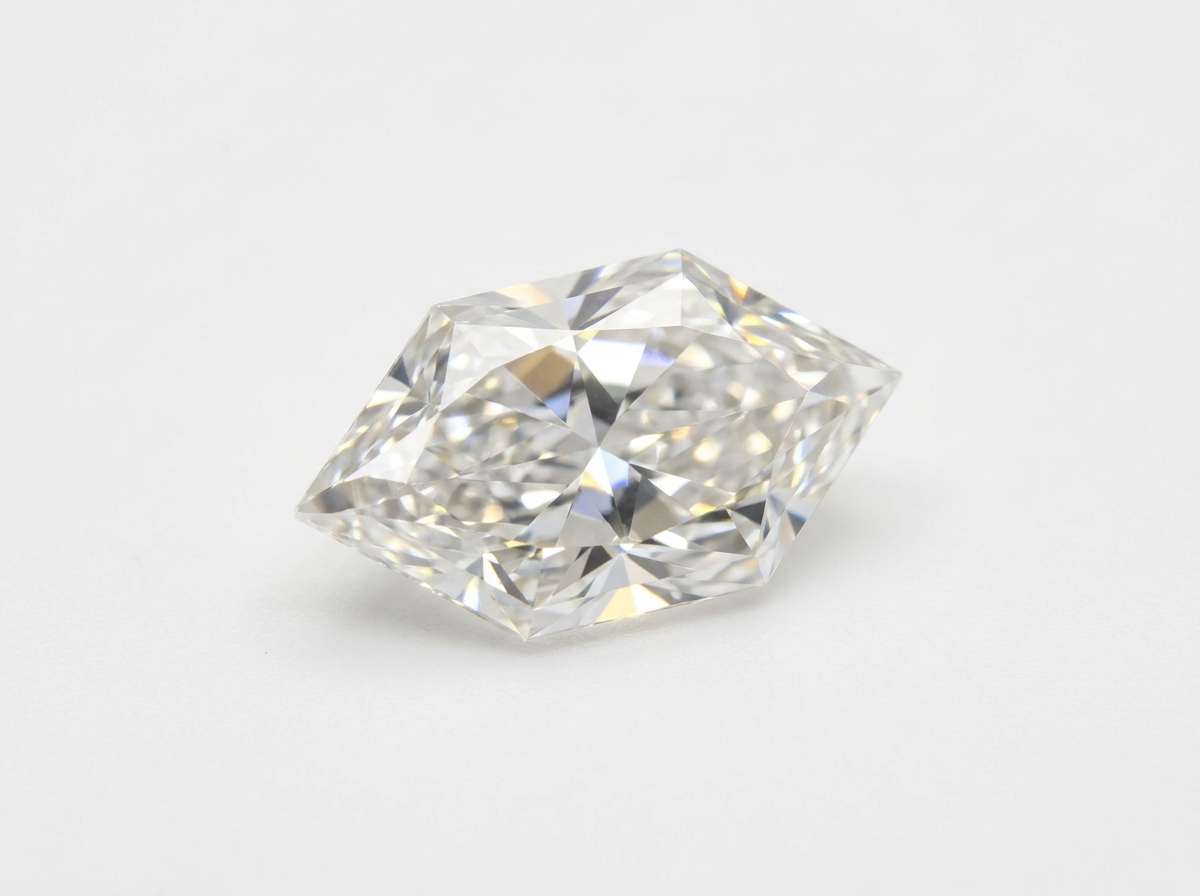
A Dutch Marquise — also called a Brilliant Hexagon — is an antique elongated cut with a six-sided outline, pointed ends, and straight, angled sides, brilliant-faceted rather than step-faceted for maximum fire. Guru Diam stocks Dutch Marquise as IGI-certified lab-grown loose diamonds, cut in-house and shipped from New York, with 164 pieces currently on hand across the size and color range.
If you've searched "Dutch Marquise" recently, you've probably landed on a single product listing and nothing else — no sourcing guide, no comparison, no real explanation of what makes the cut different from a standard marquise. That gap exists because almost nobody stocks this shape in depth, and the two or three dealers who do treat it as one SKU, not a category worth explaining. This guide fixes that: what the cut actually is, where it came from, how it's made today, what to check before you buy it, where it fits in a jewelry line, and a real, in-stock wholesale source at the end of it.
What Is a Dutch Marquise Cut Diamond?
The Dutch Marquise is an elongated hexagonal diamond: six sides, two pointed ends (like a marquise), but with the long edges broken into two angled facets per side instead of one continuous curve. That extra break in the outline is what separates it from both a standard marquise (smooth, boat-shaped) and a plain hexagon (flat-sided, no points). Because the faceting is brilliant-cut rather than step-cut, a Dutch Marquise throws noticeably more fire and scintillation than a step-cut hexagon of the same size — which is exactly why it's also sold under the name Brilliant Hexagon. Same stone, two names, and buyers search for both.
The name itself is best treated as trade shorthand rather than a geographic claim. Old diamond-cutting terminology used "Dutch" as a style label tied to Europe's historic cutting centers, where brilliant faceting was applied to non-round outlines earlier than it became standard practice elsewhere — and the label has simply stuck to this particular elongated hexagon shape ever since, regardless of where a given stone is actually cut today. Treat "Dutch Marquise" as a shape name, the same way "Old Mine" describes a cushion-like outline rather than a literal mine of origin.
Anatomy of the Cut: How to Identify a True Dutch Marquise
A Dutch Marquise reads as a family of related outlines rather than one fixed shape, which is part of why labeling drifts so much between dealers. Four features define a correct one:
- Six sides, two points. The outline closes at two opposing points, like a marquise, but the body between those points is hexagonal rather than curved.
- Two angled facets per long edge. Where a standard marquise has one continuous curved edge running from point to point, a Dutch Marquise breaks each long edge into two straight facets meeting at a shallow angle. That break is the single most reliable way to tell a Dutch Marquise from a marquise at a glance.
- Brilliant faceting, not step faceting. The crown and pavilion carry a full brilliant-cut facet arrangement — kite and triangle facets radiating from the table and culet — rather than the parallel step-cut facets used on an emerald-style hexagon. This is what produces the fire; a step-cut hexagon of the same outline throws broad flashes instead.
- A length-to-width ratio in the 1.60–1.70 range. Cut outside that band, the hexagon either reads as too stubby (closer to a plain hexagon) or too needle-like (closer to a marquise). Ask for exact millimeter measurements, not just the shape name, since two stones both labeled "Dutch Marquise" can vary noticeably in how elongated they look face-up.
The points are the part of the stone worth the closest look. Because they're the thinnest, most exposed part of the outline, symmetry and finish quality at the tips matter more here than on almost any other fancy shape — a slightly blunted or off-center point is visible to the naked eye in a way that a minor symmetry deviation on a round brilliant never would be.
A Brief History: Where the Dutch Marquise Shape Comes From
The Dutch Marquise belongs to the same design lineage as other antique elongated cuts that surface repeatedly in Art Deco and Edwardian-era jewelry from the 1900s through the 1930s. That period rewarded geometry — clean lines, symmetrical repetition, and elongated silhouettes that read as modern and architectural against the softer, rounder settings that came before it. A pointed hexagonal outline with genuine brilliant faceting fit that visual language exactly: it elongates the finger the way a marquise does, but the added facet break gives jewelers a distinctive geometric edge that a plain marquise doesn't have.
The cut fell out of common production for a straightforward reason: cutting a clean, symmetrical hexagon with true brilliant faceting by hand, from natural rough, is difficult and slow. A cutter has to plan six sides and two precise points into whatever irregular shape the rough crystal happened to grow in, then carry full brilliant faceting across all of it without the outline drifting off-ratio. Round brilliants and simpler fancy shapes were far more forgiving of rough shape and far faster to produce, so as the trade industrialized through the 20th century, output concentrated on the shapes that were cheaper to cut at volume. Dutch Marquise didn't disappear because demand went away — it disappeared because almost nobody kept cutting it.
That's the same story behind the modern resurgence of Old Mine and Old European cuts: a genuinely good antique shape that the trade mostly stopped stocking, not because buyers stopped wanting it, but because supply dried up. Dutch Marquise is a more extreme version of that same gap. Old Mine and Old European cuts at least exist in meaningful volume on the estate and antique-jewelry market, because round-adjacent cushion shapes were common enough historically that plenty of period stones survive. Dutch Marquise was never common even at its historical peak — it was always a specialty cut used sparingly — so the natural, antique supply of genuine examples was close to nonexistent even before lab-grown diamonds existed as an alternative.
Dutch Marquise vs. Standard Marquise vs. Plain Hexagon vs. Lozenge
Buyers frequently confuse Dutch Marquise with three other elongated fancy shapes. The table below lines up the specs side by side, since the differences are easier to see in outline and faceting than in a written description alone.
| Spec | Dutch Marquise (Brilliant Hexagon) | Standard Marquise | Plain Hexagon (step-cut) | Lozenge |
|---|---|---|---|---|
| Outline | Elongated hexagon, pointed ends | Boat-shaped, smooth curved sides, pointed ends | Flat-sided hexagon, no points | Elongated rhombus, four sides, two points |
| Faceting | Brilliant (multi-facet, high fire) | Brilliant | Step-cut (fewer, larger facets) | Usually step-cut |
| Side profile | Two angled facets per long edge | One continuous curved edge | One flat edge | One flat edge per side, four sides total |
| Light behavior | High fire and scintillation | High fire, elongated flash | Broad flashes, hall-of-mirrors look | Broad geometric flashes |
| Typical L:W ratio | 1.60–1.70 | 1.75–2.25 | Varies, often closer to 1:1 | 1.70–2.00 |
| Rarity in trade | Very low — most wholesalers don't stock it | Common | Uncommon, but more available than Dutch Marquise | Uncommon, usually calibrated for side stones |
| Most common role | Center stone, matched pairs | Center stone | Center stone or accent | Side stone, accent work |
The practical takeaway: if a listing just says "hexagon" or "marquise" without specifying facet style and point structure, ask which of these four it actually is before quoting a client. The four shapes are easy to mix up in a written description and easy to tell apart the moment you look at the faceting under a loupe.
How a Dutch Marquise Is Cut
Cutting a Dutch Marquise starts with planning the outline, not the facets. Because the finished stone has to hit a specific length-to-width ratio and land two symmetric points opposite each other, the cutter maps the six-sided outline onto the rough before any faceting begins — get the outline wrong and no amount of careful faceting afterward will fix a lopsided or off-ratio stone. This is where lab-grown rough has a real production advantage: because CVD rough is grown to a planned size and shape rather than recovered from whatever an irregular natural crystal happened to form, the cutter can plan the outline against rough that's already close to the target proportions, instead of sacrificing yield to force a hexagon out of an octahedral or irregular natural crystal.
Once the outline is set, faceting proceeds the same way it would on any brilliant-cut fancy shape: the crown is faceted first with the table, then the kite and triangle facets radiating outward toward the girdle, then the stone is flipped and the pavilion faceted from the culet outward. What makes a hexagonal brilliant harder than a round one is the six-way symmetry requirement combined with two more-acute points — every kite and triangle facet placement has to stay symmetric across six sides instead of the continuous, forgiving curve of a round girdle, and the two points need extra care because a slightly asymmetric point is the single most common flaw buyers spot in a finished stone.
Polishing follows the same standard as any fine fancy-cut stone: each facet is brought to a uniform, glass-flat finish and the junctions between facets checked under magnification for any stray fish-eye or extra facet the cutter may have left rough. On a shape this specialized, quality control at this stage matters more than average — because there's no universal cut-grade the way there is on a round brilliant, finish quality is the single biggest lever a cutter has over how the stone performs, and it's the detail a buyer should ask about directly rather than assume from the certificate alone.
Certification and What to Check Before You Buy
Guru Diam's Dutch Marquise inventory is IGI-certified, CVD-grown. Fancy and antique shapes like this one don't get the kind of official cut grade IGI and GIA assign to round brilliants — there's no universal Excellent/Very Good/Good scale for a hexagonal outline the way there is for a round. That means the certificate will confirm carat, color, clarity, and measurements, but cut quality on a shape like this is something you have to evaluate yourself, or trust the cutter's reputation for. Three checks matter most:
- Length-to-width ratio. Dutch Marquise typically runs 1.60–1.70 L:W. Ask for the exact measurements on the certificate, not just the shape name printed on it — labeling drifts between dealers, and a stone sold as "Dutch Marquise" at 1.85 L:W is drifting toward marquise territory.
- Facet symmetry at the points. The two pointed ends are the most failure-prone part of the cut, both in cutting and in later wear — a thin point is more chip-prone in a ring setting than a rounded outline. Check for symmetry and finish quality under magnification, and confirm the setting style protects the points (more on that below).
- Same-lab comparisons. As with any lab-grown purchase, compare color and clarity grades from the same certifying lab. IGI and GIA are not directly interchangeable grade-for-grade, so a side-by-side comparison across labs can be misleading even when both certificates look similar on paper.
Because there's no standardized cut grade for this shape, the certificate is a floor, not a full picture. A photo or short video of the actual stone under magnification tells you more about how a Dutch Marquise will perform than the paper alone — ask for it before committing, especially on anything being bought sight-unseen for a matched pair or a specific client order.
What Drives Dutch Marquise Pricing
Pricing on a Dutch Marquise follows the same base variables as any diamond — carat weight, color, and clarity — plus a set of shape-specific factors that matter more here than on a round brilliant or a common fancy shape:
- Cutting difficulty. A correctly proportioned six-sided outline with two clean points and full brilliant faceting takes more cutter time and carries more rejection risk than a round or a standard marquise, and that labor shows up in the price relative to a common shape of the same carat, color, and clarity.
- Conformity to the 1.60–1.70 L:W band. Stones cut precisely to the ideal ratio, with well-matched points, command a premium over looser interpretations of "hexagon with points," the same way a well-proportioned fancy shape generally outprices a loosely cut one.
- Rarity in the trade. Because very few wholesalers stock Dutch Marquise at all, pricing behaves more like a specialty shape than a commodity one — quotes are less standardized across dealers than they are for round brilliants, where competition on a widely stocked shape compresses margins.
- Matched-pair premiums. Sourcing two stones that match closely in size, color, and outline for studs or side stones costs more than sourcing a single stone, because the matching itself narrows the usable inventory.
- Fluorescence and finish. As with any fancy shape, strong fluorescence or finish irregularities can move price in either direction depending on client preference and the specific stone.
The upside of lab-grown production here is that pricing tracks these production variables predictably, rather than the scarcity-driven pricing typical of a natural antique-market stone. A natural Dutch Marquise, if you could find one at all, would be priced almost entirely on how rare it happened to be that week. A lab-grown one is priced on carat, grade, and cutting precision — variables a buyer can actually reason about and reorder against.
Best Jewelry Applications for Dutch Marquise Diamonds
The shape's elongating silhouette and geometric edge make it a natural fit for a specific set of jewelry categories rather than an all-purpose center stone:
- Engagement ring center stones. Set east-west (points running side to side) for a modern, architectural look, or north-south for a more classically elongating effect. Because the points are the vulnerable part of the stone, a protective setting — a bezel that wraps the points, or prongs specifically placed to guard the tips — matters more here than on a round center stone.
- Matched-pair stud and drop earrings. This is where lab-grown production genuinely changes what's possible for this shape. Two Dutch Marquise stones cut to the same spec, size, and color make a normal matched-pair order, where sourcing two natural antique stones that align that closely would be close to impossible.
- Three-stone rings and side-stone settings. The pointed outline pairs naturally with a round or cushion center stone, echoing the point-to-point geometry of a classic three-stone design while adding the fire of full brilliant faceting rather than a flatter step-cut side stone.
- Pendants and Art Deco-style pieces. Given the shape's genuine Art Deco-era pedigree, it reads naturally in geometric pendant designs, vintage-inspired line bracelets, and any piece leaning into angular, symmetrical design language rather than curved, organic settings.
- Halo settings. A hexagonal halo that echoes the center stone's outline reinforces the geometric look; a round halo around a Dutch Marquise center creates deliberate contrast instead. Both read well — the choice is a design decision, not a technical constraint.
Why Lab-Grown Made Dutch Marquise Sourceable Again
The same economics that reopened Old Mine and Old European cuts for the trade apply here, only more so — Dutch Marquise was never common even on the antique and estate market, so natural supply was always closer to nonexistent than merely scarce. Lab-grown changes that math completely: because CVD-grown rough is cut to spec rather than salvaged from whatever an estate parcel happens to contain, a cutter can produce a true Dutch Marquise — correct outline, correct facet break, correct L:W ratio — on demand, in a target size and color, instead of a buyer waiting years for the right antique stone to surface.
That matters most for two buyer situations. First, matched pairs: if a client wants Dutch Marquise studs or side stones, sourcing two natural antique stones that match in size and color is close to impossible; two lab-grown stones cut to the same spec is a normal order. Second, repeatability: if a Dutch Marquise engagement ring sells well, a jeweler can reorder the same shape and size, something the estate market simply cannot promise. Both of these are the kind of ordinary, boring reliability that a wholesale buyer actually needs — not a novelty story, just a shape that's finally back in steady supply.
Sourcing Dutch Marquise Wholesale: What's Actually Available in the US Market
Realistically, three kinds of sources exist. Gated B2B portals at a handful of Diamond District dealers list Dutch Marquise as one SKU among thousands, with no real explanation of the cut, no comparison content, and pricing behind a login. Retail-facing sellers carry it as a novelty item at consumer markup. And made-to-order cutting, where a buyer specs the size and color and the stone is cut fresh, is generally the best option when a specific size, a matched pair, or reliable reorder capability is the priority.
Guru Diam runs the third model with live on-hand stock layered on top: 164 Dutch Marquise pieces in inventory right now across the color and clarity range, plus made-to-order cutting for anything outside current stock, from our New York Diamond District desk. Because cutting happens in-house rather than being brokered from a third party, matched pairs and custom sizing are a standard request, not a special one. Trade accounts also get real-time online inventory visibility and API/CSV feed access, so a Dutch Marquise order can be checked against live stock rather than a quote that goes stale by the time it's confirmed.
Buying Checklist: Red Flags to Watch For
Because Dutch Marquise sits outside the standardized part of the market, a few extra questions up front save a lot of back-and-forth later:
- Is the shape name backed by measurements? "Dutch Marquise" or "Brilliant Hexagon" on a listing should come with an L:W ratio in the 1.60–1.70 range and visible facet breaks on the long edges. If a dealer can't produce exact measurements, treat the shape label as unverified.
- Is the faceting actually brilliant, not step-cut? A step-cut hexagon is a different, more common stone and should be priced and marketed differently. Ask directly if there's any ambiguity — the difference is easy to confirm from a single photo under a loupe.
- Are the certificate and the physical stone from the same lab and report number? This is standard due diligence on any certified stone, and worth repeating explicitly on a shape uncommon enough that a mismatched report is easier to overlook.
- Can the point symmetry be verified before purchase? Request a photo or short video under magnification rather than relying on the certificate's measurements alone — the certificate confirms dimensions, not how clean the points look face-up.
- For matched pairs, is the match confirmed in writing? Two stones described as a "matched pair" should have their size, color, and clarity differences spelled out, not just an assurance that they "look similar."
- Is the source able to reorder the same spec? If a jeweler expects to reorder a Dutch Marquise piece that sells well, confirm the supplier can actually cut to the same size and color again — a one-off antique-market stone can't be reordered at all, and that limitation should factor into the sourcing decision from the start.
How Fast Can I Get a Dutch Marquise Stone or a Finished Piece?
In-stock pieces ship same-day from New York. For a size or color not currently on hand, made-to-order cutting plus custom jewelry (CAD to finished piece) runs 4–6 days — see our custom jewelry turnaround guide for the full mechanics. That timeline is what makes Dutch Marquise a viable everyday counter offer instead of a special-order gamble a jeweler hesitates to promise a client.
Source Dutch Marquise Trade-Priced, In Stock Now
Whether the order is a single stone, a matched pair for studs, or a made-to-order size for a custom engagement ring, Guru Diam carries Dutch Marquise (Brilliant Hexagon) as IGI-certified lab-grown loose inventory from our New York and Los Angeles desks, with real-time online inventory and API/CSV feed access for trade accounts.
Ready to buy? Open a verified wholesale account at /signup and book time with a gemologist at /book-appointment.
Frequently Asked Questions
What is a Dutch Marquise diamond?
A Dutch Marquise is an antique elongated hexagonal diamond cut with pointed ends and brilliant (not step) faceting, also sold under the name Brilliant Hexagon. It differs from a standard marquise by its faceted (not curved) long edges, and from a plain hexagon by its pointed rather than flat ends.
Is Dutch Marquise the same as Brilliant Hexagon?
Yes. Dutch Marquise and Brilliant Hexagon refer to the same cut — an elongated, pointed hexagonal outline with brilliant faceting. Both names are used in the trade; buyers search for both, so treat them as interchangeable when sourcing.
Can I get Dutch Marquise diamonds as lab-grown, and are they certified?
Yes. Guru Diam's Dutch Marquise inventory is CVD-grown and IGI-certified. Lab-grown production makes this historically rare antique cut sourceable on demand — in a target size, color, and clarity — rather than dependent on finding a natural antique stone on the estate market.
Can I order a matched pair of Dutch Marquise diamonds?
Yes. Matched pairs are a standard request for this shape since cutting is done in-house to spec, rather than brokered. This is one of the main reasons lab-grown reopened the category — matching two natural antique stones for studs or side stones is close to impossible; two lab-grown stones cut to the same spec is a normal order.
How is Dutch Marquise priced compared to a standard marquise?
Dutch Marquise carries a premium over a standard marquise of the same size and grade because of cutting difficulty and rarity — very few wholesalers stock it, and much of the market is made-to-order rather than off-the-shelf. Lab-grown production keeps that premium predictable rather than scarcity-driven, since pricing tracks spec and size rather than how rare a natural example happens to be.
How fast can I get a Dutch Marquise stone or a finished custom piece?
In-stock pieces ship same-day from New York. Made-to-order cutting plus a finished custom piece (CAD to jewelry) runs 4–6 days from our New York and Los Angeles desks.