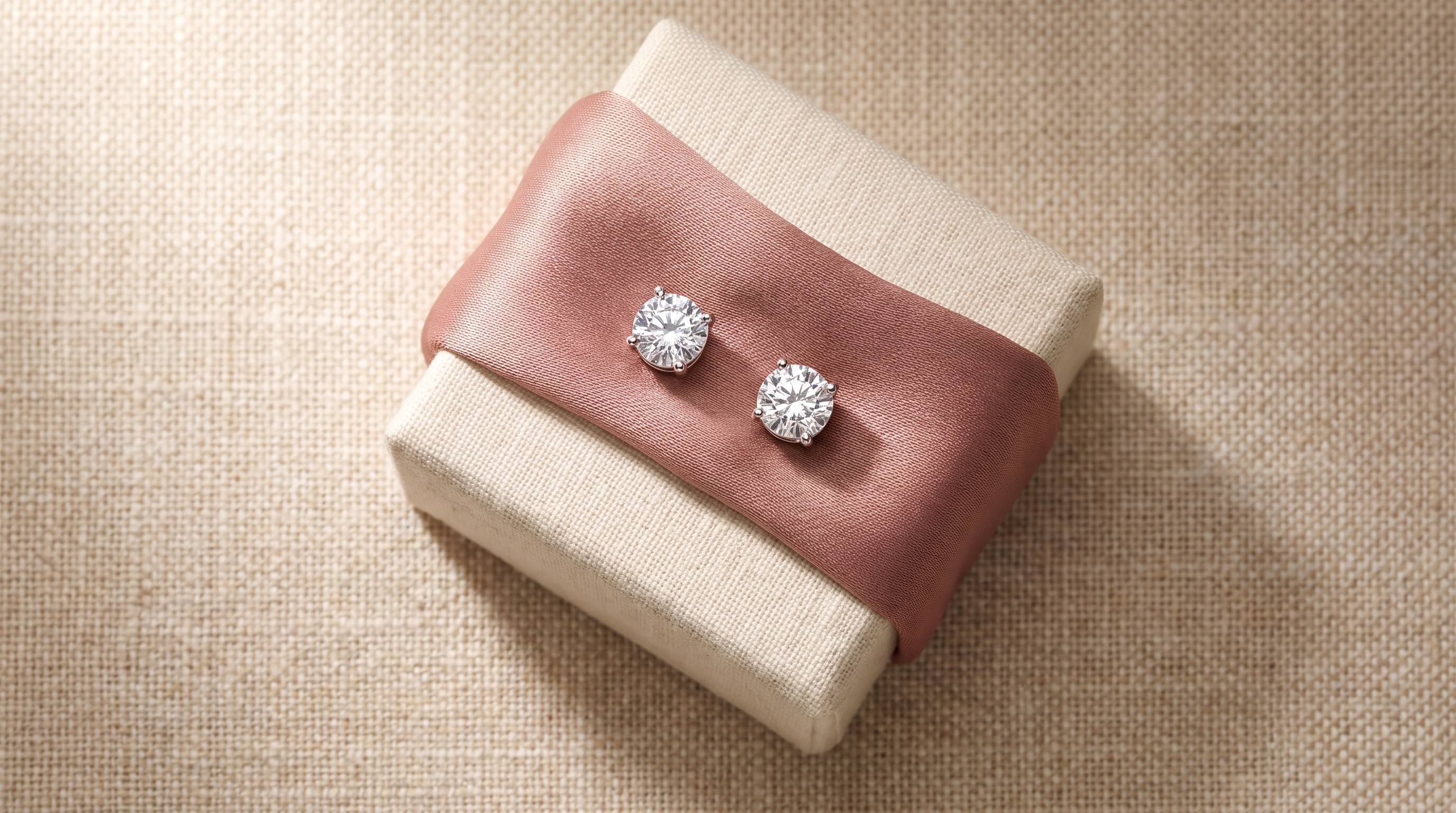
Diamond stud earrings are a pair of individually set diamonds, one per ear, matched closely enough in size, color, and cut that they read as a single, symmetrical pair rather than two separate stones. For a jeweler or manufacturer sourcing diamonds for stud production, the entire job comes down to one requirement that doesn't exist with a single-stone ring or pendant: finding or assembling a genuinely matched pair, since even a small mismatch between the two earrings is immediately visible when worn.
This guide covers stud earring sourcing from a trade perspective — what "matched pair" actually means in practice, mm-to-carat sizing for round studs, setting styles and their durability tradeoffs, backing hardware, and what to ask a wholesale supplier before committing to a matched-pair order.
What "Matched Pair" Actually Means
A matched pair for stud earrings means two diamonds of the same shape, cut style, and closely aligned color and clarity grade, with carat weights close enough that no size difference is visible to the naked eye once mounted — generally within about 0.01-0.02ct of each other for pairs under a carat each, with tighter tolerances expected as stone size increases. Color and clarity matching matters as much as carat weight: two stones of identical size but with a full color grade of difference between them (say, G and I) will visibly mismatch side by side even though both are individually "good" diamonds on their own. A genuinely matched pair is sourced and sold as a pair from the outset, not assembled after the fact from two coincidentally similar loose stones pulled from separate general inventory.
Round Diamond Stud Size Chart (MM to Carat)
Because stud earrings are sold and shopped largely by visual size, converting between millimeter diameter and carat weight is one of the most common questions in this category — for a retailer helping a customer choose a size, and for a manufacturer planning inventory around common request sizes.
| Diameter (mm) | Approx. Carat Weight (per stone, round) | Total Carat Weight (pair) |
|---|---|---|
| 3.0mm | ~0.10ct | ~0.20ct TW |
| 3.8mm | ~0.25ct | ~0.50ct TW |
| 4.4mm | ~0.33ct | ~0.66ct TW |
| 5.0mm | ~0.50ct | ~1.00ct TW |
| 5.7mm | ~0.75ct | ~1.50ct TW |
| 6.5mm | ~1.00ct | ~2.00ct TW |
| 8.1mm | ~2.00ct | ~4.00ct TW |
These figures assume a well-cut round brilliant with typical proportions; a shallower or deeper-cut stone of the same carat weight can look slightly larger or smaller in diameter, which is why a manufacturer working to a specific visual size target should confirm actual millimeter measurements on a matched pair rather than relying on carat weight alone.
Certification and Matched Pairs
Loose diamonds at 0.30ct and above are commonly individually certified (IGI, GIA, or GCAL), and a matched pair in this size range is typically sold with both stones' individual reports plus a matching confirmation from the supplier. Below that threshold, stones move into melee territory and are generally sold as graded parcel goods against a stated quality baseline (commonly DEF+/VS+) rather than individually certified — a genuinely matched small-stud pair can still be assembled from melee-grade stock, but the matching itself is the supplier's grading claim rather than a pair of individual certificates. Buyers sourcing pairs near the certification threshold should confirm upfront which approach a supplier is using, since it affects both price and the paperwork that ships with the order.
Setting Styles for Diamond Studs
Four-Prong Setting
The most common stud setting, using four prongs to hold the stone while exposing the maximum amount of the diamond to light. It's a secure, classic option that works for the widest range of stone sizes and shapes.
Martini Setting
A three-prong setting on a tapered, cone-shaped base that shows less metal from the front, making the stone appear to sit slightly larger and more prominently than an equivalent four-prong setting. It's a popular choice for retailers positioning studs as a more modern or minimal design.
Bezel Setting
A full metal rim surrounds the stone, offering the most physical protection of any stud setting style — a relevant consideration for earrings, which take frequent incidental contact from hair, clothing, and daily handling. The tradeoff is reduced light entry and a more contemporary, geometric look compared to a prong setting.
Halo Setting
A ring of smaller melee diamonds surrounds a central stone, increasing the earring's apparent size and overall sparkle without increasing the center stone's actual carat weight — a way for a retailer to offer a larger-looking product at a lower total diamond cost than an equivalent-size solitaire stud.
Backing Hardware: Screw-Back vs. Push-Back
Backing choice is a finished-jewelry manufacturing decision that affects both security and comfort, and it's worth specifying clearly in a production order since it doesn't change the diamond sourcing itself but does affect the finished product line. Screw-back posts thread into place and are markedly more secure against loss — a meaningful consideration for higher-value stud pairs — while push-back (friction) posts are faster to put on and take off and are generally preferred for lower-value, everyday-wear studs. For a full comparison of backing hardware options and how to choose between them for a given product tier, see our screw-back earring sourcing guide.
Lab-Grown vs. Natural Diamonds for Stud Production
Because a stud pair effectively doubles the diamond cost of a single-stone piece at the same per-stone size, the lab-grown-versus-natural decision has a real effect on what carat weight a retailer can offer at a given price point. CVD lab-grown diamonds let a manufacturer offer a meaningfully larger stud size for the same budget, or the same size at a lower price, than natural material of comparable color and clarity. Both can meet the same quality standard and look identical once mounted — the origin decision is a pricing and positioning choice for the retailer, not a visual difference in the finished pair.
Sourcing a Matched Pair: What to Ask a Supplier
- Were these two stones sourced and graded together as a pair, or matched after the fact from separate inventory? A supplier who maintains a dedicated matched-pairs program will hold tighter consistency than one assembling pairs on request from general stock.
- What's the carat-weight tolerance between the two stones? Ask for the specific weight of each stone in the pair, not just a combined total carat weight, since a 1.00ct TW pair could be two 0.50ct stones or a 0.60ct and a 0.40ct stone — visually very different once mounted.
- Do the two stones match in fluorescence as well as color and clarity? Mismatched fluorescence can cause two otherwise similar-grade stones to look subtly different in certain lighting, a detail easy to overlook if matching is checked only on the standard 4Cs.
- Can I review the actual physical pair before committing, not just a written spec sheet? For a first order with a new supplier, seeing the real pair side by side is the only way to confirm a visual match before a full purchase.
Coordinating Studs With a Broader Jewelry Line
Diamond studs are frequently sold alongside a matching pendant or tennis piece as part of a coordinated set, or purchased separately by a customer already wearing a matching necklace. Manufacturers building a stud line as part of a broader collection should source the center stones for studs and any coordinating pendant from the same quality tier and, where the design calls for it, the same shape family, so the pieces read as genuinely coordinated rather than only loosely similar. This is a design and merchandising decision more than a diamond-grading one, but it's worth planning at the sourcing stage — requesting matched quality across a multi-piece order from a single supplier is simpler and more consistent than sourcing each piece separately and hoping the grades align closely enough at retail.
Wholesale Pricing Structure
Stud earring diamonds are typically quoted as a pair — combined carat weight at a given quality standard — since that's how the finished product is sold at retail, though a serious buyer should always confirm individual stone weights within that total as noted above. Pricing per carat for a matched pair generally runs at a modest premium over two individually sourced loose stones of the same specs, reflecting the additional selection and grading work required to assemble a genuine visual match rather than two coincidentally similar stones.
Fancy Shapes in Stud Earrings
While round brilliant is the most common shape for studs, fancy shapes — princess, cushion, oval, pear, and emerald-cut in particular — are a well-established category, each with its own matching considerations beyond carat weight and color. Princess and cushion cuts need matching outline proportions (a noticeably more square versus more rectangular princess cut will visibly mismatch as a pair), while pear-shaped studs need matching length-to-width ratio and, for drop-style pear studs, consistent orientation between the two earrings. Emerald-cut studs need matching table size and step-cut facet pattern, since step cuts show internal clarity characteristics more visibly than brilliant cuts and any difference in inclusion visibility between the two stones will read as a mismatch even at identical clarity grades on paper.
Halo and Cluster Stud Variations
Beyond a simple center-stone halo, cluster stud designs — a group of smaller diamonds arranged to resemble a single larger stone from a distance — are a distinct sourcing category that trades a single large center diamond for a larger number of smaller, less expensive stones. This lets a retailer offer a larger apparent stud size at a lower total diamond cost than an equivalent-size solitaire, at the cost of a less unified single-stone sparkle pattern up close. Sourcing for cluster studs prioritizes matching the overall visual size and outline shape between the two earrings' clusters rather than matching every individual small stone within each cluster precisely, since the eye reads cluster designs as a shape rather than as individual stones.
Seasonal Demand and Inventory Planning
Diamond stud earrings are one of the most consistently gifted diamond jewelry categories year-round, but still see meaningful spikes around the winter holidays, Valentine's Day, Mother's Day, and graduation season — periods when a first pair of "real" diamond studs is a common milestone gift. Because assembling genuinely matched pairs at volume takes real sourcing lead time (a supplier needs enough well-matched inventory on hand to fill a production order, not just enough total carat weight), retailers and manufacturers planning stud inventory for these peak windows should place orders well ahead of the season rather than during it. Studs also see steady baseline demand outside of gifting seasons as a self-purchase item, which makes them a useful category for a retailer to keep in standing reorder rather than only stocking seasonally.
Reorder Consistency for an Ongoing Stud Program
A retailer running an ongoing stud earring program — rather than a one-time production run — depends on being able to reorder the same commercial grade repeatedly and have new pairs match not just each other, but the retailer's existing displayed inventory and prior sold pieces in terms of overall look and quality tier. A supplier whose matched-pair grading standard drifts between orders creates a real problem for a retailer trying to maintain a consistent product line over time, since customers comparing a newly purchased pair against a friend's earlier purchase from the same store will notice inconsistency. Confirming a supplier's ability to reproduce the same grading standard reliably on repeat orders is worth doing before committing to them as a primary stud-program supplier, not just on the first order.
Common Fit and Comfort Issues to Screen For
Beyond the diamond itself, finished stud earrings should be checked for post length and gauge appropriate to the target market (a post too long or too thick creates a poor, uncomfortable fit for many ear piercings), a setting base low enough to sit close to the ear without excessive gap, and consistent weight between the two earrings — a real difference in setting weight between an otherwise matched diamond pair is a common but avoidable manufacturing defect that shows up as one earring sitting or tilting differently than the other over a day of wear. Requesting a physical sample pair for fit-testing before a full production run is standard practice with a new setting partner, the same as with any other finished-jewelry category.
Metal Choices for Stud Settings
Stud earring settings are most commonly produced in 14k or 18k white gold, yellow gold, rose gold, or platinum, and unlike a continuous line piece such as a tennis bracelet, metal color has less effect on how the diamond itself reads since studs are viewed largely in isolation rather than against a long row of stones. White metals (white gold, platinum) remain the most requested option industry-wide for a classic diamond-forward look, while yellow and rose gold have grown as a styling choice for buyers wanting a warmer-toned setting, particularly in martini and bezel styles where more metal is visible around the stone. Metal choice doesn't affect diamond sourcing specs directly but should be confirmed early, since some setting styles (bezel in particular) require slightly different fabrication approaches depending on the metal used.
Packaging and Presentation for Retail
Because stud earrings are frequently purchased as gifts, presentation packaging is a more significant part of the finished product for this category than for some other jewelry types — a retailer's choice of box, pouch, and included documentation (grading report, care card, warranty information) is often part of the buying decision itself, not an afterthought. Manufacturers building a stud program should coordinate packaging sourcing alongside diamond and setting sourcing rather than treating it as a separate, later decision, since gift-ready presentation is frequently cited by retailers as a meaningful factor in stud earring sell-through, particularly during peak gifting seasons.
Sourcing Diamond Stud Earring Stones Wholesale
Guru Diam supplies certified loose diamonds and calibrated melee for jewelers and manufacturers building stud earring lines, across natural and CVD lab-grown material — CVD is the only lab-grown category in Guru Diam's catalog, with no HPHT stones anywhere. Matched pairs are sourced and sold specifically as pairs rather than assembled from general inventory on request, which is the detail that matters most for this category. Certification is available through IGI, GIA, and GCAL depending on stone size and buyer preference, and in-stock inventory ships same-day from Guru Diam's New York and Los Angeles locations. As with the rest of Guru Diam's lab-grown catalog, CVD stones are cut and polished at the company's India workshop before final grading and shipment from those two US locations. Trade accounts can browse current matched-pair inventory at matching pairs, review certified loose stones in certified diamonds, or check fancy color pair options in fancy color loose diamonds. Manufacturers building a custom stud design can start at custom jewelry, and new trade accounts can apply through trade partner, with current terms at the wholesale hub.
Frequently Asked Questions
What does "matched pair" mean for diamond stud earrings?
It means two diamonds of the same shape and closely aligned color, clarity, and carat weight, sourced and graded together so no visible size or color difference shows once the pair is mounted and worn.
What carat weight is a 1-carat pair of diamond studs?
"1 carat" studs typically refers to 1.00ct total weight (TW) for the pair — two 0.50ct stones — rather than 1.00ct per stone. A pair of 1.00ct-each stones (2.00ct TW total) is a meaningfully larger and more expensive product; always confirm whether a quoted carat figure is per-stone or total weight.
Are diamond stud earrings individually certified?
Stones at 0.30ct and above are commonly individually certified through IGI, GIA, or GCAL, with a matching confirmation for the pair. Smaller melee-range stud pairs are generally sold as graded parcel goods against a stated quality standard rather than individually certified.
What's the difference between screw-back and push-back studs?
Screw-back posts thread into place and offer significantly more security against loss, while push-back (friction) posts are quicker to put on and take off. Screw-backs are generally preferred for higher-value pairs.
Should stud earrings use natural or lab-grown diamonds?
Either can meet the same quality standard and look identical once mounted. Because a pair effectively doubles diamond cost versus a single stone, CVD lab-grown diamonds let a manufacturer offer a meaningfully larger stud size at the same price point, which is why lab-grown material is common in this category.
How is diamond stud earring pricing quoted wholesale?
Pricing is typically quoted for the pair at a combined carat weight and quality standard, at a modest premium over two individually sourced loose stones of the same specs, reflecting the extra selection work needed to assemble a genuine visual match.
Do the two stones in a stud pair need matching fluorescence?
Ideally yes. Two stones can match on carat weight, color, and clarity and still look subtly different under certain lighting if their fluorescence levels differ, so a thorough matched-pair check should include fluorescence alongside the standard 4Cs.
Guru Diam is a trade-only wholesale diamond supplier with locations in New York and Los Angeles, supplying certified loose diamonds and matched pairs — natural and CVD lab-grown — for jewelers and manufacturers producing stud earrings and other finished jewelry. Browse current matched-pair inventory in matching pairs or apply for a trade account through trade partner.