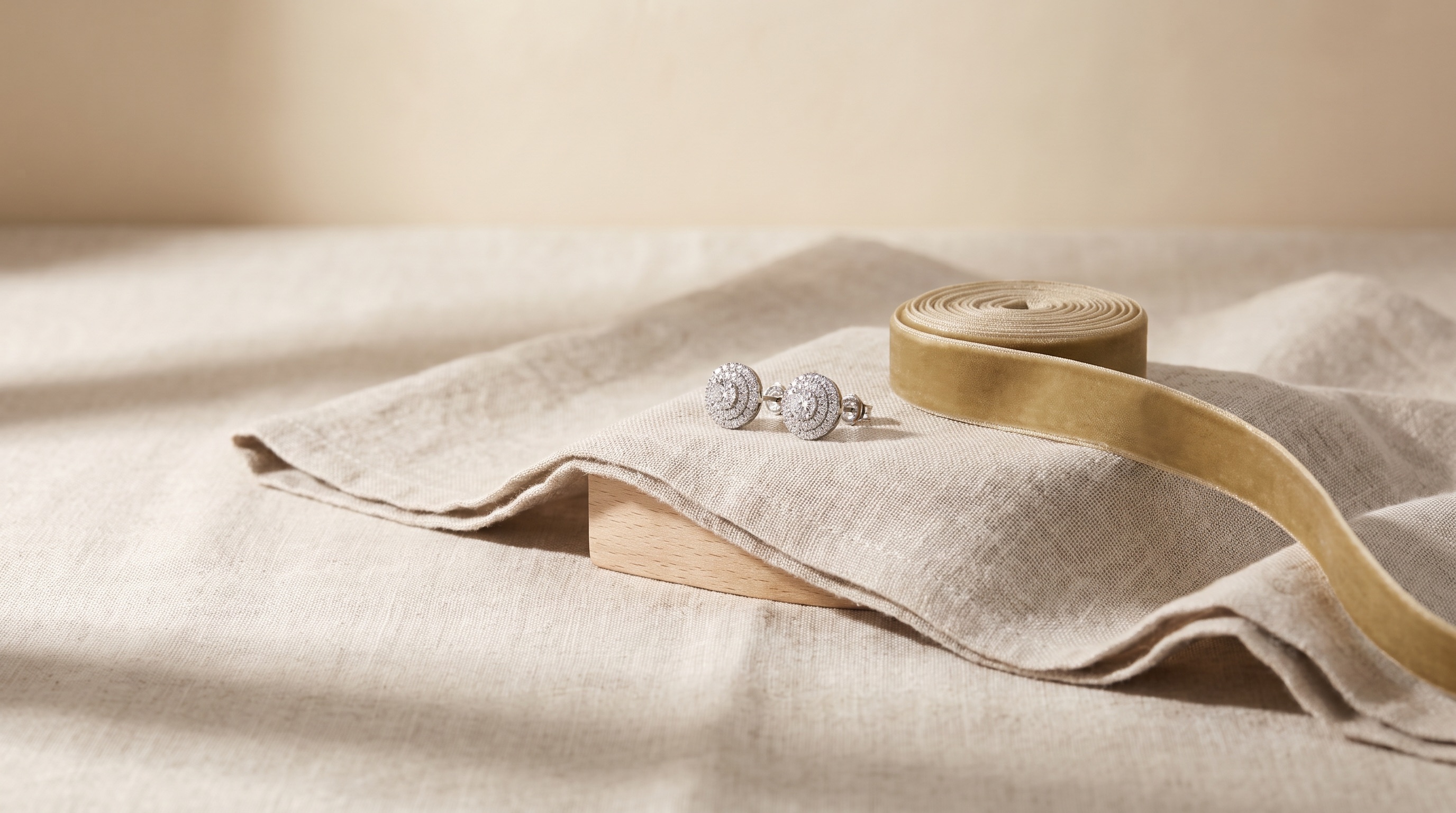
Diamond halo earrings are studs or drops built around a center diamond fully encircled by a ring of smaller melee, a construction that makes the center stone appear visually larger than its actual carat weight. For a jeweler, halo construction is a distinct two-part sourcing problem: a graded, certified center stone paired with a precisely matched, consistently graded ring of melee — get either half wrong and the finished piece won't deliver the size-enhancing effect the style is built to create.
This guide is written for the trade — retailers, designers, and manufacturers sourcing diamonds to build or expand a halo earring line — not a consumer buying guide. It covers center-stone and melee sourcing standards, halo construction types, setting methods, and what to evaluate in a wholesale supplier for this category.
Why Halo Construction Works: The Sourcing Logic
A halo earring's core value proposition to a retailer's customer is delivering more apparent size per dollar than a same-priced solitaire — a smaller, less expensive center stone surrounded by melee can read as visually comparable to a solitaire of noticeably greater carat weight, since the eye tends to register the combined outline of center stone plus halo as one larger shape. This makes halo earrings a strong margin and price-point tool for retailers, but only when the center stone and halo are sourced and matched well enough that the combined effect actually reads as intended rather than as a visibly separate small stone with a ring of unrelated melee around it.
| Factor | Solitaire Stud Sourcing | Halo Earring Sourcing |
|---|---|---|
| Stone components | Single center stone per earring | Certified center stone plus matched melee halo |
| Certification | IGI/GIA/GCAL individually certified (0.30ct+) | Center stone certified; halo melee uncertified parcel goods |
| Key risk | Center stone grade alone | Halo-to-center color/size mismatch, visible seam between components |
| Apparent size vs. actual carat weight | 1:1 — no visual enhancement | Enhanced — appears larger than actual combined weight |
Common Halo Earring Constructions
Classic Round Halo Stud
A round or cushion-shaped center stone with a single, tight ring of round melee immediately surrounding it. This is the most common halo format and the one where center-stone-to-halo color matching matters most, since the two elements sit in immediate visual contact.
Double Halo Stud
Two concentric rings of melee surrounding the center stone, typically with the outer ring set slightly larger or in a contrasting metal tone. This construction maximizes apparent size further but requires tighter size grading discipline across two separate melee rings rather than one.
Halo Drop
A halo-set stone suspended below a smaller stud or bail, combining halo construction with drop-earring hanging mechanics. This format inherits both halo's center-to-melee matching requirements and drop earrings' matched-pair hang-angle precision.
Center Stone Sourcing Standards
The center stone in a halo earring is typically the piece's primary certified element, sourced and graded the same way a solitaire center stone would be — carat weight, color, clarity, and cut grade specified individually, with IGI, GIA, or GCAL certification available at 0.30ct and above. Because the halo is designed to visually extend the center stone's apparent size, retailers building an accessible-price-point halo line can often use a smaller, less expensive center stone than an equivalent solitaire design would require to hit the same target apparent size — a deliberate sourcing tradeoff that's part of what makes halo construction commercially attractive across a wide price range.
Melee Sourcing Standards for Halo Rings
Halo melee is sourced as uncertified parcel goods against a DEF+/VS+ quality baseline, consistent with standard wholesale melee grading practice. The critical sourcing requirement specific to halo work is color matching between the melee and the center stone — a warm-toned center stone paired with an overly white melee halo (or the reverse) creates a visible color break at the seam between the two elements, undermining the size-blending effect the construction depends on. A supplier who offers melee specifically graded and color-sorted for halo matching, rather than pulling from an undifferentiated bulk parcel, meaningfully reduces this risk.
Diamond Shape Choices for Halo Earrings
Round brilliant is by far the most common center-stone shape for halo earrings, since a round outline pairs most naturally with a round melee halo and offers the most forgiving size-matching tolerance. Cushion and oval center stones appear frequently in halo designs as well, typically paired with a halo cut to follow the center stone's outline shape rather than a uniform round ring — a more setting-labor-intensive construction that requires precisely calibrated melee cut to match the halo's curved or angular perimeter.
Setting Methods for Halo Construction
Prong or micro-prong setting secures the center stone, while the surrounding melee is typically pavé-set to minimize visible metal and maximize the seamless transition from center stone to halo. The gap between the center stone's girdle and the innermost row of halo melee is a meaningful design and sourcing detail — too wide a gap breaks the intended size-blending illusion, while too tight a gap risks stress on the center stone's setting during wear. Retailers should confirm a manufacturing partner sets this gap consistently across a production run, since an inconsistent gap is one of the more common quality issues in mass-produced halo pieces.
Wholesale Price Positioning by Halo Type
| Construction | Relative Price Position | Key Cost Driver |
|---|---|---|
| Classic round halo stud | Low to mid | Center stone grade; melee cost is modest relative to total |
| Double halo stud | Mid | Additional melee ring, tighter size-grading requirements |
| Halo drop | Mid to high | Center stone grade plus drop hardware and matched-pair hang precision |
Lab-Grown vs. Natural Diamonds for Halo Earring Programs
Halo construction is especially well suited to a lab-grown center-stone strategy, since the format already trades on delivering more apparent size per dollar — pairing that construction advantage with CVD lab-grown pricing lets a retailer offer a halo earring with a larger, higher-grade center stone than a natural-stone equivalent would allow at the same price point. Natural center stones remain the standard for premium halo lines marketed on natural provenance, typically paired with a correspondingly higher price position rather than an enhanced apparent-size claim, since natural provenance itself is the value driver in that segment rather than perceived size.
Metal Choices and Halo Color Matching
White metal (platinum or white gold) is the most common setting choice for halo earrings, since it minimizes any color contrast between the metal, the center stone, and the melee halo — important given how closely the eye compares center stone and halo color in this construction. Yellow and rose gold halo earrings have grown in popularity as part of a broader mixed-metal trend, and pair well with slightly warmer-graded center stones and matching melee, letting a retailer use a modestly lower, less expensive color grade without a perceptible quality tradeoff against the warmer-toned setting.
Retail Merchandising for Halo Earrings
Because halo earrings sell partly on an apparent-size promise, product photography that clearly and honestly represents true scale — ideally alongside a size reference — helps set accurate customer expectations and reduces returns driven by a piece appearing smaller in hand than it did in a close-up photograph. Retailers should also clearly disclose the actual center-stone carat weight separately from the combined halo effect in product descriptions, both as good sourcing transparency and as protection against customer disappointment when the piece is compared side by side with a same-priced solitaire.
Common Sourcing Mistakes in Halo Earring Programs
The most frequent mistake is sourcing center stone and melee halo independently without confirming color match, resulting in a visible seam between the two elements once set — a supplier who color-sorts melee specifically for halo matching largely eliminates this risk. A second common mistake is inconsistent gap-setting between center stone and inner halo row across a production run, which undermines the size-blending illusion the construction depends on and can appear as a quality defect even when both components are individually well-graded. A third is failing to disclose true center-stone carat weight clearly at the point of sale, leading to customer disappointment when actual scale doesn't match photographed apparent size.
Halo Earrings vs. Halo Rings: Shared Sourcing Logic, Different Constraints
Halo construction principles carry over directly between rings and earrings — the same center-stone-plus-melee-ring logic, the same color-matching requirement, the same apparent-size value proposition — but earrings introduce a constraint ring settings don't face: matched-pair symmetry across two separate pieces rather than a single item. A halo ring only needs to look right on its own; a pair of halo studs needs both earrings to match each other in center-stone size and color, halo density, and gap consistency, roughly doubling the quality-control burden relative to a single halo ring of the same design. Retailers sourcing halo earrings from a supplier already set up for halo ring matching should confirm that supplier applies the same rigor to pair-matching two full halo assemblies, not just two individual center stones, since the halo itself is a second variable that also needs to match across the pair.
Order Volume and Reorder Consistency for Halo Programs
A retailer running an ongoing halo earring program benefits from a supplier who can consistently reproduce the same center-stone grade and halo melee color match across repeated orders over months or years, not just for a single initial production run. Color and clarity consistency across reorders matters more for halo construction than for many other categories, since a customer purchasing a second halo piece to match an earlier one — a common request in this category, particularly for anniversary or milestone upgrades — expects the new piece's halo to visually match the original rather than reading as an obviously different, later batch. Suppliers who maintain a stable, repeatable color-sorting standard for halo-grade melee, rather than sourcing opportunistically from whatever parcel is available at the time, serve this kind of long-running retail relationship meaningfully better.
Common Customer Questions Retailers Should Be Ready to Answer
Retail sales staff selling halo earrings are frequently asked how the piece's total diamond weight compares to an equivalent solitaire, and being able to answer clearly and honestly — distinguishing center-stone weight from total halo weight, and being upfront about the visual-enhancement effect rather than letting a customer assume the piece is "as big as it looks" in pure carat terms — builds trust and reduces post-purchase disappointment or returns. Retailers should equip sales staff with the actual center-stone carat weight, total halo melee weight, and combined total weight for every halo SKU, rather than leaving staff to describe pieces only in visual terms without the underlying numbers on hand.
Sourcing Diamonds for a Halo Earring Line Wholesale
Guru Diam supplies certified loose CVD lab-grown and natural center stones alongside melee graded and color-sorted specifically for halo matching, with IGI, GIA, and GCAL certification available at 0.30ct and above. Trade buyers can review current certified and matched inventory through certified diamonds and matching pairs, and work with Guru Diam's custom jewelry team on halo setting construction through custom jewelry. In-stock inventory ships same-day from Guru Diam's New York and Los Angeles locations. New trade accounts can apply through trade partner, with current terms available at the wholesale hub. For related sourcing fundamentals, see our hidden halo ring guide, diamond cluster earrings guide, and diamond drop earrings guide.
Halo Earring Trends Shaping Wholesale Demand
Halo construction has remained one of the most consistently requested earring styles across price tiers precisely because of its value proposition — meaningful apparent size at a controlled cost — which holds up well regardless of broader jewelry style trends favoring minimalism or maximalism in a given season. What has shifted in recent years is halo shape variety: square, cushion, and elongated oval halos following non-round center-stone outlines have grown as a share of total halo demand relative to the classic round halo, reflecting a broader trend toward fancy-shape center stones across engagement and fashion jewelry generally. Retailers building a halo earring assortment benefit from stocking at least one non-round halo shape option alongside the classic round format, since customers increasingly shop specifically for a fancy-shape halo rather than treating round as the automatic default.
Vintage and Antique-Style Halo Construction
Vintage-inspired halo designs, often paired with milgrain edging and antique-style center-stone cuts like Old Mine or Old European, represent a distinct sourcing sub-category within halo earrings, appealing to customers seeking an heirloom-adjacent aesthetic rather than a clean, contemporary halo look. These designs typically pair a warmer, lower-color-grade center stone intentionally with the vintage aesthetic, since antique-style settings and cuts are traditionally associated with warmer stone color rather than the icy-white grades favored in contemporary minimalist halo designs — a useful sourcing note for retailers, since it means vintage-style halo earrings can often be built around a lower, less expensive color grade without undermining the intended aesthetic, unlike a contemporary halo design where warmth in the stone reads as an unintended flaw rather than a stylistic choice.
Halo Earrings vs. Solitaire Earrings: Helping Customers Choose
Retail sales staff frequently field a direct comparison question between a halo earring and a solitaire earring at a similar price point, and being able to frame the tradeoff clearly helps close the sale regardless of which style the customer ultimately chooses. A solitaire offers a single, larger, more classically understated stone with no visual enhancement beyond the stone's own qualities; a halo offers greater apparent size and more overall sparkle from the combined center-and-melee effect at the same price, at the cost of a more detailed, less minimalist silhouette. Neither is objectively better — the right choice depends on whether a customer prioritizes a clean, larger-looking single stone or maximum apparent size and light performance, and staff equipped to explain this distinction clearly, rather than simply pushing whichever style carries a better margin, build more customer trust and repeat business over time.
Halo Earring Warranty and Repair Considerations
Because halo earrings combine a certified center stone with a separately sourced melee halo, retailers should establish clear internal policy on how warranty and repair claims are handled if a halo stone is lost or damaged during wear — specifically, whether a replacement melee stone will be sourced and matched to the remaining halo, or whether the full halo needs to be reset to maintain visual consistency. A single missing or mismatched halo stone is often more visually noticeable, and more complex to invisibly repair, than a single missing stone in a less structured setting, since the halo's uniformity is central to how the finished piece reads. Retailers should factor this repair complexity into after-sale service policy and pricing rather than treating a halo repair as equivalent in cost and complexity to a standard prong re-tip or single-stone replacement in a simpler setting.
Comparing Halo Earrings Across Price Tiers
Entry-tier halo earrings pair a smaller commercial-grade center stone with a single round melee halo in a straightforward round format, prioritizing accessible price and maximum apparent-size lift over grading refinement. Mid-tier halo pieces step up to better color matching between center stone and melee, tighter gap-setting consistency, and sometimes a double-halo construction. Premium halo earrings combine a higher-grade certified center stone with precisely color-sorted melee and meticulous gap consistency, often in a fancy-shape halo following an oval or cushion center stone's outline. Retailers building a full halo assortment benefit from clearly differentiating these tiers in merchandising, since the category's core value proposition — apparent size for the price — resonates at every tier, but the execution quality driving that value differs meaningfully between them.
Care and Maintenance Guidance to Pass Along to Customers
Halo earrings accumulate everyday grime in the small gaps between the center stone and surrounding melee more readily than a plain solitaire stud, since the halo's tight, multi-stone construction has more total crevice area for lotion, skin oil, and dust to settle into. Retailers should recommend customers use a soft brush and mild soap solution for routine at-home cleaning and schedule periodic professional prong checks, since a loosened prong in the tightly packed halo ring is often less visually obvious before it results in a lost stone than a loosened prong on a plain solitaire. Setting this expectation at the point of sale reduces both customer disappointment when a piece looks less brilliant than expected between cleanings and the likelihood of a preventable lost-stone claim later.
Photographing Halo Earrings for E-Commerce
Halo earrings photograph best with lighting and angle choices that clearly show the transition between center stone and melee ring, since a flat, overly bright product shot can wash out the visual separation that makes the halo's size-blending effect legible to a shopper evaluating the piece online. A slight angle rather than a purely flat top-down shot, combined with a macro-capable lens, typically communicates halo construction and density more accurately than a distant, fully flat photograph, helping online shoppers form realistic expectations before purchase and reducing the returns that come from a piece looking different in hand than it did in a listing photo.
Frequently Asked Questions
How does a halo make a diamond earring look bigger?
The ring of melee surrounding the center stone visually extends its outline, so the eye registers the combined shape as one larger element. This lets a smaller, less expensive center stone read as visually comparable to a larger solitaire.
Is the melee halo certified separately from the center stone?
Typically not. The center stone is individually certified at 0.30ct and above through IGI, GIA, or GCAL, while the surrounding melee is sold as uncertified parcel goods graded against a color and clarity baseline, standard practice across the wholesale melee trade.
What's the biggest quality risk in halo earring construction?
A visible color mismatch between the center stone and the surrounding melee halo, which breaks the intended size-blending effect. Sourcing melee specifically color-sorted for halo matching significantly reduces this risk.
Should the center stone be lab-grown or natural?
Halo construction pairs especially well with CVD lab-grown center stones, since the format already emphasizes apparent size over raw carat weight, letting a retailer offer a larger, higher-grade center stone at an accessible price. Natural center stones remain standard for premium provenance-driven lines.
What diamond shape is most common for halo earring center stones?
Round brilliant is most common, pairing naturally with a round melee halo. Cushion and oval center stones also appear frequently, typically paired with a halo cut to follow the center stone's outline shape.
What's the difference between a single halo and a double halo?
A single halo has one ring of melee around the center stone. A double halo adds a second concentric ring, often set slightly larger, for an even greater apparent-size effect, but requires tighter size-grading discipline across two separate melee rings.