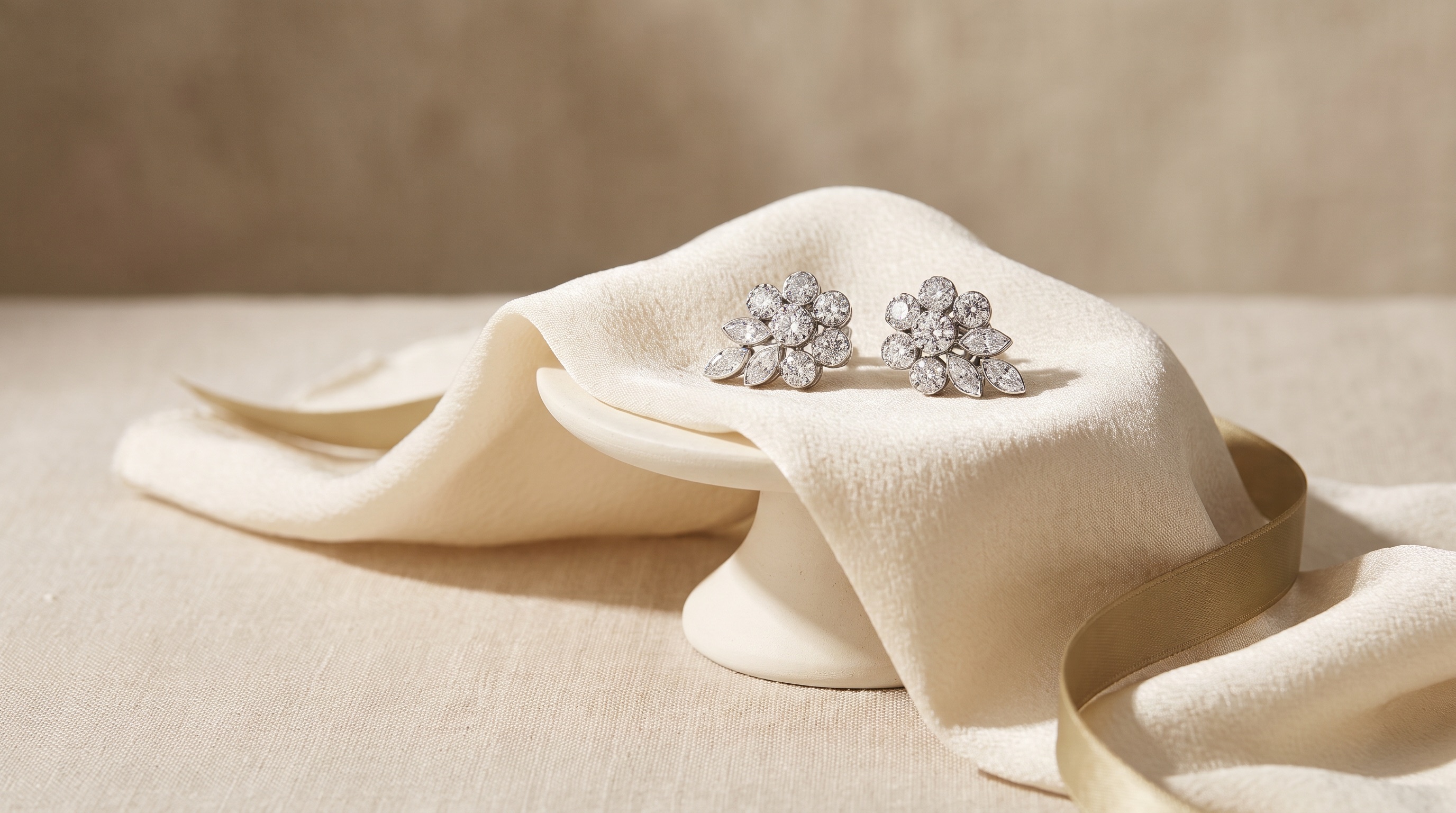
A diamond cluster earring groups multiple diamonds — typically a small center stone surrounded by melee, or several similarly-sized stones arranged tightly together — to create the visual impact of a single larger diamond at a fraction of the cost. For a jeweler or manufacturer, cluster earrings solve a specific retail problem: they let a customer buy into a bigger, more prominent look at a lower carat-weight (and lower price) than an equivalent single-stone stud would require, which makes the category a reliable, recurring seller across a wide range of price points.
This guide is written for the trade — jewelers, designers, and manufacturers sourcing loose diamonds and melee to build cluster earrings for their own retail or wholesale lines. It covers the two dominant cluster construction approaches, melee matching requirements, setting styles, sizing and carat-weight planning, and what to ask a wholesale supplier before placing a cluster-earring order.
The Two Dominant Cluster Construction Approaches
Most cluster earrings are built one of two ways. A "halo cluster" uses a single center stone surrounded by a ring of smaller melee, visually reading as one larger stone from a normal viewing distance — this is functionally a halo setting scaled down and adapted specifically for the earring format. A "true cluster" (sometimes called a "cocktail cluster" in the trade) groups several similarly-sized stones — often five to nine — packed tightly together with minimal visible metal between them, creating an organic, faceted mass rather than a single defined center point. The sourcing requirements differ meaningfully between the two: a halo cluster needs one graded center stone plus a consistent melee lot, while a true cluster needs a larger set of closely size- and color-matched stones with no single stone required to stand out individually.
Melee Matching for Halo Clusters
For a halo-style cluster earring, the surrounding melee needs to read as visually uniform in a tight ring around the center stone, which means consistent size, color, and clarity across every stone in that ring — a mismatch that might be forgivable scattered across a pavé band becomes much more obvious concentrated into a small, dense halo shape. Buyers should specify both the millimeter size and the quality grade (commonly DEF+/VS+ for a standard commercial build) when ordering halo melee, and should confirm the melee is sold as a matched, graded lot rather than pulled from general parcel stock, since consistency across a small, visually concentrated ring of stones matters more here than it would in a longer, more forgiving line like a tennis bracelet.
Stone Matching for True Cluster Designs
A true cluster design, where several similarly-sized stones sit together with no dominant center stone, requires size, color, and clarity consistency across the entire group rather than just consistency in a supporting ring around one hero stone — every stone in the cluster is equally visible, so there's no single stone whose slightly better grade can carry the overall look. This makes true cluster sourcing closer in difficulty to matched-pair or small tennis-line sourcing than to a simple halo build, and buyers should request a genuinely matched, pre-graded set for this construction style rather than assembling one from mixed melee inventory on their own.
Carat Weight Planning for Cluster Earrings
| Cluster Style | Typical Stone Count (per earring) | Common TCW Range (per pair) |
|---|---|---|
| Small halo cluster | 1 center + 6–10 melee | 0.30–0.75 TCW |
| Standard halo cluster | 1 center + 10–18 melee | 0.75–1.50 TCW |
| True cluster (no center stone) | 5–9 similarly-sized stones | 0.50–2.00+ TCW |
As with other melee-dependent categories, cluster earring pricing and design planning run on total carat weight (TCW) rather than any single stone's weight, since the visual impact comes from the combined mass of stones rather than one dominant carat figure. A manufacturer estimating diamond needs for a new cluster earring style should plan against a TCW target for the finished pair rather than specifying only a center-stone size, particularly for halo builds where the surrounding melee can represent a meaningful share of total cost.
Setting Styles Used in Cluster Earrings
Prong Setting
Individual prongs hold each stone in the cluster, maximizing light entry and brilliance across the whole group. This is the most common approach for both halo and true cluster builds, though the prongs on the smallest melee stones need careful, precise work to avoid looking bulky relative to the tiny stones they're holding.
Pavé Setting
Stones are set with minimal visible metal and small shared beads or prongs between them, producing a denser, more continuous sparkle across the cluster than individual prong-per-stone construction. Pavé cluster work requires tighter manufacturing tolerances to keep stones sitting at a uniform depth and angle relative to each other.
Bezel or Semi-Bezel
A metal rim, full or partial, surrounds some or all of the stones in the cluster for added physical protection — a meaningful consideration for earrings specifically, since they're subject to frequent contact with hair, clothing, and pillows. Bezel cluster work trades some brilliance for durability and a more modern, geometric look.
Certification Considerations for Cluster Builds
In a halo cluster, the center stone can be individually certified (IGI, GIA, or GCAL) at 0.30ct and above, while the surrounding melee ships as graded parcel goods against a stated quality baseline rather than individual reports — the same certification split used in most center-stone-plus-accent designs. In a true cluster with no single dominant stone, individual stones are often below the certification threshold entirely, and the whole group is typically sold and represented by the supplier's lot-grading statement rather than individual paperwork. Buyers should confirm upfront which certification approach applies to a specific cluster design before quoting a finished price to a retail customer, since the paperwork expectations differ meaningfully between the two construction styles.
Backing Hardware for Cluster Earrings
Because cluster earrings tend to sit larger and heavier than a simple stud, backing hardware matters more here than it does for a small single-stone earring. A standard friction push-back is adequate for smaller, lighter clusters, but larger halo or true cluster designs benefit from a screw-back or a larger-diameter, more secure friction back to prevent the earring from tilting or slipping during wear given the additional weight concentrated at the front of the earring. Manufacturers should specify backing hardware based on the finished cluster's actual weight rather than defaulting to a standard stud-earring back across the whole product line.
Natural vs. Lab-Grown Diamonds for Cluster Production
Because cluster earrings combine multiple stones into one finished piece, the natural-versus-lab-grown decision affects total piece cost more than it would for a single-stone product at the same visual carat weight. CVD lab-grown material lets a manufacturer offer a larger apparent size at a given price point, or hold the same visual size at a meaningfully lower price point, than natural stones of comparable color and clarity — a relevant consideration for a retailer positioning a cluster line at a specific price tier to compete against single-stone studs of a smaller carat weight. Both natural and lab-grown material can meet the same commercial quality standard, and the origin decision is primarily a pricing and positioning choice for the retailer.
What to Ask a Supplier When Sourcing for Cluster Earrings
- Is the melee or matched stone set sold as a pre-graded lot, specifically intended for cluster or halo work, or pulled from general inventory?
- What's the size and color tolerance across the set, and does that tolerance tighten appropriately for a true cluster versus a halo build?
- Can a physical sample be reviewed before a full production commitment, particularly for a new cluster design being run for the first time?
- Is reorder consistency available for a cluster earring style that becomes a standing retail item, not just a one-time production run?
Photographing Cluster Earrings for Retail and E-Commerce
Cluster earrings photograph differently than single-stone pieces, and retailers building product photography for a cluster line should account for that rather than reusing the same lighting and angle approach used for solitaire studs. Because the visual impact of a cluster depends on the combined sparkle of many small facets rather than one dominant stone's fire, photography benefits from slightly diffused lighting that lets the whole cluster catch light evenly, rather than a single hard spotlight that can overexpose the closest stones while leaving stones at the cluster's edge comparatively dim. A macro angle that shows the full cluster shape clearly, alongside a worn or scale-reference shot, helps an online customer understand actual finished size in a category where photographs can otherwise make a cluster look larger or smaller than it truly is relative to a simple single-stone stud.
Wholesale Pricing Structure for Cluster Earring Diamonds
Cluster earring diamonds are typically quoted with two components: a per-stone or per-carat rate for any individually certified center stones, and a per-carat rate for the surrounding or supporting melee at a specified quality standard. A manufacturer should request both figures broken out separately from a supplier rather than a single blended quote for the whole design, since the two pricing components can move independently — a shift in melee cost doesn't necessarily track a shift in certified center-stone cost, and understanding both separately makes it easier to model margin as either input changes.
Common Cluster Earring Design Variations
Beyond the standard round halo and true cluster, common variations include a "cluster stud" that mimics the visual footprint of a larger single round stone using an entirely melee-built center with no individually certified stone at all, and a "flower cluster," which arranges stones in a deliberately petal-like pattern rather than a uniform circular halo. Drop or dangle cluster earrings extend the same construction principles below the earlobe on a short chain or post extension, which adds movement to the finished piece but also adds a structural consideration — the connection point between the cluster and the drop element needs to be engineered for repeated movement and stress over years of wear, not just static holding strength.
Metal Choices for Cluster Earring Construction
Cluster earrings are most commonly built in 14k or 18k white gold or platinum, both of which recede visually behind the stones rather than competing with them for attention — an important consideration in a design where the goal is maximum apparent diamond mass rather than a metal-forward look. Yellow and rose gold are used less frequently for large clusters specifically, since the warmer metal tone becomes more visually prominent as cluster size increases, though smaller clusters or designs deliberately mixing metal tones with stones have grown as a distinct style choice in recent retail collections. Metal choice should be confirmed with a setting partner before finalizing a diamond order, since prong and bead dimensions for cluster work are sometimes adjusted slightly depending on the metal being used.
Cluster Earrings vs. Halo Rings: What Sourcing Knowledge Carries Over
A manufacturer already sourcing melee for halo engagement rings can generally apply the same lot-consistency and center-plus-melee sourcing logic directly to halo-style cluster earrings, since the underlying construction principle — one graded center stone surrounded by a matched ring of smaller stones — is identical between the two categories. The main practical difference is scale and pairing: a cluster earring order needs two matching halo builds rather than one, which means the melee lot needs to be large enough and consistent enough to supply two visually identical halos rather than a single ring's worth of stones. A supplier who can reliably split one consistent lot across a paired earring order, rather than sourcing two separate lots that might not match each other, is a meaningfully more valuable partner for this specific product category.
Common Manufacturing Defects to Screen For
Given how many individual setting operations a cluster earring requires in a small physical footprint, finished pieces should be checked for uneven gaps between stones, prongs that sit too high or catch on hair and clothing, and stones set at visibly inconsistent depths relative to their neighbors within the same cluster. A cluster earring with even one noticeably misaligned stone reads as a flawed piece far more readily than the same flaw would in a longer, more forgiving design like a tennis bracelet, since the entire cluster sits within a small, easily scrutinized area at eye level when worn.
Repair Considerations for Cluster Earring Programs
Cluster earrings carry a higher lifetime repair rate than single-stone studs for the same reason a tennis bracelet does — more individually set stones mean more opportunities for a prong to wear, catch, and eventually release a stone over years of use. Retailers building a cluster earring program benefit from keeping a small reserve of matching replacement melee from the original production lot, since sourcing a single replacement stone months or years after the original lot has sold through can be difficult to match precisely, particularly for a true cluster design where every stone is equally visible and a mismatched replacement is immediately noticeable.
Positioning Cluster Earrings Against Single-Stone Studs at Retail
Retailers benefit from framing cluster earrings explicitly against single-stone studs at a comparable price point when presenting the category to customers, since the core value proposition — greater apparent size and sparkle per dollar — is the whole reason the category exists commercially. A customer comparing a 0.50ct single round stud against a cluster earring built from a smaller center stone plus surrounding melee at the same total investment should be shown both options side by side where possible, since the visual size difference is usually significant enough to be the deciding factor once a customer sees it directly rather than reading carat and price specs on a printed tag alone. This kind of direct comparison is a genuinely effective sales tool precisely because the underlying economics (more visible diamond mass per dollar spent) are real and verifiable, not a marketing exaggeration.
Cluster Earrings in Bridal and Anniversary Gifting
Beyond everyday fashion wear, cluster earrings have a meaningful secondary market as bridal party gifts and anniversary presents, categories where a retailer benefits from stocking a range of cluster sizes and price points rather than a single standard offering. A smaller halo cluster studs works well as a bridesmaid gift at an accessible price point, while a larger true cluster or oversized halo design serves the anniversary or milestone-gift customer looking for a more substantial statement piece. Manufacturers planning a cluster earring line should consider stocking at least two or three distinct size tiers rather than a single SKU, since these different gifting occasions carry meaningfully different price expectations even within the same broad product category, and a retailer able to present the right tier confidently to a given customer closes more of these gift-driven sales than one offering only a single undifferentiated size.
Sourcing Cluster Earring Diamonds Wholesale
Guru Diam supplies both calibrated diamond melee and certified loose center stones for jewelers and manufacturers building cluster earring lines, across natural and CVD lab-grown material and across the standard color and clarity ranges used in commercial cluster production. As with the rest of Guru Diam's lab-grown catalog, CVD stones are cut and polished at the company's India workshop before final grading and shipment from the New York and Los Angeles locations. Melee is available in round brilliant and calibrated fancy shapes at DEF+/VS+ and tighter tiers, sold as consistent, gradable lots rather than mixed parcel stock, and in-stock inventory ships same-day (before 6pm EST from New York, before 4pm PST from Los Angeles). Trade accounts can browse current melee stock in matching pairs, source certified center stones in certified diamonds, or check fancy color options for a colored cluster design in fancy color loose diamonds. Manufacturers building a custom cluster design can start at custom jewelry, and new trade accounts can apply through trade partner, with current terms at the wholesale hub. For background on melee sourcing generally before building a specific cluster design, see our melee diamonds guide.
Frequently Asked Questions
What's the difference between a halo cluster and a true cluster earring?
A halo cluster uses one center stone surrounded by a ring of smaller melee to mimic a larger single stone. A true cluster groups several similarly-sized stones together with no dominant center, creating an organic, faceted mass rather than a defined center point. Sourcing requirements differ between the two.
Are cluster earring diamonds individually certified?
In a halo cluster, the center stone can be individually certified at 0.30ct and above, while surrounding melee ships as graded parcel goods. In a true cluster, individual stones are often below the certification threshold and the whole group is represented by the supplier's lot-grading statement instead.
How much total carat weight is typical for cluster earrings?
It varies by style — small halo clusters commonly run 0.30–0.75 TCW per pair, standard halo clusters 0.75–1.50 TCW, and true clusters anywhere from 0.50 to 2.00+ TCW depending on stone count and size.
What setting style is best for cluster earrings?
Prong settings maximize brilliance and are the most common choice, pavé settings produce denser continuous sparkle with less visible metal, and bezel or semi-bezel settings add physical protection at some cost to light return. The right choice depends on the design's target look and durability needs.
Should cluster earrings use natural or lab-grown diamonds?
Either can meet the same commercial quality standard and look identical once set. CVD lab-grown diamonds let a manufacturer offer a larger apparent size at a given price point, which is a meaningful advantage in a category built specifically around maximizing visual size relative to cost.
What backing hardware works best for cluster earrings?
Larger or heavier clusters generally need a screw-back or a larger, more secure friction back rather than a standard small stud back, since the additional weight concentrated at the front of the earring increases the risk of tilting or slipping during wear.
Why do cluster earrings sell well at a range of price points?
Because their core value proposition — greater apparent diamond size and sparkle per dollar than an equivalent single-stone stud — holds true across price tiers, from an accessible small halo cluster to a substantial true-cluster statement piece, which is why the category performs well both as an everyday fashion item and as a bridal or milestone gift.
Guru Diam is a trade-only wholesale diamond supplier with locations in New York and Los Angeles, supplying calibrated diamond melee and certified loose stones — natural and CVD lab-grown — for jewelers and manufacturers producing cluster earrings and other multi-stone jewelry. Browse current melee inventory in matching pairs or apply for a trade account through trade partner.