
A diamond choker necklace is a short necklace style — typically 14 to 16 inches, sitting snugly at or just below the base of the neck — set with diamonds along part or all of its length, ranging from a single delicate line of melee to a fully paved statement band. For a jeweler, the choker's defining feature is its length rather than any single stone layout, which means the category spans a wide commercial range from an entry-level diamond-by-the-yard piece to a high-end fully set band, each with a different sourcing profile.
This guide is written for the trade — retailers, designers, and manufacturers sourcing loose diamonds to build or restock a choker line — not a consumer shopping guide. It covers what defines a choker versus other necklace lengths, common layout styles, and what to look for in a wholesale diamond supplier for this category.
What Defines a Choker Necklace
A choker is defined by length and fit rather than by any particular stone arrangement: it sits close to the neck, typically 14 to 16 inches in total length, noticeably shorter than a princess-length necklace (17–19 inches) or a matinee-length piece (20–24 inches). That short length is what pushes the choker into a distinct sourcing category — because the piece sits close to the neck and is viewed at conversational distance, both stone visibility and the necklace's structural comfort against the skin matter more than they do on a longer, more freely hanging piece.
Choker Necklaces vs. Tennis Necklaces: Where the Category Splits
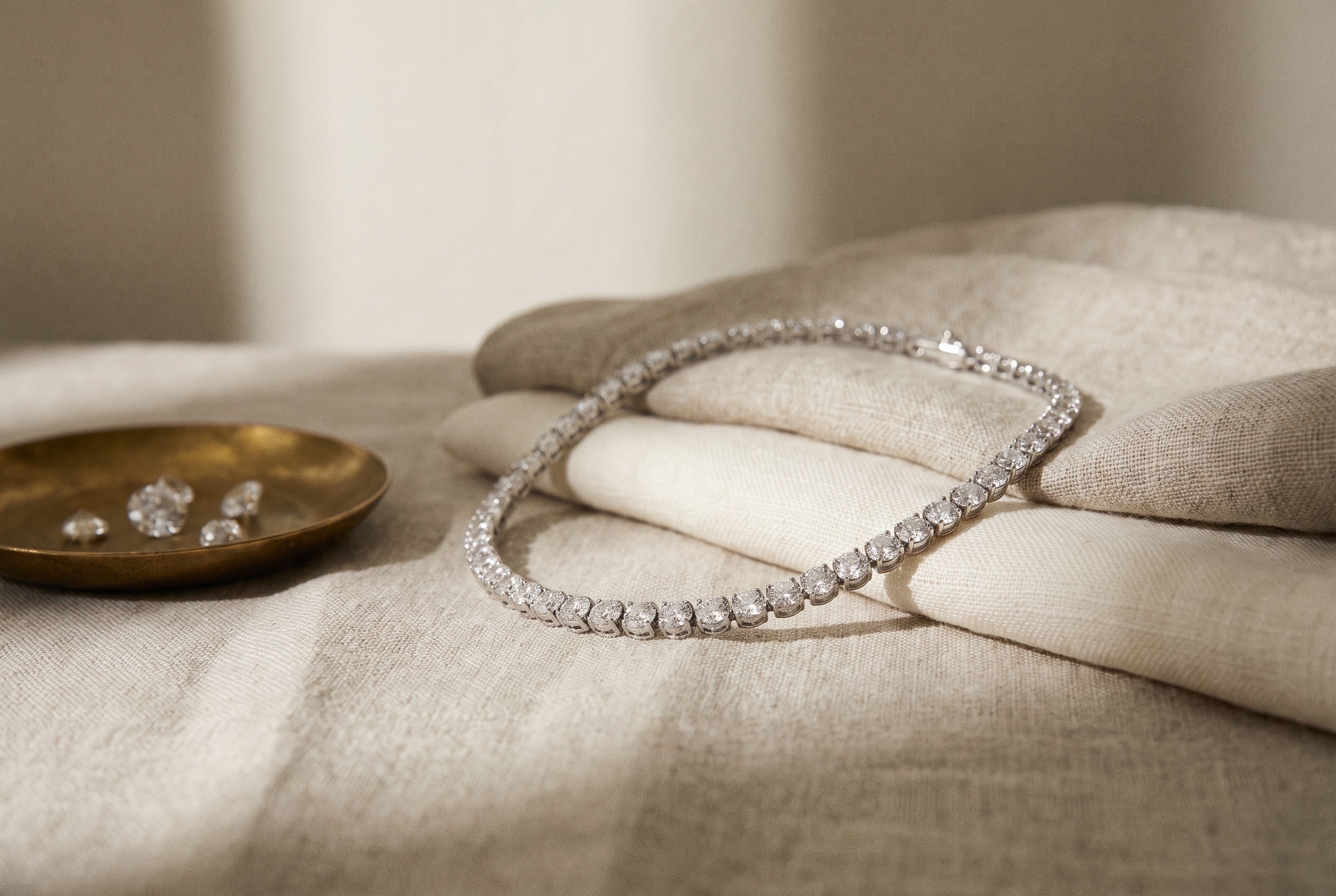
Chokers and tennis necklaces overlap heavily in construction — both can be fully set lines of diamonds — but they're distinguished primarily by length and, often, by flexibility. A tennis necklace, covered in our tennis necklace sourcing guide, is traditionally a fully diamond-set line worn at standard princess length or longer, prioritizing a continuous, uniform row of stones. A diamond choker is shorter by definition and doesn't have to be fully set — a delicate diamond-by-the-yard choker with widely spaced single stones is just as much a choker as a fully paved diamond tennis-style choker, giving the category more design range at the entry-price end than the tennis necklace format typically offers.
| Factor | Diamond Choker | Diamond Tennis Necklace |
|---|---|---|
| Typical length | 14"–16" | 16"–18", worn at standard length |
| Stone layout | Ranges from sparse (by-the-yard) to fully set | Continuous, uniform line, fully set |
| Entry price point | Can be very low (single-stone or sparse layouts) | Higher — driven by total stone count and carat weight |
| Fit | Sits close to the neck, structural comfort matters | Hangs more freely at standard length |
Common Choker Layout Styles
Diamond-by-the-Yard Choker
Individual stones spaced evenly along a fine chain, with visible chain between each stone rather than a continuous set line. This is the lowest-cost entry point into diamond chokers, since total carat weight and stone count are both minimal, and it remains one of the highest-volume styles for retailers targeting a broad, price-accessible customer base.
Riviera/Fully-Set Choker
A continuous line of diamonds set edge to edge along the full choker length, essentially a tennis necklace built at choker length rather than standard length. This is the highest-cost layout in the category, driven by total carat weight, and functions as the choker equivalent of a statement piece.
Pendant Choker
A plain or diamond-accented chain at choker length with a single diamond pendant or drop as the focal point, combining the choker's close, structural fit with a more traditional single-stone focus.
Graduated Choker
Stones increasing gradually in size toward the front center of the necklace, a layout that concentrates carat weight and cost at the visual focal point while using smaller, less expensive melee toward the back and sides.
Structural Considerations Specific to Choker Length
Because a choker sits directly against the neck rather than hanging with some drape, the chain or band's flexibility and closure placement matter more than they do on a longer necklace. A fully set riviera-style choker in particular needs enough flex between segments to sit comfortably against the neck's curve without the piece feeling rigid or shifting awkwardly when the wearer turns their head — a construction detail that affects both wearability and perceived quality, and one worth confirming with a manufacturing partner before committing to a fully set choker design at scale. Adjustable clasp positioning, allowing a small range of length adjustment, has also grown as a standard feature on choker designs specifically, since the style's snug fit makes correct sizing more noticeable than it would be on a longer, looser-hanging necklace.
Typical Stone Sizes and Total Carat Weight by Layout
A diamond-by-the-yard choker typically uses stones in the 0.02ct to 0.05ct range spaced along the chain, with total carat weight for the full piece often under 0.30ct combined. A fully set riviera choker runs considerably higher, commonly using melee in the 0.03ct to 0.10ct range set continuously along the full 14"–16" length, with total carat weight frequently landing between 3ct and 8ct combined depending on stone size and chain length — a meaningfully larger sourcing commitment than most other necklace categories, and one that benefits directly from calibrated, size-matched melee parcels to keep the finished line visually uniform.
Diamond Shape Choices for Choker Construction
Round brilliant dominates both diamond-by-the-yard and fully set riviera choker construction, valued for consistent brilliance and, in fully set work, for how efficiently its symmetrical outline packs along a continuous line with minimal visible gap between stones. Marquise and oval shapes appear in some diamond-by-the-yard designs as individual accent stones, adding shape variety along the chain without requiring the tight, uniform matching a fully set line demands. Baguette cuts show up occasionally in more architectural, geometric choker designs, set in a channel along a portion of the band rather than the full continuous-round approach.
Color and Clarity Standards for Choker Melee
For fully set riviera-style chokers, the same logic that applies to tennis necklaces applies here: because stones sit in a continuous, closely viewed line, color and clarity consistency across the full parcel matters more than any individual stone's grade — a single noticeably warmer or more included stone in an otherwise uniform line stands out immediately. A DEF+/VS+ commercial melee standard, sorted and shipped consistently, is the right baseline for this construction. Diamond-by-the-yard chokers, with individually spaced stones rather than a continuous line, have somewhat more tolerance for minor grade variation between stones since each stone reads more independently, though consistency still supports a cleaner overall look.
Lab-Grown vs. Natural Diamonds for Chokers
Given that a fully set riviera choker can carry several carats of total weight, CVD lab-grown material offers a substantial cost advantage for this specific layout, making a fully set diamond choker commercially viable at a broader range of price points than would be practical sourcing the equivalent carat weight in natural stones. Diamond-by-the-yard chokers, with their much lower total carat weight, work well in either lab-grown or natural material without the cost gap being as commercially decisive — giving retailers more flexibility to offer a natural-stone version of this specific layout at a still-reasonable price point.
Building a Choker Necklace Program: Inventory Planning
- Stock a range of melee sizes (0.02ct–0.10ct) to cover both diamond-by-the-yard and fully set riviera construction.
- Source calibrated, size-matched parcels specifically for riviera-style fully set chokers, where consistency across several carats of combined weight is essential.
- Weight material sourcing toward CVD lab-grown for fully set designs to keep multi-carat pieces commercially accessible.
- Offer both natural and lab-grown options for lower-carat diamond-by-the-yard designs, where the cost gap matters less.
- Plan for flexible, articulated construction on fully set pieces to ensure comfortable fit against the neck's curve.
Pricing a Diamond Choker: What Drives the Final Cost
Layout is the single biggest cost driver in the choker category — a diamond-by-the-yard piece and a fully set riviera choker at the same overall length can differ in price by an order of magnitude, purely as a function of total carat weight and stone count. Within a given layout, pricing follows the same logic as other multi-stone diamond jewelry: combined carat weight and setting labor (higher for continuous fully set work than for spaced individual stones) drive cost more than any single stone's grade. Retailers should merchandise the category across this full price range deliberately, using diamond-by-the-yard as an accessible entry point and riviera-style pieces as a premium upsell, rather than stocking only one layout and missing the other end of the customer base.
Chokers as Part of a Layered Necklace Trend
Diamond chokers have benefited from the same broader layered-jewelry trend driving growth in stacked rings and huggie earrings, where customers build a multi-piece look combining a choker with one or two longer necklaces rather than wearing a single necklace alone. This trend rewards retailers who merchandise chokers as part of a coordinated necklace set — offering matching or complementary pieces at princess and matinee lengths alongside the choker — since a customer building a layered look is a strong candidate for a multi-piece purchase rather than a single item.
Chain and Clasp Considerations Beyond the Diamonds
The chain or band construction underlying a choker matters as much to finished quality as the stones themselves, and it's an area retailers should scrutinize with a manufacturing partner before committing to volume production. For a diamond-by-the-yard choker, the connecting chain's link style and gauge affect both how the necklace drapes against the neck and its long-term durability under the more frequent flexing a snug choker experiences compared to a longer, more stationary necklace. For a fully set riviera choker, the connection between individual set segments needs enough articulation to follow the neck's curve without kinking or sitting unevenly, which is a more demanding fabrication requirement than a simple flexible chain. Clasp placement and style — box clasp, lobster clasp, or a hidden clasp integrated into the design — also deserves attention specifically for chokers, since the clasp sits more visibly at the back of a short necklace than it would on a longer piece where it's more easily hidden under hair or clothing.
Common Sourcing Mistakes in Choker Programs
A frequent mistake retailers make when entering the choker category is sourcing melee sized for a standard-length necklace and assuming it will work equally well at choker length, without accounting for how a shorter overall length changes the visual density and proportion of a given stone size — melee that reads as appropriately scaled on an 18-inch necklace can look either sparse or overly heavy on a 14-inch choker, depending on layout. A second common mistake is underestimating the total carat weight commitment a fully set riviera choker represents relative to other necklace styles, leading to under-ordering melee for a planned production run and having to place a rushed follow-up order mid-production. A third mistake is neglecting closure and flexibility testing before committing to volume, since a choker's snug fit exposes construction weaknesses — a rigid connection point, an uncomfortable clasp position — far more quickly in customer feedback than the same issue would on a looser-fitting, longer necklace.
Sizing and Fit Considerations Retailers Should Plan For
Neck sizing varies meaningfully across a customer base, and because a choker sits so close to the neck, that variance shows up in fit complaints more often than it does with longer necklace styles that hang with more forgiving drape regardless of exact neck circumference. Retailers building out a choker line benefit from offering an adjustable clasp range (commonly a one- to two-inch adjustment window) as standard rather than a single fixed length, since a choker that fits perfectly on one customer can sit uncomfortably tight or noticeably loose on another with a different neck size. This is a more important standard feature for chokers than for princess or matinee-length necklaces, where an inch of length variance is far less noticeable against the necklace's overall drape.
Chokers Across Price Tiers: Building a Full Category Range
Because the choker category spans such a wide layout range — from a handful of spaced stones to several carats of continuous fully set melee — retailers have an unusually good opportunity within this single style to build out a genuinely tiered assortment covering multiple customer budgets under one cohesive design concept. An entry-tier diamond-by-the-yard choker, a mid-tier graduated design concentrating carat weight toward the center front, and a premium fully set riviera choker can all be merchandised together as "good, better, best" within the same product category, which is a more natural tiering structure than trying to build similar price tiers across genuinely different necklace styles. This approach also gives sales staff a straightforward upsell path within a single conversation, moving a customer from an accessible starting point toward a higher-value piece without switching to an entirely different necklace concept.
Manufacturing Timelines and Custom Choker Orders
Fully set riviera chokers generally require longer manufacturing lead times than most other necklace styles, purely as a function of the setting labor involved in mounting several carats of melee continuously along the full length — meaningfully more bench time than a diamond-by-the-yard piece with the same number of stones spaced along a plain chain. Retailers offering custom choker commissions, whether a bespoke length adjustment or a fully custom stone layout, should set clear lead-time expectations with customers upfront given this labor difference, and should work with a manufacturing partner experienced specifically in continuous multi-stone line-setting rather than assuming general ring or pendant-setting experience transfers directly, since the two skill sets don't fully overlap.
How Choker Popularity Has Shifted Over Time
Choker necklaces have moved through several distinct popularity cycles, most notably a strong resurgence tied to 1990s-revival fashion trends that reintroduced the style to a younger customer base largely unfamiliar with its earlier popularity waves. What's changed in the diamond-specific version of the trend is the range of layout options available — earlier choker revivals leaned heavily on plain velvet or simple chain designs, while the current cycle has expanded meaningfully into fully set diamond riviera construction and more elaborate diamond-by-the-yard layouts, giving fine jewelry retailers a much larger design and price-point range to work with than earlier choker trend cycles offered. Retailers who understand this history are better positioned to talk to customers about the style's staying power rather than presenting it as a purely of-the-moment fashion choice, which can help with a customer weighing a choker purchase against a more traditional, longer-length necklace they view as a safer long-term investment.
Photographing Chokers for E-Commerce and Social Listings
Because a choker's fit and proportion is central to how the piece reads, flat product photography alone — a necklace laid out straight on a plain background — communicates less about a choker than it does about a longer necklace style, where drape and hang are less critical to conveying the piece accurately. Retailers selling chokers online benefit disproportionately from on-model photography showing the piece actually worn at the neck, since that's the only way a customer can accurately judge how the choker will sit and whether the length suits their own neck proportions before purchasing. This matters more for chokers than for most other necklace styles, and retailers who invest in proper on-model shots for this specific category typically see better conversion and fewer sizing-related returns than those relying on flat-lay photography alone, which simply can't convey a choker's fit the way it can for a longer, less form-fitting necklace.
Sourcing Diamonds for a Choker Necklace Line Wholesale
Guru Diam supplies CVD lab-grown and natural melee in calibrated parcels across the size range used in both diamond-by-the-yard and fully set riviera choker construction, sorted to a consistent DEF+/VS+ quality baseline, alongside certified loose stones for pendant-style choker designs. Trade buyers can review current melee and certified inventory through certified diamonds and matching pairs, and work with Guru Diam's custom jewelry team on setting construction through custom jewelry. In-stock inventory ships same-day from Guru Diam's New York and Los Angeles locations. New trade accounts can apply through trade partner, with current terms available at the wholesale hub. For related necklace-sourcing guides, see our tennis necklace sourcing guide.
Frequently Asked Questions
What length is a diamond choker necklace?
A choker typically runs 14 to 16 inches, sitting close to the base of the neck — noticeably shorter than a princess-length necklace (17–19 inches) or a matinee-length piece (20–24 inches).
What is the difference between a choker and a tennis necklace?
A choker is defined by its short length and can range from sparsely spaced stones to fully set. A tennis necklace is defined by a continuous, fully set line of diamonds, typically worn at standard princess length or longer.
How many carats are in a fully set diamond choker?
A fully set riviera-style choker commonly carries 3ct to 8ct of total combined weight, depending on stone size and chain length, compared to under 0.30ct for a diamond-by-the-yard choker.
Should a diamond choker be lab-grown or natural?
For fully set riviera-style chokers carrying several carats of total weight, CVD lab-grown material offers a substantial cost advantage. Diamond-by-the-yard chokers, with much lower total carat weight, work well in either material.
What diamond shape is most common in choker necklaces?
Round brilliant dominates both diamond-by-the-yard and fully set choker construction. Marquise and oval shapes appear as individual accent stones in some by-the-yard designs.
Why does fit matter more for chokers than longer necklaces?
A choker sits directly against the neck rather than hanging with drape, so the chain or band's flexibility and closure placement affect comfort and appearance more noticeably than on a longer, looser-hanging piece.
Guru Diam is a trade-only wholesale diamond supplier with locations in New York and Los Angeles, supplying calibrated CVD lab-grown and natural melee alongside certified loose diamonds, for jewelers building choker, tennis, and other necklace lines. Browse current inventory in certified diamonds or apply for a trade account through trade partner.