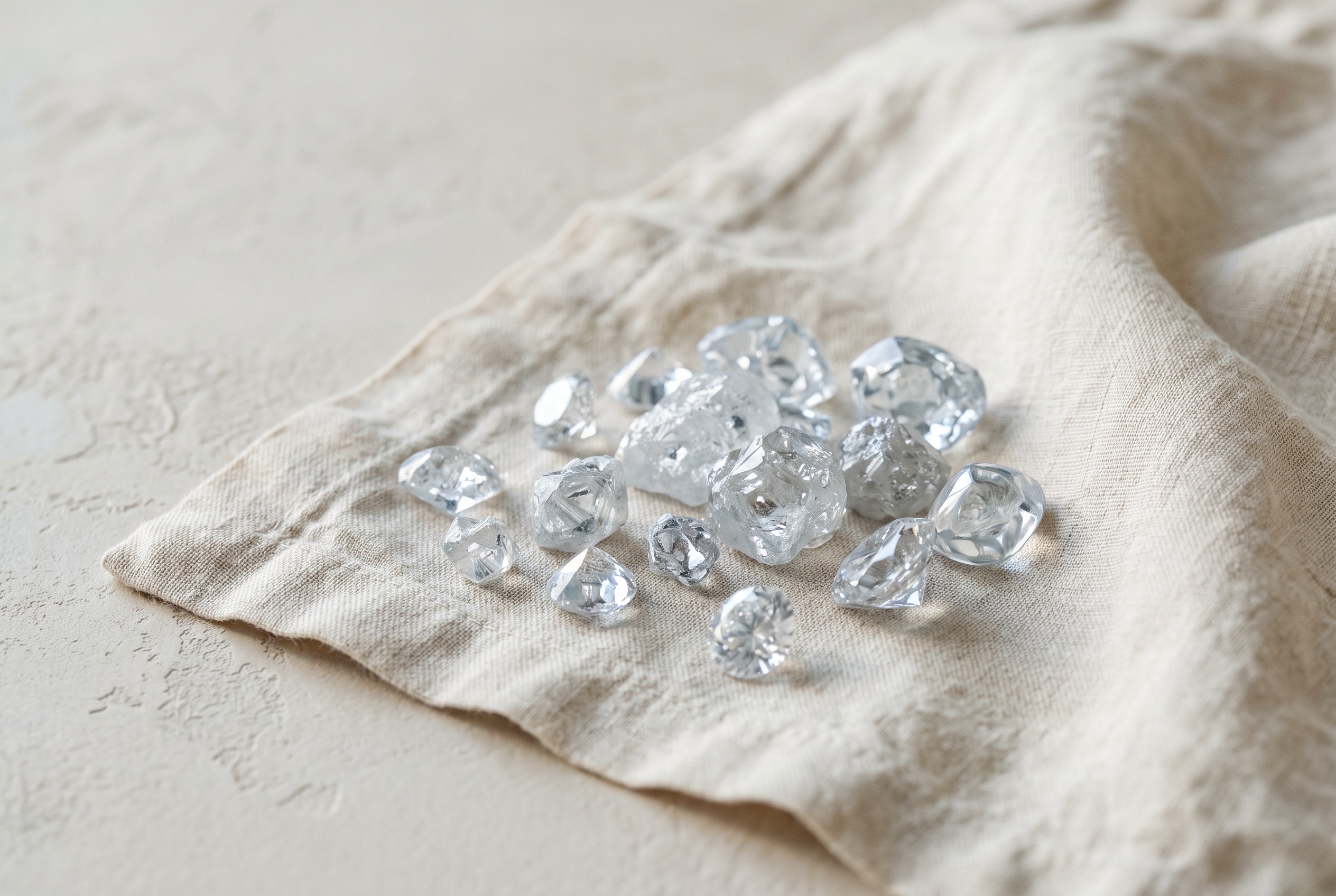
Alrosa is Russia's dominant diamond mining company, majority state-owned, and by carat volume one of the two largest diamond producers in the world alongside De Beers. Its operations are concentrated almost entirely in the Sakha Republic (Yakutia) in eastern Siberia, one of the most remote and climatically extreme diamond-producing regions on earth, where the company runs a portfolio of open-pit and underground kimberlite mines, including the historic Mir and Udachny deposits.
This guide covers how Alrosa is structured and owned, where its major mines are located, how its production and sales model works, how Western sanctions following 2022 changed its position in the global market, and what any of this means for a wholesale buyer thinking about natural diamond supply.
What Alrosa Is and Who Owns It
Alrosa (an acronym derived from the Russian for "Diamonds of Russia-Sakha") is a joint-stock company majority-owned by the Russian federal government and the regional government of the Sakha Republic, with a smaller free float of shares traded publicly before Western sanctions substantially curtailed international trading interest in Russian state-linked companies. This state-controlled ownership structure means Alrosa's strategic decisions are more directly tied to Russian national economic policy than a typical publicly listed mining company answering primarily to independent shareholders, a dynamic that has become especially relevant since 2022 as Alrosa has operated under an expanding set of Western sanctions targeting Russian state revenue sources.
Alrosa's Scale in the Global Diamond Market
| Metric | Detail |
|---|---|
| Global rank by carat volume | One of the two largest diamond miners in the world, alongside De Beers |
| Primary operating region | Sakha Republic (Yakutia), eastern Siberia, Russia |
| Ownership | Majority state-owned (Russian federal government and Sakha Republic regional government) |
| Mining methods | Both open-pit and underground kimberlite mining, plus some alluvial operations |
| Sales model | Long-term contract sales to approved buyers, supplemented by auctions and spot sales |
| Post-2022 status | Operating under expanded Western sanctions targeting Russian state revenue |
Yakutia: The Heart of Alrosa's Operations
The Sakha Republic, commonly known as Yakutia, is a vast, sparsely populated region of eastern Siberia with some of the harshest sustained winter conditions of any inhabited place on earth, where temperatures regularly fall to extremes that require specialized equipment, construction methods, and worker safety protocols not needed at diamond mines in more temperate climates. Soviet geologists identified Yakutia's kimberlite potential in the 1950s, and the region has remained the center of Russian diamond production ever since, with Alrosa's major mines, processing plants, and the mining towns built to support them concentrated across this single, remote region rather than spread across multiple parts of the country.
Operating at this scale in Yakutia requires infrastructure most other diamond-producing regions never had to build from scratch to the same degree — dedicated roads, power generation, and entire towns constructed alongside the mines themselves, echoing the same pattern seen at Russia's historic Mir mine and its surrounding town of Mirny, built essentially from nothing in the taiga specifically to support diamond mining operations.
Alrosa's Major Mines
| Mine | Type | Notable Distinction |
|---|---|---|
| Mir | Former open-pit, now underground | One of the largest human-made excavations on earth in its open-pit era; historically significant Soviet-era discovery |
| Udachny | Former open-pit, now underground | One of Alrosa's largest producing assets by volume |
| Aikhal | Underground | Long-running underground operation in the Aikhal mining district |
| Nyurba group mines | Mixed open-pit and alluvial | Includes several smaller producing deposits in the Nyurba district |
Several of Alrosa's flagship mines have followed the same open-pit-to-underground transition seen at major kimberlite mines worldwide as near-surface ore is depleted and continued production requires accessing deeper reserves through shaft and tunnel mining instead. This pattern is especially pronounced across Alrosa's portfolio given how long many of its core Yakutian deposits, discovered in the 1950s and 1960s, have now been in production — several are multiple decades into their operating lives and well past their original open-pit phase.
How Alrosa Sells Its Rough Diamonds
Alrosa historically sold the large majority of its rough production through long-term supply contracts with a defined group of approved buyers, a sales model broadly similar in structure to De Beers' long-standing contract "sight" system, supplemented by periodic auctions for specific parcels and exceptional individual stones. This long-term contract approach gives Alrosa more predictable revenue than pure spot-market sales would provide, while auctions allow the company to capture additional value on rare or exceptionally large rough stones that benefit from competitive bidding rather than fixed contract pricing.
From the point of sale, rough diamonds move into the international cutting and manufacturing pipeline. Historically, a significant share of Alrosa's rough production moved through Antwerp and other established international rough-trading centers before reaching cutting houses, with Surat, India handling the majority share of global cutting and polishing volume, including material of Russian origin, before finished stones are graded and enter wholesale markets through labs including GIA, IGI, and GCAL.
Western Sanctions Since 2022
Following Russia's full-scale invasion of Ukraine in February 2022, Western governments progressively imposed sanctions targeting Russian state revenue sources, and Alrosa, as a majority state-owned company generating substantial export revenue for the Russian government, became a specific sanctions target. The United States sanctioned Alrosa directly, and the G7 nations, alongside the European Union, subsequently worked to restrict imports of Russian-origin diamonds more broadly, including efforts to trace diamond origin through the cutting and polishing supply chain rather than relying solely on where a stone was ultimately cut and certified.
These measures have materially reshaped how Russian-origin rough diamonds move through the global market, pushing more of Alrosa's sales toward buyers and markets less exposed to Western sanctions enforcement, and increasing industry-wide attention on diamond origin verification and chain-of-custody documentation generally, an area the trade has continued adapting to as enforcement mechanisms have evolved since 2022.
Alrosa vs. De Beers: The Two Dominant Producers
| Aspect | Alrosa | De Beers |
|---|---|---|
| Ownership | Majority Russian state-owned | Majority owned by Anglo American (publicly listed) |
| Primary region | Sakha Republic (Yakutia), Russia | Botswana, South Africa, Namibia, Canada |
| Sales model | Long-term contracts plus auctions | Long-term contract "sight" system plus auctions |
| Post-2022 market position | Operating under direct Western sanctions | Not directly sanctioned; still a leading global producer |
Alrosa and De Beers have long stood as the two dominant companies by scale and global influence over rough diamond pricing, together accounting for a substantial share of the world's natural diamond supply for decades. Their different ownership structures and current sanctions exposure mean their relative market influence has shifted somewhat since 2022, but both remain central reference points for anyone tracking global natural diamond supply and pricing trends.
Kimberley Process and the Limits of Certification
Russia remains a participant in the Kimberley Process Certification Scheme, the international framework certifying rough diamond exports as conflict-free, which was designed specifically to address diamonds funding armed conflict rather than to address state-revenue or sanctions concerns tied to a specific government's broader conduct. This distinction matters for understanding the current situation: Kimberley Process compliance and Western sanctions compliance are two separate frameworks addressing different concerns, and a rough diamond can be Kimberley Process-compliant while still falling under specific national or multilateral sanctions restrictions tied to its country of origin, which is precisely the situation Alrosa's production has faced since 2022.
How Alrosa's Diamonds Reach Cutting Centers
Once sold, rough diamonds of Russian origin generally follow the same international path as rough from other major producing countries — moving through established trading channels toward cutting centers, with Surat, India remaining the dominant global hub for cutting and polishing capacity by a wide margin. Since 2022, however, increased scrutiny on origin documentation has made this step more consequential than in prior decades: buyers and cutting houses now face greater pressure to document and disclose a rough stone's country of origin clearly, rather than treating origin as incidental once material enters the general international cutting pipeline.
What Alrosa's Situation Means for Wholesale Buyers
For a US-based wholesale buyer, the practical relevance of Alrosa's situation is less about the mine itself and more about supply-chain documentation: US sanctions and G7-level restrictions on Russian-origin diamonds mean any natural diamond entering the US wholesale market should carry clear, verifiable origin documentation as a matter of standard compliance, not as an optional extra. This has made country-of-origin transparency a more prominent part of natural diamond sourcing conversations generally over the past several years than it was before 2022, regardless of whether a specific stone in question ever had any connection to Russian production.
How Alrosa Compares to Other State-Linked Producers
Alrosa's majority state ownership isn't unique in the diamond industry — several other producing countries, including Botswana through its stake in Debswana (the De Beers joint venture) and Angola through Endiama, hold significant state ownership positions in their national diamond mining operations. What sets Alrosa apart is less the state-ownership structure itself and more the specific geopolitical situation Russia has faced since 2022, which has translated state ownership into a direct sanctions target in a way that hasn't happened to the same degree with other state-linked diamond producers elsewhere in the world.
Yakutia's Long-Term Production Outlook
Many of Alrosa's core Yakutian deposits have been in continuous production since the 1950s and 1960s, meaning the region's most accessible near-surface reserves have already been substantially worked over seven-plus decades of mining. Alrosa's continued investment in transitioning mature mines like Mir and Udachny to underground operations reflects the same broader industry pattern seen at major kimberlite mines worldwide: an exceptional, long-lived deposit doesn't simply stop producing once its open-pit phase ends, but reaching remaining reserves requires progressively more capital-intensive underground infrastructure as a mine matures.
Natural Diamonds and Documented Origin
| Aspect | Documented-Origin Natural Diamonds | Undocumented-Origin Stones |
|---|---|---|
| Sanctions compliance risk | Low, with verifiable chain-of-custody documentation | Higher, particularly for Russian-origin material entering Western markets |
| Buyer confidence | Higher, supports customer-facing provenance conversations | Lower, harder to verify compliance if challenged |
| Certification | Consistent with standard GIA, IGI, GCAL reporting practices | May still carry standard grading certification without origin verification |
Grading certification and origin documentation address two different questions — a certificate from GIA, IGI, or GCAL documents a stone's 4Cs, while separate origin documentation addresses where the rough diamond actually came from. Since 2022, wholesale buyers sourcing natural diamonds in the US market have increasingly needed both, rather than treating grading certification alone as sufficient documentation for compliance purposes.
Sourcing Natural and Lab-Grown Diamonds With Documented Origin
Guru Diam is a trade-only wholesale supplier carrying both certified natural diamonds and CVD lab-grown diamonds, along with certified loose stones and finished and custom jewelry — antique cuts, standard fancy shapes, and round brilliant all included, with IGI, GIA, and GCAL certification available for either origin. In-stock inventory ships same-day from New York (before 6pm EST) and Los Angeles (before 4pm PST), giving jewelers a single sourcing relationship for natural diamonds with verifiable supply-chain documentation and lab-grown alternatives alike.
Buyers can browse certified loose diamond inventory through the certified diamonds category, source matched pairs through matching pairs, and review fancy color stones through fancy color loose diamonds. Trade accounts can review terms at the wholesale hub or apply through trade partner, and jewelers building a full piece can work through custom jewelry for a setting finished in 4-6 days.
Why Alrosa Remains Central to Understanding Global Diamond Supply
Even under sanctions, Alrosa's sheer production scale means developments at the company continue to carry outsized weight for global natural diamond supply and pricing conversations, simply because a producer of its size doesn't disappear from the aggregate global supply picture even when a specific market like the US restricts its direct participation. Understanding Alrosa's structure, its major mines, and its post-2022 sanctions situation gives a trade professional useful context for broader natural diamond market conversations, separate from any specific purchasing decision involving Russian-origin material.
From Soviet State Enterprise to Modern Company
Alrosa's roots trace back to the Soviet-era state enterprises established to develop Yakutia's kimberlite discoveries starting in the 1950s, when diamond mining in the USSR was organized entirely as a state industrial function rather than a corporate business in the modern sense. Following the Soviet Union's dissolution in 1991, Russia's diamond mining assets were reorganized into Alrosa as a joint-stock company, eventually taking a partial public listing on Russian stock exchanges in the 2010s while the federal and regional governments retained their controlling majority stake throughout that transition. This evolution from pure state enterprise to a majority-state-owned but partially publicly traded company mirrors a broader pattern seen across several former Soviet strategic industries during Russia's post-1991 economic reorganization, though Alrosa's continued majority state ownership, unlike some other privatized former Soviet industries, meant the company never fully separated from direct government control the way some other sectors did.
How Sanctions Enforcement Works in Practice
Enforcing sanctions on diamonds is structurally harder than enforcing sanctions on many other commodities, because a rough diamond's country of origin isn't inherently visible once it's cut, polished, and certified — unlike, for example, a shipment of oil or a manufactured good with clear customs documentation tied to its origin at every step. Since 2022, G7 and EU efforts to restrict Russian-origin diamonds have increasingly focused on origin-tracing requirements applied earlier in the supply chain, including documentation requirements at the point rough diamonds enter major cutting centers like Surat, India, rather than relying solely on the country listed on a finished stone's grading certificate. This has made supply-chain documentation a more active, ongoing compliance requirement for buyers and cutting houses handling any natural diamond with potential Russian-origin exposure, a meaningfully different compliance burden than existed before 2022, when country-of-origin tracking for natural diamonds was a less prominent part of standard wholesale trade practice.
Alrosa's Diamond Sorting and Grading Operations
Alrosa maintains its own large-scale rough diamond sorting and valuation operations, a capability that major producers of its size typically develop in-house rather than outsourcing, since accurate sorting directly determines how much value a producer captures from its own rough output before sale. Sorting rough diamonds by size, shape, color, and quality characteristics requires extensive trained expertise, and a producer operating at Alrosa's scale across multiple mines and decades of continuous production has built correspondingly deep institutional sorting knowledge, similar in principle to the sorting expertise De Beers has developed over its own long operating history, even though the two companies' sales and ownership structures differ substantially.
Diversification Beyond Yakutia
While the overwhelming majority of Alrosa's production comes from its core Yakutian operations, the company has at various points held interests in other diamond-related ventures, including exploration activity in other regions and, historically, some international mining interests, reflecting a broader pattern among large state-linked resource companies of diversifying beyond a single core production region over time. These secondary activities have remained small relative to Alrosa's core Yakutian production, which continues to represent the overwhelming majority of the company's output and, by extension, the overwhelming majority of Russia's total diamond production.
Why Alrosa's Government Ownership Shapes Its Strategic Priorities
A majority state-owned company's strategic decisions are more directly influenced by national government priorities than a typical independent public company answering primarily to institutional shareholders focused on quarterly returns. For Alrosa, this has meant the company's production and sales decisions have, at various points, reflected broader Russian state economic and geopolitical priorities rather than purely commercial considerations a fully independent company might weigh differently, a dynamic that has become especially visible and consequential since the 2022 sanctions regime took effect and Alrosa's role as a state revenue source came under direct international scrutiny.
What Buyers Should Track Going Forward
Given how directly Alrosa's situation is tied to an evolving geopolitical and sanctions landscape, wholesale buyers and trade professionals with any exposure to natural diamond sourcing decisions benefit from staying current on how G7 and US sanctions enforcement mechanisms continue to develop, rather than treating the compliance picture as fixed. Origin-tracing requirements and enforcement mechanisms targeting Russian-origin diamonds have continued to evolve since 2022 as regulators and industry bodies work through the practical challenges of verifying origin once rough material enters international cutting and trading channels, meaning today's compliance practices may look somewhat different from how the framework eventually settles once enforcement mechanisms mature further.
Practically, this means a wholesale buyer's due diligence on natural diamond origin shouldn't be treated as a one-time check performed when a sourcing relationship is first established. Because enforcement mechanisms and documentation standards have continued to shift since 2022, a supplier relationship that was fully compliant under an earlier documentation standard may need updated verification as requirements evolve, making origin documentation an ongoing part of a natural diamond sourcing relationship rather than a box checked once and forgotten. Building this ongoing verification habit into a standard sourcing workflow, rather than treating it as a special one-time exercise, is the most reliable way a wholesale buyer can stay ahead of a compliance landscape that has already shifted meaningfully since 2022 and shows every sign of continuing to evolve.
Frequently Asked Questions
Is Alrosa the largest diamond mining company in the world?
Alrosa is one of the two largest diamond mining companies in the world by carat volume, alongside De Beers. The two companies have long been the dominant reference points for global rough diamond supply.
Who owns Alrosa?
Alrosa is majority-owned by the Russian federal government and the regional government of the Sakha Republic (Yakutia), making it a state-controlled diamond mining company.
Where does Alrosa mine its diamonds?
Almost entirely in the Sakha Republic (Yakutia) in eastern Siberia, Russia, where it operates a portfolio of open-pit and underground kimberlite mines including Mir, Udachny, and Aikhal.
Is Alrosa under sanctions?
Yes. Following Russia's 2022 invasion of Ukraine, the United States sanctioned Alrosa directly, and the G7 and European Union have worked to restrict imports of Russian-origin diamonds more broadly.
Can US wholesale buyers legally purchase Alrosa diamonds?
Direct purchases of Alrosa-origin diamonds face significant sanctions restrictions in the US market. Wholesale buyers should prioritize verifiable, documented country-of-origin diamonds to ensure sanctions compliance.
How does Alrosa compare to De Beers?
Both are dominant global producers by scale, but Alrosa is majority Russian state-owned and currently operates under direct Western sanctions, while De Beers, majority owned by Anglo American, is not directly sanctioned and continues normal international sales operations.