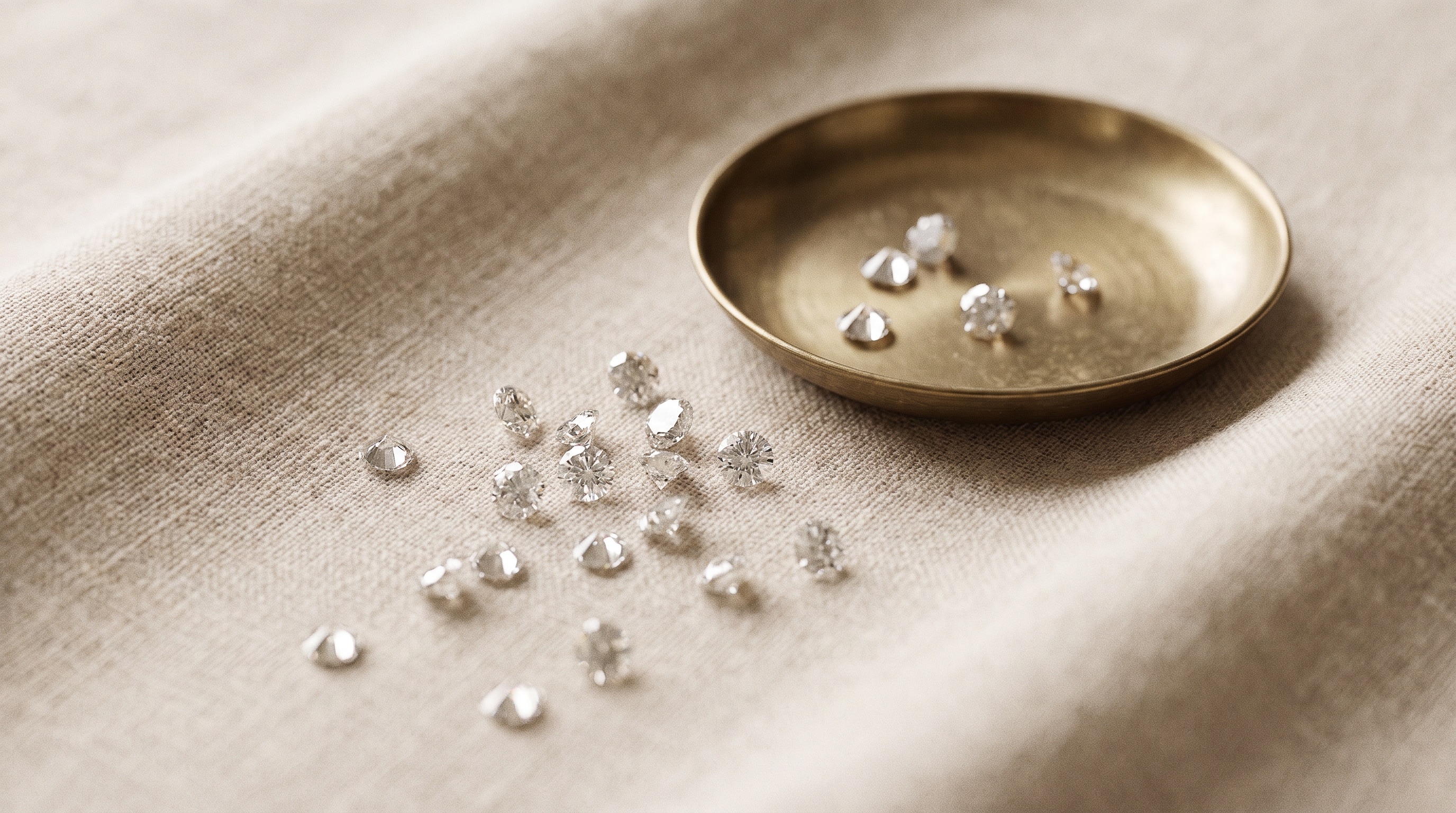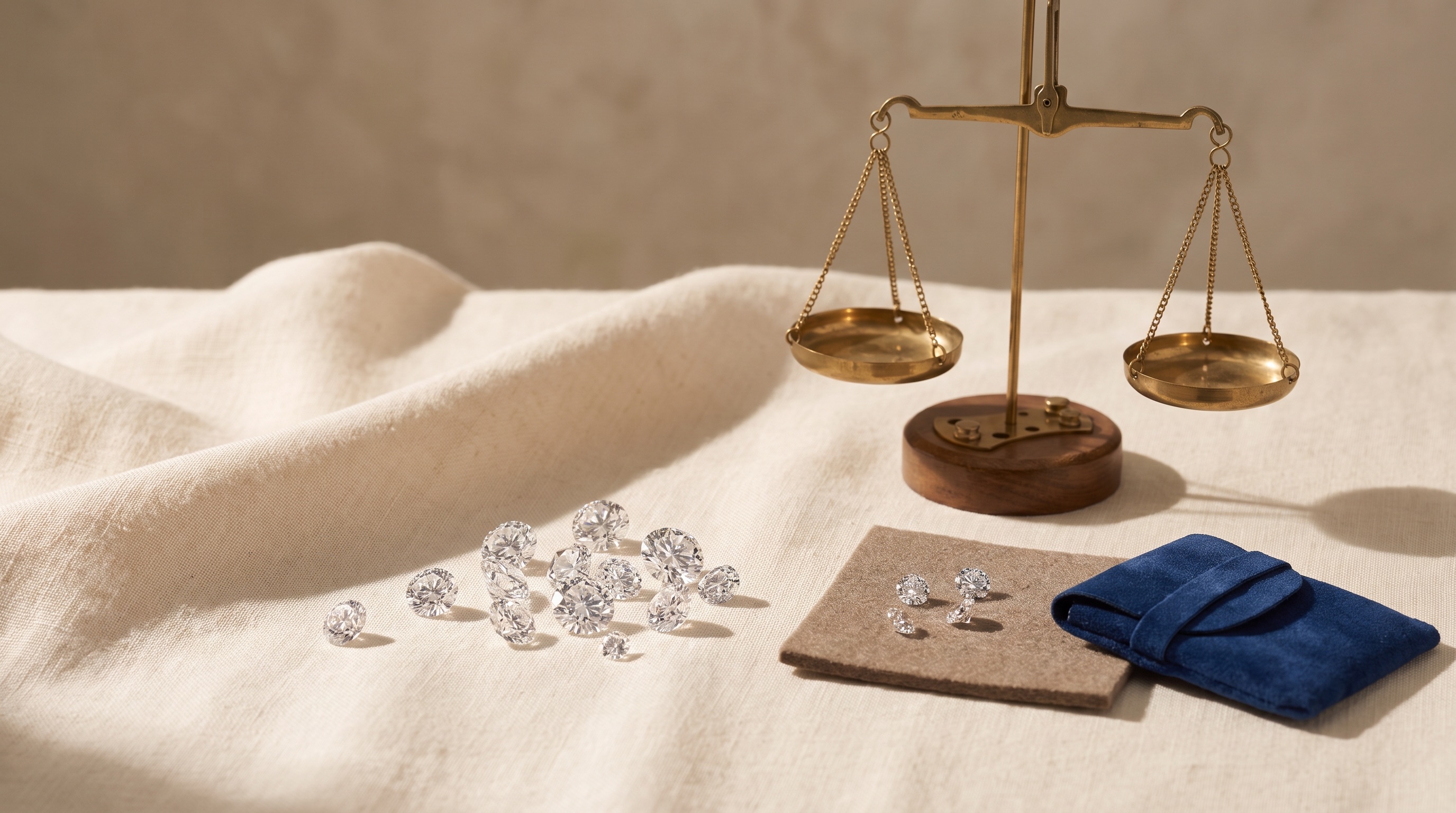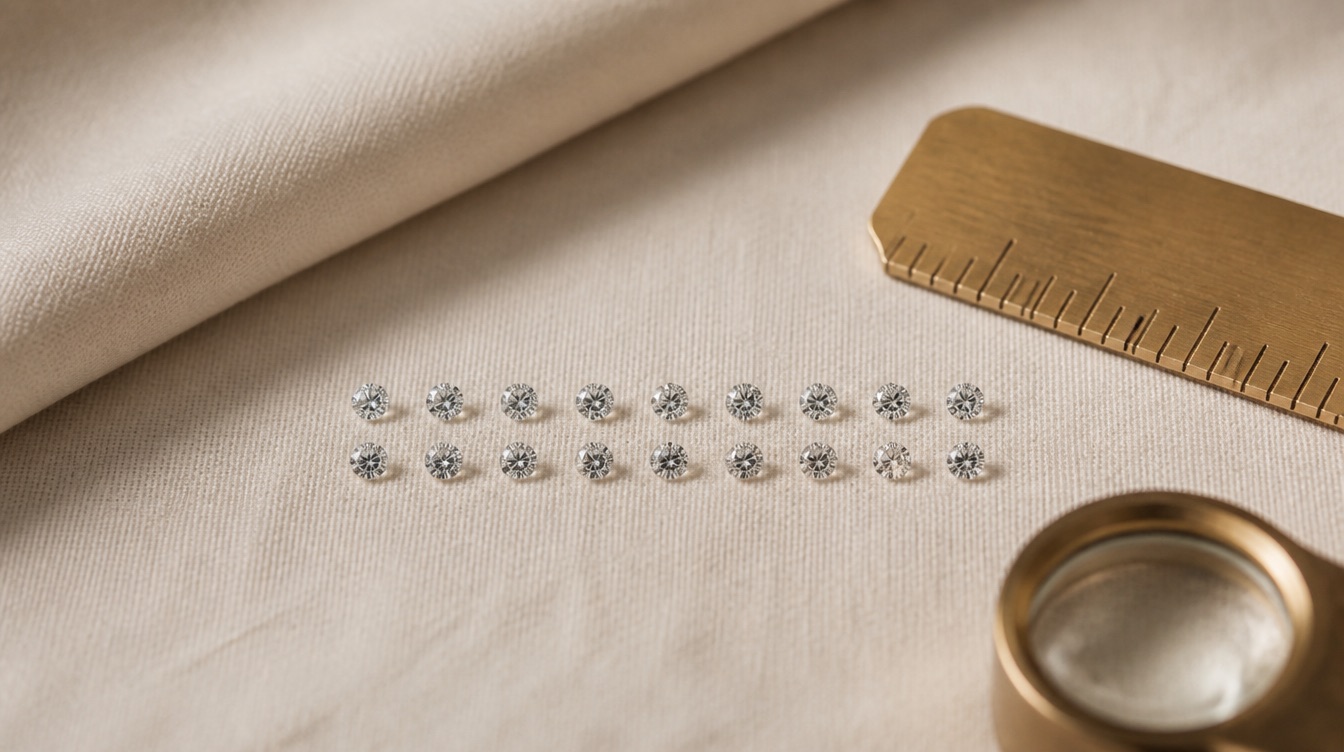
A 3.0mm round brilliant diamond weighs approximately 0.10 carat, though the actual figure typically falls somewhere in a 0.08–0.12 carat range. The exact weight depends on how the stone is cut — specifically its depth percentage, table percentage, and overall proportions — so "3mm" describes a diameter, not a fixed carat weight.
For jewelers, designers, and anyone sourcing loose diamonds or setting accent stones, this distinction matters more than it might seem. A ring setting is built around a physical diameter — the stone has to fit the prongs, the halo channel, or the pavé seat — while a buyer's invoice, insurance appraisal, or price quote is built around carat weight. Converting reliably between the two, and understanding why that conversion isn't perfectly fixed, is a basic but genuinely useful piece of trade knowledge. This guide covers what a 3.0mm round brilliant actually weighs, why that number moves within a range instead of landing on one universal figure, how 3mm fits into melee sourcing and accent-stone sizing, and how jewelers use millimeter measurements when a setting's stone seat is already fixed.
What a 3.0mm Round Brilliant Diamond Weighs
Within the trade, 3.0mm is treated as an approximately 0.10 carat round brilliant — a figure repeated so consistently across grading charts, supplier spec sheets, and jewelry CAD software that it functions as a shorthand default. In practice, an individual 3.0mm stone can weigh anywhere from roughly 0.08 carat to 0.12 carat depending on how it was cut, with 0.10 carat sitting at the practical midpoint most suppliers quote when a buyer asks for "a 3mm round" without further specification.
This is a genuinely useful planning number, not an exact conversion formula. Two diamonds can both measure exactly 3.0mm across the girdle and still differ in weight by 20-30% depending on how deep the stone is cut, how the pavilion and crown are proportioned, and how much material sits below the girdle where diameter isn't visually affected but weight still accumulates. That's normal, expected variation within the category — not a sign that a diameter measurement or a carat figure is wrong.
It's also worth noting that the 0.10ct figure predates any particular grading lab or software vendor — it's simply the point at which the diameter-to-weight math for a well-proportioned round brilliant lands, and it shows up consistently whether the source is a jeweler's loupe reference card, a CAD sizing chart, or a wholesale supplier's melee spec sheet. That consistency is part of why 3.0mm ≈ 0.10ct has become the default trade shorthand rather than any other nearby figure.
One more practical wrinkle worth flagging: "3mm" itself is sometimes measured slightly differently between a loose stone (measured directly with calipers across the girdle) and a stone already mounted in a setting (measured by the size of the seat it's meant to occupy, which typically allows a small amount of tolerance either way). Neither convention is wrong, but it's worth confirming which measurement a supplier or CAD file is actually using before assuming two "3mm" specs are describing an identical physical stone.
Why Diameter and Carat Weight Aren't a Fixed Ratio
Diameter measures the width of a stone as viewed from the top; carat weight measures its total mass, most of which sits in the pavilion below the girdle, invisible from a face-up view. Three cut variables determine how much a stone of a given diameter actually weighs:
- Depth percentage — the stone's total depth (table to culet) as a percentage of its diameter. A deeper-cut stone packs more material into the same face-up width, so it weighs more per millimeter of diameter than a shallow-cut stone of identical diameter.
- Table percentage — the width of the flat top facet relative to the stone's diameter. Table proportion interacts with depth and crown angle to shift how volume is distributed, which shows up as small but real weight differences even between stones cut to similar overall depth.
- Overall cut proportions — crown angle, pavilion angle, girdle thickness, and culet size all affect how much rough material a finished stone of a given diameter retains. A cutter optimizing for ideal light performance and a cutter optimizing to retain maximum carat weight from a piece of rough can both produce a well-made 3.0mm stone that weighs noticeably differently.
This is exactly why reputable mm-to-carat charts are always labeled as approximate, standard, or average figures rather than as a precise conversion. A supplier quoting "3.0mm ≈ 0.10ct" is giving an accurate planning reference; a supplier claiming a 3.0mm stone weighs exactly 0.10ct with no variance is oversimplifying how cut proportions actually work.
Round Brilliant Diamond mm-to-Carat Reference Table
The table below shows standard, industry-typical carat weights for round brilliant diamonds across a range of diameters neighboring 3.0mm. These are approximate reference figures — actual weight for any individual stone can shift within the stated range depending on its specific cut proportions, so treat this as a planning tool rather than a precise conversion chart.
| Diameter | Approximate Carat Weight | Typical Range |
|---|---|---|
| 2.0mm | ~0.03ct | 0.03ct–0.04ct |
| 2.5mm | ~0.06ct | 0.05ct–0.07ct |
| 3.0mm | ~0.10ct | 0.08ct–0.12ct |
| 3.5mm | ~0.15ct | 0.13ct–0.17ct |
| 4.0mm | ~0.23ct | 0.20ct–0.25ct |
| 4.5mm | ~0.29ct | 0.26ct–0.34ct |
| 5.0mm | ~0.40ct | 0.35ct–0.47ct |
Notice that the carat weight doesn't scale in a straight line with diameter — a 5.0mm stone isn't simply "5/3 the carat weight" of a 3.0mm stone, because carat weight tracks volume, and volume scales with roughly the cube of a linear measurement like diameter, not with diameter directly. That's why small increases in millimeter size produce increasingly larger jumps in carat weight as diameter grows.
Melee Sizing: Where 3mm Sits in the Broader Range
In wholesale trade terms, 3.0mm sits well within the melee size range, which generally runs from about 0.8mm up to 9.0mm in diameter. Melee — the trade term for small diamonds used as accent stones rather than sold individually as a graded centerpiece — is sourced, priced, and shipped very differently from larger certified loose stones, and understanding which category a given stone falls into affects how a buyer should expect to source and pay for it.
Melee ships as uncertified parcel goods, graded against a stated commercial quality baseline rather than accompanied by individual grading reports. The most common baseline in the trade is DEF+/VS+ — meaning near-colorless-to-colorless color (D, E, or F on the standard scale) and clarity at VS (very slightly included) or better. A 3.0mm, roughly 0.10ct stone bought as melee is priced and delivered against that quality standard, sorted and matched by lot, not individually graded and papered the way a larger loose stone would be.
Melee vs. Individually Certified Loose Stones
It's worth being precise about this distinction, since it's a common point of confusion for buyers newer to sourcing. Individually certified loose diamonds — with a full grading report from a lab like IGI, GIA, or GCAL — are generally available starting around 0.30 carat and up. A 3.0mm round brilliant, at roughly 0.10 carat, sits well below that threshold and is handled as melee rather than as an individually certified stone. That's standard, expected trade practice, not a shortcut or a quality compromise — grading and papering every stone in a category that ships by the thousand simply isn't how the melee segment of the market operates anywhere in the trade.
Buyers should be cautious of any supplier who claims individual certification on true melee-sized goods like a 3.0mm stone; that claim doesn't match how melee is actually produced, screened, and sold. The correct expectation for melee is a supplier's lot-quality statement against a named baseline (DEF+/VS+, for example), not a per-stone certificate. If a project calls for a larger, individually certified center stone alongside 3mm melee accents, expect certification paperwork for the center stone only, with the melee accompanied by a quality statement for the lot instead.
Common Uses for 3mm Round Diamonds in Jewelry
A 3.0mm round brilliant is a mid-to-upper melee size, large enough to read as a distinct, visible stone rather than a fine pavé speck, which makes it a popular choice for a specific set of applications:
- Side stones — flanking a center stone in a three-stone ring or similar design, where 3mm provides visible presence without competing with the center stone's size.
- Halo settings — the ring of small stones surrounding a center diamond to increase apparent size and add brilliance; 3mm sits toward the larger end of typical halo-stone sizing, used especially on larger halos or double-halo designs.
- Pavé and cluster work — 3mm reads as a more prominent pavé stone than the very fine 1–1.5mm sizes used in dense pavé fields, often used where a design wants visible individual sparkle rather than a continuous textured surface.
- Tennis bracelets and lines — at 3mm, stones sit at the larger, more statement end of a continuous tennis-line design, where size consistency across dozens of stones matters as much as individual stone quality.
- Accent stones in earrings and pendants — used as a secondary stone alongside a larger drop or center stone, or set in small clusters for standalone pieces.
Across all of these applications, what a jeweler actually needs specified is the millimeter diameter, since that's the physical dimension that determines fit — the approximate carat weight is a useful secondary figure for pricing and total-carat-weight disclosure, but it isn't the number a setter is working against when a prong or channel is cut to size.
Reverse-Engineering Carat Weight From a Fixed Setting
This is one of the more practical, everyday reasons the mm-to-carat relationship matters in production jewelry. A CAD file or a physical setting is frequently built around a fixed stone seat — a prong basket, a halo channel, a pavé bezel — sized to a specific millimeter diameter before the exact stones for that run have been sourced. When that's the case, a jeweler or buyer needs to work backward from the seat's diameter to figure out roughly what carat weight of stone will actually fit and what that translates to for total-carat-weight labeling and pricing.
This is exactly where a standard mm-to-carat reference earns its keep: if a setting's accent seats are cut for 3.0mm stones, a buyer sourcing melee for that run can reasonably plan around ~0.10ct per stone for quoting and total-carat-weight purposes, while still expecting the actual per-stone weight to land somewhere in the 0.08–0.12ct range once the lot is sorted and matched. For a production run using dozens of stones in a halo or pavé line, small per-stone weight variance within that range is normal and gets absorbed across the lot; it only becomes a problem if a supplier can't hold reasonably consistent sizing and weight across a full order, which is a matching and quality-control issue rather than a diameter-to-carat conversion issue.
Fancy Shapes: Why the Same Ratio Doesn't Apply
The mm-to-carat relationship covered above is specific to round brilliant cuts. Fancy shapes — oval, pear, marquise, emerald, cushion, and others — don't follow the same diameter-to-weight ratio, because "diameter" isn't even a single consistent measurement across a non-round outline; a fancy shape is instead measured by length and width, and the ratio between those two dimensions (along with depth, faceting style, and how elongated the shape is cut) changes how much weight a given footprint carries. An elongated marquise or oval, for example, can carry meaningfully different weight than a round stone with a comparable face-up area, depending on how the shape is proportioned.
There isn't a single reliable "fancy shape mm-to-carat chart" the way there is for round brilliants, precisely because fancy shapes vary so much in their length-to-width ratios and cutting styles. Anyone sourcing fancy-shaped melee or accent stones by size should ask a supplier for shape-specific sizing and weight figures rather than assuming a round-based conversion transfers over — it doesn't, and treating it as if it does is a common sourcing mistake.
Why Millimeter Sizing Matters More Than Carat Weight for Some Buyers
Carat weight is the figure most familiar to end consumers and the figure that drives price, but for a jeweler or manufacturer working from a CAD file or a physical mounting, millimeter diameter is frequently the more operationally important number. A setting is engineered to a physical dimension — the prong spread, the channel width, the halo seat — and that dimension doesn't change based on which carat-weight stone theoretically corresponds to it on a reference chart. Ordering stones by millimeter size first, then confirming approximate carat weight for pricing and disclosure purposes second, is the more reliable sourcing sequence for any project where the setting geometry is already fixed.
This is also why melee suppliers quote and sort inventory primarily by millimeter size rather than by carat weight alone — a buyer specifying "3.0mm round, DEF+/VS+" is giving a supplier a far more actionable spec than "0.10ct round," since the latter could, in principle, be filled with stones of slightly varying diameter that all happen to average out to the stated weight but don't sit consistently in a fixed seat.
Quality Considerations for 3mm and Similar Small Accent Stones
Color and clarity still matter at 3mm, even though individual grading reports aren't part of how melee is sold. At this size, stones are typically viewed set and in groups rather than loose under magnification, so the practical quality bar is what reads clean and bright to the eye once mounted — which is exactly what the DEF+/VS+ commercial baseline is built to deliver. A buyer assembling a halo or pavé design with dozens of 3mm stones should be more focused on consistency across the full lot (uniform color, uniform clarity, uniform diameter) than on chasing a tighter individual grade on any single stone, since visual mismatch across a set of side-by-side accent stones is far more noticeable to the eye than a marginal clarity difference within a single stone.
Buyers building a higher-end line can request a tighter color/clarity band for melee-sized accent stones, understanding that a tighter standard applied across an entire lot increases both cost and sourcing lead time compared to the standard DEF+/VS+ baseline.
Diameter consistency deserves the same attention as color and clarity consistency, particularly for a continuous design like a tennis line or a tightly set pavé band. A lot of 3.0mm stones with a wider-than-expected diameter tolerance can leave visible gaps or uneven spacing once set, even if every stone individually passes the stated color and clarity baseline — so a buyer comparing melee suppliers should ask about millimeter tolerance across a lot, not just the color/clarity grade, especially for a production run where dozens of stones need to sit flush and even side by side.
Sourcing 3mm Round Diamonds at Wholesale
For jewelers and manufacturers sourcing 3.0mm round brilliants — whether for melee-quantity accent work or as reference sizing for a custom design — the practical requirements are consistent millimeter calibration, a clearly stated quality baseline, and reliable availability for reorders on the same specification. Guru Diam's wholesale catalog carries round brilliant melee across the standard 0.8mm–9.0mm range, including 3.0mm, sold as CVD lab-grown parcel goods against a DEF+/VS+ baseline, alongside individually certified loose stones at 0.30ct and above through IGI, GIA, or GCAL for buyers who need a graded center stone alongside melee accents.
Guru Diam operates as a trade-only B2B supplier out of New York and Los Angeles, with same-day shipping on in-stock inventory placed before 6pm EST in New York or 4pm PST in Los Angeles — useful for a production run where a melee reorder needs to land quickly against a live deadline. For buyers combining melee sourcing with a finished piece — a halo ring built around 3mm accent stones, for instance — custom engagement rings are finished in 4-6 days once the design and stones are confirmed, well ahead of the multi-week timelines common elsewhere in the trade. Buyers assembling matched sets of small stones for symmetrical designs, like a pair of accent stones flanking a center diamond, can also source through Guru Diam's matched pairs category, and manufacturers or independent jewelers evaluating a wholesale relationship for the first time can review sourcing terms through Guru Diam's trade partner program.
Frequently Asked Questions
How many carats is a 3mm round diamond?
A 3.0mm round brilliant diamond weighs approximately 0.10 carat, with an actual range of roughly 0.08 to 0.12 carat depending on how the individual stone is cut. This figure is a standard trade reference, not a fixed conversion, since depth percentage, table percentage, and overall cut proportions all affect how much weight a stone of a given diameter carries.
Why do two 3mm diamonds sometimes weigh different amounts?
Diameter only measures a stone's width as seen from the top, while carat weight measures total mass, most of which sits in the pavilion below the girdle where it isn't visible from a face-up view. A deeper-cut stone or one with different crown and pavilion angles can weigh noticeably more or less than another stone of the exact same diameter, which is why 3.0mm corresponds to a range (about 0.08–0.12ct) rather than one single carat figure.
Is a 3mm diamond considered melee?
Yes. Melee generally covers round brilliant and fancy calibrated diamonds from about 0.8mm up to 9.0mm in diameter, and a 3.0mm stone falls comfortably within that range. Melee ships as uncertified parcel goods graded against a stated quality baseline (commonly DEF+/VS+ in the trade) rather than with individual grading reports.
Can a 3mm diamond be individually certified?
Individually certified loose diamonds from labs like IGI, GIA, or GCAL are generally available starting around 0.30 carat and up, and a 3.0mm stone at roughly 0.10 carat sits well below that threshold. A 3mm stone is handled as melee — sold by lot against a stated commercial quality baseline rather than papered individually — which is standard, expected trade practice for stones of this size.
What is a 3mm diamond typically used for in jewelry?
At 3mm, a round brilliant sits toward the larger end of common accent-stone sizing, frequently used as a side stone flanking a center diamond, as a stone in a larger halo, in prominent pavé or cluster work, or as a statement-size stone in a tennis bracelet or line. It's large enough to read as a distinct, individually visible stone rather than fine pavé detailing.
Does the mm-to-carat chart work the same way for non-round diamond shapes?
No. The standard mm-to-carat relationship applies specifically to round brilliant cuts. Fancy shapes like oval, pear, marquise, emerald, and cushion are measured by length and width rather than a single diameter, and their weight depends heavily on their length-to-width ratio and cutting style, so a round-based mm-to-carat chart doesn't transfer over to fancy shapes with any reliable accuracy.